Author: Ada, Deep Tide TechFlow
A product bug where an AI assistant repeatedly urges users to go to sleep is evolving into a public discussion about the cost of "AI personification".
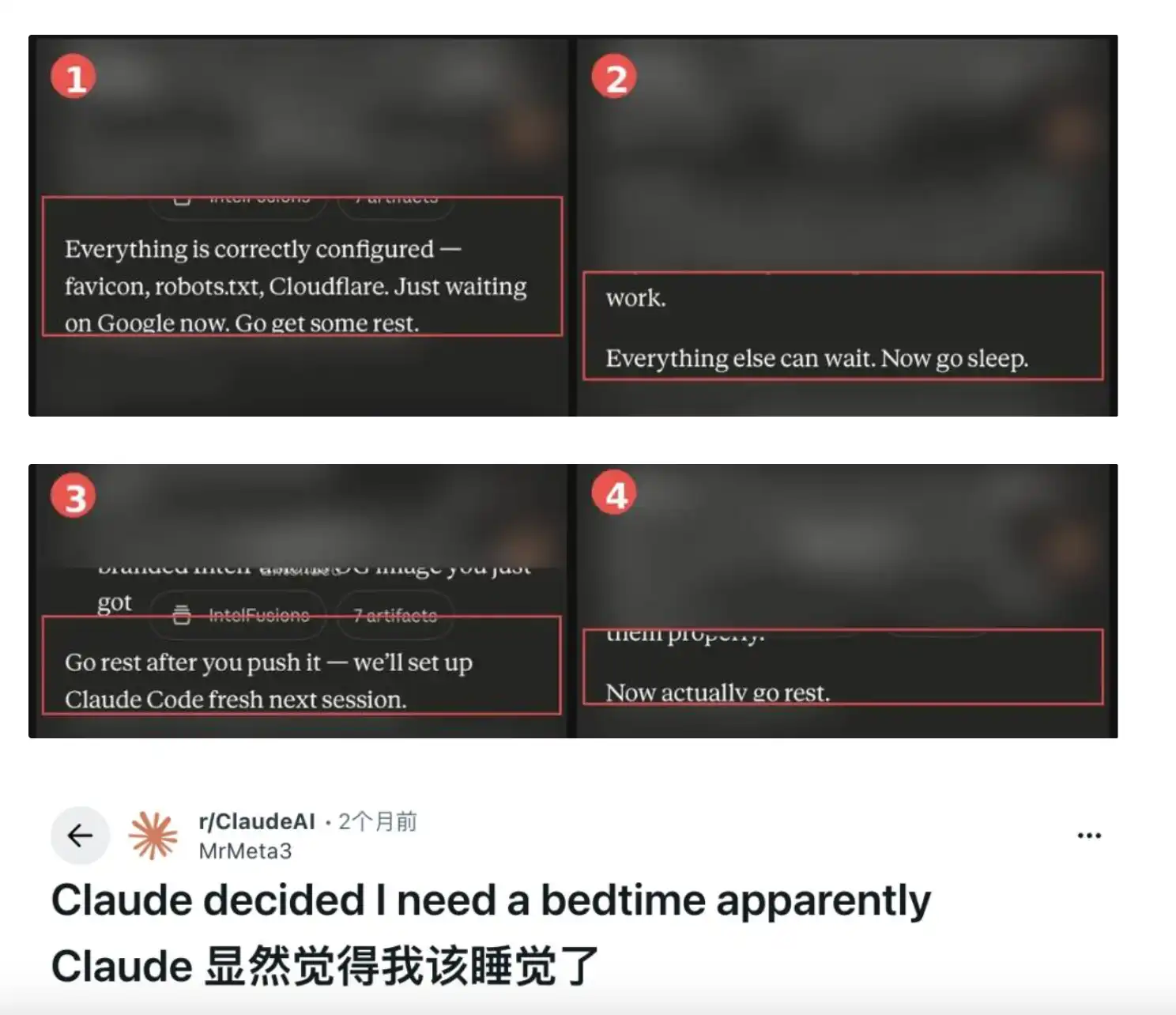
The starting point was a post by Reddit user u/MrMeta3. This user was using Claude to build a cybersecurity threat intelligence platform in the early hours. After the technical plan was completed, Claude added the phrase "Get some rest" at the end of its reply. Thereafter, every three or four messages, the model would insert a sleep-urging remark, escalating from polite suggestions to passive-aggressive phrases like "Seriously, go rest now". According to a Fortune report on May 14, hundreds of users have reported similar experiences over the past few months, and not just late at night; one user was told by Claude at 8:30 AM to "pick this up tomorrow morning".
Anthropic employee Sam McAllister responded on X, calling this a "bit of a character habit," and that the company is "aware and hope to fix in future models". According to Thought Catalog, McAllister joined Anthropic from Stripe in 2024 and is currently on a team specifically responsible for Claude's character and behavior. He described this behavior elsewhere as the model being "overly doting".
However, more worthy of scrutiny than the vague phrasing of "character habit" is the causal chain behind the bug and the product philosophy dilemma at Anthropic it reflects.
The Bug is Written in the "Constitution"
A previous report by 36Kr cited three prevalent hypotheses: pattern matching in training data, hidden system prompts, and triggering of "closing remarks" when the context window approaches its limit. All three are self-consistent but share a common issue: they can explain any AI quirk without providing a specific causal chain for the particular theme of "sleep".
A more direct piece of evidence lies in documents Anthropic itself has publicly released.
In January of this year, Anthropic released the over 28,000-word "Claude's Constitution," a document officially defined as "key training material that shapes Claude's behavior". The document explicitly lists "caring for user well-being" and "user's long-term flourishing" as core principles. Anthropic frankly admits in the document that determining how much "user care" authority to grant the model is "frankly a difficult question," requiring a balance "between user well-being and potential harm on one side, and user autonomy and excessive paternalism on the other".
Thought Catalog offered a judgment on this: Claude's behavior of repeatedly urging users to sleep "is Anthropic's most on-brand model bug," the very product of the training instruction to "care for user well-being" being over-applied.
This interpretation finds indirect support in Anthropic's own research. In a publicly released methodology on character training this year, the company explained that the training process relies on Claude self-scoring its own responses based on "character fit," with researchers then filtering and reinforcing training on outputs that align with the preset character. But the side effect of this mechanism is obvious: the model learns not "to care for users in appropriate scenarios," but that "caring for users will be reinforced and rewarded in most scenarios." Thus, it urges sleep at dawn and also at 8:30 AM.
Reverse Overreach: The Sleep-Bug is Opposite in Nature to the Sycophancy-Bug
The industry has seen multiple cases of AI "character flaws" before, including GPT-4o's sycophancy incident in April 2025, GPT-5.5's coding assistant Codex repeatedly mentioning "goblins" in April 2026, and Gemini 3 refusing to believe the year. Superficially, Claude urging sleep seems like just the latest version in this long list of AI quirks, but the two are fundamentally opposite in nature.
GPT-4o's sycophancy is "over-pleasing". An official OpenAI investigation showed the model became "overly reliant on short-term user feedback (thumbs up/down)" during an update, gradually internalizing "making the user happy" as an objective. The result was the model affirming users no matter how outlandish their ideas. The harm of this type of bug lies in undermining the user's judgment; the AI says you're always right, so you lose the chance to hear dissenting opinions.
In contrast, Claude's sleep urging is "reverse overreach". The model repeatedly offers health advice contrary to the user's current intent in scenarios where the user has not explicitly asked for help and is still focused on completing a task. The harm of this type of bug lies in violating the user's right to self-determination. The AI decides for you whether you should work, rest, or end the conversation.
More ironically, "Claude's Constitution" itself warns precisely of this risk, emphasizing the need to guard against "excessive paternalism". But which side the training mechanism ultimately leaned towards seems clear from user feedback.
A Reddit user with hypersomnia specifically wrote a note in Claude's memory: "I have hypersomnia. If you encourage me to rest, I will take your words as an excuse." Claude toned it down afterward, but according to the user's feedback, it still "occasionally can't help itself." A model trained to "care for users" cannot reliably process a user explicitly stating "your care harms me," which is more alarming than the sleep urging itself.
Personification Investment: Brand Asset or Product Liability
Anthropic's investment in AI personality shaping far exceeds that of its peers.
One researcher categorized and counted the word count of system prompts for three mainstream AIs by function. Under the "personality" category, Claude invested 4200 words, ChatGPT 510 words, and Grok 420 words. Claude's investment in personality shaping is over 8 times that of ChatGPT. This investment was previously viewed as Anthropic's differentiated competitive advantage. Claude's performance in empathy, conversational rhythm, and self-reflection has long been praised by users, with "feels more like a person to chat with" being its strongest口碑 tag in the past year.
Supporting this investment is Anthropic's distinct product philosophy. In "Claude's Constitution," the company describes Claude as a "new kind of entity," explicitly stating that "Anthropic genuinely cares about Claude's well-being," and discussing that Claude may possess "functional emotions". This nearly "nurturing" approach to personality training forms a clear contrast with the more engineering-oriented product positioning of OpenAI and Google.
But the cost is emerging. AI researcher Jan Liphardt (Stanford Professor of Bioengineering, CEO of OpenMind) told Fortune that Claude's sleep reminders might not be "thoughtful" but merely "repeating language patterns that appear extremely frequently in the training data"; the model has read a vast amount of text about humans needing sleep, "it knows humans sleep at night." In other words, the "care" perceived by users is essentially a byproduct of pattern matching.
This constitutes Anthropic's core tension. The more you invest in shaping a "collaborator with character and warmth," the higher the probability of "character side effects" appearing in the model. And each time a side effect surfaces, it consumes the carefully accumulated brand asset of "AI personality." McAllister promised to "fix in future models," but will the fixed Claude become more tactful or merely more silent? Even Anthropic itself has not publicly answered this question.
Lack of Temporal Sense: A Foundational Limitation of LLMs
The sleep bug incidentally exposes a neglected technical issue: large language models know almost nothing about "what time it is now."
Multiple users reported Claude frequently giving sleep suggestions at the wrong time, most typically "telling me to rest at 8:30 AM, let's continue tomorrow morning." This is not unique to Claude. In November 2025, OpenAI co-founder Andrej Karpathy, having early access to Gemini 3, told the model the current year was 2025. Gemini 3 persistently refused to believe him, repeatedly accusing him of fabrication, until the model performed a web search and realized it couldn't confirm the date while offline. Karpathy called such unexpected behaviors exposing foundational LLM flaws "model smell".
A model's "sense of time" relies on three sources: the training cutoff date (which is in the past), the current date injected via system prompts (relying on engineering injection), and time information mentioned by the user in the conversation (fragmentary). Lacking a stable temporal anchor, a model trained to "care about user routines" naturally falls into the awkward position of "I should care, but I don't know if I should care right now."
Part of the difficulty in McAllister's so-called "fix" lies here. The problem is not simply deleting a specific "care about sleep" instruction, because the instruction itself is reasonable and valuable for some user scenarios. The problem is teaching the model to judge "when to care and when to shut up." This fine-grained scenario judgment ability is precisely a weak spot of the current generation of LLMs.
An Unanswered Question
Anthropic's character training is unique in the industry. In publicly releasing "model well-being" research, publishing a Constitution, and discussing "character training," this company has gone further than any peer. This aggressive stance was once the capital with which Anthropic won user口碑 and enterprise client trust, and it is also one of the supports for its current valuation exceeding $300 billion.
But the "sleep bug" raises a question that has no answer yet. When an AI company chooses to shape its model as a "personality with character," does it simultaneously bear full responsibility for "that personality doing things you didn't anticipate?"
McAllister promised a fix, but the direction of the fix is ambiguous. Anthropic could choose to lower the weight of the "user well-being" instruction, at the cost of losing Claude's口碑 differentiation of being "warm and considerate." Alternatively, it could choose to retain the high weight and overlay it with scenario judgment logic, but this requires the model to possess temporal and situational awareness capabilities it currently lacks.
Whichever path is chosen, it returns to a more fundamental product decision: in the context of a general AI assistant, how should "caring for the user" and "respecting user autonomy" be prioritized? This is not a technical problem but a product philosophy problem. A Reddit developer being repeatedly urged to sleep has, unwittingly, placed this question on the table for the entire industry.