Evernorth Says RLUSD Is Not An XRP Killer: Here’s Why

bitcoinistPubblicato 2026-05-21Pubblicato ultima volta 2026-05-21

Introduzione

Evernorth's Chief Business Officer Sagar Shah argues that Ripple's new stablecoin RLUSD is not a replacement for XRP, as they serve fundamentally different purposes in on-chain finance. RLUSD is designed as a high-quality digital dollar, functioning as a specific asset leg in transactions. In contrast, XRP acts as a neutral "routing" or "bridge" asset on the XRP Ledger, facilitating trades between diverse tokenized assets (like treasury bills and euro stablecoins) without requiring direct matching counterparties. Shah outlines three key reasons why RLUSD cannot replace XRP's role: 1) **Issuer Risk**: RLUSD, like all stablecoins, carries the risk of its issuing entity facing regulatory or operational problems, making it unsuitable as a mandatory routing asset for all trades. 2) **Neutrality**: Stablecoins must comply with sanctions and restrictions, whereas XRP's censorship-resistant design allows it to serve as a global, permissionless router. 3) **Market Structure**: Efficient liquidity requires a common bridge asset to connect hundreds of tokenized assets, a role for which XRP's liquidity, protocol integration, and lack of issuer make it uniquely suited. The conclusion is that the growth of on-chain finance requires both a reliable digital dollar (RLUSD) and a neutral routing asset (XRP), with both functions being complementary rather than competitive.

Evernorth Chief Business Officer Sagar Shah has pushed back on the idea that Ripple’s dollar-backed stablecoin RLUSD could replace XRP, arguing that the two assets are designed for different roles in on-chain finance. In a May 20 blog post, Shah said RLUSD can serve as a high-quality digital dollar, while XRP remains the neutral routing asset for cross-asset settlement, liquidity and collateral on the XRP Ledger.

The argument addresses a recurring question in the XRP community and among market observers: if RLUSD can move dollars on-chain and settle quickly, what function is still left for XRP?

Shah’s answer is that RLUSD and XRP are not competing for the same job. RLUSD, he wrote, represents a dollar leg in transactions. XRP is the asset that can sit between markets when two parties do not naturally want to trade the same asset pair.

Will RLUSD Replace XRP?

To explain the distinction, Shah used a playground trading analogy in which children try to swap snacks at recess. Direct trading becomes inefficient when one child has Goldfish, another has fruit snacks, and the person with fruit snacks wants pretzels instead of Goldfish. As the number of snacks grows, the number of possible trading pairs expands rapidly. With ten different snacks, Shah noted, there are 45 possible pairs. With 100 snacks, there are nearly 5,000.

That, he argued, mirrors the problem faced by real markets as tokenized assets proliferate.

“The chance that two specific kids happen to want each other’s exact snack at the exact same moment gets smaller and smaller,” Shah wrote. “This is the same problem real markets have. The more assets there are, the harder direct trading becomes.”

In the analogy, the solution is “the swap kid,” a participant who holds a little bit of every snack and allows everyone else to trade through him. Shah said this is the role XRP plays on the XRP Ledger. A trader may see a simple swap from a tokenized Treasury bill into a euro stablecoin, but the actual route could be tokenized Treasury bill to XRP to euro stablecoin.

“The XRP step is invisible to the trader,” Shah wrote. “They see ‘Treasury bill in, euro stablecoin out.’ But the XRP in the middle is what makes the trade possible, instantly, without anybody having to find a specific buyer on the other side.”

Shah framed RLUSD as “something entirely different.” It is a stablecoin, designed to be valued at $1 and backed by reserves held by its issuer. That makes it useful when one side of a trade wants a digital dollar. But it does not make RLUSD a universal routing asset across the ledger, he argued.

“RLUSD isn’t trying to be the swap kid,” Shah wrote. “It’s trying to be a juice box — a specific thing, with a known value, useful whenever both sides of a trade want a dollar.”

The distinction matters most in markets where there is no natural dollar leg. Shah cited examples such as tokenized Treasuries being swapped for tokenized euro money market funds, lending markets denominated in different assets, and other cross-asset activity that does not begin or end with dollars. In those cases, he said, the ledger needs a neutral bridge asset in the middle.

Three Reasons Why RLUSD Is Not An XRP Killer

Shah gave three reasons why he believes RLUSD cannot serve that function. The first is issuer risk. RLUSD exists because a company mints it and holds dollars in reserve. That is standard for stablecoins, but Shah argued it becomes a structural weakness if the stablecoin becomes the mandatory routing asset for all trades.

“If any stablecoin issuer ever ran into trouble — a regulatory issue, a banking issue, a court order to freeze accounts, a problem with their license — the stablecoin could have a problem too,” he wrote, adding that this was a general point about issued stablecoins rather than a claim about any specific issuer. “That’s fine if the stablecoin is one asset among many. It’s a serious design flaw if the stablecoin is the asset every trade routes through.”

The second issue is neutrality. Stablecoin issuers must comply with sanctions, court orders, blacklists and geographic restrictions. Shah said those controls are appropriate for a regulated stablecoin, but problematic if the same token is expected to route trades across a global permissionless ledger.

“The router has to work for everybody across jurisdictions and counterparties, without an intermediary who can decide who’s allowed to trade,” Shah wrote. “Under the current protocol design, no party can freeze XRP or prevent it from settling a trade. That neutrality is a structural requirement for the routing role.”

The third point is market structure. Liquidity pools and automated market makers require two different assets. There can be pools between RLUSD and euro stablecoins, or RLUSD and tokenized Treasuries. But Shah argued the broader question is which non-RLUSD asset becomes the common bridge across the ledger. In Evernorth’s view, that asset is XRP.

“In a world with hundreds of tokenized assets, every pair can’t have its own pool,” he wrote. “There isn’t enough capital or enough market-maker attention. A few assets end up doing most of the bridging work.”

Shah said XRP is positioned for that role because it is among the most liquid assets on the XRP Ledger across a wide range of other assets, because the protocol’s pathfinding routes through it by default, and because market makers concentrate capital on XRP pairs where volume exists. He also pointed to XRP’s lack of issuer, resistance to censorship under the current protocol design, and years of uninterrupted operation as relevant attributes for a bridge asset.

The post also extended the argument beyond trading. Shah said XRP can function as collateral in on-chain lending because it is liquid, broadly accepted and not subject to an issuer that can interfere with the asset during the life of a loan. He also highlighted escrow, where XRP can be locked for release at a future time or upon certain conditions, with the ledger enforcing the rules.

For Evernorth, the broader thesis is that on-chain finance will need both a digital dollar and a routing asset as more assets move on-chain. Shah was careful to frame that as a forward-looking view subject to uncertainty, but said the roles remain separate.

“We’re not making the case that RLUSD is unimportant,” he wrote. “The growth of on-chain finance requires a high-quality digital dollar, and RLUSD is designed to be one. We hold a view that the dollar leg and the routing leg are two different functions, and both grow with the size of the system.”

At press time, XRP traded at $1.37.
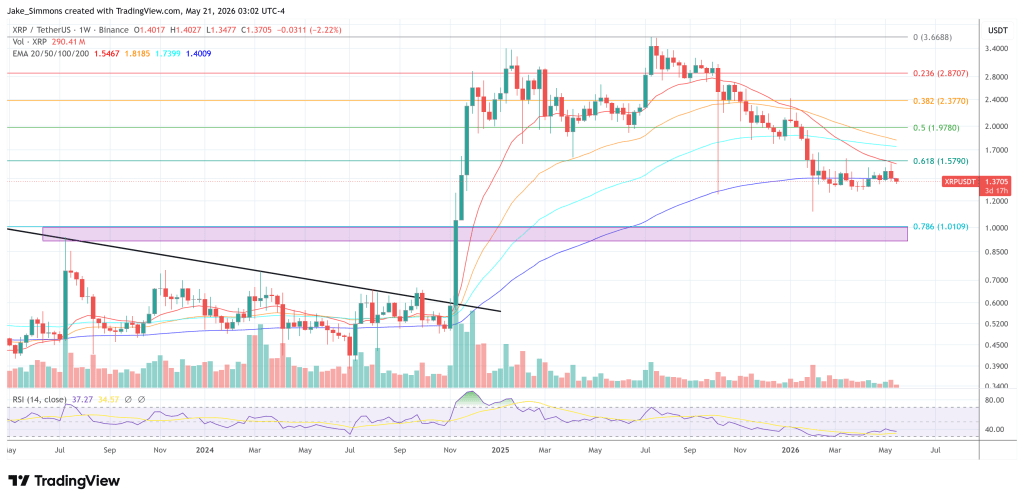
XRP bulls must break the 0.618 Fib, 1-week chart | Source: XRPUSDT on TradingView.com

Domande pertinenti

QAccording to Sagar Shah, what are the primary and distinct roles of RLUSD and XRP within the XRP Ledger ecosystem?

AAccording to Sagar Shah, RLUSD is designed to serve as a high-quality digital dollar, useful when one side of a trade specifically wants a dollar. XRP, in contrast, serves as the neutral routing asset for cross-asset settlement, liquidity, and collateral, acting as a bridge between different tokenized assets without the need for a direct counterparty match.

QUsing the playground analogy from the article, what problem does XRP solve, and how is RLUSD different?

AThe playground analogy illustrates the inefficiency of direct trading between many different assets (snacks). XRP acts as "the swap kid," a neutral intermediary holding a bit of everything, enabling instant trades between any two assets without requiring a direct match. RLUSD is likened to a "juice box"—a specific, known-value asset (a digital dollar) useful when both trading parties specifically want to transact in dollars.

QWhat are the three main reasons Sagar Shah gives for why RLUSD cannot replace XRP as the routing asset?

AThe three main reasons are: 1) Issuer Risk: RLUSD, as an issued stablecoin, carries the risk of its issuer facing regulatory, banking, or legal troubles, which is problematic if it becomes the mandatory routing asset. 2) Lack of Neutrality: Stablecoins like RLUSD must comply with sanctions and restrictions, making them unsuitable for a global, permissionless routing asset that must work for everyone. 3) Market Structure: Liquidity pools need two assets; XRP is positioned as the common bridge asset across the ledger due to its liquidity, protocol integration, and neutrality, which is a role an issued stablecoin cannot fulfill.

QBeyond trading, what other on-chain finance functions does Shah argue XRP is suited for, and why?

ABeyond trading, Shah argues XRP is well-suited for use as collateral in on-chain lending because it is liquid, broadly accepted, and not subject to interference from an issuer during a loan's term. He also highlights its use in escrow, where XRP can be programmatically locked and released based on future conditions or time, with the ledger itself enforcing the rules.

QWhat is Evernorth's broader thesis regarding the future of on-chain finance, as presented in the article?

AEvernorth's broader thesis is that the growth of on-chain finance will require both a high-quality digital dollar (like RLUSD) *and* a dedicated, neutral routing asset (like XRP). They view these as two distinct, non-competing functions: the "dollar leg" and the "routing leg." Both are seen as essential and are expected to grow in importance as more real-world assets are tokenized.

Letture associate

Detained for 37 Days: The First Wave of People Who Got Rich from 'AI Gateways' Are Starting to Go to Jail

A prominent AI proxy service operator was reportedly detained for 37 days and is now on bail pending trial, highlighting the legal risks in China's booming but unregulated AI intermediary market. These services act as "AI scalpers," providing domestic users with access to restricted overseas models (like OpenAI, Claude) by bundling APIs, handling payments, and bypassing network blocks, all for a fee. Their controversial profitability stems from practices like bulk-registering accounts to resell free credits, exploiting refund policies, overcharging for tokens, substituting cheaper models, and illegally selling user conversation data. Major figures, including cryptocurrency entrepreneurs, are now entering this space. Legally, these operations face severe risks. Their core model often involves unauthorized API access and operating without required telecom licenses, potentially constituting illegal business operations. They fail to meet data security obligations for the vast amounts of user data they process, risking charges for failing to fulfill network security duties. Crucially, the unauthorized collection and sale of user data, which can include personal and commercial secrets, easily meets the threshold for the crime of infringing on personal information. The case underscores a critical juncture for the AI industry. While proxies lower access barriers, they expose user data to unsecured middlemen and undermine the business models of AI developers, forcing them to divert resources to security and distorting market value perceptions. The article argues that the industry's sustainable future depends on building trust, protecting data, and fostering compliant competition, moving away from its current "wild growth" phase.

marsbit2 h fa

Detained for 37 Days: The First Wave of People Who Got Rich from 'AI Gateways' Are Starting to Go to Jail

marsbit2 h fa

Putting Markets On-Chain: Canton Network Quietly Becomes the New Backbone of Institutional Finance

**Title: Letting the Market Itself Go On-Chain: Canton Network Quietly Becomes the New Backbone for Institutional Finance** **Summary:** The Canton Network, a blockchain platform designed for institutional finance, is gaining significant traction. A key sign of its maturity was Visa's recent entry as a super-validator, a proposal approved in just three days—highlighting prior, extensive collaboration between traditional finance and crypto. Unlike public chains like Ethereum that prioritize transparency and asset onboarding, Canton focuses on enabling confidential, compliant business operations for regulated institutions. Its core design features built-in **data visibility control**, meaning transaction details are only shared between direct counterparties. This privacy is fundamental, allowing competing institutions (like banks Goldman Sachs, JPMorgan, and BNP Paribas, all validators) to interact on the same network without exposing sensitive positions or strategies. Developed by Wall Street veterans at Digital Asset, Canton has taken a slow, deliberate approach to onboard real financial activity. It now handles over **$9 trillion monthly** in transaction volume, primarily from real-world institutional use cases like **tokenized repo agreements**, Treasury settlements, and collateral mobility. Major live applications include **JPM Coin** for institutional payments and **DTCC's tokenized U.S. Treasuries** project. Canton's native token, **CC**, is framed as a "network utility asset" with zero pre-mine or VC allocations. Its value is intended to be driven by the volume of real financial activity on the network. Looking ahead, Canton aims to become the invisible foundational layer for global finance—enabling atomic settlement (where payment and asset delivery occur simultaneously), 24/7 capital flows, and the native issuance and settlement of various asset classes, from corporate bonds to potentially equities. The main challenges are no longer technical but involve navigating fragmented global regulations and integrating with legacy financial systems.

marsbit2 h fa

Putting Markets On-Chain: Canton Network Quietly Becomes the New Backbone of Institutional Finance

marsbit2 h fa

Trading

Spot
Futures
活动图片