Cardano Founder Calls For Simpler, Safer Crypto Across All Chains

bitcoinistPubblicato 2026-05-08Pubblicato ultima volta 2026-05-08

Introduzione

Cardano founder Charles Hoskinson argued at Consensus 2026 that the crypto industry must overcome its complex and intimidating user experience to achieve mainstream adoption. He highlighted the burdens of managing seed phrases, navigating exchanges, and understanding DeFi risks as major barriers. Hoskinson's solution involves simplifying self-custody, identity, privacy, and multi-chain access without reverting to centralized control. He praised efforts like Ethereum's account abstraction but warned that abstraction must be paired with privacy to avoid recreating Web2's surveillance model. Hoskinson introduced Midnight Passport as a framework designed to offer secure, mobile-native management across multiple blockchains. He also discussed the future role of AI agents in handling transactions, emphasizing that privacy will be critical as these agents require deep personal context to operate effectively.

Cardano founder Charles Hoskinson used a Wednesday keynote at Consensus 2026 in Miami to argue that crypto’s next phase will not be won by another isolated chain, token or wallet. The Cardano founder said the industry must make self-custody, identity, privacy and multi-chain access simple enough for mainstream users without handing control back to centralized intermediaries.

Hoskinson framed the problem bluntly: crypto still asks users to manage seed phrases, navigate exchanges, wait for withdrawals, choose between networks, avoid fake apps and understand DeFi risk before they can do anything useful. That, he said, remains the core barrier to bringing “the next few billion people” into the industry.

“The number one problem that people say again and again and again when they think about cryptocurrencies, whether you’re an experienced user and you’ve been in the industry a long time or you’re a completely new person, you’ve heard about the industry is, I’m gonna fuck it up. The safety side,” Hoskinson said. “That is the user experience in 2026. That make any sense to you? Is this like a product you wanna use?”

Cardano Founder Targets Crypto’s UX Problem

His answer was not to abandon crypto’s original principles, but to make them usable. Hoskinson contrasted crypto’s current experience with Web2 products such as Google Wallet, which he said has around 1.5 billion users and trains consumers to expect one-click setup, recovery and seamless mobile access. Crypto, in his view, cannot keep insisting it is “different” if the product experience remains too punishing for ordinary users.

A central theme of the keynote was abstraction. Hoskinson credited Ethereum with advancing account abstraction and chain abstraction standards, arguing that these efforts became necessary as fragmented layer-2 environments created a poor user experience. He also pointed to Near Protocol as an example of embedding those ideas at the protocol level, citing $71 million in transaction fees in a year and billions of dollars traded through Near intents.

But Hoskinson warned that abstraction carries a tradeoff. When users delegate complexity to third parties, those parties often gain visibility into assets, transactions, preferences, identity and business data. For crypto to scale without repeating the surveillance model of Web2, he argued, abstraction must be paired with privacy.

“When you abstract things, you delegate to people. You trust people. You give them something to do that on your behalf somewhere else,” he said. “You don’t worry about the doing, but when they do the doing, they know you. They know what you’re buying. They know where you’re at.”

That argument led into Hoskinson’s pitch for Midnight Passport, a framework he described as combining mobile-native key management, recovery, self-sovereign identity, selective disclosure, wallet credentials, name services and multi-chain signatures. The idea, according to Hoskinson, is to let users scan a QR code, rely on trusted execution hardware already built into phones, encrypt off-chain data client-side and create wallets across networks such as Bitcoin, Ethereum, Solana and XRP.

“I don’t care what networks you want to use. I don’t care what assets you want to have,” Hoskinson said. “I want you to have control of those assets. I want you to custody those assets. I want you to be in control of your identity and your data.”

The keynote also expanded into AI agents, which Hoskinson described as an incoming force that could reshape internet commerce and crypto usage. He argued that agents may eventually handle most searches, transactions and online activity, while humans interact with a smaller “human internet.” For crypto, that raises a practical question: if users cannot safely evaluate DeFi protocols, counterparties or risks themselves, AI systems may become the layer that performs diligence and execution.

Hoskinson said this makes privacy even more important, because effective agents require deep personal context. Midnight Passport, he said, is being developed not only for people but also for agents, allowing rules to be set around identity, data access and execution.

At press time, Cardano traded at $0.2689.
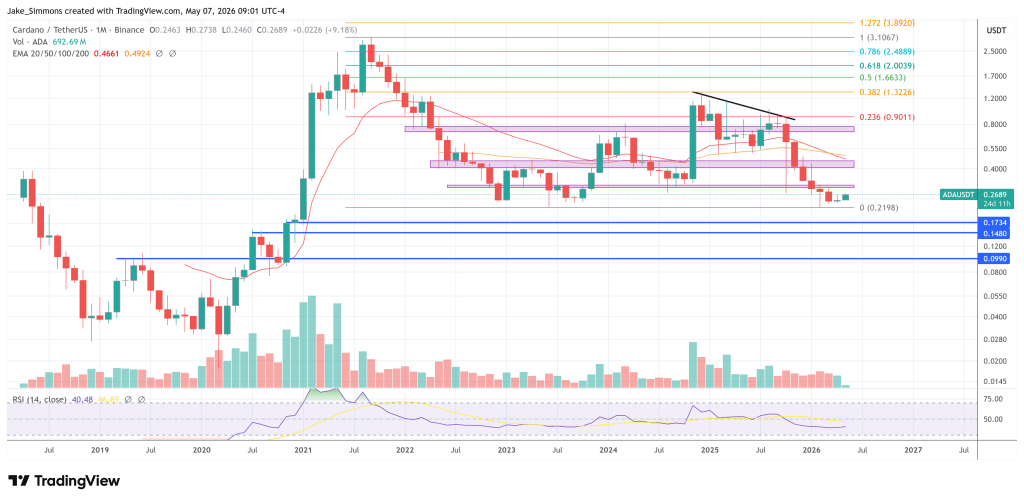
Cardano remains below key resistance, 1-monthly chart | Source: ADAUSDT on TradingView.com

Domande pertinenti

QWhat is the main barrier to bringing mainstream users into crypto, according to Charles Hoskinson?

AAccording to Hoskinson, the main barrier is the poor user experience, which asks users to manage seed phrases, navigate exchanges, wait for withdrawals, choose between networks, avoid fake apps, and understand DeFi risks before they can do anything useful.

QWhat does Hoskinson identify as a necessary tradeoff that comes with simplifying crypto through abstraction?

AHoskinson identifies that the tradeoff with abstraction is often a loss of privacy. When users delegate complexity to third parties, those parties gain visibility into their assets, transactions, preferences, identity, and business data.

QWhat is the proposed solution, Midnight Passport, designed to combine?

AMidnight Passport is designed to combine mobile-native key management, recovery, self-sovereign identity, selective disclosure, wallet credentials, name services, and multi-chain signatures to simplify user experience across different blockchains.

QAccording to the keynote, why will privacy become even more critical with the rise of AI agents?

APrivacy will become more critical because effective AI agents require deep personal context to operate. Therefore, systems are needed to set rules around identity, data access, and execution for these agents, protecting user data.

QHow did Hoskinson contrast the current crypto user experience with that of successful Web2 products?

AHe contrasted it with products like Google Wallet, which trains consumers to expect one-click setup, recovery, and seamless mobile access. He argued crypto cannot insist it is 'different' if its product experience remains too punishing compared to these seamless mainstream options.

Letture associate

Next-Generation Crypto Security: Not Dependent on Devices, But on Isolated Architecture

Next-Generation Crypto Security: Moving from Device-Reliance to Isolation Architecture For a decade, hardware wallets like Ledger and Trezor have been the gold standard for securing crypto assets by keeping private keys offline. However, as on-chain transactions increase and attacks grow more sophisticated, their limitations are becoming apparent. Security is no longer just about offline key storage but also involves transaction signing, online interactions, supply chain trust, and future quantum computing threats. The next generation of crypto security is shifting from "relying on a more secure device" to "relying on a more robust system architecture." While hardware wallets offer a clear security model, their safety depends on trusting the manufacturer, secure firmware updates, and the physical device itself—introducing central points of failure. Furthermore, during use, the device must interact with online gadgets (e.g., via USB or QR codes), creating potential attack vectors like transaction tampering. The emerging alternative is the "isolation architecture" wallet. Its core principle is to strictly separate private key management and transaction signing (kept offline) from the network broadcast function (handled online). Even if the online component is compromised, attackers can only access already-signed transactions, not the private keys. This approach reduces reliance on any single physical device or vendor. Another critical driver is "post-quantum" security. Current cryptographic algorithms (e.g., elliptic curve) could become vulnerable to future quantum computers. Standards like those from NIST in 2024 are pushing the industry to prepare now, as attackers could harvest encrypted data today for decryption later. Projects like Lock.com (currently in early access) are exploring this direction, combining isolation architecture with post-quantum cryptography in a hardware-independent model. This reflects a broader industry trend: crypto infrastructure is evolving from a collection of single-point tools into integrated systems where security is embedded in the architecture itself. The fundamental question is changing. Users are shifting from asking "Which hardware wallet should I buy?" to "Which security architecture should I trust?" The future of crypto security may depend less on a specific device and more on transparent, verifiable system design that inherently isolates risk.

Odaily星球日报1 h fa

Next-Generation Crypto Security: Not Dependent on Devices, But on Isolated Architecture

Odaily星球日报1 h fa

Trading

Spot
Futures

Articoli Popolari

Come comprare ADA

Benvenuto in HTX.com! Abbiamo reso l'acquisto di Cardano (ADA) semplice e conveniente. Segui la nostra guida passo passo per intraprendere il tuo viaggio nel mondo delle criptovalute.Step 1: Crea il tuo Account HTXUsa la tua email o numero di telefono per registrarti il tuo account gratuito su HTX. Vivi un'esperienza facile e sblocca tutte le funzionalità,Crea il mio accountStep 2: Vai in Acquista crypto e seleziona il tuo metodo di pagamentoCarta di credito/debito: utilizza la tua Visa o Mastercard per acquistare immediatamente CardanoADA.Bilancio: Usa i fondi dal bilancio del tuo account HTX per fare trading senza problemi.Terze parti: abbiamo aggiunto metodi di pagamento molto utilizzati come Google Pay e Apple Pay per maggiore comodità.P2P: Fai trading direttamente con altri utenti HTX.Over-the-Counter (OTC): Offriamo servizi su misura e tassi di cambio competitivi per i trader.Step 3: Conserva Cardano (ADA)Dopo aver acquistato Cardano (ADA), conserva nel tuo account HTX. In alternativa, puoi inviare tramite trasferimento blockchain o scambiare per altre criptovalute.Step 4: Scambia Cardano (ADA)Scambia facilmente Cardano (ADA) nel mercato spot di HTX. Accedi al tuo account, seleziona la tua coppia di trading, esegui le tue operazioni e monitora in tempo reale. Offriamo un'esperienza user-friendly sia per chi ha appena iniziato che per i trader più esperti.

1.2k Totale visualizzazioniPubblicato il 2024.12.10Aggiornato il 2025.03.21

Come comprare ADA

Discussioni

Benvenuto nella Community HTX. Qui puoi rimanere informato sugli ultimi sviluppi della piattaforma e accedere ad approfondimenti esperti sul mercato. Le opinioni degli utenti sul prezzo di ADA ADA sono presentate come di seguito.

活动图片