Authored by: 100y_eth
Compiled by: AididiaoJP
Key Takeaways
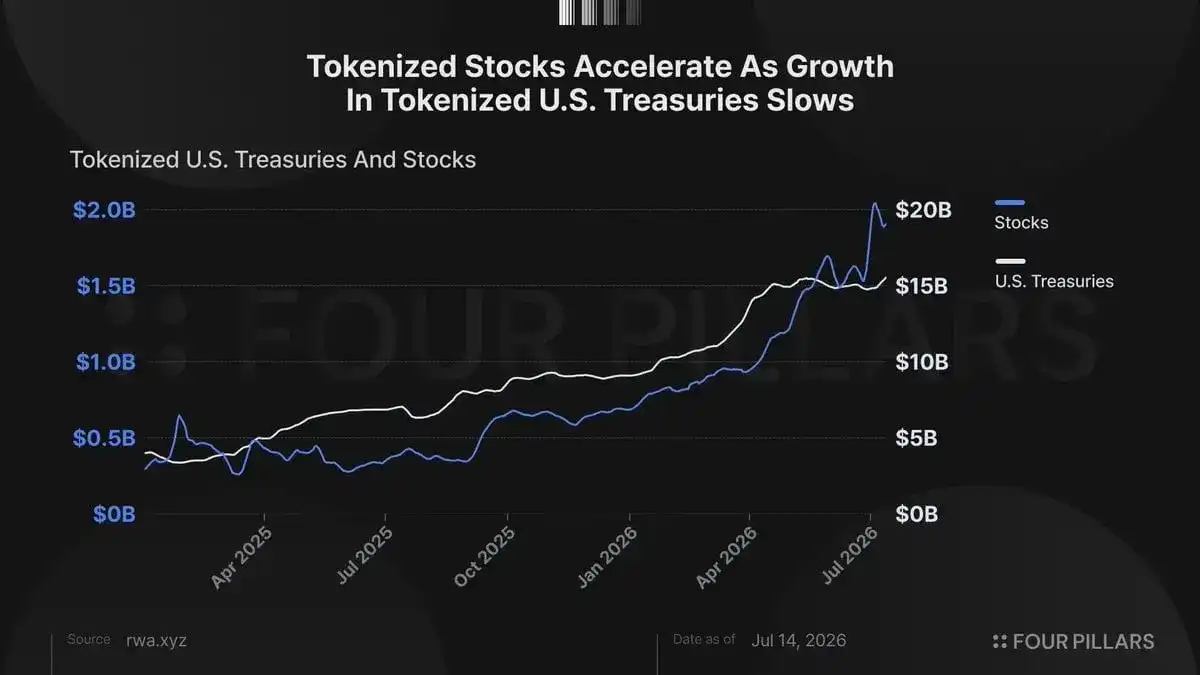
Unlike the recently stagnant tokenized U.S. Treasury bond market, the tokenized stock market is experiencing rapid expansion in both scale and quality.
From traditional stock infrastructure providers and fintech companies to crypto exchanges and Web3 native platforms, all see tokenized stocks as the next significant opportunity in the RWA industry. In fact, there are multiple pathways for stock tokenization, and understanding their respective advantages, disadvantages, and positioning is crucial.
This article will analyze the strategies of various players from different backgrounds, such as Securitize, Ondo, xStocks, Robinhood, DTCC, the New York Stock Exchange, Nasdaq, and Coinbase.
Everyone is Watching Tokenized Stocks
Today, regulators, banks, institutions, fintech companies, and almost all major market participants are showing strong interest in tokenization. But it's only recently that the term 'tokenization' has truly become a focal point. In the early stages, the main driver of growth in the tokenized market was undoubtedly U.S. Treasury bonds. Its rapid take-off relied on three factors: the safety of U.S. government debt, the relatively simple tokenization structure, and the relatively high yields at the time.
The tokenized U.S. Treasury market grew from $701 million on January 1, 2024, to surpassing $15 billion for the first time on April 17, 2026, representing a staggering compound annual growth rate of approximately 3.81x. However, after breaching $15 billion, the market has hovered around this level, showing a clear slowdown in growth. Considering that a significant portion of the demand for tokenized U.S. Treasuries came from DeFi protocols or exchange margin scenarios, the recent unfavorable market environment making demand stagnate is not surprising.
Just as the momentum for tokenized U.S. Treasuries weakened, another tokenization track is rapidly rising in both quantity and quality—tokenized stocks. The market size grew approximately 6.5x from $291 million on January 1, 2025, to around $1.9 billion currently within a year and a half. At the industry level, whether it's Web3 native players like Securitize and Ondo Global Markets, financial companies like Robinhood and Coinbase, or financial infrastructure providers like DTCC, the NYSE, and Nasdaq, either have already launched tokenized stocks or are actively preparing to do so.
What advantages do tokenized stocks have over traditional stock markets that make almost all major U.S. players see them as the next significant opportunity? At first glance, tokenizing stocks might seem simple, but in practice, depending on the regulatory framework adopted, various tokenization structures emerge, each with its own set of advantages. To understand these differences, one must first grasp the SEC's classification framework for tokenized securities.
SEC's Classification Framework for Tokenized Securities
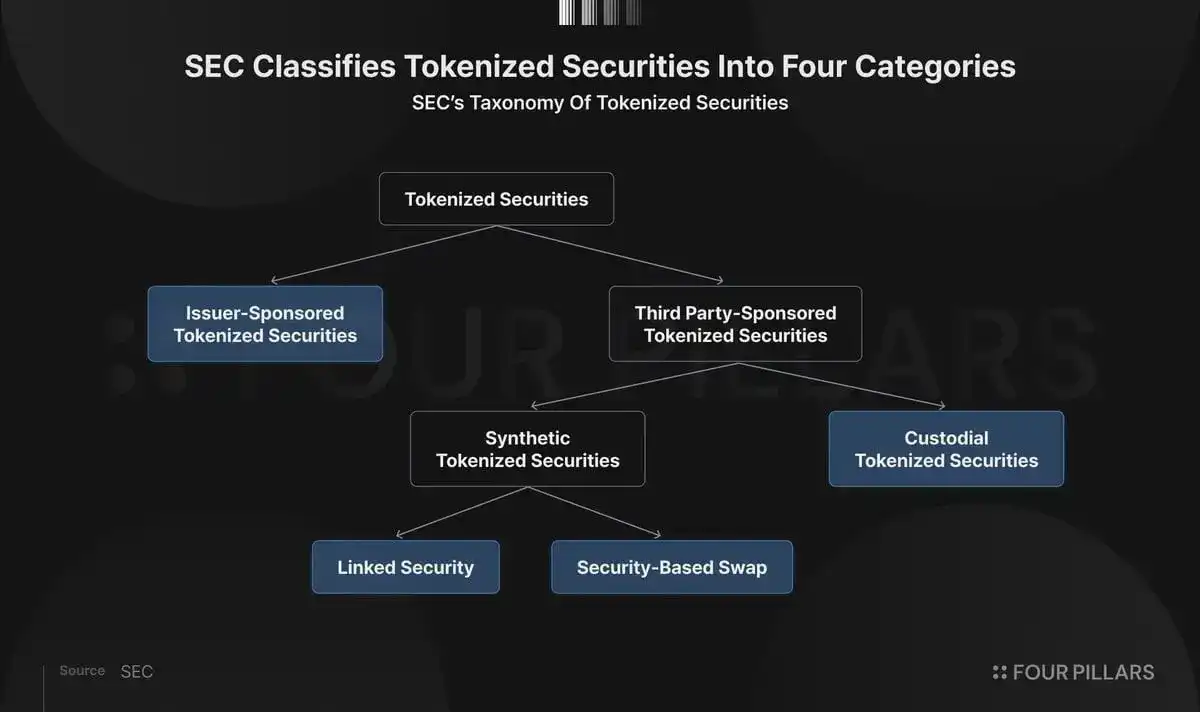
In January of this year, the SEC issued a statement proposing a classification framework for tokenized securities.
First, based on whether the tokenization is conducted by the security issuer itself or a third party, they are categorized as 'Issuer-Sponsored Tokenized Securities' or 'Third Party-Sponsored Tokenized Securities.'
Third Party-Sponsored Tokenized Securities are further subdivided: if the rights associated with the underlying security itself are tokenized, they are 'Custodial Tokenized Securities'; if a separate tokenized product is issued that is merely linked to the price, yield, events, or other characteristics of the underlying security, they are 'Synthetic Tokenized Securities.'
Synthetic types are further classified by product type: if a third party issues an independent security (such as a debt security), it's a 'Linked Security'; if it involves entering into a derivative contract, it's a 'Security-Based Swap.'
Ultimately, under this framework, tokenized securities can be classified into the following four categories, which also apply to tokenized stocks:
- Issuer-Sponsored Tokenized Securities: The stock issuer itself, or its designated agent (like a transfer agent), directly tokenizes and operates the security. The issuer (or its agent) connects a blockchain or other DLT system to the official shareholder register for maintaining shareholder records. This method does not fundamentally alter the existing legal framework and directly complies with current securities laws. The biggest advantage is that the token inherits all shareholder rights, including ownership. However, strict compliance requirements limit usability to some extent. Main representatives: Securitize, Superstate, Figure.
- Custodial Tokenized Securities: A third party tokenizes the rights (indirect rights) to securities held by a depository (like DTCC) or broker. This also inherits all related rights but is highly dependent on existing stock market infrastructure, ownership remains indirect, and improvements to the traditional system are relatively limited. Main representatives: DTCC; Ondo also recently used this method to tokenize IVV and MU.
- Linked Security: A third party issues and tokenizes an independent security (e.g., a debt security) that provides synthetic exposure to the underlying stock. Token holders only obtain price performance exposure and do not inherit other shareholder rights. The biggest advantage is high flexibility for on-chain use. Main representatives: Ondo, xStocks, Robinhood Stock Tokens.
- Security-Based Swap: A third party issues a derivative contract providing synthetic exposure to the underlying stock and tokenizes the contract. Like Linked Securities, it only provides price-related exposure and does not inherit other rights. Currently, Robinhood Classic Stock Tokens is almost the sole major example.
Analysis of Major Tokenized Stock Platforms
Securitize: Taking the Most Direct Route
Securitize is currently the largest tokenization platform by market share, with tokenized RWA valued at $5.1 billion. Its flagship product is BlackRock's money market fund BUIDL. Securitize holds SEC-registered broker-dealer, transfer agent, and ATS licenses and leverages these regulatory advantages to adopt a 'Direct Tokenized Security' model. According to the SEC classification, this falls under 'Issuer-Sponsored Tokenized Securities.'
Recently, Securitize has extended the same model to tokenized stocks. When it went public via a SPAC with its own stock SECZ, it used its own service to tokenize and issue $180 million worth of SECZ on-chain.
The advantages of this model are clear: existing stocks can be tokenized as-is while fully complying with current securities laws. Investors first directly register ownership of their shares, previously held via DTCC or brokers, through DRS. Then, Securitize, acting as the transfer agent, tokenizes these shares. The result is that the stock token shares the same CUSIP as the existing stock, inheriting not only economic rights but also all related rights like voting rights and claims on remaining assets in bankruptcy.
However, precisely because the tokenized stock is essentially another form of the same stock, it comes with corresponding drawbacks. Most importantly, the compliance requirements are strict, and on-chain use is relatively restricted. Unlike Ondo's or xStocks' tokenized stocks, Securitize's stock tokens can only be transferred between KYC/AML-approved whitelisted wallets, and on-chain interactions are only possible with a limited set of smart contracts pre-approved by the team.
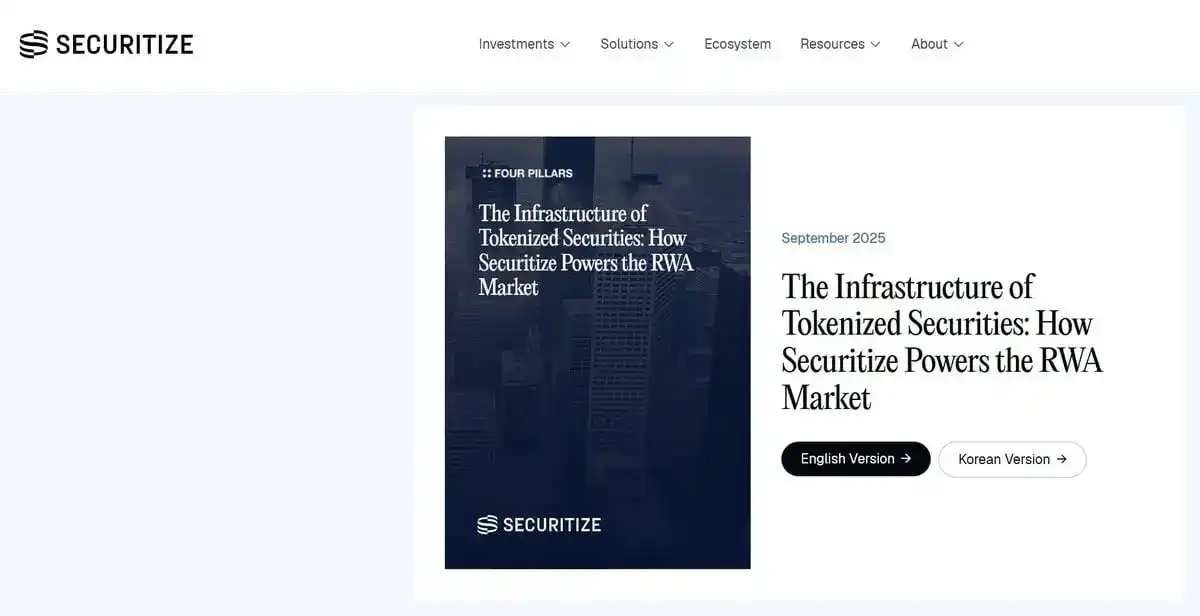
How does Securitize enforce compliance requirements like KYC/AML on-chain? The answer is the DS Protocol. This is a suite of smart contracts developed by Securitize that uses code to enforce compliance throughout the lifecycle of a tokenized security (issuance, transfer, use, voting, dividends). Four Pillars previously produced an in-depth research report on the DS Protocol, which is also archived on Securitize's website. Readers interested in understanding how tokenized securities operate at the smart contract level can refer to that report.
Platforms adopting similar methods for tokenizing stocks include Superstate and Figure. They all act as transfer agents for tokenization, with the main difference being the type of stock tokenized: Securitize and Superstate tokenize shares identical to existing stocks via the DRS system, while Figure issues a separate blockchain-native class of shares and tokenizes that portion.
Ondo & xStocks: Expanding the Ecosystem with Broad Accessibility
Ondo and xStocks adopt a structure where, when a user orders a stock token, an offshore SPV acquires the underlying stock and then issues a tokenized debt security backed by that stock.
Take xStocks as an example. It has a Jersey-regulated SPV—Backed Assets (JE) Limited. When a user requests a stock token issuance via the platform, this SPV purchases the underlying stock through U.S.-based Alpaca Securities and holds it in a segregated account with a regulated custodian. The SPV then issues an independent debt security backed by these stocks, tokenizes it, and delivers it to the user.
This structure falls under the SEC's 'Linked Security' classification.
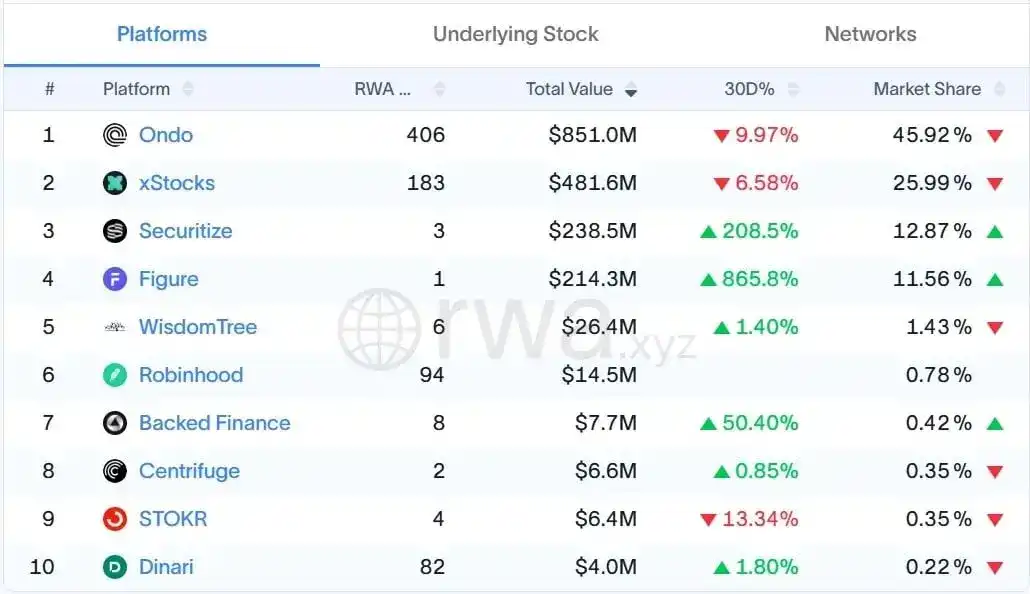
Currently, Ondo has tokenized 406 different stocks, with a total value of approximately $851 million; xStocks has tokenized 183 stocks, worth about $482 million. Their respective market shares in the tokenized stock space are 45.9% and 26.0%, firmly occupying the top two positions.
The key to their rapid growth lies in the broad accessibility enabled by their tokenization structure. Strictly speaking, they are not tokenizing the stock itself but rather tokenizing a debt security issued by a third party and backed by the stock. Therefore, compared to the issuer-sponsored model that directly tokenizes existing stocks, this structure has more relaxed compliance requirements for distribution and secondary trading. Users can more freely trade and use Ondo and xStocks issued tokenized stocks on CEXs and on-chain DeFi protocols. For example, with xStocks, anyone can trade via Jupiter DEX using a Web3 wallet or deposit them into lending protocols like Kamino as collateral to borrow stablecoins.
However, this indirect tokenization also brings issues: even if the underlying asset is the same, tokens issued by different platforms are not interoperable, leading to liquidity fragmentation. For example, for Nvidia stock backing, Ondo issues NVDAon, and xStocks issues NVDAx, and the two are not interchangeable. Additionally, due to reliance on Regulation S, U.S. investors and U.S. persons cannot use them.
To address these limitations, Ondo recently acquired Oasis Pro, obtaining broker-dealer, ATS, and transfer agent licenses, moving towards a more compliance-friendly tokenization model. In fact, Ondo has already used these licenses to tokenize IVV ETF shares and MU stock held in a brokerage account via the 'Custodial Tokenized Securities' model, demonstrating the possibility of parallel multi-structure operations.
Robinhood: Can the Latecomer Make a Strong Push?
Another important new player has joined the tokenized stock ecosystem—Robinhood. It had already offered tokenized stock services to European investors through Classic Stock Tokens. However, according to the SEC classification, that structure was a 'Security-Based Swap': Robinhood enters into a derivative contract with the user based on the stock and tokenizes the contract into a receipt token. The entire structure was highly closed, usable only within the Robinhood App.
On July 1, 2026, Robinhood launched a new Stock Tokens service. Its tokenization structure adopts the 'Linked Security' model, almost identical to the ones used by Ondo and xStocks mentioned earlier, with similar advantages and disadvantages.
While the structure is the same, the potential Robinhood brings is clear: its product DNA and massive existing user base. Concurrently with launching Stock Tokens, Robinhood also launched the Robinhood Chain mainnet, centered around Stock Tokens. U.S. users can also deposit stablecoins into Morpho on Robinhood Chain via the Robinhood App to earn 7% interest. Despite entering later than Ondo and xStocks, with its product iteration capabilities and ecosystem expansion potential, Robinhood still has the opportunity to scale quickly.
DTCC, NYSE, Nasdaq: Signals of Financial Infrastructure Reshaping
It's not just platforms and companies considering stock tokenization. Key traditional stock market settlement and trading infrastructure providers—DTCC, the New York Stock Exchange (NYSE), and Nasdaq—are also moving towards tokenization.
The DTC, under DTCC, has received an SEC no-action letter allowing the tokenization of some securities held by DTC on pre-approved blockchains. DTC expects this to enhance collateral liquidity, extend trading hours, improve operational and settlement efficiency, and enable programmability and real-time auditing. On July 15, DTCC conducted limited tokenization of securities like QQQ and SPY in a live securities infrastructure environment and successfully completed transactions and collateral transfers.
In April 2026, the NYSE submitted a rule change proposal to the SEC supporting DTC's tokenization pilot, allowing stocks to be settled in tokenized form. Additionally, the NYSE is developing a new regulated exchange—the Digital Trading Platform—aiming to use blockchain infrastructure to enable 7x24 trading of U.S. stocks and ETFs and support stablecoin funding. In March 2026, the NYSE also signed a memorandum of understanding with Securitize, designating Securitize as the first potential digital transfer agent for this new platform.
Nasdaq received SEC rule change approval in March 2026, allowing stocks in DTC's tokenization pilot to be traded and settled in tokenized form. Nasdaq is also collaborating with Payward, the parent company of Kraken, to design gateway services enabling issuers and investors to transfer stocks between the regulated Nasdaq market and the permissionless blockchain environment.
Coinbase: Which Path Will It Take?
The last player worth watching is Coinbase. It hasn't launched tokenized stock services yet, but since last year, it has stated its intention to do so multiple times. In February of this year, Coinbase launched 5x24 trading for traditional stocks in the U.S.; at an event in June, it announced that it would offer tokenized stocks soon.
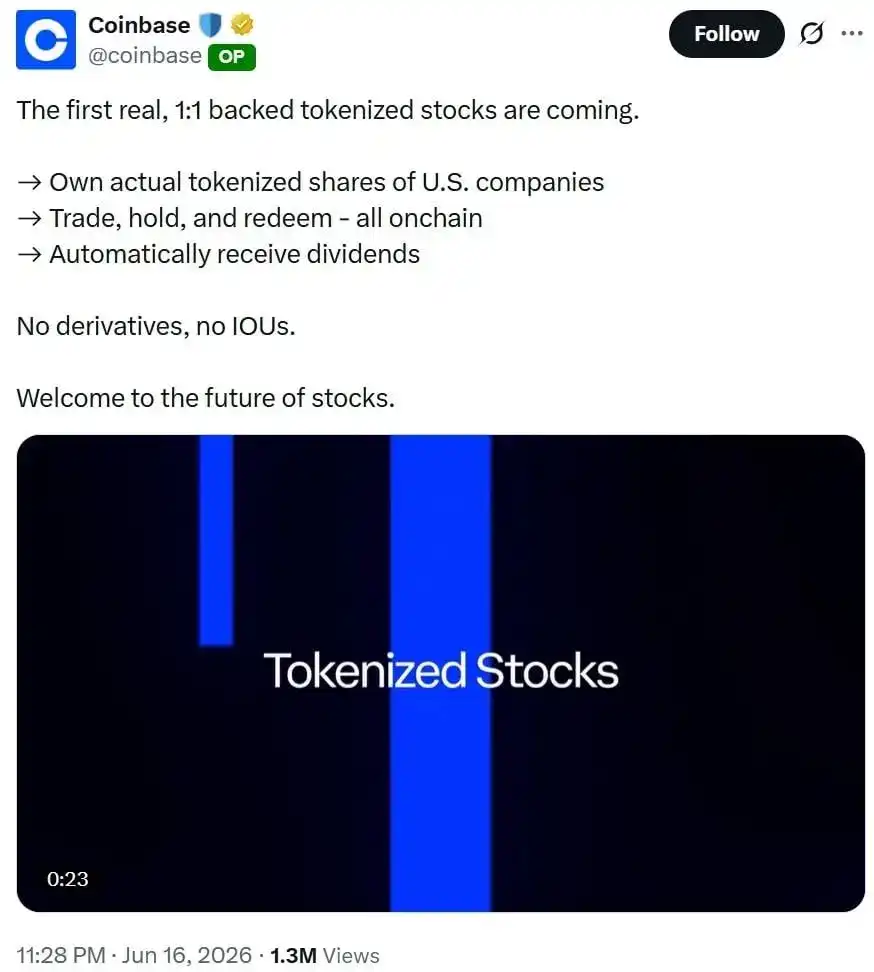
The industry is highly focused on what structure Coinbase will use to tokenize stocks. Coinbase has stated that its service will not only ensure tokens are 1:1 backed by real stocks but will also provide shareholder rights, though the specific structure hasn't been detailed. More importantly, it explicitly stated these stock tokens will be usable on-chain while not being available to U.S. customers.
If an issuer-sponsored structure is adopted, tokens typically inherit all shareholder rights and are available to U.S. customers, but on-chain usability is relatively restricted. The combination of 'broad on-chain availability + exclusion of U.S. customers' seems more aligned with a third-party structure (like Linked Securities). Which structure Coinbase ultimately uses to tokenize stocks and how it leverages its own exchange infrastructure to expand the tokenized stock ecosystem warrant continued observation.
Competing on the Same Battlefield
The goal of financial services is clear: to enable anyone, anywhere, anytime, to trade all types of assets through a single backend and frontend. Today's financial services may seem close to this goal, but in reality, integration mostly happens at the frontend, while the backend remains fragmented.
Stocks, as one of many asset classes, are no exception. From Robinhood, which started with stock trading, Coinbase, which started with crypto trading, traditional stock infrastructure providers DTCC/NYSE/Nasdaq, to Web3 native players like Securitize, Ondo, and xStocks, tokenization structures and strategic directions vary, yet all are moving towards the same North Star—tokenized stocks.
The key points to watch next are how the U.S. and other jurisdictions view tokenized stocks, how regulatory frameworks are implemented, and how these changes will reshape the competitive landscape among the various players; also, whether tokenized stocks can become the next important catalyst driving the expansion of the entire RWA track, following tokenized U.S. Treasuries.
The Korean market is also worth watching: despite high retail trading activity, RWA industry development is relatively slow. How discussions around tokenized stocks unfold in Korea deserves ongoing tracking.