Banks Prepare To Spend $100 Million+ To Stop Crypto Bills, Expert Warns

bitcoinistPubblicato 2026-03-11Pubblicato ultima volta 2026-03-11

Introduzione

The fight over US crypto legislation is intensifying into a direct clash between the digital asset industry and the established banking sector. According to Dennis Porter, CEO of the Satoshi Action Fund, the banking industry is preparing a massive lobbying push, potentially exceeding $100 million, to counteract efforts to advance crypto market structure and stablecoin legislation. Porter warns that this creates a significant counterbalance to crypto lobbying groups and could lead lawmakers to withdraw support. He states that crypto industry faces political challenges, including low public trust and ethical concerns linked to Trump family involvement. Furthermore, market structure legislation is politically difficult as it covers a wide range of complex issues. The banking industry holds an advantage due to its entrenched local influence, including physical branches and jobs in lawmakers' districts. Porter cautions that if the dispute escalates into an open lobbying war, it could jeopardize the already tight Senate vote. He also notes that the legislative window is narrowing as midterm elections approach, with electoral incentives increasingly shaping the calendar.

The fight over US crypto legislation is turning into a direct clash between digital-asset firms and one of Washington’s oldest power centers. In an interview with Pete Rizzo, Satoshi Action Fund founder and CEO Dennis Porter said the banking industry is preparing a nine-figure lobbying push that could complicate efforts to advance both market structure legislation and stablecoin rules.

Crypto’s D.C. Outlook Just Got Darker

Porter said the core dispute is no longer just about whether Congress wants to regulate crypto, but on whose terms. President Donald Trump has publicly backed keeping the GENIUS Act intact, Porter noted, which he described as a positive sign for crypto firms. But he argued that support from the White House does not resolve the deeper standoff with banks, especially around stablecoins and the issue of rewards programs that banks view as a threat to deposits.

“The bank lobby has come out and said that they do plan to spend to counteract the crypto industry,” Porter said. “They said they’re raising nine figures, which is right up there with the Fairshake number. So that does create that counterbalance where they can essentially assert themselves into the ecosystem and start to peel some of these lawmakers off.”

That matters because, in Porter’s telling, crypto is entering the fight without a clean political backdrop. He said Democrats have grown more cautious around digital-asset legislation as Trump family involvement in the sector has raised ethics concerns among both lawmakers and voters.

At the same time, he described market structure as a far more expansive and politically difficult package than stablecoin legislation, since it touches not only securities-versus-commodities questions but also DeFi, illicit finance, ethics provisions and the makeup of the CFTC.

Porter argued that this leaves the legislation exposed to a wider set of objections and delays. He said there is still a path forward if key Democrats become comfortable with revisions, but added that the bill currently lacks a decisive forcing mechanism and has been pushed aside while lawmakers focus on a housing package.

The bank-crypto standoff, he suggested, could become especially dangerous if it turns into an open lobbying war. “If we end up in a situation where they’re directly lobbying against each other, you could see a lot of not just Democrats peel off this bill, but even possibly Republicans peel off this bill as well,” Porter said. “The vote is already tight in the Senate, very tight.”

His reasoning was straightforward: banks bring not just money, but entrenched local influence. Unlike much of crypto, Porter said, banks can point to branches, jobs and long-standing relationships in lawmakers’ districts. That advantage becomes even more important at a time when, by his own account, the industry is struggling politically.

“And also, crypto really is not popular right now,” Porter said. “Public trust in the crypto space is at an all-time low. Something that we’re deeply concerned about at Satoshi Action. Something that definitely needs some work.”

Porter framed that weakness as both a political problem and a policy argument. In his view, one purpose of market structure legislation is precisely to clean out the “crap” and scams that have damaged the sector’s reputation. But until lawmakers see a clearer consumer and political upside, he suggested, crypto firms may have trouble overcoming resistance from incumbents that view stablecoins as an existential threat to their business model.

He was notably cautious on timing. While some analysts have argued the window effectively closes by summer, Porter said the odds decline as the midterms approach but do not disappear entirely. His broader point was that the legislative calendar is being shaped as much by electoral incentives as by the text of the bills themselves.

At press time, the total crypto market cap stood at $2.34 trillion.
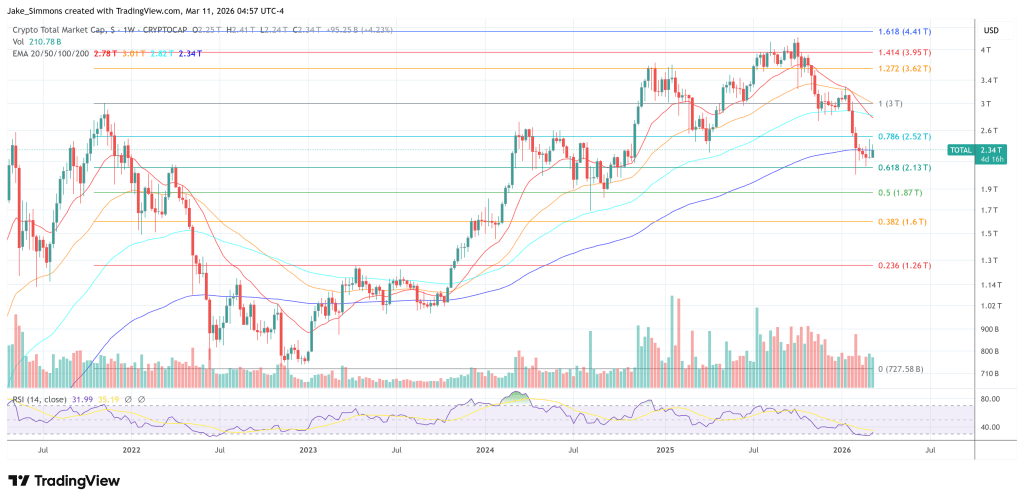
Total crypto market cap, 1-week chart | Source: TOTAL on TradingView.com

Domande pertinenti

QAccording to Dennis Porter, how much money is the banking industry preparing to spend to counteract crypto legislation efforts?

AThe banking industry is preparing to spend a nine-figure sum, which is over $100 million, to lobby against crypto bills.

QWhat are the two main types of US crypto legislation mentioned that are being complicated by this banking push?

AThe two main types of US crypto legislation mentioned are market structure legislation and stablecoin rules.

QWhat reason does Porter give for why banks have a significant advantage in a lobbying war against crypto?

APorter states that banks have an advantage because they bring not just money, but entrenched local influence, including physical branches, jobs, and long-standing relationships in lawmakers' districts.

QWhat does Dennis Porter cite as a major political weakness for the crypto industry in this fight?

AHe cites that 'crypto is not popular right now' and that 'public trust in the crypto space is at an all-time low.'

QBeyond the bank opposition, what other reason is given for why the market structure bill is politically difficult to pass?

AThe market structure bill is described as politically difficult because it is a far more expansive package that touches on securities-vs-commodities questions, DeFi, illicit finance, ethics provisions, and the makeup of the CFTC, leaving it exposed to a wider set of objections.

Letture associate

STAR 50 Soars 10.73%, Why Did A-Shares Stage a "V-Shaped Reversal"?

After a prolonged decline, the Chinese A-share market staged a strong rally on July 21. The STAR 50 index surged 10.73%, its largest single-day gain in nearly a year, leading a broad-based "V-shaped" reversal. The Shanghai Composite Index rose 1.79%, the Shenzhen Component Index gained 4.81%, and the ChiNext Index jumped 7.05%. Total market turnover reached 2.97 trillion yuan, an increase of 256.1 billion yuan from the previous session, with over 3,100 stocks advancing. The semiconductor sector spearheaded the rebound, with related ETFs posting significant gains. Analysts attribute the surge to three converging factors. First, coordinated capital inflows from "national team" institutions, insurance funds, listed company buybacks, and fund house self-purchases have bolstered market liquidity and confidence. Second, supportive policy signals, including commitments from regulators to ensure stable market operations, provided a favorable backdrop. Third, a stabilization and recovery in overseas markets, notably South Korea, created a positive external environment. Institutions suggest the most severe panic selling phase for the tech sector has likely passed, following a significant digestion of crowded positions and leveraged funds. While short-term volatility may persist, the medium to long-term outlook remains underpinned by enduring trends like AI computing demand expansion and semiconductor localization. The market's focus now shifts to the sustainability of supportive fund flows, earnings reports, and upcoming catalysts from the global AI industry chain.

marsbit11 min fa

STAR 50 Soars 10.73%, Why Did A-Shares Stage a "V-Shaped Reversal"?

marsbit11 min fa

U.S. Tech Momentum Stocks Post Largest Single-Day Gain Ever, But Is the Plunge Over?

US tech momentum stocks staged a sharp rebound on Tuesday (July 21st). Morgan Stanley's TMT Momentum Factor surged over 12%, marking its largest single-day gain on record, exceeding even peaks from the 2000 dot-com bubble. Key momentum indices from Goldman Sachs also posted their strongest daily performances in years. The rally was led by semiconductors, with the Philadelphia Semiconductor Index jumping 4.6%. This rebound followed three consecutive down days and a cumulative 33% plunge in momentum stocks, one of the steepest drawdowns since the dot-com era. Analysts attribute the surge largely to a short squeeze. Heavy selling had pushed high-beta momentum stocks into deeply oversold territory, forcing many short sellers, particularly in Asia, to cover their positions, creating a self-reinforcing buying spiral. However, the rebound's internals appear weak. Trading volume was notably low, and advancing stocks still lagged decliners on the S&P 500, indicating a narrow, concentrated rally rather than broad market participation. Diverging views emerge on the outlook. BTIG warns the bounce has hit key resistance and recommends selling into strength, citing extreme volatility and historical parallels to past market tops. Conversely, Goldman Sachs and UBS believe the momentum unwind is nearing its end, suggesting it may be time to gradually add exposure, as positioning has been significantly reduced. They caution, however, that high volatility warrants a measured approach, potentially using defined-risk strategies. The upcoming earnings season, particularly reports from major tech firms like Alphabet, is seen as a critical test for the rally's sustainability. Simultaneously, bond markets flashed a warning, with yields rising partly due to spiking oil prices. Analysts note that if long-term Treasury yields break decisively higher, it could pose a significant headwind for equities, especially growth stocks.

marsbit18 min fa

U.S. Tech Momentum Stocks Post Largest Single-Day Gain Ever, But Is the Plunge Over?

marsbit18 min fa

U.S. Tech Momentum Stocks Record Largest Single-Day Gain Ever, but Has the Rout Ended?

U.S. tech momentum stocks staged a dramatic rebound on Tuesday, July 21st. Key momentum indices like the Morgan Stanley TMT Momentum Factor and Goldman Sachs' High Beta Momentum Long Index posted historic or near-historic single-day gains, fueled largely by semiconductor stocks. This sharp rally followed a severe three-day sell-off that saw momentum stocks plunge 33%, marking one of the steepest pullbacks since the dot-com bubble. Analysts attribute the bounce primarily to a short squeeze, as forced covering from over-leveraged traders, particularly in Asia, created a buying spiral. However, the rally's health is questioned due to weak market breadth—overall trading volume was low, and decliners outnumbered advancers in the S&P 500 despite the index's gain—suggesting a narrow, concentrated surge rather than broad recovery. Opinions on the sustainability diverge. BTIG strategists warn the rebound has hit key resistance levels, citing extreme volatility and historic stock dispersion as signs of an ongoing broader correction, and recommend selling into strength. Conversely, Goldman Sachs and UBS view the aggressive momentum unwinding as nearing its end, noting reduced positioning and a lack of new fundamental catalysts. They suggest the sell-off presents a selective opportunity to add exposure, albeit cautiously and gradually using defined-risk strategies. The immediate trajectory hinges on the ongoing earnings season, with market focus on Alphabet's capital expenditure guidance for AI investment clarity. Meanwhile, bond markets present a risk, with rising Treasury yields—potentially heading toward 5.5%—and widening credit spreads for mega-cap tech companies posing a threat to equity valuations. The combination of technical factors, earnings results, and macro conditions leaves the durability of the rebound in doubt.

链捕手21 min fa

U.S. Tech Momentum Stocks Record Largest Single-Day Gain Ever, but Has the Rout Ended?

链捕手21 min fa

Long-Divided Must Unite, Long-United Must Divide: When L1 Becomes Its Own Rollup, What Is Ethereum's Endgame?

"The Inevitable Cycle: When L1 Becomes Its Own Rollup – What is Ethereum's Endgame?" For years, the Ethereum community grappled with concerns that L2s were fragmenting the ecosystem and eroding L1's value. While L2s provided cheaper execution, they also splintered liquidity and the unified user experience of a single chain. This has prompted a fundamental reassessment of the relationship between L1 and L2. Ethereum's roadmap is evolving. The "Scale" initiative merges L1 and L2 expansion into a holistic framework. L1 itself is advancing with higher gas limits, statelessness, and zkEVM verification, no longer content to be just a low-throughput settlement layer. Consequently, the primary value proposition of L2s is shifting from merely providing cheap blockspace to offering L1 cannot easily provide: application-specific optimizations, privacy features, and flexible governance models. L2s are becoming a spectrum of execution environments with varying degrees of security inheritance from Ethereum. A critical challenge in this multi-chain future is interoperability. The vision is to make Ethereum "feel like one chain again." This relies on advancements in native account abstraction (like EIP-7702) and intent-based architectures (Open Intents Framework), where users declare desired outcomes, and solvers handle the complex cross-chain execution. Furthermore, shortening Ethereum's finality time from minutes to seconds is crucial, as it underpins trust between chains for bridges, stablecoins, and cross-chain applications. Perhaps the most provocative idea is that Ethereum L1 itself could become a form of "its own Rollup." As zkEVM and proof systems mature, high-performance nodes could execute transactions and generate validity proofs. Regular validators would then verify these proofs instead of re-executing all transactions. This blurs the traditional L1/L2 hierarchy, making "Rollup" more of a general execution-verification architecture. Native Rollup aims to integrate L2 validation more directly into the Ethereum protocol, allowing L2s to inherit L1's security more fully and move away from reliance on security councils. In the end, L2s are not destined to replace L1 or be made obsolete by it. The likely future is a unified system where diverse execution environments—each optimized for specific use cases like DeFi, gaming, or privacy—coexist. They will share a common foundation of security, liquidity, and verifiable state, seamlessly connected to restore a cohesive user experience. The next phase for Ethereum is not just about scaling through separation, but about intelligently reintegrating what was separated back into a coherent whole.

链捕手37 min fa

Long-Divided Must Unite, Long-United Must Divide: When L1 Becomes Its Own Rollup, What Is Ethereum's Endgame?

链捕手37 min fa

Trading

Spot
活动图片





