'ASIC Giant' Marvell Sets Record Quarterly Revenue, Raises Guidance Again, CEO Says Data Center Business Is 'On Fire'

marsbitPubblicato 2026-05-28Pubblicato ultima volta 2026-05-28

Introduzione

Marvell Technology, a leading player in custom AI chips and data center connectivity, reported record revenue for its fiscal Q1 2027, driven by explosive demand in its data center business. Revenue reached $2.418 billion, slightly surpassing expectations, though GAAP net income fell year-over-year due to acquisition-related costs. Crucially, data center revenue hit $1.83 billion, making up 76% of the total and growing 27% YoY. The company significantly raised its full-year and next-year guidance, citing "exceptionally strong AI-related orders." Revenue is now projected at ~$11.5 billion for FY2027 and ~$16.5 billion for FY2028. CEO Matt Murphy emphasized that growth in the data center segment is accelerating. The AI Interconnect business, now expected to grow over 70% annually, saw its forecast lifted again due to rising network demands in complex AI models. Additionally, Marvell's custom chip (XPU) business is on a steep growth path, with FY2028 revenue anticipated to double and a target of over $10 billion by FY2029. The company also expanded its strategic collaboration with NVIDIA, focusing on silicon photonics, system integration, and AI-RAN solutions. To secure supply for surging demand, Marvell plans about $1 billion in supplier prepayments this fiscal year, highlighting its long-term capacity planning. Despite the strong results, the stock dipped slightly in after-hours trading.

Marvell delivered a seemingly brilliant report card with record revenue and a significant guidance raise.

After the U.S. market closed on May 27th, AI custom chip, optical communication, and data center interconnect leader Marvell released its Q1 FY2027 financial results and held an earnings call. The data center business continued its explosive growth, leading the company to once again significantly raise its full-year guidance. CEO Matt Murphy directly stated on the call, "Our data center business is on fire", and "orders are exceptionally strong."

Marvell's Q1 FY2027 revenue was $2.418 billion, up 28% year-over-year and 9% quarter-over-quarter, slightly exceeding analyst expectations of $2.41 billion. Non-GAAP earnings per share were $0.80, in line with analyst estimates. However, GAAP net profit was $34.5 million, a significant decline from $177.9 million in the same period last year, primarily due to one-time costs and non-cash amortization related to the acquisitions of Celestial AI and XConn.

The data center business contributed $1.83 billion in revenue, accounting for 76% of total revenue, up 27% year-over-year and 11% quarter-over-quarter.

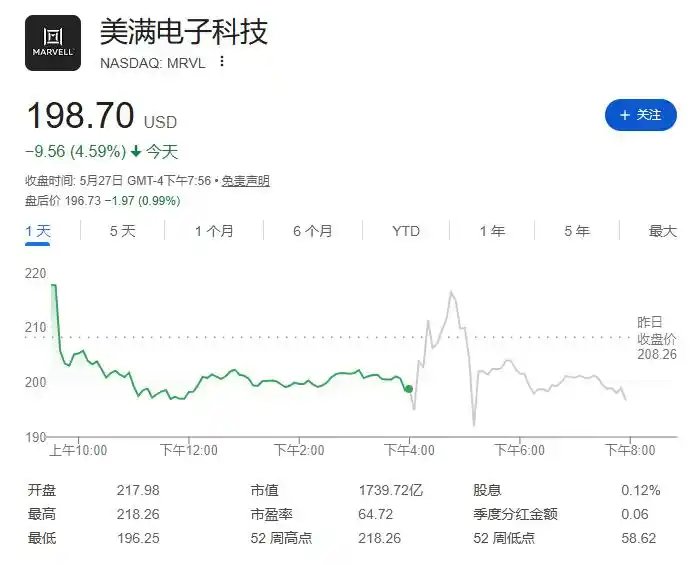
Following the earnings report and call, the company's stock price fell slightly by about 1%. Year-to-date, the stock had already more than doubled ahead of the earnings report. Against high expectations, merely "meeting expectations" may no longer be enough to impress the market.
01

"AI-Related Orders Are Exceptionally Strong," Marvell Raises Guidance Again

This marks Marvell raising its guidance for multiple consecutive quarters.

For the Q2 FY2027 guidance, the company expects revenue of approximately $2.7 billion (plus or minus 5%), representing year-over-year growth of about 35%, higher than the analyst consensus estimate of $2.6 billion. The non-GAAP EPS guidance range is $0.88 to $0.98, compared to the analyst consensus of $0.90.

For the full-year guidance, Marvell raised its FY2027 revenue expectation to approximately $11.5 billion, representing growth of about 40% year-over-year. Three months ago, the company's guidance was "approaching $11 billion."

More attention-grabbing is the outlook for FY2028. Marvell raised its FY2028 revenue target to approximately $16.5 billion, about $1.5 billion higher than the guidance provided last quarter, representing year-over-year growth of about 45%.

CEO Matt Murphy stated in the earnings release: "We are seeing exceptionally strong AI-related orders, and as a result, we are significantly raising our revenue expectations for Marvell's FY2027 and FY2028, showing substantial improvement compared to the guidance provided last quarter."

02

Data Center: Accounts for 76% of Revenue, Growth Still Accelerating

Q1 data center revenue was $1.83 billion, up 27% year-over-year and 11% quarter-over-quarter, accounting for 76% of total revenue.

Marvell's growth forecasts for this business are:

FY2026: +46% (already achieved)

FY2027: approximately +50%

FY2028: approximately +55%

Murphy stated:

The data center business is on fire, and we expect growth rates to accelerate this year and next, starting from an already high base.

03

Interconnect Business: Growth Rate from 30%→50%→70%, CEO Says "There's Room for Upside"

The AI Data Center Interconnect business is the largest segment within Marvell's data center portfolio, covering optical interconnect, DCI modules, coherent optics, and other product lines.

The expected annual growth rate for this business has been raised consecutively over the past few quarters: around 30% around September last year, later raised to 50%, and now raised again to over 70%.

When pressed by analysts, Murphy said directly:

I think there is a lot of potential for upside here. Our traditional DSP business will see a significant jump next year, the 1.6T product line has higher value content, DCI is accelerating, along with new businesses like retimers, AEC, and scale-up optics... This is the beginning of a major growth cycle for us.

Why has the interconnect business suddenly become so important? Murphy provided a clear logic:

Early generative AI primarily addressed compute and memory bottlenecks, with network interconnect being a secondary concern. However, with the deployment of more complex architectures like inference models and Mixture of Experts (MoE) models, the volume of data transmission within AI clusters has increased dramatically, significantly elevating the importance of network interconnect.

Some key numbers:

TIA and Driver Chips: Expected to surpass an annualized revenue run rate of $1 billion in the coming quarters.

DCI Module Business: Already shipping to all five major U.S. hyperscale cloud providers. Expected to surpass an annualized revenue run rate of $1 billion in FY2028, approximately double that of FY2026 (~$500 million).

Scale-up optics (NPO/CPO Optical Interconnect): Previously expected to be around $150 million; now raised, expected to exceed $300 million in FY2028.

04

Custom Chips (XPU): Doubling Next Year, Targeting Over $10 Billion by FY2029

Marvell's custom chip (Custom/XPU) business is another important growth line and a major focus for the market.

Current Progress:

FY2027 Custom Chip Revenue: Growth exceeding 20% year-over-year.

FY2028 Custom Chip Revenue: Expected to double year-over-year, higher than last quarter's expectation.

FY2029 Target: Exceed $10 billion (previous target was approximately $8 billion).

Analyst Vivek Arya (Bank of America Securities) pressed during the call: Does this mean FY2028 custom chip revenue will be over $4 billion, then jump to $10 billion in FY2029, implying a single-year incremental revenue of $5-6 billion?

Murphy's response was: Yes, you heard that correctly.

Three drivers for FY2028 custom chip growth:

Continued growth from existing flagship XPU projects.

More than ten XPU satellite projects (NIC, CXL, etc.) entering higher-volume production stages, with demand consistently exceeding expectations.

A new leading XPU project entering production — Murphy stated, "The project is progressing smoothly, and the full-year production plan is in place."

Murphy also revealed that while newly won design projects typically require about a two-year development cycle before contributing revenue, the significance of these projects lies in providing security for longer-term growth, which he referred to as "insurance policies."

05

Expanding Collaboration with NVIDIA, Three Key Directions Materializing

This quarter, Marvell announced an expanded strategic collaboration with NVIDIA. Murphy detailed three core directions on the call:

1. Optical Interconnect Collaboration: Marvell has long provided DSP, TIA, and drivers to NVIDIA. The two companies are now further collaborating on developing silicon photonics technology, considered a key enabling technology for scale-up networks.

2. NVLink Fusion Integration: Allows Marvell to build custom chips and network semiconductors that seamlessly interface with NVIDIA's infrastructure. Murphy stated this provides hyperscale cloud providers with greater flexibility to freely mix and match between custom chips and NVIDIA chips. "Marvell uniquely provides the bridge between these two architectures," creating new market opportunities for both companies.

3. AI-RAN: Marvell will enhance its Octeon base station processors to enable them to work directly in tandem with NVIDIA GPUs, running both 5G/6G wireless workloads and AI applications on the same hardware platform.

06

Supply Chain: Locking in Capacity Early, ~$1 Billion in Prepayments Planned This Year

Facing continuously climbing demand, supply chain management has become a critical variable.

CFO Willem Meintjes revealed on the call that the company plans to make approximately $1 billion in supplier prepayments during FY2027, with the first payments starting in Q2. These prepayments will be credited against future material purchases.

COO Chris Koopmans explained Marvell's supply chain strategy in response to analyst questions:

Everything related to AI has been supply-constrained from day one. Our approach is to build extremely close relationships with a small number of core suppliers, provide them with five-year demand forecasts, deliver on our promises every time, and back up our forecasts with action and prepayments.

Financially, Q1 operating cash flow reached a record $639 million. The company repurchased $200 million worth of stock in the quarter and paid $54 million in dividends. As of the end of Q1, total debt stood at $4.96 billion, with net debt/EBITDA at 0.32x.

This article is from the WeChat public account "Wall Street Insights Max," author: Long Yue

Domande pertinenti

QWhat was the key factor behind Marvell's significant increase in its revenue guidance for fiscal years 2027 and 2028?

AThe key factor was exceptionally strong AI-related orders, which led the company to significantly raise its revenue outlook compared to the guidance provided the previous quarter.

QWhat percentage of Marvell's total Q1 revenue came from its Data Center segment, and what was its growth rate?

AMarvell's Data Center segment contributed 76% of its total Q1 revenue, with a year-over-year growth of 27% and a sequential growth of 11%.

QHow did Marvell describe the growth trajectory for its AI Data Center Interconnect (Interconnect) business?

AMarvell described the growth trajectory as accelerating significantly, with the annual growth rate expectation being raised from around 30% to 50%, and now to over 70%. The CEO indicated there is substantial upside potential remaining.

QWhat is Marvell's stated revenue target for its Custom Chip (XPU) business by fiscal year 2029, and what major driver was mentioned for growth in fiscal year 2028?

AMarvell's stated revenue target for its Custom Chip (XPU) business by fiscal year 2029 is over $10 billion. A major driver for growth in fiscal year 2028 is the expected doubling of its custom chip revenue, aided by a new major XPU project entering production.

QWhat are the three core areas of Marvell's expanded strategic collaboration with NVIDIA, as detailed in the earnings call?

AThe three core areas are: 1) Collaboration on optical interconnect and silicon photonics technology. 2) NVLink Fusion Integration, allowing Marvell to build custom chips and networking semiconductors that interface seamlessly with NVIDIA infrastructure. 3) AI-RAN, enhancing Marvell's Octeon base station processors to work directly with NVIDIA GPUs for simultaneous 5G/6G and AI workloads.

Letture associate

Buyback and Burn: Just Empty Promises? The Unbridgeable Rights Gap Between Tokens and Equity

"Token Repurchase and Burn: An Empty Promise? The Unbridgeable Rights Gap Between Tokens and Equity" Holding company stock grants shareholders residual claim rights - a legally enforceable entitlement to remaining assets after all other obligations are paid. This comes with rights like voting, dividends, and a share in sale proceeds. Crypto protocols have long promised token holders similar benefits: governance participation and a share of future growth. However, this narrative is fundamentally flawed and built on voluntary promises, not enforceable legal rights. The core difference is that token holders lack any legally enforceable claim to a protocol's underlying value or revenues. Common mechanisms like using protocol revenue to buy back and burn tokens are purely discretionary; the team can alter or stop the policy at any time. Token holders have no legal recourse. This rights gap becomes critically apparent when protocols introduce traditional equity alongside tokens, as seen with Venice AI's $65M funding round. Equity investors hold legal contracts with rights to company assets and profits, while token holders' benefits depend entirely on the continued goodwill of the protocol's management. The acquisition of Houdini Swap, where equity holders were paid while token holders received nothing, starkly illustrates this disparity. Upcoming legislation like the CLARITY Act threatens to eliminate the regulatory gray area that has allowed this ambiguous "pseudo-equity" narrative. The Act would classify tokens as either digital commodities (regulated by CFTC) or investment contract assets/securities (regulated by SEC). Protocols aiming for the "digital commodity" classification would be explicitly prohibited from granting token holders any legal claim to corporate revenue, profits, or assets. Promising that tokens will appreciate from protocol profits would likely classify them as securities. Projects like Aave are attempting technical solutions, such as its automated, on-chain "Aavenomics 3.0" buyback mechanism. However, this remains code that the governance body could still vote to change, not an immutable legal contract. The industry faces a clear fork: either acknowledge tokens as digital commodities and stop promising economic rights tied to corporate profits, or formally register tokens as securities and bear the associated compliance burden. The decade-long narrative equating tokens with ownership is built on unenforceable promises. The entry of traditional equity investors with real legal rights exposes this foundational weakness, which may unravel with the next major funding deal.

Foresight News37 min fa

Buyback and Burn: Just Empty Promises? The Unbridgeable Rights Gap Between Tokens and Equity

Foresight News37 min fa

Navigating the World of Event Trading: Top 5 Prediction Markets for Every Type of User

The prediction market industry has grown significantly, with trading volumes exceeding $20 billion monthly by mid-2026, driven by sports, politics, and macroeconomics. Success now depends heavily on platform choice and execution logistics. This guide compares five leading networks: **Polymarket**: A high-volume, decentralized platform on Polygon, using USDC for international and crypto-native users. It offers diverse markets but lacks built-in risk tools. **Kalshi**: A CFTC-regulated U.S. exchange for institutional traders, using direct fiat. It leads in regulated volume, especially for major sports and economic events, but has limited contract listings. **Outpoll**: A CeDeFi platform for advanced traders, focusing on professional tools. It uniquely features built-in stop-loss/take-profit orders, 0.1% fees, and full API support, with settlement in USDC. **OG Predictive**: A CFTC-regulated, sports-focused platform from Crypto.com. It offers granular player props and a flat fee structure, appealing to long-term position traders. **Manifold Markets**: A play-money, no-KYC platform for casual users and developers. It allows user-generated markets on any topic with zero fees, serving as a sandbox for strategy testing. Key differentiators include regulatory models (regulated vs. decentralized), funding (fiat vs. crypto), order types, risk management features, API access, and mobile support. The conclusion emphasizes that in today's event trading, profitability hinges not just on accurate predictions but on optimizing execution through platform infrastructure, liquidity, fees, and risk tools.

TheNewsCrypto1 h fa

Navigating the World of Event Trading: Top 5 Prediction Markets for Every Type of User

TheNewsCrypto1 h fa

Why Are Large-Scale Crypto Conferences No Longer Glamorous?

Why Are Major Crypto Conferences Losing Their Allure? A growing sense of fatigue surrounds large in-person crypto conferences, with many founders and investors now avoiding events they would never have missed just two years ago. While complaints cite declining ROI and information quality, the root causes are more structural. Crypto, global from inception, once relied on these mega-conferences as neutral hubs for essential face-to-face connections. However, their core value has been fragmented. High-quality participants—developers, investors—have largely migrated to smaller, private side-events, leaving main stages for repetitive content already shared online. The main conference often just becomes the excuse for being in the same city, with attendees scrambling between exclusive dinners and micro-events. While these intimate gatherings offer signal-rich conversations, they lose the "serendipitous encounters" of large conferences and can create insular echo chambers, especially as talent concentrates in hubs like New York. Meanwhile, invite-only, high-caliber summits are rising, offering quality and scale but at the cost of accessibility and crypto's early egalitarian ethos. This shift isn't unique to crypto; AI events in San Francisco show a similar trend. The perception of higher-value interactions drives core groups towards smaller, private settings, potentially creating a vicious cycle that drains larger events of their vitality. Yet, a more optimistic view exists. The apparent decline of crypto-centric events may signal industry maturation. Leading projects are now focused outward—on stablecoins for traditional finance, consumer-facing digital banks, or real-world assets. Crypto topics are increasingly integrated into mainstream finance and tech conferences. Just as dedicated "internet conferences" faded, dedicated crypto summits may become redundant as the technology embeds into every sector. The future likely holds far fewer large, inward-looking crypto conferences. The industry has moved past needing frequent self-congratulatory gatherings. True growth lies in engaging with the broader economy. This evolution towards private networking and mainstream integration, for better or worse, is a mark of the industry coming of age.

marsbit1 h fa

Why Are Large-Scale Crypto Conferences No Longer Glamorous?

marsbit1 h fa

Coin & Stock Compass: Global Listed Companies Net Sold $85.45 Million in BTC Last Week, Strategy's Dollar Reserves Scale Up to $3 Billion (July 14)

Global Public Companies Net Sell $85.45 Million in BTC; Strategy's Dollar Reserves Hit $3 Billion (July 14) Last week saw a significant net sell-off of Bitcoin by global public companies, excluding miners, totaling $85.45 million—a 908.42% decrease from the prior week. Major buyers like Strategy (formerly MicroStrategy) and Japan's Metaplanet were notably absent from the market. However, two companies, Brazil's OrangeBTC and asset manager Strive, made purchases, adding 8 and 18 BTC, respectively. The aggregate BTC holdings of tracked public companies now stand at 1,139,635 BTC, valued at approximately $71.38 billion and representing 5.7% of Bitcoin's circulating market cap. In corporate updates, Strategy announced its dollar reserves have grown by $450 million to reach $3 billion, while its BTC holdings remain at 843,775 coins. Hyperscale Data increased its BTC reserves past 1,000 coins. Strategy will report its Q2 2026 financial results on July 30. Mining firm Cleanspark added 454 BTC, bringing its total to 13,924 BTC. Conversely, BitFuFu sold 184 BTC, Bitdeer maintained zero net BTC holdings after selling its weekly production, and Empery Digital sold 1,400 BTC to fund an AI data center project and repay debt. Overall, public companies purchased 110,000 BTC in Q2 2026, 1.8 times the volume of the previous two quarters combined. In other cryptocurrency-related corporate news, Ethereum treasury company Bitmine increased its ETH holdings by 27,801 coins, with total staked ETH exceeding 4.9 million. Solana-focused company DFDV transferred daily operations of its meme coin DONT to an independent team. BNB treasury company BNB Plus was delisted from Nasdaq for failing to meet the $1 minimum bid price and moved to trade on the OTCQB market under the symbol BNBX. The broader equity markets showed mixed signals. Bank of America warned that bullish investor positioning indicated a potential pullback risk for stocks. In contrast, Morgan Stanley predicted the ongoing earnings season could broaden market gains beyond tech giants. Specific regional highlights included continued foreign investor outflows from South Korean stocks, pressure on US equities, and the upcoming IPO of Chinese memory chip maker ChangXin Memory. Most crypto-linked stocks remained in a downtrend.

marsbit1 h fa

Coin & Stock Compass: Global Listed Companies Net Sold $85.45 Million in BTC Last Week, Strategy's Dollar Reserves Scale Up to $3 Billion (July 14)

marsbit1 h fa

Trading

Spot
活动图片