The landscape of foreign trade cities in 2026 has changed once again.
In the first seven months, the national total import and export value continued to surge significantly, with the power of imports rising strongly, leading to a drastic reshuffle in the rankings of various cities.
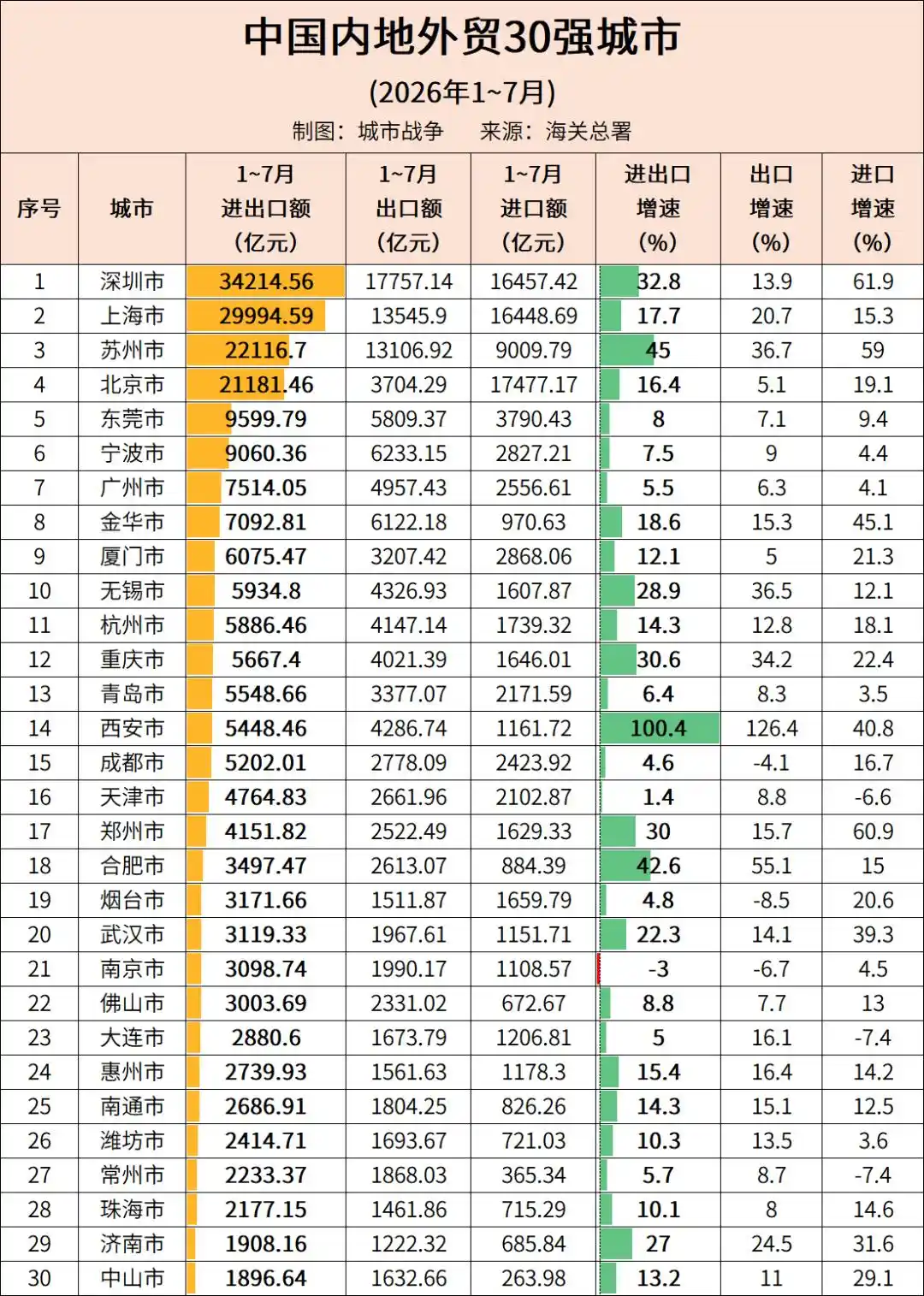
Key points first: Shenzhen widens its gap with Shanghai, firmly securing its position as China's top foreign trade city. An important signal is that Shenzhen's import value has surpassed Shanghai's for the first time. Suzhou overtakes Beijing, rising to become the third-largest foreign trade city. Wuxi breaks into the top ten in foreign trade, while Qingdao exits the top ten positions. Xi'an emerges as the biggest dark horse, with its foreign trade soaring by 100.4% in the first seven months of this year.
Recently, the General Administration of Customs released foreign trade data for the first seven months of this year, revealing a noteworthy change: imports are rising even more sharply than exports.
In the first seven months of this year, China's total goods import and export value reached 30.13 trillion yuan, a year-on-year increase of 17.3%. Exports amounted to 17.44 trillion yuan, growing by 14%, while imports reached 12.69 trillion yuan, surging by 22%. In the same period last year, imports had actually decreased by 1.6%.
One rising and the other falling, the growth rate of imports has clearly exceeded that of exports, becoming the main force driving foreign trade growth.
What does this indicate? Demand in the domestic market is genuinely recovering. People are buying more goods, factories are procuring more raw materials and components, and overall economic demand is on the rise.
Furthermore, many of the imported goods are intermediate products—such as chips, steel, and chemical raw materials—which are processed and assembled domestically before being exported abroad. This creates a cycle between imports and exports: stronger imports provide more momentum for exports as well.
The changes in the national picture are reflected in significant shifts in the rankings of individual cities.
Shenzhen continues to firmly hold its position as the "top foreign trade city," and its lead over Shanghai is widening. In the first seven months of this year, Shenzhen's total import and export value reached 3.42 trillion yuan, a year-on-year increase of 32.8%, exceeding Shanghai's total by 422 billion yuan. It's worth noting that for the whole of 2025, Shenzhen was only ahead of Shanghai by 43.05 billion yuan. In just one year, the gap has multiplied.
This recent surge in Shenzhen's foreign trade is primarily driven by imports. In the first seven months, Shenzhen's import value reached 1.65 trillion yuan, skyrocketing by 61.9% year-on-year. This also marks the first time in history that Shenzhen's import scale has surpassed Shanghai's—Shenzhen imported 1,645.7 billion yuan, while Shanghai imported 1,644.9 billion yuan. The difference is small, but the significance is substantial.
The change is even more evident compared to last year: in the same period of 2025, Shenzhen's import value was only 1.02 trillion yuan, with a growth rate of just 9.4%. In one year, the import scale has virtually leaped to a new level. Following the surge in imports, the structure of Shenzhen's imports and exports has undergone a fundamental change: in the past, exports were significantly larger than imports, but now their scales are almost equivalent.
It's worth mentioning that the foreign trade structures of Beijing and Shanghai differ from most cities, with imports exceeding exports in both. Imports account for 55% of Shanghai's total foreign trade, while Beijing is even more extreme, with imports making up 82.5% of its total.
The reason isn't hard to understand: these two cities are centers for headquarters economies and bulk commodity trading. A large portion of their imports serves the national market, hence their exceptionally large import volumes.
Compared to 2025, what changes have occurred among this year's top 30 foreign trade cities?
First, let's look at the cities rising the fastest. Suzhou has surpassed Beijing for the first time, rising from fourth to third nationally, becoming a top-tier TO3 city. Wuxi climbed from 14th to 10th place, entering the national top ten; Chongqing rose from 15th to 12th; Xi'an leaped five positions, jumping from 19th to 14th.
Additionally, Hefei moved from 21st to 18th, Wuhan from 22nd to 20th, Huizhou from 25th to 24th, and Jinan from 30th to 29th. Zhongshan rose from 32nd to 30th, successfully breaking into the national top 30 for foreign trade.
Which cities saw their rankings decline? Qingdao dropped from 10th to 13th, falling out of the top ten; Chengdu fell from 12th to 15th, and Tianjin dropped from 13th to 16th. Nanjing experienced a larger decline, falling from 17th to 21st, while Foshan dropped from 20th to 22nd.
Overall, the biggest change in this year's foreign trade city landscape is the collective surge of a group of manufacturing and export-oriented cities.
A distinct characteristic of this year's foreign trade is: whoever has a strong chip and AI hardware industry is surging rapidly. The three cities with the most explosive growth rates—Xi'an, Suzhou, Hefei, Shenzhen—with increases of 100.4%, 45%, 42.6%, and 32.8% respectively, all have powerful chip foundations behind them.
Xi'an is the biggest dark horse, with its imports and exports soaring by 100.4% in the first seven months. Samsung's factory in Xi'an is the world's largest NAND flash memory production base, accounting for 40% of Samsung's total production capacity. Micron also has a presence here, and local chip companies are also making efforts. In the first seven months, Xi'an's exports of mechanical and electrical products grew by 143.8%, accounting for over 95% of its total exports.
Suzhou relies on its electronic information and AI computing hardware sectors. Its single-month foreign trade growth rate in July reached 67.8%. The import and export value of the Suzhou Industrial Park in the first seven months has already exceeded that of the entire previous year, with AI computing hardware products accounting for over half of its exports.
Hefei boasts Changxin Technology, with its memory chip industry providing strong support for foreign trade.
Shenzhen needs no introduction; it is itself a major electronics manufacturing hub, with very active imports and exports of AI servers and consumer electronics. Wuxi, as a major hub for integrated circuits with a complete semiconductor industry chain, also saw its ranking rise significantly due to this.
However, not all cities have kept up with the pace. Among the top 30 foreign trade cities, 19 had growth rates below the national average of 17.3%.
This article is from the WeChat public account "City Wars," author: Ting Hai Moyu