Arizona AG Alerts Seniors on ATM Scams: How LiquidChain ($LIQUID) Solves Security

bitcoinistPubblicato 2026-02-03Pubblicato ultima volta 2026-02-03

Introduzione

Arizona Attorney General Kris Mayes has issued a warning about a rise in cryptocurrency ATM scams targeting seniors, where fraudsters pose as officials and trick victims into depositing cash into Bitcoin kiosks. These scams exploit the irreversible nature of blockchain transactions and the complexity of current crypto infrastructure. LiquidChain ($LIQUID) is presented as a solution through its Layer 3 protocol, which unifies liquidity across Bitcoin, Ethereum, and Solana into a single execution environment. By eliminating the need for complex bridging and wrapped assets, it reduces transaction steps and potential points of failure. The platform aims to enhance security and usability, offering simplified cross-chain interactions and verifiable settlement. Its architecture is designed to lower fraud risks by streamlining user experience and providing a more transparent, secure DeFi environment.

The warnings from Arizona are becoming increasingly urgent.

Attorney General Kris Mayes issued a stark alert regarding a surge in cryptocurrency ATM scams targeting older adults, a predatory trend that exploits the irreversible nature of blockchain transactions.

According to the AG’s Office, scammers are posing as government officials or tech support agents. They then direct victims to deposit cash into physical Bitcoin kiosks under the guise of ‘protecting’ their savings.

It exposes a critical vulnerability in the current crypto on-ramp infrastructure: the lack of safety guardrails for non-technical users. Once cash is fed into a kiosk and converted to crypto in a scammer’s wallet, the funds are effectively gone.

The technological barrier to entry, combined with high-pressure social engineering, creates a perfect storm for fraud. While state regulators launch reporting tools and public awareness campaigns, the deeper issue lies in the complexity of the current blockchain landscape.

When users are forced to navigate confusing interfaces and fragmented networks, security risks compound. The solution might not just be better education, but better underlying infrastructure that simplifies execution.

That’s the precise operational gap LiquidChain ($LIQUID) aims to fill by rethinking how liquidity moves across the blockchain ecosystem.

Fragmented Liquidity Creates Vectors For Exploitation

The scams plaguing Arizona seniors often rely on the opacity of moving funds between different silos. Frankly, the current DeFi landscape is a mess. Liquidity is fragmented across Bitcoin, Ethereum, and Solana. Jumping between these chains usually requires complex bridging, wrapped assets, and multiple transaction steps.

Each step introduces friction and a potential point of failure where malicious actors can confuse users.

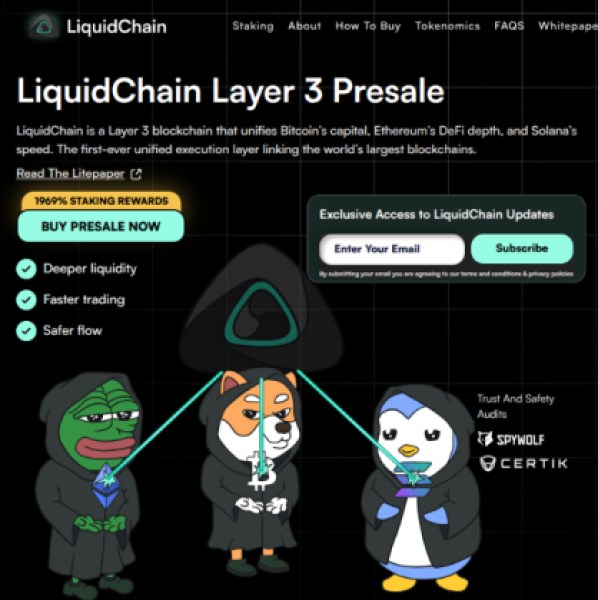
LiquidChain ($LIQUID) tackles this fundamental flaw by functioning as a Layer 3 (L3) infrastructure that fuses Bitcoin, Ethereum, and Solana liquidity into a single execution environment. By creating a Unified Liquidity Layer, the protocol eliminates the need for risky wrapped assets or convoluted bridge transfers.
Source: LiquidChain

For a user or developer, this means Single-Step Execution. The data suggests that reducing the number of ‘hops’ a transaction must take drastically lowers the surface area for errors.

The project’s ‘Deploy-Once Architecture’ allows developers to build applications accessing users and liquidity from all three major chains simultaneously. Instead of a disjointed system where funds can easily disappear into the ether of a complex bridge, LiquidChain offers a cohesive environment.

This consolidation is critical. By streamlining the user flow, the protocol removes the technical obfuscation that scammers often hide behind.

EXPLORE THE LIQUIDCHAIN ECOSYSTEM.

LiquidChain L3 Protocol Enhances Verifiable Settlement

Beyond simplification, the core security proposition of LiquidChain lies in its status as a Layer 3 protocol. Layer 1s (like Bitcoin) provide security, and Layer 2s handle scaling. But L3s? That’s where the magic happens, application-specific layers where custom logic and verifiable settlement occur.

The project utilizes a Cross-Chain VM (Virtual Machine) designed to handle the intricacies of multi-chain settlement without forcing the user to manage distinct wallets for every network.

This infrastructure is powered by the $LIQUID token, which serves as the primary transaction fuel for the network. Unlike legacy systems, where value transfer is opaque, the LiquidChain model emphasizes verifiable settlement.

For institutional participants (and savvy retail traders), this transparency is non-negotiable. The protocol also introduces Liquidity Staking, incentivizing users to secure the network while earning rewards, creating a deeper economic alignment between network security and user participation.

We’re seeing a clear shift in the market away from ‘wild west’ infrastructure toward compliant, transparent execution layers.

With Developer Grants available to encourage secure application building, the ecosystem is positioning itself as a hub for the next generation of safe, cross-chain DeFi. If you’re watching the infrastructure thesis, $LIQUID represents a bet on the convergence of major chains into a safer, more usable whole.

VISIT THE OFFICIAL LIQUIDCHAIN ($LIQUID) PRESALE SITE.

This article is for informational purposes only and does not constitute financial advice. Cryptocurrency investments, including presales and new protocols like LiquidChain, carry significant market risk and volatility. Always conduct independent research.


Domande pertinenti

QWhat is the main warning issued by Arizona Attorney General Kris Mayes regarding cryptocurrency?

AArizona Attorney General Kris Mayes issued a warning about a surge in cryptocurrency ATM scams targeting older adults, where scammers pose as government officials or tech support to trick victims into depositing cash into Bitcoin kiosks.

QHow does LiquidChain ($LIQUID) aim to address security vulnerabilities in the current crypto infrastructure?

ALiquidChain ($LIQUID) addresses security vulnerabilities by functioning as a Layer 3 infrastructure that unifies liquidity from Bitcoin, Ethereum, and Solana into a single execution environment, eliminating the need for risky wrapped assets or complex bridge transfers and reducing points of failure.

QWhat is the 'Deploy-Once Architecture' mentioned in the context of LiquidChain?

AThe 'Deploy-Once Architecture' allows developers to build applications that can access users and liquidity from Bitcoin, Ethereum, and Solana simultaneously, creating a cohesive environment instead of a fragmented system.

QWhat role does the $LIQUID token play in the LiquidChain ecosystem?

AThe $LIQUID token serves as the primary transaction fuel for the LiquidChain network, powering its cross-chain virtual machine and enabling verifiable settlement, while also supporting liquidity staking to incentivize network security.

QHow does LiquidChain's approach reduce the risk of scams like those targeting seniors in Arizona?

ALiquidChain reduces scam risks by streamlining user flow through single-step execution and a unified liquidity layer, which removes technical obfuscation and complex transaction steps that scammers often exploit to confuse users.

Letture associate

While Everyone Says NFTs Are 'Dead', the Art World is Quietly Completing an 'On-Chain Renaissance'

While many declare NFTs "dead" and dismiss them as overhyped JPEGs, a significant institutional shift is quietly underway within the art world, signaling a "on-chain renaissance." Traditional art, a ~$60B market, is stagnant, aging, and highly concentrated, facing a massive $80 trillion generational wealth transfer to digital-native heirs. Contrary to the narrative, leading institutions have been building infrastructure for digital and on-chain art. Major museums like MoMA, the Centre Pompidou, LACMA, and the Guggenheim have acquired seminal NFT works into their permanent collections. Top galleries like Pace, Gagosian, and Hauser & Wirth have launched NFT platforms or accepted crypto, with Pace giving a solo show to generative artist Tyler Hobbs. Auction houses Sotheby's and Christie's operate dedicated on-chain sales platforms. This follows a historical pattern where every major art movement—from Impressionism to Pop Art—was initially mocked before institutional acceptance. NFT art, only 7-12 years old, is progressing faster. Auction data shows resilience, with works by Beeple ($69.3M), Pak (~$91M), and Dmitri Cherniak ($6.2M in a bear market) achieving high prices. A new cohort of collectors (e.g., FlamingoDAO, PleasrDAO) and "Medici" figures like Cozomo de' Medici are accumulating foundational works. The core argument is that NFTs represent not a speculative asset class but a new ownership system for digital culture, solving provenance issues through immutable, timestamped blockchain records. The medium has survived the speculative crash and is being institutionalized. The bet isn't on short-term price rallies but on the long-term cultural significance of on-chain art as the defining medium for the next generation of collectors.

marsbit30 min fa

While Everyone Says NFTs Are 'Dead', the Art World is Quietly Completing an 'On-Chain Renaissance'

marsbit30 min fa

Jensen Huang's Message to Graduates: AI Won't Replace You, But Those Who Excel at Using AI Will

NVIDIA CEO Jensen Huang, addressing 2026 graduates at Carnegie Mellon University, emphasized that AI will not replace people, but those who leverage AI effectively will have an advantage. He delivered this message during a commencement speech where he also received an honorary doctorate, his seventh. Huang reflected on his personal journey as an immigrant, starting from humble beginnings as a dishwasher to co-founding NVIDIA. He shared early struggles, including a near-bankruptcy moment saved by honesty with Sega, highlighting resilience and learning from failure. He positioned the current era as the dawn of the AI revolution, a shift as significant as past computing waves. Huang explained that AI is redefining computing from human-written software to machine learning, creating a new industry focused on manufacturing intelligence. While acknowledging fears about job displacement, he argued that AI amplifies human capabilities rather than replaces human purpose. Tasks may be automated, but the core meaning of professions remains. Huang urged graduates to embrace this transformative time with responsibility and optimism. He stated that AI should democratize technology, bridging gaps and enabling broader participation in creation and problem-solving. His final advice was to actively engage with the opportunity: "So run, don’t walk," and to put their hearts into their work.

marsbit37 min fa

Jensen Huang's Message to Graduates: AI Won't Replace You, But Those Who Excel at Using AI Will

marsbit37 min fa

Three Scenarios for BTC's Future Direction and a Duel Between Two Strong Forces | Special Invited Analysis

**Title: Three Scenarios for BTC's Future Trajectory and a Key Duel | Invited Analysis** The market remains at a critical juncture. Over the past week, Bitcoin (BTC) consolidated broadly between $79,500 and $80,600, validating previous technical analysis. The current focus is on whether this marks the start of a new uptrend or a pause within a larger correction. **BTC Multi-Cycle Analysis & Three Possible Scenarios** BTC's daily chart structure, following its peak at $126,200 in October 2025, presents three primary technical scenarios based on Elliott Wave theory: 1. **Bullish Scenario (End of Correction):** The corrective A-B-C wave from $126,200 ended at the $60,000 low in February 2026. The current price action is the start of a major Wave I uptrend. A subsequent Wave II pullback would not break below $60,000. 2. **Bearish Scenario 1 (Complex Correction):** The correction is unfolding as an A-B-C-D-E pattern. The current move from $60,000 is a D-wave rally. After its completion, a final E-wave decline could potentially breach the $60,000 level. 3. **Bearish Scenario 2 (Larger Correction):** The entire move down from $126,200 to $60,000 was a large A-wave. The current rally is a B-wave correction within a larger A-B-C structure, to be followed by a C-wave decline below $60,000. *Analysis suggests Scenario 2 is less probable due to time disproportions between waves. The battle is effectively between the Bullish Scenario (1) and Bearish Scenario (3).* **Key BTC Levels & Weekly Strategy** On the 4-hour chart, BTC trades above a crucial consolidation zone ("Central Pivot C"). * **Key Resistance:** $83,500-$84,500; $89,000-$90,500. * **Key Support:** $78,500-$79,500 (pivot upper bound); $73,500-$75,000; $69,500-$70,500. **Weekly Outlook:** The market direction hinges on BTC's ability to hold above or break below the $78,500-$79,500 support zone. * **Mid-term Strategy:** Neutral/Wait-and-see stance due to unclear direction. * **Short-term Tactics:** Two contingency plans using 30% max capital: * **Plan A (Bullish):** Look for long entries if price holds above $78,500-$79,500 with confirming signals. Initial stop-loss below $78,500. * **Plan B (Bearish):** Consider short positions if price breaks below $73,500-$75,000 with confirming signals. Initial stop-loss above $76,500. **HYPE Analysis & Strategy** HYPE's daily chart shows a seven-segment structure from its January low of $20.46, forming a "rising pivot" zone. * **Key Level to Watch:** $45.76 (previous high). A break above would confirm the bullish structure remains intact. * **Short-term Strategy:** Focus on pivot zone boundaries ($38.41 upper, $34.44 lower). * **Long:** Consider on support near $38.41 with bullish confirmation signals. * **Short:** Consider on a break below $34.44 with bearish confirmation signals. * Position size must be below 30% with strict stop-loss discipline. **Risk Management Reminder:** Always set an initial stop-loss upon entry. Move stop-loss to breakeven at +1% profit, then trail it upwards to lock in profits dynamically. All views are based on technical analysis for informational purposes only and do not constitute investment advice. The market is inherently risky.

Odaily星球日报45 min fa

Three Scenarios for BTC's Future Direction and a Duel Between Two Strong Forces | Special Invited Analysis

Odaily星球日报45 min fa

Sequoia Interview with Hassabis: Information is the Essence of the Universe, AI Will Open Up Entirely New Scientific Branches

Demis Hassabis, co-founder and CEO of Google DeepMind and Nobel laureate, discusses the path to AGI and its profound implications in a Sequoia Capital interview. He outlines his lifelong dedication to AI, tracing his journey from game development (e.g., *Theme Park*)—a perfect AI testing ground—to neuroscience and finally founding DeepMind in 2009. He emphasizes the critical lesson of being "5 years, not 50 years, ahead of time" for successful entrepreneurship. Hassabis reiterates DeepMind's two-step mission: first, solve intelligence by building AGI; second, use AGI to tackle other complex problems. He highlights the transformative potential of "AI for Science," particularly in biology where tools like AlphaFold have revolutionized protein folding. He envisions AI-powered simulations drastically shortening drug discovery from years to weeks and enabling personalized medicine. Furthermore, he predicts AI will spawn new scientific disciplines, such as an engineering science for understanding complex AI systems (mechanistic interpretability) and novel fields enabled by high-fidelity simulators for complex systems like economics. He posits a fundamental worldview where information, not just matter or energy, is the essence of the universe, making AI's information-processing core uniquely suited to understanding reality. He defends classical Turing machines as potentially sufficient for modeling complex phenomena, including quantum systems, as demonstrated by AlphaFold. On consciousness, Hassabis suggests first building AGI as a powerful tool, then using it to explore deep philosophical questions. He believes components like self-awareness and temporal continuity are necessary for consciousness but that defining it fully remains an open challenge. He predicts AGI could arrive around 2030 and, once achieved, would be used to probe the deepest questions of science and reality, much as envisioned in David Deutsch's *The Fabric of Reality*.

链捕手1 h fa

Sequoia Interview with Hassabis: Information is the Essence of the Universe, AI Will Open Up Entirely New Scientific Branches

链捕手1 h fa

Trading

Spot
Futures
活动图片




