A Memory Reduction Report Triggers a Plunge: Is It an Overreaction?

marsbitPubblicato 2026-06-05Pubblicato ultima volta 2026-06-05

Introduzione

A supply chain report regarding NVIDIA's Rubin platform's system memory configuration triggered a significant sell-off in AI memory stocks. The report suggested a potential reduction in per-rack CPU-side system memory (SOCAMM/LPDDR) from ~55TB to ~28TB, impacting the perceived value per cabinet. This led to sharp declines for Micron and SK Hynix, as the market broadly reacted to the negative headline of "memory cut," without initially distinguishing between CPU system memory and GPU-side HBM4. The article clarifies that the reported adjustment primarily affects the CPU-side system memory profit pool, not the HBM4 demand tied directly to GPUs, which remains a critical and supply-constrained component. The sell-off is interpreted as a high-position, sentiment-driven reaction in a crowded trade, rather than a fundamental reassessment of HBM. While the cost reduction per cabinet could theoretically boost overall rack shipments, this remains speculative. The key going forward is concrete data on final Rubin BOMs, actual shipment volumes, and revenue splits for companies like Micron (exposed to SOCAMM/DRAM) and SK Hynix (focused on HBM). The event highlights a market shift from buying a broad AI memory narrative to scrutinizing specific profit pools within the AI hardware chain.

A supply chain report regarding NVIDIA's Rubin rack caused a first-round decline in the AI memory sector.

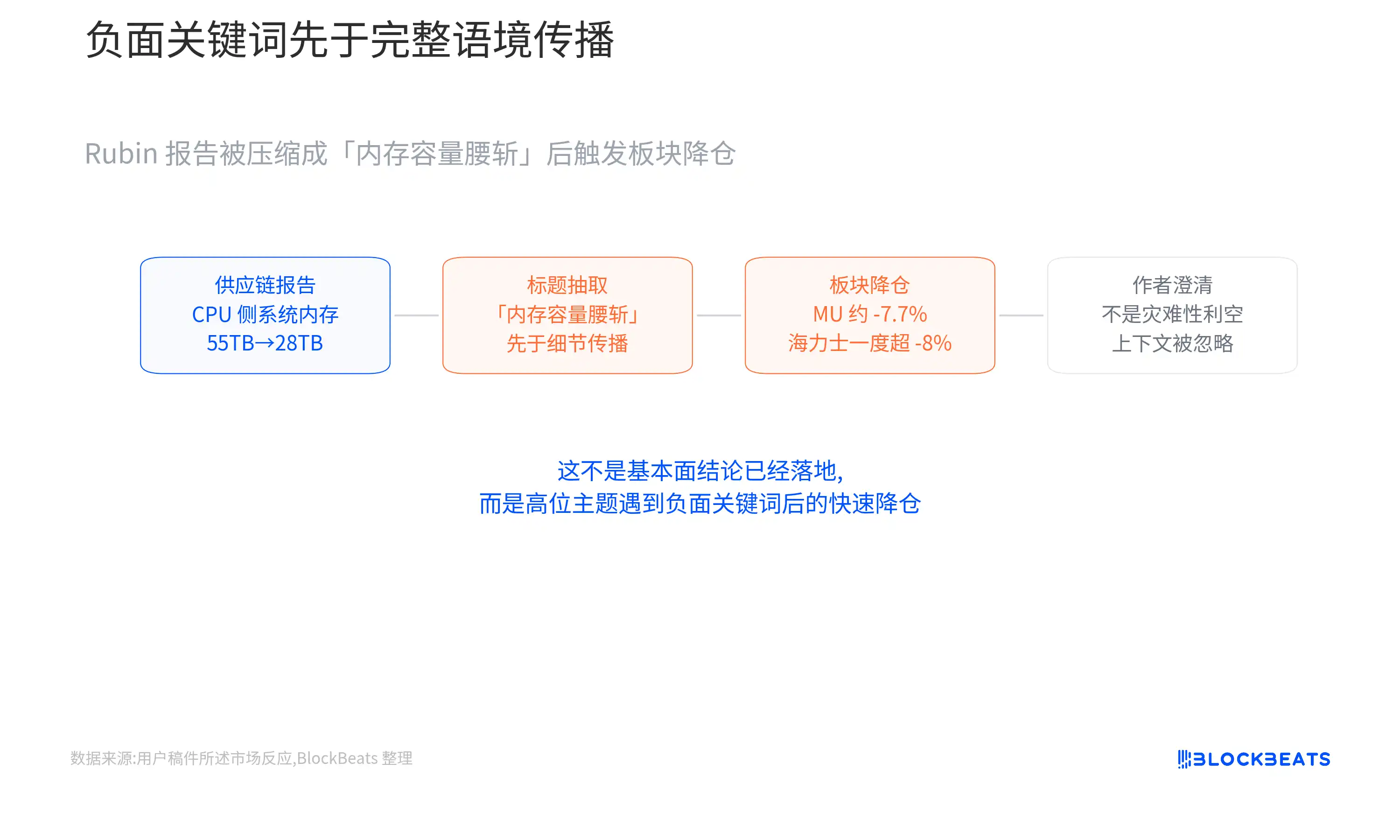
The report mentioned that single-rack memory capacity might drop from approximately 55TB to about 28TB. Subsequently, Micron fell about 7.7% in a single day, and SK Hynix opened down more than 8% the next day. More subtly, the report's author, Dylan Patel, later clarified that many reposts only captured the most eye-catching part, and this was not a "catastrophic bearish" report.

The reason for such a significant reaction is that it touched the most sensitive point of the current AI hardware trend. Over the past period, the market has been trading not on an ordinary memory cycle, but on the expectation that after the Rubin platform enters mass production, AI racks will continue to drive demand for HBM and supporting memory, thereby re-elevating memory suppliers' revenue and pricing power. Since GTC earlier this year, themes like HBM4, SK Hynix's market share, and Micron catching up in AI memory have been repeatedly traded in the market.

However, the phrase "memory being cut" is too crude.

The adjustments disclosed by SemiAnalysis primarily refer to changes in the configuration of SOCAMM and LPDDR on the CPU side within the Rubin NVL72 rack. Most systems might adopt 96GB modules instead of higher-capacity 192GB modules, reducing single-rack memory capacity from a planned ~55TB to ~28TB. This change affects the system memory value per rack but cannot directly imply that HBM4 demand on the GPU side has been simultaneously downgraded.

What really needs to be dissected is which profit pool this adjustment affects and which expectation the market is currently trading on.

Why Did AI Memory Stocks Plunge Collectively?

The market sold off based on a positioning reaction when a high-flying theme encountered negative keywords.

Currently, the confirmed part is that the market reaction was heavy, but the event itself remains at the level of a supply chain report. SemiAnalysis disclosed that NVIDIA might downgrade the CPU-side SOCAMM configuration to ensure the delivery schedule for the Rubin NVL72. The numbers mentioned in the report include single-rack memory capacity dropping from ~55TB to ~28TB, and rack cost decreasing from ~$7.6 million to ~$6.8 million. These numbers should be understood as the reporting perspective of SemiAnalysis, not yet the final confirmed BOM (Bill of Materials) from NVIDIA.
Over the past few quarters, the rise of AI memory stocks relied on a very smooth narrative: the more AI racks, the greater the shortage of advanced memory, and the thicker the profits for suppliers.

The simpler this story, the greater the killing power of a negative headline. Once "memory capacity halved" appeared, the market would first downgrade the memory value per rack, rarely distinguishing immediately which type of memory was being adjusted.

Micron's reaction is most illustrative.

It is both a traditional DRAM supplier and a beneficiary of AI server memory upgrades. Much of the upside previously priced in by the market came from the repricing notion that "AI memory is no longer just a cyclical product." If Rubin's per-rack system memory capacity declines, capital would immediately worry whether expectations for Micron's per-rack revenue from SOCAMM and LPDDR segments were set too high.

SK Hynix also followed the decline, indicating the shock has extended beyond a single supplier.

It is stronger in the HBM field, and the market had previously circulated rumors that it secured the majority of HBM orders related to Vera Rubin. But when AI memory trading becomes crowded, capital does not wait to verify all details before acting. The synchronous decline of memory stocks reflects a contraction in sector risk appetite, not that each company suffered the same fundamental shock.

Dylan Patel's subsequent clarification also points to this. He stated the report was not intended to create a "disaster" narrative, and many missed the context.

Translated into market language, capital did not fully trade on a supply chain analysis but rather on a rapid position reduction after a high-flying sector encountered negative keywords.

AI Memory Begins Redividing Profit Pools

What was primarily downgraded this time is the CPU-side system memory, not the GPU-adjacent HBM4.

Memory in a Rubin rack cannot be summarized with one word. The simplest breakdown is into two layers:

The first layer is GPU-side HBM4, serving the accelerator chip itself;

The second layer is CPU-side SOCAMM and LPDDR, more akin to the system RAM for the entire machine.
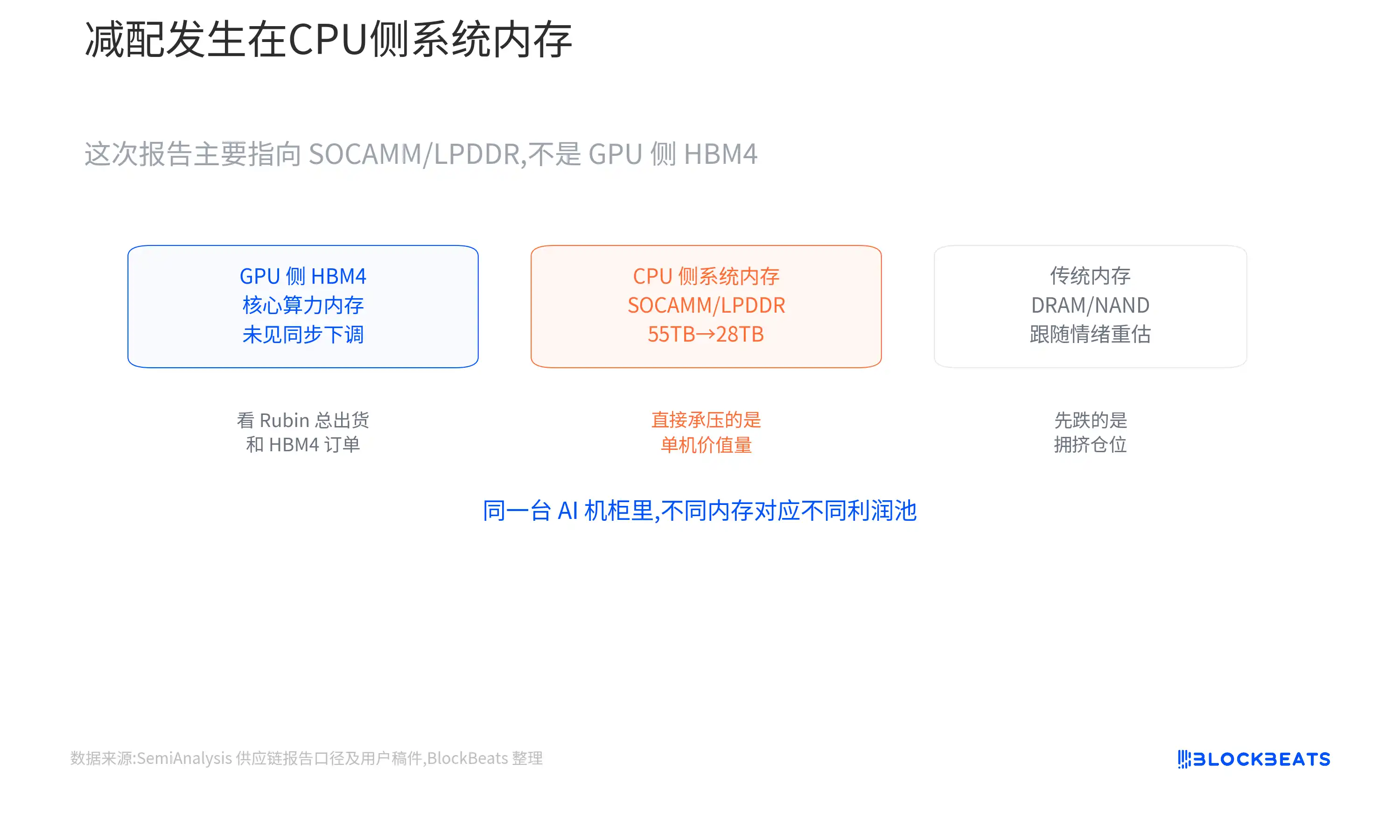
The former determines the speed at which data is fed to the GPU, while the latter affects overall machine scheduling, maintenance, and the performance of some workloads.

The "55TB to 28TB" mentioned by SemiAnalysis primarily falls on CPU-side system memory.

It might change the quantity, capacity, and procurement cost of SOCAMM modules per Rubin NVL72 rack. If most systems shift from 192GB modules to 96GB modules, the per-unit value of high-capacity SOCAMM indeed decreases, pressuring the revenue upside for related suppliers.

But GPU-side HBM4 is another line.

The Rubin platform still revolves around the Rubin GPU and Vera CPU, and HBM4 remains the core memory component for GPU packaging and computing power release. Current information does not show that HBM4 capacity or Rubin GPU shipments have been simultaneously downgraded. Previous multi-party predictions still regard HBM as one of the tightest and most pricing-powerful segments in AI servers, with SK Hynix also seen by the market as a primary beneficiary.

Think of an AI rack as an extremely expensive high-performance server.

HBM is closer to high-speed memory attached next to the GPU, while SOCAMM is closer to replaceable system memory for the whole machine. This adjustment mainly targets the latter.

For holdings, the distinction is very direct: if Micron has greater exposure in the SOCAMM segment, the downgrade in per-unit value would hit its expectations first; SK Hynix's HBM logic is relatively independent but would also be dragged down by sector sentiment in crowded trading.

Extrapolating system memory reduction directly into a breakdown of HBM4 demand lacks sufficient evidence.

A more reasonable breakdown is that the CPU-side profit pool indeed faces downward revision pressure, while the GPU-side HBM still depends on total Rubin shipments and HBM4 order cadence.

The AI memory theme can no longer be covered by a single line of "all memory is strong." Micron, SK Hynix, and Samsung Electronics have different exposures in HBM, SOCAMM, traditional DRAM, and NAND. Different types of memory within the same rack also correspond to different prices, margins, and supply-demand constraints.

Can Cost Reduction Translate to More Rack Shipments?

An optimistic interpretation stems from cost and delivery cadence.

SemiAnalysis's calculations show that the Rubin NVL72 rack cost might drop from ~$7.6 million to ~$6.8 million, a reduction of ~$800,000.
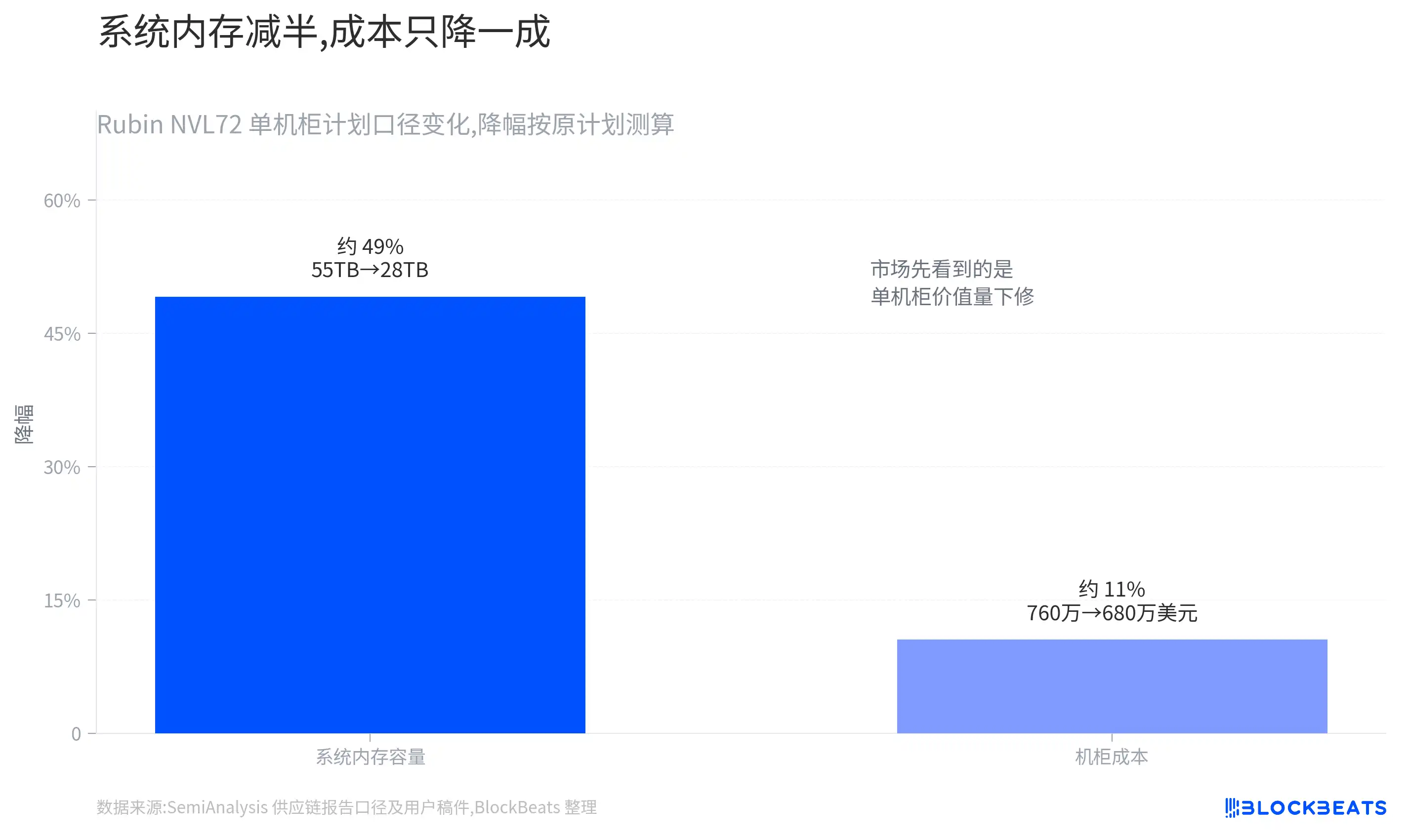
For cloud vendors like Microsoft, Google, Amazon, and Meta, AI racks are not just hardware purchases but involve calculating hourly computing costs, delivery time, and stability of large-scale deployment.

If a reduced configuration allows Rubin to be delivered faster, some per-unit value decline might be offset by more racks.

The logic is not complicated. If high-capacity SOCAMM supply is tight, NVIDIA choosing a more readily available configuration can lower the BOM per rack and reduce the risk of a single component delaying overall machine delivery.

For buyers, if a lower system memory configuration does not significantly impact core workloads, getting racks earlier might be more attractive than waiting for fully configured versions.

The problem is that this step remains speculative for now.

Cost reduction does not automatically equal increased orders. For "per-unit value decline" to be offset by "increased total rack volume," NVIDIA needs to deliver more Rubin NVL72 racks, and cloud vendors also need to add or advance purchases.

Existing materials lack public orders, quarterly guidance, or actual shipment data to prove this.

To understand with a simple scenario: if a certain SOCAMM capacity is nearly halved per rack, then total rack shipments need to increase significantly for the total Bit demand in this segment to return to previous expectations.
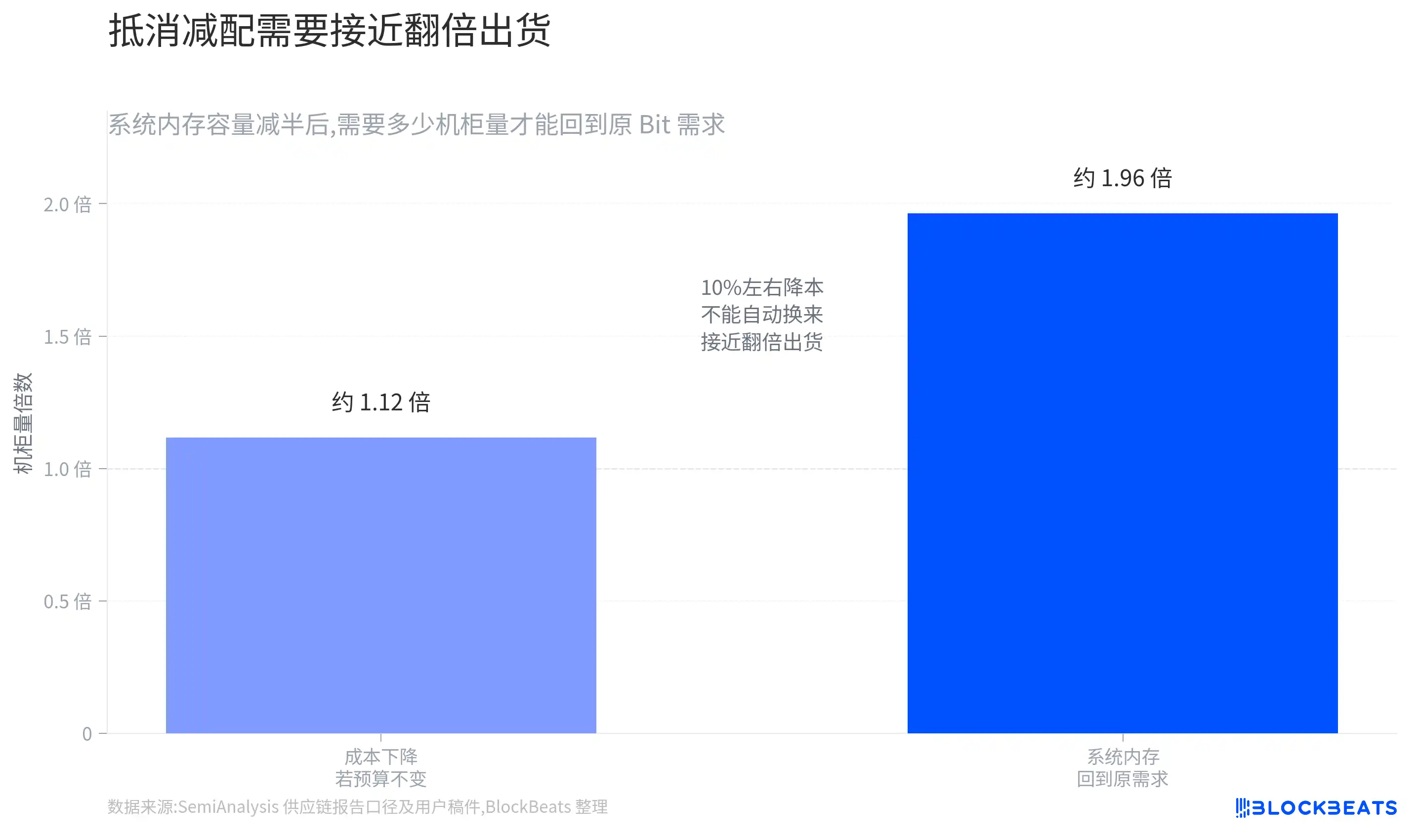
Even with a ~10% cost reduction, one cannot directly conclude that customers will buy enough extra racks. Large cloud vendor procurement is also influenced by power, data center construction, GPU supply, advanced packaging, and networking equipment; a single BOM reduction is just one variable.

The HBM situation is relatively more stable but not completely immune.

If total Rubin shipments remain robust, HBM4 will still be one of the most direct beneficiaries; if subsequent evidence shows overall machine delivery is hampered by other bottlenecks, HBM would also be affected by the platform's shipment cadence.

The difference is that this report did not directly downgrade HBM4 configuration. What the market awaits is total rack shipment volume, not just focusing on SOCAMM capacity numbers.

Shipment Data is the True Pricing Anchor

The current biggest risk is that the market first revalues based on profit pool breakdown, but subsequent data fails to back the optimistic interpretation.

If NVIDIA or the supply chain ultimately confirms that Rubin NVL72 will long-term adopt lower SOCAMM configurations, while total rack shipments are not significantly revised upward, CPU-side system memory suppliers will face more lasting compression of revenue expectations.

For Micron, the key is not just the overall label of "benefiting from AI memory," but the revenue breakdown of different products.

In subsequent earnings reports and conference calls, it's necessary to see if management discloses growth cadence for AI server-related DRAM, SOCAMM, HBM, and whether margins change due to specifications, prices, or customer bargaining power.

If the company only provides optimistic statements on overall demand but cannot explain the impact of SOCAMM configuration adjustments, the market may continue to discount it.

For SK Hynix, the verification point leans more towards HBM.

If its HBM4 order share, shipment cadence, and pricing maintain strength, this pullback resembles more of a sector sentiment fluctuation; if subsequent Rubin total shipments or HBM delivery cadence also show downgrades, the market would then extend the shock from SOCAMM to the HBM theme.

This is also a typical evolution as the AI memory theme reaches its mid-stage.

Early on, the market bought the direction: more AI racks are being built, and advanced memory is getting scarcer.

Now, representative stocks have accumulated significant gains, and capital is beginning to scrutinize whether each piece of profit is truly materializing. A single supply chain detail can trigger a 7%-8% intraday swing, indicating sector trading has become somewhat crowded, making negative information easier to amplify.

Before actual shipment and earnings breakdowns emerge, labeling this pullback as "bad news fully priced in" or "AI demand collapse" is premature.

A more prudent view is to acknowledge the pressure of per-unit value downgrade on the CPU side, while pricing HBM4 and SOCAMM separately.

What can most change the judgment next is still whether NVIDIA confirms the final BOM for Rubin NVL72, whether actual Rubin rack shipment plans can be revised upward, and the revenue exposure and margin changes for Micron, SK Hynix, and Samsung Electronics in HBM versus SOCAMM/LPDDR.


Domande pertinenti

QWhat triggered the sharp decline in the AI memory stock market according to the article?

AThe decline was triggered by a supply chain report from SemiAnalysis, which suggested a potential reduction in CPU-side system memory (SOCAMM/LPDDR) capacity per Nvidia Rubin NVL72 rack, from about 55TB to about 28TB. The report's alarming headline caused a market panic, despite later clarifications that it was not a 'disastrous bearish' report.

QAccording to the article, what is the key distinction between the two main types of memory in an AI server rack, and which one was reportedly impacted by the configuration change?

AThe two main types are GPU-side HBM (High Bandwidth Memory, like HBM4) and CPU-side system memory (like SOCAMM and LPDDR). The reported configuration change primarily impacted the CPU-side system memory (SOCAMM/LPDDR), potentially reducing its capacity and value per rack. The article states there is no confirmed change to the GPU-side HBM4 configuration.

QWhy did stocks like Micron and SK Hynix both fall significantly, even though their exposure to the affected memory segment might differ?

ABoth stocks fell due to a sharp contraction in sector risk appetite and a crowded trade. When the negative headline about 'memory capacity being halved' hit, investors reacted quickly by reducing exposure to the entire AI memory theme without initially distinguishing between the different memory types (HBM vs. system memory). This caused a broad sell-off before details were fully digested.

QWhat is the potential positive interpretation of the reported memory configuration change for the Rubin rack, as mentioned in the article?

AThe potential positive interpretation is that reducing the CPU-side memory specification could lower the overall cost and complexity of the Rubin NVL72 rack, potentially improving its delivery timeline and reliability. If this leads to increased total rack shipments by Nvidia, the reduction in per-unit value for certain memory components could be offset by higher volume.

QWhat does the article suggest is the most important factor for determining the true impact on memory suppliers following this report?

AThe article suggests that actual shipment data and financial breakdowns are the key determinants. For a final assessment, the market needs to see: Nvidia's confirmed final BOM for Rubin racks, the actual shipment plans for Rubin platforms, and detailed revenue/earnings breakdowns from suppliers like Micron and SK Hynix showing their exposure and margin trends for HBM versus SOCAMM/LPDDR products.

Letture associate

Bitcoin's 'Rally Ends,' Officially Entering the Later Stage of a Bear Market?

Bitcoin prices declined 13% this week, reversing the recent rebound and signaling a likely transition into the later stages of a bear market. Key on-chain metrics deteriorated, with the short-term holder cost basis falling below the Realized Price—a pattern last seen in early 2022, characteristic of bear market maturity. The rally to ~$82k proved to be a bear market bounce, as evidenced by the 90-day realized profit/loss ratio failing to sustain above the bullish threshold of 2. Daily realized losses surged to $1.35B, including significant selling from long-term holders who accumulated near cycle tops, indicating ongoing supply redistribution. Price was rejected almost precisely at the aggregate US spot ETF cost basis of ~$83k, turning that level into resistance and leaving the average ETF investor underwater again. Spot market selling pressure intensified, with the 7-day volume delta turning significantly negative to its weakest level since February. While a major long liquidation event cleared over $400M in leverage, spot demand has not yet stepped in to absorb the resulting supply. Options markets continue pricing in higher future volatility (elevated volatility risk premium) and maintain a skew toward put options, reflecting persistent demand for downside protection, though not yet panic. Overall, market structure remains fragile. Sustained recovery likely requires a reclaim of the ETF cost basis, a shift back to positive spot demand, and a slowdown in realized loss-taking. Until then, the market risks further downside or extended consolidation within the broader bear trend.

Foresight News40 min fa

Bitcoin's 'Rally Ends,' Officially Entering the Later Stage of a Bear Market?

Foresight News40 min fa

How Risky is the "Death Spiral" of MSTR and STRC?

Summary: This article explores the perceived "death spiral" risk between MicroStrategy (MSTR), its Bitcoin holdings, and its perpetual preferred stock (STRC), drawing comparisons to the LUNA-UST collapse. While both systems feature price anchors, high yields for holders, and potential feedback loops, their core mechanisms differ fundamentally. The MSTR-STRC structure relies on continuous financing to sustain its high dividend payouts, primarily through stock ATM offerings. A negative feedback cycle could occur: falling MSTR stock price makes raising equity capital harder, increasing pressure to sell Bitcoin, which undermines STRC confidence and further depresses MSTR. However, unlike LUNA-UST's automated, direct linkage, the MSTR-STRC loop is weaker and has brakes: STRC dividends can be deferred or rates lowered, and STRC holders have a $100/share liquidation preference in bankruptcy, providing a price floor. The company's sustainability hinges on its ability to continue financing. Its current ~$900 million USD reserves cover only about 6.3 months of its ~$1.71 billion annual interest/dividend burden. The next six months are critical, aligning with both the potential bottom in Bitcoin's four-year cycle and the depletion timeline of its reserves. While a LUNA-style catastrophic collapse is deemed highly unlikely due to structural differences, the key question is whether MicroStrategy can navigate this period through healthy deleveraging to restart its capital engine.

Foresight News59 min fa

How Risky is the "Death Spiral" of MSTR and STRC?

Foresight News59 min fa

How Much Debt Does Strategy Really Have? Is There a Risk of Implosion?

MicroStrategy's Debt Risk: A Turning Point in the "Never Sell" Strategy As of June 3, 2026, MicroStrategy holds 843,706 bitcoins (valued at ~$53.1B) but faces significant financial obligations. Its capital structure includes $6.75B in convertible notes and $15.48B in perpetual preferred stock (led by the $8.5B STRC series), creating an annual payout burden of ~$1.71B. With software revenue at only ~$500M, interest and dividend obligations far exceed operating income. A critical shift occurred in late May 2026 when the company sold 32 bitcoins for ~$2.5M to cover dividends, breaking CEO Michael Saylor's long-standing "never sell" pledge. This symbolic move triggered a sharp decline in both Bitcoin's price and MSTR stock, reflecting market fears about cash flow sustainability. The core of the strain is the STRC perpetual preferred stock, designed as a "permanent loan" with no maturity date but requiring high monthly dividends (currently 11.5%). Its business model relies on a three-part cycle: issuing new STRC shares, using proceeds to buy more Bitcoin and fund a USD reserve, and using that reserve to pay dividends. This cycle depends on continuous investor demand for STRC and Bitcoin's price appreciation. Analysis shows Bitcoin needs to appreciate at least 2.3% annually to cover the $1.71B in yearly obligations at current holdings. With Bitcoin price down ~22% from March 2026 highs, this pressure has intensified. The company's $900M USD reserve can only cover about 7 months of payments if STRC issuance stalls. Key risks are not immediate bankruptcy or forced Bitcoin liquidation (as BTC is not collateral), but rather: 1) The erosion of MSTR's premium to its Bitcoin holdings (mNAV), which would cripple its ability to raise cheap capital; 2) A vicious cycle where stagnant Bitcoin prices reduce STRC demand, draining the USD reserve and forcing BTC sales, further depressing prices. The period from February 2027 to September 2028 is a crucial test, with over $5.9B in convertible notes facing put options or maturity. In essence, MicroStrategy has evolved from a simple Bitcoin holder into a complex financial entity acting like a "private Bitcoin bank," leveraging its BTC holdings to create layered financial products. Its survival depends on maintaining Bitcoin's price trend, its stock premium, and market appetite for its preferred shares. The recent token sale marks not a betrayal of its Bitcoin thesis, but an admission that the leveraged strategy must eventually be paid for.

marsbit1 h fa

How Much Debt Does Strategy Really Have? Is There a Risk of Implosion?

marsbit1 h fa

Trading

Spot
Futures

Articoli Popolari

Cosa è $S$

Comprendere SPERO: Una Panoramica Completa Introduzione a SPERO Mentre il panorama dell'innovazione continua a evolversi, l'emergere delle tecnologie web3 e dei progetti di criptovaluta gioca un ruolo fondamentale nel plasmare il futuro digitale. Un progetto che ha attirato l'attenzione in questo campo dinamico è SPERO, denotato come SPERO,$$s$. Questo articolo mira a raccogliere e presentare informazioni dettagliate su SPERO, per aiutare gli appassionati e gli investitori a comprendere le sue basi, obiettivi e innovazioni nei domini web3 e crypto. Che cos'è SPERO,$$s$? SPERO,$$s$ è un progetto unico all'interno dello spazio crypto che cerca di sfruttare i principi della decentralizzazione e della tecnologia blockchain per creare un ecosistema che promuove l'impegno, l'utilità e l'inclusione finanziaria. Il progetto è progettato per facilitare interazioni peer-to-peer in modi nuovi, fornendo agli utenti soluzioni e servizi finanziari innovativi. Al suo interno, SPERO,$$s$ mira a responsabilizzare gli individui fornendo strumenti e piattaforme che migliorano l'esperienza dell'utente nello spazio delle criptovalute. Questo include la possibilità di metodi di transazione più flessibili, la promozione di iniziative guidate dalla comunità e la creazione di percorsi per opportunità finanziarie attraverso applicazioni decentralizzate (dApps). La visione sottostante di SPERO,$$s$ ruota attorno all'inclusività, cercando di colmare le lacune all'interno della finanza tradizionale mentre sfrutta i vantaggi della tecnologia blockchain. Chi è il Creatore di SPERO,$$s$? L'identità del creatore di SPERO,$$s$ rimane piuttosto oscura, poiché ci sono risorse pubblicamente disponibili limitate che forniscono informazioni dettagliate sul suo fondatore o fondatori. Questa mancanza di trasparenza può derivare dall'impegno del progetto per la decentralizzazione—un ethos che molti progetti web3 condividono, dando priorità ai contributi collettivi rispetto al riconoscimento individuale. Centrando le discussioni attorno alla comunità e ai suoi obiettivi collettivi, SPERO,$$s$ incarna l'essenza dell'empowerment senza mettere in evidenza individui specifici. Pertanto, comprendere l'etica e la missione di SPERO rimane più importante che identificare un creatore singolo. Chi sono gli Investitori di SPERO,$$s$? SPERO,$$s$ è supportato da una varietà di investitori che vanno dai capitalisti di rischio agli investitori angelici dedicati a promuovere l'innovazione nel settore crypto. Il focus di questi investitori generalmente si allinea con la missione di SPERO—dando priorità a progetti che promettono avanzamenti tecnologici sociali, inclusività finanziaria e governance decentralizzata. Queste fondazioni di investitori sono tipicamente interessate a progetti che non solo offrono prodotti innovativi, ma contribuiscono anche positivamente alla comunità blockchain e ai suoi ecosistemi. Il supporto di questi investitori rafforza SPERO,$$s$ come un concorrente degno di nota nel dominio in rapida evoluzione dei progetti crypto. Come Funziona SPERO,$$s$? SPERO,$$s$ impiega un framework multifunzionale che lo distingue dai progetti di criptovaluta convenzionali. Ecco alcune delle caratteristiche chiave che sottolineano la sua unicità e innovazione: Governance Decentralizzata: SPERO,$$s$ integra modelli di governance decentralizzati, responsabilizzando gli utenti a partecipare attivamente ai processi decisionali riguardanti il futuro del progetto. Questo approccio favorisce un senso di proprietà e responsabilità tra i membri della comunità. Utilità del Token: SPERO,$$s$ utilizza il proprio token di criptovaluta, progettato per servire varie funzioni all'interno dell'ecosistema. Questi token abilitano transazioni, premi e la facilitazione dei servizi offerti sulla piattaforma, migliorando l'impegno e l'utilità complessivi. Architettura Stratificata: L'architettura tecnica di SPERO,$$s$ supporta la modularità e la scalabilità, consentendo un'integrazione fluida di funzionalità e applicazioni aggiuntive man mano che il progetto evolve. Questa adattabilità è fondamentale per mantenere la rilevanza nel panorama crypto in continua evoluzione. Coinvolgimento della Comunità: Il progetto enfatizza iniziative guidate dalla comunità, impiegando meccanismi che incentivano la collaborazione e il feedback. Nutrendo una comunità forte, SPERO,$$s$ può affrontare meglio le esigenze degli utenti e adattarsi alle tendenze di mercato. Focus sull'Inclusione: Offrendo basse commissioni di transazione e interfacce user-friendly, SPERO,$$s$ mira ad attrarre una base utenti diversificata, inclusi individui che potrebbero non aver precedentemente interagito nello spazio crypto. Questo impegno per l'inclusione si allinea con la sua missione generale di empowerment attraverso l'accessibilità. Cronologia di SPERO,$$s$ Comprendere la storia di un progetto fornisce preziose intuizioni sulla sua traiettoria di sviluppo e sui traguardi. Di seguito è riportata una cronologia suggerita che mappa eventi significativi nell'evoluzione di SPERO,$$s$: Fase di Concettualizzazione e Ideazione: Le idee iniziali che formano la base di SPERO,$$s$ sono state concepite, allineandosi strettamente con i principi di decentralizzazione e focus sulla comunità all'interno dell'industria blockchain. Lancio del Whitepaper del Progetto: Dopo la fase concettuale, è stato rilasciato un whitepaper completo che dettaglia la visione, gli obiettivi e l'infrastruttura tecnologica di SPERO,$$s$ per suscitare interesse e feedback dalla comunità. Costruzione della Comunità e Prime Interazioni: Sono stati effettuati sforzi attivi di outreach per costruire una comunità di early adopters e potenziali investitori, facilitando discussioni attorno agli obiettivi del progetto e ottenendo supporto. Evento di Generazione del Token: SPERO,$$s$ ha condotto un evento di generazione del token (TGE) per distribuire i propri token nativi ai primi sostenitori e stabilire una liquidità iniziale all'interno dell'ecosistema. Lancio della Prima dApp: La prima applicazione decentralizzata (dApp) associata a SPERO,$$s$ è stata attivata, consentendo agli utenti di interagire con le funzionalità principali della piattaforma. Sviluppo Continuo e Partnership: Aggiornamenti e miglioramenti continui alle offerte del progetto, inclusi partnership strategiche con altri attori nello spazio blockchain, hanno plasmato SPERO,$$s$ in un concorrente competitivo e in evoluzione nel mercato crypto. Conclusione SPERO,$$s$ rappresenta una testimonianza del potenziale del web3 e delle criptovalute di rivoluzionare i sistemi finanziari e responsabilizzare gli individui. Con un impegno per la governance decentralizzata, il coinvolgimento della comunità e funzionalità progettate in modo innovativo, apre la strada verso un panorama finanziario più inclusivo. Come per qualsiasi investimento nello spazio crypto in rapida evoluzione, si incoraggiano potenziali investitori e utenti a ricercare approfonditamente e a impegnarsi in modo riflessivo con gli sviluppi in corso all'interno di SPERO,$$s$. Il progetto mostra lo spirito innovativo dell'industria crypto, invitando a ulteriori esplorazioni delle sue innumerevoli possibilità. Mentre il percorso di SPERO,$$s$ è ancora in fase di sviluppo, i suoi principi fondamentali potrebbero effettivamente influenzare il futuro di come interagiamo con la tecnologia, la finanza e tra di noi in ecosistemi digitali interconnessi.

75 Totale visualizzazioniPubblicato il 2024.12.17Aggiornato il 2024.12.17

Cosa è $S$

Cosa è AGENT S

Agent S: Il Futuro dell'Interazione Autonoma in Web3 Introduzione Nel panorama in continua evoluzione di Web3 e criptovalute, le innovazioni stanno costantemente ridefinendo il modo in cui gli individui interagiscono con le piattaforme digitali. Uno di questi progetti pionieristici, Agent S, promette di rivoluzionare l'interazione uomo-computer attraverso il suo framework agentico aperto. Aprendo la strada a interazioni autonome, Agent S mira a semplificare compiti complessi, offrendo applicazioni trasformative nell'intelligenza artificiale (AI). Questa esplorazione dettagliata approfondirà le complessità del progetto, le sue caratteristiche uniche e le implicazioni per il dominio delle criptovalute. Cos'è Agent S? Agent S si presenta come un innovativo framework agentico aperto, progettato specificamente per affrontare tre sfide fondamentali nell'automazione dei compiti informatici: Acquisizione di Conoscenze Specifiche del Dominio: Il framework apprende in modo intelligente da varie fonti di conoscenza esterne ed esperienze interne. Questo approccio duale gli consente di costruire un ricco repository di conoscenze specifiche del dominio, migliorando le sue prestazioni nell'esecuzione dei compiti. Pianificazione su Lungo Orizzonte di Compiti: Agent S impiega una pianificazione gerarchica potenziata dall'esperienza, un approccio strategico che facilita la suddivisione e l'esecuzione efficiente di compiti complessi. Questa caratteristica migliora significativamente la sua capacità di gestire più sottocompiti in modo efficiente ed efficace. Gestione di Interfacce Dinamiche e Non Uniformi: Il progetto introduce l'Interfaccia Agente-Computer (ACI), una soluzione innovativa che migliora l'interazione tra agenti e utenti. Utilizzando Modelli Linguistici Multimodali di Grandi Dimensioni (MLLM), Agent S può navigare e manipolare senza sforzo diverse interfacce grafiche utente. Attraverso queste caratteristiche pionieristiche, Agent S fornisce un framework robusto che affronta le complessità coinvolte nell'automazione dell'interazione umana con le macchine, preparando il terreno per innumerevoli applicazioni nell'AI e oltre. Chi è il Creatore di Agent S? Sebbene il concetto di Agent S sia fondamentalmente innovativo, informazioni specifiche sul suo creatore rimangono elusive. Il creatore è attualmente sconosciuto, il che evidenzia sia la fase embrionale del progetto sia la scelta strategica di mantenere i membri fondatori sotto anonimato. Indipendentemente dall'anonimato, l'attenzione rimane sulle capacità e sul potenziale del framework. Chi sono gli Investitori di Agent S? Poiché Agent S è relativamente nuovo nell'ecosistema crittografico, informazioni dettagliate riguardanti i suoi investitori e sostenitori finanziari non sono documentate esplicitamente. La mancanza di approfondimenti pubblicamente disponibili sulle fondazioni di investimento o sulle organizzazioni che supportano il progetto solleva interrogativi sulla sua struttura di finanziamento e sulla roadmap di sviluppo. Comprendere il supporto è cruciale per valutare la sostenibilità del progetto e il suo potenziale impatto sul mercato. Come Funziona Agent S? Al centro di Agent S si trova una tecnologia all'avanguardia che gli consente di funzionare efficacemente in contesti diversi. Il suo modello operativo è costruito attorno a diverse caratteristiche chiave: Interazione Uomo-Computer Simile a Quella Umana: Il framework offre una pianificazione AI avanzata, cercando di rendere le interazioni con i computer più intuitive. Mimando il comportamento umano nell'esecuzione dei compiti, promette di elevare le esperienze degli utenti. Memoria Narrativa: Utilizzata per sfruttare esperienze di alto livello, Agent S utilizza la memoria narrativa per tenere traccia delle storie dei compiti, migliorando così i suoi processi decisionali. Memoria Episodica: Questa caratteristica fornisce agli utenti una guida passo-passo, consentendo al framework di offrire supporto contestuale mentre i compiti si sviluppano. Supporto per OpenACI: Con la capacità di funzionare localmente, Agent S consente agli utenti di mantenere il controllo sulle proprie interazioni e flussi di lavoro, allineandosi con l'etica decentralizzata di Web3. Facile Integrazione con API Esterne: La sua versatilità e compatibilità con varie piattaforme AI garantiscono che Agent S possa adattarsi senza problemi agli ecosistemi tecnologici esistenti, rendendolo una scelta attraente per sviluppatori e organizzazioni. Queste funzionalità contribuiscono collettivamente alla posizione unica di Agent S all'interno dello spazio crittografico, poiché automatizza compiti complessi e multi-fase con un intervento umano minimo. Man mano che il progetto evolve, le sue potenziali applicazioni in Web3 potrebbero ridefinire il modo in cui si svolgono le interazioni digitali. Cronologia di Agent S Lo sviluppo e le tappe di Agent S possono essere riassunti in una cronologia che evidenzia i suoi eventi significativi: 27 Settembre 2024: Il concetto di Agent S è stato lanciato in un documento di ricerca completo intitolato “Un Framework Agentico Aperto che Usa i Computer Come un Umano”, mostrando le basi per il progetto. 10 Ottobre 2024: Il documento di ricerca è stato reso pubblicamente disponibile su arXiv, offrendo un'esplorazione approfondita del framework e della sua valutazione delle prestazioni basata sul benchmark OSWorld. 12 Ottobre 2024: È stata rilasciata una presentazione video, fornendo un'idea visiva delle capacità e delle caratteristiche di Agent S, coinvolgendo ulteriormente potenziali utenti e investitori. Questi indicatori nella cronologia non solo illustrano i progressi di Agent S, ma indicano anche il suo impegno per la trasparenza e il coinvolgimento della comunità. Punti Chiave su Agent S Man mano che il framework Agent S continua a evolversi, diversi attributi chiave si distinguono, sottolineando la sua natura innovativa e il potenziale: Framework Innovativo: Progettato per fornire un uso intuitivo dei computer simile all'interazione umana, Agent S porta un approccio nuovo all'automazione dei compiti. Interazione Autonoma: La capacità di interagire autonomamente con i computer attraverso GUI segna un passo avanti verso soluzioni informatiche più intelligenti ed efficienti. Automazione di Compiti Complessi: Con la sua metodologia robusta, può automatizzare compiti complessi e multi-fase, rendendo i processi più veloci e meno soggetti a errori. Miglioramento Continuo: I meccanismi di apprendimento consentono ad Agent S di migliorare dalle esperienze passate, migliorando continuamente le sue prestazioni e la sua efficacia. Versatilità: La sua adattabilità attraverso diversi ambienti operativi come OSWorld e WindowsAgentArena garantisce che possa servire un'ampia gamma di applicazioni. Man mano che Agent S si posiziona nel panorama di Web3 e delle criptovalute, il suo potenziale per migliorare le capacità di interazione e automatizzare i processi segna un significativo avanzamento nelle tecnologie AI. Attraverso il suo framework innovativo, Agent S esemplifica il futuro delle interazioni digitali, promettendo un'esperienza più fluida ed efficiente per gli utenti in vari settori. Conclusione Agent S rappresenta un audace passo avanti nell'unione tra AI e Web3, con la capacità di ridefinire il modo in cui interagiamo con la tecnologia. Sebbene sia ancora nelle sue fasi iniziali, le possibilità per la sua applicazione sono vaste e coinvolgenti. Attraverso il suo framework completo che affronta sfide critiche, Agent S mira a portare le interazioni autonome al centro dell'esperienza digitale. Man mano che ci addentriamo nei regni delle criptovalute e della decentralizzazione, progetti come Agent S giocheranno senza dubbio un ruolo cruciale nel plasmare il futuro della tecnologia e della collaborazione uomo-computer.

533 Totale visualizzazioniPubblicato il 2025.01.14Aggiornato il 2025.01.14

Cosa è AGENT S

Come comprare S

Benvenuto in HTX.com! Abbiamo reso l'acquisto di Sonic (S) semplice e conveniente. Segui la nostra guida passo passo per intraprendere il tuo viaggio nel mondo delle criptovalute.Step 1: Crea il tuo Account HTXUsa la tua email o numero di telefono per registrarti il tuo account gratuito su HTX. Vivi un'esperienza facile e sblocca tutte le funzionalità,Crea il mio accountStep 2: Vai in Acquista crypto e seleziona il tuo metodo di pagamentoCarta di credito/debito: utilizza la tua Visa o Mastercard per acquistare immediatamente SonicS.Bilancio: Usa i fondi dal bilancio del tuo account HTX per fare trading senza problemi.Terze parti: abbiamo aggiunto metodi di pagamento molto utilizzati come Google Pay e Apple Pay per maggiore comodità.P2P: Fai trading direttamente con altri utenti HTX.Over-the-Counter (OTC): Offriamo servizi su misura e tassi di cambio competitivi per i trader.Step 3: Conserva Sonic (S)Dopo aver acquistato Sonic (S), conserva nel tuo account HTX. In alternativa, puoi inviare tramite trasferimento blockchain o scambiare per altre criptovalute.Step 4: Scambia Sonic (S)Scambia facilmente Sonic (S) nel mercato spot di HTX. Accedi al tuo account, seleziona la tua coppia di trading, esegui le tue operazioni e monitora in tempo reale. Offriamo un'esperienza user-friendly sia per chi ha appena iniziato che per i trader più esperti.

1.1k Totale visualizzazioniPubblicato il 2025.01.15Aggiornato il 2026.06.02

Come comprare S

Discussioni

Benvenuto nella Community HTX. Qui puoi rimanere informato sugli ultimi sviluppi della piattaforma e accedere ad approfondimenti esperti sul mercato. Le opinioni degli utenti sul prezzo di S S sono presentate come di seguito.

活动图片