Those Pre-Bitcoin PoW Protocols Have Recently Been Reimplemented

marsbitPubblicato 2026-05-11Pubblicato ultima volta 2026-05-11

Introduzione

This article details a recent surge in replicating pre-Bitcoin Proof-of-Work (PoW) protocols, specifically focusing on Hal Finney's 2004 RPOW (Reusable Proofs of Work). Within five days in May 2026, multiple independent builders in the Bitcoin/cypherpunk community launched projects inspired by this early electronic cash proposal. The initiative began with Fred Krueger's `rpow2.com`, a centralized but auditable system that replaced RPOW's original IBM 4758 hardware with Ed25519 signatures. Initially a faithful replica, it later adopted Bitcoin-like features (21M supply cap, difficulty adjustment) and a controversial 5.24% founder allocation. This sparked rapid forks, including `rpow4.com` which incorporated full Bitcoin parameters, a prediction market (`rpowmarket.com`), and a DEX (`rpow2swap.com`). Concurrently, Mike In Space created a prototype of Wei Dai's 1998 b-money proposal (`b-money.replit.app`), pushing the historical exploration even further back. The article contrasts these centralized, server-dependent experiments with Bitcoin's core innovation of decentralized, trustless consensus. It also highlights a parallel development: the `HASH` project on Ethereum, which uses smart contract hooks to enable a purely fair-launch, browser-mineable PoW token with 0% allocations to team or VCs. The collective activity is framed as a meme-driven, educational exploration of cypherpunk history rather than a serious financial movement, with all projects heavily disclaiming any inv...

Author: 798.eth

Preface:

Yesterday, I posted an article about a PoW protocol fork. Today, the browser mining project on the Ethereum mainnet is also here, using v4 hooks to guard the entrance to liquidity pool creation.

Previously seen projects used hooks for economic engine design. UPEG uses hooks to stitch ERC-20 and NFT together. SATO uses hooks to take over pricing curves. SLOP uses hooks to automatically use swap fees to buy floor NFTs for burning. These all design hooks as economic engines.

Today, I looked at one called HASH. Its logic is completely different. It's essentially a PoW token with a 21M cap, difficulty adjustment, halving—copying the whole BTC set. Mining runs keccak256 in the browser. Hooks are not involved in the mining logic; they only do two things. First, guard the entrance to pool creation: only after the genesis sale is complete is anyone allowed to call seedPool to trigger pool creation, and the parameters must match. Second, each swap charges 1% in both directions to the protocol treasury.

In other words, hooks in this project are infrastructure. Not an economic engine, but a gatekeeper at the moment of launch, plus a layer of protocol fee channel beyond LP fees.

0% team, 0% VC, 0% airdrop—all supply goes through public sale plus PoW. The reason they can achieve such a thorough fair launch is that hooks move the pool creation step from the dev's hands into the contract.

Not financial advice.

Only looking for innovative aspects.

Below is the original article:
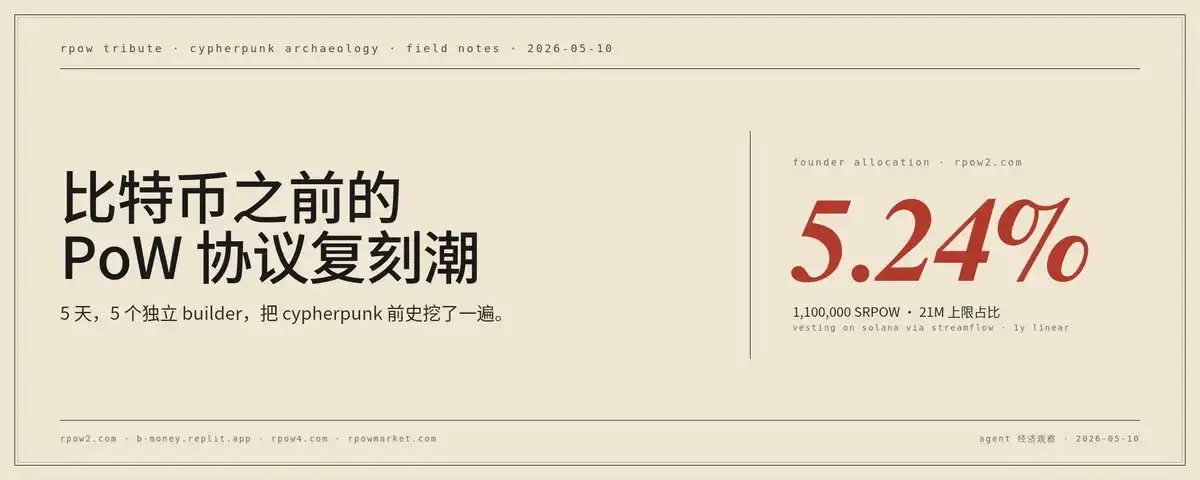
5 days, 5 independent builders dug through cypherpunk prehistory. The first one is RPOW.

Bitcoin did not appear out of thin air.

It has a cypherpunk lineage: Adam Back's Hashcash in 1997, Wei Dai's b-money and Nick Szabo's Bit Gold in 1998, Hal Finney's RPOW in 2004. These proposals each solved part of the problem of "using PoW as electronic cash." Hashcash provided primitives, b-money gave a blueprint for decentralized settlement, Bit Gold gave a blueprint for transferable value, RPOW made PoW tokens reusable. Satoshi strung this lineage together in 2008, writing the Bitcoin whitepaper.

22 years later, in early May 2026, over 5 days, this lineage was collectively reimplemented by a group of people on X and GitHub. The first protocol to be forked was RPOW.

What is RPOW

In 2004, Finney published RPOW on the cypherpunk mailing list—the first electronic currency based on PoW. It was centralized, running on a single server. But this server was connected to an IBM 4758, a FIPS 140-certified hardware cryptographic coprocessor capable of hashing its own internal code and signing a remote attestation. Any user could use this attestation to verify that the server was running Finney's published source code, unaltered—centralized but auditable. This was the real problem RPOW's entire design solved.

In 2009, Bitcoin launched, offering a different answer to the same problem: decentralized consensus. It cut off the trusted hardware path, requiring no trust in any single machine. Finney was the first person to receive a transfer from Satoshi and passed away in 2014 from ALS.

Jump to May 7, 2026

That day, Fred Krueger registered rpow2.com and deployed it.

A brief background on Krueger. He was a Wall Street trader at Salomon Brothers and RBS Greenwich Capital from the 1980s to 1990s. From the 1990s to 2000s, he successively founded TagWorld, iWin, Traffic Marketplace, and Adconion Media Group, with nine exits totaling $500 million according to his own 2018 statement. He entered crypto in 2017 with WorkCoin. In 2022, he initiated Libre Chain, claiming to be Bitcoin's first decentralized lending market. In 2025, he co-authored The Big Bitcoin Book and Bitcoin One Million with Ben Sigman, and in the same year initiated 2718.fund, a Bitcoin fund generating 10% APY cash flow through BTC-collateralized stablecoin loans, with 2718 derived from Euler's number e. He has 244K followers on X, is a Bitcoin maximalist, anti-Ethereum, and has publicly predicted a BTC terminal value of $4.5M to $10M.

I retrieved the webpage from May 7th. It was written like this:

No IBM 4758 — Ed25519 signatures, magic-link auth, Postgres ledger. Still centralized. Still no supply cap. Still no difficulty adjustment. Faithful by design.

No Bitcoin features. At that time, Krueger chose to faithfully replicate Finney, replacing the IBM 4758 with Ed25519 and Postgres, keeping the rest as is.

Within the next 48 hours

On May 8th, developer cryptonaut420 (Nick Rathman) registered rpow4.com, directly copying Bitcoin's full parameters: halving every 210,000 blocks, initial reward of 50 RPOW, transaction fees, treasury—everything included.

On May 9th, GitHub user ImMike launched rpowmarket.com, creating a Polymarket-style BTC price prediction market, integrating rpow2/3/4 as betting tokens.

On May 10th, EmblemVault CSO Adam McBride built rpow2swap.com.

5 days, 3 forks plus a prediction market plus a DEX.

Krueger didn't sit idle

Between May 9th and 10th, he changed the about page of rpow2:

Still centralized — but Bitcoin-flavored where it counts: a fixed 21,000,000 supply cap, and a stepped difficulty adjustment that adds one trailing-zero bit for every 1,000,000 coins minted.

The line "Faithful by design" was gone.

The next paragraph is more telling:

Founder allocation: 1,100,000 SRPOW (5.24% of the 21M cap) was allocated at launch as a "satoshi" tribute, vested linearly over one year via the Streamflow protocol on Solana.

He added a 21M cap, difficulty adjustment, and conveniently reserved 1.1 million tokens as a founder pre-mine. Linear vesting over one year via the Streamflow protocol on Solana, named "satoshi tribute."

Satoshi's most iconic feature was no pre-mine. Anyone who wanted BTC had to mine it themselves. Calling a 5.24% founder pre-mine a "satoshi tribute" is somewhat ironic.

Back to the most crucial line on the webpage.

No IBM 4758 — Ed25519 signatures.

Ed25519 can prove the party holding the private key signed the transaction; it cannot prove what code the party holding the key is running. This misses the entirety of Finney's engineering contribution.

Krueger copied the parts of Bitcoin that look like Bitcoin: 21M cap, halving, scarcity narrative, the word "satoshi." He didn't copy the parts that make Bitcoin Bitcoin: decentralized consensus, the trustless alternative to remote attestation, fair launch.

The story overflows beyond RPOW

On the morning of May 10th, around UTC 06:30, Mike In Space hosted b-money.replit.app on Replit, paying homage to Wei Dai's 1998 electronic cash proposal.

The scale is tiny: 5 accounts, 107.5 total supply, 16 transactions. The code has an `activeContracts` field, corresponding to the `contracts` concept in Wei Dai's original paper.

Mike In Space is not a random person. He is the founder of the Bitcoin Stamps protocol, author of the SRC-20 protocol, and a contributor to Bitcoin Magazine. One of the core figures in the current wave of Bitcoin on-chain inscription.

Wei Dai's b-money predates Hal Finney's RPOW by 6 years. It was never truly implemented because Wei Dai himself stated in his proposal, "I'm not sure if this can work." Mike's version is also clearly a prototype, but it pushes the cypherpunk replication effort to an origin even earlier than RPOW.

The next logical stops would be Bit Gold (Nick Szabo 1998), then DigiCash or Chaum's ecash from the 1980s. This archaeological path is already laid out.

This wave of collective action

5 independent builders: Krueger, cryptonaut420, ImMike, Adam McBride, Mike In Space.

There is overlap at the community level. They all belong to the Bitcoin old-timers / Counterparty / Ordinals / NFT archaeology lineage. Mike In Space's Bitcoin Stamps protocol is exactly the asset type Adam McBride wraps at EmblemVault. This isn't five unrelated people independently forking; it's the same subculture collectively responding to the same meme within 5 days.

Currently, on rpow2swap, rpow FDV is 0.68M. Let's see how it develops later. Essentially, rpow is centralized; if the server is shut down, everything is gone.

But this replication lineage is still quite interesting.

Disclaimer

This article is solely for event documentation and engineering analysis and does not constitute any form of investment advice. All projects mentioned are explicitly labeled by their respective authors as experimental, homage, or for entertainment purposes.

rpow2's webpage clearly states:

this IS a centralized system. The ledger lives in a Postgres database operated by one person on rented infrastructure. If that server is breached, lost, or seized, your tokens may be lost with it. No warranty, no recovery guarantees.

rpowmarket's disclaimer reads: parody · no value · for fun.

b-money.replit.app is a free-hosted prototype.

Not financial advice.

Domande pertinenti

QWhat is the main innovation of the HASH project mentioned in the article regarding its use of 'hooks'?

AIn the HASH project, hooks are not used as an economic engine but as infrastructure. Their primary function is twofold: 1) To guard the launch of the liquidity pool by only allowing the pool creation after the genesis sale is complete and only with correct parameters. 2) To levy a 1% protocol fee on both sides of every swap into a treasury. This allows for a completely fair launch with 0% for the team, VC, or airdrops, as the hook removes the pool creation step from the developer's control and places it within the smart contract.

QAccording to the article, what key Bitcoin-like feature did Fred Krueger add to his RPOW2 project after other forks emerged, and what controversial decision did he make?

AAfter other forks of RPOW appeared, Fred Krueger updated his RPOW2 project to include key Bitcoin-like features: a fixed 21,000,000 supply cap and a stepped difficulty adjustment. However, he controversially allocated 1,100,000 SRPOW (5.24% of the total supply) as a "founder allocation" or "satoshi tribute" for himself, vested linearly over one year via the Streamflow protocol on Solana. This pre-mine contradicts Satoshi Nakamoto's principle of a fair, no-pre-mine launch for Bitcoin.

QWhat fundamental difference exists between Hal Finney's original 2004 RPOW design and Fred Krueger's 2026 RPOW2 implementation in terms of achieving trust?

AHal Finney's original RPOW used an IBM 4758 hardware security module to provide remote attestation, proving the server was running his exact, unaltered public source code. Fred Krueger's RPOW2 implementation replaced this with Ed25519 signatures and a Postgres ledger. While Ed25519 can prove a transaction was signed by a private key holder, it cannot prove what code the key holder is running, thus losing the core trust mechanism of Finney's design and remaining fundamentally centralized.

QWho implemented a version of Wei Dai's 'b-money' proposal, and what is the significance of this act within the context of the article?

AMike In Space (creator of Bitcoin Stamps) implemented a prototype of Wei Dai's 1998 "b-money" proposal at b-money.replit.app. This action is significant because it pushed the wave of cypherpunk protocol recreations to an even earlier origin point than the RPOW forks. b-money was a seminal, yet unimplemented, precursor to Bitcoin that proposed decentralized settlement. Mike's prototype, though simple, represents a direct homage to this foundational idea in the cypherpunk lineage.

QWhat common characteristic do the five builders mentioned in the article (Krueger, cryptonaut420, ImMike, Adam McBride, Mike In Space) share, according to the author's analysis?

AThe five builders are not random individuals but belong to the same interconnected subculture or community. They are part of the "Bitcoin old-timer / Counterparty / Ordinals / NFT archaeology" lineage. For example, Mike In Space's Bitcoin Stamps protocol is a type of asset that Adam McBride's project, EmblemVault, wraps. Their collective action over five days represents a coordinated response within this specific community to the same 'meme' or idea of recreating historical cypherpunk protocols.

Letture associate

IREN's Insanity: Selling Miners, Buying GPUs, Stock Price Up 16%

IREN, a Bitcoin mining company, saw its stock price surge 16% after releasing its quarterly earnings on May 8th. The surge was not driven by Bitcoin's price, but by the company's radical strategic shift away from cryptocurrency mining and towards AI infrastructure. The company reported a $140 million impairment charge after decommissioning and listing for sale 5,800 of its Bitmain S21 Pro mining rigs. It also maintains a policy of selling all mined Bitcoin daily, holding zero crypto assets. Despite this dismantling of its core business, investor sentiment was positive due to IREN's aggressive pivot into AI. This shift is backed by massive, long-term contracts. IREN announced a new 5-year, $3.4 billion collaboration with NVIDIA, which includes an equity investment commitment. This follows a previously secured 5-year, $9.7 billion GPU cloud services agreement with Microsoft. To support these deals, IREN acquired European data center capacity and cloud software capabilities. Management targets 480 megawatts of AI capacity, 150,000 GPUs, and $3.7 billion in annual recurring revenue by late 2026. While other North American miners are exploring hybrid "mining + AI" models, IREN is making a clean break, betting entirely on the booming demand for AI compute power. The move highlights a broader industry trend where the value of mining hardware is declining while GPU-based AI infrastructure is in critically short supply.

marsbit39 min fa

IREN's Insanity: Selling Miners, Buying GPUs, Stock Price Up 16%

marsbit39 min fa

Trading

Spot
Futures

Articoli Popolari

Cosa è BITCOIN

Comprendere HarryPotterObamaSonic10Inu (ERC-20) e la sua posizione nel mondo delle criptovalute Negli ultimi anni, il mercato delle criptovalute ha assistito a un aumento della popolarità delle meme coin, catturando l'interesse non solo dei trader, ma anche di coloro che cercano coinvolgimento comunitario e valore di intrattenimento. Tra questi token unici c'è HarryPotterObamaSonic10Inu (ERC-20), un progetto intrigante che mescola riferimenti culturali nel tessuto delle criptovalute. Questo articolo esplora gli aspetti chiave di HarryPotterObamaSonic10Inu, analizzando i suoi meccanismi, l'etica guidata dalla comunità e il suo coinvolgimento con il panorama crittografico più ampio. Che cos'è HarryPotterObamaSonic10Inu (ERC-20)? Come suggerisce il suo nome, HarryPotterObamaSonic10Inu è una meme coin costruita sulla blockchain di Ethereum, classificata secondo lo standard ERC-20. A differenza delle criptovalute tradizionali che possono enfatizzare l'utilità pratica o il potenziale investimento, questo token prospera grazie al valore di intrattenimento e alla forza della sua comunità. Il progetto mira a creare un ambiente in cui gli utenti coinvolti possono riunirsi, condividere idee e partecipare ad attività ispirate a diversi fenomeni culturali. Una caratteristica notevole di HarryPotterObamaSonic10Inu è la zero tassa sulle transazioni. Questo elemento allettante tende a incoraggiare il trading e il coinvolgimento della comunità, privo di costi aggiuntivi che possono scoraggiare i trader di piccole dimensioni. L'offerta totale della moneta è fissata a un miliardo di token, un numero che segna la sua intenzione di mantenere una circolazione sostanziale all'interno della comunità. Creatore di HarryPotterObamaSonic10Inu (ERC-20) Le origini di HarryPotterObamaSonic10Inu sono avvolte in un certo mistero; i dettagli sul creatore rimangono sconosciuti. Lo sviluppo di questo token non presenta un team identificabile o un piano esplicito, cosa non rara nel settore delle meme coin. Invece, il progetto è emerso organicamente, con il suo progresso fortemente dipendente dall'entusiasmo e dalla partecipazione della sua comunità. Investitori di HarryPotterObamaSonic10Inu (ERC-20) Per quanto riguarda investimenti esterni e finanziamenti, HarryPotterObamaSonic10Inu rimane ambiguo. Il token non elenca alcuna fondazione di investimento conosciuta o un sostegno organizzativo significativo. Invece, la linfa vitale del progetto è la sua comunità di base, che informa la sua crescita e sostenibilità attraverso azioni collettive e coinvolgimento nello spazio crittografico. Come funziona HarryPotterObamaSonic10Inu (ERC-20)? In quanto meme coin, HarryPotterObamaSonic10Inu opera principalmente al di fuori delle strutture tradizionali che governano spesso il valore degli asset. Ci sono diversi aspetti distintivi che definiscono il funzionamento del progetto: Transazioni senza tasse: Senza costi fiscali sulle transazioni, gli utenti possono comprare e vendere liberamente il token senza preoccuparsi di costi nascosti. Coinvolgimento della comunità: Il progetto prospera sull'interazione della comunità, sfruttando le piattaforme social per creare entusiasmo e facilitare il coinvolgimento. Discussioni, condivisione di contenuti e coinvolgimento sono elementi cruciali che aiutano ad espandere la sua portata e a favorire la lealtà tra i sostenitori. Nessuna utilità pratica: Va notato che HarryPotterObamaSonic10Inu non offre un'utilità concreta all'interno dell'ecosistema finanziario. Piuttosto, è classificato come un token principalmente per attività di intrattenimento e comunitarie. Riferimento culturale: Il token incorpora astutamente elementi della cultura pop per attirare interesse, collegandosi a appassionati di meme e seguaci delle criptovalute. HarryPotterObamaSonic10Inu esemplifica come le meme coin operino in modo diverso rispetto ai progetti di criptovalute più tradizionali, entrando nel mercato come costrutti sociali innovativi piuttosto che come asset utilitari. Cronologia di HarryPotterObamaSonic10Inu (ERC-20) La storia di HarryPotterObamaSonic10Inu è segnata da diversi traguardi notevoli: Creazione: Il token è emerso da un meme virale, catturando l'immaginazione di molti appassionati di criptovalute. Le date di creazione specifiche non sono disponibili, sottolineando la sua crescita organica. Inserimento negli scambi: HarryPotterObamaSonic10Inu ha fatto il suo ingresso in vari scambi, consentendo un accesso e un trading più facili da parte della comunità. Iniziative di coinvolgimento della comunità: Attività in corso volte a migliorare l'interazione della comunità, comprese gare, campagne sui social media e generazione di contenuti da parte di fan e sostenitori. Piani di espansione futura: La tabella di marcia del progetto include il lancio di una collezione NFT, merchandising e un sito di eCommerce relativo ai suoi temi culturali, coinvolgendo ulteriormente la comunità e cercando di aggiungere più dimensioni al suo ecosistema. Punti chiave su HarryPotterObamaSonic10Inu (ERC-20) Natura guidata dalla comunità: Il progetto dà priorità al contributo collettivo e alla creatività, garantendo che il coinvolgimento degli utenti sia al centro del suo sviluppo. Classificazione come meme coin: Rappresenta l'epitome delle criptovalute basate sull'intrattenimento, distinguendosi dai veicoli d'investimento tradizionali. Nessuna affiliazione diretta con Bitcoin: Nonostante la somiglianza nel nome del ticker, HarryPotterObamaSonic10Inu è distintivo e non ha alcuna relazione con Bitcoin o altre criptovalute consolidate. Focus sulla collaborazione: HarryPotterObamaSonic10Inu è progettato per creare uno spazio per la collaborazione e la condivisione di storie tra i suoi detentori, fornendo un canale per la creatività e il legame comunitario. Prospettive future: L'ambizione di espandersi oltre il suo presupposto iniziale verso NFT e merchandising delinea un percorso per il progetto per potenzialmente entrare in strade più mainstream all'interno della cultura digitale. Poiché le meme coin continuano a catturare l'immaginazione della comunità crittografica, HarryPotterObamaSonic10Inu (ERC-20) si distingue per i suoi legami culturali e il suo approccio centrato sulla comunità. Anche se potrebbe non adattarsi al modello tipico di un token orientato all'utilità, la sua essenza risiede nella gioia e nella camaraderia coltivate tra i suoi sostenitori, evidenziando la natura in evoluzione delle criptovalute in un'epoca sempre più digitale. Con la continuazione dello sviluppo del progetto, sarà importante osservare come le dinamiche della comunità influenzano la sua traiettoria nel panorama in continuo cambiamento della tecnologia blockchain.

1.5k Totale visualizzazioniPubblicato il 2024.04.01Aggiornato il 2024.12.03

Cosa è BITCOIN

Come comprare BTC

Benvenuto in HTX.com! Abbiamo reso l'acquisto di Bitcoin (BTC) semplice e conveniente. Segui la nostra guida passo passo per intraprendere il tuo viaggio nel mondo delle criptovalute.Step 1: Crea il tuo Account HTXUsa la tua email o numero di telefono per registrarti il tuo account gratuito su HTX. Vivi un'esperienza facile e sblocca tutte le funzionalità,Crea il mio accountStep 2: Vai in Acquista crypto e seleziona il tuo metodo di pagamentoCarta di credito/debito: utilizza la tua Visa o Mastercard per acquistare immediatamente BitcoinBTC.Bilancio: Usa i fondi dal bilancio del tuo account HTX per fare trading senza problemi.Terze parti: abbiamo aggiunto metodi di pagamento molto utilizzati come Google Pay e Apple Pay per maggiore comodità.P2P: Fai trading direttamente con altri utenti HTX.Over-the-Counter (OTC): Offriamo servizi su misura e tassi di cambio competitivi per i trader.Step 3: Conserva Bitcoin (BTC)Dopo aver acquistato Bitcoin (BTC), conserva nel tuo account HTX. In alternativa, puoi inviare tramite trasferimento blockchain o scambiare per altre criptovalute.Step 4: Scambia Bitcoin (BTC)Scambia facilmente Bitcoin (BTC) nel mercato spot di HTX. Accedi al tuo account, seleziona la tua coppia di trading, esegui le tue operazioni e monitora in tempo reale. Offriamo un'esperienza user-friendly sia per chi ha appena iniziato che per i trader più esperti.

3.8k Totale visualizzazioniPubblicato il 2024.12.12Aggiornato il 2025.03.21

Come comprare BTC

Cosa è $BITCOIN

ORO DIGITALE ($BITCOIN): Un'Analisi Completa Introduzione all'ORO DIGITALE ($BITCOIN) L'ORO DIGITALE ($BITCOIN) è un progetto basato su blockchain che opera sulla rete Solana, con l'obiettivo di combinare le caratteristiche dei metalli preziosi tradizionali con l'innovazione delle tecnologie decentralizzate. Sebbene condivida un nome con Bitcoin, spesso definito “oro digitale” a causa della sua percezione come riserva di valore, l'ORO DIGITALE è un token separato progettato per creare un ecosistema unico all'interno del panorama Web3. Il suo obiettivo è posizionarsi come un asset digitale alternativo valido, anche se i dettagli riguardanti le sue applicazioni e funzionalità sono ancora in fase di sviluppo. Cos'è l'ORO DIGITALE ($BITCOIN)? L'ORO DIGITALE ($BITCOIN) è un token di criptovaluta esplicitamente progettato per l'uso sulla blockchain di Solana. A differenza di Bitcoin, che fornisce un ruolo di stoccaggio di valore ampiamente riconosciuto, questo token sembra concentrarsi su applicazioni e caratteristiche più ampie. Aspetti notevoli includono: Infrastruttura Blockchain: Il token è costruito sulla blockchain di Solana, nota per la sua capacità di gestire transazioni ad alta velocità e a basso costo. Dinamiche di Offerta: L'ORO DIGITALE ha un'offerta massima fissata a 100 quadrilioni di token (100P $BITCOIN), sebbene i dettagli riguardanti la sua offerta circolante siano attualmente non divulgati. Utilità: Sebbene le funzionalità precise non siano esplicitamente delineate, ci sono indicazioni che il token potrebbe essere utilizzato per varie applicazioni, potenzialmente coinvolgendo applicazioni decentralizzate (dApp) o strategie di tokenizzazione degli asset. Chi è il Creatore dell'ORO DIGITALE ($BITCOIN)? Attualmente, l'identità dei creatori e del team di sviluppo dietro l'ORO DIGITALE ($BITCOIN) rimane sconosciuta. Questa situazione è tipica tra molti progetti innovativi nel settore blockchain, in particolare quelli allineati con la finanza decentralizzata e i fenomeni delle meme coin. Sebbene tale anonimato possa favorire una cultura guidata dalla comunità, intensifica le preoccupazioni riguardo alla governance e alla responsabilità. Chi sono gli Investitori dell'ORO DIGITALE ($BITCOIN)? Le informazioni disponibili indicano che l'ORO DIGITALE ($BITCOIN) non ha alcun sostenitore istituzionale noto o investimenti di venture capital prominenti. Il progetto sembra operare su un modello peer-to-peer incentrato sul supporto e sull'adozione della comunità piuttosto che su percorsi di finanziamento tradizionali. La sua attività e liquidità si trovano principalmente su exchange decentralizzati (DEX), come PumpSwap, piuttosto che su piattaforme di trading centralizzate consolidate, evidenziando ulteriormente il suo approccio di base. Come Funziona l'ORO DIGITALE ($BITCOIN) Le meccaniche operative dell'ORO DIGITALE ($BITCOIN) possono essere elaborate in base al suo design blockchain e alle caratteristiche della rete: Meccanismo di Consenso: Sfruttando il proof-of-history (PoH) unico di Solana combinato con un modello di proof-of-stake (PoS), il progetto garantisce una validazione efficiente delle transazioni contribuendo all'alta performance della rete. Tokenomics: Sebbene meccanismi deflazionistici specifici non siano stati dettagliati ampiamente, l'ampia offerta massima di token implica che potrebbe soddisfare microtransazioni o casi d'uso di nicchia che devono ancora essere definiti. Interoperabilità: Esiste il potenziale per l'integrazione con l'ecosistema più ampio di Solana, inclusi vari piattaforme di finanza decentralizzata (DeFi). Tuttavia, i dettagli riguardanti integrazioni specifiche rimangono non specificati. Cronologia degli Eventi Chiave Ecco una cronologia che evidenzia traguardi significativi riguardanti l'ORO DIGITALE ($BITCOIN): 2023: Il dispiegamento iniziale del token avviene sulla blockchain di Solana, contrassegnato dal suo indirizzo di contratto. 2024: L'ORO DIGITALE guadagna visibilità poiché diventa disponibile per il trading su exchange decentralizzati come PumpSwap, consentendo agli utenti di scambiarlo contro SOL. 2025: Il progetto assiste a un'attività di trading sporadica e a un potenziale interesse per impegni guidati dalla comunità, sebbene non siano state documentate partnership significative o avanzamenti tecnici fino ad ora. Analisi Critica Punti di Forza Scalabilità: L'infrastruttura sottostante di Solana supporta alti volumi di transazioni, il che potrebbe migliorare l'utilità di $BITCOIN in vari scenari di transazione. Accessibilità: Il potenziale basso prezzo di trading per token potrebbe attrarre investitori al dettaglio, facilitando una partecipazione più ampia grazie a opportunità di proprietà frazionata. Rischi Mancanza di Trasparenza: L'assenza di sostenitori, sviluppatori o di un processo di audit pubblicamente noti potrebbe generare scetticismo riguardo alla sostenibilità e all'affidabilità del progetto. Volatilità del Mercato: L'attività di trading è fortemente dipendente dal comportamento speculativo, il che può comportare una significativa volatilità dei prezzi e incertezze per gli investitori. Conclusione L'ORO DIGITALE ($BITCOIN) emerge come un progetto intrigante ma ambiguo all'interno dell'evolvente ecosistema di Solana. Sebbene tenti di sfruttare la narrativa dell'“oro digitale”, la sua partenza dal ruolo consolidato di Bitcoin come riserva di valore sottolinea la necessità di una chiara differenziazione della sua utilità e struttura di governance. L'accettazione e l'adozione future dipenderanno probabilmente dall'affrontare l'attuale opacità e dalla definizione più esplicita delle sue strategie operative ed economiche. Nota: Questo rapporto comprende informazioni sintetizzate disponibili a ottobre 2023, e potrebbero essersi verificati sviluppi oltre il periodo di ricerca.

99 Totale visualizzazioniPubblicato il 2025.05.13Aggiornato il 2025.05.13

Cosa è $BITCOIN

Discussioni

Benvenuto nella Community HTX. Qui puoi rimanere informato sugli ultimi sviluppi della piattaforma e accedere ad approfondimenti esperti sul mercato. Le opinioni degli utenti sul prezzo di BTC BTC sono presentate come di seguito.

活动图片