Tether Ramps Up Wallet Freezes, Blocking Over $500M In USDT

bitcoinistPubblicato 2026-05-10Pubblicato ultima volta 2026-05-10

Introduzione

Tether has significantly increased its wallet freezing activity, blocking over $514 million in USDT across 370 addresses on the Tron and Ethereum networks in just the past 30 days. Data from BlockSec shows the vast majority of these freezes (328 addresses, $506 million) occurred on Tron. The pace is accelerating, with the 2025 annual total of $1.26 billion across 4,163 addresses at risk of being surpassed this year. Once frozen, wallets are rarely reinstated, and more than half of the associated funds are typically permanently destroyed. A growing portion of these enforcement actions are coordinated with law enforcement. Recent examples include freezing $344 million linked to suspected sanctions evasion with Iran and $61 million tied to "pig butchering" scams. Cumulatively from 2023-2025, Tether has frozen roughly $3.3 billion across 7,268 addresses, far exceeding actions by competitors like Circle. This surge has sparked broader debate within crypto about the power issuers and projects hold to freeze or recover funds, highlighting how compliance and central controls remain integral behind the scenes of decentralized ecosystems.

Once frozen, a Tether-blacklisted wallet almost never comes back. Only 3.6% of addresses placed on the blocklist in 2025 were later removed, according to BlockSec data.

More than half of the funds tied to those wallets were permanently destroyed using the contracts’ “destroyBlackFunds” function — a detail that underscores just how final these enforcement actions tend to be.

Freezes Surge Across Tron And Ethereum

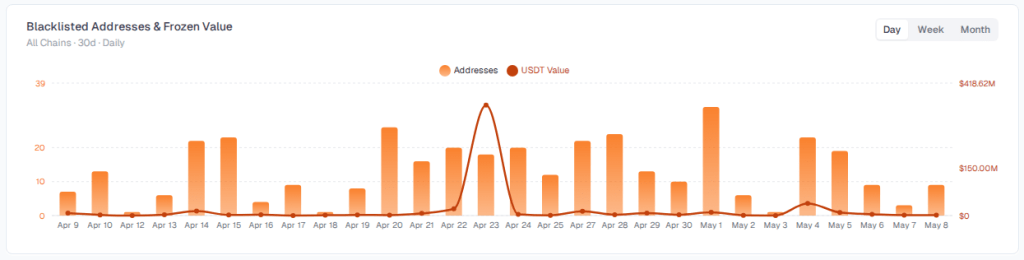
In the past 30 days alone, Tether froze over $514 million in USDT across 370 addresses on the Ethereum and Tron networks.

BlockSec’s USDT Freeze Tracker shows 328 of those addresses were on Tron, with about $506 million locked there. Ethereum accounted for 42 addresses and $8.73 million. The gap between the two networks points to Tron as the main front in Tether’s enforcement push.
Source: BlockSec

The pace is picking up. All of 2025 saw Tether blacklist 4,163 addresses and freeze a combined $1.26 billion. At the current rate, that annual total could be surpassed well before December.

A broader study covering 2023 through 2025 put the cumulative figure at roughly $3.3 billion across 7,268 addresses — far ahead of rival stablecoin issuer Circle over the same period.

Law Enforcement Plays A Growing Role

Some of the largest recent freezes were tied directly to government investigations. In April, Tether coordinated with the US Treasury’s Office of Foreign Assets Control to lock more than $344 million in USDT across two Tron addresses.

Bitcoin is currently trading at $80,349. Chart: TradingView

Officials said those wallets were linked to suspected sanctions evasion involving Iran. Months earlier, in February, Tether assisted authorities in seizing over $61 million connected to pig butchering scams — a form of fraud where victims are manipulated into sending large sums under false pretenses.

Tether had previously disclosed that it froze around $4.2 billion in tokens over three years due to links with illicit activity, with $3.5 billion of that amount locked since 2023 as law enforcement agencies stepped up crypto-related investigations.

Broader Questions Around Freeze Powers

The surge in blacklisting has sparked debate beyond stablecoins. Some decentralized finance projects have used upgradeable contracts and admin controls to halt or recover funds after major exploits, raising questions about who holds those powers and when they should be used.

For stablecoins like USDT, issuers retain direct control over minting and burning. Data shows these freeze mechanisms are now a routine part of fraud, sanctions, and scam investigations — used not occasionally, but consistently and at scale.

Featured image from Halo, chart from TradingView

Domande pertinenti

QWhat percentage of Tether-blacklisted wallets in 2025 were later removed, and what happens to the funds?

AOnly 3.6% of Tether-blacklisted addresses in 2025 were later removed. More than half of the funds tied to those wallets were permanently destroyed using the 'destroyBlackFunds' contract function.

QHow much USDT did Tether freeze in the past 30 days, and which blockchain network was most impacted?

AIn the past 30 days, Tether froze over $514 million in USDT across 370 addresses. The Tron network was the most impacted, with 328 addresses and about $506 million frozen, compared to 42 addresses and $8.73 million on Ethereum.

QWhat was the cumulative amount of USDT frozen by Tether from 2023 through 2025, and how does it compare to its rival Circle?

AFrom 2023 through 2025, Tether froze roughly $3.3 billion in USDT across 7,268 addresses. This amount is far ahead of what its rival stablecoin issuer, Circle, froze over the same period.

QWhat were two notable law enforcement-related Tether freezes mentioned in the article?

ATwo notable law enforcement-related freezes were: 1) In April, Tether coordinated with the U.S. Treasury's OFAC to freeze over $344 million in USDT linked to suspected sanctions evasion involving Iran. 2) In February, Tether assisted in seizing over $61 million connected to pig butchering scams.

QWhat broader debate has the surge in Tether blacklisting sparked, according to the article?

AThe surge in Tether blacklisting has sparked a broader debate about who holds freeze powers and when they should be used, extending beyond stablecoins to decentralized finance projects that use upgradeable contracts and admin controls to halt or recover funds after major exploits.

Letture associate

I've Been a Divorce Lawyer for 26 Years: How Has Cryptocurrency Become a New Tool for the Wealthy to Hide Assets?

Natalie Brunell reports on insights from divorce lawyer James Sexton, who has 26 years of experience. He argues that money itself is not the root of marital breakdown; rather, emotional disconnection is the core issue. While financial hardship increases divorce risk, excessive wealth can also make divorce easier by reducing the incentive to work on the relationship. Sexton discusses financial management in marriages, advocating for transparency and a "yours, mine, and ours" system that balances shared finances with individual autonomy and privacy. He notes the growing normalization of prenuptial agreements, especially among younger generations. A significant portion focuses on cryptocurrency's role in divorce. Sexton explains that crypto became a new tool for hiding assets due to its early anonymity and complexity. He highlights that many lawyers and spouses lack understanding, allowing knowledgeable parties to gain advantages. He cites a New York legal form that only added a specific crypto disclosure field in 2026. On saving relationships, Sexton emphasizes small, consistent acts of reconnection, affirmation, and expressing appreciation, which he finds more effective than criticism. He concludes that fostering warmth and kindness is a simple yet powerful way to strengthen bonds and, in his words, "put divorce lawyers out of business."

marsbit16 min fa

I've Been a Divorce Lawyer for 26 Years: How Has Cryptocurrency Become a New Tool for the Wealthy to Hide Assets?

marsbit16 min fa

Turing Award Laureate Sutton's New Work: Using a Formula from 1967 to Solve a Major Flaw in Streaming Reinforcement Learning

New research titled "Intentional Updates for Streaming Reinforcement Learning" (arXiv:2604.19033v1), involving Turing Award laureate Richard Sutton, addresses a core challenge in deep reinforcement learning (RL): the "stream barrier." Current deep RL methods typically rely on replay buffers and batch training for stability, failing catastrophically when learning online from single data points (streaming). The authors propose a fundamental shift: instead of prescribing how far to move parameters (a fixed step size), their "Intentional Updates" method specifies the desired change in the function's output (e.g., a 5% reduction in value prediction error). It then calculates the step size needed to achieve that intent. This idea is inspired by the Normalized Least Mean Squares (NLMS) algorithm from 1967. Applied to value and policy learning, this yields algorithms like Intentional TD(λ) and Intentional AC. The method inherently stabilizes learning by adapting the step size based on the local gradient landscape, preventing overshooting/undershooting. In experiments on MuJoCo continuous control and Atari discrete tasks, Intentional AC achieved performance rivaling batch-based algorithms like SAC in a streaming setting (batch size=1, no replay buffer), while being ~140x more computationally efficient per update. The work demonstrates significant robustness, reducing reliance on numerous stabilization tricks. A remaining challenge is bias in policy updates due to action-dependent step sizes. Overall, this approach advances efficient, online, "learn-as-you-go" RL, enabling adaptive systems without massive data buffers or compute clusters.

marsbit24 min fa

Turing Award Laureate Sutton's New Work: Using a Formula from 1967 to Solve a Major Flaw in Streaming Reinforcement Learning

marsbit24 min fa

From KYC to KYA, Is It Time to Give AI Agents Their Own 'ID Cards'?

Titled "From KYC to KYA: Is It Time to Issue 'Identity Cards' for AI Agents?", this article discusses the emerging concept of Know Your Agent (KYA) as AI agents become increasingly autonomous. In Agent-to-Agent (A2A) scenarios, where agents execute contracts, payments, and trades without human intervention, the lack of a shared identity standard creates risks like unauthorized transactions, fraud, and accountability gaps. KYA acts as a trust layer to verify an agent's origin, authority, and accountability. The need for KYA is most critical outside centralized platforms (like Google or Coinbase), such as in decentralized exchanges (DEX), A2A payments, and merchant payments. Several key players are building KYA infrastructure: - **ERC-8004**: A proposed Ethereum standard that issues a unique AgentID as an NFT, building on-chain identity, reputation, and validation systems. - **Visa TAP**: Visa's solution issues agent identity credentials, with transactions verified via triple signatures (legitimacy, delegator, payment method). - **Trulioo**: Extends its KYC/KYB compliance infrastructure using a Digital Passport for Agents (DAP), issued after verifying both the developer and user, and refreshed per transaction. - **Sumsub**: Focuses on post-issuance real-time verification, detecting agent anomalies during transactions using its existing compliance systems. Regulatory bodies are also acting. The EU AI Act mandates operator identification in logs for high-risk AI systems, the US NIST prioritizes agent identity management standards, and Singapore has released a national AI governance framework. Similar to how the 2019 FATF Travel Rule impacted crypto exchanges, possessing KYA infrastructure may determine market entry in the AI agent era. The market is expected to segment rather than produce a single winner, with success depending on integrations with merchants, payment networks, and KYC client bases.

marsbit1 h fa

From KYC to KYA, Is It Time to Give AI Agents Their Own 'ID Cards'?

marsbit1 h fa

The Next Generation of Payments Lies Not in the Payment Layer

The Next-Generation of Payment is Not in the Payment Layer This is the second piece in a series analyzing Stripe's AI strategy. The series stems from Stripe's vision of becoming the economic infrastructure for the AI Agent era, announced at Stripe Sessions 2026. A key debate centers on whether Know Your Agent (KYA) is merely an upgrade to existing payment systems. The author argues the opposite: payment will become a subsystem of KYA, not the other way around. Historically, major payment innovations (online banking, mobile wallets, QR codes) emerged from new transaction scenarios that broke the underlying assumptions of old systems, not from optimization within the payment layer itself. Agent economy is that new scenario, and KYA is the foundational infrastructure growing to support it. KYA's proposed five layers—Agent Identity, Authorization Scope, Intent Signing, Liability Chain Auditing, and Credit Rating—extend far beyond payments. Only authorization and auditing directly touch the payment链路. Identity, intent, and credit layers serve broader needs like cross-platform calls, AI alignment, and permission management. Stripe's strategic moves validate this view. Its focus on "economic infrastructure for AI," investments in protocols like Agentic Commerce Protocol (an identity/session protocol), Shared Payment Tokens, stablecoin infrastructure, embedded wallets, and its own Tempo blockchain for settlement, all point to building the KYA layer, not just optimizing payments. Data shows the core challenge in AI commerce has shifted upstream: determining "who this is, what they intend to do, and if they deserve resources" happens long before checkout. This is why Stripe is moving its Radar fraud prevention from the transaction moment to the entire user lifecycle—a KYA-layer concern. Legally, ultimate responsibility will still fall on a human, as laws like AB 316 dictate. However, in a distributed,网状 liability chain involving users, Agent platforms, model providers, and payment protocols, KYA's role is to use cryptography to make every entity's actions and roles verifiable and traceable. This enables accountability where it was previously impossible to pinpoint evidence, fundamentally changing责任追溯, not just payment efficiency. The next-generation payment形态 will not be designed within the payment layer. It will emerge from the Agent economy scenario after the KYA infrastructure is established.

marsbit3 h fa

The Next Generation of Payments Lies Not in the Payment Layer

marsbit3 h fa

Trading

Spot
Futures
活动图片