On L1 Value Capture from Two Solana Proposals

marsbitPubblicato 2026-08-05Pubblicato ultima volta 2026-08-05

Introduzione

The article, "Discussing L1 Value Capture Through Two Solana Proposals," by Max Resnick, explores how Layer 1 (L1) blockchain tokens derive their fundamental value, drawing parallels to traditional asset pricing theory. Resnick argues that L1 token value, like stock value, stems from claims on future income streams for holders, not merely from network activity or technological promise. This value is captured when fees are either burned (economically akin to a buyback) or distributed to stakers (akin to dividends). Inflationary staking rewards, by contrast, redistribute value among holders rather than creating it. The core challenge is the quality and defensibility of fee-based revenue. High-quality fees come from sustainable, recurring demand for the network's economic utility (e.g., long-term financial activity), not from transient speculation (e.g., meme coins, airdrops). The strength of a blockchain's network effects—liquidity, applications, users—can make its revenue more defensible and grant it greater pricing power than often assumed. The article proposes a foundational valuation framework for L1s, separating revenue (fees captured for token holders), costs, and total token supply. A key accounting principle is that inflationary rewards should not be counted as a cost unless the newly minted tokens are symmetrically counted as a value input; otherwise, it misrepresents profitability. Finally, Resnick discusses the economics of increasing protocol fees to boost reven...

Author: Max Resnick, Chief Economist at Anza

Compiled by: Jiahuan, ChainCatcher

I am publishing this article as SIMD 550 (doubling the rate of inflation reduction) and SIMD 553 (resource costs) are about to enter the voting stage. This piece is not a specific commentary on these two proposals; I have already left my comments on the respective GitHub proposals. Here, I primarily discuss how the problems these proposals aim to address relate to the valuation of L1s.

Part 1: The Establishment of Asset Pricing Theory

Before asset pricing theory was formally established, investors were not short of methods to value companies. Some focused on hard assets and liquidation value, others emphasized profits, dividends, growth, management quality, or market psychology. There were many metrics available; what was truly missing was a rigorous framework to explain exactly which metrics determine value and how these metrics should be weighed against each other.

By the late 1920s, on the eve of the Great Depression, this ambiguity had become dangerous. Investors could cite facts like profit growth, market expansion, new technologies, and improved corporate governance, but these facts were often used to justify market prices rather than to derive asset value.

Graham and Dodd (1934) later described that era as one where analysis gave way to "potential and prophecy." Even when data was presented, it became "pseudo-analysis to support the illusions of the moment."

Anyone who frequently indulges in Crypto Twitter should find this scene familiar. Today's discussions around L1 tokens are similarly filled with the potential, prophecy, and pseudo-analysis that characterized the stock market of the late 1920s.

The number of people participating in blockchain development is at a record high. Transaction activity is at an all-time peak. Tokens will become currency, collateral, digital oil, or a call option betting on the future financial system.

Some of these claims may be true and could even imply upside for the underlying network. But if they cannot explain how these factors translate into token holder surplus, they do not constitute a coherent valuation framework.

John Burr Williams was the first to push asset pricing towards rigor. In "The Theory of Investment Value," Williams (1938) argued that value is "the present worth of future dividends, or of future coupons and principal in the case of a bond."

Gordon (1959) later expressed the same idea more succinctly: "A stock, like any other asset, is worth to a buyer only the benefits he expects to receive from it in the future."

Equity has value not because a company is impressive, active, important, or technologically irreplaceable. It has value because equity grants shareholders a claim on future income.

For L1 tokens, value can accrue in two ways. The first is fee burning, which economically resembles a buyback. The second is distributing fees to stakers, which economically resembles a dividend.

Staking rewards funded by issuance are different. They are neither income created by the network nor a cost borne by the network. The protocol creates new tokens and distributes them to stakers while diluting the holdings of non-stakers.

This mechanism may be necessary to secure the network and may determine who gradually comes to own the network over time. But from the perspective of all token holders, it neither creates nor destroys value.

A blockchain can process millions of transactions while creating almost no value for token holders because the surplus may be captured by users, applications, validators, or other intermediaries. Conversely, a chain with less activity may be more valuable if it converts a larger proportion of economic activity into token holder value.

But not all fees are created equal. The 'R' in ARR stands for recurring, meaning sustainable and repeatable income. Dichev, Graham, Harvey, and Rajgopal (2013) noted that high-quality earnings should be "sustainable and repeatable." The same standard applies to L1 fees.

One dollar of fees generated by long-term financial activity is not the same as one dollar generated by airdrops, meme coin mania, cascading liquidations, or temporary network congestion.

Some fees come from users' ongoing demand for scarce block space. Others are merely exhaust from speculative cycles. Once incentives disappear, volatility subsides, or users run out of money, these activities also vanish.

Fee quality depends on persistence and defensibility.

Are users paying because the chain provides long-term economic utility, or because a short-term activity happens to be on this chain? Can the protocol continue to charge these fees without driving users, applications, or order flow elsewhere? Can the token continue to capture these profits, or will this value eventually be competed away by validators, applications, searchers, block builders, users, or other chains?

Historically, crypto investors have often made two opposite errors regarding earnings quality simultaneously.

On one hand, they overestimated earnings quality because much crypto activity is speculative, reflexive, and episodic.

On the other hand, they underestimated earnings quality because they did not fully appreciate the strength of L1 network effects. Liquidity, applications, wallets, infrastructure, users, developers, assets, and order flow reinforce each other.

These network effects may make certain fees harder for competitors to capture than they initially appear. They also suggest that dominant blockchains like Solana and Ethereum may have stronger pricing power than the market generally believes, potentially benefiting from raising fees.

Part 2: Accounting Standards for Revenue, Inflation, and Total Supply

The next step is to specify a minimal fundamental model for L1s that can lead to valuation multiples.

It may be premature to call it the "standard model" now. There is currently no universally accepted standard model for L1 valuation. But the categorization below is the form I believe a standard model should take. It intentionally mirrors the methods stock analysts use to value companies.

The reason this needs to be explicitly written down is that there isn't even consensus on the most basic accounting objects.

I've discussed this framework with some of the smartest people I know, and they often disagree on fundamental questions. Are validator rewards funded by inflation considered a cost? Should foundation expenditures be treated as operating expenses? Should the unspent portion of foundation tokens be included in the token supply? Should MEV paid to validators count as protocol revenue, validator revenue, or neither?

Some of the confusion may stem from the fact that there can be more than one correct way to write a valuation model. Accounting classifications are not unique. As long as the corresponding offsetting items are also adjusted, you can move an item from one side of the ledger to the other while keeping the model correct.

But this flexibility is also dangerous. Many models are internally consistent, but many are not. Having multiple correct methods does not mean there are fewer incorrect ones.

Inflation rewards are the simplest example.

Staking rewards funded by issuance are essentially rewards paid by token holders to stakers via dilution. From the perspective of all token holders combined, the two offset each other. The protocol does not earn revenue when it mints new tokens, nor does it incur a real external cost when distributing these tokens to stakers.
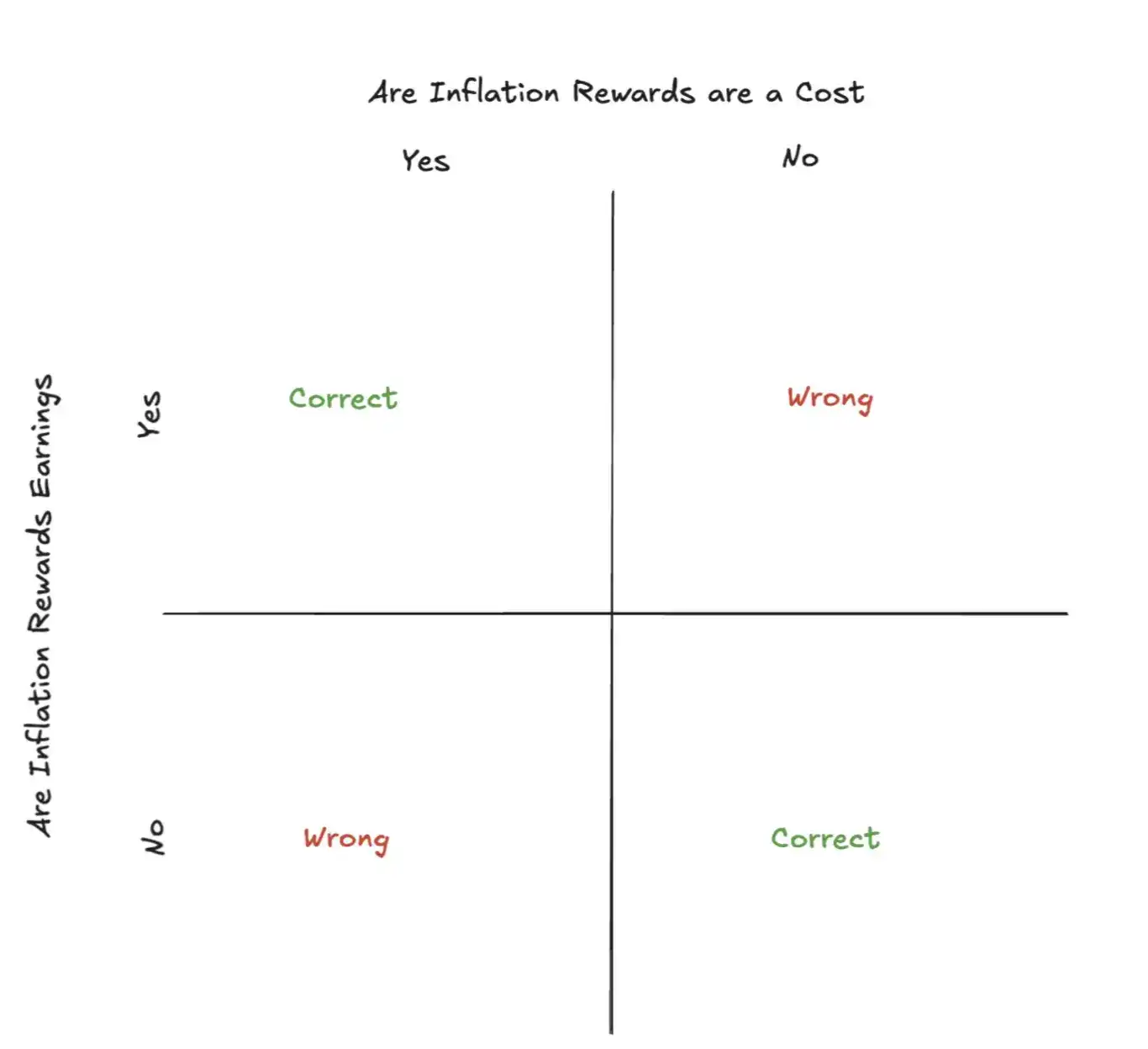
You can create a correct model that treats inflation rewards as a cost, but only if you simultaneously count newly issued tokens as a source of value to offset that cost. Otherwise, the model leads to absurd conclusions, such as Solana being unprofitable because it pays large staking rewards.

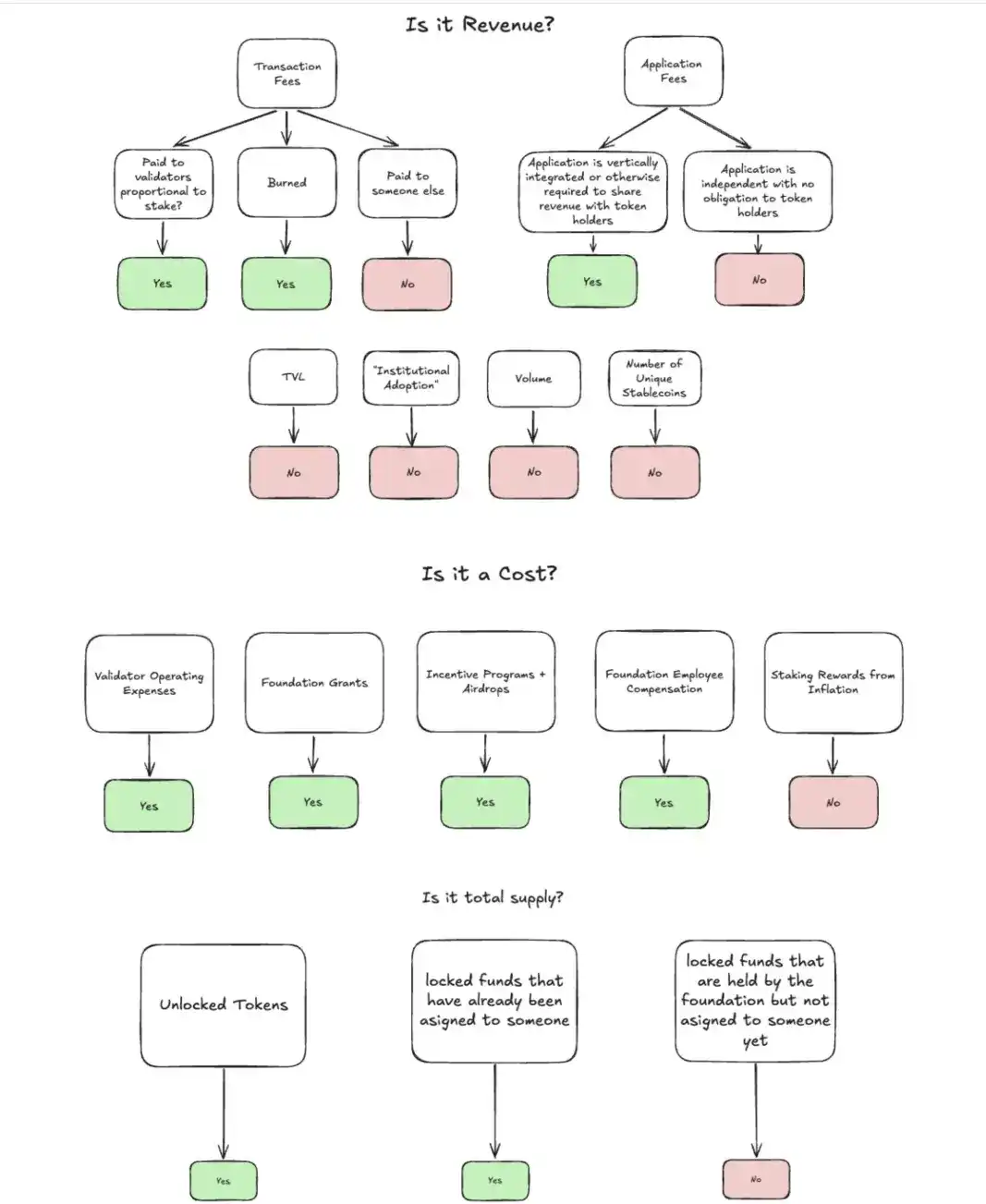
The categorization below is my proposed baseline. It separates three objects: revenue, costs, and total supply.

I believe these definitions most closely resemble the models stock analysts are already familiar with, making them easier to understand and reason about.

Other classifications may be correct, but deviations from this one must have clear justification. Proprietary models come with two costs.

First, they are harder for others to understand. Second, it is easy to miss dependencies between items.

For example, if foundation expenditures are classified as a cost, then the unspent portion of foundation tokens cannot also be included in the total supply, or it would be double-counted. If inflation rewards are classified as a cost, newly issued tokens must be treated symmetrically.
Part 3: Supply, Demand, and Price

Recently, several blockchains have explicitly raised fees with the goal of increasing revenue. However, revenue equals price multiplied by quantity.

Raising fees increases the revenue contributed by transactions that remain, but it also causes some transactions to disappear. Therefore, the net effect of a fee increase on revenue is uncertain; it hinges on the price elasticity of demand for transactions.

To understand the reasoning behind these adjustments, I spoke with some of the decision-makers involved. They believed the fees on these chains were originally too low, so demand was relatively inelastic within that price range.

This argument might apply to specific cases but is not universally true.

I have done some past research utilizing randomness in EIP-1559 pricing. The analysis showed that the price elasticity of gas demand is roughly between 0.6 and 0.8. That is, a 10% price increase leads to a 6% to 8% decrease in quantity demanded.

Moreover, this data only reflects short-term price fluctuations and does not capture the aggregate effects of applications migrating off-chain or optimizing their programs.
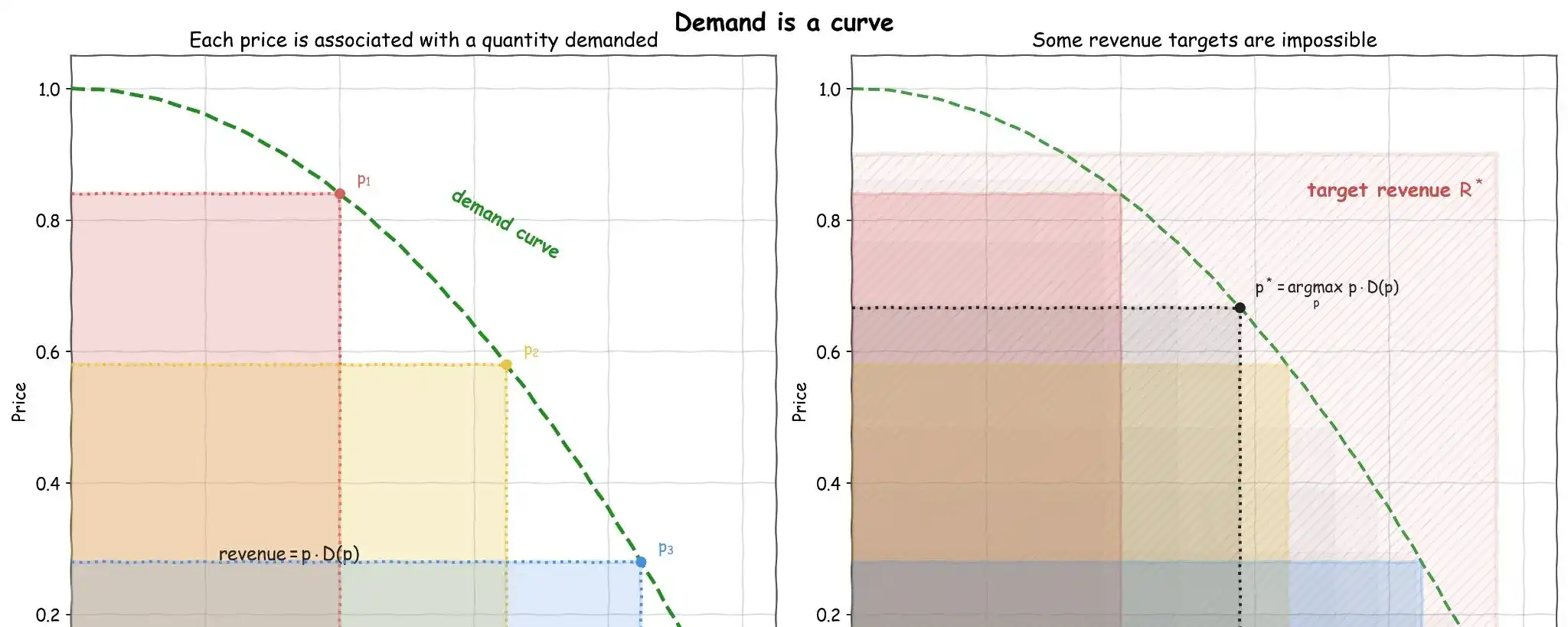
Therefore, a flat fee is a rather blunt instrument for generating revenue. Different types of on-chain transactions have different willingness to pay.

A small wallet transfer, a large stablecoin transfer, and a liquidation may consume the same block space, but they generate different total surplus and have different willingness to pay.
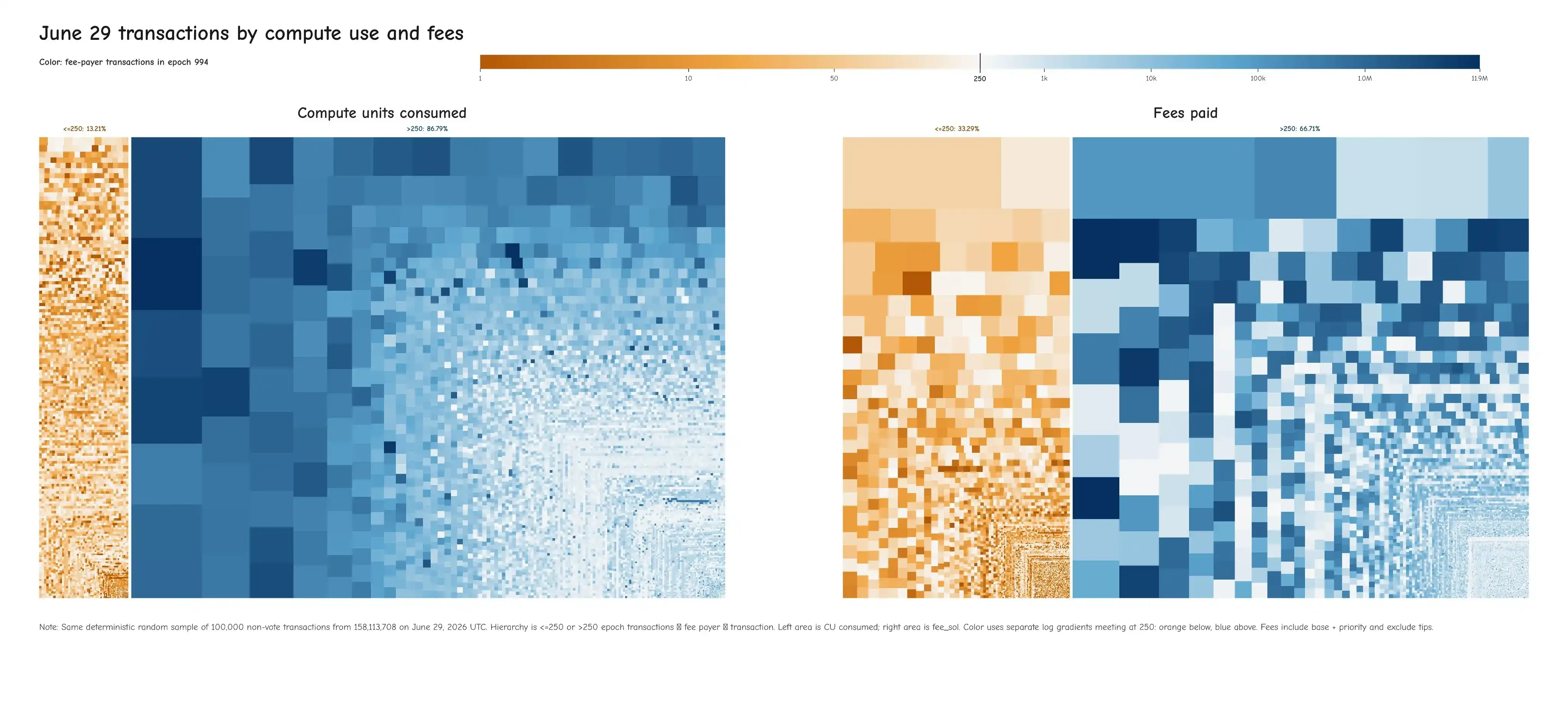
Note: Blue dots represent fee payers who initiated more than 250 transactions in the period, suggesting they are more likely to be bots and thus have higher price elasticity. Bots typically have thin profit margins, so they tend to reduce resource consumption significantly when prices rise.

Protocols want to charge higher fees for transactions with a higher willingness to pay. Computation-based fees are a step in this direction but not thorough enough.

For financial activity, the nominal transaction amount is often a better indicator of willingness to pay than computational load. This is why exchanges typically charge fees based on basis points.

Token programs can provide a way to charge fees proportional to transaction value. By modifying token programs, a small percentage-based fee can be levied on token transfers. This way, even if a high-value transfer uses similar computational resources as a low-value one, the high-value transfer still pays more.


Crypto di tendenza

Domande pertinenti

QAccording to the article, what are the two primary ways that value can be aggregated to L1 token holders, and how do they differ economically from staking rewards funded by inflation?

AAccording to the article, value can be aggregated to L1 token holders in two primary ways: 1) Burning fees, which is economically equivalent to a share buyback, and 2) Distributing fees to stakers, which is economically equivalent to paying a dividend. These differ from staking rewards funded by inflation, which are neither network income nor a real external cost. They represent a redistribution from non-stakers to stakers through dilution, not the creation of value for token holders as a whole.

QWhat is the key difference between 'high-quality' fees and lower-quality fees for an L1 blockchain, as discussed in the article?

AThe key difference lies in the sustainability and defensibility of the fees. High-quality fees are recurring and repeatable, stemming from persistent demand for scarce block space due to long-term economic utility. Lower-quality fees are temporary and non-recurring, often generated by speculative activities like airdrop farming, memecoin frenzies, liquidations, or temporary network congestion that can disappear when incentives fade or volatility subsides.

QIn the author's proposed 'standard model' for L1 accounting, how should inflationary staking rewards and new token issuance be treated, and why?

AIn the author's proposed standard model, inflationary staking rewards should not be treated as a network cost, and newly issued tokens should not be treated as network income. This is because, from the perspective of all token holders, they are offsetting internal transfers—the dilution from new issuance is the 'cost' paid by holders to fund the staking rewards. Treating them as a cost without a corresponding income entry would incorrectly suggest the network is unprofitable.

QWhat caution does the article offer regarding the strategy of increasing protocol fees to raise revenue, and what economic concept is central to this caution?

AThe article cautions that increasing protocol fees does not automatically lead to higher revenue because revenue equals price multiplied by quantity. Raising fees can reduce the quantity of transactions. The central economic concept is the price elasticity of demand. If demand is elastic, a fee increase will lead to a proportionally larger drop in transactions, reducing total revenue. The article cites research suggesting Ethereum gas demand has a price elasticity between 0.6 and 0.8, meaning it is somewhat elastic.

QWhat is the proposed alternative to a uniform fee structure that the author suggests could better capture value from high-willingness-to-pay transactions?

AThe author suggests that a more effective alternative to a uniform fee structure would be to implement fees based on the nominal transaction value, similar to how exchanges charge basis points. This could be done by modifying token programs to levy a small proportional fee on token transfers. This way, a high-value transfer pays more than a low-value transfer even if they consume similar computational resources, better capturing value from transactions with a higher willingness to pay.

Letture associate

MARA Opens 'Slipstream' to Public as 'Coldcard' Victims Race to Save Assets

MARA Holdings, a Nasdaq-listed Bitcoin mining and AI infrastructure company (formerly Marathon Digital), has opened its "Slipstream" service to the public. Slipstream allows users to send Bitcoin transactions directly to MARA's mining pool, keeping them hidden from the public mempool until mined into a block, rather than broadcasting them openly. The public launch coincides with a critical vulnerability discovered in Coldcard hardware wallets. A firmware bug dating to March 2021 significantly reduced the randomness when generating wallet seed phrases, making funds vulnerable to theft. Hackers have already stolen an estimated 1,816 BTC (approx. $116 million) from over 5,200 wallets. For users needing to move funds from vulnerable wallets, especially those with multi-signature setups, broadcasting a standard transaction publicly can reveal key details and allow attackers to intercept it. Slipstream mitigates this risk by keeping the transaction private until confirmation. MARA first launched Slipstream in February 2024 for large or non-standard transactions. It does not charge an extra fee; users only pay standard Bitcoin network fees. However, confirmation timing depends on MARA's mining luck, as it controls roughly 5.37% of the Bitcoin network's total hashrate. The Bitcoin community views Slipstream's open access as a practical crisis tool for Coldcard holders, not a permanent replacement for the public mempool for everyday transactions.

cryptonews.ru12 min fa

MARA Opens 'Slipstream' to Public as 'Coldcard' Victims Race to Save Assets

cryptonews.ru12 min fa

Trading

Spot

Articoli Popolari

Cosa è SOLANA

HarryPotterWifHatMyroWynn10Inu,$solana: Un’Immersione nel Trendy Meme Coin Project Introduzione Nel panorama in continua evoluzione delle criptovalute, progetti innovativi emergono continuamente, catturando l'immaginazione di investitori ed appassionati. Uno di questi progetti è HarryPotterWifHatMyroWynn10Inu,$solana, una meme coin che ha iniziato a ritagliarsi una sua nicchia all'interno della comunità crypto. Questo articolo ha l'obiettivo di fornirti una panoramica completa del progetto, spiegandone lo scopo, l'architettura, il creatore, gli investitori e i traguardi significativi lungo il percorso. Cos'è HarryPotterWifHatMyroWynn10Inu,$solana? Panoramica HarryPotterWifHatMyroWynn10Inu,$solana è un progetto di meme coin strutturato sulla blockchain di Solana – una piattaforma rinomata per la sua scalabilità e velocità. Con l'intento di portare gioia e creatività nello spazio crypto, questo progetto non solo funge da token di scambio ma anche come catalizzatore per la generazione e la condivisione di contenuti meme. La comunità al suo interno è incoraggiata a partecipare attivamente, fornendo un ecosistema dinamico dove la creatività e la collaborazione prosperano. Obiettivi e Scopi Nella sua essenza, il progetto mira a favorire un ambiente dove gli appassionati di meme possano riunirsi, condividere e creare nuovi contenuti meme. Questo approccio narrativo infonde entusiasmo nella comunità, promuovendo il coinvolgimento e allo stesso tempo evidenziando le robuste funzionalità insite nella blockchain di Solana. Costruendo un progetto incentrato sulla comunità, HarryPotterWifHatMyroWynn10Inu,$solana desidera inoltre esplorare l'impatto sociale delle valute digitali come mezzo di espressione. Chi è il Creatore di HarryPotterWifHatMyroWynn10Inu,$solana? L'identità del creatore dietro HarryPotterWifHatMyroWynn10Inu,$solana rimane avvolta nel mistero. Il progetto è stato strutturato in modo tale che la proprietà sia stata rinunciata; pertanto, prospera come un'iniziativa guidata dalla comunità. Questa decentralizzazione promuove la trasparenza e la partecipazione democratica tra tutti i soggetti coinvolti. Tale approccio è sempre più popolare nel mondo delle meme coin, dove il coinvolgimento della comunità regna sovrano. Chi sono gli Investitori di HarryPotterWifHatMyroWynn10Inu,$solana? Attualmente, non ci sono informazioni pubblicamente disponibili riguardo agli specifici investitori o fondazioni che supportano HarryPotterWifHatMyroWynn10Inu,$solana. L'assenza di investitori noti sottolinea ulteriormente l'etica orientata alla comunità del progetto, che si mantiene indipendente dai tradizionali schemi finanziari. Questa indipendenza consente al progetto di sviluppare la propria identità libera da pressioni esterne, facendo affidamento invece sull'interesse collettivo della sua base utenti. Come Funziona HarryPotterWifHatMyroWynn10Inu,$solana? Modello Economico Il progetto impiega un modello economico unico che sostiene la sua funzionalità e il coinvolgimento degli utenti. Le transazioni all'interno di HarryPotterWifHatMyroWynn10Inu,$solana sono progettate per essere vantaggiose per tutte le parti coinvolte. Ogni operazione comporta una commissione, che viene successivamente redistribuita tra gli attuali possessori, aumentando al contempo il pool di liquidità. I componenti chiave di questo modello includono: Meccanismo di Riflesso: Una parte delle commissioni di transazione viene restituita ai possessori, promuovendo l'investimento a lungo termine nel token. Acquisizione di Pool di Liquidità: I fondi sono destinati a migliorare la liquidità, garantendo che le operazioni di acquisto e vendita possano essere eseguite senza intoppi. Meccanismi di Bruciatura: Una parte dei token potrebbe essere bruciata per creare scarsità, aumentando potenzialmente il valore man mano che la domanda cresce. Questo design incoraggia un ecosistema autosufficiente che prospera grazie alle interazioni e agli investimenti della comunità. Coinvolgimento della Comunità Nel cuore di HarryPotterWifHatMyroWynn10Inu,$solana c'è il valore attribuito al coinvolgimento della comunità. Permettendo agli utenti di partecipare allo sviluppo del progetto attraverso varie attività, come la creazione di meme e promozioni, il progetto favorisce un ecosistema vibrante dove la creatività può fiorire. Cronologia di HarryPotterWifHatMyroWynn10Inu,$solana La traiettoria di HarryPotterWifHatMyroWynn10Inu,$solana presenta diversi eventi degni di nota che hanno plasmato la sua posizione attuale nella comunità crypto: Creazione: La data specifica di creazione rimane non divulgata, ma l'ideazione del progetto è radicata nella cultura meme che permea l'era digitale. Passaggio alla Comunità: Dopo la rinuncia alla proprietà da parte del suo creatore, il progetto è passato a un modello guidato dalla comunità, permettendo a tutti i partecipanti di avere una parte nel suo successo. Audit e Collezione NFT: In un tentativo di aumentare la credibilità, il progetto ha completato un audit approfondito, lanciando simultaneamente una collezione NFT che serve a incarnare la sua etica centrata sui meme. Partnership e Sviluppo: Il progetto è attualmente impegnato a esplorare potenziali partnership con altri token e a organizzare lo sviluppo di un sito web unico e opzioni di merchandising basate sui suoi leggendari meme. Punti Chiave In sintesi, HarryPotterWifHatMyroWynn10Inu,$solana si presenta come un attore notevole nel settore delle meme coin delle criptovalute. Ecco alcuni dei punti salienti: Iniziativa Guidata dalla Comunità: Il progetto prospera come uno sforzo collaborativo, incoraggiando contributi attivi da parte dei membri della comunità mentre si distacca da pretese di proprietà. Modello Economico Innovativo: Utilizzando meccanismi di riflesso, acquisizione di liquidità e bruciatura, crea un ambiente finanziario robusto e coinvolgente per gli utenti. Coinvolgimento con NFT e Merchandising: Con il lancio di una collezione NFT, il progetto mira a approfondire il coinvolgimento all'interno della sua comunità, rafforzando il legame tra cultura meme e valuta digitale. Esplorazione di Partnership: L'iniziativa non è stagnante – lo sviluppo in corso e le potenziali partnership indicano un approccio lungimirante volto alla crescita sostenuta. Conclusione Mentre HarryPotterWifHatMyroWynn10Inu,$solana continua a guadagnare slancio all'interno del panorama delle criptovalute, la sua combinazione unica di coinvolgimento della comunità, strutture economiche innovative e integrazione della cultura meme delineano il suo potenziale percorso futuro. Anche con il mistero che circonda le sue origini e le affiliazioni degli investitori, il progetto cattura una storia intrigante che parla dell'essenza dell'innovazione decentralizzata. In un mondo dove le criptovalute sono spesso viste attraverso una lente puramente finanziaria, HarryPotterWifHatMyroWynn10Inu,$solana dimostra che il movimento crypto incorpora creatività, comunità e collaborazione. Che tu sia un investitore esperto o un neofita, il percorso che si sta sviluppando di questo progetto di meme coin rappresenta sicuramente uno studio di caso coinvolgente degno di attenzione.

523 Totale visualizzazioniPubblicato il 2024.04.04Aggiornato il 2024.12.03

Cosa è SOLANA

Cosa è SOLANA 2.0

BarbieCrashBandicootRFK777Inu, $SOLANA 2.0: Un Nuovo Giocatore nel Paesaggio Cripto Introduzione a BarbieCrashBandicootRFK777Inu, $SOLANA 2.0 Nel paesaggio in continua evoluzione delle criptovalute, nuovi entrant catturano costantemente l'attenzione di investitori ed entusiasti. Tra questi progetti emergenti c'è BarbieCrashBandicootRFK777Inu, rappresentato dal simbolo della criptovaluta $SOLANA 2.0. Questa iniziativa unica combina elementi di glamour, avventura e cultura meme, proponendosi di sfidare le aspettative in un'area estremamente competitiva. Con aspirazioni di crescita e innovazione, questo progetto cattura lo spirito di un underdog che lotta contro giganti affermati. Che cos'è BarbieCrashBandicootRFK777Inu, $SOLANA 2.0? Alla sua essenza, BarbieCrashBandicootRFK777Inu è un progetto di criptovaluta che trae ispirazione da varie riferimenti culturali iconici. Includendo l'eleganza e il fascino associati a Barbie, l'energia dinamica di Crash Bandicoot e la spinta instancabile rappresentata da RFK, il progetto mira a offrire un'esperienza multifattoriale nel mondo delle criptovalute. Il principale obiettivo del progetto BarbieCrashBandicootRFK777Inu è quello di unire questi elementi disparati in un ecosistema coeso che attragga un vasto pubblico. Abbracciando la fantasia della cultura meme, rimanendo però ancorato ai principi di decentralizzazione e empowerment finanziario, il progetto si è posizionato come un'opzione convincente sia per investitori esperti che per neofiti del mondo cripto. Chi è il Creatore di BarbieCrashBandicootRFK777Inu, $SOLANA 2.0? Nonostante l'interesse crescente per BarbieCrashBandicootRFK777Inu, le informazioni riguardanti il suo creatore rimangono per lo più sconosciute. L'anonimato del suo fondatore o team di sviluppo solleva interrogativi sulla struttura e governance del progetto. Nel mondo delle criptovalute, non è raro che i progetti operino senza creatori pubblici. Questa mancanza di informazioni potrebbe scoraggiare alcuni potenziali investitori, mentre altri potrebbero vederla come un'opportunità per abbracciare lo spirito di decentralizzazione che sottende molte iniziative nel campo delle criptovalute. Chi sono gli Investitori di BarbieCrashBandicootRFK777Inu, $SOLANA 2.0? Attualmente, ci sono poche informazioni disponibili riguardo ai fondamenti d'investimento o alle organizzazioni che supportano BarbieCrashBandicootRFK777Inu. La mancanza di un sostegno d'investimento dettagliato per il progetto evidenzia la natura indipendente di numerose criptovalute. In questo caso, resta da vedere se il finanziamento del progetto provenga da un supporto della comunità a livello locale o dal supporto di entità finanziarie più grandi. Come Funziona BarbieCrashBandicootRFK777Inu, $SOLANA 2.0? BarbieCrashBandicootRFK777Inu è progettato con una serie di funzionalità che contribuiscono alla sua unicità all'interno dello spazio cripto affollato. Sebbene i dettagli tecnici specifici rimangano segreti, si prevede che il progetto incorpori funzionalità volte a migliorare il coinvolgimento degli utenti e a promuovere la crescita della comunità. La combinazione di influenze variegate—dalla moda e avventura ai giochi—incoraggia un'atmosfera inclusiva che si rivolge a interessi diversi. Inoltre, i legami del progetto con l'ecosistema $SOLANA 2.0 suggeriscono potenziali vantaggi tecnologici. Questo potrebbe includere velocità di transazione innovative, scalabilità e costi contenuti, allineandosi con le capacità tecniche della blockchain di Solana. I fondatori del progetto sembrano voler sfruttare questa base tecnologica per creare un'esperienza comunitaria duratura e un'offerta di prodotto sostanziale. Timeline di BarbieCrashBandicootRFK777Inu, $SOLANA 2.0 Il percorso di BarbieCrashBandicootRFK777Inu contiene diverse tappe chiave, fornendo spunti sullo sviluppo del progetto fino ad ora: Concettualizzazione del Progetto: Sono emerse idee iniziali riguardo alla fusione di glamour, avventura e cultura meme, dando forma al concetto unico del progetto. Creazione del Token: È stato istituito il token simbolico $SOLANA 2.0, progettato per incarnare le aspirazioni del progetto e attrarre l'interesse di potenziali investitori. Sviluppo del Progetto: Attualmente, il progetto è in fase di ulteriore sviluppo, con un'enfasi sulla sfida ai player consolidati nel campo delle criptovalute e sulla fornitura di offerte innovative. Queste tappe riflettono la traiettoria di crescita del progetto, evidenziando il suo impegno a sviluppare un'esperienza pionieristica nel campo delle criptovalute. Punti Chiave su BarbieCrashBandicootRFK777Inu, $SOLANA 2.0 Concetto Unico: BarbieCrashBandicootRFK777Inu si distingue per la fusione di elementi di glamour, avventura e cultura meme in un unico progetto di criptovaluta. Spirito da Underdog: Il progetto abbraccia una persona underdog, mirante a sfidare progetti di criptovaluta consolidati e ritagliarsi una nicchia nell'industria. Fase di Sviluppo: Sono in corso sforzi di sviluppo attivi, con l'intenzione di fornire offerte fresche e innovative in linea con le aspettative della comunità e degli investitori. Conclusione BarbieCrashBandicootRFK777Inu, rappresentato dal simbolo $SOLANA 2.0, è un nuovo e interessante entrant nel mercato delle criptovalute. La sua combinazione unica di riferimenti culturali e visione ambiziosa potrebbe risuonare con coloro che cercano valori alternativi nei progetti cripto. Sebbene lo stato sconosciuto del suo creatore e degli investitori possa sollevare sopracciglia, l'enfasi del progetto su fascino e avventura presenta una narrativa affascinante che espande i confini di ciò che le criptovalute possono incarnare. Man mano che il progetto continua a svilupparsi, sarà interessante osservare la sua evoluzione all'interno del più ampio paesaggio cripto e come si posizioni tra i suoi concorrenti. Per coloro che vi sono coinvolti, BarbieCrashBandicootRFK777Inu potrebbe svelare esperienze sorprendenti che ridefiniscono l'interazione con gli asset digitali. Per ora, mentre il progetto avanza, il suo percorso rimane un promemoria che l'innovazione nel settore cripto non conosce limiti, offrendo tutto, dall'eccitazione e intrattenimento alla possibilità di empowerment finanziario.

237 Totale visualizzazioniPubblicato il 2024.04.05Aggiornato il 2024.12.03

Cosa è SOLANA 2.0

Come comprare SOL

Benvenuto in HTX.com! Abbiamo reso l'acquisto di Solana (SOL) semplice e conveniente. Segui la nostra guida passo passo per intraprendere il tuo viaggio nel mondo delle criptovalute.Step 1: Crea il tuo Account HTXUsa la tua email o numero di telefono per registrarti il tuo account gratuito su HTX. Vivi un'esperienza facile e sblocca tutte le funzionalità,Crea il mio accountStep 2: Vai in Acquista crypto e seleziona il tuo metodo di pagamentoCarta di credito/debito: utilizza la tua Visa o Mastercard per acquistare immediatamente SolanaSOL.Bilancio: Usa i fondi dal bilancio del tuo account HTX per fare trading senza problemi.Terze parti: abbiamo aggiunto metodi di pagamento molto utilizzati come Google Pay e Apple Pay per maggiore comodità.P2P: Fai trading direttamente con altri utenti HTX.Over-the-Counter (OTC): Offriamo servizi su misura e tassi di cambio competitivi per i trader.Step 3: Conserva Solana (SOL)Dopo aver acquistato Solana (SOL), conserva nel tuo account HTX. In alternativa, puoi inviare tramite trasferimento blockchain o scambiare per altre criptovalute.Step 4: Scambia Solana (SOL)Scambia facilmente Solana (SOL) nel mercato spot di HTX. Accedi al tuo account, seleziona la tua coppia di trading, esegui le tue operazioni e monitora in tempo reale. Offriamo un'esperienza user-friendly sia per chi ha appena iniziato che per i trader più esperti.

2.0k Totale visualizzazioniPubblicato il 2024.12.12Aggiornato il 2026.06.02

Come comprare SOL

Discussioni

Benvenuto nella Community HTX. Qui puoi rimanere informato sugli ultimi sviluppi della piattaforma e accedere ad approfondimenti esperti sul mercato. Le opinioni degli utenti sul prezzo di SOL SOL sono presentate come di seguito.

活动图片