Wells Fargo and JPMorgan Chase Snap Up Over 10,000 BTC Each in a Single Quarter: Who's Quietly Accumulating in the Bear Market?

marsbitPubblicato 2026-08-17Pubblicato ultima volta 2026-08-17

Introduzione

Institutional Bitcoin Accumulation Defies Market Downturn in Q2 2026 Despite a 14.2% decline in Bitcoin's price in Q2 2026, institutional holdings in Bitcoin ETFs increased by 7.5%, indicating a significant bullish divergence. While total ETF holdings fell by 6.6%, institutional allocation grew to a record 44.2% of the total. Key players driving this trend include Wells Fargo and JPMorgan, each adding over 10,000 BTC during the quarter. The Abu Dhabi sovereign wealth fund also increased its position. Notably, Ameriprise Financial, a major US wealth manager, entered the market with a new position, signaling Bitcoin's integration into traditional wealth management channels. The total number of institutions reporting Bitcoin holdings via 13F filings decreased slightly by 6.8%, reflecting ongoing market pressures. However, the substantial growth in total institutional BTC held suggests that major players view current price levels as an attractive entry point. This accumulation during a bear market phase is seen as a strong positive signal for a potential market recovery.

Author: Bitcoin Strategy

Translation: TechFlow

TechFlow Insight: Bitcoin fell 14% in Q2, yet institutional 13F holdings increased by 7.5%. Smart money continued to accumulate at the bottom. Wells Fargo and JPMorgan Chase each added over 10,000 BTC in a single quarter, with Abu Dhabi's sovereign fund also following suit. This indicates institutions view current prices as an entry point, providing an important reference for judging the market bottom.

Dear Bitcoin holders,

In this week's Roxom "State of the Bitcoin Market" program, I discussed price action. I categorize this cycle as the institutional adoption and maturity cycle, with the primary catalyst being ETF approval.

We have repeatedly discussed that the main entry points for institutional adoption are ETFs and vault companies.

This is why Bitcoin Strategy publishes a quarterly institutional adoption report based on the latest institutional ETF holdings. The data comes from SEC 13F filings, which are required for institutions managing over $100 million in assets—the so-called "smart money."

Yesterday was the deadline, and the latest data for institutional ETF holdings in the second quarter of 2026 has been released.

In today's briefing, we will discuss the latest insights from these filings, which serve as a proxy indicator for institutional Bitcoin adoption. Let's dive right in!


Institutional Adoption Report: Q2 2026
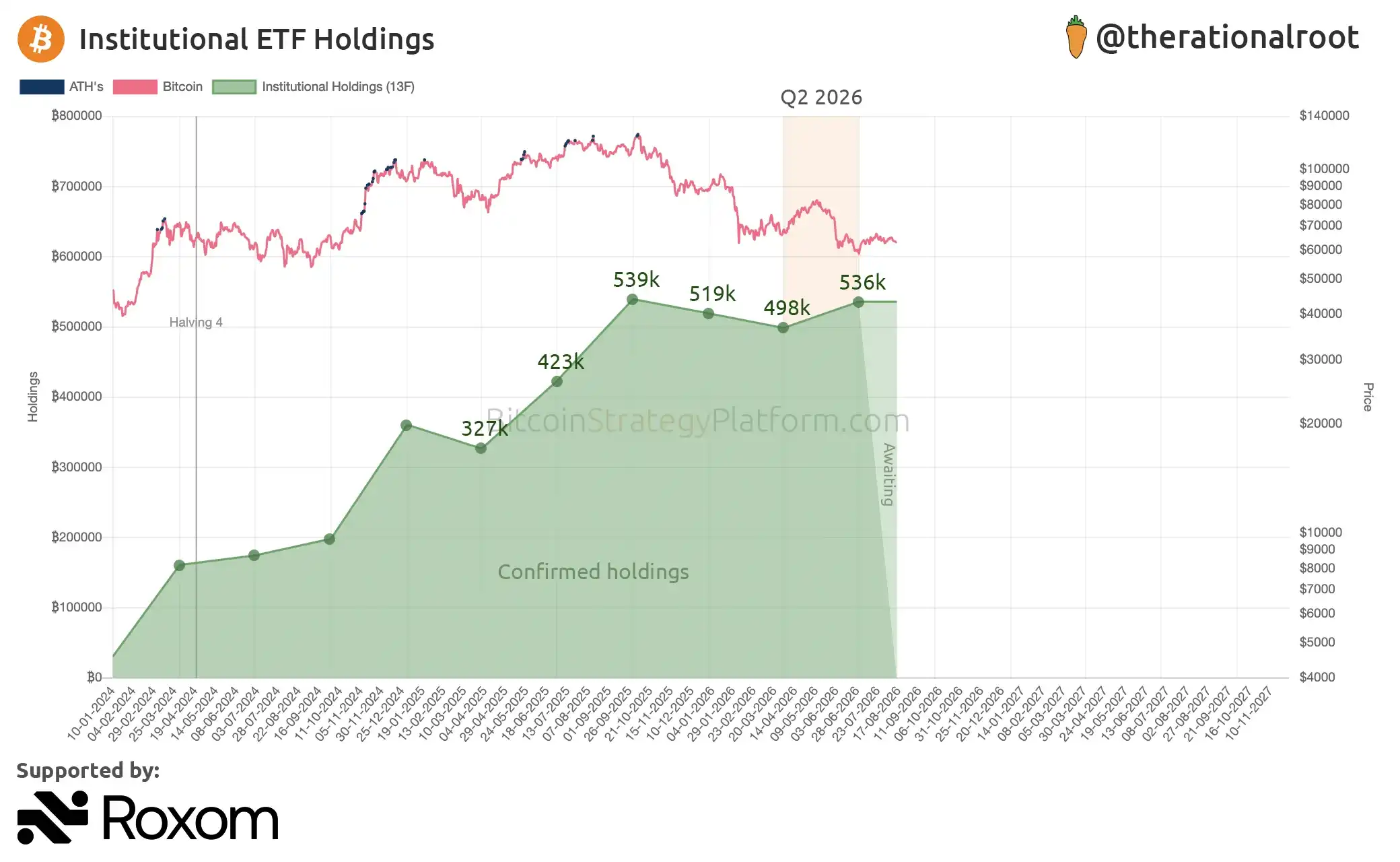
👉 Key Insight: In Q2, the Bitcoin price fell 14.2%, while institutional holdings increased 7.5%. This bullish divergence indicates that institutions continued to accumulate during Bitcoin's bottom formation.


Institutional Share of ETF Holdings
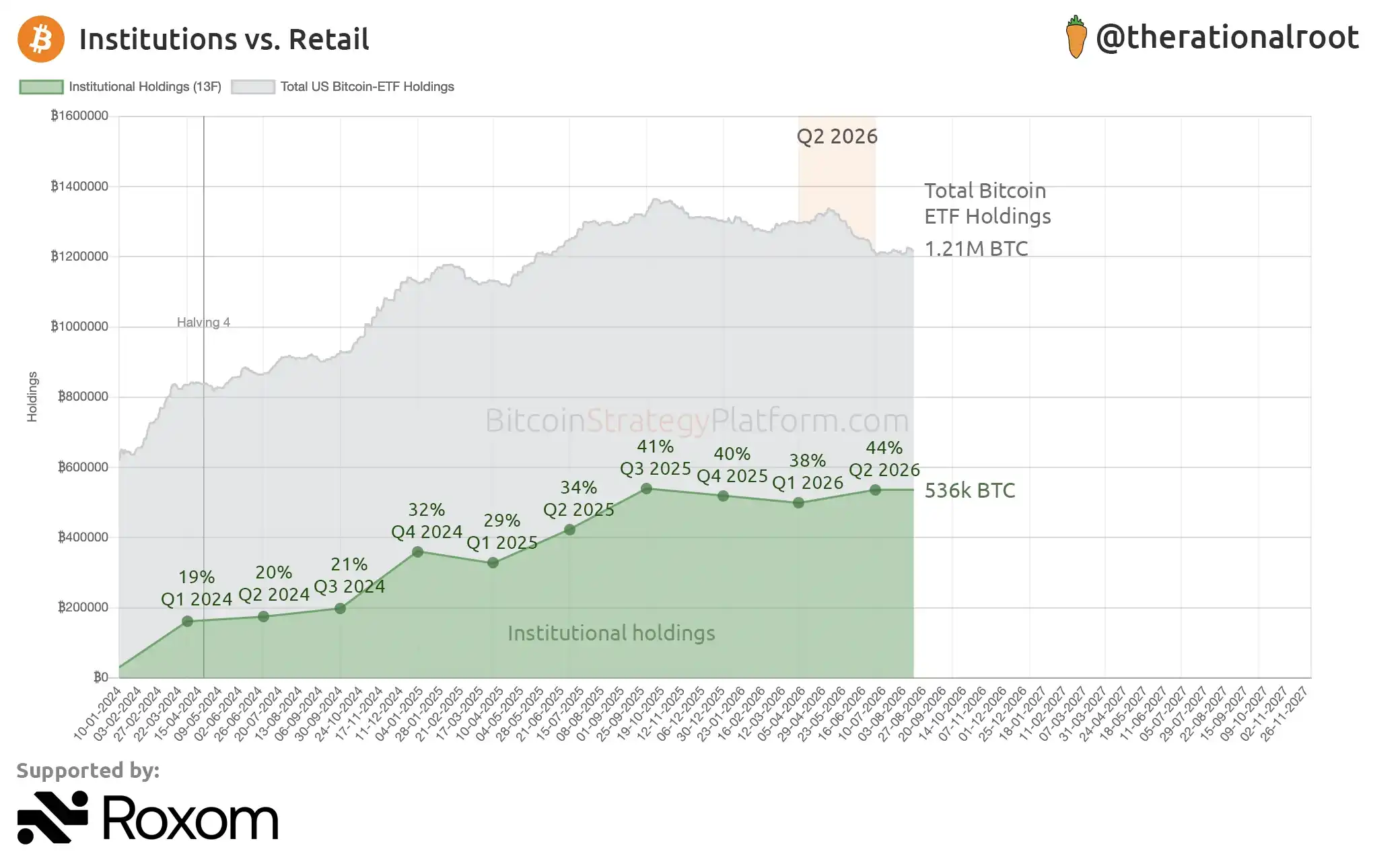
Total ETF holdings decreased from 1,297,010 BTC to 1,211,322 BTC, down 6.6%; while institutional holdings increased from 498,389 BTC to 535,723 BTC, up 7.5%.

👉 Key Insight: Despite the decline in total ETF holdings, institutions increased their positions. The institutional share rose from 38.4% to 44.2%, reaching a new all-time high!


Top 25 ETF Holders

Below are the top 25 institutional Bitcoin ETF holders.
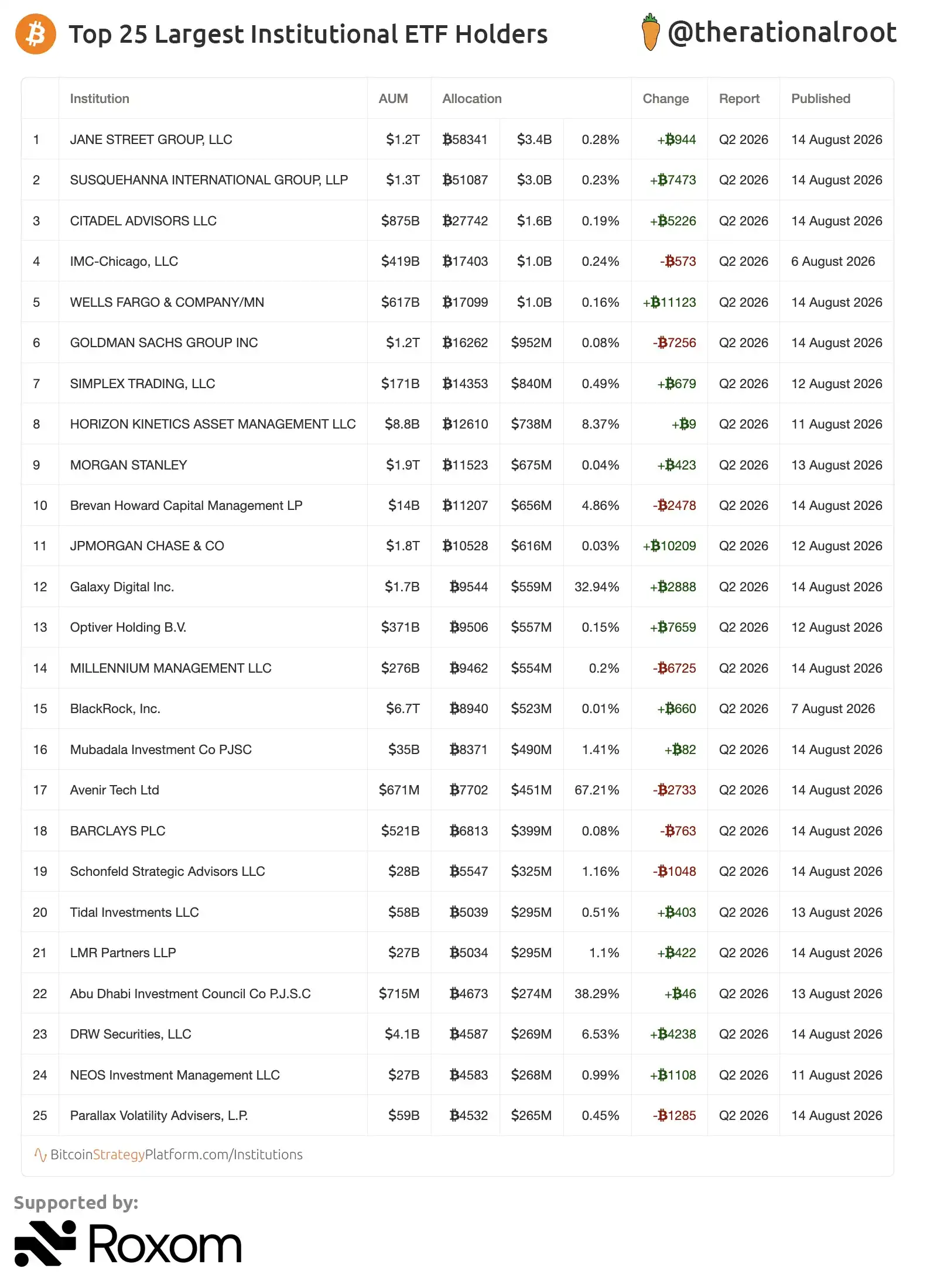
👇 Key Insights:

Seventeen of them increased their positions this quarter.

Both Wells Fargo and JPMorgan Chase added over 10,000 BTC each.

Abu Dhabi's sovereign wealth fund increased its position.


New Entrants

Below is a list of new entrants who initiated positions of 100 BTC or more for the first time.
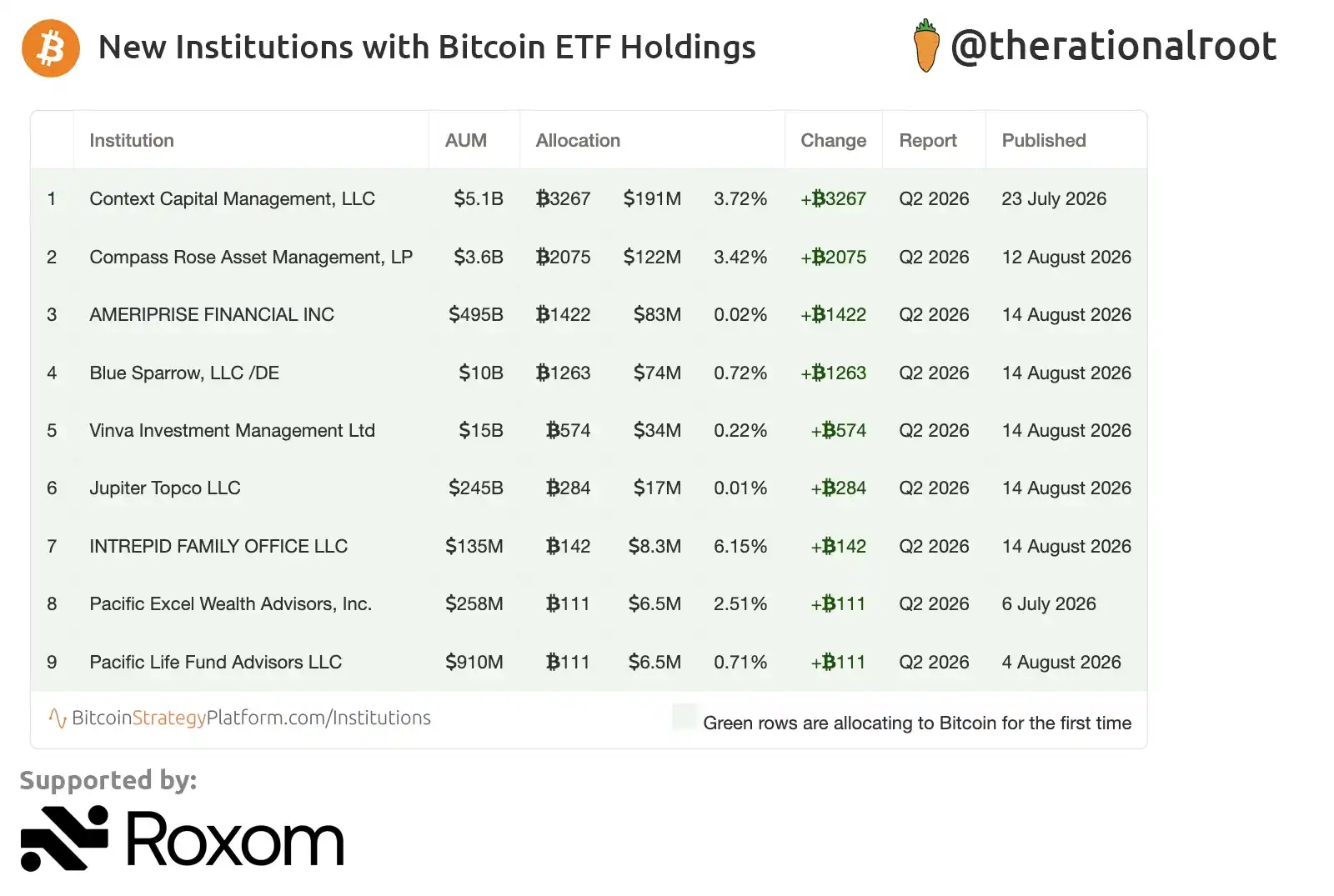
The most notable is Ameriprise, a mainstream U.S. wealth management and financial services firm with over 10,000 financial advisors and approximately $1.7 trillion in assets under management.

This reaffirms that Bitcoin has become a mature institutional-grade asset and is gradually being integrated into traditional wealth management through financial advisors. This is a very positive development.

Other new entrants are primarily hedge funds and investment management firms, with Context Capital Management and Compass Rose Asset Management making the largest new allocations at $191 million and $122 million, respectively. While the names may not be as prominent, these are still substantial new positions and a positive sign of continued institutional adoption growth.


Number of Institutions
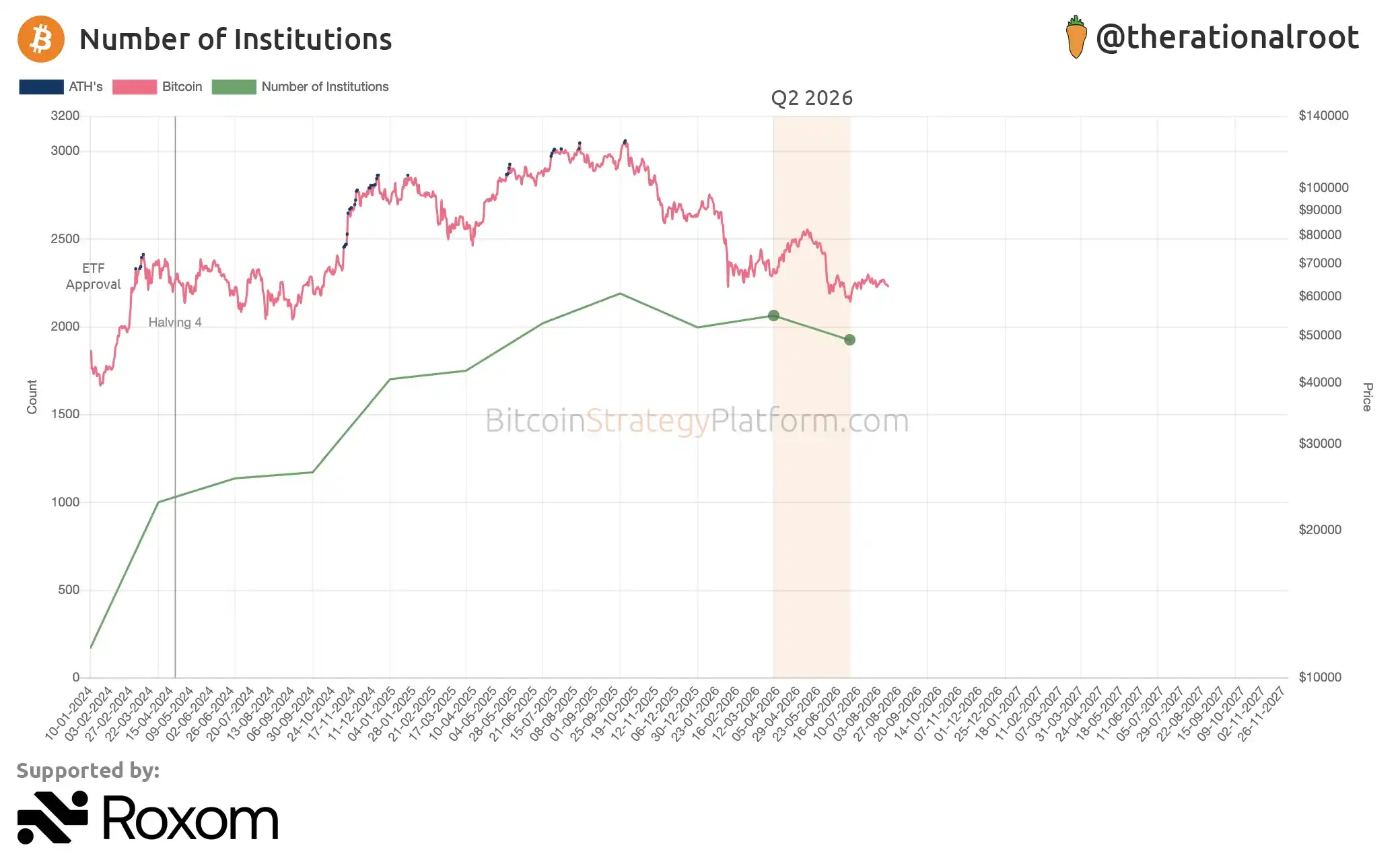
The number of institutions reporting Bitcoin holdings via 13F filings decreased from approximately 2,000 in Q1 to nearly 1,900 in Q2, a decline of 6.8%.

This indicates the bear market is still quite brutal. Despite the overall increase in institutional holdings, some institutions were still forced out or became fearful.


Conclusion

This institutional data truly exceeded my expectations. Given the bear market phase and price action, I did not anticipate seeing such significant growth. Total institutional holdings have nearly surpassed the numbers we saw at the cycle peak.

This confirms that institutions view current prices as an attractive entry point. Combined with the recovery following recent digital credit stress tests, the possibility of a rebound has increased.

I hope you can appreciate this bullish divergence! As always, I strive to provide you with the best data and insights. I would love to see your comments and thoughts. 👊 🧡

See you next week, 🫡

Crypto di tendenza

Domande pertinenti

QAccording to the article, what key divergence signals that institutions are accumulating Bitcoin during a perceived bottom?

AThe article highlights a bullish divergence where the Bitcoin price fell by 14.2% in Q2, while institutional holdings in ETFs increased by 7.5%. This indicates institutions are accumulating during price weakness.

QWhich two major financial institutions added over 10,000 BTC each in a single quarter, as per the Q2 2026 data?

AWells Fargo and JPMorgan Chase each added over 10,000 BTC to their holdings in the second quarter of 2026.

QWhat significant development does the entry of Ameriprise into Bitcoin ETFs represent, according to the author's analysis?

AAmeriprise's entry signifies Bitcoin's maturation into an institutional-grade asset and its gradual integration into traditional wealth management portfolios through financial advisors.

QDespite an increase in total institutional BTC holdings, what metric decreased in Q2 2026, and what does the author suggest this indicates about the market?

AThe number of institutions reporting Bitcoin holdings via 13F filings decreased by 6.8%, from about 2,000 to nearly 1,900. The author suggests this shows the bear market remains brutal, forcing or frightening some institutions to exit.

QWhat overall conclusion does the author draw about institutional sentiment from the Q2 2026 data on Bitcoin ETF holdings?

AThe author concludes that institutions view the current price levels as an attractive entry point. The strong growth in holdings during a bear market confirms their positive long-term sentiment and increases the likelihood of a market recovery.

Letture associate

Tencent Reaps a Paper Profit of 50 Billion

A decade ago, China held no share in the global DRAM market. Today, Changxin Technology, after listing on the STAR Market, has become the most valuable A-share company. Its landmark IPO has generated historic returns for investors. Among them, Tencent, which invested approximately 2 billion RMB in 2022 through its entity Beijing Fengyi, now holds an estimated paper gain of around 50 billion RMB based on Changxin's current market valuation of approximately 4 trillion RMB. Alibaba also made significant bets. Its affiliates invested a total of roughly 7.6 billion RMB across two funding rounds in 2022 and 2025. Their combined stake is now worth an estimated 170 billion RMB—a paper profit surpassing Alibaba's entire net profit for fiscal year 2026. The shareholder registry reveals a who's who of Chinese capital. Major state-backed funds like the National Integrated Circuit Industry Investment Fund (Big Fund II) and Anhui provincial capital hold stakes worth hundreds of billions. Early and crucial support came from the Hefei municipal government, which played a foundational role in the company's establishment and growth. Strategic industrial investor GigaDevice, under the same leadership as Changxin, invested about 2.3 billion RMB, now worth roughly 53 billion. Home appliance giant Midea's 1 billion RMB investment has ballooned to an estimated 22 billion RMB. Virtually all major domestic financial institutions, venture capital, and private equity firms participated. However, the story also includes a notable exit: Country Garden's venture arm sold its stake for 2 billion RMB in late 2024 to address its own liquidity crisis. Those shares would be worth approximately 44 billion RMB at the IPO price, highlighting a stark contrast in timing between the downturn of the real estate cycle and the rise of the semiconductor sector.

marsbit2 min fa

Tencent Reaps a Paper Profit of 50 Billion

marsbit2 min fa

Calterah Races for the STAR Market: 31% Market Share, Over 900 Million in Losses, the Berkeley Mentor-Student Duo's Path to Breakthrough in Millimeter-Wave Radar

Calterah Microelectronics (Calterah), a Shanghai-based automotive chip company specializing in millimeter-wave radar chips, has filed for a listing on China's Sci-Tech Innovation Board (STAR Market), seeking to raise 3.49 billion yuan. Founded in 2014 by Dr. Chen Jiashu, a UC Berkeley PhD, and his professor Ali Niknejad, Calterah pioneered the use of CMOS technology for automotive-grade 77GHz radar chips, challenging the dominance of global giants like Texas Instruments. The company has grown rapidly, with revenue soaring from 206 million yuan in 2023 to 632 million yuan in 2025. It holds a 31.1% share in China's automotive millimeter-wave radar chip market and a 4% global share, with cumulative shipments exceeding 30 million chips for clients including BYD, Geely, NIO, Volvo, and Rivian. Despite strong market traction, Calterah faces significant financial challenges. It has reported cumulative net losses exceeding 900 million yuan over the past three and a half years, driven by massive R&D spending, which accounted for 147.75% of revenue in 2023. Operating cash flow remains negative, and the company relies heavily on external financing. Other risks include high customer and supplier concentration, with its top five distributors accounting for over 99% of revenue and overseas procurement exceeding 50%. Supply chain security is a concern due to reliance on foundries like TSMC. The proceeds from the IPO will fund R&D for high-performance radar chips, ultra-wideband (UWB) chips for applications like digital car keys, and a new technology center. Calterah aims to expand beyond automotive into industrial and consumer sectors. However, it faces intense competition, potential price wars, and the long, costly cycle of automotive-grade certification. Its path forward hinges on achieving profitability, maintaining technological leadership, and building a sustainable business model in a fiercely competitive global market.

marsbit2 min fa

Calterah Races for the STAR Market: 31% Market Share, Over 900 Million in Losses, the Berkeley Mentor-Student Duo's Path to Breakthrough in Millimeter-Wave Radar

marsbit2 min fa

Burning Through Billions, Market Cap Evaporates 200 Billion: SenseTime Suddenly Turns a Profit

Chinese AI giant SenseTime, once a star in the AI "Four Dragons," recently projected its first-ever profit for H1 2026, sparking a temporary stock surge. However, its current market cap of ~HK$64.6 billion remains over 80% below its peak of ~HK$300 billion in early 2022. The article analyzes SenseTime's dramatic fall from grace. It excelled in the "AI 1.0" era, dominating computer vision for applications like facial recognition and smart cities. However, it was disrupted by the "AI 2.0" generative AI revolution led by ChatGPT, which shifted focus from recognition to creation. Compounded by US sanctions, the death of its founder, a short-seller report, and a decline in its core smart city business, the company faced a perfect storm. Its workforce was cut by nearly 60%. To survive, SenseTime pivoted, actively "killing" its old self. It transitioned from project-based solutions to a generative AI and visual AI dual-engine model. Now, over 70% of its revenue comes from large language models, a more scalable, subscription-like business. Cost-control measures on expensive model training have also contributed to its path to profitability. Yet, significant challenges remain. The current AI race is an ecosystem battle dominated by giants like Microsoft/OpenAI, Google, and Chinese tech firms with integrated clouds, apps, and vast user bases. SenseTime, as an independent AI company, lacks such a super app or traffic gateway. The key question is whether it can build a sustainable moat based solely on model capability and industry deployment in this new competitive landscape.

marsbit6 min fa

Burning Through Billions, Market Cap Evaporates 200 Billion: SenseTime Suddenly Turns a Profit

marsbit6 min fa

Shanghai Sees a Semiconductor Equipment IPO Emerge, Led by Former Grace Semiconductor Employee

A Shanghai-based semiconductor equipment company, Mifee Technology, has filed for an IPO on the Shanghai Stock Exchange's STAR Market. The company specializes in developing and manufacturing Automatic Material Handling Systems (AMHS), a core automation system in semiconductor wafer fabrication that directly impacts production efficiency and yield. Mifee is one of the few domestic Chinese companies with proprietary AMHS technology, offering both hardware and software systems. While the global AMHS market is dominated by Japanese giants like Daifuku and Murata Machinery, which hold approximately 90% market share, Mifee has captured about 1.6% globally. The company's revenue has grown significantly, reaching 393 million yuan in 2025, and it achieved profitability that year with a net income of 60.45 million yuan, following losses in 2023 and 2024. Its revenue streams include sales of individual AMHS equipment and complete factory AMHS projects, with the latter starting to contribute revenue from 2024. The company faces risks including high customer concentration, with its top five clients accounting for over 90% of revenue in 2025, and significant fluctuations in gross margin, which was 48.97% in 2025 after dropping to 24.67% in 2024. Mifee is controlled by an 80s-born couple, Chairman/CEO Feng Miao and Deputy General Manager Na Ke, who previously worked at Shanghai Grace Semiconductor Manufacturing Co. The company plans to raise approximately 1.191 billion yuan from its IPO to fund production, R&D, overseas expansion, and working capital.

marsbit7 min fa

Shanghai Sees a Semiconductor Equipment IPO Emerge, Led by Former Grace Semiconductor Employee

marsbit7 min fa

Trading

Spot

Articoli Popolari

Cosa è BITCOIN

Comprendere HarryPotterObamaSonic10Inu (ERC-20) e la sua posizione nel mondo delle criptovalute Negli ultimi anni, il mercato delle criptovalute ha assistito a un aumento della popolarità delle meme coin, catturando l'interesse non solo dei trader, ma anche di coloro che cercano coinvolgimento comunitario e valore di intrattenimento. Tra questi token unici c'è HarryPotterObamaSonic10Inu (ERC-20), un progetto intrigante che mescola riferimenti culturali nel tessuto delle criptovalute. Questo articolo esplora gli aspetti chiave di HarryPotterObamaSonic10Inu, analizzando i suoi meccanismi, l'etica guidata dalla comunità e il suo coinvolgimento con il panorama crittografico più ampio. Che cos'è HarryPotterObamaSonic10Inu (ERC-20)? Come suggerisce il suo nome, HarryPotterObamaSonic10Inu è una meme coin costruita sulla blockchain di Ethereum, classificata secondo lo standard ERC-20. A differenza delle criptovalute tradizionali che possono enfatizzare l'utilità pratica o il potenziale investimento, questo token prospera grazie al valore di intrattenimento e alla forza della sua comunità. Il progetto mira a creare un ambiente in cui gli utenti coinvolti possono riunirsi, condividere idee e partecipare ad attività ispirate a diversi fenomeni culturali. Una caratteristica notevole di HarryPotterObamaSonic10Inu è la zero tassa sulle transazioni. Questo elemento allettante tende a incoraggiare il trading e il coinvolgimento della comunità, privo di costi aggiuntivi che possono scoraggiare i trader di piccole dimensioni. L'offerta totale della moneta è fissata a un miliardo di token, un numero che segna la sua intenzione di mantenere una circolazione sostanziale all'interno della comunità. Creatore di HarryPotterObamaSonic10Inu (ERC-20) Le origini di HarryPotterObamaSonic10Inu sono avvolte in un certo mistero; i dettagli sul creatore rimangono sconosciuti. Lo sviluppo di questo token non presenta un team identificabile o un piano esplicito, cosa non rara nel settore delle meme coin. Invece, il progetto è emerso organicamente, con il suo progresso fortemente dipendente dall'entusiasmo e dalla partecipazione della sua comunità. Investitori di HarryPotterObamaSonic10Inu (ERC-20) Per quanto riguarda investimenti esterni e finanziamenti, HarryPotterObamaSonic10Inu rimane ambiguo. Il token non elenca alcuna fondazione di investimento conosciuta o un sostegno organizzativo significativo. Invece, la linfa vitale del progetto è la sua comunità di base, che informa la sua crescita e sostenibilità attraverso azioni collettive e coinvolgimento nello spazio crittografico. Come funziona HarryPotterObamaSonic10Inu (ERC-20)? In quanto meme coin, HarryPotterObamaSonic10Inu opera principalmente al di fuori delle strutture tradizionali che governano spesso il valore degli asset. Ci sono diversi aspetti distintivi che definiscono il funzionamento del progetto: Transazioni senza tasse: Senza costi fiscali sulle transazioni, gli utenti possono comprare e vendere liberamente il token senza preoccuparsi di costi nascosti. Coinvolgimento della comunità: Il progetto prospera sull'interazione della comunità, sfruttando le piattaforme social per creare entusiasmo e facilitare il coinvolgimento. Discussioni, condivisione di contenuti e coinvolgimento sono elementi cruciali che aiutano ad espandere la sua portata e a favorire la lealtà tra i sostenitori. Nessuna utilità pratica: Va notato che HarryPotterObamaSonic10Inu non offre un'utilità concreta all'interno dell'ecosistema finanziario. Piuttosto, è classificato come un token principalmente per attività di intrattenimento e comunitarie. Riferimento culturale: Il token incorpora astutamente elementi della cultura pop per attirare interesse, collegandosi a appassionati di meme e seguaci delle criptovalute. HarryPotterObamaSonic10Inu esemplifica come le meme coin operino in modo diverso rispetto ai progetti di criptovalute più tradizionali, entrando nel mercato come costrutti sociali innovativi piuttosto che come asset utilitari. Cronologia di HarryPotterObamaSonic10Inu (ERC-20) La storia di HarryPotterObamaSonic10Inu è segnata da diversi traguardi notevoli: Creazione: Il token è emerso da un meme virale, catturando l'immaginazione di molti appassionati di criptovalute. Le date di creazione specifiche non sono disponibili, sottolineando la sua crescita organica. Inserimento negli scambi: HarryPotterObamaSonic10Inu ha fatto il suo ingresso in vari scambi, consentendo un accesso e un trading più facili da parte della comunità. Iniziative di coinvolgimento della comunità: Attività in corso volte a migliorare l'interazione della comunità, comprese gare, campagne sui social media e generazione di contenuti da parte di fan e sostenitori. Piani di espansione futura: La tabella di marcia del progetto include il lancio di una collezione NFT, merchandising e un sito di eCommerce relativo ai suoi temi culturali, coinvolgendo ulteriormente la comunità e cercando di aggiungere più dimensioni al suo ecosistema. Punti chiave su HarryPotterObamaSonic10Inu (ERC-20) Natura guidata dalla comunità: Il progetto dà priorità al contributo collettivo e alla creatività, garantendo che il coinvolgimento degli utenti sia al centro del suo sviluppo. Classificazione come meme coin: Rappresenta l'epitome delle criptovalute basate sull'intrattenimento, distinguendosi dai veicoli d'investimento tradizionali. Nessuna affiliazione diretta con Bitcoin: Nonostante la somiglianza nel nome del ticker, HarryPotterObamaSonic10Inu è distintivo e non ha alcuna relazione con Bitcoin o altre criptovalute consolidate. Focus sulla collaborazione: HarryPotterObamaSonic10Inu è progettato per creare uno spazio per la collaborazione e la condivisione di storie tra i suoi detentori, fornendo un canale per la creatività e il legame comunitario. Prospettive future: L'ambizione di espandersi oltre il suo presupposto iniziale verso NFT e merchandising delinea un percorso per il progetto per potenzialmente entrare in strade più mainstream all'interno della cultura digitale. Poiché le meme coin continuano a catturare l'immaginazione della comunità crittografica, HarryPotterObamaSonic10Inu (ERC-20) si distingue per i suoi legami culturali e il suo approccio centrato sulla comunità. Anche se potrebbe non adattarsi al modello tipico di un token orientato all'utilità, la sua essenza risiede nella gioia e nella camaraderia coltivate tra i suoi sostenitori, evidenziando la natura in evoluzione delle criptovalute in un'epoca sempre più digitale. Con la continuazione dello sviluppo del progetto, sarà importante osservare come le dinamiche della comunità influenzano la sua traiettoria nel panorama in continuo cambiamento della tecnologia blockchain.

2.3k Totale visualizzazioniPubblicato il 2024.04.01Aggiornato il 2024.12.03

Cosa è BITCOIN

Come comprare BTC

Benvenuto in HTX.com! Abbiamo reso l'acquisto di Bitcoin (BTC) semplice e conveniente. Segui la nostra guida passo passo per intraprendere il tuo viaggio nel mondo delle criptovalute.Step 1: Crea il tuo Account HTXUsa la tua email o numero di telefono per registrarti il tuo account gratuito su HTX. Vivi un'esperienza facile e sblocca tutte le funzionalità,Crea il mio accountStep 2: Vai in Acquista crypto e seleziona il tuo metodo di pagamentoCarta di credito/debito: utilizza la tua Visa o Mastercard per acquistare immediatamente BitcoinBTC.Bilancio: Usa i fondi dal bilancio del tuo account HTX per fare trading senza problemi.Terze parti: abbiamo aggiunto metodi di pagamento molto utilizzati come Google Pay e Apple Pay per maggiore comodità.P2P: Fai trading direttamente con altri utenti HTX.Over-the-Counter (OTC): Offriamo servizi su misura e tassi di cambio competitivi per i trader.Step 3: Conserva Bitcoin (BTC)Dopo aver acquistato Bitcoin (BTC), conserva nel tuo account HTX. In alternativa, puoi inviare tramite trasferimento blockchain o scambiare per altre criptovalute.Step 4: Scambia Bitcoin (BTC)Scambia facilmente Bitcoin (BTC) nel mercato spot di HTX. Accedi al tuo account, seleziona la tua coppia di trading, esegui le tue operazioni e monitora in tempo reale. Offriamo un'esperienza user-friendly sia per chi ha appena iniziato che per i trader più esperti.

4.8k Totale visualizzazioniPubblicato il 2024.12.12Aggiornato il 2026.06.02

Come comprare BTC

Cosa è $BITCOIN

ORO DIGITALE ($BITCOIN): Un'Analisi Completa Introduzione all'ORO DIGITALE ($BITCOIN) L'ORO DIGITALE ($BITCOIN) è un progetto basato su blockchain che opera sulla rete Solana, con l'obiettivo di combinare le caratteristiche dei metalli preziosi tradizionali con l'innovazione delle tecnologie decentralizzate. Sebbene condivida un nome con Bitcoin, spesso definito “oro digitale” a causa della sua percezione come riserva di valore, l'ORO DIGITALE è un token separato progettato per creare un ecosistema unico all'interno del panorama Web3. Il suo obiettivo è posizionarsi come un asset digitale alternativo valido, anche se i dettagli riguardanti le sue applicazioni e funzionalità sono ancora in fase di sviluppo. Cos'è l'ORO DIGITALE ($BITCOIN)? L'ORO DIGITALE ($BITCOIN) è un token di criptovaluta esplicitamente progettato per l'uso sulla blockchain di Solana. A differenza di Bitcoin, che fornisce un ruolo di stoccaggio di valore ampiamente riconosciuto, questo token sembra concentrarsi su applicazioni e caratteristiche più ampie. Aspetti notevoli includono: Infrastruttura Blockchain: Il token è costruito sulla blockchain di Solana, nota per la sua capacità di gestire transazioni ad alta velocità e a basso costo. Dinamiche di Offerta: L'ORO DIGITALE ha un'offerta massima fissata a 100 quadrilioni di token (100P $BITCOIN), sebbene i dettagli riguardanti la sua offerta circolante siano attualmente non divulgati. Utilità: Sebbene le funzionalità precise non siano esplicitamente delineate, ci sono indicazioni che il token potrebbe essere utilizzato per varie applicazioni, potenzialmente coinvolgendo applicazioni decentralizzate (dApp) o strategie di tokenizzazione degli asset. Chi è il Creatore dell'ORO DIGITALE ($BITCOIN)? Attualmente, l'identità dei creatori e del team di sviluppo dietro l'ORO DIGITALE ($BITCOIN) rimane sconosciuta. Questa situazione è tipica tra molti progetti innovativi nel settore blockchain, in particolare quelli allineati con la finanza decentralizzata e i fenomeni delle meme coin. Sebbene tale anonimato possa favorire una cultura guidata dalla comunità, intensifica le preoccupazioni riguardo alla governance e alla responsabilità. Chi sono gli Investitori dell'ORO DIGITALE ($BITCOIN)? Le informazioni disponibili indicano che l'ORO DIGITALE ($BITCOIN) non ha alcun sostenitore istituzionale noto o investimenti di venture capital prominenti. Il progetto sembra operare su un modello peer-to-peer incentrato sul supporto e sull'adozione della comunità piuttosto che su percorsi di finanziamento tradizionali. La sua attività e liquidità si trovano principalmente su exchange decentralizzati (DEX), come PumpSwap, piuttosto che su piattaforme di trading centralizzate consolidate, evidenziando ulteriormente il suo approccio di base. Come Funziona l'ORO DIGITALE ($BITCOIN) Le meccaniche operative dell'ORO DIGITALE ($BITCOIN) possono essere elaborate in base al suo design blockchain e alle caratteristiche della rete: Meccanismo di Consenso: Sfruttando il proof-of-history (PoH) unico di Solana combinato con un modello di proof-of-stake (PoS), il progetto garantisce una validazione efficiente delle transazioni contribuendo all'alta performance della rete. Tokenomics: Sebbene meccanismi deflazionistici specifici non siano stati dettagliati ampiamente, l'ampia offerta massima di token implica che potrebbe soddisfare microtransazioni o casi d'uso di nicchia che devono ancora essere definiti. Interoperabilità: Esiste il potenziale per l'integrazione con l'ecosistema più ampio di Solana, inclusi vari piattaforme di finanza decentralizzata (DeFi). Tuttavia, i dettagli riguardanti integrazioni specifiche rimangono non specificati. Cronologia degli Eventi Chiave Ecco una cronologia che evidenzia traguardi significativi riguardanti l'ORO DIGITALE ($BITCOIN): 2023: Il dispiegamento iniziale del token avviene sulla blockchain di Solana, contrassegnato dal suo indirizzo di contratto. 2024: L'ORO DIGITALE guadagna visibilità poiché diventa disponibile per il trading su exchange decentralizzati come PumpSwap, consentendo agli utenti di scambiarlo contro SOL. 2025: Il progetto assiste a un'attività di trading sporadica e a un potenziale interesse per impegni guidati dalla comunità, sebbene non siano state documentate partnership significative o avanzamenti tecnici fino ad ora. Analisi Critica Punti di Forza Scalabilità: L'infrastruttura sottostante di Solana supporta alti volumi di transazioni, il che potrebbe migliorare l'utilità di $BITCOIN in vari scenari di transazione. Accessibilità: Il potenziale basso prezzo di trading per token potrebbe attrarre investitori al dettaglio, facilitando una partecipazione più ampia grazie a opportunità di proprietà frazionata. Rischi Mancanza di Trasparenza: L'assenza di sostenitori, sviluppatori o di un processo di audit pubblicamente noti potrebbe generare scetticismo riguardo alla sostenibilità e all'affidabilità del progetto. Volatilità del Mercato: L'attività di trading è fortemente dipendente dal comportamento speculativo, il che può comportare una significativa volatilità dei prezzi e incertezze per gli investitori. Conclusione L'ORO DIGITALE ($BITCOIN) emerge come un progetto intrigante ma ambiguo all'interno dell'evolvente ecosistema di Solana. Sebbene tenti di sfruttare la narrativa dell'“oro digitale”, la sua partenza dal ruolo consolidato di Bitcoin come riserva di valore sottolinea la necessità di una chiara differenziazione della sua utilità e struttura di governance. L'accettazione e l'adozione future dipenderanno probabilmente dall'affrontare l'attuale opacità e dalla definizione più esplicita delle sue strategie operative ed economiche. Nota: Questo rapporto comprende informazioni sintetizzate disponibili a ottobre 2023, e potrebbero essersi verificati sviluppi oltre il periodo di ricerca.

522 Totale visualizzazioniPubblicato il 2025.05.13Aggiornato il 2025.05.13

Cosa è $BITCOIN

Discussioni

Benvenuto nella Community HTX. Qui puoi rimanere informato sugli ultimi sviluppi della piattaforma e accedere ad approfondimenti esperti sul mercato. Le opinioni degli utenti sul prezzo di BTC BTC sono presentate come di seguito.

活动图片