Another automotive-grade chip company is targeting the capital market.
On August 13th, the Shanghai Stock Exchange website posted an acceptance notice: Calterah Microelectronics Technology (Shanghai) Co., Ltd. ("Calterah") has had its application for a STAR Market IPO accepted. The company plans to raise 3.489 billion yuan to fund projects including high-performance millimeter-wave radar chips, ultra-wideband chips, and the construction of an advanced technology center.
From a doctoral thesis project on CMOS millimeter-wave radar in a Berkeley lab, to a hundred-billion-unicorn standing at the gates of the STAR Market. The spotlight not only shines on the glory of domestic substitution, but also exposes the harsh reality all domestic automotive chip companies must face: cumulative losses exceeding 900 million yuan over three and a half years, a highly concentrated customer and supplier structure, and a mere 4% global market share amidst competition from global giants.
Calterah's IPO is not just a capital story of one company; it is also a chapter in the journey of a "disruptor."
01 The "Disruptor" from the Berkeley Lab
The story begins in 2014.
That year, Jash Chen, freshly graduated with a PhD from UC Berkeley, made a somewhat surprising decision to those around him: returning to China to start a business. At that time, he had already gained some renown in the field of CMOS millimeter-wave integrated circuit design, having led a team in the US to develop the world's first 60GHz WiGig CMOS SoC chip.
But Chen knew clearly that the place where the technology could realize its greatest value was not Silicon Valley, but China. Back then, China's automotive industry was on the eve of an intelligent explosion, but the core component of millimeter-wave radar chips was completely controlled by international giants like Texas Instruments, NXP, and Infineon, with a domestic substitution rate close to zero. The price, supply rhythm, and customization level of a chip were all dictated by others.
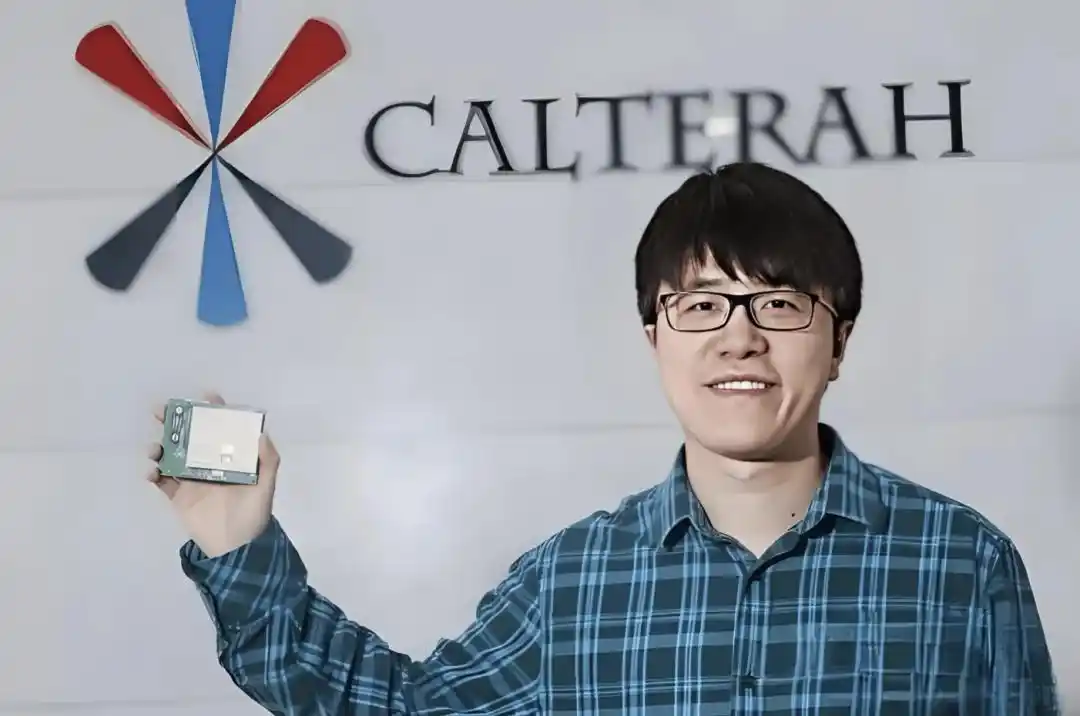
Jash Chen, Founder and CEO of Calterah
So, he teamed up with his mentor, Professor Ali Niknejad, Director of the Berkeley Wireless Research Center, and registered a company in Shanghai's Zhangjiang district, naming it "Calterah" — "CAL" as a nod to Berkeley, and "TERAH" from Terahertz, symbolizing ambition for high-frequency radar technology.
This mentor-student duo never intended to pursue low-end replication as mere "domestic substitution" from the start; their goal was: to redefine millimeter-wave radar chips using CMOS technology.
At the time, this was a rather "rebellious" technological path. The industry standard was to use GaAs or SiGe processes for multi-chip assembly solutions, which were stable in performance but costly and low in integration. While the CMOS process was low-cost and highly integrated, its performance in high-frequency bands had long been questioned as "not automotive-grade enough." Many wondered, were these Berkeley PhDs too idealistic?
But Chen was betting on the evolution speed of CMOS technology. History proved he bet correctly.
In 2015, just one year after its founding, Calterah developed and successfully taped out the world's first fully integrated 77GHz radar transceiver single-chip.
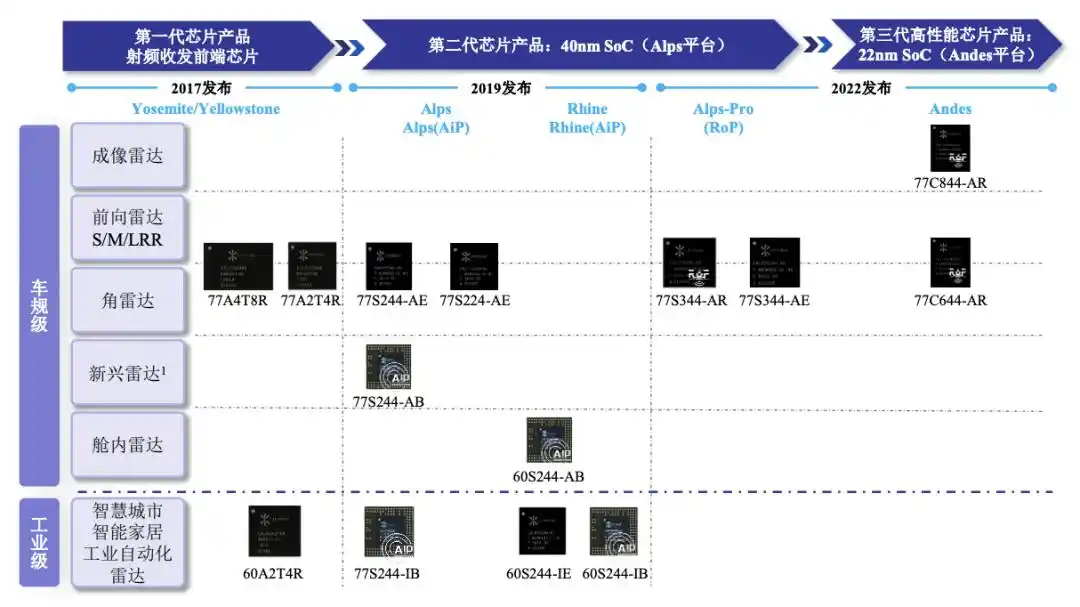
Calterah launched its first-generation chip product in 2017
In 2017, the world's first automotive-grade CMOS-process 77GHz millimeter-wave radar RF front-end chip, Yosemite, officially entered mass production, tearing open a gap for domestic millimeter-wave radar chips from then on.
In 2019, it again launched the world's first 77/60GHz millimeter-wave radar AiP (Antenna-in-Package) SoC chip, integrating antennas into the package, further lowering the design threshold for radar modules.
By 2025, Calterah's share in the domestic automotive millimeter-wave radar chip market had climbed to 31.1%, second only to Texas Instruments and ranking second domestically; globally, it ranked fourth with a market share of about 4%. As of the first quarter of 2026, its cumulative shipments exceeded 30 million units, with partnerships spanning over 30 automakers including BYD, Geely, Changan, NIO on its client list, and it had entered the supply chains of overseas OEMs like Volvo and Rivian.
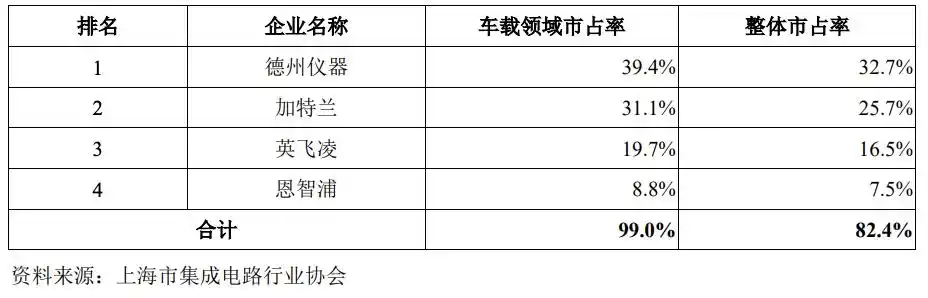
2025 China Millimeter-wave Radar Chip Market Landscape
From a technological concept in a lab to being installed in millions of vehicles worldwide, this journey took Calterah a full twelve years.
02 The Real Challenges Beneath the Glory
But if you think this is a perfect IPO story of "technological leadership, market recognition, and everything in place," you would be mistaken. The dense numbers in the prospectus reveal another side.
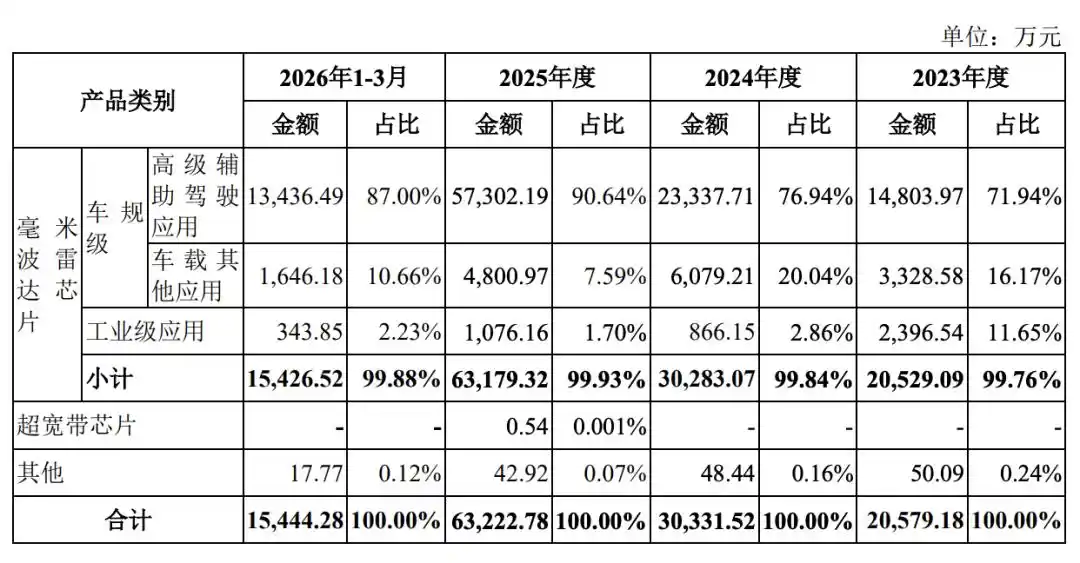
Calterah's Revenue by Product
First, look at growth. From 2023 to 2025, Calterah's revenue rose from 206 million yuan to 632 million yuan, with a three-year compound annual growth rate exceeding 75%. In the first quarter of 2026, it generated another 154 million yuan in revenue, with millimeter-wave radar chips contributing over 99% of the income. Its products cover domestic automakers like BYD, Geely, NIO, as well as overseas OEM supply chains like Volvo and Rivian, with cumulative shipments exceeding 30 million units.
However, behind the impressive revenue lies persistent net losses exceeding 900 million yuan cumulatively over three and a half years. From 2023 to 2025, Calterah's net profit attributable to the parent company recorded losses of 323 million yuan, 334 million yuan, and 193 million yuan respectively. In the first quarter of 2026, it continued to lose 60.2866 million yuan, bringing the cumulative loss over three and a half years to over 900 million yuan. No turning point for profitability is in sight in the short term.
Where did all the money burn? Research and development.
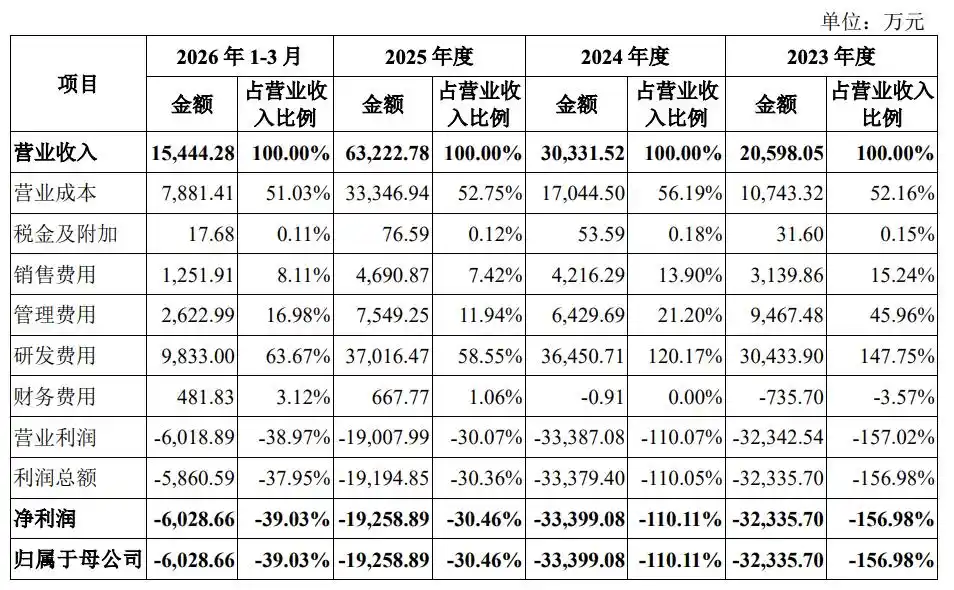
Calterah Financial Data
Financial report data shows that over the three reporting years (2023 to 2025), Calterah's cumulative R&D investment exceeded 1.039 billion yuan. In 2023, the R&D expense ratio once reached as high as 147.75%, meaning for every one yuan of revenue, nearly 1.5 yuan was spent on R&D. This ratio remained over 58% in 2025.
In terms of cash flow, Calterah's net cash flow from operating activities has been consistently negative. From 2023 to Q1 2026, operating cash flow remained negative at -170 million yuan, -249 million yuan, -18 million yuan, and -121 million yuan respectively. Combined with the need for large prepayments for wafer and packaging/test procurement, prepayments reached 42.9 million yuan in Q1 2026, with inventory levels continuously climbing to 220 million yuan.
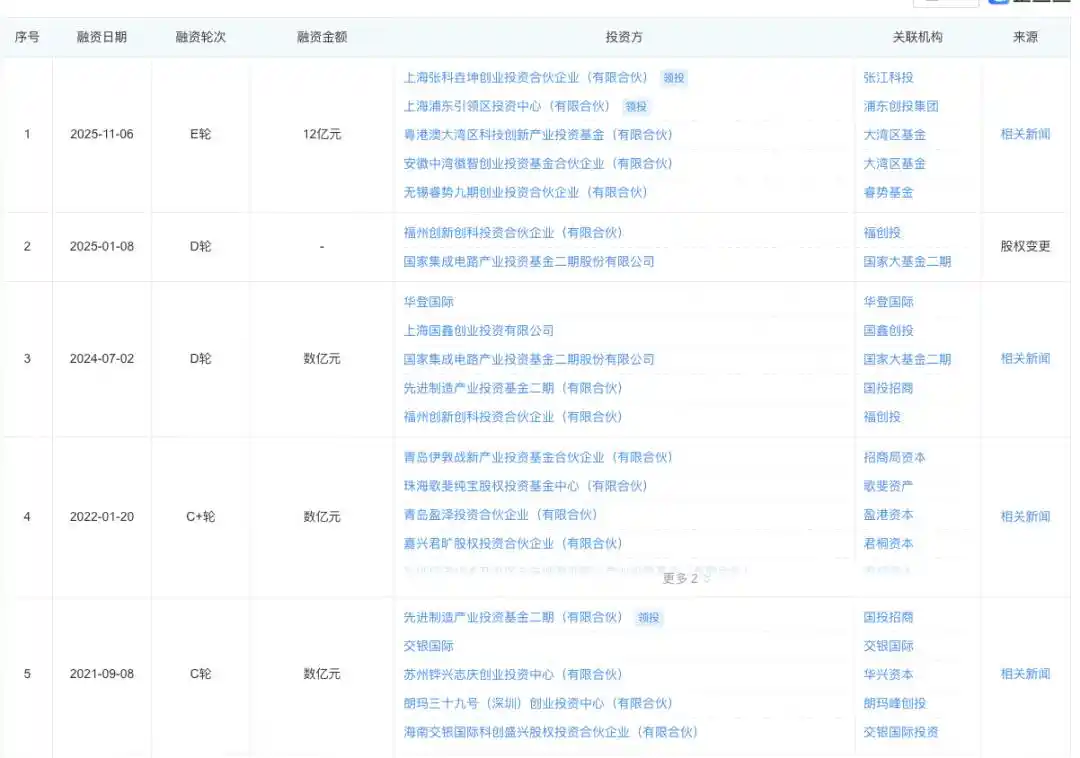
Part of Calterah's Financing Situation. Source: Qichacha
This means Calterah essentially still relies on financing "blood transfusions" to sustain operations. This makes it understandable why Calterah swiftly filed its prospectus just five months after completing a 1.2 billion yuan Series E financing in March 2026, with its valuation surpassing ten billion. For it, the secondary market financing channel is not a choice but a survival necessity.
The prospectus shows the company has no single shareholder holding over 30%, and thus no controlling shareholder. The company's Chairman and General Manager, Jash Chen, directly holds 12.1376% of the issuer's shares and indirectly controls 20.8730% of the shares through Nanchang Silicon Venture, collectively controlling 33.0106% of the company's voting rights, making him the company's actual controller.
Among other major shareholders, Hong Kong Ziteng holds 8.5120%, Silergy holds 7.8558%, and Wuxi Fosun Jialan holds 5.1790%. The National Integrated Circuit Industry Investment Fund Phase II (Big Fund II), as one of the shareholders, holds 0.6266%.
The customer structure also harbors some concerns. The prospectus shows that Calterah's revenue contribution from its top five customers has long remained at a high level. From 2023 to Q1 2026, revenue from the top five distributors consistently exceeded 99%. The concentration of end customers is similarly high, with revenue from the largest end customer exceeding 50% in 2025.
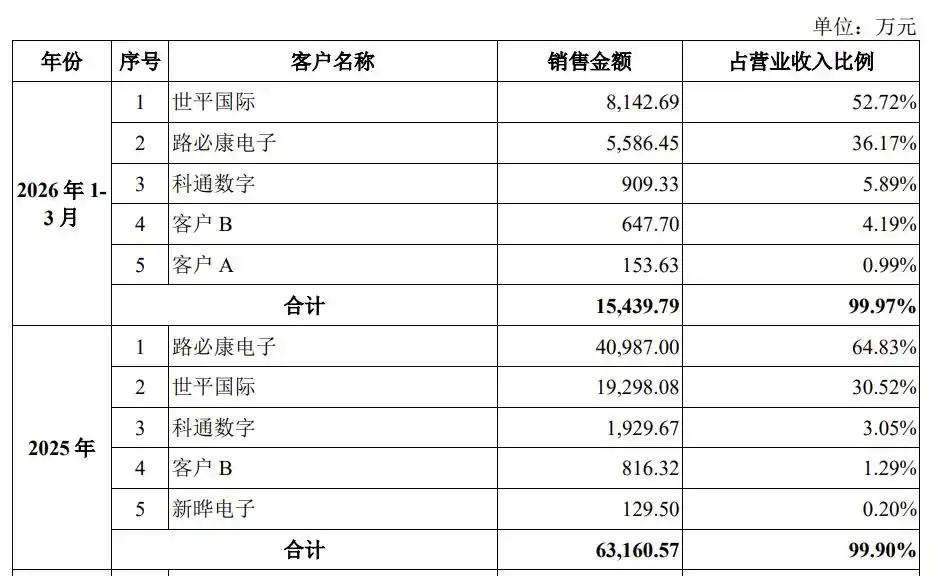
Calterah's Major Customer Situation
Furthermore, Calterah operates as a Fabless design company, heavily reliant on overseas manufacturers for wafer foundry, advanced packaging/test, EDA software, and core IP. The proportion of overseas procurement remained above 50% during the reporting period, with procurement from the top five suppliers increasing year by year, reaching 80.16% in Q1 2026. Against the backdrop of global trade frictions, supply restrictions, price hikes, or delivery delays from overseas manufacturers could directly impact mass production.
03 How Deep Are the Industry Waters?
Calterah's challenges are not an isolated case; they are rather a microcosm of the entire domestic automotive-grade chip track.
First, this is a winner-takes-all market. The global share of millimeter-wave radar chips is highly concentrated in the hands of a few international giants like Texas Instruments, Infineon, and NXP. They possess decades of technological accumulation, vast patent barriers, and deeply entrenched automotive ecosystem relationships. Although Calterah has carved out a niche in terms of share, its global market share is only 4%, and the magnitude gap with the giants remains vast.
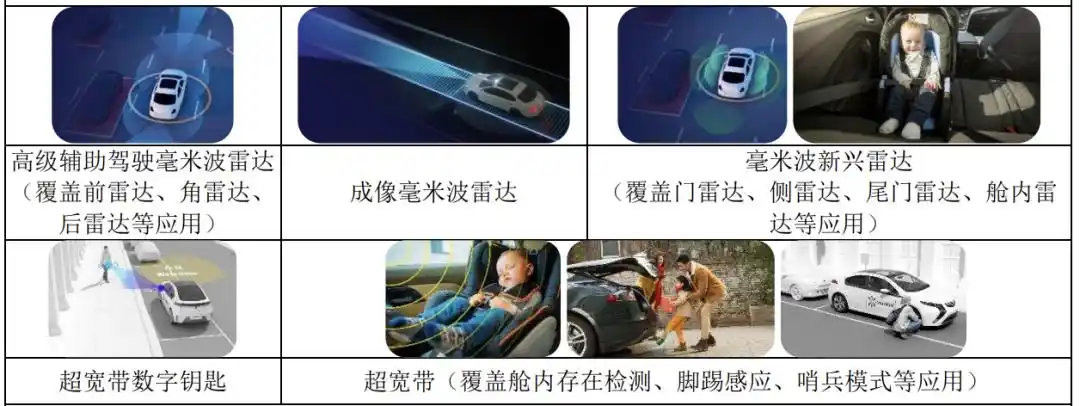
Application of Calterah Products in the Automotive Field
Second, the time window for automotive qualification is brutally unforgiving. A chip typically takes several years from design to front-end mass production. This means today's revenue reflects technological decisions and market judgments made five years ago. And today's R&D investments may only see returns around 2030 or later. Does the capital market have enough patience to wait for a "five-year answer"? This is a question all automotive chip companies must face.
Third, the price war has already begun. As more and more domestic players enter the millimeter-wave radar chip race, especially with 4D millimeter-wave radar becoming a hot spot, product homogenization is intensifying. The speed at which prices move from a blue ocean to a red ocean may be faster than anyone anticipated. Currently, Calterah's product line still relies mainly on traditional millimeter-wave radar chips, with 4D high-resolution products still under development. Whether it can maintain its position in the next round of technological competition remains an unknown.
Then there is supply chain security. Calterah's chip manufacturing heavily relies on a few foundries like TSMC. Under the current global geopolitical landscape, such concentration is itself a risk. Any fluctuation in foundry capacity or disruption in the supply chain would have不言而喻 (不言而喻 - obvious) consequences. Although it has already started building a domestic supply chain platform (Kun platform), domestic processes and supporting ecosystem maturity still lag, making it difficult to fully replace overseas resources in the short term. Supply chain security risks persist.
For this IPO, Calterah plans to raise 3.489 billion yuan, primarily targeting three areas: R&D and industrialization of high-performance millimeter-wave radar chips; R&D and industrialization of high-precision ultra-wideband advanced connectivity chips; and the construction of an advanced technology innovation center and headquarters.

Part of Calterah's Automotive Customers
It's evident that the story Calterah wants to tell is no longer just about "domestic substitution for automotive radar chips." Its ultra-wideband (UWB) chip product line targets scenarios like automotive digital keys, in-cabin child presence detection, and foot-kick sensing, attempting to tap into the new track of "sensing and communication fusion." Additionally, the penetration of millimeter-wave radar into industrial and consumer fields like smart homes, elderly care monitoring, security surveillance, and smart transportation also forms the second growth curve Calterah is sketching.
From a technological path perspective, Calterah's strategic direction is clear: from single products to platforms, from automotive-grade to general sensing, from domestic substitution to global competition. But between a clear strategy and commercial success lies a chasm of time and capital.
From that doctoral thesis project on CMOS millimeter-wave radar in a Berkeley lab, to the hundred-billion-unicorn now standing at the gates of the STAR Market, Calterah has indeed persevered for twelve years.
But the STAR Market is not the finish line; it is the starting point for another, even more grueling marathon. Next, it must prove, at an even faster pace, the achievability of profitability, generational leadership in technology, and the sustainability of its business model. For an automotive-grade chip company, the real test paper only truly begins after listing.
Of course, the first step is completing the listing.
This article is from the WeChat public account "Cyber-car" (ID: Cyber-car), author: Zhang Lianyi