As semiconductor chip processes continue to shrink, equipment expenditure for advanced process wafer fabs grows exponentially. The construction, expansion, and operation/maintenance of semiconductor wafer fabs provide broad development space for the Automatic Material Handling System (AMHS) industry.
AMHS equipment is part of semiconductor factory production automation and control equipment, falling under the category of semiconductor equipment. It is one of the core systems that directly impacts production efficiency and product yield in semiconductor wafer fabs. Recently, a company in this field is seeking an IPO.
According to news from Glonghui, recently, Meifei Technology (Shanghai) Co., Ltd. (referred to as "Meifei Technology") submitted its prospectus to the Shanghai Stock Exchange, aiming to list on the STAR Market, with Haitong Securities as the sponsor.
Meifei Technology is one of the very few domestic suppliers in mainland China that master core AMHS technology with independent intellectual property rights and can provide various AMHS hardware equipment and software systems for semiconductor wafer fabs, possessing a certain degree of scarcity. The company also achieved a turnaround to profitability in 2025, but faces risks such as high customer concentration and significant fluctuations in gross margin.
01 Significant Room for Import Substitution in AMHS Field, Company Faces High Customer Concentration
The upstream AMHS industry chain components include tracks and power supply equipment, overhead hoist transports (OHT), motors, controllers, control systems, industrial software, etc., with participants including Yaskawa, Panasonic, Mitsubishi, Siemens, Keyence, Omron, etc.
The midstream AMHS includes conveying systems, storage and purification equipment, and software systems. The market has long been monopolized by Japanese companies, leaving significant room for import substitution.
According to Gartner data, in 2025, Japan's Daifuku Group and Murata Machinery together hold about 90% of the global AMHS market share; SEMES, a subsidiary of South Korea's Samsung Group, holds about 9.1%; Meifei Technology's market share is about 1.6%.
Downstream application scenarios include semiconductor manufacturing, display panel manufacturing, and new energy battery manufacturing, with participants including TSMC, Samsung, Intel, BOE, etc.
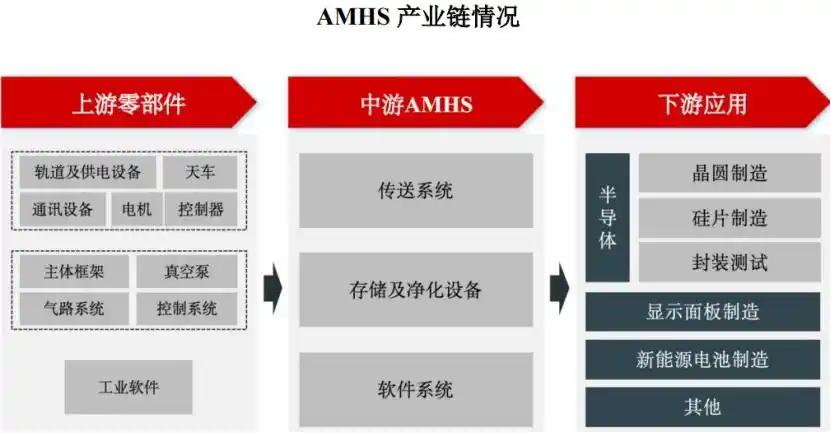
Image from the prospectus
Meifei Technology's main business revenue primarily comes from the sale of AMHS equipment and related services. Among these, AMHS equipment includes full-factory projects and individual equipment.
The company's full-factory projects involve system equipment where the entire AMHS uses products independently developed by the company, including OHT conveying systems, storage and purification equipment, and supporting software in each project. In 2024, the company's full-factory projects completed acceptance at the client for the first time, beginning to generate revenue.
Individual equipment includes storage equipment, purification equipment, other equipment, and software.
Specifically, during 2023, 2024, and 2025 (referred to as the "Reporting Period"), the revenue share of Meifei Technology's individual equipment decreased from 96.84% to 80.92%, still representing a large proportion. Additionally, the company generates a small amount of revenue from AMHS equipment-related maintenance services.
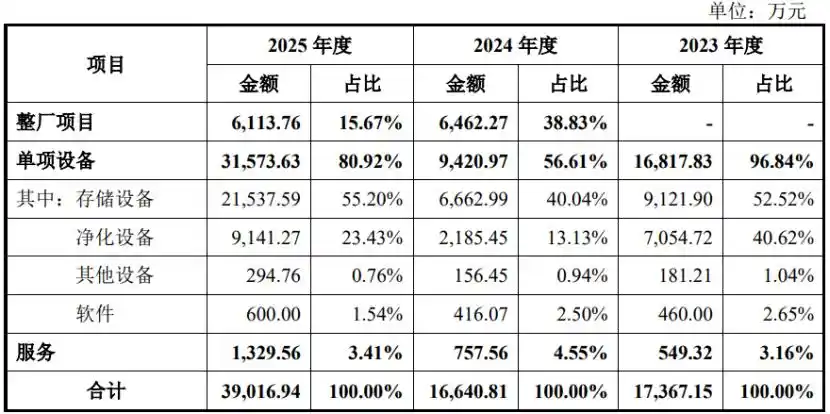
Composition of the company's main business revenue by product and service type, Source: Prospectus
Meifei Technology procures raw materials including stacker cranes, PCB boards, tooling, custom sheet metal parts and other non-standard processed parts; standard parts like control circuits, sensors, motors, pneumatic components, valves, reducers, bearings; as well as auxiliary items like tools and labor protection supplies.
Its suppliers include Shanghai Puzhi Precision Machinery Co., Ltd., Kunshan Chenyi Digital Technology Co., Ltd., Suzhou Magnoclean Cleanroom Materials Co., Ltd., Kunshan Jiulongfeng Precision Technology Co., Ltd., Shenzhen Hertz Innovation Technology Co., Ltd., etc.
The company's downstream customers are mainly semiconductor wafer fabs, including companies like SiEn (Qingdao) Integrated Circuit Co., Ltd., iRay Technology Company Limited, Guangdong GTA Semiconductor Co., Ltd. During the Reporting Period, revenue from Meifei Technology's top five customers accounted for 98.65%, 80.64%, and 92.42% of the period's revenue respectively, indicating high customer concentration, which may put the company in a weak position in business negotiations.
02 Turned Profit in 2025, Significant Gross Margin Fluctuations
In recent years, Meifei Technology's revenue has fluctuated. Benefiting from business scale expansion, recovery in operating income, and the push for import substitution demand due to trade frictions, the company achieved profitability in 2025.
In 2023, 2024, and 2025, Meifei Technology's operating revenue was approximately 174 million yuan, 167 million yuan, and 393 million yuan respectively, with corresponding net profits of -35.152 million yuan, -53.1105 million yuan, and 60.453 million yuan.
Among these, the company was not profitable in 2023 and 2024, mainly related to market conditions and the company's strategic planning. During these two years, affected by global economic weakness, escalating geopolitical conflicts, etc., the semiconductor industry experienced a significant downturn cycle, downstream market demand cooled, and the company's operating income declined. Additionally, the comprehensive gross margin was under pressure during the development stage of OHT conveying systems and full-factory projects, coupled with high expense levels due to the company's counter-cyclical expansion efforts.
As a key system for semiconductor wafer fab production and manufacturing, AMHS is characterized by being technology-intensive, having extremely stringent reliability requirements, and deep integration with customer production processes. The industry has long been dominated by two giants: Japan's Daifuku Group and Murata Machinery.
Compared to these two giants, Meifei Technology still lags in terms of revenue scale, brand influence, global service network, and high-end customer resources.
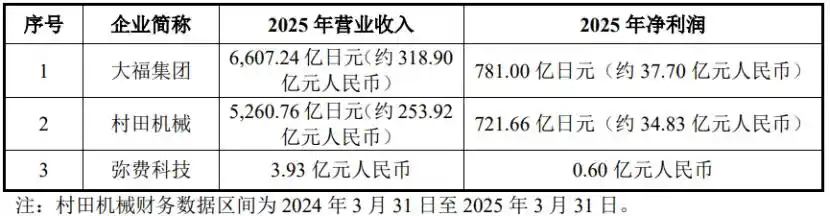
Comparison of the company with Daifuku Group and Murata Machinery regarding 2025 operating revenue and net profit, Image from the prospectus
The market demand for the AMHS industry where Meifei Technology operates is related to macroeconomic trends and the cyclicality of the downstream semiconductor industry.
In recent years, benefiting from the semiconductor market boom, the global semiconductor equipment market has grown significantly. According to SEMI data, the global semiconductor equipment market size reached 135.1 billion USD in 2025; during the same period, the semiconductor equipment market size in mainland China was 49.3 billion USD, making it the world's largest semiconductor equipment market.
According to CMI forecasts, the global semiconductor equipment market size will approach 200 billion USD by 2032, with a compound annual growth rate (CAGR) of about 5.76% from 2025 to 2032.
According to a report released by CCID Consulting, the global AMHS market size accounts for about 3% of total semiconductor equipment. The global AMHS market size in 2025 was 4.053 billion USD, with the AMHS market size in mainland China approximately 1.479 billion USD during the same period.
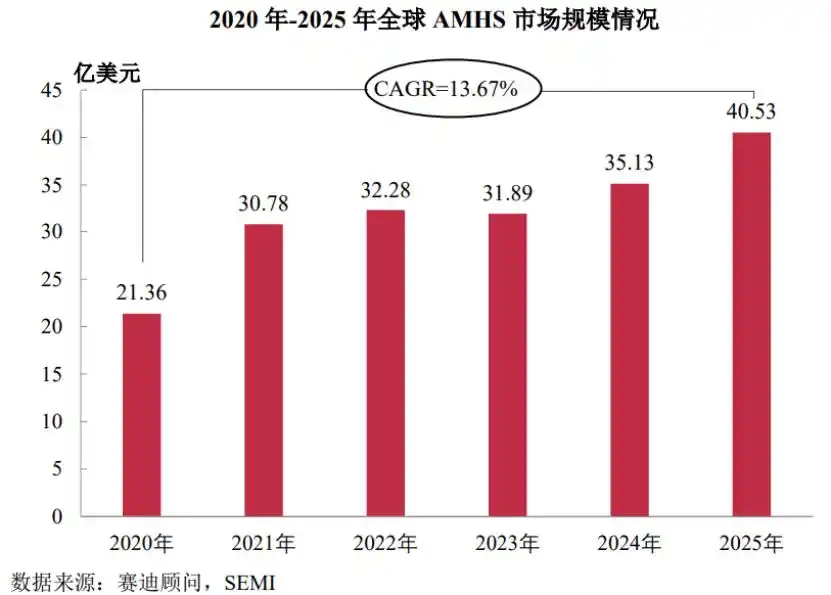
Image from the prospectus
With the development of the semiconductor industry, a company's technological capability has become a key factor in gaining a long-term competitive advantage.
During the Reporting Period, Meifei Technology's R&D expenses were 38.6044 million yuan, 46.645 million yuan, and 52.9481 million yuan, accounting for 22.18%, 27.91%, and 13.47% of operating revenue respectively.
Due to the company's relatively small revenue scale in 2023 and 2024, the R&D expense ratio was relatively high. As the company's operating revenue increased rapidly, the R&D expense ratio declined.
It is worth noting that during the Reporting Period, Meifei Technology's comprehensive gross margins were 49.68%, 24.67%, and 48.97%, showing significant fluctuations, with the 2024 gross margin lower than the industry average.
Among these, in 2024, the company was in a critical stage of market development for new products. The first batch of full-factory projects equipped with the company's self-developed OHT conveying system were accepted by customers. These projects had negative gross margins due to relatively favorable pricing and substantial manpower and material investments.
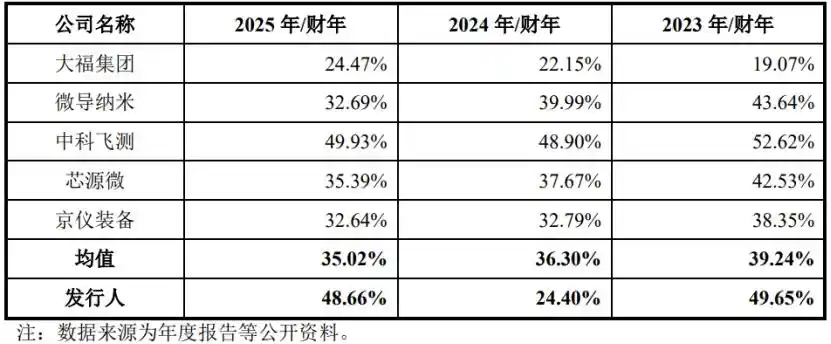
Comparison of AMHS product gross margin in the company's main business with that of comparable listed peers, Image from the prospectus
03 An IPO Emerges from Shanghai, Controlled by an 80s Couple
Meifei Technology is registered in the Lingang New Area of the Shanghai Pilot Free Trade Zone. Its predecessor, Meifei Limited, was established in 2014 by Miao Feng's mother, Zhao Xiufang, and was transformed into a joint-stock limited company in 2022.
Prior to this issuance, the husband-and-wife team Miao Feng, Ke Na, and their concert parties Shanghai Mizheng, Shanghai Mida, and Shanghai Mizhen collectively control approximately 41.98% of the voting rights of the company's shares and are the actual controllers.
Additionally, Wu Shuichang, Qiming Rongxin, General Industry Investment, Jiequan Mingyuan, Haitong Innovation, etc., are all shareholders of the company.
Miao Feng was born in 1982, holds a master's degree, and is a doctoral candidate at Huazhong University of Science and Technology. He previously served as a CIM Engineer at Shanghai Grace Semiconductor Manufacturing Co., Ltd., an EAP Engineer at Trina Solar Co., Ltd., an MES Engineer at Shanghai Lixin Integrated Circuit Manufacturing Co., Ltd., a Senior Automation Engineer at UMC (United Microelectronics Corporation), a Software Principal Engineer at Aikyu (Shanghai) Trading Co., Ltd., General Manager of the LED Division at Shanghai Glaway Software Co., Ltd., and other positions. He has served as Chairman and General Manager of Meifei Technology since January 2017.
Ke Na was born in 1984 and holds a master's degree. She has previously held positions including Senior Training Management Specialist at Shanghai Grace Semiconductor Manufacturing Co., Ltd., Human Resources Department Manager at Sumitomo Heavy Industries Drive Technology (China) Co., Ltd., Human Resources Director at Shanghai Baofeng Machinery Manufacturing Co., Ltd., Deputy General Manager of Meifei Limited, and General Manager of Reversable Management Consulting (Shanghai) Co., Ltd. She is currently the Deputy General Manager of Meifei Technology.
Company Director and Financial Officer Zhu Tiankai was born in 1981 and holds a doctoral degree. He has previously served as a Process Engineer at Aikyu (Shanghai) Trading Co., Ltd., Senior Process Engineer at Advanced Micro-Fabrication Equipment Inc. China (AMEC), Analyst at McKinsey & Company (Shanghai), and Financial Officer of Meifei Limited.
For this IPO, Meifei Technology plans to raise approximately 1.191 billion yuan, to be used for the Semiconductor AMHS Production and R&D (Yangzhou) Base Construction Project, the Malaysia Overseas Business Center Project, the R&D Center Construction Project, and supplementing working capital.
This article is from the WeChat public account "Glonghui New Stocks", author: Bro Says New Stocks