Adam Back slams Bitcoiner VC for ‘uninformed noise’ about quantum risk

cointelegraphPubblicato 2025-12-20Pubblicato ultima volta 2025-12-20

Introduzione

Blockstream CEO Adam Back criticized Castle Island Ventures' Nic Carter for amplifying concerns about quantum computing threats to Bitcoin, calling it "uninformed noise." Carter defended his firm's investment in quantum-resistant startup Project Eleven, stating he was "quantum pilled" and believes Bitcoin is vulnerable. He argues governments are preparing for quantum risks and Bitcoin is a "bug bounty" for quantum attacks. While some, like Capriole Investments' Charles Edwards, warn the threat could emerge in 2-9 years, Back contends quantum technology is still decades away from being a real threat. Others, like Kevin O’Leary, doubt attacking Bitcoin would be a practical use of quantum computing.

Blockstream CEO Adam Back has criticized Castle Island Ventures founding partner Nic Carter for amplifying concerns about quantum computing threats to Bitcoin.

“You make uninformed noise and try to move the market or something. You’re not helping,” Back said in an X post on Friday, after Carter explained in an X post why Castle Island Ventures invested in Project Eleven, a startup focused on protecting Bitcoin and other crypto assets from the threat of quantum computing.

Back said the Bitcoin community is not in denial about the need to research and develop protections against potential quantum computing threats, but is instead doing that work “quietly.” However, Carter refuted Back’s comment, arguing that many Bitcoin developers are still in “total denial” about the risk of quantum computing to Bitcoin.
Source: Pledditor

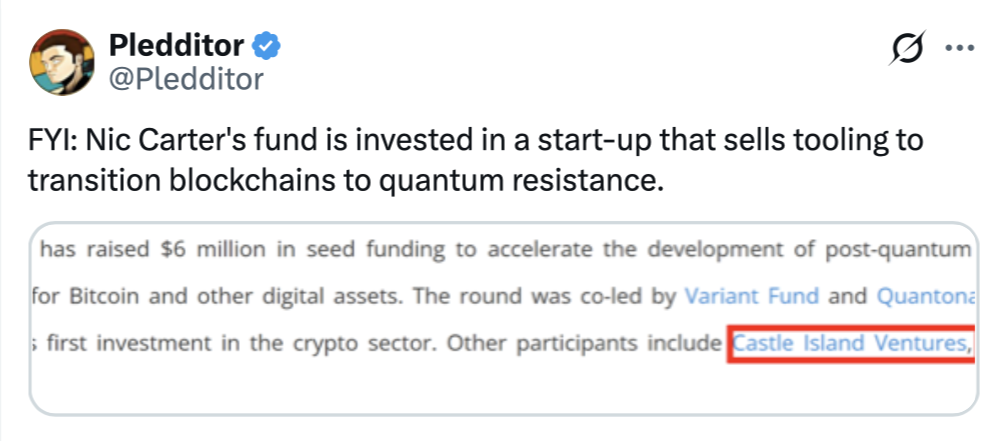
While Castle Island Ventures’ investment only recently resurfaced on social media within the Bitcoin community, Carter first disclosed it in a Substack post on Oct. 20. “I disclosed this in the first sentence of my main article on quantum. Can’t get more transparent than that,” Carter said.

Carter says he was “quantum pilled”

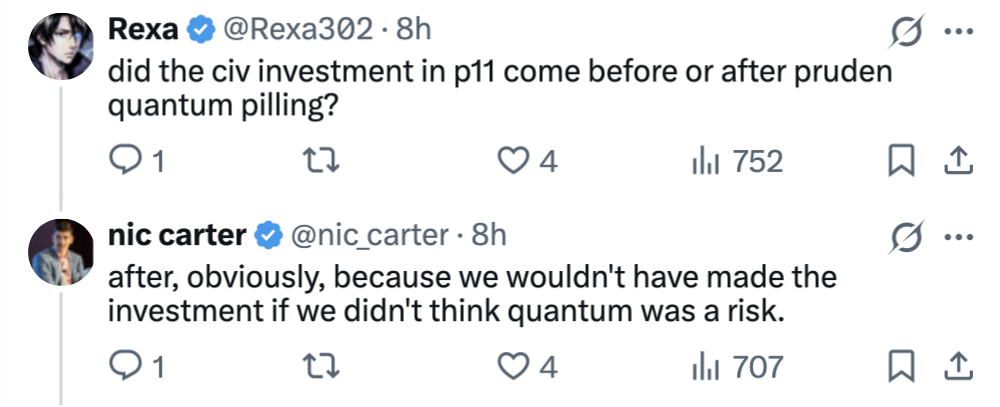
Carter said that he invested in the project because Project Eleven CEO Alex Pruden “quantum pilled” him. “I became extremely concerned about quantum threats to blockchains. I put capital behind my convictions, always have,” he said.
Source: Nic Carter

“I knew the bad faith criticisms would come, so I made absolutely sure to be crystal clear about my financial exposure here,” Carter added.

Carter raised several points why quantum computing poses a risk to Bitcoin, including governments planning for a post-quantum world, Bitcoin itself being “a bug bounty” for quantum supremacy, and the increasing amount of investment in quantum firms.

Carter isn’t the only prominent Bitcoin figure to have recently stepped up public warnings about the potential quantum computing threat to Bitcoin.

Some warn the threat could emerge in as little as two years

Capriole Investments founder Charles Edwards warned in a post on X on Thursday that quantum computing could pose a genuine threat to Bitcoin within the next two to nine years unless the network upgrades to quantum-resistant cryptography.

However, others are less concerned.

Related: Anxiety of quantum risk to Bitcoin is weighing on its price: Execs

Multimillionaire entrepreneur Kevin O’Leary recently told Cointelegraph Magazine that using quantum computing to break Bitcoin’s security wouldn’t be the most effective use of the technology, arguing it would be far more valuable in areas like AI-driven medical research.

Meanwhile, Back recently said it is good for Bitcoin to be “quantum ready,” but it won’t be a threat for the next few decades, as the technology is still “ridiculously early,” and has research and development issues.

Magazine: Big questions: Would Bitcoin survive a 10-year power outage?

Domande pertinenti

QWhat is Adam Back's criticism of Nic Carter regarding quantum computing threats to Bitcoin?

AAdam Back criticized Nic Carter for making 'uninformed noise' and trying to move the market, arguing that the Bitcoin community is already working 'quietly' on quantum protections rather than being in denial.

QWhy did Nic Carter invest in Project Eleven?

ANic Carter invested in Project Eleven because its CEO Alex Pruden 'quantum pilled' him, making him extremely concerned about quantum threats to blockchains, and he wanted to put capital behind his convictions.

QWhat are some reasons Carter believes quantum computing poses a risk to Bitcoin?

ACarter cited governments planning for a post-quantum world, Bitcoin being 'a bug bounty' for quantum supremacy, and increasing investments in quantum firms as reasons for the risk.

QHow soon does Charles Edwards believe quantum computing could threaten Bitcoin?

ACharles Edwards warned that quantum computing could pose a genuine threat to Bitcoin within the next two to nine years unless the network upgrades to quantum-resistant cryptography.

QWhat is Adam Back's timeline for when quantum computing might become a threat to Bitcoin?

AAdam Back stated that quantum computing won't be a threat to Bitcoin for the next few decades, as the technology is still 'ridiculously early' and has research and development issues.

Letture associate

Making AI Products Is No Longer the Hard Part; Being Seen Is: Developers, Web3, and Chinese AI Opportunities at mu Shanghai

The article discusses the shifting challenges of AI entrepreneurship, based on insights from the mu Shanghai AI WEEK event in May 2026. As AI tools drastically lower the barrier to creating product prototypes, the core difficulty for startups has moved from "how to build" to "who to build for"—finding real users, sustainable business models, and community engagement. The event itself was structured as an extended, immersive developer community space rather than a traditional conference, attracting a global mix of participants (40% AI, 20-30% Web3). This format emphasized deep networking and collaborative creation over one-way presentations. A key observation is that with powerful models and coding assistants becoming ubiquitous, execution is less of a moat. The new scarce resource is judgment—identifying valuable, defensible scenarios where an application won't be quickly rendered obsolete by the next model update. This pushes competition downstream to distribution, user acquisition, and commercialization. Notably, many Web3 practitioners are migrating into AI, bringing with them expertise in community building, global collaboration, and grassroots marketing—skills highly relevant as AI apps fight for visibility. Meanwhile, opportunities in AI hardware, robotics, and embodied intelligence are seen as more durable, leveraging China's robust manufacturing and supply chain ecosystem as a key advantage. The article notes that major Chinese model companies (like MiniMax) are now actively competing for developer mindshare through community programs, hackathons, and improved tooling, recognizing developers as core users. Ultimately, the conclusion is that while AI simplifies building, the harder part of the journey is ensuring a product is truly needed, understood, and retained by its users.

marsbit11 min fa

Making AI Products Is No Longer the Hard Part; Being Seen Is: Developers, Web3, and Chinese AI Opportunities at mu Shanghai

marsbit11 min fa

Why is the RWA Boom Failing to Benefit DeFi?

The rapid growth of the tokenized real-world assets (RWA) market, now nearing $30 billion on-chain, has largely bypassed the DeFi ecosystem. Only about $2.47 billion is actively locked in DeFi protocols, indicating a penetration rate of just 9%. A major barrier is the "permissioned" architecture of most RWA products, like BlackRock's BUIDL fund, which are designed for institutional compliance. They require whitelisting, off-chain settlement, and strict investor accreditation, making them incompatible with open, permissionless DeFi applications like Aave or Uniswap. This is evident in categories like bonds/money market funds ($16.6B on-chain, $920M in DeFi) and tokenized equities ($2.7B on-chain, $78M in DeFi). Notable exceptions are private credit protocols (e.g., Maple Finance, Centrifuge) and assets like Ondo's USDY, which were designed from inception for DeFi composability, allowing them to be used freely as collateral. Morpho and Aave Horizon also demonstrate successful RWA lending integrations. However, industry reports (IOSCO, ECB) warn that growth may remain confined within traditional financial systems due to fragmented regulations, lack of unified standards, and inherent conflicts between DeFi's open logic and compliance requirements like minimum investments and fixed redemption windows. The RWA sector is effectively split into two markets: a compliant, permissioned on-chain finance market and a smaller DeFi-native market focused on composability. For DeFi penetration to rise significantly, asset issuers must prioritize designs that enable permissionless circulation from the start, moving away from models centered solely on institutional compliance.

marsbit32 min fa

Why is the RWA Boom Failing to Benefit DeFi?

marsbit32 min fa

Clarity Act Outlook: No Yield, No Payment

"Clear Act Outlook: No Yield, No Payment" analyzes the evolving U.S. regulatory landscape for stablecoins, focusing on the interplay between the proposed "Clarity Act" and the existing "Genius Act." The article argues that the Genius Act successfully fostered "payment stablecoins" by permitting tokenized assets like U.S. Treasuries as reserves. This created a structured market where stablecoin issuers (like USDC) must hold these reserves, often purchased as Tokenized Money Market Funds (TMMFs) from giants like BlackRock. These TMMFs are primarily B2B products, ensuring user-facing stablecoins remain non-interest-bearing and used primarily for payments. The upcoming Clarity Act is seen as the next phase, aiming to restrict passive yield on stablecoins. Its goal is to dismantle the arbitrage advantage of offshore stablecoins like USDT by redirecting Treasury demand towards compliant, U.S.-sanctioned TMMFs. For on-chain and compliant offshore dollars, this creates new pressure: they must spur adoption and utility to generate yield, as simple Treasury staking may be restricted. This indirectly promotes dollar circulation and sustained Treasury purchases. Ultimately, the analysis posits that U.S. regulation seeks to create a new dollar distribution model. By separating payment function from yield generation and anchoring both to U.S. debt instruments, it aims to embed the dollar and Treasury demand into the global crypto economy, managing yields through sanctioned intermediaries while leaving room for DeFi and cross-border arbitrage.

marsbit1 h fa

Clarity Act Outlook: No Yield, No Payment

marsbit1 h fa

Trading

Spot
Futures
活动图片