Биткоин откатился от $93 500 на медвежьих данных по занятости в США

cryptonews.ruPubblicato 2025-12-22Pubblicato ultima volta 2025-12-22

Главное:

  • Сильные данные по рынку труда США не ослабили ожиданий снижения ставки ФРС в декабре.

  • Крипторынок продолжает расходиться с фондовым, несмотря на прогнозы сильного завершения 2025 года для акций.

  • Цифровому золоту нужно вернуть несколько ключевых уровней сопротивления, чтобы изменить медвежий сценарий.

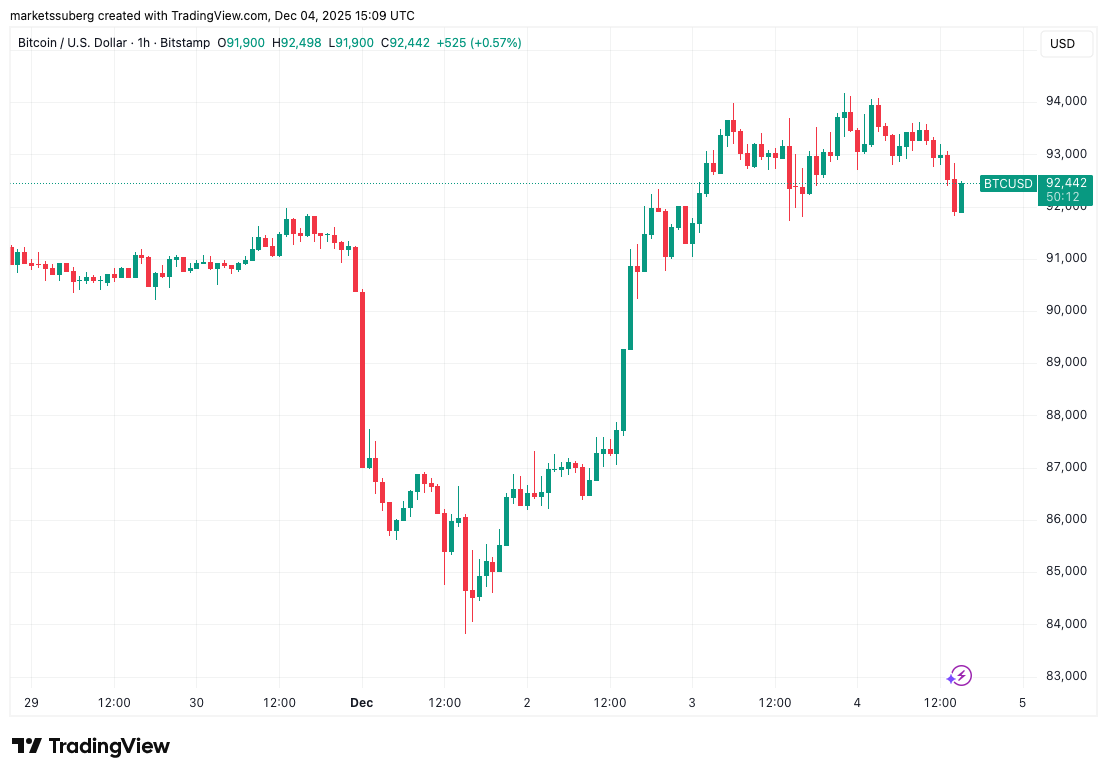
Биткоин (BTC) снова не смог удержать ключевой годовой уровень. Цена актива откатилась от отметки $93 5000 на фоне публикации свежих данных о занятости в США.

ФРС «не останется выбора»

Данные TradingView показывают ослабление ценового действия первой криптовалюты после публикации очень низких данных по первичным заявкам на пособие по безработице в США.
Federal Reserve, Bitcoin Price, Markets, Market Analysis
Часовой график BTC/USD. Источник: TradingView.

Как первичные, так и текущие заявки оказались ниже ожиданий, согласно данным St. Louis Fed.
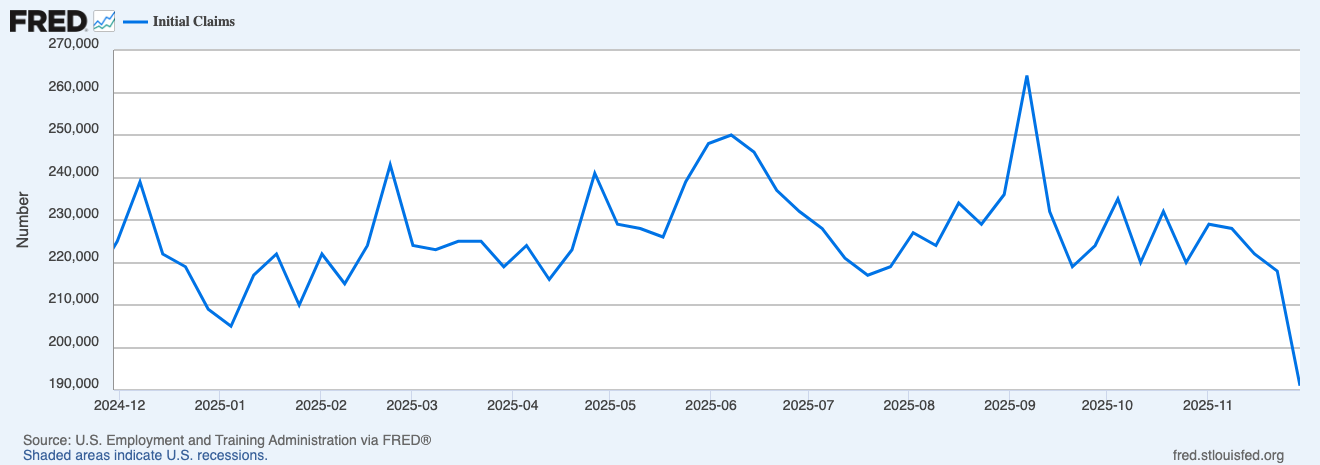
Первичные недельные заявки на пособие по безработице в США по состоянию на 29 ноября. Источник: St. Louis Fed.

Несмотря на этот сигнал укрепления рынка труда — а, следовательно, устойчивости экономики — рынки удвоили ожидания того, что Федеральная резервная система снизит процентные ставки на заседании 10 декабря.

По теме: аналитики назвали ключевые факторы для восстановления биткоина

Аналитики объясняют это растущим разрывом между рисковыми активами и покупательной способностью потребителей.

«У ФРС нет выбора: даже при инфляции в 3%, агентство должно снизить ставки, чтобы спасти потребителей США», — сказали в The Kobeissi Letter.
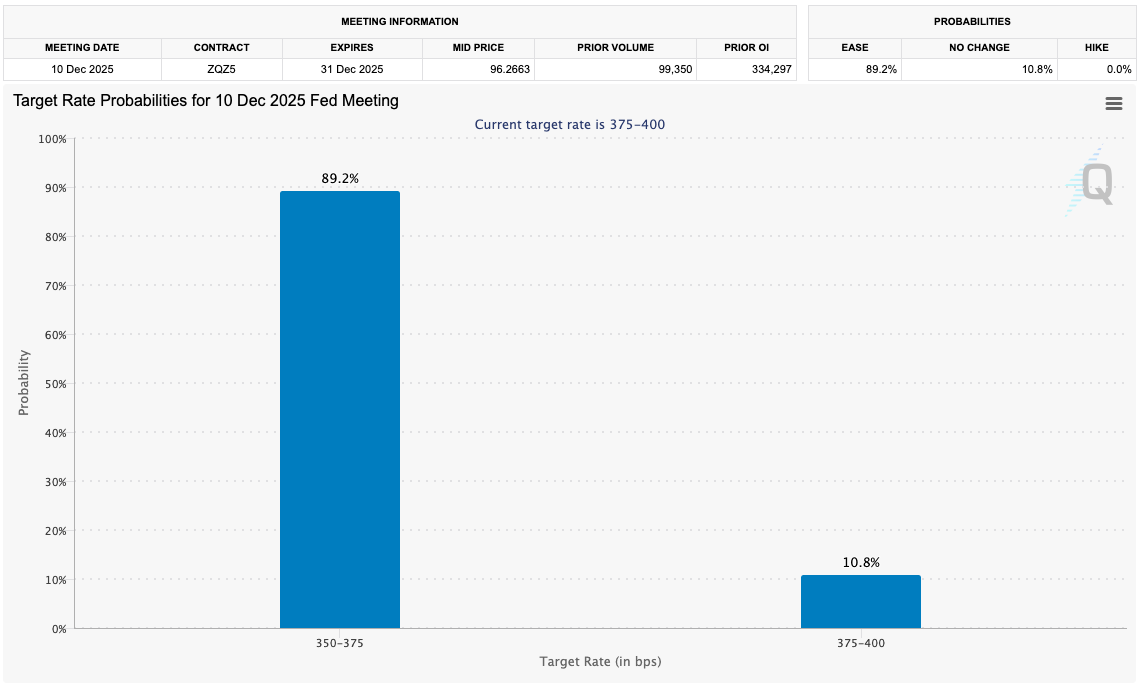
Вероятность снижения целевой ставки ФРС на заседании 10 декабря. Источник: CME Group.

Снижение ставки, по идее, должно поддержать приток ликвидности в криптоактивы. При этом даже риск скорого повышения ставок в Японии противоречит действиям ее центрального банка, который только что завершил вливание $135 млрд экономического стимула.

В Kobeissi назвали ситуацию в Японии «свободным для всех» рынком.

«Страна печатает стимулы, но при этом поднимает ставки? Что-то здесь не так», — резюмировали аналитики.

По теме: биткоин рухнул к $86 000 на ястребиных сигналах Банка Японии
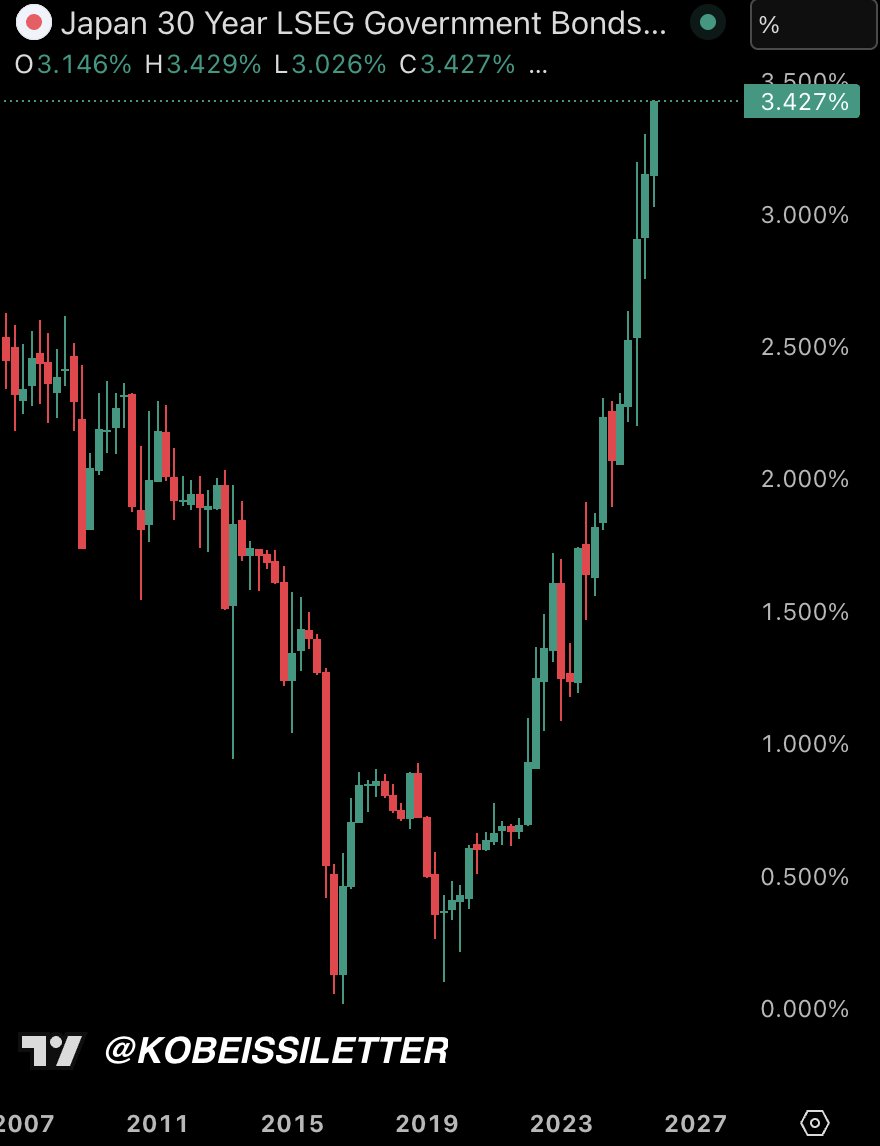
График облигаций Японии. Источник: The Kobeissi Letter/X.

Медвежий сценарий для биткоина

На фоне того, что индекс S&P 500 находится всего в 0,5% от новых исторических максимумов, первая криптовалюта и альткоины продолжают выглядеть слабыми.

По словам аналитиков, среди трейдеров на горизонте маячит несколько ключевых уровней сопротивления, которые необходимо отвоевать.

«Помимо годового открытия на $93 500, точками интереса являются ликвидность, расположенная ближе к $100 000, а также 50-недельные простые (SMA) и экспоненциальные (EMA) скользящие средние», — говорят они.

По теме: снижение ставки ФРС в декабре маловероятно, но биткоин устоит — Кевин О’Лири

Согласно Material Indicators, для восстановления активу необходим ретест 50-недельной SMA, но сначала нужно преодолеть сопротивление в диапазоне $96 000–98 000.

«Слишком рано называть это восстановлением бычьего рынка. Нам нужно пробить эти уровни сопротивления со здоровым RSI на закрытии недели, прежде чем мы сможем начать этот разговор», — заявили аналитики.
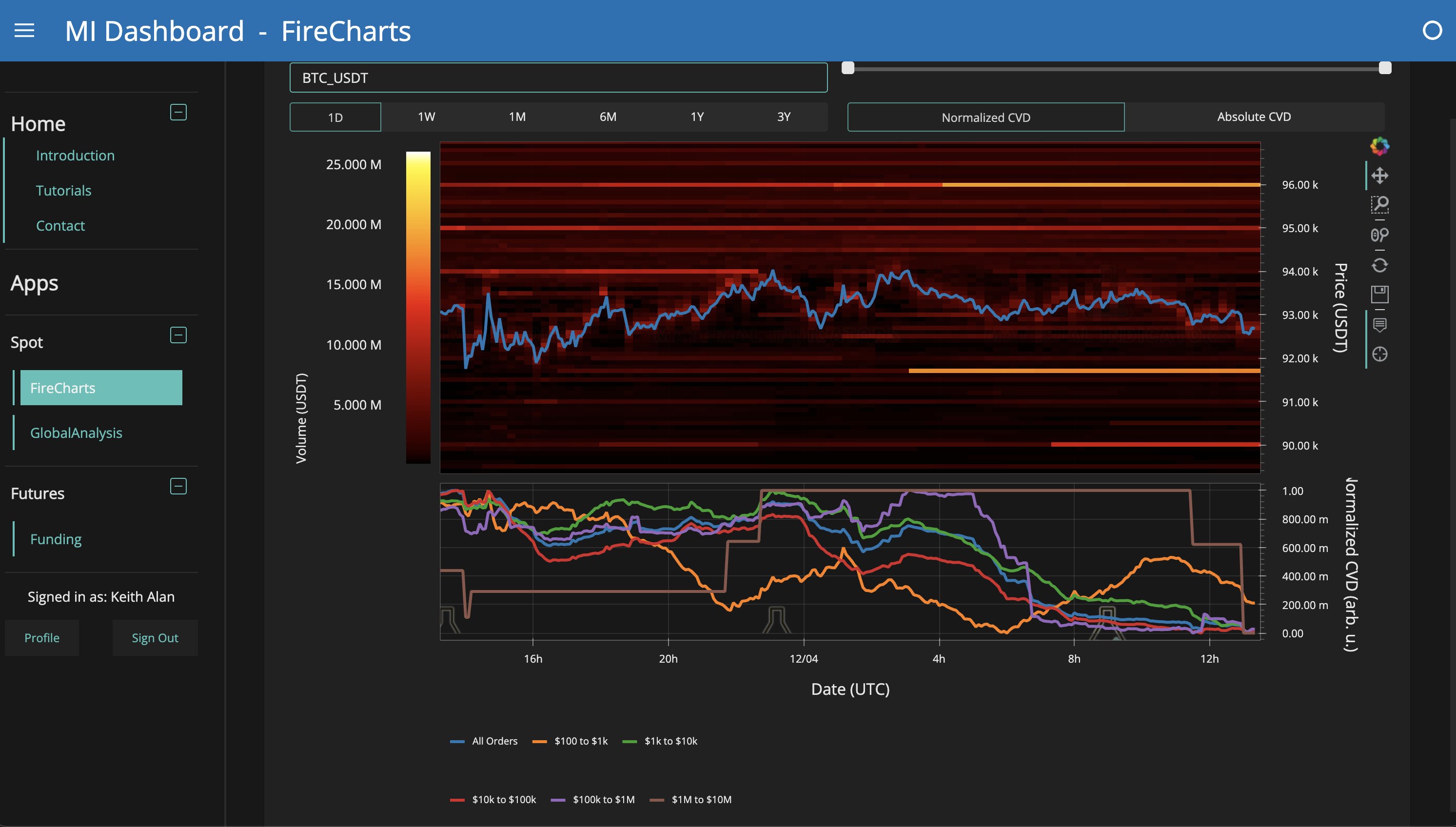
Данные о ликвидности книги ордеров BTC/USDT с операциями крупных участников. Источник: Material Indicators/X.

Они также указали, что неспособность биткоина закрепиться выше годового открытия является признаком того, что медвежий сценарий остается сильным.

По теме: Артур Хэйес спрогнозировал рост биткоина до $500 000 к концу 2026 года

Эта статья не содержит инвестиционных советов или рекомендаций. Каждое инвестиционное и торговое решение связано с риском, читатели должны самостоятельно проводить исследование перед принятием решений.


Letture associate

Analysis of the Latest Portfolio Adjustment by the "Top Player" in the U.S. Stock Market: $9 Billion Short on NVIDIA, Shifting Focus to Power and Memory Sectors

AI investor Leopold Aschenbrenner has made a significant portfolio shift, taking a $9 billion nominal short position against top AI infrastructure stocks like NVIDIA, ASML, and Oracle. Simultaneously, he is redirecting capital towards what he sees as the next critical bottlenecks in the AI boom: power, memory, and data center networking, alongside private investments in AI model companies like Anthropic. This move is interpreted not as a call that the AI bubble has burst, but as a rotation within the infrastructure stack. The analysis highlights NVIDIA's recent $25 billion bond issuance as a potential signal, questioning why a cash-rich company would seek external debt despite high profits and increased dividends/buybacks. The core investment thesis is that the initial, crowded "picks and shovels" trade in semiconductors is maturing. The next wave of capital is expected to flow into the physical and logistical constraints of AI expansion: electricity supply, memory chip capacity, data center construction, and enabling technologies like optical networking (fiber) for high-bandwidth communication, where copper remains crucial for short distances. Aschenbrenner's substantial (approx. 20% of fund) private stake in Anthropic is noted as a key part of his strategy—investing directly in the "mine" (AI models) rather than just the "shovels." The discussion concludes that while certain segments may be overvalued, the overarching AI infrastructure demand driven by real product usage remains robust. The most promising long-term investments are seen in essential, non-sexy infrastructure—particularly energy and power companies—whose demand is viewed as a global constant irrespective of AI's cyclicality.

marsbit7 min fa

Analysis of the Latest Portfolio Adjustment by the "Top Player" in the U.S. Stock Market: $9 Billion Short on NVIDIA, Shifting Focus to Power and Memory Sectors

marsbit7 min fa

BIT Research: Liquidity is Disappearing, Will Bitcoin Replay the Bottoming Pattern of 2022?

The crypto market is currently in an adjustment phase driven by policy expectations and liquidity shifts. Despite a brief rebound fueled by geopolitical easing and SpaceX's strong IPO performance, unexpectedly hawkish signals from new Fed Chair Kevin Warsh have removed anticipated easing support. Concurrently, stablecoin liquidity is shrinking, with insufficient new capital inflows, pushing the market into a typically quiet summer period. Pricing lacks catalysts for a sustained rally. Daily trading volume has significantly contracted, stablecoin growth has slowed markedly, and the supportive effect of Strategy's (formerly MicroStrategy) STRC preferred stock-financed Bitcoin purchases is fading. Amid policy uncertainty, seasonal weakness, and liquidity contraction, Bitcoin faces near-term downward pressure. Warsh's hawkish pivot and refusal to provide a clear policy outlook have increased risk premiums, historically unfavorable for Bitcoin. Technically, the trend remains bearish below $73,700, with $62,446 as critical support. A break below could accelerate declines, though a prolonged consolidation phase, similar to 2022's bottoming process, is possible. Liquidity is a core constraint. Current daily volume is around $500 billion, roughly 25% of the peak during the July-Oct 2025 rally. The 12-month growth rates for USDT and USDC have fallen to ~20%, with 6-month growth near zero, indicating weak new inflows. Bitcoin ETF and Strategy-driven inflows have also weakened, with a 30-day rolling net outflow. With inflation at 4.2% above the Fed's target, combined hawkish policy, seasonal factors, and liquidity shortages challenge Bitcoin's ability to hold above $60,000. However, this adjustment phase may be forming a cyclical low this summer, potentially setting the stage for the next bull cycle.

marsbit35 min fa

BIT Research: Liquidity is Disappearing, Will Bitcoin Replay the Bottoming Pattern of 2022?

marsbit35 min fa

Who Makes the Best Use of Claude Code? The Answer Might Not Be Programmers

Claude Code Usage Report Summary (Based on ~400k sessions) Core Finding: In agentic programming with Claude Code, a clear division of labor has emerged: humans primarily decide *what* to build (planning decisions), while Claude decides *how* to build it (execution decisions). Key Insights: 1. **Effectiveness is not limited to programmers.** In code-generation tasks, success rates for users in non-technical fields (law, finance, management, research) are nearing those of software engineers. What matters most is the user's domain expertise and understanding of the problem to be solved. 2. **Domain expertise drives success and efficiency.** Sessions where users exhibited "expert" proficiency in the task's domain saw verified success rates double compared to "novice" sessions. Experts also delegated more work per instruction, with Claude executing more actions and producing more output. 3. **AI is amplifying, not replacing, domain knowledge.** Claude Code lowers the *implementation* barrier, not the *judgment* barrier. The value of knowing the "what" and "why" is increasing relative to just knowing the "how" to code. 4. **Usage is evolving.** Over a 7-month period (Oct '25 - Apr '26), the share of sessions for debugging halved, while use for software operations, data analysis, and non-code writing roughly doubled. The estimated economic value of typical tasks increased by ~25%. Conclusion: The data suggests coding agents are making programming background less critical for completing technical tasks. However, they reward and amplify deep domain understanding. The ability to successfully direct an AI agent stems more from mastery of a specific field than from coding skill itself. The primary gains come from being competent in a domain; deep specialization adds only marginal additional advantage. This may signal a shift where software creation becomes integrated into various professions.

marsbit1 h fa

Who Makes the Best Use of Claude Code? The Answer Might Not Be Programmers

marsbit1 h fa

Trading

Spot
Futures
活动图片