Ripple Powers New Offramp For BlackRock, VanEck Tokenized Fund

bitcoinistPubblicato 2025-09-25Pubblicato ultima volta 2025-09-25

Introduzione

Ripple has added another institutional rail to its stablecoin strategy: through an integration with Securitize, holders of BlackRock’s USD Institutional...

Trusted Editorial content, reviewed by leading industry experts and seasoned editors. Ad Disclosure

Ripple has added another institutional rail to its stablecoin strategy: through an integration with Securitize, holders of BlackRock’s USD Institutional Digital Liquidity Fund (BUIDL) and VanEck’s VBILL tokenized US Treasuries can now redeem fund shares for Ripple USD (RLUSD) around the clock—initially on Ethereum, with support for the XRP Ledger (XRPL) in the pipeline.

BlackRock And VanEck Turn To Ripple’s RLUSD

In a press release dated September 23, Ripple and Securitize said a new smart-contract flow “would allow holders of BlackRock’s BUIDL and VanEck’s VBILL to exchange their shares … for Ripple USD (RLUSD),” describing the mechanism as “an additional stablecoin off ramp for BUIDL and VBILL tokenized short term treasury funds.” The companies emphasized continuous availability—“24/7”—and framed the upgrade as programmable liquidity for compliant, on-chain investment products. Securitize also confirmed it is integrating with the XRP Ledger “to expand access and bring new utility to the XRPL ecosystem.”

Jack McDonald, Ripple’s SVP of Stablecoins, positioned the move as a bridge between tokenized funds and transactional money: “RLUSD is for institutional use, offering regulatory clarity, stability, and real utility. As adoption grows, partnerships with trusted platforms like Securitize are key to unlocking new liquidity and enterprise-grade use cases.” On X, McDonald distilled the news for market participants: “RLUSD is now a key stablecoin offramp for BlackRock’s BUIDL and VanEck’s VBILL tokenized fund holders. The integration is starting with ETH, though Securitize is planning to integrate with the XRP Ledger.”

Ripple President Monica Long linked the Securitize integration to a broader RLUSD tokenization push announced the prior week with DBS and Franklin Templeton, where RLUSD serves as a “liquid, stable and compliant exchange mechanism for tokenized assets in lending and trading use cases.” “This week, Securitize added RLUSD as a new offramp for BlackRock and VanEck’s tokenized funds,” she noted.

Ripple CEO Brad Garlinghouse underscored the 24/7 redemption promise and the XRPL roadmap: “Very excited to share that BlackRock’s BUIDL and @VanEck_US’s VBILL tokenized fund holders can redeem shares for RLUSD/ETH 24/7 365 through Securitize, and soon to come RLUSD/XRPL. Enterprise-grade instant onchain liquidity at your fingertips. That’s real utility.”

The companies framed the design as explicitly regulatory-first. Ripple said RLUSD is issued under a New York Department of Financial Services (NYDFS) trust charter, with “1:1 USD backing by high-quality liquid assets, strict reserve management and asset segregation, third-party attestations and clear redemption rights.” Ripple added that since launch in late 2024, RLUSD has integrated into DeFi and cross-border payment flows and surpassed $700 million in market capitalization.

For tokenized funds, the off-ramp matters because it stitches together yield-bearing on-chain treasuries with settlement-grade stablecoin liquidity. BlackRock’s BUIDL and VanEck’s VBILL are tokenized short-term US Treasury strategies issued through Securitize on public blockchains; the new workflow lets qualified holders convert fund shares into RLUSD without banking hours friction, potentially improving collateral mobility for trading, lending, repo and treasury operations.

Ripple Puts New Focus On Tokenization

The development also follows Ripple’s tie-up with DBS and Franklin Templeton, which is listing Franklin’s sgBENJI token on the DBS Digital Exchange alongside RLUSD to enable swapping between the tokenized fund and the stablecoin, and to explore using tokenized fund units as repo collateral—an example of how banks envisage tokenization rails meeting institutional liquidity needs.

While the initial redemption path is live on Ethereum via Securitize, both firms signaled that XRPL integration is next, aligning with Ripple’s push to make RLUSD natively useful across multiple venues. If executed, XRPL support would extend the same institutional redemption mechanics to a different settlement environment—one that Ripple and parts of the treasury-tokenization market already touch via custody, payments, and prior Franklin Templeton XRPL issuance plans.

Notably, BlackRock will be represented at Ripple Swell 2025 in New York on November 4–5 at Convene Hudson Yards. Maxwell Stein, BlackRock’s Director of Digital Assets, is slated to speak in a session titled “The Impact of Tokenized Financial Assets on Capital Markets,” alongside Rory Callagy of Moody’s.

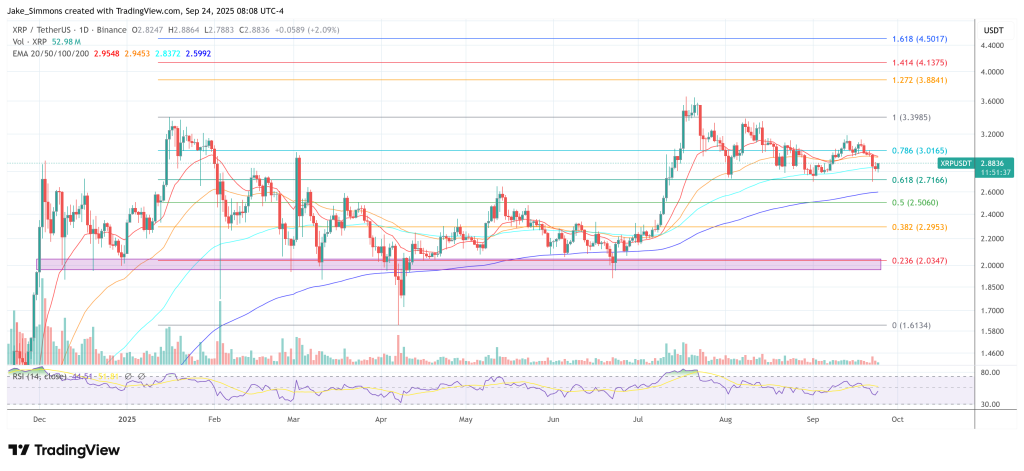
At press time, XRP traded at $2.88.
XRP price
XRP price, 1-day chart | Source: XRPUSDT on TradingView.com
Featured image created with DALL.E, chart from TradingView.com
Editorial Process for bitcoinist is centered on delivering thoroughly researched, accurate, and unbiased content. We uphold strict sourcing standards, and each page undergoes diligent review by our team of top technology experts and seasoned editors. This process ensures the integrity, relevance, and value of our content for our readers.

Jake Simmons has been a Bitcoin enthusiast since 2016. Ever since he heard about Bitcoin, he has been studying the topic every day and trying to share his knowledge with others. His goal is to contribute to Bitcoin's financial revolution, which will replace the fiat money system. Besides BTC and crypto, Jake studied Business Informatics at a university. After graduation in 2017, he has been working in the blockchain and crypto sector. You can follow Jake on Twitter at @realJakeSimmons.

Letture associate

Mysterious "Ox Alpha" Large Model Goes Viral with Limited-Time Free Access

A mysterious anonymous AI model named "Ox Alpha," nicknamed "Cow is Coming" by Chinese netizens, has appeared on OpenRouter, sparking widespread speculation. The model offers a 1 million token context, supports text, image, and video inputs, can call tools, and is currently free. Its standout feature is strong coding ability. Initial tests on the DeepSWE benchmark, which evaluates real-world software engineering tasks, showed an 80% pass rate on a subset of tasks, reportedly nearing top-tier code models. However, follow-up tests yielded a 63% score, with variations attributed to different task sets and configurations. The model's true developer is a major topic of debate. The prevailing theory points to Zhipu AI's unreleased GLM-5.3 Flash or its multimodal variant. Evidence cited includes identical visual token consumption patterns with GLM-5V-Turbo for videos, a consistent offset in text token counts compared to GLM-5.3, and similar behavioral traits like refusing audio processing. Zhipu has a precedent of anonymous testing. Simultaneously, another anonymous model, "korrine," appeared on Code Arena, with guesses ranging from Moonshot's Kimi K3.1 to models from Qwen or MiMo, adding to the industry's guessing game. This trend of anonymous "undercover" testing allows for unbiased performance evaluation in platforms like Arena and provides real-world, high-pressure testing through tools like OpenRouter before official release. It also serves as an effective marketing tactic, prolonging discussion through suspense. If Ox Alpha is indeed a "Flash" model, its performance raises expectations for the full-scale version's potential.

marsbit2 h fa

Mysterious "Ox Alpha" Large Model Goes Viral with Limited-Time Free Access

marsbit2 h fa

Breaking News: DeepSeek Announces All-Day Off-Peak Pricing on Weekends, Making Weekend Work More Cost-Effective?

DeepSeek has announced a significant change to its API pricing model, effective August 23. The new policy removes peak/off-peak distinctions on weekends (Saturdays and Sundays), charging the lower off-peak rate for the entire two-day period. This adjustment has sparked mixed reactions within the developer and professional communities. For developers and businesses heavily reliant on DeepSeek's V4-Flash and V4-Pro APIs, this is welcome news. It allows them to schedule bulk processing tasks on weekends without the higher peak-hour costs, potentially halving their API bills for such workloads. Some users have celebrated the move for making weekend work more cost-effective. However, the announcement has also raised concerns among employees. There is apprehension that companies, particularly in cost-sensitive sectors like AI-powered short drama production, might reorganize work schedules to align with these new cost incentives. Instances are already emerging where teams schedule high-token tasks during cheaper nighttime hours or adjust staff shifts. This has led to worries about a potential shift towards weekend workdays and weekday time-off, prioritizing cost savings over traditional work-life balance. Debate has ensued regarding the practicality of such schedule changes, with questions about increased communication overhead and overall efficiency. Speculation about DeepSeek's motives for the change includes theories that peak pricing correlates with internal model training schedules, though others counter that training is largely automated. The new pricing structure is now in effect, prompting users to reconsider their task scheduling strategies.

marsbit3 h fa

Breaking News: DeepSeek Announces All-Day Off-Peak Pricing on Weekends, Making Weekend Work More Cost-Effective?

marsbit3 h fa

Just Now, The World's First Human vs. Robot Tennis Match Begins, Robot's Desperate Save Leaves Zheng Jie Astonished

Just now, the world's first human vs. robot tennis match began, featuring stunning robotic saves that left tennis star Zheng Jie in awe. This historic event, part of the second World Humanoid Robot Games and broadcast live globally by China Media Group, marked a pivotal moment in Chinese technological innovation and embodied artificial intelligence. The match featured both mixed human-robot doubles and a groundbreaking singles match between Zheng Jie and the "Galaxy Xingzai" humanoid robot developed by Galaxy General. The robot demonstrated impressive skills including serving, forehands, backhands, and strategic court movement, with serves exceeding 100 km/h. It exhibited remarkable adaptability, recovering from a fall to continue play and handling slices and spins. The doubles match highlighted its ability to coordinate dynamically with a human partner. The event's significance extends far beyond a novelty match. Tennis represents an ultimate pressure test for embodied AI, demanding real-time integration of perception, decision-making, full-body motion control, and live博弈 within fractions of a second—a stark contrast to the discrete, contemplative environment of board games like Go mastered by AlphaGo. It directly confronts Moravec's paradox, showcasing AI's move from digital cognition to physical execution. This capability is powered by Galaxy General's proprietary "Galaxy Star Brain" (AstraBrain) model. Its key innovation is a unified architecture that integrates high-level task understanding/tactical decision-making ("brain") and dynamic whole-body motion control ("cerebellum") into a single model, eliminating latency and information loss between separate modules. The model was trained using a two-step process via the "Galaxy Star Workshop" platform. First, it learned foundational movement priors from "imperfect" human motion data (both amateur and professional). Second, it underwent massive-scale evolution in a virtual tennis simulator where multiple AI agents played millions of games against each other. Through this adversarial training, skills like极限救球and recovery from falls emerged autonomously without explicit programming, before being transferred to the physical robot. This "AstraTennis" moment symbolizes a major leap: a decade after AlphaGo conquered the digital world, embodied AI from China has now demonstrated it can operate under the extreme, unpredictable physical pressures of real-world competition.

marsbit3 h fa

Just Now, The World's First Human vs. Robot Tennis Match Begins, Robot's Desperate Save Leaves Zheng Jie Astonished

marsbit3 h fa

Trading

Spot
活动图片