Mysterious "Ox Alpha" Large Model Goes Viral with Limited-Time Free Access

marsbitPubblicato 2026-08-23Pubblicato ultima volta 2026-08-23

Introduzione

A mysterious anonymous AI model named "Ox Alpha," nicknamed "Cow is Coming" by Chinese netizens, has appeared on OpenRouter, sparking widespread speculation. The model offers a 1 million token context, supports text, image, and video inputs, can call tools, and is currently free. Its standout feature is strong coding ability. Initial tests on the DeepSWE benchmark, which evaluates real-world software engineering tasks, showed an 80% pass rate on a subset of tasks, reportedly nearing top-tier code models. However, follow-up tests yielded a 63% score, with variations attributed to different task sets and configurations. The model's true developer is a major topic of debate. The prevailing theory points to Zhipu AI's unreleased GLM-5.3 Flash or its multimodal variant. Evidence cited includes identical visual token consumption patterns with GLM-5V-Turbo for videos, a consistent offset in text token counts compared to GLM-5.3, and similar behavioral traits like refusing audio processing. Zhipu has a precedent of anonymous testing. Simultaneously, another anonymous model, "korrine," appeared on Code Arena, with guesses ranging from Moonshot's Kimi K3.1 to models from Qwen or MiMo, adding to the industry's guessing game. This trend of anonymous "undercover" testing allows for unbiased performance evaluation in platforms like Arena and provides real-world, high-pressure testing through tools like OpenRouter before official release. It also serves as an effective marketing tactic,...

It's trendy to test large models with 'anonymous accounts'.

Recently, an anonymous model named Ox Alpha suddenly appeared on OpenRouter. Ox means 'ox' or 'cow', and domestic netizens quickly gave it a more relatable nickname:

"Ox Comes" large model.

According to information disclosed by OpenRouter, Ox Alpha has a 1 million token context window, supports text, image, and video input, can call tools, and is currently completely free.
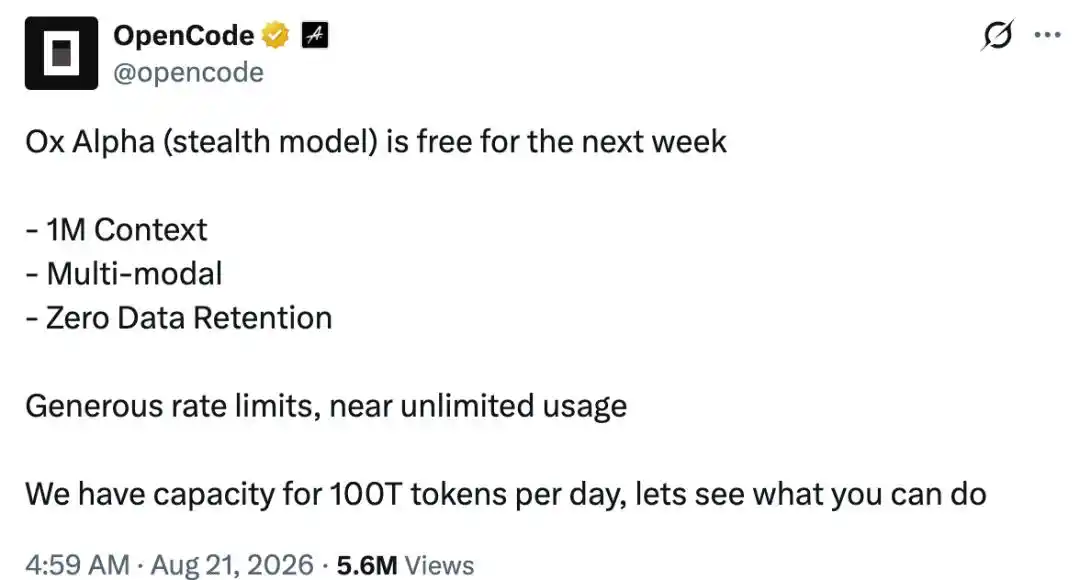
Shortly after launch, developers integrated it into a coding agent and threw it into a real code repository for testing.

Preliminary test results show that this mysterious "Ox Comes" large model's capabilities are already approaching current top-tier code models.

Meanwhile, netizens revealed that an anonymous model named korrine is being tested on Code Arena. Some speculate it's Kimi K3.1, while others point to Qwen and MiMo, with varied guesses.

In August, the large model circle has suddenly turned into a large-scale guessing game.

"Ox Comes" Model Performs Remarkably

What truly drew attention to Ox Alpha was its coding capability.

Developer Ben Davis selected 10 tasks from DeepSWE for testing, and Ox Alpha completed 8 of them, achieving an 80% pass rate. In his published comparison results, Fable 5 Max scored 65%, GLM-5.3 Max and Grok 4.6 xhigh both scored 62%, and GPT-5.6 Sol Max scored 52%.
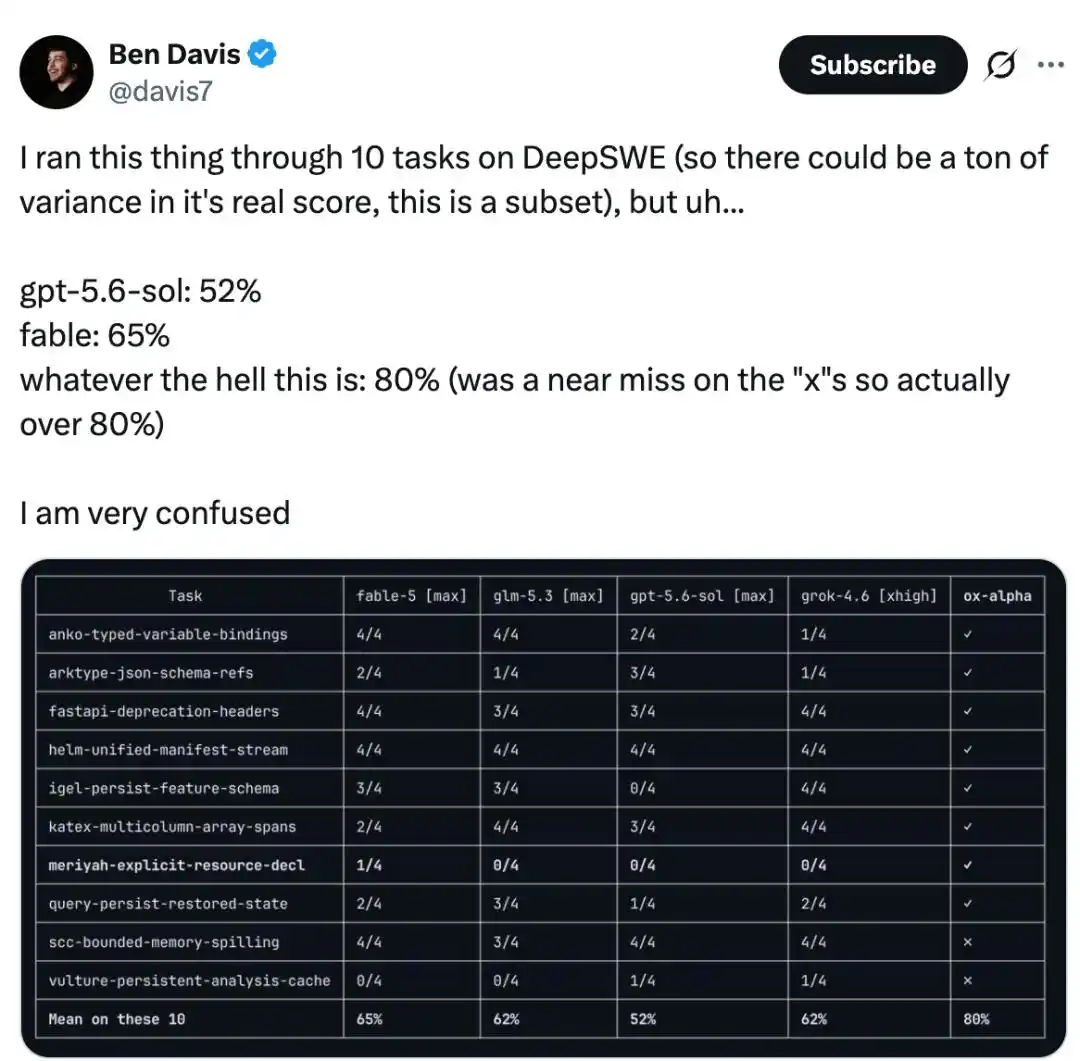
DeepSWE examines real-world software engineering ability. The model needs to read code repositories, locate problems, modify code, run tests, and continue fixing based on error reports. Compared to single-round coding problems, it's closer to the actual work of a coding Agent.

However, 10 tasks is a very small sample. Subsequently, other developers tested on another subset of DeepSWE, reporting a result of about 63%. The task scopes and execution configurations of the two tests were not identical, making it impossible to definitively rank Ox Alpha based on this alone.
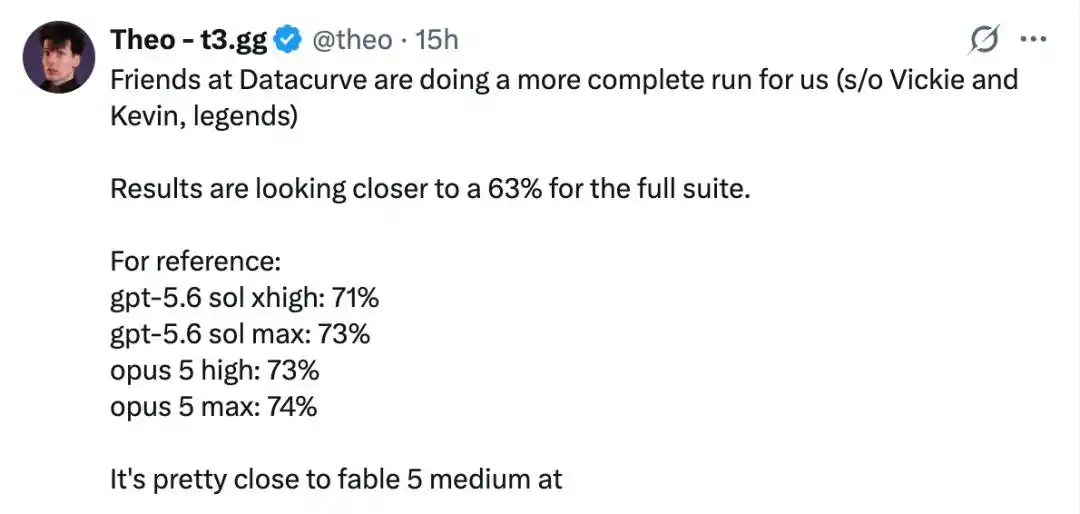
Nevertheless, these results preliminarily show that this anonymous model has demonstrated strong potential for long-context coding, with capabilities approaching current leading models.

Who Created the "Ox Comes" Large Model?

The most widespread speculation about the identity of the "Ox Comes" model is that it is an unreleased GLM-5.3 Flash from Zhipu AI, or a multimodal version of GLM-5.3.

Someone even wrote a blog to analyze this:

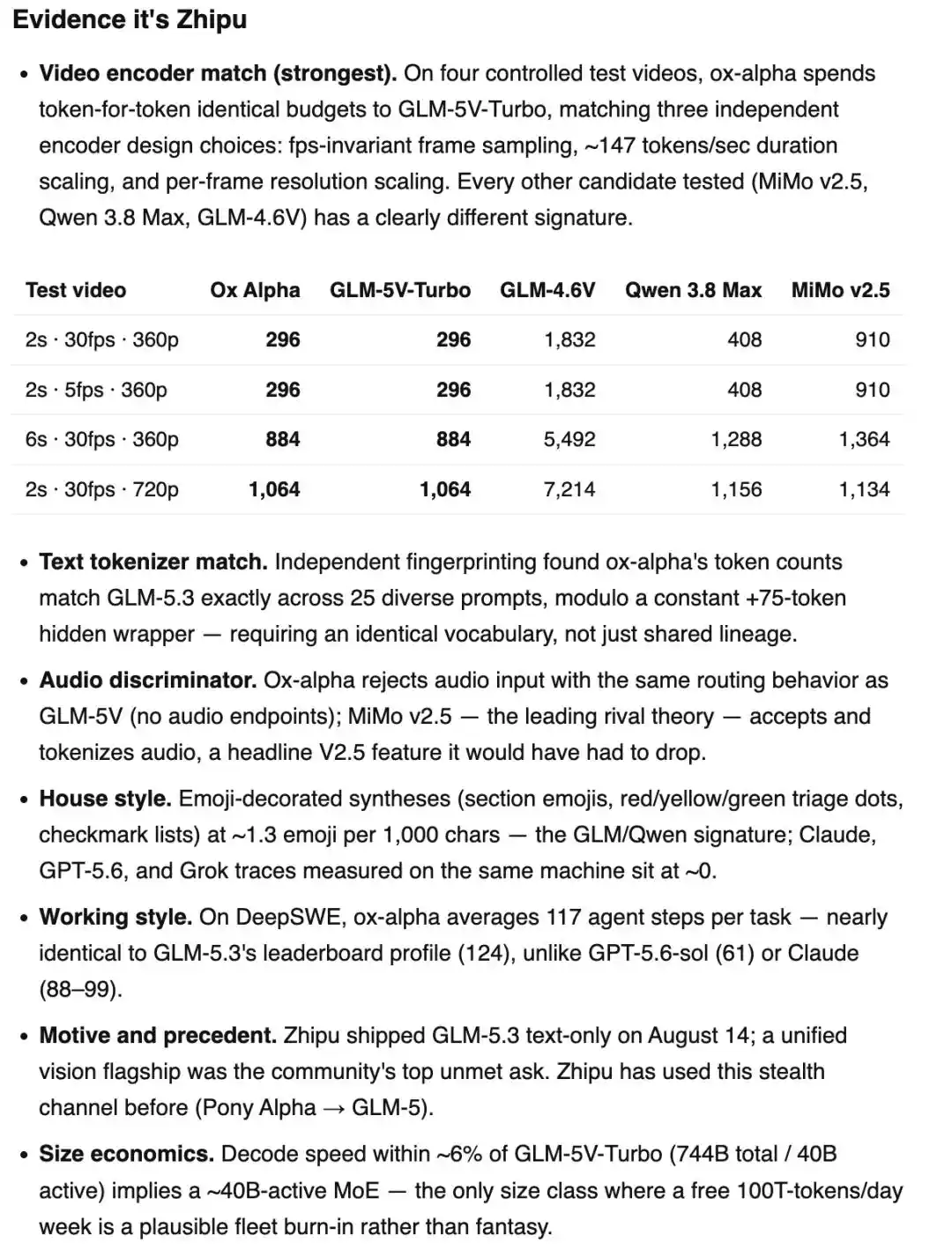
1. The strongest evidence comes from the video encoder. For four videos with different frame rates, durations, and resolutions, the visual tokens consumed by Ox Alpha matched exactly with GLM-5V-Turbo. MiMo, Qwen, and GLM-4.6V all showed significantly different results.

2. The text tokenizer also shows a high degree of alignment. The researcher tested 25 sets of prompts; the token count between Ox Alpha and GLM-5.3 consistently maintained a fixed difference of 75 tokens.

3. Other features also point to Zhipu AI. Ox Alpha refuses to process audio, which matches the routing method of GLM-5V; its answer style, the number of Agent execution steps, and the inference interface are also very similar to GLM. Zhipu AI previously used Pony Alpha for anonymous testing of GLM-5, establishing a precedent for this practice.
https://ox-alpha-evidence-production.up.railway.app/

Other netizens have also found clues in conversations.
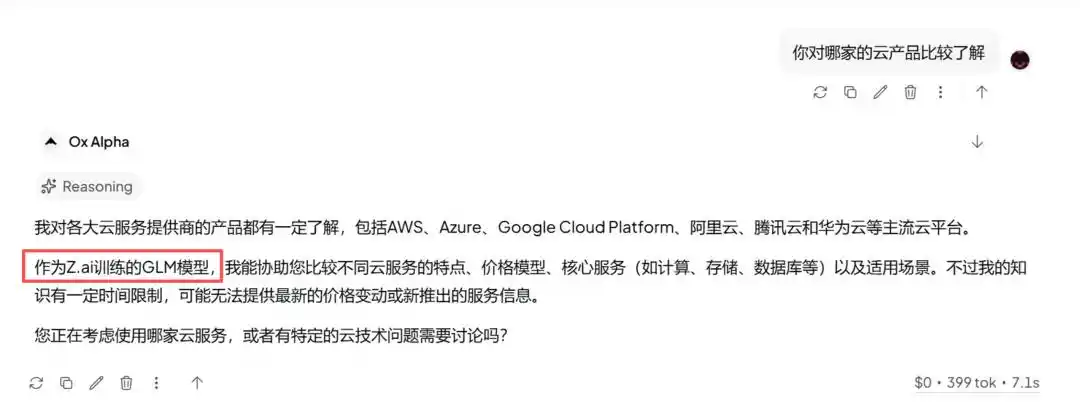
Ben Davis believes he is 99% certain this is GLM-5.x.
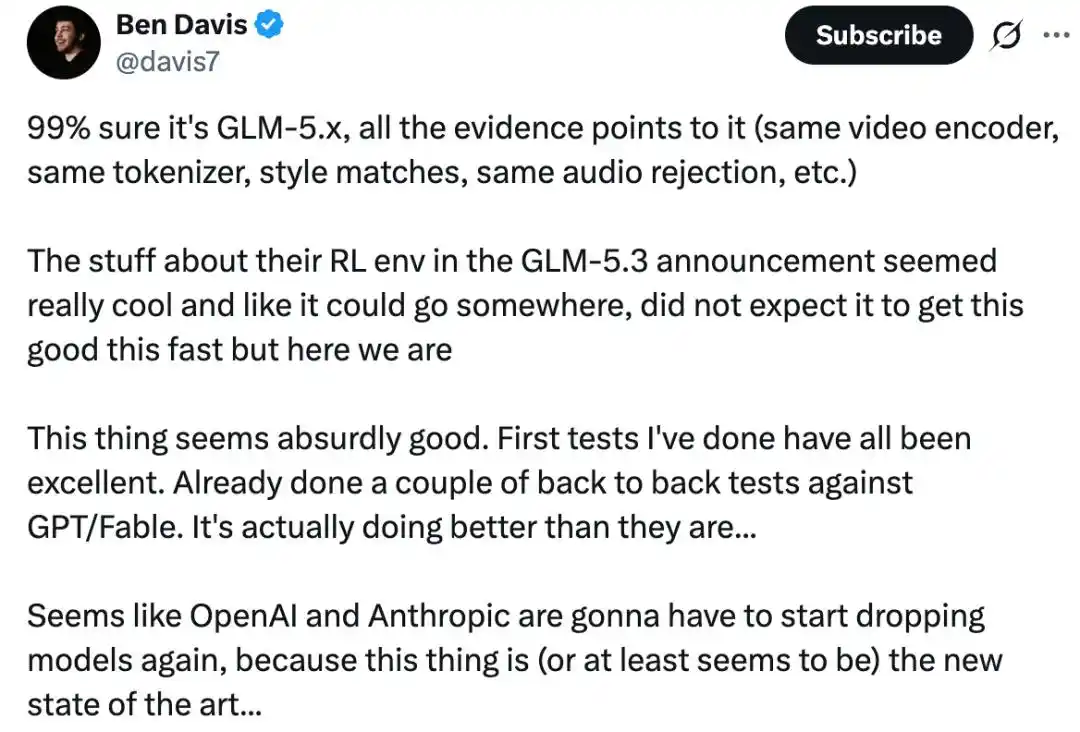
These clues increase the credibility of the GLM theory, but are still insufficient for definitive identity confirmation.

As of now, neither OpenRouter nor Zhipu AI have publicly responded.

korrine's Identity is Even More Mysterious

While the identity of the "Ox Comes" model remains unclear, another anonymous model named korrine has appeared on Code Arena.

Initially, many speculated it was Kimi K3.1, because before the release of Kimi K3, it was believed to have been tested under the codename kivine. The similar structure of kivine and korrine sparked this association.
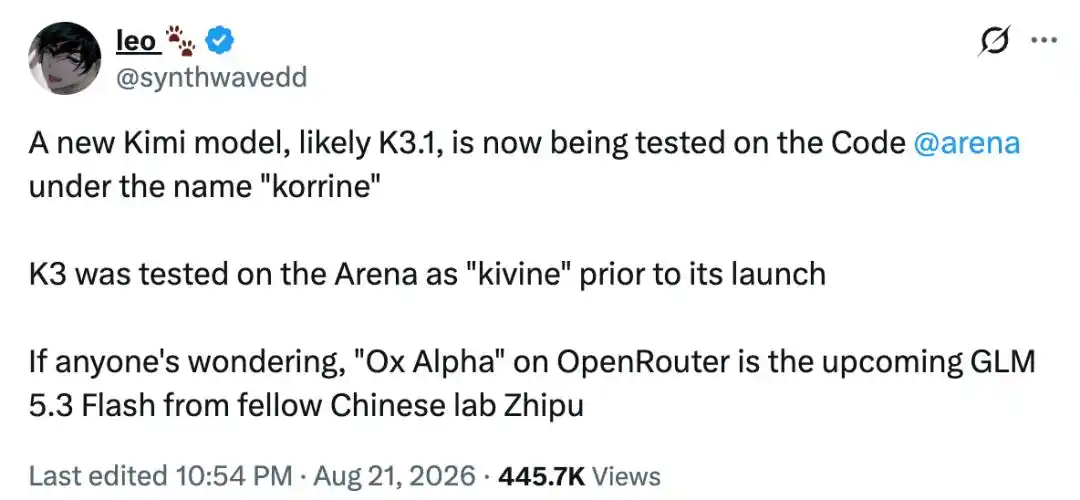
However, the original source of the rumor later added that the previously learned about new Moonshot model might correspond to another codename, adamant-ananke. korrine could also come from other Chinese teams like Qwen.

In the comments, some also pointed to MiMo V3.

Why Do Large Model Companies Like 'Testing in Disguise'?

Anonymous testing is becoming an important step before the official release of large models.

Hiding the manufacturer and model name in the Arena can minimize preconceptions brought by branding. Users cannot see the model's identity and can only choose based on actual outputs. The accumulated battle results are also closer to the real user experience.

OpenRouter provides a different kind of testing environment.

Developers integrate the model into various coding Agents, letting it enter real repositories, continuously call tools, and handle software engineering tasks lasting several hours. Issues like context stability, tool calling reliability, and whether the model gets stuck in loops or goes off track during long tasks can be quickly exposed under intense use.

For model developers, this is akin to a public stress test. Teams can observe failure cases in advance, verify the capacity of their inference services, and also accumulate real-world reputation before official launch.

Moreover, "guessing the model" is increasingly becoming a marketing tactic; the suspense over identity can indeed prolong the discussion cycle.

Finally, back to the model itself. If Ox Alpha is truly a Flash model and its coding ability is already approaching top-tier levels, where will the ceiling be pushed by the more resource-intensive, more capable full version?

Reference Links:

https://x.com/Adidotdev/status/2090833298713096241

https://x.com/davis7/status/2090669483740279155?s=20

https://x.com/davis7/status/2090655207831298095?s=20

https://x.com/MaxForAI/status/2090783750217162788

This article is from the WeChat public account "Almost Human" (ID: almosthuman2014), author: Following AI


Domande pertinenti

QWhat is the name of the anonymous model discussed in the article that appeared on OpenRouter, and why did it capture significant attention?

AThe anonymous model discussed is named 'Ox Alpha' (nicknamed 'Niu Lai' by Chinese netizens). It captured significant attention primarily due to its impressive performance on real-world software engineering tasks, specifically in coding tests like DeepSWE where it achieved high pass rates, showing capabilities approaching top-tier code models.

QAccording to the article's investigation, which company is the leading candidate for being behind the 'Ox Alpha' model, and what evidence supports this claim?

AThe leading candidate suggested in the article is Zhipu AI, possibly an unreleased GLM-5.3 Flash or a multimodal version of GLM-5.3. Supporting evidence includes: 1) Its video encoder's visual token consumption perfectly matches GLM-5V-Turbo, 2) Its text tokenizer shows a fixed token count offset compared to GLM-5.3, and 3) Other behavioral traits, such as refusing to process audio, align with Zhipu's GLM models. The company also has a precedent for anonymous testing.

QBesides 'Ox Alpha', what is the name of the other anonymous model mentioned in the article that is being tested on Code Arena, and what are some speculations about its origin?

AThe other anonymous model mentioned is named 'korrine', tested on Code Arena. Speculations about its origin include that it could be Moonshot AI's upcoming Kimi K3.1 (due to a similar earlier test codename), a model from Qwen, or MiMo V3. The article states its identity is even more mysterious than that of Ox Alpha.

QWhat are the two main benefits for AI model companies to conduct anonymous testing, as explained in the article?

AThe article explains two main benefits: 1) It allows for unbiased evaluation by removing brand bias, enabling users to judge models based solely on performance, leading to results that better reflect real user experience. 2) It serves as a public stress test, helping companies identify failure cases, verify the capacity of their inference services, and build genuine user reputation before an official launch.

QWhat specific capability of the 'Ox Alpha' model was tested using the DeepSWE benchmark, and what was one of its notable performance results mentioned?

AThe 'Ox Alpha' model was tested on its real-world software engineering capability using the DeepSWE benchmark, which requires tasks like reading code repositories, locating issues, modifying code, and running tests. One notable result mentioned was that in an initial test of 10 tasks by a developer, Ox Alpha completed 8, achieving an 80% pass rate, which was higher than several other top models in the comparison.

Letture associate

Breaking News: DeepSeek Announces All-Day Off-Peak Pricing on Weekends, Making Weekend Work More Cost-Effective?

DeepSeek has announced a significant change to its API pricing model, effective August 23. The new policy removes peak/off-peak distinctions on weekends (Saturdays and Sundays), charging the lower off-peak rate for the entire two-day period. This adjustment has sparked mixed reactions within the developer and professional communities. For developers and businesses heavily reliant on DeepSeek's V4-Flash and V4-Pro APIs, this is welcome news. It allows them to schedule bulk processing tasks on weekends without the higher peak-hour costs, potentially halving their API bills for such workloads. Some users have celebrated the move for making weekend work more cost-effective. However, the announcement has also raised concerns among employees. There is apprehension that companies, particularly in cost-sensitive sectors like AI-powered short drama production, might reorganize work schedules to align with these new cost incentives. Instances are already emerging where teams schedule high-token tasks during cheaper nighttime hours or adjust staff shifts. This has led to worries about a potential shift towards weekend workdays and weekday time-off, prioritizing cost savings over traditional work-life balance. Debate has ensued regarding the practicality of such schedule changes, with questions about increased communication overhead and overall efficiency. Speculation about DeepSeek's motives for the change includes theories that peak pricing correlates with internal model training schedules, though others counter that training is largely automated. The new pricing structure is now in effect, prompting users to reconsider their task scheduling strategies.

marsbit1 h fa

Breaking News: DeepSeek Announces All-Day Off-Peak Pricing on Weekends, Making Weekend Work More Cost-Effective?

marsbit1 h fa

Just Now, The World's First Human vs. Robot Tennis Match Begins, Robot's Desperate Save Leaves Zheng Jie Astonished

Just now, the world's first human vs. robot tennis match began, featuring stunning robotic saves that left tennis star Zheng Jie in awe. This historic event, part of the second World Humanoid Robot Games and broadcast live globally by China Media Group, marked a pivotal moment in Chinese technological innovation and embodied artificial intelligence. The match featured both mixed human-robot doubles and a groundbreaking singles match between Zheng Jie and the "Galaxy Xingzai" humanoid robot developed by Galaxy General. The robot demonstrated impressive skills including serving, forehands, backhands, and strategic court movement, with serves exceeding 100 km/h. It exhibited remarkable adaptability, recovering from a fall to continue play and handling slices and spins. The doubles match highlighted its ability to coordinate dynamically with a human partner. The event's significance extends far beyond a novelty match. Tennis represents an ultimate pressure test for embodied AI, demanding real-time integration of perception, decision-making, full-body motion control, and live博弈 within fractions of a second—a stark contrast to the discrete, contemplative environment of board games like Go mastered by AlphaGo. It directly confronts Moravec's paradox, showcasing AI's move from digital cognition to physical execution. This capability is powered by Galaxy General's proprietary "Galaxy Star Brain" (AstraBrain) model. Its key innovation is a unified architecture that integrates high-level task understanding/tactical decision-making ("brain") and dynamic whole-body motion control ("cerebellum") into a single model, eliminating latency and information loss between separate modules. The model was trained using a two-step process via the "Galaxy Star Workshop" platform. First, it learned foundational movement priors from "imperfect" human motion data (both amateur and professional). Second, it underwent massive-scale evolution in a virtual tennis simulator where multiple AI agents played millions of games against each other. Through this adversarial training, skills like极限救球and recovery from falls emerged autonomously without explicit programming, before being transferred to the physical robot. This "AstraTennis" moment symbolizes a major leap: a decade after AlphaGo conquered the digital world, embodied AI from China has now demonstrated it can operate under the extreme, unpredictable physical pressures of real-world competition.

marsbit1 h fa

Just Now, The World's First Human vs. Robot Tennis Match Begins, Robot's Desperate Save Leaves Zheng Jie Astonished

marsbit1 h fa

The Biggest Dark Horse in AI Payments Might Be Coinbase Giving Agents a Wallet

In the AI payments race, while most focus on traditional giants like Visa or AI platforms like OpenAI, Coinbase has quietly emerged as a key player. Data from 2026 shows over 90% of on-chain Agent transactions occur on Coinbase's Base network, with 99% settled in USDC and over 97% using the x402 protocol. Coinbase's pivotal move was launching "Agentic Wallets" in February 2026—a dedicated wallet infrastructure giving AI Agents their own financial identity. Unlike Visa or Stripe, which connect Agents to existing payment rails, Coinbase provides Agents with autonomous wallets to hold assets (like stablecoins), initiate transfers, and execute transactions under predefined rules. This solves core issues for machine-to-machine payments: high credit card fees for micropayments, the need for constant human authorization, and unclear transaction attribution. Coinbase's strength lies in its closed-loop ecosystem: the Base blockchain (low-cost, high-throughput), the x402 payment protocol, Agentic Wallets, and native assets like USDC. This integrated stack, built through years of infrastructure investment, positioned Coinbase to capture early Agent payment demand as the AI economy surged. The key insight is that AI payment adoption may depend less on whose standard wins and more on whose usable infrastructure is ready first. While debates over protocols and payment rails continue, real Agent transactions are already flowing—primarily through Coinbase's ecosystem. It may not be the ultimate winner, but for now, it's the frontrunner by being prepared.

marsbit2 h fa

The Biggest Dark Horse in AI Payments Might Be Coinbase Giving Agents a Wallet

marsbit2 h fa

Dialogue with Bitwise CIO: Bitcoin May Be Near Bottom, Who Will Drive the Next Rally?

In a recent podcast, Bitwise CIO Matt Hougan analyzed Bitcoin's current market cycle, suggesting it is near a bottom characterized by low volatility and investor indifference. He believes the next major price surge will be driven primarily by wealth management platforms, financial advisors, and family offices, who control trillions in assets and are now gaining access to Bitcoin ETFs. Hougan views Bitcoin as a long-dated, out-of-the-money call option on it becoming a global reserve asset. Its value increases with global monetary system volatility, making it a natural hedge against currency disorder. He outlined Bitcoin's adoption path: first as a global digital store of value (competing with gold), and potentially later as a check against fiat currency abuse by sovereign states. Addressing the muted price action despite institutional ETF inflows, Hougan explained that significant selling by long-term retail holders has offset buying pressure. However, he is optimistic as data shows retail selling has subsided, which, combined with continued institutional inflows, could propel prices higher. Hougan downplayed the future impact of Federal Reserve interest rates and MicroStrategy's actions on Bitcoin's price, arguing they are becoming less relevant. Instead, he pointed to runaway U.S. fiscal deficits and debt as the core long-term drivers. Finally, he discussed the transformative potential of asset tokenization, predicting all traditional assets will eventually trade 24/7 on blockchains. This will merge traditional and crypto markets, increasing efficiency but also introducing crypto-like features such as overnight volatility and easier access to leverage into traditional finance.

marsbit2 h fa

Dialogue with Bitwise CIO: Bitcoin May Be Near Bottom, Who Will Drive the Next Rally?

marsbit2 h fa

Trading

Spot
活动图片