HYPE Price Under Pressure: $12B Unlock and Hayes’ Ferrari Sale Shake Confidence

bitcoinistPubblicato 2025-09-25Pubblicato ultima volta 2025-09-25

Introduzione

The Hyperliquid (HYPE) token is under heavy selling pressure as concerns mount over a looming $12 billion unlock event. Trading...

Trusted Editorial content, reviewed by leading industry experts and seasoned editors. Ad Disclosure

The Hyperliquid (HYPE) token is under heavy selling pressure as concerns mount over a looming $12 billion unlock event. Trading at $43.37, HYPE has fallen more than 12% in the past 24 hours and is down 20.8% this week, raising alarm across the crypto market.

The scheduled unlock on November 29 will see team tokens representing 23.8% of the total supply released over 24 months, with analysts warning of $500 million in monthly selling pressure.

Research group Maelstrom described the upcoming vesting as a “Sword of Damocles” moment, noting that only 17% of the supply may be absorbed by buybacks.

This overhang has already caused major whales to trim their positions, with one investor withdrawing $122 million worth of HYPE while holding onto $90 million in unrealized profits.
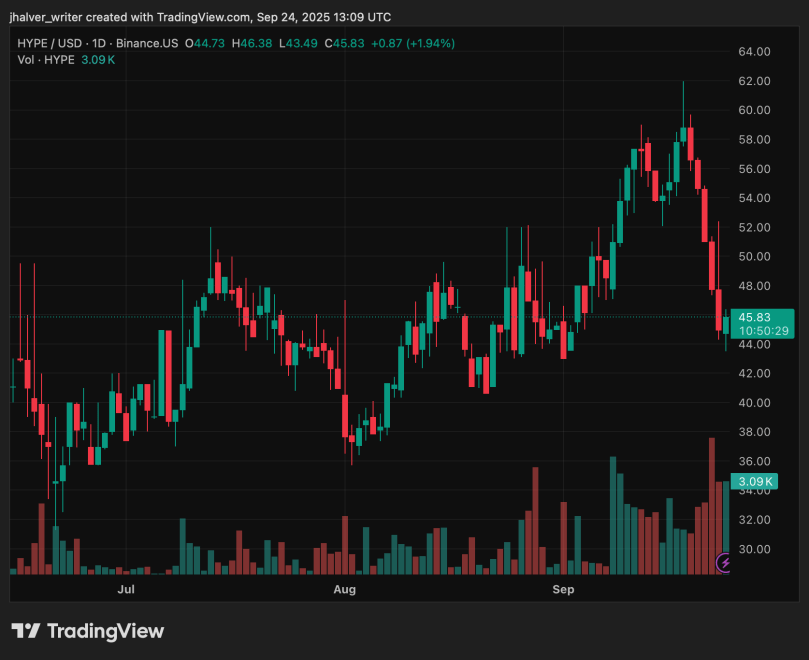
Hyperliquid HYPE HYPEUSD

HYPE's price trends to the downside on the daily chart. Source: HYPEUSD on Tradingview

Arthur Hayes’ Ferrari Sale Sparks Hyperliquid (HYPE) Selloff

Adding fuel to the bearish sentiment, BitMEX co-founder Arthur Hayes recently exited his entire HYPE position, cashing out over 96,000 tokens for approximately $4.8 million. Hayes revealed on social media that the sale was to cover a deposit for his new Ferrari 849 Testarossa, generating nearly $823,000 in profit.

The move stunned the market, especially given Hayes’ bold prediction just weeks earlier at the WebX 2025 conference, where he forecasted a 126x surge in HYPE over three years. His abrupt selloff, paired with mounting unlock concerns, has shaken investor confidence in Hyperliquid’s long-term trajectory.

Tokenomics Reform Proposal: Can It Restore Trust?

In response to growing concerns, DBA Asset Management’s Jon Charbonneau and researcher Hasu have introduced a comprehensive proposal to overhaul HYPE’s tokenomics. The plan recommends:

  • Burning 45% of HYPE’s supply, including unminted tokens allocated for emissions and assistance funds.
  • Eliminating Hyperliquid’s fixed 1 billion supply cap, aligning with flexible issuance models seen in Ethereum and Solana.

Supporters argue the proposal could remove distortions in fully diluted valuation (FDV) metrics and create a fairer assessment of Hyperliquid’s fundamentals. However, critics warn that cutting emissions may weaken growth incentives and reduce flexibility in responding to future challenges.

Despite its current price struggles, Hyperliquid remains one of the fastest-growing decentralized derivatives exchanges, recently hitting $3.4 billion in daily trading volumes. Whether the proposed reforms can stabilize HYPE ahead of November’s unlock will be a decisive test for the project’s resilience.

Cover image from ChatGPT, HYPEUSD chart from Tradingview

Editorial Process for bitcoinist is centered on delivering thoroughly researched, accurate, and unbiased content. We uphold strict sourcing standards, and each page undergoes diligent review by our team of top technology experts and seasoned editors. This process ensures the integrity, relevance, and value of our content for our readers.

Letture associate

Research Report Analysis: AI Triggers MLCC Supercycle, How Many Years of Gains Can Samsung Electro-Mechanics Enjoy?

Title: Analyst Report: AI Ignites MLCC Super Cycle, How Many Years of Benefits Can Samsung Electro-Mechanics Reap? Summary: Morgan Stanley has sharply raised its target price for Samsung Electro-Mechanics from 920,000 KRW to 2,560,000 KRW, recasting the MLCC (Multi-Layer Ceramic Capacitor) industry from cyclical to structurally bullish. The core thesis is that AI servers demand 10-15 times more MLCCs than traditional servers, with a single AI server requiring up to 440,000 units compared to just 30,000 for a standard server. This drives not only higher volumes but also a shift to more advanced, higher-value MLCCs, boosting Average Selling Prices (ASP). The current supply crunch is seen as structural, not a temporary cyclical mismatch, driven by capacity constraints meeting sustained new demand. High-end MLCC production lines are fully booked, with new lines taking two years to build. Morgan Stanley forecasts MLCC price increases of 30% in H2 2026 and another 30-50% in 2027. Samsung Electro-Mechanics is positioned as the primary beneficiary through three channels: 1) Direct MLCC price hikes, especially for high-margin AI-use MLCCs, driving significant operating margin expansion from 15.7% (present) to 24.5% by 2027. 2) Strong growth in its ABF substrate business from saturated AI/ASIC chip orders. 3) Future revenue streams from new product lines like silicon capacitors and glass substrates. The firm's ROE is projected to surge from 7.5% in FY25 to 32.2% by FY28, with an increased dividend payout. Risks include potential smartphone demand weakness or execution issues in China, while upside catalysts are further price increases and confirmation of higher MLCC content in next-gen AI platforms like Rubin/VR200. The story transforms Samsung Electro-Mechanics from a traditional component supplier into a key AI infrastructure player, with its growth narrative supported by current supply constraints and pricing power.

marsbit14 min fa

Research Report Analysis: AI Triggers MLCC Supercycle, How Many Years of Gains Can Samsung Electro-Mechanics Enjoy?

marsbit14 min fa

Trading

Spot
Futures
活动图片