Сопротивление $113 000 сломлено: аналитики ждут новых максимумов

cryptonews.ruPubblicato 2025-01-10Pubblicato ultima volta 2025-09-11

Биткоин прорвал ключевое сопротивление на уровне $113 000, что указывает на возможное возобновление роста цены к новым историческим высотам. Аналитики считают, что быки далеки от капитуляции.

По мнению трейдера и аналитика Rekt Capital, биткоин вряд ли достиг пика текущего бычьего рынка. 11 сентября BTC/USD поднялся выше отметки $114 000 благодаря благоприятным макроэкономическим условиям в США.
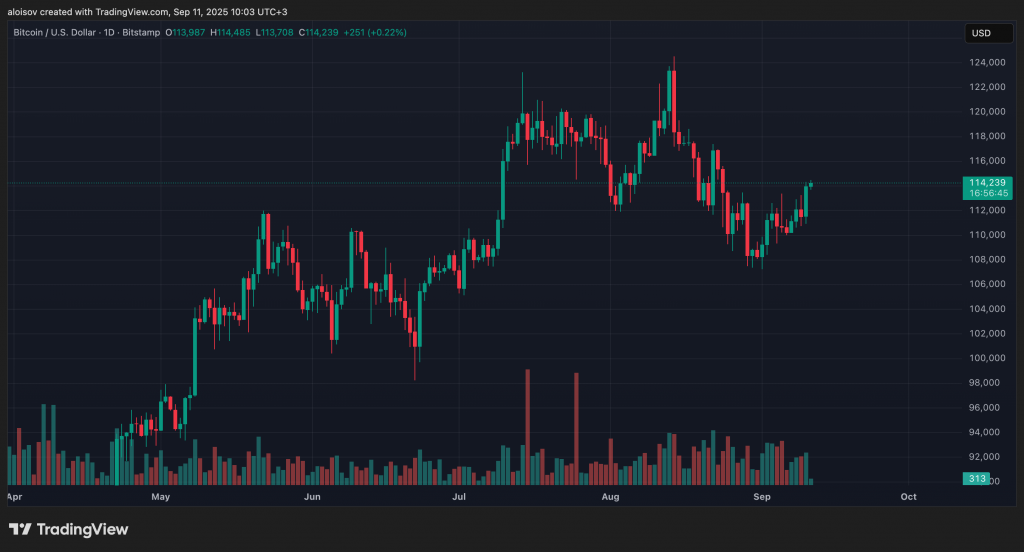
1-дневный график BTC/USD. Источник: Bitstamp

Преодоление сопротивления

Ключевые технические сигналы говорят в пользу продолжения роста. Биткоин не только прорвал локальный нисходящий тренд, но и активно атакует важную зону сопротивления.

«Каждый отскок от уровня $113 000 сопровождается все более мелкими откатами, — отметил Rekt Capital в соцсети X. — Потребовалось время, но похоже, что $113 000 слабеет как точка отторжения».
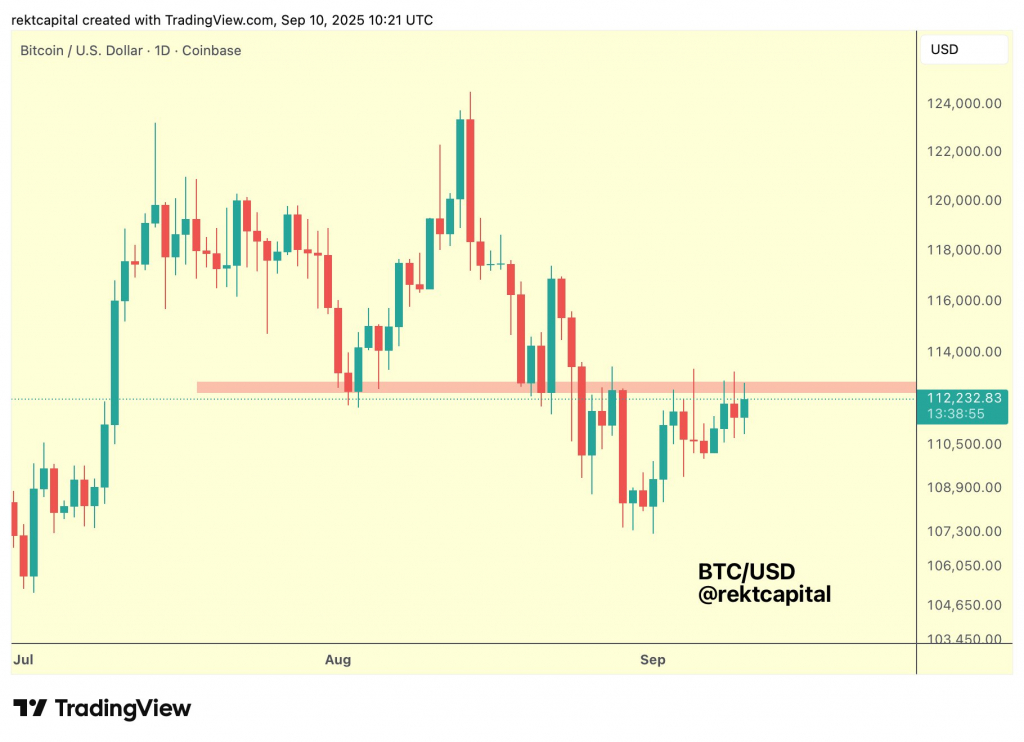
1-дневный график BTC/USD. Аналитика: Rekt Capital

2 сентября биткоин завершил несколько недель снижения дневной свечой выше линии нисходящего тренда. Это произошло через день после того, как курс достиг минимума почти за два месяца.

Циклы становятся длиннее

Несмотря на медвежьи прогнозы, которые сопровождали падение ниже $108 000, аналитик видит бычий рынок далеким от завершения.

«Маловероятно, что биткоин уже достиг пика своего бычьего рынка, поскольку это означало бы, что данный цикл стал одним из самых коротких в истории, — рассуждает он. — Скорее наоборот, циклы становятся немного длиннее, а не короче».

Такой взгляд предполагает, что текущий бычий цикл еще не исчерпал свой потенциал, а рост до $124 000 является промежуточной целью, а не конечной точкой роста.

Следующий барьер — $115 000

Кит Алан (Keith Alan), соучредитель торгового ресурса Material Indicators, видит следующее препятствие для быков на уровне 50-дневной простой скользящей средней в $114 700.

«Ожидаю сопротивление около 50-дневной скользящей средней, которая близка к психологическому уровню $115 000», — сообщил он подписчикам в X.
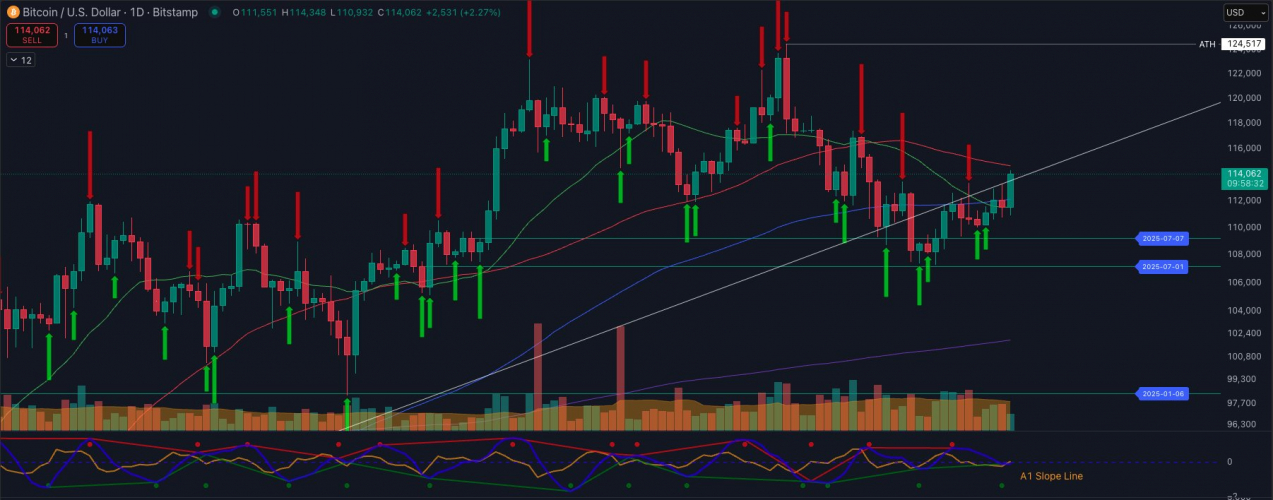
1-дневный график BTC/USD. Аналитика: Кит Алан

Letture associate

UK Crypto Regulation Enters Countdown: What Changes Are in the FCA's New Rules?

UK Crypto Regulation Enters Countdown: Key Changes in FCA's New Rules The UK Financial Conduct Authority (FCA) has published its final crypto asset regulatory policy, marking a shift from consultation to implementation. The new regime, set to fully expand from October 25, 2027, moves crypto businesses from registration to authorisation. A critical window from September 30, 2026, to February 28, 2027, allows existing firms to apply for transitional provisions, enabling them to continue operating while their authorisation is reviewed. Existing registrations will not automatically convert. The rules cover a broad range of activities including stablecoin issuance, custody, trading platform operation, arranging deals, staking, and lending. Authorised firms must meet new prudential capital requirements, with permanent minimum capital ranging from £750,000 for proprietary trading to £75,000 for arranging deals. They must also hold a basic liquid asset buffer for operational resilience. Market integrity rules now apply to trading platforms and intermediaries, covering areas like insider trading and requiring best execution checks against at least three UK-authorised venues. Custodians face enhanced client asset protection rules (CASS 17), focusing on ownership, reconciliation, and private key management. For stablecoins, issuers must provide full backing from issuance and allow redemption at par value within a T+1 timeframe. Reserve assets are categorised into core (e.g., demand deposits) and expanded types, with specific liquidity requirements (ODDR and CBAR) to ensure redemption capacity. Systemically important stablecoin issuers may be jointly regulated by the FCA and the Bank of England. The FCA cautions that the rules do not eliminate the high-risk, speculative nature of most crypto assets but establish a more comprehensive financial regulatory framework for the industry.

Foresight News5 min fa

UK Crypto Regulation Enters Countdown: What Changes Are in the FCA's New Rules?

Foresight News5 min fa

From Pump.fun to Collector Crypt: Has Solana's Revenue Throne Changed Hands?

From Pump.fun to Collector Crypt: Is Solana’s Revenue Throne Changing Hands? Solana’s on-chain narrative is expanding from meme coins to tokenized trading cards. Previously, Pump.fun dominated consumer revenue on Solana. However, starting in Q2 2026, Pump.fun's quarterly revenue growth slowed, while Collector Crypt shows a stronger recent growth trajectory. Data indicates Pump.fun's Q1 revenue was $108.3M, dropping 36.1% to $69.2M in Q2 so far. Conversely, Collector Crypt's revenue grew 108.8%, from $12.3M in Q1 to $25.8M in Q2 to date, with recent weekly revenue hitting $5.1M. While Pump.fun remains larger in scale, Collector Crypt demonstrates stronger short-term momentum. Collector Crypt's model involves custodying graded physical trading cards, minting corresponding NFTs on Solana, and selling randomized packs. Revenue comes from pack sales, secondary market fees, and royalties. Its profitability, estimated around 4-5%, stems from bulk card purchases at a discount and a buyback system for users. However, a full-scale reversal in rankings hasn't occurred. Year-to-date, Pump.fun's revenue is ~$177.5M (with its ecosystem at ~$466.5M), vastly exceeding Collector Crypt's ~$38.1M. The shift is more about narrative and recent growth dynamics than total historical volume. Pump.fun relies on speculative token launches, while Collector Crypt focuses on collectibility, scarcity, and real-world asset backing. This highlights a broadening of Solana's consumer revenue sources beyond meme coins. The sustainability of Collector Crypt's growth depends on maintaining demand for randomized packs, expanding beyond Pokémon cards (currently dominant) into sports cards, and navigating potential regulatory scrutiny on "loot box" mechanics. In conclusion, Pump.fun remains the larger revenue engine, but Collector Crypt's rise signifies a diversification of Solana's consumer application revenue into tangible, collection-based scenarios alongside speculative meme coin activity.

链捕手5 min fa

From Pump.fun to Collector Crypt: Has Solana's Revenue Throne Changed Hands?

链捕手5 min fa

EF: Ethereum Is Becoming the Most Needed Neutral Infrastructure for Governments and Institutions

Ethereum Foundation's Global Policy Strategy team released a report titled "Ethereum for Governments and Institutions," positioning Ethereum as critical, neutral public infrastructure. It argues that current digital systems, controlled by centralized intermediaries, create single points of failure and trust risks. In contrast, Ethereum’s decentralized architecture offers a credible, neutral alternative for applications like digital identity, public records, and asset tokenization. The report highlights Ethereum's resilience, noting it has never experienced downtime since 2015. It is secured by approximately $76 billion in staked ETH, features a geographically diverse validator network, and maintains multiple independent client implementations. This design eliminates counterparty risk, as no single entity can alter rules or shut down the network. Compared to other blockchains assessed in a referenced OpenZeppelin report, Ethereum demonstrates superior economic security, lower validator participation barriers promoting decentralization, and a mature ecosystem with over 11,000 developers. Real-world implementations, such as decentralized identity projects in Bhutan and Buenos Aires and land registry systems in India, are cited as evidence of its practical utility for public sectors. The guide serves as a non-technical primer for policymakers, emphasizing the need for infrastructure that preserves sovereignty and enables coordination without reliance on centralized intermediaries.

Odaily星球日报14 min fa

EF: Ethereum Is Becoming the Most Needed Neutral Infrastructure for Governments and Institutions

Odaily星球日报14 min fa

After Snagging a Nobel Laureate, Anthropic Poaches Berkeley CS Department Head, Recruiting Four Top Talents in Two Weeks

In a stunning move, Anthropic has recruited Jelani Nelson, the chair of UC Berkeley's prestigious EECS Computer Science Division and a leading theoretical computer scientist, on a leave of absence. This follows a two-week hiring spree where Anthropic also secured Nobel laureate John Jumper and two key Gemini researchers from Google. Nelson's expertise in streaming algorithms, dimensionality reduction, and randomized algorithms—fundamentally about processing vast data with minimal resources—directly addresses core challenges in large language models: training efficiency, data compression, and computational complexity. His work on the Johnson-Lindenstrauss lemma underpins modern vector search and embedding compression. Anthropic's recruitment signals a strategic shift in the AI race from merely scaling models to optimizing foundational algorithms for efficiency. This "leave of absence" model, exemplified by figures like Fei-Fei Li, is becoming a mainstream talent pipeline, allowing scholars to retain academic positions while gaining industry access to unprecedented compute and real-world problems. The recent talent war has escalated from poaching between AI firms to raiding top university departments, with Berkeley being a prime target. As OpenAI and Anthropic near potential IPOs, offering pre-IPO equity, they are effectively becoming parallel research institutions. The competition's focus is now descending to the theoretical bedrock of algorithms.

marsbit18 min fa

After Snagging a Nobel Laureate, Anthropic Poaches Berkeley CS Department Head, Recruiting Four Top Talents in Two Weeks

marsbit18 min fa

Trading

Spot
活动图片