On the afternoon of July 1st, a post on X sent shockwaves through Silicon Valley's academic circles.
Jelani Nelson, the head of the Computer Science division within UC Berkeley's EECS department and a professor of theoretical computer science, temporarily set down his office keys and went to Anthropic.
He posted on X:
I have joined Anthropic and am taking a leave from the university. Excited to work with so many talented and mission-driven people on what I believe is the defining technology of our time.
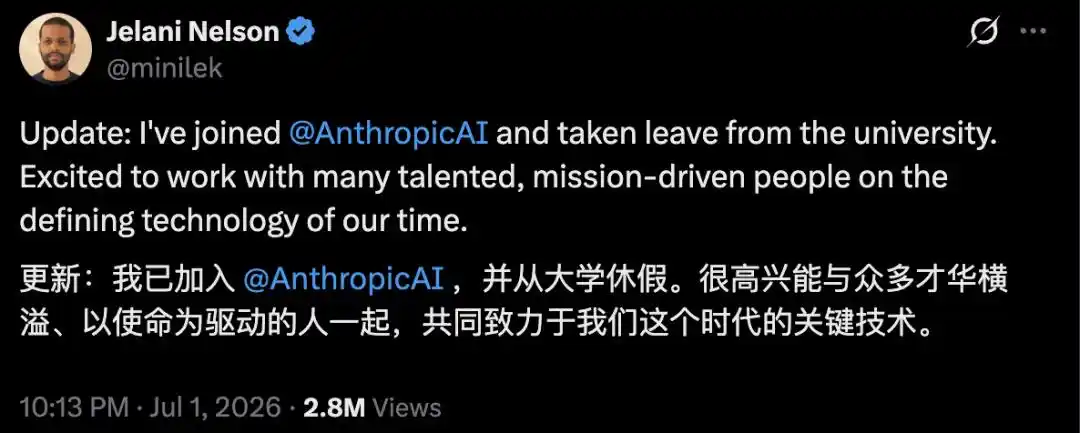
Just two sentences, packed with information: he's already started, his academic position is retained, and the method is a leave of absence. As for his specific role, team, or direction—nothing mentioned.
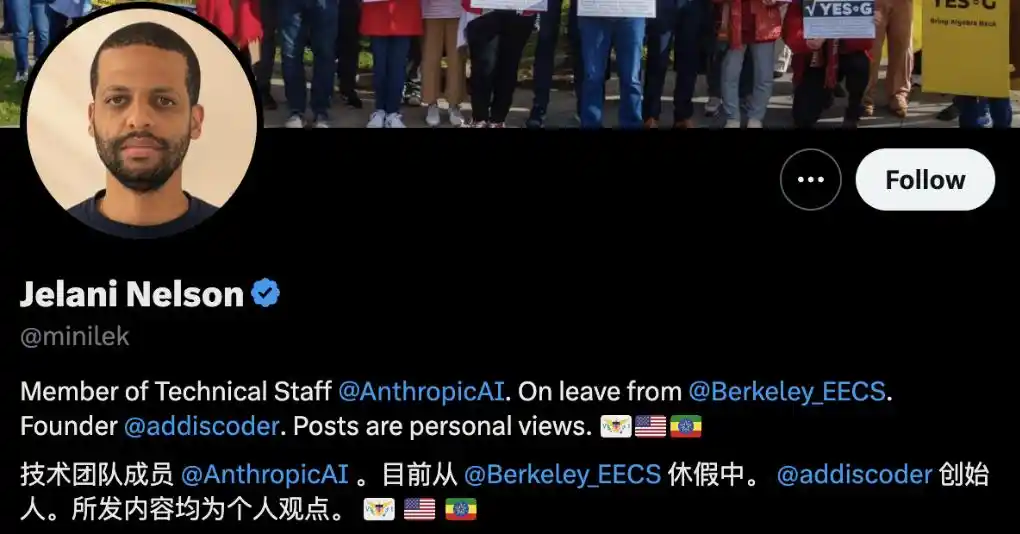
Nelson's X bio has been updated accordingly: Member of Technical Staff at Anthropic, now a colleague of Karpathy who just joined in May.
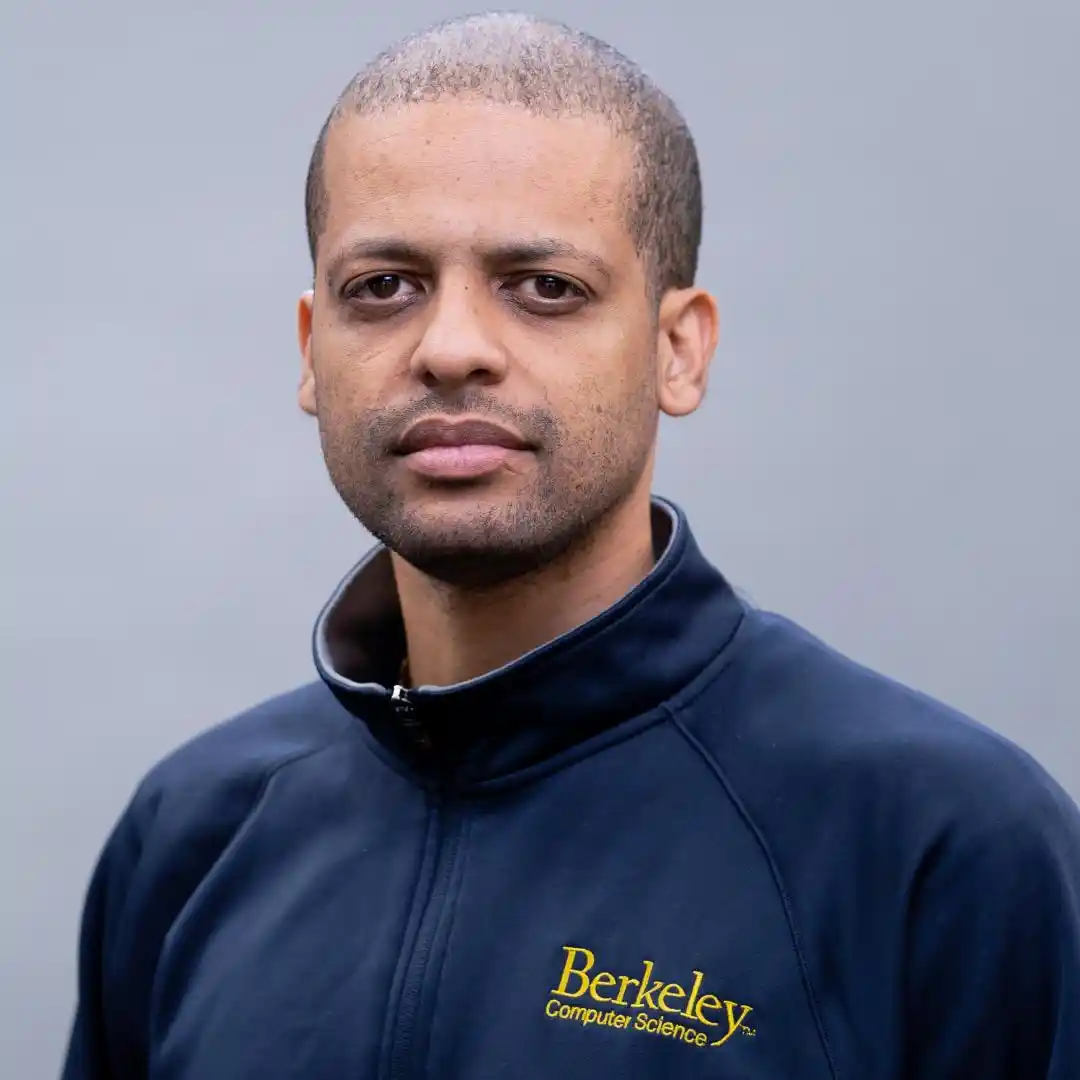
Jelani Nelson, Chair of the Computer Science Division, UC Berkeley Electrical Engineering and Computer Sciences (EECS) Department
The person leading one of the top-tier computer science departments in the U.S. just walked away.
For three years, AI companies have been fiercely competing for talent, poaching from engineering to product, from alignment to multimodal.
This time, they've reached into the pinnacle of theoretical computer science.
From MIT to Berkeley, the Person Who Made "Counting" World-Optimal
Nelson's resume is virtually the standard full package for a theoretical computer scientist.
He taught himself HTML to build websites in middle school, learned programming in high school, and during college proved through competitions his ability to write bug-free code the fastest.
He completed his Bachelor's, Master's, and PhD all at MIT, earning a doctorate in Computer Science in 2011, focusing on efficient algorithms for massive data.
He describes the field's attraction to him as "almost religious": it's both a fundamental problem at the core of human thought and deeply relevant to the real world.
After his PhD, he did postdoctoral stints at Berkeley, Princeton University, and the Institute for Advanced Study (IAS) in Princeton, joining Harvard's faculty in 2013.
In 2019, Nelson bid farewell to Harvard and moved west to UC Berkeley.
The Harvard Crimson didn't mince words in its headline: his departure left a "Big Hole" in the computer science department.
At Berkeley, he flourished, immersing himself in the theoretical community centered around the Simons Institute for the Theory of Computing.
In the fall of 2024, Nelson took over as Chair of the Computer Science Division of EECS, leading one of the world's top CS departments.
His main research areas are streaming algorithms, dimensionality reduction, and randomized algorithms.
In plain language, Nelson tackles the same kind of problem: how to compute when the data is too large to handle.
A few years ago, he set his sights on a problem reminiscent of elementary school arithmetic: teaching computers to count.
It seems simple, but when numbers get so large that phones and servers can't remember "where they were," the cost in storage and speed becomes unmanageable.
His team provided a mathematical formula proving the minimum memory any algorithm solving this problem must use.
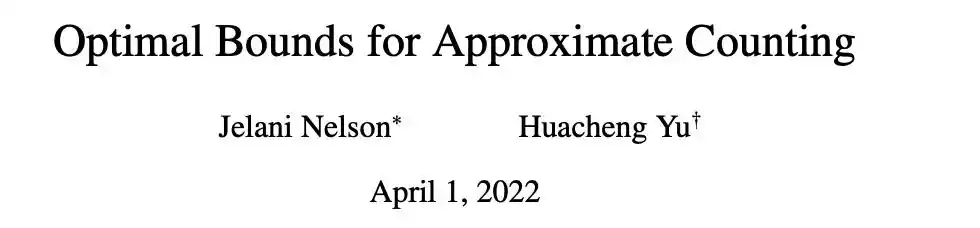
Nelson's team's paper, proving the memory lower bound for the approximate counting problem. https://arxiv.org/pdf/2010.02116
Engineers make programs run faster; Nelson proves the fastest a program can possibly run. That's the work of a theoretical computer scientist: setting the physical lower bound for computation.
Nelson's contributions to academia go far beyond just "counting."
First, together with Kasper Green Larsen, he proved the optimality of the Johnson–Lindenstrauss lemma.
This is a cornerstone in dimensionality reduction, and he nailed down its theoretical lower bound. Previously, he and Daniel Kane also proposed the sparse Johnson–Lindenstrauss transform.
Second, with Kane and David Woodruff, he gave an asymptotically optimal algorithm for the count-distinct problem (how many distinct elements are in a data stream).
In his view, even something everyone can do, like "counting," hides a theoretically optimal solution.
This work has brought him a long list of honors: Sloan Research Fellowship, Presidential Early Career Award for Scientists and Engineers (PECASE), you name it.
Beyond academia, Nelson has another side.
In 2011, while still a PhD student at MIT, he went to Ethiopia and founded AddisCoder, a free coding summer camp.
Fourteen years later, nearly 700 alumni have emerged, with some going on to pursue PhDs at Harvard, MIT, and Stanford.
Later, Jamaican reggae superstar Chronixx proactively approached him to donate, leading to the sister program JamCoders.

The free coding summer camp AddisCoder, founded by Nelson in 2011, has trained nearly 700 students. (Source: AddisCoder official website)
Nelson is also one of the most vocal opponents of California's math curriculum reforms, for a simple reason: his grandfather, from a poor background, became a doctor through quality public education, changing the trajectory of his entire family.
Therefore, in his view, removing rigorous math courses from public schools is akin to pulling the ladder out from under the next generation.
This "work beyond academia" later earned him the ACM Eugene L. Lawler Award for Humanitarian Contributions within Computer Science.
What Does Anthropic Need a Theoretical Scholar For?
What does a professor working on streaming algorithms have to do with an LLM company?
Nelson's research areas (streaming algorithms, dimensionality reduction, randomized algorithms) essentially study the same thing: how to process the largest data with the least memory and computation.
On the LLM side, this maps precisely to the most expensive challenges: training efficiency, data compression, and computational complexity.
Take the Johnson–Lindenstrauss lemma, for which he completed the final piece of the puzzle. The question it answers is so basic it's almost common sense: how small can high-dimensional data be compressed without losing information?
The underlying intuition for today's ubiquitous vector retrieval and embedding compression is built upon this lemma.
Training a cutting-edge model is essentially about compressing and filtering an astronomical data stream; on the inference side, everything from GPU memory and caching to context windows involves a struggle with memory and complexity.
And this is precisely the problem domain Nelson has been drilling into for twenty years.
As model scale hits the ceiling of compute and data, the value of "saving" begins to surpass that of "piling on." The focus of AI competition is shifting from "whose model is stronger" to "whose underlying algorithms are more efficient."
The toolkit of streaming and randomized algorithms naturally fits the problem of "approximating optimal solutions with limited resources," which happens to hit the shared anxiety of all frontier labs today.
From this perspective, Anthropic bringing on a theoretical computer scientist looks more like remedial study: beyond models, engineering, and alignment, laying a deeper theoretical foundation.
Top Professors Joining AI Companies: The Trend is Not to Quit
Regarding joining Anthropic, Nelson's exact words were "taken leave from the university," a leave of absence.
Leave is different from resignation: the faculty position is retained, and he can return at any time.
This is a well-established system in American academia, where professors take paid or unpaid leave for a period to go into industry, start a business, or do anything else.
This path has been validated before.
In 2017, Fei-Fei Li used an academic sabbatical to become Google Cloud's Vice President and Chief Scientist of AI, returning to Stanford two years later.
Now, the revolving door between academia and industry is spinning faster, and "joining on leave" is becoming a mainstream model.
For scholars, it's a safety net, especially since industry offers computational power, data, and real-world problems academia can't match.
For AI companies, it's a low-friction channel for talent acquisition. Even more cost-effective is that signing a scholar often means signing not just one person, but also his students, peers, and the entire academic network behind him.
The traditional one-way street of "getting tenure and staying until retirement" is being replaced by the "one foot in industry" leave model.
For universities, once this door is opened, it's hard to close.
After Poaching from Peers, AI Giants Start Poaching from Universities
How frenzied was the AI talent market in June alone?
June 18th: Noam Shazeer, co-author of the Transformer paper and co-lead of Gemini, announced his departure from Google for OpenAI.
Remember, Google had just bought him back from Character.AI in a $2.7 billion deal in 2024. Less than two years later, he's gone again.
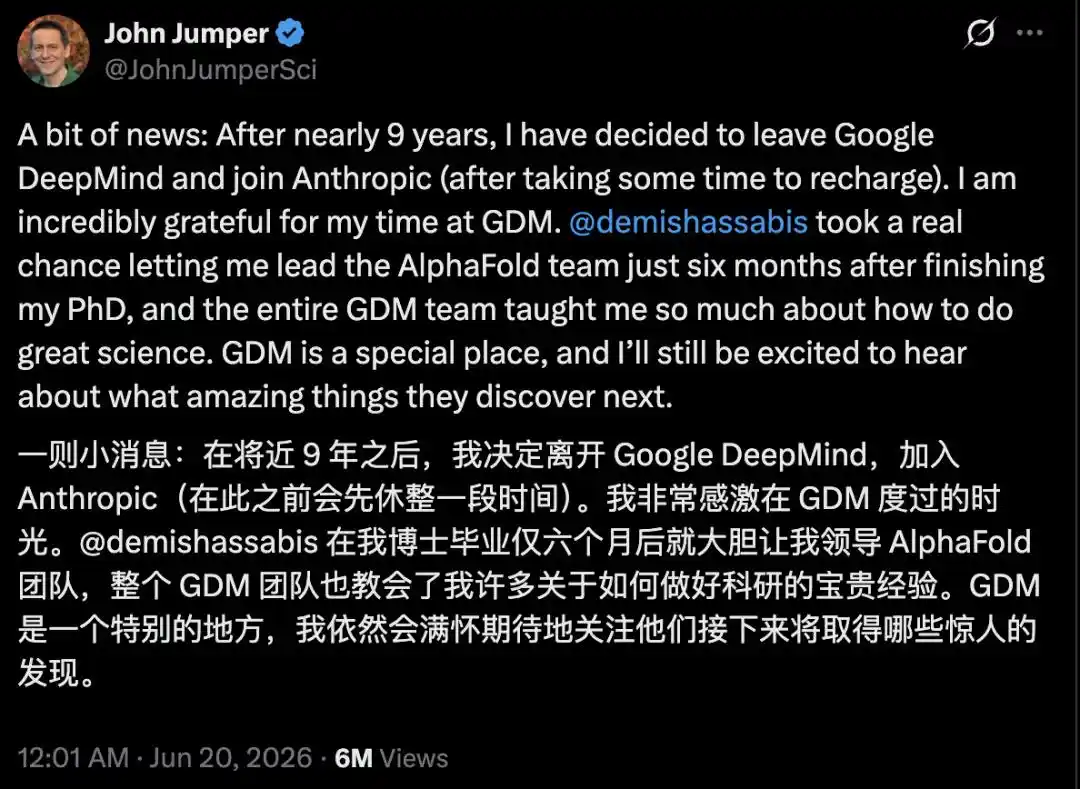
June 19th: John Jumper, who won the 2024 Nobel Prize in Chemistry for AlphaFold, announced: leaving DeepMind after nearly nine years to join Anthropic.
Subject to senior DeepMind non-compete clauses, he might not officially start until next year.
June 24th: Bloomberg reported that Gemini core researchers Jonas Adler and Alexander Pritzel would also follow to join Anthropic. Both were collaborators on Jumper's protein structure work.
Alphabet's stock price fell in response, with investors openly questioning Google's ability to retain talent.
Up to this point, the battlefield was still among AI companies. Soon, the fire spread to universities.
June 25th: Dawn Song, an AI safety scholar who taught at Berkeley for 19 years, announced joining Meta's Superalignment Lab as Vice President of AI Research.
July 1st: Nelson.
In just two weeks: one Nobel laureate, two core Gemini researchers, one senior professor, plus one sitting department chair.
Among them, Jumper, Adler, Pritzel, and Nelson—all four flowed to Anthropic.
The backdrop to this frenetic talent movement isn't hard to guess.
OpenAI has secretly filed IPO paperwork, and multiple sources point to Anthropic also nearing an IPO. For top researchers, joining now means pre-IPO equity, a price large corporations can't match.
Berkeley's role in this migration is particularly eye-catching.
The Simons Institute for the Theory of Computing is located here, as is one of the top EECS departments in the U.S.—continuously supplying blood to Anthropic, OpenAI, and DeepMind across theory, machine learning systems, and AI safety.
The last round of AI giants poached people who could train models. This round, they're poaching people who know the limits of models.
As top scholars pour in, AI companies are, in effect, growing into a "second research institution system."
If the best theorists are all on "leave" at companies, what's left for universities? No one knows.
The only certainty is that the focal point of the AI race has already shifted from model capabilities down to the foundational layer of algorithmic theory.
References:
https://x.com/minilek/status/2072322757908664728?s=20
https://www2.eecs.berkeley.edu/Faculty/Homepages/minilek.html
https://vcresearch.berkeley.edu/news/jelani-nelson-considers-human-thought-computer-science-tools
https://arxiv.org/pdf/2010.02116
This article is from the WeChat public account "AI Science Insider," author: ASI Revelation