Where Is Dogecoin In Musk’s X Payments Beta? Silence Continues

bitcoinistPubblicato 2025-05-28Pubblicato ultima volta 2025-05-28

Introduzione

Elon Musk has quietly switched X Money—formerly shrouded in code-leak rumors—into live testing–but despite years of hints, Dogecoin is still...

Trusted Editorial content, reviewed by leading industry experts and seasoned editors. Ad Disclosure

Elon Musk has quietly switched X Money—formerly shrouded in code-leak rumors—into live testing–but despite years of hints, Dogecoin is still nowhere to be seen. Responding late Sunday to a fan account that had trumpeted “X Money soon,” the X owner wrote: “This will be a very limited access beta at first. When people’s savings are involved, extreme care must be taken.” The post, timestamped May 25, is the clearest signal yet that Musk is ready to expose a real-world user cohort to the long-promised payments layer inside his “everything app.”

The confirmation locks in a timeline Musk has toyed with since buying Twitter in 2022 and re-branding it as X. X Money is envisioned as a full wallet and banking stack that sits natively inside the social network, edging it toward Tencent’s WeChat model. Internal milestones suggest a broader US rollout “later this year,” but Musk’s caveat underscores that initial testers will number in the low thousands at most, giving engineers a controlled environment in which to watch balances and transfers behave under real stress.

If the beta feels cautious, the regulatory chessboard explains why. X Payments has amassed money-transmitter licences in 41 US states and the District of Columbia, according to the company’s own disclosures and NMLS filings. Missing from that list is New York, whose Department of Financial Services demands the famously onerous BitLicense for any crypto-adjacent activity.

Earlier this month two Manhattan lawmakers urged DFS to deny X Money’s application, warning that Musk’s “pattern of reckless conduct” made him unfit to handle consumer funds. “What we’re talking about is nothing less than Elon Musk becoming a permanent part of the country’s financial infrastructure—with access to enormous quantities of consumer data,” Assemblymember Micah Lasher said in a letter.

California—another heavyweight jurisdiction—granted its licence in late 2024, smoothing the path for Visa to become X Money’s first network partner. At January’s CES, X CEO Linda Yaccarino said users would fund an in-app “X Wallet” instantly via Visa Direct and move money to bank accounts in real time, adding that the Visa tie-in was “the first of many big announcements” for 2025.

No Dogecoin In Sight

For the crypto market, the unanswered question is whether Musk will fold digital assets—especially his meme-coin of choice, Dogecoin—into the product. Sunday’s exchange offered no such hint; neither did Yaccarino’s Visa reveal. That silence matches January’s messaging and runs counter to years of speculation that Musk would use Dogecoin to jump-start adoption.

If the limited beta proceeds without incident, X Payments expects to widen access state-by-state as remaining licences land. New York’s verdict looms largest; success there would unlock Wall Street users and cement X’s claim to national coverage. Even without Dogecoin and crypto rails, the service positions X to levy interchange and wallet fees—a new revenue channel for a platform still “barely breaking even,” as Musk admitted to staff in January.

For now, Dogecoin remains on the sidelines, its fate tethered to regulatory clarity and Musk’s own risk appetite. But with a live beta finally in motion, the window for decisive technical integration—fiat or otherwise—has opened. The Dogecoin community will be watching every commit, every licence approval, and every hint in Musk’s notoriously cryptic replies.

At press time, Dogecoin traded at $0.228.
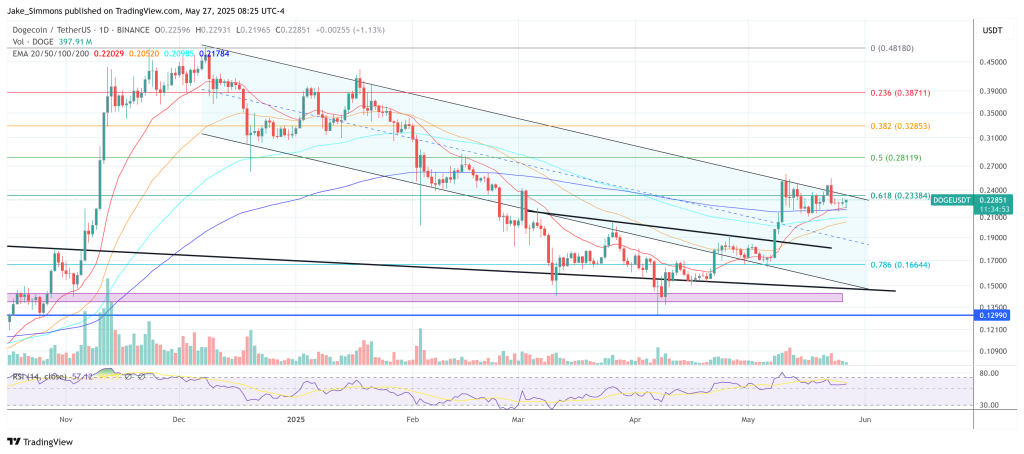
Dogecoin price
DOGE price breakout looms, 1-day chart | Source: DOGEUSDT on TradingView.com
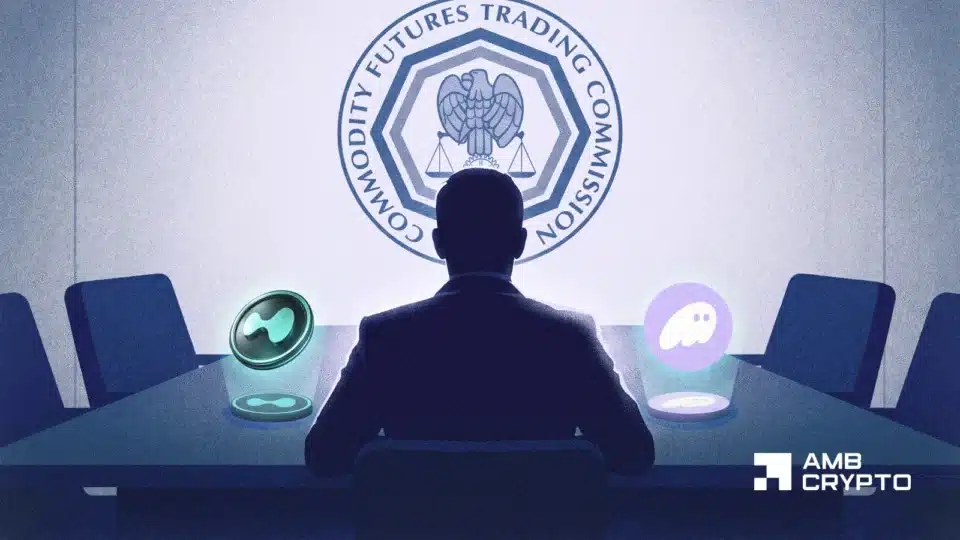
Featured image created with DALL.E, chart from TradingView.com
Editorial Process for bitcoinist is centered on delivering thoroughly researched, accurate, and unbiased content. We uphold strict sourcing standards, and each page undergoes diligent review by our team of top technology experts and seasoned editors. This process ensures the integrity, relevance, and value of our content for our readers.

Jake Simmons has been a Bitcoin enthusiast since 2016. Ever since he heard about Bitcoin, he has been studying the topic every day and trying to share his knowledge with others. His goal is to contribute to Bitcoin's financial revolution, which will replace the fiat money system. Besides BTC and crypto, Jake studied Business Informatics at a university. After graduation in 2017, he has been working in the blockchain and crypto sector. You can follow Jake on Twitter at @realJakeSimmons.

Letture associate

Is Ethereum Truly a "World Computer"?

Title: Is Ethereum Really a "World Computer"? Ethereum, envisioned as a "world computer" by its founder Vitalik Buterin, aims to be a decentralized platform for global applications. However, a recent analysis by Four Pillars raises questions about whether it is more accurately a "Western computer," based on the geographical distribution of its validators. Currently, the United States dominates with 38.19% of all validators, followed by Germany at 13.04%. Combined, these two countries account for over half of the network. In contrast, Asian representation is minimal, with Singapore holding only 3.15%. The concentration is partly due to affordable cloud hosting services like Hetzner and OVH in Europe and North America, as well as the prevalence of residential validators in the U.S., where individuals run nodes via home internet connections. When examining professionally operated validators, the distribution becomes more balanced. The U.S. share drops to 25.81%, while Asian countries like Singapore (7.28%), Hong Kong (6.44%), Japan (6.38%), and South Korea (4.59%) collectively approach the U.S. level. This shift reflects strategic deployments by institutions to meet regulatory requirements and reduce latency for local users. However, regions like South America, the Middle East, and Africa remain underrepresented. Ethereum's peer-to-peer network mechanisms, such as gossipsub, disadvantage areas with low node density, creating a feedback loop where delayed message propagation reduces validator performance and rewards. This imbalance challenges Ethereum's promises of censorship resistance and global accessibility. Despite these issues, opportunities exist for growth in underrepresented regions. As demand for localized staking infrastructure rises, early entrants in areas like the Middle East could establish dominant positions by offering compliant, low-latency solutions. The evolving validator landscape highlights both the structural challenges and the potential for Ethereum to move closer to its "world computer" ideal.

Foresight News38 min fa

Is Ethereum Truly a "World Computer"?

Foresight News38 min fa

WEEX TradFi Trading Competition Kicks Off, 50,000 USDT Prize Pool First-Come, First-Served, Open a Position and Get 5 U

WEEX Exchange Launches "TradFi Trading Competition" with a 50,000 USDT Prize Pool Amidst a crypto market downturn, WEEX Exchange highlights the growth of tokenized traditional finance (TradFi) assets as a key trend, allowing users to trade stocks, ETFs, and commodities using crypto. The platform has launched a "TradFi Trading Competition" from July 9th to 23rd, featuring a 50,000 USDT prize pool. The campaign offers three reward tiers: 1. **New User Bonus (25,000 USDT pool):** New users depositing ≥100 USDT, completing a specified spot trade, and one TradFi contract trade (margin ≥10 USDT) receive 200 USDT. 2. **Volume-Based Rewards (20,000 USDT pool):** All users can earn tiered bonuses for achieving TradFi contract trading volumes of 5,000 USDT (3 USDT), 20,000 USDT (10 USDT), and 100,000 USDT (50 USDT). Rewards are stackable. 3. **Participation Reward:** Any user opening a TradFi contract trade during the event receives 5 USDT instantly. The article promotes WEEX's TradFi features, which include trading tokenized shares of companies like NVIDIA and Tesla using USDT, 24/7 trading, fractional share investing starting from $5, and high leverage up to 100x for hedging. It positions these features as solutions to traditional investing barriers like high fees, strict trading hours, and high share prices. The summary concludes by encouraging users to join the competition and leverage WEEX's platform to access global TradFi markets.

marsbit2 h fa

WEEX TradFi Trading Competition Kicks Off, 50,000 USDT Prize Pool First-Come, First-Served, Open a Position and Get 5 U

marsbit2 h fa

Trading

Spot
活动图片