Walsh Is Quietly Reshaping the Federal Reserve Through Five Working Groups

marsbitPubblicato 2026-07-10Pubblicato ultima volta 2026-07-10

Introduzione

In an effort to subtly reshape the Federal Reserve, Chair Kevin Wash has established five "Chair's Advancement of Monetary Policy" working groups. These groups, led entirely by 15 external experts and supported by Fed staff, cover the entire monetary policy "operating system": data inputs, productivity/employment/inflation models, balance sheet tools, and external communications. The initiative centralizes agenda-setting, knowledge production, data access, and public narrative control under the Chair's office, while formal decision-making power remains with the FOMC and Board. Analysts note this mirrors tactics like China's use of central working groups—bypassing bureaucratic inertia, creating parallel reporting channels, and enabling rapid "top-level design" to reset policy agendas. This suggests Wash may hold off on major policy moves until the groups conclude their studies. Key future questions are whether these groups become permanent and if their conclusions effectively become pre-determined policy for the FOMC to ratify.

Author: qinbafrank

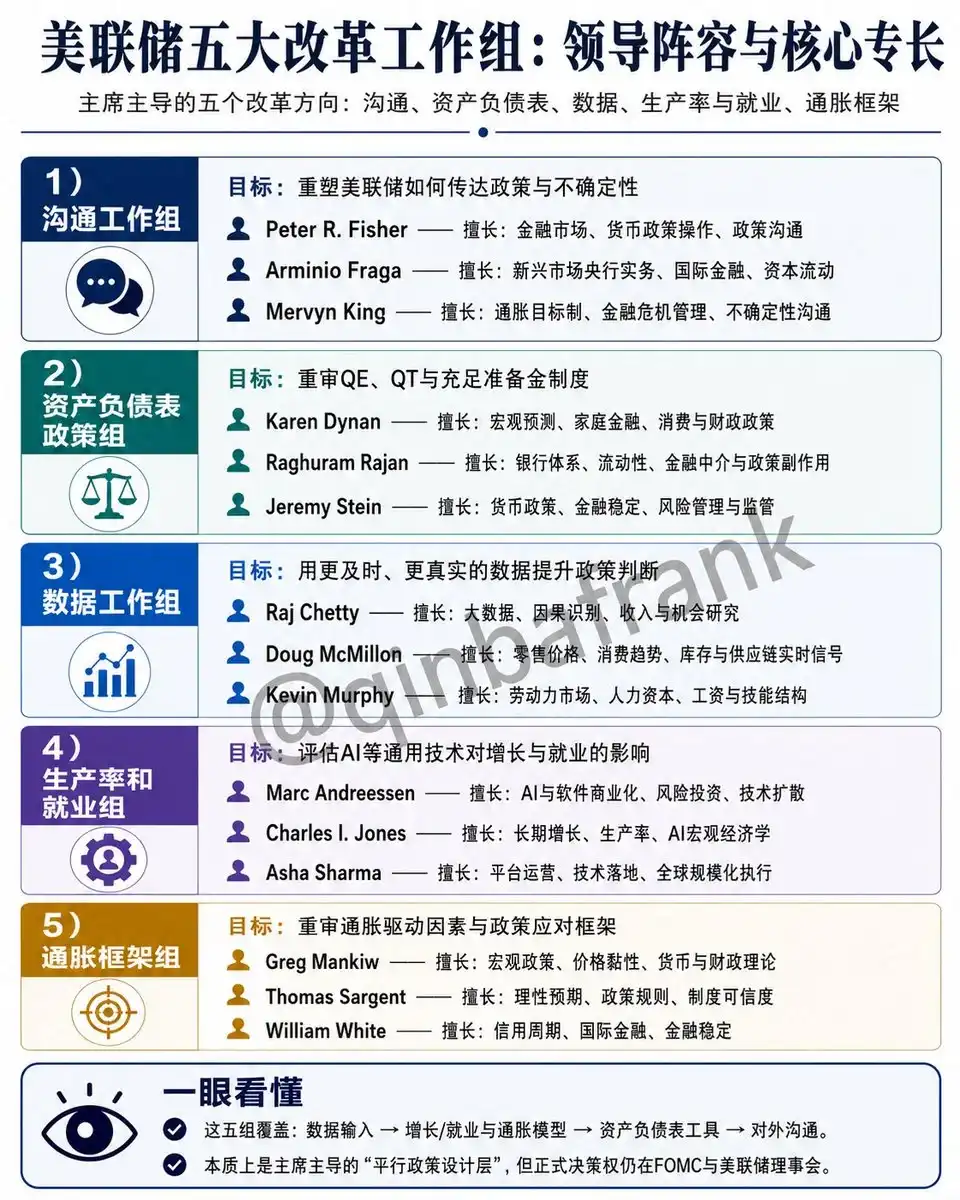
Today, the Federal Reserve announced the leadership lineup for its five major reform working groups. My initial impression is that Kevin Walsh is building a parallel policy design layer dominated by the Fed Chair: statutory decision-making authority remains with the FOMC and the Board of Governors, but agenda-setting power, knowledge production, access to data, and control over the public narrative are clearly shifting towards the Chair and the external experts he selects. There is also a slight hint of the Central Working Group style often used in my Party's institutional reforms.

The Fed has formally named them the "Chair's Working Groups to Advance Monetary Policy." All 15 co-leaders are external individuals, supported by Federal Reserve staff. They will conduct independent research and ultimately submit their conclusions to the FOMC.

These five groups are not five scattered projects; they cover the entire "operating system" of monetary policy:

Data Input → Productivity, Employment, and Inflation Models → Balance Sheet Tools → External Communication.

It must be said that Walsh is highly skillful. The characteristics of these working groups are:

1) Launched personally by the top leader;

2) Transcend existing departmental boundaries;

3) Establish parallel information reporting channels;

4) Bypass the delays and departmental interests of regular bureaucratic procedures;

5) Rapidly reset the policy agenda through "top-level design";

6) Centralize coordination and knowledge authority through a special organization.

Is there a slight hint of the working group style often used in my Party's institutional reforms?

For the future, this means that before the reform working groups produce their research results, the probability of Walsh remaining inactive is very high.

Looking ahead, we can watch to see if the working groups will exist long-term? Will there be a situation where the working groups' conclusions are tantamount to the Chair's predetermined policy? Will the FOMC ultimately be left only with the role of ratification?
Domande pertinenti

QWhat are the five new working groups recently announced by the Federal Reserve, and what is their purpose?

AThe Federal Reserve announced five new 'Chair's Advancing Monetary Policy Working Groups'. Their purpose is to conduct independent research covering the entire monetary policy 'operating system' — from data input and economic models to balance sheet tools and external communication — and to submit their conclusions to the Federal Open Market Committee (FOMC).

QHow does the author perceive Kevin Warsh's role in establishing these Fed working groups?

AThe author believes Kevin Warsh is using these working groups to quietly reshape the Federal Reserve. The analysis suggests Warsh is creating a parallel layer of policy design, centralizing agenda-setting, knowledge production, data access, and public narrative power with the Fed Chair and selected external experts, while the formal decision-making authority remains with the FOMC and the Board of Governors.

QWhat are the key characteristics of these new Federal Reserve working groups, according to the article?

AAccording to the article, the key characteristics of the working groups are: 1) Initiated directly by the top leader; 2) Spanning existing departmental boundaries; 3) Establishing parallel information reporting channels; 4) Bypassing slow bureaucracy and departmental interests; 5) Quickly resetting the policy agenda through 'top-level design'; and 6) Centralizing coordination and knowledge authority through a special organization.

QWhat potential future implications of these working groups does the article raise?

AThe article raises several questions about future implications: Will the working groups become permanent? Could their conclusions become tantamount to the Chair's predetermined policy, with the FOMC merely providing formal ratification? It also suggests that until the groups' research is complete, the Fed Chair is likely to delay major policy moves.

QWhat comparison does the author draw regarding the structure and function of these Fed working groups?

AThe author draws a comparison to the 'central working groups' frequently used in the Chinese Communist Party's institutional reforms, noting a similar organizational approach for implementing major reforms and policy coordination from the top.

Letture associate

Trading

Spot
活动图片