‘Walled off’ – Hyperliquid, Phantom press CFTC for 3 DeFi demands

ambcryptoPubblicato 2026-07-10Pubblicato ultima volta 2026-07-10

Introduzione

Hyperliquid and Solana-based wallet Phantom have urged the U.S. Commodity Futures Trading Commission (CFTC) to modernize regulations for decentralized finance (DeFi). In a letter, they made three key requests: first, that non-custodial software developers not be automatically treated as brokers or exchanges; second, that existing no-action relief for self-custodial wallets be formalized into guidance; and third, that the CFTC create a framework allowing regulated entities to use blockchain for trading and settlement. They argue these changes are necessary to prevent stifling innovation and pushing activity offshore. The request responds to a CFTC inquiry on barriers to fintech partnerships. Similar exemptions are under discussion in the proposed CLARITY Act. However, granting these requests could face legal challenges from traditional market participants like the Chicago Mercantile Exchange (CME), which has previously sued the CFTC over crypto product approvals. Traditional players argue DeFi platforms should meet the same regulatory standards as conventional exchanges. With the CLARITY Act's future uncertain, any CFTC action on DeFi exemptions may lead to further litigation.

Hyperliquid and Solana-based wallet Phantom have urged the U.S derivatives market regulator, Commodity Futures Trading Commission [CFTC], to modernize its regulations.
Source: HPC

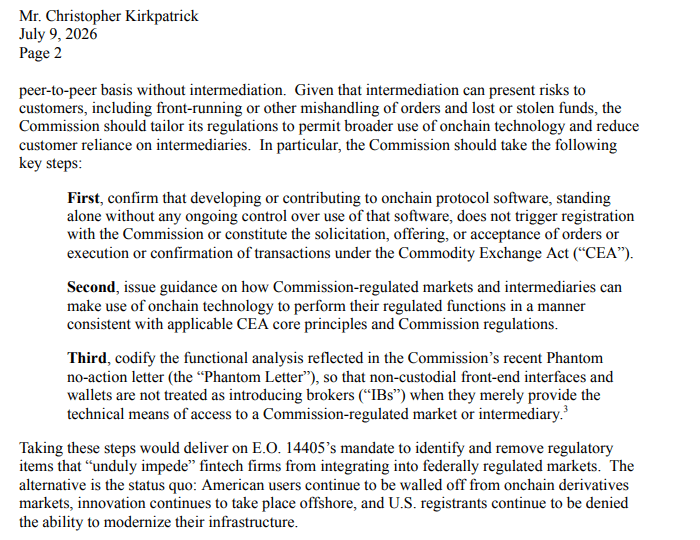
In a letter sent to the CFTC, the DeFi players requested three things. First, the agency should not treat a non-custodial software developer (users control funds, not the platform) as a broker.

In other words, creating on-chain protocols should not automatically trigger CFTC registration as an exchange or clearinghouse. Put plainly, they want developer protections.

Second, the no-action relief granted to self-custodial wallets, as issued to Phantom in March 2026, should be made formal guidance.

An industry coalition made a similar argument and pushed in April. If adopted, non-custodial DeFi front-ends like Phantom would not need broker-dealer or exchange registration to handle even U.S tokenized stocks.

Finally, they want the CFTC to create a framework that allows regulated entities to use blockchain for trading and settlement.

Why are DeFi firms seeking exemptions?

The letter was a response to the CFTC’s request for information regarding issues that are preventing fintechs from partnering with its regulated entities.

Some of the issues raised by Hyperliquid and Phantom are DeFi exemptions, some of which are being deliberated in the CLARITY Act. In fact, even the SEC is exploring a similar “innovation exemption” for tokenized assets trading.

The DeFi players cautioned that failure to explore these recommendations would reinforce the status quo, with dire consequences.

The alternative is the status quo: American users continue to be walled off from onchain derivatives markets, innovation continues to take place offshore, and U.S. registrants continue to be denied the ability to modernize their infrastructure.

Why DeFi exemptions request could be delayed

But these requests, even if granted, could trigger legal challenges from traditional market participants. The Chicago Mercantile Exchange (CME) has already sued the CFTC over its approval of Kalshi’s crypto perpetuals (perps).

CME argued that perps are swaps rather than futures, meaning the contracts should fall under its regulatory framework. That stance prompted the CFTC to reconsider how it defines swaps.

Hyperliquid Policy Center founder Jake Chervinsky called the CME lawsuit anti-competitive and a “shocking misjudgement.”

Citadel Securities and the umbrella body representing traditional exchanges have also opposed DeFi exemptions, particularly for tokenized asset trading. They argue regulators should treat every platform as a broker based on its function, not its underlying technology.

In short, DeFi platforms handling U.S. tokenized stocks should meet the same disclosure requirements and legal obligations as traditional exchanges.

Like CME, other traditional market participants could sue the agency if it grants the requested DeFi exemptions, particularly because lawmakers have not codified them and the CLARITY Act’s future remains uncertain.


Final Summary

  • Hyperliquid and Phantom have requested CFTC for formalized exemptions for DeFi front-ends
  • But with the CLARITY Act still in limbo, CME and other traditional players will continue to legally challenge the regulator over such requests.


Domande pertinenti

QWhat are the three main requests that Hyperliquid and Phantom made to the CFTC in their letter?

AFirst, that the CFTC should not treat non-custodial software developers as brokers, thereby providing developer protections. Second, to formalize the no-action relief granted to self-custodial wallets into official guidance. Third, to create a framework allowing regulated entities to use blockchain for trading and settlement.

QWhat potential consequence do Hyperliquid and Phantom warn about if the CFTC fails to act on their recommendations?

AThey warn that failure to explore these recommendations would reinforce the status quo, where American users are walled off from on-chain derivatives markets, innovation continues offshore, and U.S. registrants are denied the ability to modernize their infrastructure.

QWhy could the CFTC's potential approval of DeFi exemptions face legal challenges?

ATraditional market participants like the Chicago Mercantile Exchange (CME) could sue the CFTC, as they have already done over its approval of Kalshi's crypto perpetuals. These players argue that DeFi platforms should be treated based on their function, not technology, and must meet the same requirements as traditional exchanges.

QWhat is the CLARITY Act and what is its current status mentioned in the article?

AThe CLARITY Act is legislation that is deliberating some of the DeFi exemption issues raised by Hyperliquid and Phantom. The article states that the Act's future remains uncertain and it is currently 'still in limbo.'

QWhat argument did traditional entities like CME and Citadel Securities make against granting DeFi exemptions?

AThey argue that regulators should treat every platform as a broker based on its function, not its underlying technology. They believe DeFi platforms handling U.S. tokenized stocks should meet the same disclosure requirements and legal obligations as traditional exchanges.

Letture associate

Is Ethereum Truly a "World Computer"?

Title: Is Ethereum Really a "World Computer"? Ethereum, envisioned as a "world computer" by its founder Vitalik Buterin, aims to be a decentralized platform for global applications. However, a recent analysis by Four Pillars raises questions about whether it is more accurately a "Western computer," based on the geographical distribution of its validators. Currently, the United States dominates with 38.19% of all validators, followed by Germany at 13.04%. Combined, these two countries account for over half of the network. In contrast, Asian representation is minimal, with Singapore holding only 3.15%. The concentration is partly due to affordable cloud hosting services like Hetzner and OVH in Europe and North America, as well as the prevalence of residential validators in the U.S., where individuals run nodes via home internet connections. When examining professionally operated validators, the distribution becomes more balanced. The U.S. share drops to 25.81%, while Asian countries like Singapore (7.28%), Hong Kong (6.44%), Japan (6.38%), and South Korea (4.59%) collectively approach the U.S. level. This shift reflects strategic deployments by institutions to meet regulatory requirements and reduce latency for local users. However, regions like South America, the Middle East, and Africa remain underrepresented. Ethereum's peer-to-peer network mechanisms, such as gossipsub, disadvantage areas with low node density, creating a feedback loop where delayed message propagation reduces validator performance and rewards. This imbalance challenges Ethereum's promises of censorship resistance and global accessibility. Despite these issues, opportunities exist for growth in underrepresented regions. As demand for localized staking infrastructure rises, early entrants in areas like the Middle East could establish dominant positions by offering compliant, low-latency solutions. The evolving validator landscape highlights both the structural challenges and the potential for Ethereum to move closer to its "world computer" ideal.

Foresight News16 min fa

Is Ethereum Truly a "World Computer"?

Foresight News16 min fa

WEEX TradFi Trading Competition Kicks Off, 50,000 USDT Prize Pool First-Come, First-Served, Open a Position and Get 5 U

WEEX Exchange Launches "TradFi Trading Competition" with a 50,000 USDT Prize Pool Amidst a crypto market downturn, WEEX Exchange highlights the growth of tokenized traditional finance (TradFi) assets as a key trend, allowing users to trade stocks, ETFs, and commodities using crypto. The platform has launched a "TradFi Trading Competition" from July 9th to 23rd, featuring a 50,000 USDT prize pool. The campaign offers three reward tiers: 1. **New User Bonus (25,000 USDT pool):** New users depositing ≥100 USDT, completing a specified spot trade, and one TradFi contract trade (margin ≥10 USDT) receive 200 USDT. 2. **Volume-Based Rewards (20,000 USDT pool):** All users can earn tiered bonuses for achieving TradFi contract trading volumes of 5,000 USDT (3 USDT), 20,000 USDT (10 USDT), and 100,000 USDT (50 USDT). Rewards are stackable. 3. **Participation Reward:** Any user opening a TradFi contract trade during the event receives 5 USDT instantly. The article promotes WEEX's TradFi features, which include trading tokenized shares of companies like NVIDIA and Tesla using USDT, 24/7 trading, fractional share investing starting from $5, and high leverage up to 100x for hedging. It positions these features as solutions to traditional investing barriers like high fees, strict trading hours, and high share prices. The summary concludes by encouraging users to join the competition and leverage WEEX's platform to access global TradFi markets.

marsbit2 h fa

WEEX TradFi Trading Competition Kicks Off, 50,000 USDT Prize Pool First-Come, First-Served, Open a Position and Get 5 U

marsbit2 h fa

Switching Chains for Another Shot at Success: Can It Really 'Change One's Destiny'?

Recent months have witnessed a wave of established blockchain projects migrating to new public chains, notably Base and Arbitrum, coupled with strategic pivots in their business models—essentially "re-starting" elsewhere. Examples include Sophon (moving from ZKsync to Base to cut $3M+ annual costs and focus on consumer apps), Moonbeam (shifting from Polkadot to Base to pursue decentralized AI), and Secret Network (planning a move from Cosmos to Arbitrum to explore privacy-AI integrations, though its token price plunged 30% post-announcement). A common thread is that these migrating projects are primarily layer-1 or layer-2 chains now seeking relevance in AI and real-world consumer applications. This trend highlights the relative stagnation of ecosystems like Polkadot and Cosmos, which are seeing significant outflows. However, the community remains skeptical about whether such chain-hopping truly enables a turnaround. Historical cases like y00ts NFTs (which moved from Solana to Polygon and back to Ethereum) and Synthetix (which retreated from a multi-chain strategy) show that migration often fails to deliver expected benefits and can add complexity. In today's more rational market, devoid of easy narrative or airdrop红利, simply changing chains is unlikely to be a silver bullet. For both migrating projects and destination chains, the real challenge lies not in attracting projects but in developing actual use cases that retain users.

marsbit2 h fa

Switching Chains for Another Shot at Success: Can It Really 'Change One's Destiny'?

marsbit2 h fa

Trading

Spot
活动图片