Ripple Strengthens Grip in Growing Middle Eastern Crypto Industry

TheCryptoTimesPubblicato 2025-05-01Pubblicato ultima volta 2025-05-01

Ripple is tightening its hold on the fast-growing crypto industry in the Middle East. This year, the company became the first blockchain payments provider to receive a license from the Dubai Financial Services Authority (DFSA). 

This license enables Ripple to offer its Ripple Payments service to businesses in the UAE. The firm generally wants to offer transparent cross-border payments in one of the world’s biggest trade and remittance markets, according to a recently posted blog post

Meanwhile, the Middle East is now the world’s seventh-largest crypto economy. Ripple started growing in the region when it opened an office in Dubai in 2020. Now, 20% of Ripple’s total customers are in the Middle East.

This regain has a great success when it comes to crypto thanks to its strong regulation, youthful tech-savvy population, and high interest from both startups and major institutions.

“This licensing milestone helps legitimize real-world applications of digital assets in the Middle East,” Ripple said. The firm now offers tools such as stablecoins, custody, and trusted payments to support the growth of digital assets.

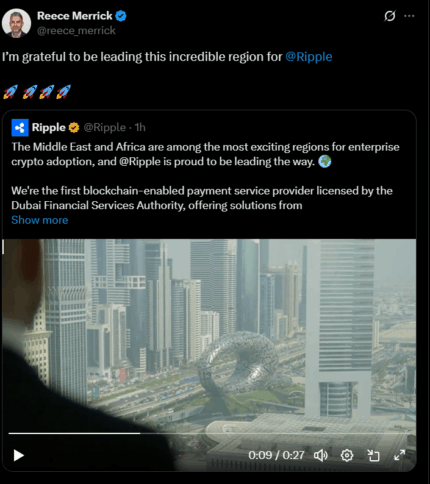
In a recent tweet on X, Reece Merrick, Ripple’s Managing Director for Middle East and Africa said that he’s “grateful to be leading this incredible region for Ripple.” In a video posted by the company, he confirmed that both regions are “one of the most promising regions in the world for crypto development and adoption.”
Ripple Is Stepping Up In The Middle East And Africa
Ripple is stepping up in the Middle East and Africa | Source: x.com/reece_merrick

Moveover, about 85% of finance and enterprise businesses say that they are more confident in digital assets now than they were six months ago. Also, 97% believe that digital assets will be an important part of their business in three years’ time.

Already, 40% of firms in the Middle East and Africa use digital asset custody solutions. Another 56% plan to use them soon. Ripple also launched RLUSD, a stablecoin made for secure payments and use in DeFi projects.

Furthermore, after building momentum in the Middle East, Ripple now has its eyes on the UK. The British government is working on new crypto rules, and Ripple sees this as a big opportunity. 

Cassie Craddock, Ripple’s UK, and Europe Managing Director, also said, “The UK has the chance to lead – now’s the time to move at pace..” She praised the UK’s approach as “flexible” and “globally competitive.” Ripple already has an office in London and believes smart rules can help the UK become a crypto leader.

Also Read: Tether Reports $1B Profit and $120B in U.S. Treasury for Q1 2025


Letture associate

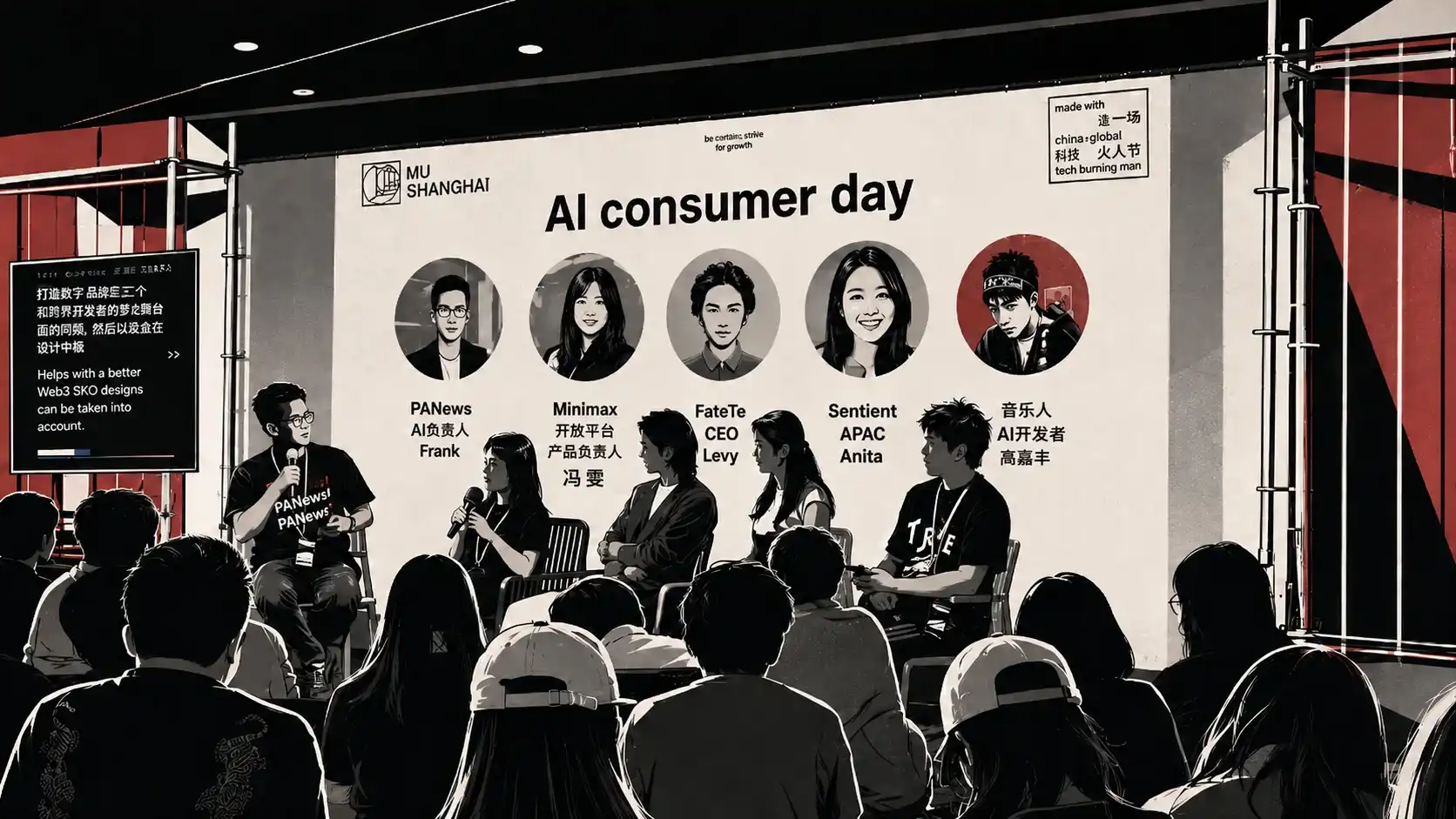
muShanghai Discusses Consumer AI: After Continuous Iteration of Large Models, Product Competition Moves Towards Scenarios and Experience

The roundtable discussion "Innovative Practices and Path Exploration of the AI Consumption Ecosystem" at muShanghai AI Week, featuring experts from model platforms, cultural apps, the open-source ecosystem, and music creation, delved into the practical paths for consumer AI products. A key consensus emerged: while AI model advancements lower prototyping barriers, the real challenge for enduring products lies beyond raw technology. True differentiation comes from deep scene understanding, data organization, user education, delivering emotional value, and building open ecosystems. The competition is shifting from "who has the stronger model" to "who best understands the specific user and scenario." Participants highlighted that application-layer barriers, such as accumulated contextual data and cultural localization (e.g., FateTell's translation of Eastern metaphysics for global users), are not easily erased by model updates. They cautioned that AI simplifies prototyping but not the core entrepreneurial hurdles: user acquisition, community building, and commercialization. The discussion emphasized that value must return to human needs—like emotional comfort (FateTell) or preserving the creative *process* in music-making, as highlighted by musician-developer Gao Jiafeng, rather than just outputting a final product. With the rise of AI Agents, user education is evolving from manual documentation reading to more guided, interactive learning within the product experience itself. Looking ahead 3-5 years, panelists foresee AI moving into the physical world via hardware and robotics, enabling more personalized services and addressing growing needs for companionship amidst technological anxiety. The future points towards "technology democratization," where AI assists diverse lifestyles, and cultural forms may be recombined, with emotional connection becoming paramount. Ultimately, as models continue to evolve, the products that endure will be those that meet genuine human needs, foster understanding, and build meaningful connections.

marsbit1 h fa

muShanghai Discusses Consumer AI: After Continuous Iteration of Large Models, Product Competition Moves Towards Scenarios and Experience

marsbit1 h fa

Trading

Spot
Futures
活动图片