XRP Supporter Kitao Tapped For Fuji Holdings Board

bitcoinistPubblicato 2025-04-15Pubblicato ultima volta 2025-04-15

Introduzione

Yoshitaka Kitao—well known for his enduring support of Ripple and its digital asset XRP—has been named by Dalton Investments as...

Trusted Editorial content, reviewed by leading industry experts and seasoned editors. Ad Disclosure

Yoshitaka Kitao—well known for his enduring support of Ripple and its digital asset XRP—has been named by Dalton Investments as a candidate for the board of directors at Fuji Media Holdings, Japan’s largest media conglomerate. The proposal, first reported by Nikkei, surfaced amid ongoing efforts by the US-based activist investor to address what it deems as governance shortcomings at Fuji Media. “The activist investor, which holds a significant stake in the media giant, has previously voiced dissatisfaction with the company’s governance,” the Nikkei report notes.

XRP Supporter Kitao Joins Fuji Media

Kitao’s deep-rooted connections to Ripple can be traced back several years through SBI Holdings, the financial services powerhouse he helms as Chairman & President. Under Kitao’s guidance, SBI became a strategic partner of the San Francisco-headquartered blockchain firm, launching initiatives such as SBI Ripple Asia to spearhead the adoption of XRP across the Japanese banking sector.

Over the past years, Kitao often championed XRP’s capacity for “cutting-edge cross-border remittances,” once describing Ripple’s technology as “the next standard for international money transfers.”

In 2019, he formalized his commitment to Ripple by accepting a position on its board of directors—an appointment that underscored his alignment with the firm’s ambition to modernize global payment rails. Though he stepped away from that directorship after two years, his advocacy for XRP endured. One of his recent social media posts emphasized the significance of RLUSD.

Fuji Media Holdings, meanwhile, has found itself in a precarious position after a string of governance controversies. Earlier this year, it orchestrated a sweeping executive overhaul meant to restore shareholder confidence and stabilize its operations. Chairman Shuji Kanoh departed the company, followed closely by the resignation of Fuji TV head Koichi Minato.

The board subsequently reduced its membership to 10 directors, a move widely interpreted as a bid to tighten oversight and accountability. Hisashi Hieda, the conglomerate’s 87-year-old director, stepped down in March, adding to the sense of a thorough housecleaning at one of Japan’s most influential media giants.

The Fuji Media empire, best known for its flagship Fuji TV network, holds a commanding presence in Japan’s entertainment sector through the production of dramas, variety shows, anime, and an array of digital media offerings. Its content enjoys near-ubiquitous recognition among Japanese audiences.

Unlike Fujifilm, the camera and imaging firm that shares a similar name but operates a completely different business, Fuji Media has carved out a unique place in broadcasting and streaming platforms, contributing substantially to Japan’s cultural narrative.

Against this backdrop, Dalton Investments’ push to see Kitao join the board has opened up questions about whether the seasoned financier’s fintech and XRP insights might steer Fuji Media toward new forms of innovation—or at least provide it with a measure of stability at a time when media companies are under increasing pressure to diversify revenue streams.

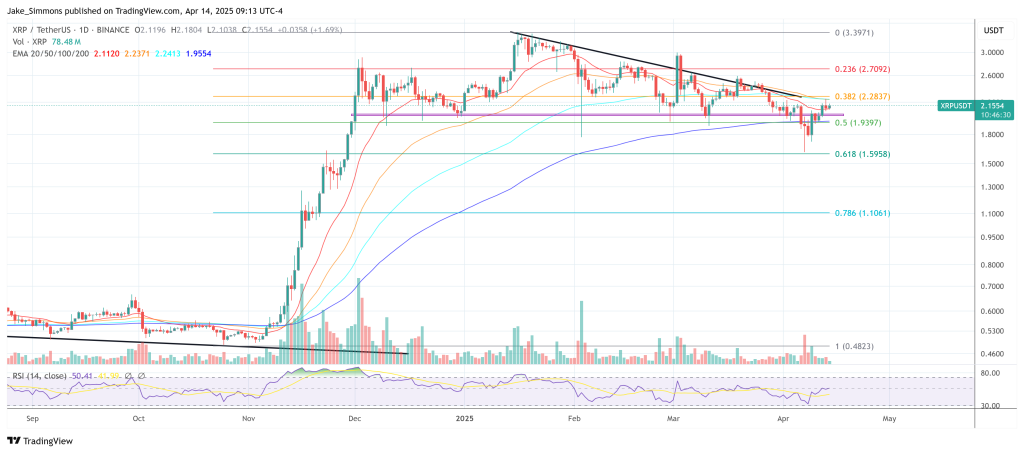
At press time, XRP traded at $2.15.
XRP price
XRP rose back above key resistance, 1-day chart | Source: XRPUSDT on TradingView.com
Featured image created with DALL.E, chart from TradingView.com
Editorial Process for bitcoinist is centered on delivering thoroughly researched, accurate, and unbiased content. We uphold strict sourcing standards, and each page undergoes diligent review by our team of top technology experts and seasoned editors. This process ensures the integrity, relevance, and value of our content for our readers.

Jake Simmons has been a Bitcoin enthusiast since 2016. Ever since he heard about Bitcoin, he has been studying the topic every day and trying to share his knowledge with others. His goal is to contribute to Bitcoin's financial revolution, which will replace the fiat money system. Besides BTC and crypto, Jake studied Business Informatics at a university. After graduation in 2017, he has been working in the blockchain and crypto sector. You can follow Jake on Twitter at @realJakeSimmons.

Letture associate

Six Complaints from an Ethereum Developer

A disgruntled early Ethereum developer and token holder presents six core criticisms of the project's trajectory, contrasting it with Solana's rise. 1. **Premature Complacency**: The Ethereum Foundation shifted from a "building" to an "infrastructure" mindset too soon, adopting a passive, "retired chairman" posture before securing market dominance, reflected in ETH's ~65% decline against BTC post-Merge. 2. **Misguided Messaging**: The Merge was marketed primarily on ESG (99.95% energy reduction) rather than user benefits like speed or yield, appealing to internal ideals instead of market demands. 3. **Delayed Execution**: Proof-of-Stake, on the roadmap since 2015, took seven years to launch, ceding critical narrative and development windows. Competitors like Solana built entire ecosystems in that time. 4. **Poor Native Staking UX**: Years after the Merge, there is still no first-party, user-friendly staking application, forcing reliance on centralized services like Lido and undermining ETH's "sound money" narrative. 5. **Managed Decline**: The rollup-centric roadmap deliberately weakens the base layer's fee capture, outsourcing value and profitability to L2s like Arbitrum and Base, which issue their own tokens and fragment capital. 6. **Ideology Over Product**: Ethereum culture prioritizes philosophical purity ("credible neutrality," "public goods") over competitive product delivery that meets user demands (e.g., financialization), while Solana's ecosystem focuses on coordinated execution. The diagnosis is accumulated execution debt, not a coordination failure. Ethereum possessed a structural advantage in 2021 but spent years in governance debates, while Solana efficiently executed. The current market cap reflects these specific strategic failures, not abstract theory.

marsbit2 h fa

Six Complaints from an Ethereum Developer

marsbit2 h fa

Six Complaints from an Ethereum Developer

Six Grievances from an Ethereum Developer The author, an early investor and developer still building on Ethereum, expresses deep frustration with its trajectory and declining ETH/BTC price since the merge. The core argument is that Ethereum's current market position stems from concrete failures in execution and strategy, not abstract coordination problems. The first grievance targets a shift in the Ethereum Foundation's mentality from builders to "infrastructure," adopting a premature posture of a retired victor. Second, marketing the Merge around ESG (99.95% energy reduction) is seen as talking to its own conscience rather than the market, which prioritizes user experience and yield. Third, the seven-year delay in delivering Proof-of-Stake (PoS) ceded critical narrative and development time to competitors like Solana. Fourth, three years post-merge, there is still no user-friendly first-party staking application, forcing reliance on centralized services like Lido and undermining ETH's monetary narrative. Fifth, the rollup-centric roadmap has strategically surrendered base-layer fee capture to L2s, fragmenting value within the ecosystem while Solana demonstrates an integrated L1's value accrual. Finally, the author criticizes an institutional culture that prioritizes philosophical ideals (credible neutrality, pluralism) over competitive product delivery focused on what users actually want. The diagnosis is "accumulated execution debt." Ethereum possessed a structural advantage in 2021 but spent years in governance debates, while Solana's ecosystem coordinated efficiently to deliver and capture the next wave of value. The conclusion is that Ethereum's market cap reflects its abandonment of the fight for asset appreciation.

链捕手2 h fa

Six Complaints from an Ethereum Developer

链捕手2 h fa

Token Budget Wars: Enterprise AI Enters the 'Accounting Era'

Token Budget Wars: Enterprise AI Enters the "Accounting Era" Enterprise AI is shifting from the question of "whether to adopt" to "how to account for it." As AI inference costs evolve from experimental budgets into ongoing operational expenses, CEOs and CFOs are demanding proof of value: what tangible results does each dollar spent on tokens deliver? The core of "Token Budget Wars" is not simply about reducing AI bills, but about intelligently allocating compute resources. It involves determining which business processes warrant more computational power, which tasks can use cheaper models, which can be outsourced or handled manually, and which are merely inefficient consumption. A key insight is that AI usage (token consumption) does not equal value. While SaaS usage indicated software adoption, AI token usage only indicates the "meter is running." The same workflow can cost vastly different amounts due to factors like prompt quality, context, model choice, and retries. The critical metric for scaling is "marginal token utility"—the business value created per additional dollar of inference cost. However, this is difficult to measure due to challenges like the long tail of retries, context inflation (where costs can scale quadratically with context length), and inefficient model routing (defaulting to the most powerful model for all tasks). The competition for token allocation is intensifying because, in the AI era, influence is tied to how much intelligence one can command, not just team size. AI spending is essentially competing with labor costs, whether for replacing external BPOs, internal staff, or generating new revenue. BPO contracts provide a clearer benchmark as they are priced per completed unit. The missing layer is attribution from tokens to business outcomes. Companies need a system that connects inference spending to completed work and results, capturing the agent's decision trajectory—what it saw, retrieved, tried, and why it succeeded or failed. This recorded rationale becomes a valuable asset. Ultimately, those who master token-to-outcome attribution will control the allocation of AI resources within enterprises, deciding which workflows get more compute, which are capped, or which revert to humans. The first phase of enterprise AI proved models could do the work. The next phase will determine how much of that work is worth paying for.

marsbit2 h fa

Token Budget Wars: Enterprise AI Enters the 'Accounting Era'

marsbit2 h fa

Trading

Spot
Futures
活动图片