Galaxy Weighs Theories After $8.3M Bitcoin Burn Mystery

bitcoinistPubblicato 2026-05-28Pubblicato ultima volta 2026-05-28

Introduzione

Galaxy Research is investigating a mysterious Bitcoin transaction where approximately 107 BTC (worth $8.3 million) was deliberately sent to a provably unspendable "burn" address. The primary question is the motive behind destroying such a large sum. Galaxy proposed several theories, including a tax-loss strategy (though deemed unlikely for old coins), a religious or ideological act, an attempt to dispose of illicit funds, or coercion. The firm suggested a plausible explanation could be an automated error, where a trading system mistakenly sent funds to a known burn address labeled "Counterparty" instead of the intended recipient. Galaxy acknowledged all theories are speculative, and the true reason may never be known.

Galaxy Research is trying to explain one of the stranger Bitcoin transactions of the year after five addresses sent roughly 107 BTC, worth about $8.3 million, to an old burn address, making the coins provably unspendable.
The move, flagged by Galaxy in a thread on X, immediately raised the question that sits at the center of the episode: why would anyone deliberately destroy a large amount of Bitcoin rather than sell it, move it, donate it, or leave it dormant?

“ACTUAL ONCHAIN BOATING ACCIDENT?” Galaxy Research wrote. “On Monday, 5 bitcoin addresses sent ~107 BTC ($8.3m) to an old burn address, making the coins provably unspendable. Why would someone do this? The Galaxy Research team’s best theories are in the thread below (spoiler: none are very good).”

The burn address in question is not merely a wallet whose owner lost a key. Galaxy said the address, 1111111111111111111114oLvT2, corresponds to a Hash160 value of twenty zero bytes. Encoding that with Bitcoin’s P2PKH version byte produces the address. In practical terms, spending coins from it would require finding a public key whose Hash160 is all zeros, an outcome Galaxy framed as computationally out of reach.

That makes the transaction different from a mistaken transfer to an exchange address, a wallet controlled by an unknown counterparty, or an address whose private key may exist somewhere. The coins were not simply moved into obscurity. They were sent to a destination designed to be unspendable.

Theories Why Someone Burns $8.3 Million In Bitcoin

Galaxy’s first theory was tax-related, but the firm appeared skeptical of its own explanation. A sender could have been attempting to create a tax loss by destroying the coins, the team wrote, but that logic weakens if the Bitcoin was acquired long ago. “Most are very old, so selling them would produce gains, not losses,” Galaxy said.

The thread then moved into more speculative territory. Galaxy suggested the burn could have been motivated by religious reasons, citing traditions in which adherents renounce possessions. But it also noted that giving assets away, rather than destroying them, is the more typical pattern. That distinction matters: a donation or transfer would move wealth to another party, while a burn removes it from circulation entirely.

Another possibility raised by Galaxy was that the coins were tied to illicit activity and that the sender concluded there was no viable path to launder or spend them. In that scenario, destruction would function less as a financial decision than as a risk-management act, eliminating the asset rather than attempting to move it through traceable channels.

Galaxy also floated darker explanations involving coercion. “Perhaps the sender was under some form of duress, such as torture or threat of kidnapping or bodily harm, and instead of making him spend the coins to the attacker, the attacker is sick and twisted and instead demanded the victim destroy his wealth. We sincerely hope it is not this one.” The firm added a related theory in which proof-of-burn was demanded as an initiation ritual for a club or cult.

The most striking theory, and the one Galaxy described as “perhaps among the most likely,” was not human ideology or criminal pressure but an automated error. The team imagined a large trading or Bitcoin operation using an agentic system to execute transfers. “Say you are running a big agentic trading or bitcoin operation, and you recently onboarded a new counterparty,” Galaxy wrote. “You instruct your agent to ‘send the counterparty 107 BTC’ and the [agent] accidentally sends it to the Countparty (Burn Address) instead of your counterparty.”

The typo-like logic behind that theory is notable. “Counterparty” is also associated with one of Bitcoin’s older burn mechanisms, and the address used here has long been known as a burn destination. If an automated system confused a real counterparty with a burn address label, the result could be catastrophic: an irreversible transfer with no recovery path.

Galaxy did not claim to have identified the sender, and the thread made clear that each theory remains conjecture. “We may never know who sent the 107 BTC or why, but these are the best we can come up with,” the firm wrote, inviting other explanations.

At press time, BTC traded at $72,828.
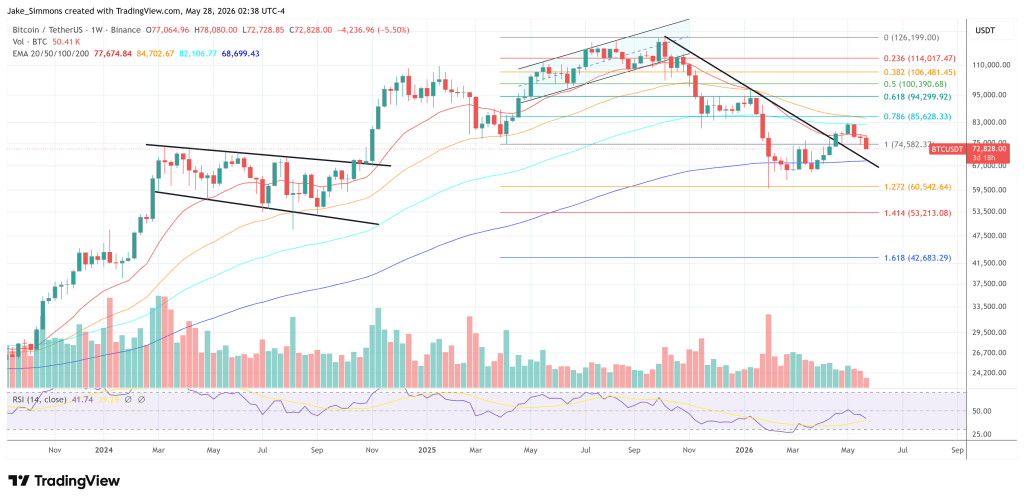
Bitcoin falls below the 1.0 Fib again, 1-week chart | Source: BTCUSDT on TradingView.com

Domande pertinenti

QWhat is the unusual Bitcoin transaction described in the article, and why is it puzzling?

AThe transaction involved five addresses sending approximately 107 BTC (worth about $8.3 million) to an old burn address, making the coins provably unspendable. This is puzzling because it represents a deliberate destruction of a large amount of value, raising the question of why someone would do this instead of selling, moving, donating, or simply holding the assets.

QWhat makes the specific burn address used in the transaction uniquely unspendable?

AThe burn address (1111111111111111111114oLvT2) corresponds to a Hash160 value of twenty zero bytes. Spending coins from it would require finding a public key whose Hash160 is all zeros, which Galaxy Research describes as computationally out of reach. This is different from a transfer to a lost wallet, as it was designed from the start to be unspendable.

QWhat were some of the theories proposed by Galaxy Research to explain why someone might burn $8.3 million in Bitcoin?

AGalaxy proposed several theories: 1) A tax-loss motivation, though this is weak if the Bitcoin was acquired long ago. 2) Religious reasons involving renouncing possessions. 3) The coins were tied to illicit activity with no viable laundering path. 4) Coercion or duress forcing the destruction. 5) An automated error, such as an agentic system confusing a real counterparty with the burn address labeled 'Countparty'.

QWhich theory did Galaxy Research consider 'perhaps among the most likely'?

AGalaxy Research considered the automated error theory as perhaps among the most likely. They suggested a scenario where an agentic trading system, instructed to send Bitcoin to a new counterparty, accidentally sent it to the burn address (known historically as a 'Countparty' burn mechanism) due to a typo-like confusion.

QAccording to the article, what key distinction did Galaxy make between destroying assets and giving them away?

AThe key distinction is that a donation or transfer moves wealth to another party, while a burn removes it from circulation entirely. This matters because destroying assets, unlike giving them away, eliminates the value completely rather than redistributing it.

Letture associate

Six Complaints from an Ethereum Developer

A disgruntled early Ethereum developer and token holder presents six core criticisms of the project's trajectory, contrasting it with Solana's rise. 1. **Premature Complacency**: The Ethereum Foundation shifted from a "building" to an "infrastructure" mindset too soon, adopting a passive, "retired chairman" posture before securing market dominance, reflected in ETH's ~65% decline against BTC post-Merge. 2. **Misguided Messaging**: The Merge was marketed primarily on ESG (99.95% energy reduction) rather than user benefits like speed or yield, appealing to internal ideals instead of market demands. 3. **Delayed Execution**: Proof-of-Stake, on the roadmap since 2015, took seven years to launch, ceding critical narrative and development windows. Competitors like Solana built entire ecosystems in that time. 4. **Poor Native Staking UX**: Years after the Merge, there is still no first-party, user-friendly staking application, forcing reliance on centralized services like Lido and undermining ETH's "sound money" narrative. 5. **Managed Decline**: The rollup-centric roadmap deliberately weakens the base layer's fee capture, outsourcing value and profitability to L2s like Arbitrum and Base, which issue their own tokens and fragment capital. 6. **Ideology Over Product**: Ethereum culture prioritizes philosophical purity ("credible neutrality," "public goods") over competitive product delivery that meets user demands (e.g., financialization), while Solana's ecosystem focuses on coordinated execution. The diagnosis is accumulated execution debt, not a coordination failure. Ethereum possessed a structural advantage in 2021 but spent years in governance debates, while Solana efficiently executed. The current market cap reflects these specific strategic failures, not abstract theory.

marsbit2 h fa

Six Complaints from an Ethereum Developer

marsbit2 h fa

Six Complaints from an Ethereum Developer

Six Grievances from an Ethereum Developer The author, an early investor and developer still building on Ethereum, expresses deep frustration with its trajectory and declining ETH/BTC price since the merge. The core argument is that Ethereum's current market position stems from concrete failures in execution and strategy, not abstract coordination problems. The first grievance targets a shift in the Ethereum Foundation's mentality from builders to "infrastructure," adopting a premature posture of a retired victor. Second, marketing the Merge around ESG (99.95% energy reduction) is seen as talking to its own conscience rather than the market, which prioritizes user experience and yield. Third, the seven-year delay in delivering Proof-of-Stake (PoS) ceded critical narrative and development time to competitors like Solana. Fourth, three years post-merge, there is still no user-friendly first-party staking application, forcing reliance on centralized services like Lido and undermining ETH's monetary narrative. Fifth, the rollup-centric roadmap has strategically surrendered base-layer fee capture to L2s, fragmenting value within the ecosystem while Solana demonstrates an integrated L1's value accrual. Finally, the author criticizes an institutional culture that prioritizes philosophical ideals (credible neutrality, pluralism) over competitive product delivery focused on what users actually want. The diagnosis is "accumulated execution debt." Ethereum possessed a structural advantage in 2021 but spent years in governance debates, while Solana's ecosystem coordinated efficiently to deliver and capture the next wave of value. The conclusion is that Ethereum's market cap reflects its abandonment of the fight for asset appreciation.

链捕手2 h fa

Six Complaints from an Ethereum Developer

链捕手2 h fa

Token Budget Wars: Enterprise AI Enters the 'Accounting Era'

Token Budget Wars: Enterprise AI Enters the "Accounting Era" Enterprise AI is shifting from the question of "whether to adopt" to "how to account for it." As AI inference costs evolve from experimental budgets into ongoing operational expenses, CEOs and CFOs are demanding proof of value: what tangible results does each dollar spent on tokens deliver? The core of "Token Budget Wars" is not simply about reducing AI bills, but about intelligently allocating compute resources. It involves determining which business processes warrant more computational power, which tasks can use cheaper models, which can be outsourced or handled manually, and which are merely inefficient consumption. A key insight is that AI usage (token consumption) does not equal value. While SaaS usage indicated software adoption, AI token usage only indicates the "meter is running." The same workflow can cost vastly different amounts due to factors like prompt quality, context, model choice, and retries. The critical metric for scaling is "marginal token utility"—the business value created per additional dollar of inference cost. However, this is difficult to measure due to challenges like the long tail of retries, context inflation (where costs can scale quadratically with context length), and inefficient model routing (defaulting to the most powerful model for all tasks). The competition for token allocation is intensifying because, in the AI era, influence is tied to how much intelligence one can command, not just team size. AI spending is essentially competing with labor costs, whether for replacing external BPOs, internal staff, or generating new revenue. BPO contracts provide a clearer benchmark as they are priced per completed unit. The missing layer is attribution from tokens to business outcomes. Companies need a system that connects inference spending to completed work and results, capturing the agent's decision trajectory—what it saw, retrieved, tried, and why it succeeded or failed. This recorded rationale becomes a valuable asset. Ultimately, those who master token-to-outcome attribution will control the allocation of AI resources within enterprises, deciding which workflows get more compute, which are capped, or which revert to humans. The first phase of enterprise AI proved models could do the work. The next phase will determine how much of that work is worth paying for.

marsbit3 h fa

Token Budget Wars: Enterprise AI Enters the 'Accounting Era'

marsbit3 h fa

Trading

Spot
Futures

Articoli Popolari

Cosa è BITCOIN

Comprendere HarryPotterObamaSonic10Inu (ERC-20) e la sua posizione nel mondo delle criptovalute Negli ultimi anni, il mercato delle criptovalute ha assistito a un aumento della popolarità delle meme coin, catturando l'interesse non solo dei trader, ma anche di coloro che cercano coinvolgimento comunitario e valore di intrattenimento. Tra questi token unici c'è HarryPotterObamaSonic10Inu (ERC-20), un progetto intrigante che mescola riferimenti culturali nel tessuto delle criptovalute. Questo articolo esplora gli aspetti chiave di HarryPotterObamaSonic10Inu, analizzando i suoi meccanismi, l'etica guidata dalla comunità e il suo coinvolgimento con il panorama crittografico più ampio. Che cos'è HarryPotterObamaSonic10Inu (ERC-20)? Come suggerisce il suo nome, HarryPotterObamaSonic10Inu è una meme coin costruita sulla blockchain di Ethereum, classificata secondo lo standard ERC-20. A differenza delle criptovalute tradizionali che possono enfatizzare l'utilità pratica o il potenziale investimento, questo token prospera grazie al valore di intrattenimento e alla forza della sua comunità. Il progetto mira a creare un ambiente in cui gli utenti coinvolti possono riunirsi, condividere idee e partecipare ad attività ispirate a diversi fenomeni culturali. Una caratteristica notevole di HarryPotterObamaSonic10Inu è la zero tassa sulle transazioni. Questo elemento allettante tende a incoraggiare il trading e il coinvolgimento della comunità, privo di costi aggiuntivi che possono scoraggiare i trader di piccole dimensioni. L'offerta totale della moneta è fissata a un miliardo di token, un numero che segna la sua intenzione di mantenere una circolazione sostanziale all'interno della comunità. Creatore di HarryPotterObamaSonic10Inu (ERC-20) Le origini di HarryPotterObamaSonic10Inu sono avvolte in un certo mistero; i dettagli sul creatore rimangono sconosciuti. Lo sviluppo di questo token non presenta un team identificabile o un piano esplicito, cosa non rara nel settore delle meme coin. Invece, il progetto è emerso organicamente, con il suo progresso fortemente dipendente dall'entusiasmo e dalla partecipazione della sua comunità. Investitori di HarryPotterObamaSonic10Inu (ERC-20) Per quanto riguarda investimenti esterni e finanziamenti, HarryPotterObamaSonic10Inu rimane ambiguo. Il token non elenca alcuna fondazione di investimento conosciuta o un sostegno organizzativo significativo. Invece, la linfa vitale del progetto è la sua comunità di base, che informa la sua crescita e sostenibilità attraverso azioni collettive e coinvolgimento nello spazio crittografico. Come funziona HarryPotterObamaSonic10Inu (ERC-20)? In quanto meme coin, HarryPotterObamaSonic10Inu opera principalmente al di fuori delle strutture tradizionali che governano spesso il valore degli asset. Ci sono diversi aspetti distintivi che definiscono il funzionamento del progetto: Transazioni senza tasse: Senza costi fiscali sulle transazioni, gli utenti possono comprare e vendere liberamente il token senza preoccuparsi di costi nascosti. Coinvolgimento della comunità: Il progetto prospera sull'interazione della comunità, sfruttando le piattaforme social per creare entusiasmo e facilitare il coinvolgimento. Discussioni, condivisione di contenuti e coinvolgimento sono elementi cruciali che aiutano ad espandere la sua portata e a favorire la lealtà tra i sostenitori. Nessuna utilità pratica: Va notato che HarryPotterObamaSonic10Inu non offre un'utilità concreta all'interno dell'ecosistema finanziario. Piuttosto, è classificato come un token principalmente per attività di intrattenimento e comunitarie. Riferimento culturale: Il token incorpora astutamente elementi della cultura pop per attirare interesse, collegandosi a appassionati di meme e seguaci delle criptovalute. HarryPotterObamaSonic10Inu esemplifica come le meme coin operino in modo diverso rispetto ai progetti di criptovalute più tradizionali, entrando nel mercato come costrutti sociali innovativi piuttosto che come asset utilitari. Cronologia di HarryPotterObamaSonic10Inu (ERC-20) La storia di HarryPotterObamaSonic10Inu è segnata da diversi traguardi notevoli: Creazione: Il token è emerso da un meme virale, catturando l'immaginazione di molti appassionati di criptovalute. Le date di creazione specifiche non sono disponibili, sottolineando la sua crescita organica. Inserimento negli scambi: HarryPotterObamaSonic10Inu ha fatto il suo ingresso in vari scambi, consentendo un accesso e un trading più facili da parte della comunità. Iniziative di coinvolgimento della comunità: Attività in corso volte a migliorare l'interazione della comunità, comprese gare, campagne sui social media e generazione di contenuti da parte di fan e sostenitori. Piani di espansione futura: La tabella di marcia del progetto include il lancio di una collezione NFT, merchandising e un sito di eCommerce relativo ai suoi temi culturali, coinvolgendo ulteriormente la comunità e cercando di aggiungere più dimensioni al suo ecosistema. Punti chiave su HarryPotterObamaSonic10Inu (ERC-20) Natura guidata dalla comunità: Il progetto dà priorità al contributo collettivo e alla creatività, garantendo che il coinvolgimento degli utenti sia al centro del suo sviluppo. Classificazione come meme coin: Rappresenta l'epitome delle criptovalute basate sull'intrattenimento, distinguendosi dai veicoli d'investimento tradizionali. Nessuna affiliazione diretta con Bitcoin: Nonostante la somiglianza nel nome del ticker, HarryPotterObamaSonic10Inu è distintivo e non ha alcuna relazione con Bitcoin o altre criptovalute consolidate. Focus sulla collaborazione: HarryPotterObamaSonic10Inu è progettato per creare uno spazio per la collaborazione e la condivisione di storie tra i suoi detentori, fornendo un canale per la creatività e il legame comunitario. Prospettive future: L'ambizione di espandersi oltre il suo presupposto iniziale verso NFT e merchandising delinea un percorso per il progetto per potenzialmente entrare in strade più mainstream all'interno della cultura digitale. Poiché le meme coin continuano a catturare l'immaginazione della comunità crittografica, HarryPotterObamaSonic10Inu (ERC-20) si distingue per i suoi legami culturali e il suo approccio centrato sulla comunità. Anche se potrebbe non adattarsi al modello tipico di un token orientato all'utilità, la sua essenza risiede nella gioia e nella camaraderia coltivate tra i suoi sostenitori, evidenziando la natura in evoluzione delle criptovalute in un'epoca sempre più digitale. Con la continuazione dello sviluppo del progetto, sarà importante osservare come le dinamiche della comunità influenzano la sua traiettoria nel panorama in continuo cambiamento della tecnologia blockchain.

1.5k Totale visualizzazioniPubblicato il 2024.04.01Aggiornato il 2024.12.03

Cosa è BITCOIN

Come comprare BTC

Benvenuto in HTX.com! Abbiamo reso l'acquisto di Bitcoin (BTC) semplice e conveniente. Segui la nostra guida passo passo per intraprendere il tuo viaggio nel mondo delle criptovalute.Step 1: Crea il tuo Account HTXUsa la tua email o numero di telefono per registrarti il tuo account gratuito su HTX. Vivi un'esperienza facile e sblocca tutte le funzionalità,Crea il mio accountStep 2: Vai in Acquista crypto e seleziona il tuo metodo di pagamentoCarta di credito/debito: utilizza la tua Visa o Mastercard per acquistare immediatamente BitcoinBTC.Bilancio: Usa i fondi dal bilancio del tuo account HTX per fare trading senza problemi.Terze parti: abbiamo aggiunto metodi di pagamento molto utilizzati come Google Pay e Apple Pay per maggiore comodità.P2P: Fai trading direttamente con altri utenti HTX.Over-the-Counter (OTC): Offriamo servizi su misura e tassi di cambio competitivi per i trader.Step 3: Conserva Bitcoin (BTC)Dopo aver acquistato Bitcoin (BTC), conserva nel tuo account HTX. In alternativa, puoi inviare tramite trasferimento blockchain o scambiare per altre criptovalute.Step 4: Scambia Bitcoin (BTC)Scambia facilmente Bitcoin (BTC) nel mercato spot di HTX. Accedi al tuo account, seleziona la tua coppia di trading, esegui le tue operazioni e monitora in tempo reale. Offriamo un'esperienza user-friendly sia per chi ha appena iniziato che per i trader più esperti.

3.8k Totale visualizzazioniPubblicato il 2024.12.12Aggiornato il 2025.03.21

Come comprare BTC

Cosa è $BITCOIN

ORO DIGITALE ($BITCOIN): Un'Analisi Completa Introduzione all'ORO DIGITALE ($BITCOIN) L'ORO DIGITALE ($BITCOIN) è un progetto basato su blockchain che opera sulla rete Solana, con l'obiettivo di combinare le caratteristiche dei metalli preziosi tradizionali con l'innovazione delle tecnologie decentralizzate. Sebbene condivida un nome con Bitcoin, spesso definito “oro digitale” a causa della sua percezione come riserva di valore, l'ORO DIGITALE è un token separato progettato per creare un ecosistema unico all'interno del panorama Web3. Il suo obiettivo è posizionarsi come un asset digitale alternativo valido, anche se i dettagli riguardanti le sue applicazioni e funzionalità sono ancora in fase di sviluppo. Cos'è l'ORO DIGITALE ($BITCOIN)? L'ORO DIGITALE ($BITCOIN) è un token di criptovaluta esplicitamente progettato per l'uso sulla blockchain di Solana. A differenza di Bitcoin, che fornisce un ruolo di stoccaggio di valore ampiamente riconosciuto, questo token sembra concentrarsi su applicazioni e caratteristiche più ampie. Aspetti notevoli includono: Infrastruttura Blockchain: Il token è costruito sulla blockchain di Solana, nota per la sua capacità di gestire transazioni ad alta velocità e a basso costo. Dinamiche di Offerta: L'ORO DIGITALE ha un'offerta massima fissata a 100 quadrilioni di token (100P $BITCOIN), sebbene i dettagli riguardanti la sua offerta circolante siano attualmente non divulgati. Utilità: Sebbene le funzionalità precise non siano esplicitamente delineate, ci sono indicazioni che il token potrebbe essere utilizzato per varie applicazioni, potenzialmente coinvolgendo applicazioni decentralizzate (dApp) o strategie di tokenizzazione degli asset. Chi è il Creatore dell'ORO DIGITALE ($BITCOIN)? Attualmente, l'identità dei creatori e del team di sviluppo dietro l'ORO DIGITALE ($BITCOIN) rimane sconosciuta. Questa situazione è tipica tra molti progetti innovativi nel settore blockchain, in particolare quelli allineati con la finanza decentralizzata e i fenomeni delle meme coin. Sebbene tale anonimato possa favorire una cultura guidata dalla comunità, intensifica le preoccupazioni riguardo alla governance e alla responsabilità. Chi sono gli Investitori dell'ORO DIGITALE ($BITCOIN)? Le informazioni disponibili indicano che l'ORO DIGITALE ($BITCOIN) non ha alcun sostenitore istituzionale noto o investimenti di venture capital prominenti. Il progetto sembra operare su un modello peer-to-peer incentrato sul supporto e sull'adozione della comunità piuttosto che su percorsi di finanziamento tradizionali. La sua attività e liquidità si trovano principalmente su exchange decentralizzati (DEX), come PumpSwap, piuttosto che su piattaforme di trading centralizzate consolidate, evidenziando ulteriormente il suo approccio di base. Come Funziona l'ORO DIGITALE ($BITCOIN) Le meccaniche operative dell'ORO DIGITALE ($BITCOIN) possono essere elaborate in base al suo design blockchain e alle caratteristiche della rete: Meccanismo di Consenso: Sfruttando il proof-of-history (PoH) unico di Solana combinato con un modello di proof-of-stake (PoS), il progetto garantisce una validazione efficiente delle transazioni contribuendo all'alta performance della rete. Tokenomics: Sebbene meccanismi deflazionistici specifici non siano stati dettagliati ampiamente, l'ampia offerta massima di token implica che potrebbe soddisfare microtransazioni o casi d'uso di nicchia che devono ancora essere definiti. Interoperabilità: Esiste il potenziale per l'integrazione con l'ecosistema più ampio di Solana, inclusi vari piattaforme di finanza decentralizzata (DeFi). Tuttavia, i dettagli riguardanti integrazioni specifiche rimangono non specificati. Cronologia degli Eventi Chiave Ecco una cronologia che evidenzia traguardi significativi riguardanti l'ORO DIGITALE ($BITCOIN): 2023: Il dispiegamento iniziale del token avviene sulla blockchain di Solana, contrassegnato dal suo indirizzo di contratto. 2024: L'ORO DIGITALE guadagna visibilità poiché diventa disponibile per il trading su exchange decentralizzati come PumpSwap, consentendo agli utenti di scambiarlo contro SOL. 2025: Il progetto assiste a un'attività di trading sporadica e a un potenziale interesse per impegni guidati dalla comunità, sebbene non siano state documentate partnership significative o avanzamenti tecnici fino ad ora. Analisi Critica Punti di Forza Scalabilità: L'infrastruttura sottostante di Solana supporta alti volumi di transazioni, il che potrebbe migliorare l'utilità di $BITCOIN in vari scenari di transazione. Accessibilità: Il potenziale basso prezzo di trading per token potrebbe attrarre investitori al dettaglio, facilitando una partecipazione più ampia grazie a opportunità di proprietà frazionata. Rischi Mancanza di Trasparenza: L'assenza di sostenitori, sviluppatori o di un processo di audit pubblicamente noti potrebbe generare scetticismo riguardo alla sostenibilità e all'affidabilità del progetto. Volatilità del Mercato: L'attività di trading è fortemente dipendente dal comportamento speculativo, il che può comportare una significativa volatilità dei prezzi e incertezze per gli investitori. Conclusione L'ORO DIGITALE ($BITCOIN) emerge come un progetto intrigante ma ambiguo all'interno dell'evolvente ecosistema di Solana. Sebbene tenti di sfruttare la narrativa dell'“oro digitale”, la sua partenza dal ruolo consolidato di Bitcoin come riserva di valore sottolinea la necessità di una chiara differenziazione della sua utilità e struttura di governance. L'accettazione e l'adozione future dipenderanno probabilmente dall'affrontare l'attuale opacità e dalla definizione più esplicita delle sue strategie operative ed economiche. Nota: Questo rapporto comprende informazioni sintetizzate disponibili a ottobre 2023, e potrebbero essersi verificati sviluppi oltre il periodo di ricerca.

99 Totale visualizzazioniPubblicato il 2025.05.13Aggiornato il 2025.05.13

Cosa è $BITCOIN

Discussioni

Benvenuto nella Community HTX. Qui puoi rimanere informato sugli ultimi sviluppi della piattaforma e accedere ad approfondimenti esperti sul mercato. Le opinioni degli utenti sul prezzo di BTC BTC sono presentate come di seguito.

活动图片











