Google Engineer Arrested For Using Company’s Own Search Data To Win $1.2 Million On Polymarket

bitcoinistPubblicato 2026-05-28Pubblicato ultima volta 2026-05-28

Introduzione

A Google information security engineer, Michele Spagnuolo, has been arrested and charged with commodities fraud, wire fraud, and money laundering. Prosecutors allege he used confidential internal Google search data to place bets on the crypto-based prediction market Polymarket, winning approximately $1.2 million by knowing outcomes before the public. Using an internal tool showing real-time search trends, he reportedly placed successful wagers on contracts tied to Google's "Year in Search" rankings for 2025. This is the second federal criminal case involving Polymarket insider trading in just over a month, following an April arrest of a U.S. Army sergeant accused of using classified military information. The cases highlight increasing legal scrutiny of prediction markets, with blockchain transparency aiding prosecutors. Google placed Spagnuolo on leave and is cooperating with authorities.

A Google information security engineer has been arrested and charged with commodities fraud, wire fraud, and money laundering after allegedly using confidential internal company data to place a series of bets on Polymarket — the crypto-based prediction market platform — winning approximately $1.2 million by knowing the outcomes of his wagers before the trading public did.

The US Attorney’s Office for the Southern District of New York unsealed the complaint against Michele Spagnuolo, 36 — also known by his Polymarket account alias “AlphaRaccoon” — on May 27, 2026. Spagnuolo, an Italian citizen residing in Switzerland, was arrested in New York and appeared before US Magistrate Judge Sarah Netburn, where he was released on a $2.25 million bond secured by $1 million in cash, per the DOJ’s official statement. He did not enter a plea.
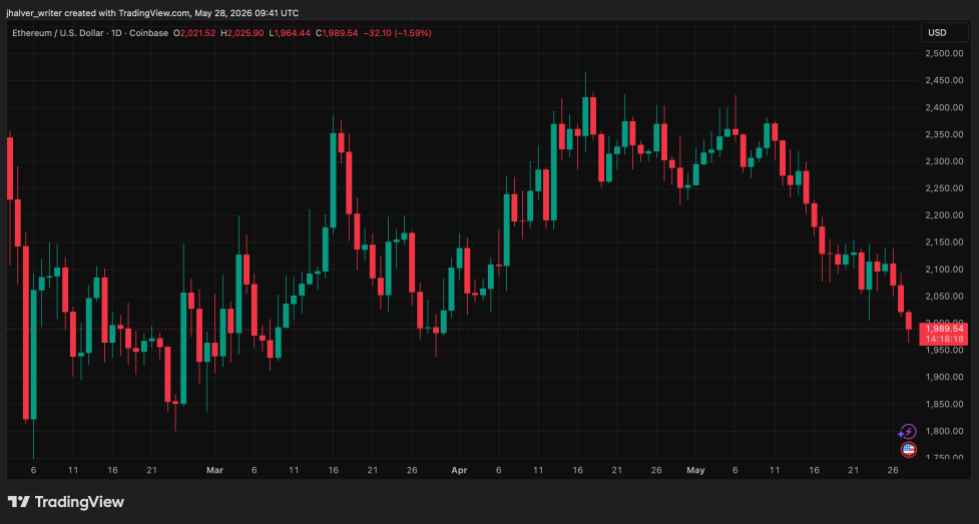
ETH's price trends to the downside on the daily chart. Source: ETHUSD on Tradingview

How The Scheme Worked

According to the unsealed complaint, Spagnuolo had access to an internal Google software tool — bearing a banner marked “Google Confidential” in red text — that provided real-time visibility into what users were searching across Google’s platform, including data that fed directly into Google’s annual “Year in Search” rankings, per the DOJ filing.

Beginning in May 2024, Spagnuolo created a Polymarket account and began placing bets on contracts tied to which individuals would rank on Google’s most-searched list for 2025 — markets Polymarket launched last fall, per the complaint.

Prosecutors allege Spagnuolo transferred approximately $3.8 million in USDC to his Polymarket address and placed bets including a $381.12 “yes” wager that the artist d4vd would rank in Google’s most-searched list and correctly predicted contracts such as “Will Zohran Mamdani rank in the Top 5 most searched” and “Will Squid Game be the number one searched TV show,” per CNBC’s reporting of the complaint. His success rate across these markets was, according to the complaint, no accident. He knew the answers before the markets settled.

The CFTC filed a simultaneous civil case against Spagnuolo seeking monetary disgorgement, restitution, and additional penalties, per the complaint. Google confirmed it had placed Spagnuolo on leave and was cooperating with law enforcement — noting that the tool he used was technically available to all employees, but that using confidential information to place bets represented a serious breach of company policy, per a statement reported by ABC News.

The Second Case In Thirty Days

The Spagnuolo arrest is the second federal criminal case tied to Polymarket insider trading in just over a month. In April 2026, US Army Special Forces Master Sergeant Gannon Ken Van Dyke was arrested for allegedly using classified military knowledge of the planned capture of Venezuelan President Nicolás Maduro to place bets on Polymarket, reportedly netting more than $400,000. Van Dyke has pleaded not guilty, per CNN’s reporting.

Polymarket’s chief legal officer Olivia Chalos said in a statement that the company worked closely with the US Attorney’s Office and the CFTC on the Spagnuolo case — noting that Polymarket is the only prediction platform to date whose cooperation has led to insider trading charges in the United States, and that the blockchain-based nature of the platform means bad actors leave footprints.

This development marks a critical and accelerating moment for the nascent prediction market sector. Two federal insider trading arrests in thirty days — one involving military classified information, the other corporate search data — arriving simultaneously with an active congressional investigation into Polymarket and Kalshi, confirms that the legal perimeter around prediction markets is closing fast. The transparency of blockchain trading, once seen primarily as a feature for users, is now functioning as a forensic trail for federal prosecutors.

Cover image from Grok, ETHUSD chart from Tradingview

Domande pertinenti

QWhat was the Google engineer accused of doing, and how much did he allegedly win?

AThe Google engineer, Michele Spagnuolo, was accused of using confidential internal search data to place bets on Polymarket's prediction markets, specifically those tied to Google's 'Year in Search' rankings. He allegedly won approximately $1.2 million by knowing the outcomes before the trading public.

QWhat specific internal tool did the Google engineer allegedly misuse, and what kind of data did it provide?

AHe allegedly misused an internal Google software tool that displayed a 'Google Confidential' banner. This tool provided real-time visibility into what users were searching across Google's platform, including data that fed directly into Google's annual 'Year in Search' rankings.

QWhat were the federal criminal charges brought against Michele Spagnuolo?

AMichele Spagnuolo was charged with commodities fraud, wire fraud, and money laundering.

QAccording to the article, what was the other recent insider trading case involving Polymarket?

AIn April 2026, US Army Special Forces Master Sergeant Gannon Ken Van Dyke was arrested. He was accused of using classified military knowledge about the planned capture of Venezuelan President Nicolás Maduro to place bets on Polymarket, allegedly netting more than $400,000.

QHow did Polymarket's chief legal officer characterize the platform's role in the Spagnuolo case?

APolymarket's chief legal officer, Olivia Chalos, stated that the company worked closely with authorities, that Polymarket is the only prediction platform whose cooperation has led to U.S. insider trading charges, and that the blockchain-based nature of the platform means bad actors leave forensic footprints.

Letture associate

The Truth About Global Payments, Exposed by Airwallex

Airwallex's founder, Jack Zhang, outlines the three primary paths in the global payments industry and explains why the company chooses the most demanding one: building its own global financial infrastructure. The article begins by highlighting a common industry problem: payment platforms appear homogenized on the surface, offering similar features like global acquiring and multi-currency accounts. However, their underlying capabilities differ vastly. Customers truly care about payment stability, compliance robustness, and reliable market entry support. Zhang identifies three strategic paths: 1. **Bypassing Traditional Systems (Web3/Crypto):** This path promises efficiency via stablecoins and blockchain settlement but struggles with mainstream adoption, significant regulatory friction, and a lack of competitive edge against established players, often leaving it with niche or non-compliant markets. 2. **Packaging Existing Infrastructure:** The most common route, where companies layer a modern interface over legacy banking and partner networks. While enabling fast expansion, it fails to solve core issues like dependency on correspondent banks and intermediary risk, merely postponing the need for solid foundations. 3. **Building Own Global Infrastructure:** The path chosen by Airwallex, Ant International, and others. It involves obtaining local licenses, establishing direct regulatory relationships, building local teams, and controlling the full technology stack. This "heavy" approach is slow and capital-intensive but aims to internalize complexity, providing customers with a "lighter" experience. The core argument is that for business clients, the highest cost isn't transaction fees but hidden risks like frozen accounts, payment delays, and regulatory shocks. By investing heavily in its own infrastructure, Airwallex seeks to absorb these complexities, offering customers greater stability, cost savings (beyond fees), and long-term certainty. This foundational investment, though initially slow, enables compound growth, as evidenced by Airwallex's accelerated revenue scaling. In conclusion, while shortcuts enable faster growth, mastering the most difficult aspects—owning the underlying infrastructure—creates durable value for customers and sustainable advantage for the payment provider.

marsbit1 h fa

The Truth About Global Payments, Exposed by Airwallex

marsbit1 h fa

The Truth About Global Payments, Revealed by Airwallex

The article discusses Airwallex's approach to global payments, highlighting the key challenges and different strategic paths in the industry. It begins by addressing common user questions about platform reliability, cryptocurrency payments, and the necessity of Airwallex's "heavy" infrastructure model. The core argument is that while many payment platforms appear similar on the surface—offering features like global acquiring and multi-currency accounts—their underlying capabilities differ drastically. The piece identifies three primary paths for global payment providers: 1. **Bypassing Traditional Infrastructure (Web3/Crypto):** This path promises efficiency through stablecoins and on-chain settlements but faces significant regulatory hurdles and offers little advantage over established players for mainstream use, often serving only niche or non-compliant markets. 2. **Aggregating/Packaging Existing Infrastructure:** The most common route, where companies layer a better user experience over legacy banking and partner networks. While fast to market, this approach does not solve fundamental issues like dependency on intermediaries, correspondent banking risks, and compliance fragility. 3. **Building Proprietary Global Infrastructure:** The path chosen by Airwallex and similar firms. This involves obtaining local licenses, building direct regulatory relationships, establishing local teams, and controlling the compliance and technology stack. This is the most difficult and capital-intensive route but aims to internalize complexity. Airwallex's strategy of "heavy" investment in its own infrastructure is framed not as inefficiency, but as a long-term bet to provide clients with greater stability, cost savings beyond fees, and certainty. The platform's "heaviness" absorbs risk and operational complexity, aiming to deliver a "lighter" experience for business customers. The article concludes that in global payments, while shortcuts enable faster growth, mastering the most difficult aspects—the underlying infrastructure—is what creates durable value for clients and sustainable competitive advantage.

链捕手1 h fa

The Truth About Global Payments, Revealed by Airwallex

链捕手1 h fa

Trading

Spot
Futures
活动图片