Why Does the Automated Market Maker (AMM) Mechanism Fail in the Prediction Market Field?

marsbitDipublikasikan tanggal 2026-04-14Terakhir diperbarui pada 2026-04-14

Abstrak

The article explores why Automated Market Makers (AMMs), particularly the x*y=k model popularized by Uniswap, fail in prediction markets despite their success in decentralized finance (DeFi). AMMs excel in DeFi by enabling permissionless liquidity provision and continuous trading for tokens that fluctuate indefinitely. However, prediction markets involve binary outcomes where assets settle to either $1 or $0 at expiration. This structural difference causes inherent flaws: liquidity providers (LPs) inevitably suffer losses as pools automatically rebalance toward the losing side upon settlement—making "impermanent loss" permanent. Additionally, AMMs distort price discovery for probability-based markets due to slippage and low liquidity. Early prediction platforms like Polymarket and Augur experimented with AMMs but abandoned them for Central Limit Order Books (CLOBs), which better handle precise probabilistic pricing and binary settlements. The article concludes that while AMMs revolutionized token swaps, their mechanics are mismatched for prediction markets, requiring alternative infrastructure that accommodates binary outcomes and mandatory settlement.

Author: Melee

Compiled by: AididiaoJP, Foresight News

In July 2017, Hayden Adams was laid off by his employer Siemens, where he worked as a mechanical engineer. His college roommate Karl Floersch was working at the Ethereum Foundation at the time and often told him about smart contracts. Adams had previously paid no attention. Now unemployed and looking for something to do, he decided to listen.

The Birth of the Automated Market Maker (AMM)

Floersch recommended a blog post by Vitalik Buterin about running an on-chain exchange using a mathematical formula instead of an order book. The principle was not to match buyers and sellers, but to allow traders to exchange with a pool of assets, with the price automatically set based on the ratio of tokens in the pool. No working version existed at the time. Adams took it on as a learning project, received a $65,000 grant from the Ethereum Foundation, and launched Uniswap in November 2018.
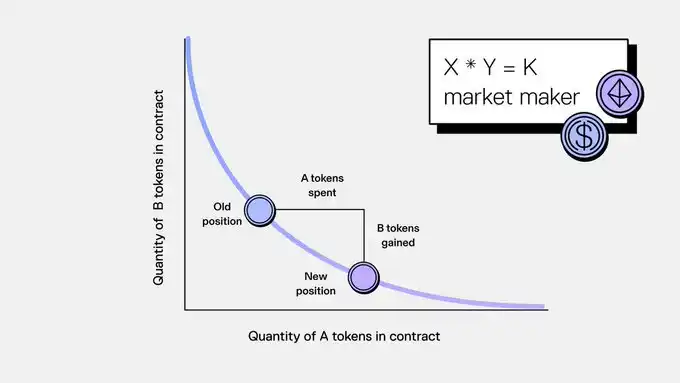
Its formula was deceptively simple: x * y = k.

Two tokens are placed in a pool, and the product of their quantities remains constant. When someone buys one token, they must deposit the other token, changing the ratio within the pool and adjusting the price accordingly. No order book, no matching engine, no professional market makers needed. Anyone can deposit tokens into the pool and earn fees from every transaction.

The automated market maker thus became the cornerstone of decentralized finance. Uniswap, Curve, Balancer, and dozens of other protocols handle billions of dollars in trading volume. On-chain order books are slow and expensive, and traditional market makers have no interest in tokens with only two hundred holders. Automated market makers allow anyone to create a liquid market for any asset at any time. Before AMMs, listing a new asset required permission and infrastructure. After AMMs, all you need is a liquidity pool.

The benefits were obvious. So, prediction markets naturally tried to adopt them too.

Automated Market Makers and Prediction Markets

Prediction markets face the same cold-start problem as token markets. You need liquidity before people are willing to trade, and you need traders before people are willing to provide liquidity. Little known is that Robin Hanson had proposed an automated market making solution for prediction markets years earlier in his 2002 Logarithmic Market Scoring Rule.

He thought he had theoretically solved the cold-start problem. However, in practice, the solution suffered from the same fundamental issue that every subsequent attempt to automate liquidity for prediction markets encountered: the formula couldn't distinguish between perpetually fluctuating tokens and equity certificates that expire.

Prediction market outcomes are binary. They ultimately settle to one or zero. In a token swap pool, both assets can fluctuate indefinitely, and the AMM formula works precisely because neither token is designed to go to zero.

Early Polymarket used an AMM based on the logarithmic market scoring rule. Augur also experimented with similar schemes. If automated liquidity pools worked for token swaps, they should, in theory, work for election betting too.

They didn't.

Why AMMs Fail in Prediction Markets

When a prediction market event settles, one side is worth one dollar, the other zero. For anyone providing liquidity to the pool, the mathematical outcome is nearly brutal. As the market moves towards settlement, the pool automatically rebalances towards the losing side.

Impermanent Loss

What decentralized finance traders call "impermanent loss" becomes completely "permanent" here. Every market settles, and every pool will eventually hold a pile of worthless shares.

In regular DeFi pools, trading fees can offset impermanent loss over time.
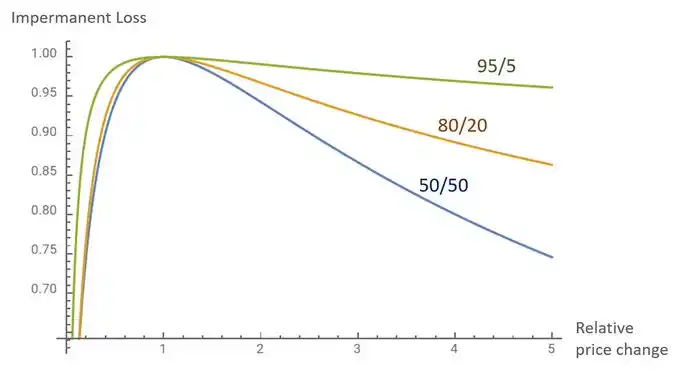
But in prediction markets, the loss is a structural certainty. The only question is how much the liquidity provider loses. Protocols have tried to persuade users to deposit assets into these pools through liquidity mining, reward programs, and various incentive structures. All of these are just different ways to subsidize users to lose money at a slower rate.

Price Discovery

Then there is the issue of price discovery. AMMs price assets based on the pool ratio and a fixed formula. For tokens, the "correct price" is a moving target, and a formula-driven approximation is sufficient. Prediction market prices are supposed to represent probabilities. The slippage introduced by the constant product curve distorts the signal, especially in low-liquidity markets, where a single trade can swing the implied probability by several basis points.

Is the Central Limit Order Book (CLOB) Better Than AMMs?

Polymarket realized this early on. In late 2022, the platform migrated from a logarithmic market scoring rule-based AMM to a central limit order book. AMMs were designed for continuous token swaps across a price range. Prediction markets require precise probability pricing on binary outcomes with known terminal values. They are entirely different problems.

The characteristics that made AMMs revolutionary for tokens—permissionless market creation, instant liquidity bootstrapping, no reliance on professional market makers—are exactly what prediction markets desperately need. The problem is that the specific mechanism, the constant function formula built for token swaps, breaks down when faced with the reality of binary outcomes and inevitable settlement.

The challenge for prediction markets is to replicate these effects with infrastructure that reflects how these markets actually settle.


Pertanyaan Terkait

QWhat is the core mathematical formula behind the Automated Market Maker (AMM) mechanism introduced by Uniswap?

AThe core mathematical formula is x * y = k, where x and y represent the quantities of two tokens in the pool, and k is a constant product.

QWhy do AMMs fail in the prediction market space according to the article?

AAMMs fail in prediction markets because these markets involve binary outcomes that eventually settle to $1 or $0, causing structural and certain losses for liquidity providers, unlike in token swaps where both assets can fluctuate indefinitely and fees can offset impermanent loss.

QWhat did early prediction market platforms like Polymarket and Augur experiment with?

AEarly platforms like Polymarket used an AMM based on Robin Hanson's Logarithmic Market Scoring Rule, and Augur also experimented with similar automated liquidity solutions.

QWhat is the key difference between token trading and prediction markets that makes AMMs unsuitable for the latter?

AToken trading involves assets designed to never go to zero and allows for continuous price fluctuations, while prediction markets have binary outcomes that definitively settle to $1 or $0, making AMM-induced losses certain rather than 'impermanent'.

QWhat solution did Polymarket eventually adopt to address the limitations of AMMs?

APolymarket migrated from an AMM based on the Logarithmic Market Scoring Rule to a Central Limit Order Book (CLOB) to better handle precise probability pricing and binary settlement in prediction markets.

Bacaan Terkait

Hoskinson Klaim Cardano Dapat Melampaui Bitcoin Dengan Memecahkan Masalah Kepercayaan Crypto

Charles Hoskinson mengklaim bahwa tujuan jangka panjang Cardano bukan hanya sekadar bersaing di pasar kripto, tetapi untuk menjadi lapisan infrastruktur kepercayaan global. Dalam siaran langsung 8 Juni, pendiri Cardano itu berargumen bahwa nilai ADA bergantung pada kemampuan jaringan dalam mengurangi ketergantungan dunia pada pihak ketiga tepercaya, yang dapat membawanya melampaui Bitcoin. Hoskinson menyatakan bahwa krisis saat ini lebih dari sekadar pasar bear; ini adalah krisis eksistensial di mana kripto dipertanyakan relevansinya. Ia menekankan bahwa fungsi inti industri ini adalah mengurangi biaya kepercayaan dalam perdagangan global, yang mencapai ratusan miliar dolar per tahun melalui audit, asuransi, dan fungsi perantara lainnya. Solusi yang diajukan adalah "verifiable reflexivity," di mana sesuatu membawa bukti kebenarannya sendiri, seperti surat suara yang membuktikan keabsahannya. Blokchain berperan sebagai lapisan penyimpanan untuk transaksi semacam ini, sementara kontrak pintar dan bukti tanpa pengetahuan (zero-knowledge proofs) menjadi mesinnya. Kripto, dalam kerangka ini, adalah sumber daya ekonomi untuk membayar infrastruktur terdesentralisasi. Hoskinson menguraikan empat persyaratan untuk Cardano: mesin desentralisasi melalui Ouroboros, model akuntansi UTXO yang diperluas, ekspansi modular seperti Hydra dan partner chains (contoh: Midnight), serta tata kelola terdesentralisasi yang mampu mengkhususkan diri. Tantangan tata kelola, termasuk fungsi eksekutif dan spesialisasi, masih perlu diperkuat. Ia menekankan bahwa Cardano harus mampu "menyembuhkan diri sendiri" dan bertahan bahkan tanpa kepercayaan pada pendirinya. Jika berhasil membangun sistem kepercayaan yang dapat diverifikasi, ADA berpotensi menjadi "mata uang kepercayaan global" dan melampaui Bitcoin. Pada saat berita, ADA diperdagangkan pada $0,16.

bitcoinist44m yang lalu

Hoskinson Klaim Cardano Dapat Melampaui Bitcoin Dengan Memecahkan Masalah Kepercayaan Crypto

bitcoinist44m yang lalu

Artikel Baru Arthur Hayes: Gelembung AI Menuju Ledakan, Pasar Kripto Tertekan Jangka Pendek

Artikel Arthur Hayes membahas potensi gelembung pasar AI yang mendekati titik pecah dan tekanan jangka pendek pada pasar kripto. Hayes berargumen bahwa harga minyak, yang sedang naik akibat ketegangan geopolitik antara AS dan Iran di Selat Hormuz, merupakan variabel kunci. Inflasi akibat kenaikan harga energi dapat mendorong calon presiden AS, Donald Trump, untuk mengambil sikap keras terhadap industri AI demi menarik suara pemilih, seperti menjanjikan regulasi dan pajak yang lebih ketat untuk pusat data dan perusahaan AI. Hal ini, ditambah dengan kenaikan biaya energi yang menggerogoti keuntungan perusahaan AI, serta tekanan dari penawaran saham IPO raksasa seperti SpaceX, Anthropic, dan OpenAI, dapat memicu koreksi besar-besaran di pasar saham AI. Hayes menunjukkan bahwa aliran dana likuiditas global dalam beberapa tahun terakhir telah terserap hampir seluruhnya ke sektor AI, bukan ke aset kripto seperti Bitcoin. Oleh karena itu, jika gelembung AI pecah, pasar kripto juga akan terkena dampak negatif dalam jangka pendek. Sebagai strategi, Hayes menyatakan telah melikuidasi saham-saham AI, mengurangi eksposur ke altcoin kripto (hanya mempertahankan Bitcoin dan Ethereum), dan beralih ke saham perusahaan energi yang diuntungkan dari tren kenaikan harga minyak. Dia memperkirakan Bitcoin akan mencapai titik terendah setelah koreksi pasar dan kemudian pulih ketika bank sentral melonggarkan kebijakan moneternya sebagai respons terhadap gejolak finansial.

marsbit1j yang lalu

Artikel Baru Arthur Hayes: Gelembung AI Menuju Ledakan, Pasar Kripto Tertekan Jangka Pendek

marsbit1j yang lalu

Peta Jalan Masa Depan OpenAI: Membuat AI Menguntungkan Setiap Orang di Seluruh Dunia

Beberapa generasi sekali, teknologi baru muncul dan mengubah segalanya. AI saat ini menghadirkan fenomena serupa. Bukan tentang teknologinya sendiri, tetapi tentang apa yang dapat dilakukan orang dengannya: memahami tagihan medis, mempelajari keterampilan baru, merawat orang tua, hingga mendorong penemuan ilmiah. Seperti listrik di masa lalu yang awalnya untuk kenyamanan tetapi akhirnya memunculkan kemungkinan baru yang mendorong kemajuan, AI memiliki potensi serupa untuk meningkatkan kemampuan dan kesejahteraan manusia. Masa depan yang aman memerlukan distribusi kekuatan yang luas, bukan terpusat pada beberapa perusahaan atau pemerintah. AI harus melayani manusia, membantu mereka mencapai tujuan, dan manfaatnya harus dapat diakses oleh semua orang, di mana saja. OpenAI berkomitmen membangun AI yang melayani manusia. Otomasi penuh bukanlah tujuan; peran manusia dalam memberikan arahan, pertimbangan, dan nilai tetap sangat penting. Kemajuan pesat dalam penelitian AI, termasuk penggunaan AI untuk mempercepat penelitian itu sendiri (target signifikan pada 2028), justru membuat penilaian manusia dan kolaborasi publik semakin krusial. Koordinasi global juga akan semakin dibutuhkan. Tiga tujuan inti OpenAI adalah: 1. Membangun peneliti AI otomatis untuk mempercepat kemajuan dengan tetap terkendali dan bertanggung jawab. 2. Mempercepat perkembangan ekonomi melalui kemajuan ilmiah dan produktivitas, dengan memastikan manfaat dibagikan secara luas. 3. Menyediakan AGI pribadi untuk setiap orang di bumi, memberi mereka akses untuk mendapatkan manfaat dari teknologi transformatif ini sesuai pilihan mereka. OpenAI kini memasuki fase ketiga: mengubah kemampuan canggih menjadi alat yang melimpah, terjangkau, aman, dan mudah digunakan untuk semua orang dan organisasi. Distribusi kekuasaan yang luas adalah kunci masa depan yang lebih baik, tangguh, dan bebas. Jika dilakukan dengan benar, AI dapat menjadi landasan peningkatan produktivitas, kreativitas, dan peluang ekonomi bagi banyak orang, sehingga memenuhi misi memastikan AGI menguntungkan seluruh umat manusia.

marsbit1j yang lalu

Peta Jalan Masa Depan OpenAI: Membuat AI Menguntungkan Setiap Orang di Seluruh Dunia

marsbit1j yang lalu

Trading

Spot
Futures
活动图片




