When Asia-Pacific Stock Markets Plunge Below Circuit Breaker, Why Does Bitcoin Stand Out?

marsbitDipublikasikan tanggal 2026-03-05Terakhir diperbarui pada 2026-03-05

Abstrak

Amid escalating Middle East tensions that triggered a historic sell-off in Asia-Pacific equities on March 4, Bitcoin demonstrated unexpected resilience. While South Korea’s KOSPI plummeted 12%, its worst drop in history, and Japan’s Nikkei 225 fell 3.7%, Bitcoin rebounded after a brief dip, surging past $74,000 to a two-week high. The divergence stems from structural and fundamental differences between traditional equities and crypto. Asia-Pacific markets, heavily reliant on energy imports, faced direct economic risks from soaring oil prices due to disruptions in the Strait of Hormuz. In contrast, Bitcoin’s fixed supply and decentralized nature positioned it as a hedge against inflation and currency devaluation. Crypto markets, operating 24/7, priced in geopolitical risks ahead of traditional markets, reflecting higher pricing efficiency. Additionally, equities entered the crisis with high valuations and leverage, whereas crypto had undergone prior corrections, reducing speculative excess. Institutional participation via Bitcoin ETFs also provided stability, dampening volatility. This episode underscores a shift in asset perception: crypto is increasingly seen as a global, non-sovereign store of value amid geopolitical turmoil, while regionally tethered assets face heightened vulnerability.

Author: Jae, PANews

On March 4, as the Middle East situation suddenly deteriorated, global financial markets instantly entered a "wartime state." For global investors, this was a trading day that would go down in history.

The obstruction of shipping in the global energy choke point, the Strait of Hormuz, triggered a sharp surge in international oil prices. Panic quickly swept through traditional capital markets, and Asia-Pacific stock markets faced an epic wave of selling.

South Korea's KOSPI plummeted 12% in a single day, marking its largest drop in history; Japan's Nikkei 225 fell sharply by 3.7%, its worst performance in five months; Middle Eastern stock markets plunged nearly 5% in a catch-up decline; major European and U.S. stock indices closed lower across the board.

However, an unusual phenomenon quietly emerged amid this selling wave.

The crypto market, typically seen as "high-risk, high-volatility," the asset class that would be the first to collapse in any geopolitical crisis, actually held steady this time.

After a brief panic sell-off, Bitcoin quickly rebounded, briefly breaking through $74,000 to hit a two-week high. On the same day, investors in Seoul watched as the KOSPI fell below the circuit breaker line.

This is no longer a simple dichotomy of "safe haven" versus "risk," but a deep reassessment of asset nature, pricing logic, and market structure.

Asia-Pacific Stock Markets Become the Epicenter, South Korea's KOSPI Plunges 12%

After the outbreak of war, global stock markets entered a "race to the bottom." Due to their high dependence on external energy, Asia-Pacific markets became the hardest hit.

South Korean stocks fell the most.

The Korea Composite Stock Price Index (KOSPI) closed down more than 12%, its largest single-day drop in history. The day before (March 3), it had already fallen 7%. Over two trading days, the cumulative decline was nearly 20%, with a total market capitalization evaporation of approximately $430 billion, marking the worst two-day decline since the 2008 global financial crisis.

South Korea's Kosdaq index fared even worse, plunging 14%, triggering multiple circuit breakers during the day.

Why South Korea?

South Korea is the world's eighth-largest crude oil consumer, with about 70% of its oil imports coming from the Middle East. Net oil imports account for 2.7% of its GDP. Its economy is manufacturing-oriented and highly sensitive to energy prices.

The blockade of the Strait of Hormuz and the resulting surge in oil prices mean soaring corporate costs, declining profit expectations, and intensified inflationary pressures. For this export-oriented economy, missiles in the Middle East war are not distant news but numbers directly impacting financial reports.

Even more critical is the market structure. Foreign investors hold over 30% of South Korean stocks, and retail margin trading accounts for nearly 80%. When panic strikes, foreign capital withdrawal, leveraged positions blowing up, and quantitative stop-losses occur simultaneously, leading to a stampede-like sell-off.

Japan followed closely.

The Nikkei 225 index closed down 3.7%, its largest single-day drop in nearly five months; the Topix index fell even more sharply, closing down 4%.

Japan is also a major energy importer. Trump's statement that "larger military action against Iran may be taken" was enough to make traders in Tokyo nervous.

The Middle East itself was at the eye of the storm.

After a two-day closure, UAE markets reopened, with the Dubai Financial Market General Index falling 4.7% in early trading, a rare drop in recent years. Saudi Arabia's benchmark index fell nearly 5% in the early stages of the conflict. The Kuwait Stock Exchange simply suspended trading to avoid a collapse-like sell-off.

For Gulf countries, war means uncertainty in oil revenues, stagnation in tourism and aviation, and accelerated capital flight.

The ripple effects of the Middle East conflict quickly spread to global financial markets, with European and U.S. stocks also weakening. Although the declines were somewhat moderated, major indices still closed lower.

Global Stocks Keep Falling, Crypto Market Rebounds "Ahead"

While global stock markets were in turmoil, the performance of the crypto market surprised many.

After the initial panic sell-off, Bitcoin quickly stabilized and rebounded, rising above $74,000 on March 5 to hit a two-week high.

This divergence is not accidental. It is the result of multiple factors, including pricing efficiency, valuation misalignment, inflation risks, anchoring mechanisms, and participant structure.

When the war broke out over the weekend, the crypto market was the only market that could trade.

No market closures, no circuit breakers, no delays. From the first explosion in Tehran, global investors could express their judgments in the crypto market.

This means that when Asia-Pacific stock markets opened on Monday morning, the crypto market had already completed several rounds of price discovery, digesting and pricing in most of the risks in advance. Bitcoin's "first decline, then rise" price movement is a reflection of this pricing efficiency.

At certain moments, the highly sensitive crypto market may be becoming the leading indicator for all assets.

Additionally, before this "black swan" event, stock and crypto markets were in different valuation cycles.

Global major stock markets had been rising steadily since the beginning of the year, with the Nikkei 225 repeatedly hitting new historical highs, the South Korean KOSPI near a five-year high, and the three major U.S. stock indices oscillating near all-time highs. Global major stock markets had accumulated significant profits, and valuation bubbles were building.

Once a "black swan" event occurred, profit-taking concentrated, combined with stop-loss selling, leading to a暴跌行情 (plunge).

In contrast, the crypto market had experienced multiple deep corrections since October 2025. The valuation and leverage levels of mainstream assets had fallen back to reasonable ranges, with profits fully realized and risks released in advance.

When panic strikes, the reactions of a market with泡沫高杠杆 (bubbles and high leverage) and a market that has been squeezed dry and is undervalued are naturally different.

The macro risk variable brought by the Middle East war is inflation.

Soaring energy prices will increase inflation stickiness, forcing global central banks to delay interest rate cut cycles or even maintain high rates. For stocks, this is a "valuation + earnings" double whammy. Interest rates suppress valuations, and costs squeeze profits.

For Bitcoin, the logic of inflation is恰恰相反 (exactly the opposite). Its fixed supply of 21 million coins makes it seen as "digital gold" in an environment of fiat money over-issuance and high inflation.

Against the backdrop of geopolitical conflicts加剧 (intensifying) fiat currency credit fluctuations, more and more investors are using it as a tool to hedge against inflation and fiat depreciation.

Simultaneously, local capital in the Middle East faces a triple困境 (dilemma) of fiat depreciation, stock market crashes, and intensified geopolitical risks. They need to find borderless, jurisdiction-agnostic safe-haven assets, and cryptocurrencies have become one of the main destinations. This influx of incremental capital also offset some of the safe-haven selling pressure.

Stock market pricing is anchored to the real economy and corporate profits, while crypto market pricing is anchored to global liquidity and decentralized attributes.

For export-oriented, energy-import-dependent economies like Japan and South Korea, the Middle East war directly impacts their economic fundamentals. Soaring crude oil prices push up production costs, and against the backdrop of weak global demand, companies find it difficult to fully pass on cost pressures, significantly compressing profit margins.

Conversely, the fiat depreciation and cross-border capital controls triggered by the Middle East situation反而突出 (instead highlight) the decentralized attributes of crypto assets, making them an optional target for global capital to hedge geopolitical risks.

This is the fundamental reason for the截然不同 (starkly different) reactions of stock and crypto markets to the same geopolitical risk.

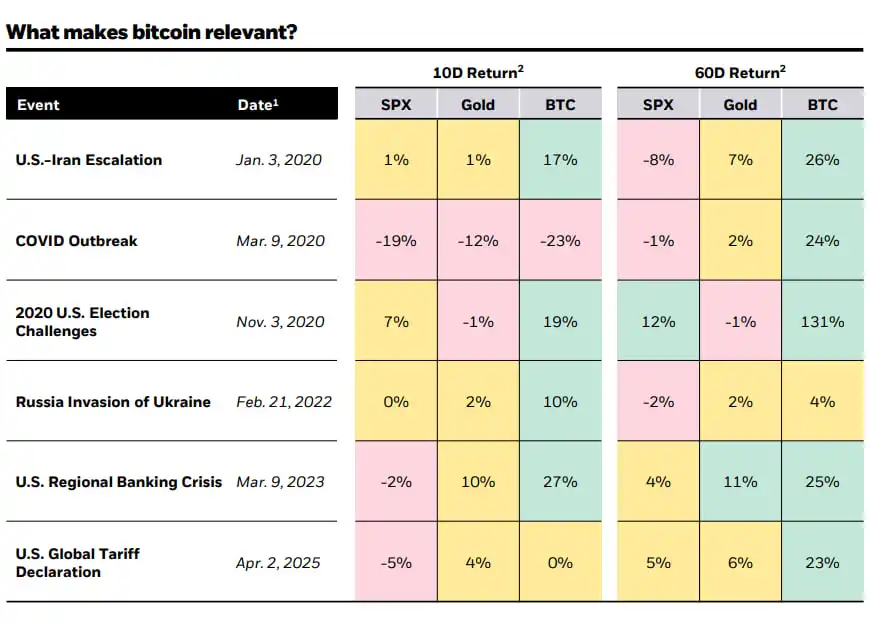
BlackRock's research has pointed out that Bitcoin's performance in the face of geopolitical shocks is better than that of gold and stocks. So far, this conclusion still holds.
Market participant structure determines volatility.

The sharp fall in the South Korean stock market exposed the fragility of its market structure: high foreign ownership, crowded leveraged trading, and program trading dominance.

When panic strikes, these three factors resonate, directly triggering stampede and circuit breakers.

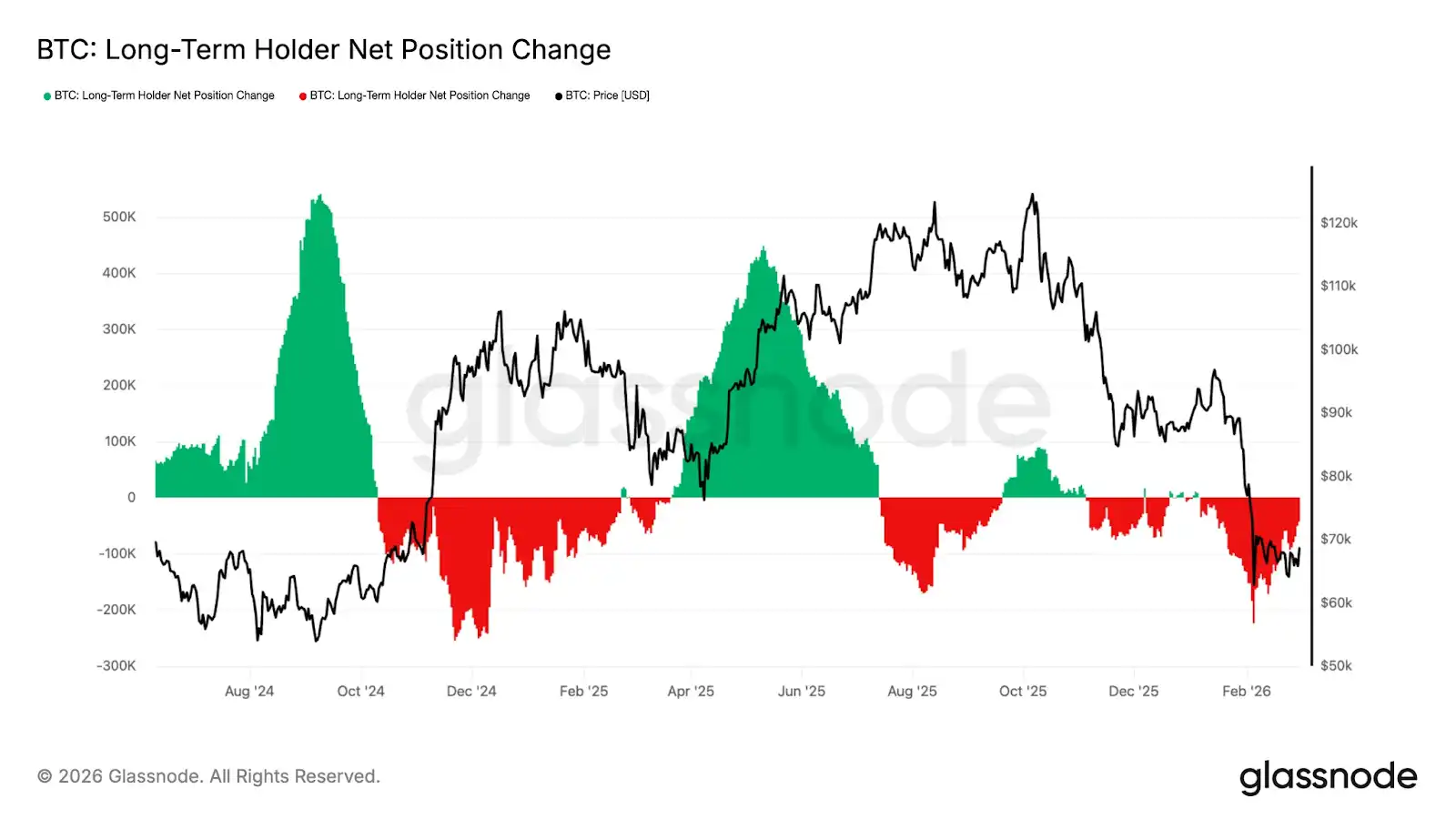
The participant structure of the crypto market has fundamentally changed. Glassnode data shows that the net position changes of Bitcoin long-term holders have趋于缓和 (tended to moderate), indicating that selling intensity is weakening.
U.S. spot Bitcoin ETFs have also brought stable institutional funds. Part of the pricing power has been transferred to institutions, which typically have more professional risk control capabilities and longer-term investment perspectives, forming a underlying liquidity support.

More importantly, the crypto market had completed multiple rounds of deleveraging before this "black swan" event爆发 (erupted). The derivatives market did not see large-scale cascading liquidations, further reducing volatility.

War is a human tragedy and a touchstone for market resilience.

Yesterday's global selling wave taught all investors a lesson.

What is "high-risk" may not truly be high risk. While the crypto market held its ground amid volatility, the traditionally "relatively stable" stock market was experiencing暴跌与熔断 (plunges and circuit breakers).

Whether this is a temporary misalignment or a change in deep logic and a rewriting of asset labels仍需时间验证 (still requires time to verify).

But in an era of normalized geopolitical risks, the pricing anchors of assets are shifting. Assets tied to a single economy will become increasingly fragile, while assets anchored to global liquidity will become increasingly resilient.

The divergence between stock and crypto markets during this U.S.-Iran war once again proves that crypto assets are gradually becoming an alternative medium that cannot be ignored in global geopolitical games.

For many countries, the Middle East war is an unavoidable economic shock. For the crypto market, the same war is a confirmation of its value logic.

When the storm comes, what matters is not where you stand, but what your anchor is tied to.

Kripto yang Sedang Tren

Pertanyaan Terkait

QWhy did the Asia-Pacific stock markets, particularly South Korea's KOSPI, experience a significant decline on March 4th?

AThe Asia-Pacific stock markets, especially South Korea's KOSPI, plummeted due to heightened geopolitical tensions in the Middle East, which caused a sharp surge in international oil prices. South Korea, being highly dependent on Middle Eastern oil imports and having an export-oriented economy, faced increased production costs and inflation pressures. Additionally, its market structure, with high foreign ownership and leveraged retail trading, led to a cascade of selling, including foreign capital flight, leveraged position liquidations, and quantitative stop-loss triggers.

QHow did Bitcoin perform amidst the global stock market sell-off, and what was its key price movement?

ABitcoin initially experienced a brief panic sell-off but quickly stabilized and rebounded, surging past $74,000 at one point and hitting a two-week high. This contrasted sharply with the sharp declines in traditional stock markets.

QWhat factors contributed to Bitcoin's resilience and ability to rebound during the market turmoil?

ASeveral factors contributed to Bitcoin's resilience: its market operates 24/7, allowing for immediate price discovery and risk digestion before traditional markets opened; it had undergone multiple deep corrections previously, reducing valuation bubbles and leverage; it is seen as a hedge against inflation and fiat devaluation due to its fixed supply; it benefits from its decentralized, borderless nature appealing to capital seeking refuge from geopolitical risks; and its participant structure has shifted with more institutional investors through ETFs providing stable liquidity and better risk control.

QHow does the pricing anchor differ between traditional stock markets and the cryptocurrency market according to the article?

ATraditional stock markets are anchored to实体经济 and corporate earnings, meaning their value is tied to the economic fundamentals and profitability of companies within specific economies. In contrast, the cryptocurrency market, particularly Bitcoin, is anchored to global liquidity and its decentralized attributes, making it less dependent on any single economy's performance and more responsive to broader monetary policies and geopolitical shifts that affect fiat currencies.

QWhat did the market reaction during this event suggest about the changing role of crypto assets in global finance?

AThe event suggested that crypto assets are increasingly being recognized as an alternative hedge and a resilient asset class during geopolitical crises. Their performance, which contrasted with traditional markets, indicates a potential shift in asset pricing logic, where decentralized, globally anchored assets may offer more stability in times of regional economic shocks, challenging the conventional risk perceptions of cryptocurrencies.

Bacaan Terkait

Bank Italia Tidak Melihat Keunggulan Sistemik Stablecoin dalam Transfer

Studi Bank Italia menunjukkan bahwa stablecoin tidak memberikan keunggulan sistemik yang berkelanjutan dalam hal biaya dan kecepatan transfer uang. Semua keuntungan hilang akibat biaya untuk deposit dan penarikan ke/dari fiat serta proses dalam infrastruktur pembayaran lokal. Peneliti membandingkan transfer 200 USDC di 10 koridor bilateral antara Italia dengan Brasil, Argentina, Jepang, UEA, dan Afrika Selatan. Metriknya adalah biaya total dan waktu penyelesaian dibandingkan layanan uang standar. Biaya akhir transfer stablecoin bervariasi dari 0,3% hingga hampir 9%, tergantung arahnya. Di koridor dengan sistem pembayaran instan, penyelesaian membutuhkan waktu kurang dari 20 menit. Sementara di daerah tanpa infrastruktur tersebut, proses memakan waktu satu hingga dua hari kerja. Biaya dan penundaan utama dikaitkan dengan pertukaran dan konversi mata uang, serta kualitas infrastruktur lokal. Komisi blockchain bukan faktor utama. Rata-rata biaya transfer uang global adalah 6,65%. Di sebagian besar koridor yang diteliti, stablecoin lebih murah dari level ini, namun dibandingkan dengan Wise, stablecoin hanya lebih unggul di tiga dari tujuh rute yang sebanding. Penulis berpendapat efeknya akan lebih terasa jika stablecoin bisa dibelanjakan langsung untuk barang/jasa tanpa konversi ke mata uang lokal. Mereka juga mencatat bahwa rezim regulasi yang melarang tidak menghilangkan permintaan akan "koin stabil", dan aturan yang terlalu ketat justru mempersulit penggunaan oleh klien ritel.

cryptonews.ru1j yang lalu

Bank Italia Tidak Melihat Keunggulan Sistemik Stablecoin dalam Transfer

cryptonews.ru1j yang lalu

Boom Bitcoin Memanas: Pernyataan Baru Saylor Picu Spekulasi Pembelian

Ketua Eksekutif MicroStrategy Inc., Michael Saylor, kembali memicu spekulasi pembelian Bitcoin baru perusahaan setelah memposting pesan "Bitcoin Drive engaged" pada 2 Agustus. Postingan hari Minggu ini disertai dengan pelacak pembelian biasa MicroStrategy, yang sejalan dengan praktik Saylor memberi sinyal perubahan treasury sebelum laporan mingguan. Laporan Saylor menunjukkan bahwa cadangan Bitcoin MicroStrategy adalah 843.775 BTC dengan nilai pasar sekitar $53,25 miliar. Dua penjualan Bitcoin baru-baru ini, total 3.588 BTC, telah mengurangi cadangan dari 847.363 BTC. Penjualan ini, menurut pengajuan SEC, ditujukan untuk mendanai pembayaran saham preferen dan menambah cadangan dolar AS. Perusahaan juga dilaporkan tidak melakukan pembelian Bitcoin dalam minggu yang berakhir 26 Juli, sambil meningkatkan cadangan dolar AS menjadi sekitar $3,75 miliar. Ekspektasi untuk pengumuman treasury pada hari Senin diperkuat oleh pola sebelumnya, di mana sinyal serupa pada hari Minggu mendahului pengungkapan cadangan uang yang lebih besar pada 27 Juli. Pembaruan data hari Senin ini akan menunjukkan apakah MicroStrategy kembali ke akumulasi Bitcoin, karena perusahaan menyeimbangkan cadangan Bitcoinnya yang besar dengan kewajiban tunai yang meningkat dan manajemen modal yang aktif. Risiko keuangan tetap tinggi setelah MicroStrategy melaporkan kerugian operasional $8,33 miliar untuk kuartal II 2026, termasuk kerugian belum terealisasi $8,32 miliar pada aset digitalnya.

cryptonews.ru1j yang lalu

Boom Bitcoin Memanas: Pernyataan Baru Saylor Picu Spekulasi Pembelian

cryptonews.ru1j yang lalu

Saham Perusahaan yang Bergerak di Bidang Kecerdasan Buatan Diperdagangkan Seperti 'Meme Coin', Sementara Bitcoin Hampir Tak Berubah Harganya — Tinjauan Mingguan

Tinjauan minggu ini menyoroti dominasi berita pasar saham tradisional dan makroekonomi atas berita kripto. Peringatan keamanan mendesak dikeluarkan untuk pengguna Coldcard terkait potensi kompromi kunci pribadi. Sementara itu, Bitcoin relatif stabil di sekitar $64.000, perhatian pasar justru terfokus pada volatilitas ekstrem di saham AI dan pasar Asia, terutama Korea Selatan yang mengalami penurunan signifikan. Likuidasi besar oleh dana "Situational Awareness" diduga berkontribusi pada penurunan ini. Di sektor kripto, tren bearish berlanjut dengan beberapa perusahaan seperti BitMart dan Storj Labs mengumumkan penutupan atau kebangkrutan. Perusahaan yang masih beroperasi, seperti Coinbase, mengalami tekanan dengan penurunan harga saham dan gelombang PHK di industri. Di sisi lain, MicroStrategy terus menambah cadangan kasnya dan membeli kembali sahamnya. Ekosistem DeFi menghadapi tantangan potensial dari kesuksesan proyek seperti Trade.xyz dan Pump.fun, yang dapat memutuskan untuk beroperasi secara mandiri. Isu perdagangan orang dalam juga mencuat di platform Hyperliquid. Sementara itu, token AI seperti Bittensor (TAO) menarik perhatian investor venture capital, meski disertai peringatan agar investor retail berhati-hati. Artikel ditutup dengan penekanan kembali pada pentingnya kewaspadaan keamanan, khususnya dalam penyimpanan aset kripto secara mandiri, di tengah potensi meningkatnya kerentanan perangkat keras dompet digital.

cryptonews.ru2j yang lalu

Saham Perusahaan yang Bergerak di Bidang Kecerdasan Buatan Diperdagangkan Seperti 'Meme Coin', Sementara Bitcoin Hampir Tak Berubah Harganya — Tinjauan Mingguan

cryptonews.ru2j yang lalu

Trading

Spot

Artikel Populer

Cara Membeli 4

Selamat datang di HTX.com! Kami telah membuat pembelian 4 (4) menjadi mudah dan nyaman. Ikuti panduan langkah demi langkah kami untuk memulai perjalanan kripto Anda.Langkah 1: Buat Akun HTX AndaGunakan alamat email atau nomor ponsel Anda untuk mendaftar akun gratis di HTX. Rasakan perjalanan pendaftaran yang mudah dan buka semua fitur.Dapatkan Akun SayaLangkah 2: Buka Beli Kripto, lalu Pilih Metode Pembayaran AndaKartu Kredit/Debit: Gunakan Visa atau Mastercard Anda untuk membeli 4 (4) secara instan.Saldo: Gunakan dana dari saldo akun HTX Anda untuk melakukan trading dengan lancar.Pihak Ketiga: Kami telah menambahkan metode pembayaran populer seperti Google Pay dan Apple Pay untuk meningkatkan kenyamanan.P2P: Lakukan trading langsung dengan pengguna lain di HTX.Over-the-Counter (OTC): Kami menawarkan layanan yang dibuat khusus dan kurs yang kompetitif bagi para trader.Langkah 3: Simpan 4 (4) AndaSetelah melakukan pembelian, simpan 4 (4) di akun HTX Anda. Selain itu, Anda dapat mengirimkannya ke tempat lain melalui transfer blockchain atau menggunakannya untuk memperdagangkan mata uang kripto lainnya.Langkah 4: Lakukan trading 4 (4)Lakukan trading 4 (4) dengan mudah di pasar spot HTX. Cukup akses akun Anda, pilih pasangan perdagangan, jalankan trading, lalu pantau secara real-time. Kami menawarkan pengalaman yang ramah pengguna baik untuk pemula maupun trader berpengalaman.

892 Total TayanganDipublikasikan pada 2025.10.20Diperbarui pada 2026.06.02

Cara Membeli 4

Diskusi

Selamat datang di Komunitas HTX. Di sini, Anda bisa terus mendapatkan informasi terbaru tentang perkembangan platform terkini dan mendapatkan akses ke wawasan pasar profesional. Pendapat pengguna mengenai harga 4 (4) disajikan di bawah ini.

活动图片