War, Weekends, and Locked Liquidity: How RWA is Reshaping Global Trading Hours, as Seen from the Iran Airstrike Incident

marsbitDipublikasikan tanggal 2026-03-03Terakhir diperbarui pada 2026-03-03

Abstrak

This article analyzes the 2026 Iran airstrike as a pivotal moment demonstrating how Real World Asset (RWA) tokenization is reshaping global finance by eliminating traditional market hours. The attack, deliberately timed on a weekend when traditional markets (stocks, forex) were closed, created a 48-hour "trading vacuum." This exposed a critical vulnerability: traditional T+1/T+2 settlement systems and reliance on banking hours leave investors as "liquidity prisoners" during off-hours crises, unable to hedge and forced to absorb massive gap risk upon Monday's open. In stark contrast, tokenized gold assets like XAUT and PAXG on blockchain networks experienced a surge in trading, providing continuous, 24/7 price discovery and a crucial hedging mechanism. This event marked a historic shift: for the first time, pricing power for a major commodity like gold temporarily transferred to the digital asset market during a geopolitical crisis. The chain's "settlement equals清算" T+0 logic and atomic swaps allowed instant, global capital movement without counterparty risk. The conclusion is that RWA's core value is the temporal expansion of liquidity. This event will drive traditional institutions, quant funds, and market makers to integrate blockchain-based RWA trading pools to capture alpha and manage risk in a truly 24/365 global market, ultimately rendering obsolete the traditional financial infrastructure bound by working hours.

Author: Max.s

On February 28, 2026 (Saturday), air raid sirens in the Middle East pierced the quiet of global geopolitics. The United States and Israel launched a meticulously planned large-scale airstrike on targets within Iran.

The timing of this military operation was like an extremely precise surgical strike, evident not only in the physical coordinates of the tactical attack but also in the grasp of the global financial market's "time coordinates." Choosing to launch the surprise attack on a weekend, during the traditional Western financial market closure, was deeply significant: it maximally prevented the immediate spread of panic in stock and foreign exchange markets, and also gave various governments and central banks a full 48-hour buffer period to intervene and guide market expectations.

However, global capital did not sit idly by during this deliberately created "trading vacuum." While the CME (Chicago Mercantile Exchange) gold and crude oil futures screens froze at Friday's closing prices, and the buy/sell buttons for various ETFs were forcibly grayed out by the system, real undercurrents were surging fiercely in another, never-sleeping network. Cryptocurrency gold tokens, represented by XAUT (Tether Gold) and PAXG (PAX Gold), experienced a trading peak on blockchain networks like Ethereum.
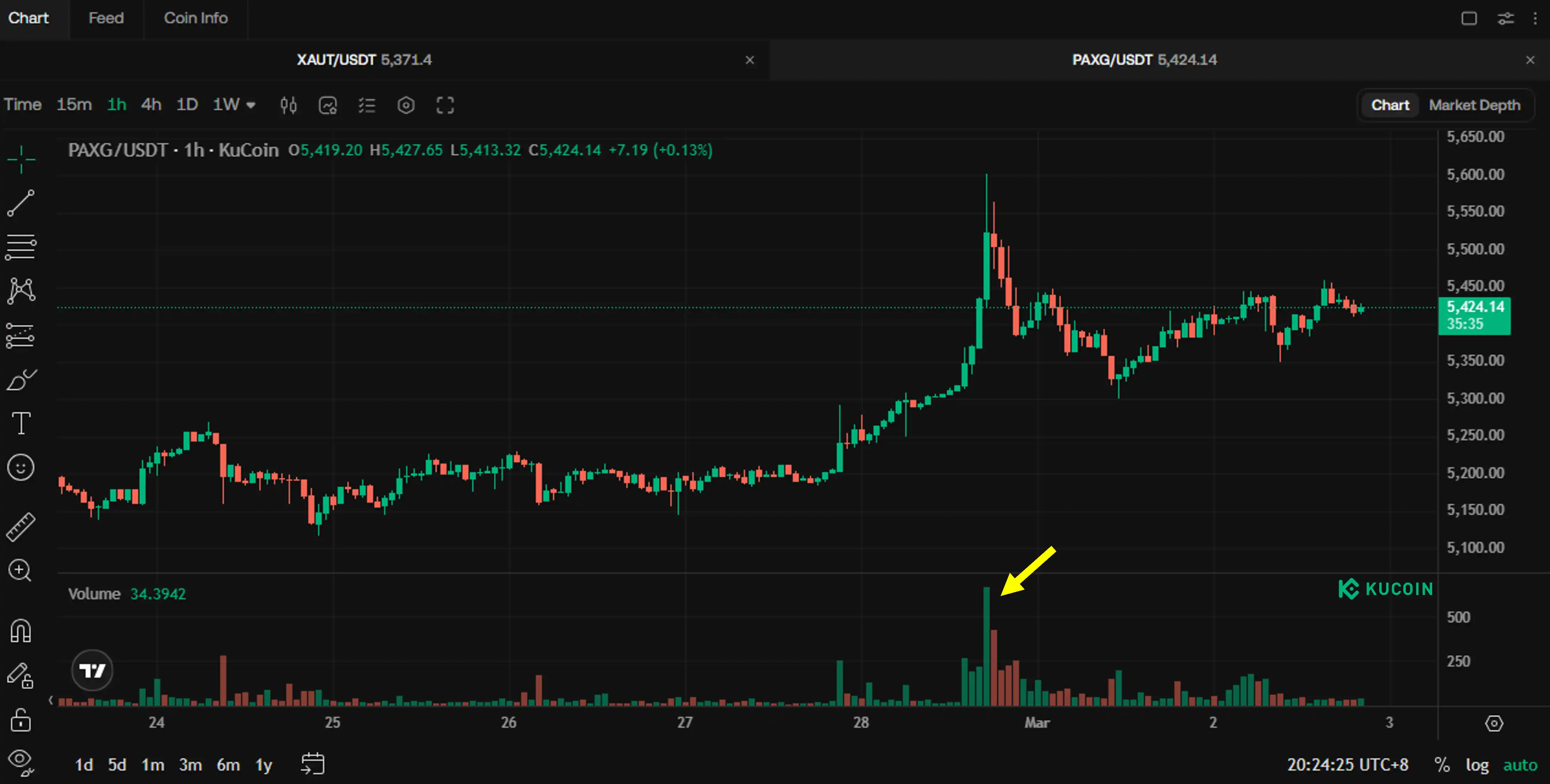
This was not just a game of geopolitical chess, but also a stress test on "liquidity privilege." The airstrike incident, in an extremely stark manner, declared to all traditional finance professionals: the traditional financial infrastructure, based on T+1 or T+2 settlement and constrained by workdays and fixed trading hours, is being left behind by the times. The tokenization of real-world assets (RWA), and the completion of round-the-clock trading and settlement through digital assets, is no longer a social experiment by geeks, but an inevitable trend in the global capital's fight for pricing power and trading Alpha.

From the perspective of quantitative trading and hedge funds, the core of risk management lies in the accessibility of hedging instruments. Following the airstrike on February 28th, the risk exposure of macro hedge funds spiked instantly. Conventionally, crude oil and gold are the preferred safe-haven hedging instruments. But on that Saturday morning, tens of thousands of financial institutions and professional traders became "liquidity prisoners."

Traditional financial market infrastructure is built upon the industrial era's timetable. Although electronic trading has been widespread for decades, the underlying clearing and settlement systems (such as DTCC, Euroclear systems, and the SWIFT network) still heavily rely on the batch processing of centralized institutions and banking hours. When a black swan event occurs outside trading hours, the reaction mechanism of traditional markets is completely frozen. Investors can only watch as information spreads at the speed of light, while the flow of funds is like an insect trapped in amber, immobile.

This type of strike, "deliberately avoiding trading days," essentially compresses all market volatility and gap risk into the few short minutes of Monday's market open. For quantitative market makers and high-frequency trading institutions, this kind of discontinuous hedging gap risk is fatal. During the highly information-asymmetric and liquidity-starved Monday opening phase, it is extremely easy to trigger chain reactions of long squeezes or short blow-ups.

In contrast, the cryptocurrency market demonstrated a dimensionality-reducing resilience. Within minutes of the attack news breaking on February 28th, capital rapidly flowed into crypto liquidity pools. XAUT and PAXG trading pairs on major centralized crypto exchanges absorbed避险需求 (hedging demand) on a massive scale. As shown in the chart, the funding rate (longs pay shorts) reached 0.5% on February 28th.
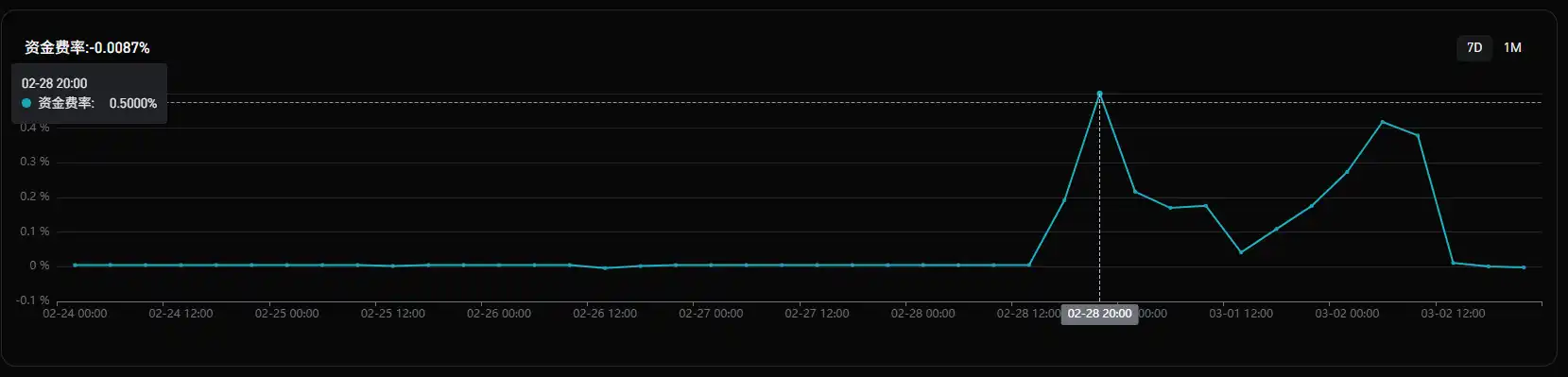
We can clearly see this smooth yet steep value appreciation curve from the on-chain data: no market halt, no trading curbs, no opening gap uncertainty. The price of on-chain gold tokens followed every update from the front lines, continuously pricing in milliseconds. Before the CME opened on Monday, the price of on-chain XAUT had already completed sufficient price discovery.

This led to a highly disruptive financial phenomenon: for the first time in history during a major geopolitical crisis, the pricing power of traditional commodities temporarily shifted to the digital asset market.

When the Asian early trading session opened on March 2nd (Monday), the traditional gold spot and futures markets surged at the open. Over that weekend, XAUT was no longer a shadow asset of GLD (SPDR Gold ETF) or COMEX futures. Instead, on-chain tokens, in a sense, became the "price oracle" for Wall Street's Monday open. Astute arbitrageurs used this 48-hour time difference to build substantial positions on-chain and, at the moment the traditional market opened on Monday, arbitraged away the basis spread, equalizing prices across the two worlds.
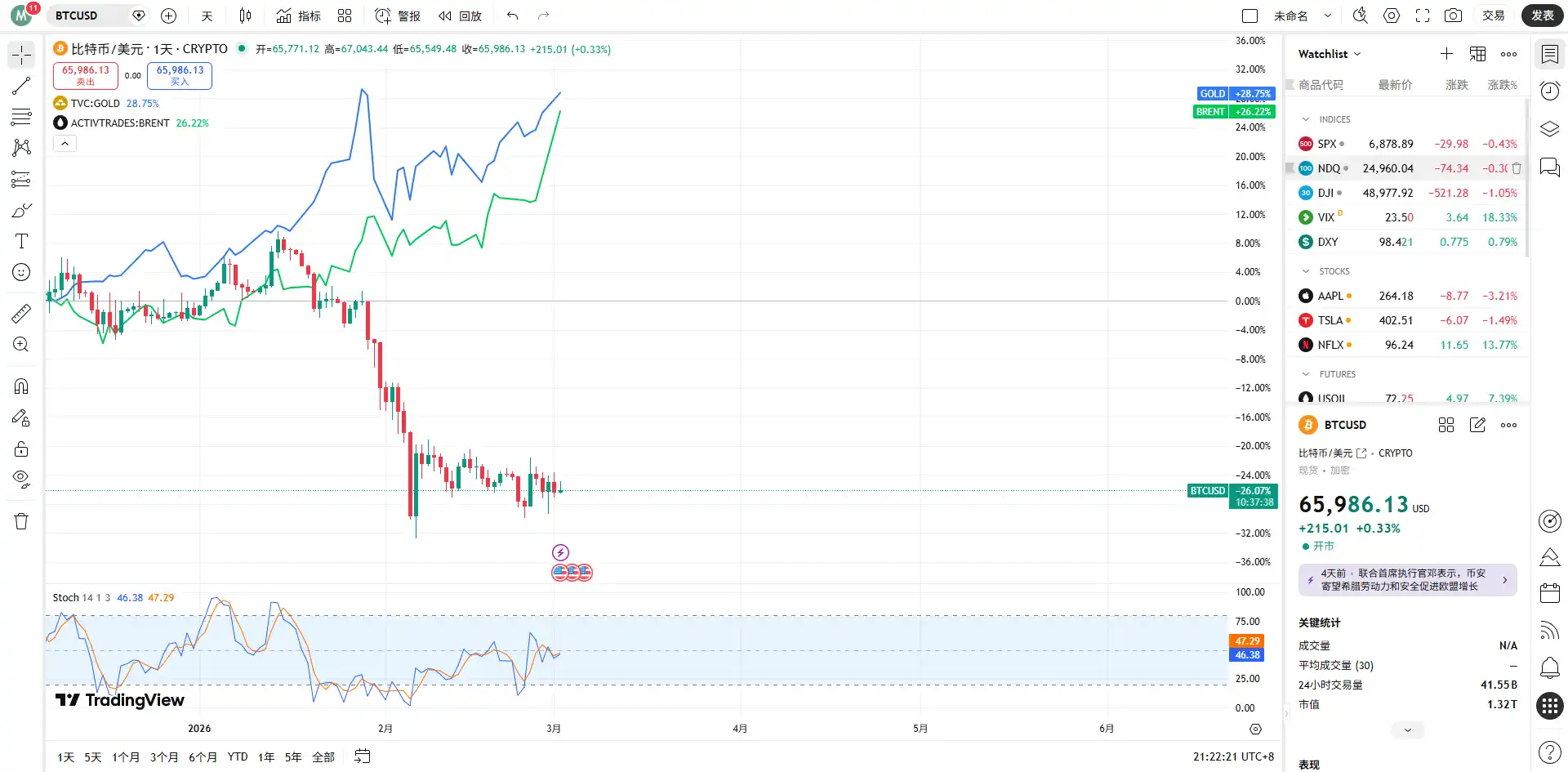
The weekend's gold token trading frenzy revealed the most core value proposition of RWA assets: the expansion of the time dimension of liquidity.

In previous narratives, the advantages of RWA were often focused on lowering barriers, fractionalizing ownership, or increasing transparency. But for professional financial practitioners, the greatest appeal of RWA lies in the T+0 underlying logic of "settlement equals clearing," and the 7x24x365 round-the-clock operational mechanism.

Imagine if, instead of a Middle East airstrike, a sovereign debt default, a major bank collapse, or an unexpected emergency central bank rate cut had occurred over the weekend. Traditional institutions would be forced to passively bear enormous exposure risk until Monday's open. But if government bonds, foreign exchange, and even core stock indices were deeply tokenized and had established sufficient liquidity pools on the blockchain, institutional investors could immediately execute risk hedging and asset swaps via smart contracts the moment the risk materializes.

In this event, not only gold but also the exchange network between stablecoins and crypto-native assets acted as a superhighway for safe-haven capital flows. In the traditional financial system, cross-border, cross-institution fund transfers require complex correspondent bank confirmations and multiple compliance checks, taking days to complete. On-chain, hedging positions worth hundreds of millions of dollars can be atomically swapped within one block time (12 seconds on Ethereum), with no counterparty default risk.

For Wall Street, the weekend at the end of February 2026 was a profound lesson in investment research. Previously, many traditional institutions took a wait-and-see attitude towards BlackRock's launch of BUIDL (a tokenized treasury fund) and the rise of RWA protocols like Ondo Finance, considering it a gimmick to attract existing crypto capital. But the airstrike incident proved that in the face of extreme black swan events, the liquidity premium provided by tokenized assets is a hardcore Alpha that no excellent quantitative model can replace.

Quantitative funds will no longer be satisfied with the trading interfaces provided by CME or Nasdaq; they will massively connect APIs to on-chain DEXs and RWA trading pools with institutional-grade compliance systems. To capture "non-synchronous trading opportunities" during weekends and holidays, building cross-border arbitrage models spanning TradFi and DeFi will become standard configuration for top hedge funds.

When brokers and market-making institutions realize that significant trading demand and commission profits are bleeding into blockchain networks on weekends, profit motives will force them to actively become liquidity providers for on-chain assets. In the future, large market makers like Jane Street and Jump Trading will not only make markets for ETFs on weekdays but will also inject liquidity into round-the-clock RWA asset pools on weekends.

Starting with highly standardized commodities like gold and crude oil, this will gradually spread to short-term treasury bonds, high-quality corporate bonds, and even US stock indices. The载体 (carrier) of financial assets will migrate completely from the ledgers of trust companies and clearinghouses to distributed ledgers. No more T+2 fund settlement periods, no more Friday afternoon sell-offs due to weekend anxiety; global capital will truly achieve seamless circulation across physical time and space.

"Money never sleeps" was once one of Wall Street's most famous slogans, but the reality is that traditional Wall Street not only sleeps but also takes weekends and public holidays. The artillery fire on February 28, 2026, proved in a cruel way that in the face of an increasingly complex and unpredictable global macro environment, fragmented trading times and locked liquidity are themselves the greatest systemic risks.

The price discovery process led by digital assets like XAUT over that weekend sounded the death knell for the traditional clearing system. RWA is not just about moving real-world assets onto the blockchain; it is about using code to reconstruct the temporal laws of financial operation. For quantitative analysts, traders, and financial engineers, the future battlefield will no longer be confined to the screens for 5 days a week, 8 hours a day. Whoever masters the trading and settlement infrastructure for round-the-clock digital assets first will hold the throat of the global market on the next unexpected black swan night.


Pertanyaan Terkait

QWhat was the strategic significance of the timing of the U.S. and Israeli airstrike on Iran, as described in the article?

AThe airstrike was strategically timed to occur on a weekend when traditional Western financial markets were closed. This timing maximally blocked the immediate spread of panic in stock and forex markets and provided governments and central banks with a 48-hour buffer period to intervene and guide market expectations.

QHow did the cryptocurrency market, specifically gold tokens like XAUT and PAXG, react during the 'trading vacuum' created by the weekend airstrike?

ADuring the weekend trading vacuum, capital rapidly flowed into cryptocurrency markets. Gold tokens like XAUT and PAXG on Ethereum and other blockchain networks experienced a significant surge in trading volume, acting as a crucial hedging tool and providing continuous price discovery while traditional markets were frozen.

QAccording to the article, what is the most significant value proposition of Real World Asset (RWA) tokenization for professional financial practitioners?

AFor professional financial practitioners, the most significant value proposition of RWA tokenization is the expansion of the time dimension of liquidity. Its core appeal lies in the T+0 'settlement equals clearing' logic and its 7x24x365 non-stop operational mechanism, allowing for immediate risk hedging and asset swaps at the moment a risk event occurs.

QWhat new financial phenomenon did the event demonstrate regarding the pricing power of traditional commodities?

AThe event demonstrated that, for the first time in history during a major geopolitical crisis, the pricing power of traditional commodities (like gold) temporarily shifted to the digital asset market. The price of on-chain tokens like XAUT completed full price discovery over the weekend and effectively acted as a 'price oracle' for the opening of traditional markets on Monday.

QWhat long-term shift in the financial infrastructure does the article predict as a result of this event and the rise of RWA?

AThe article predicts a fundamental migration of financial asset carriers from the ledgers of trust companies and clearinghouses to distributed ledgers (blockchain). This will eliminate T+2 settlement delays and weekend liquidity anxiety, enabling global capital to achieve seamless circulation across physical time and space, with major market makers providing liquidity for 24/7 RWA asset pools.

Bacaan Terkait

Fujian Jinjiang, Sebuah Unicorn Super Penyimpanan yang Tumbuh dalam Diam

Perusahaan memori super unicorn Fujian Jinhua secara diam-diam bersembunyi di Jinjiang, Fujian, yang terkenal dengan sepatu olahraganya. Dulu, Jinhua adalah salah satu dari tiga basis chip memori domestik bersama Yangtze Memory dan ChangXin Memory Technologies (CXMT), bahkan pernah menjadi yang paling menjanjikan. Namun, Jinhua menghadapi rintangan besar. Pada 2018, ia dimasukkan dalam daftar entitas oleh Departemen Perdagangan AS dan menghadapi tuduhan pidana, yang menghentikan produksinya selama hampir lima tahun. Baru pada Februari 2024, pengadilan federal AS membebaskannya dari semua tuduhan. Jinhua didirikan pada 2016 dengan misi nasional untuk mematahkan monopoli Samsung, SK Hynix, dan Micron di pasar DRAM. Perusahaan ini bekerja sama dengan United Microelectronics Corporation (UMC) dari Taiwan. Chen Zhengkun, mantan eksekutif Micron, memimpin proyek ini sebagai CEO, didorong oleh mimpi mengembangkan teknologi DRAM secara mandiri. Meskipun pembangunan pabrik berjalan cepat, Micron menuduh UMC dan Jinhua mencuri rahasia dagangnya, memicu sengketa hukum panjang. Setelah dimasukkan dalam daftar entitas, Jinhua harus membangun kembali lini produksinya hampir dari nol dengan mengurangi ketergantungan pada teknologi AS, dipimpin oleh Chen yang dijuluki "penyihir hasil". Saat ini, Jinhua fokus pada pasar DRAM ceruk (niche) untuk perangkat seperti TV pintar dan router. Kapasitas produksinya mencapai sekitar 40.000 wafer 12 inci per bulan, dengan target 60.000 wafer pada 2026. Perusahaan memiliki lebih dari 1.000 paten. Meski bebas secara hukum, Jinhua masih berada dalam daftar entitas AS. Dukungan kuat dari pemerintah kota Jinjiang dan provinsi Fujian sangat penting bagi kelangsungan hidup Jinhua selama masa sulit. Kota yang secara tradisional mengandalkan tekstil dan makanan ini sekarang berinvestasi besar dalam industri sirkuit terpadu, dengan Jinhua sebagai pionir. Industri IC Jinjiang diperkirakan akan mencapai nilai output lebih dari 14 miliar yuan pada 2025. Dalam siklus super memori yang didorong oleh AI, meskipun skala Jinhua masih kecil dibandingkan raksasa global, kebangkitannya dari keterpurukan melambangkan ketahanan dan tekad dalam mengembangkan industri memori China.

marsbit2m yang lalu

Fujian Jinjiang, Sebuah Unicorn Super Penyimpanan yang Tumbuh dalam Diam

marsbit2m yang lalu

"Gergaji Musim Panas" Berlanjut: Breakout $67.000 Akan Menjadi Awal Kenaikan Bitcoin

Harga Bitcoin terus terkonsolidasi dalam kisaran $58.000–$67.000 sejak awal Juni, dengan harga terkini di sekitar $62.217 pada 1 Agustus. Para analis pasar mempertimbangkan beberapa skenario kunci. Secara teknis, pergerakan di atas $66.000 dianggap penting untuk mengubah momentum. Beberapa trader seperti Crypto Candy memprediksi kemungkinan penurunan menuju $60.000 jika level $66.000 tidak tertembus. Trader lain, Jelle, menggambarkan situasi ini sebagai "gergaji musim panas" yang berkepanjangan dan mempertahankan strategi rata-rata biaya dengan pembelian berkala. Di sisi lain, skenario breakout ke atas tetap ada. Daan Crypto Trades menekankan bahwa keberhasilan menembus $67.000 sangat penting untuk menghindari fase konsolidasi yang berlarut-larut. Roman bahkan memperkirakan bahwa breakout dengan volume yang kuat dapat mendorong harga dengan cepat ke zona $70.000–$80.000. Dari perspektif jangka panjang, analis Gert van Lagen melihat fase ini sebagai periode akumulasi, dengan Bitcoin menguji pola grafik besar "cangkir dengan pegangan". Dia mencatat bahwa pemegang jangka panjang masih enggan menjual, yang ditunjukkan oleh metrik NUPL mereka yang masih jauh dari zona kapitulasi. Kesimpulannya, pasar Bitcoin saat ini berada dalam fase akumulasi yang menentukan. Level $60.000 dan $67.000 menjadi kunci, dan breakout dari level mana pun kemungkinan akan menentukan arah tren berikutnya. Skenario AI dalam artikel juga mempertanyakan apakah konsolidasi saat ini dapat membentuk fondasi yang lebih kuat, atau apakah setiap ujian di level $67.000 akan terus menghadapi hambatan psikologis yang sama dari pemegang aset jangka pendek.

cryptonews.ru1j yang lalu

"Gergaji Musim Panas" Berlanjut: Breakout $67.000 Akan Menjadi Awal Kenaikan Bitcoin

cryptonews.ru1j yang lalu

Perhatian Wajib Pekan Depan|Undang-Undang CLARITY Diperkirakan Akan Masuk ke Pemungutan Suara Senat; SpaceX dan Circle Umumkan Laporan Keuangan (3-9 Agustus)

**Ringkasan Acara Penting Pekan Depan (3-9 Agustus)** Pekan depan diwarnai sejumlah pengumuman keuangan penting dan perkembangan regulasi kripto di AS. **Laporan Keuangan & Acara Perusahaan:** * **SpaceX** akan merilis laporan keuangan Q2 2026 pada 4 Agustus, diikuti gelombang pencairan saham internal pertama (hingga 12%) pada 6 Agustus. * **Circle** (penerbit USDC) dan **Hut 8** (penambang Bitcoin) masing-masing akan mengumumkan laporan kuartalan pada 5 Agustus dan 4 Agustus. * **American Bitcoin (ABTC)**, perusahaan tambang kripto yang dikaitkan dengan keluarga Trump, merilis laporan Q2 pada 3 Agustus. * Perusahaan robotika **宇树科技 (Unitree Robotics)** akan melakukan penawaran saham perdana (IPO) di pasar STAR China, dengan hari penentuan harga awal pada 5 Agustus. **Regulasi Kripto AS:** * **CLARITY Act**, undang-undang kerangka kerja federal untuk aset kripto, berpeluang dilakukan pemungutan suara penuh di Senat AS minggu ini. Para negosiator harus merampungkan aturan tentang konflik kepentingan sebelum masa reses 7 Agustus. RUU ini memerlukan 60 suara untuk disetujui. **Pengumuman Data & Teknologi:** * **Laporan Non-Farm AS** untuk Juli akan dirilis pada 7 Agustus, menjadi fokus pasar. * **Grok AI** versi 4.6 (dengan 1,5 triliun parameter) diperkirakan diluncurkan sekitar 7 Agustus, diikuti versi 4.7 yang lebih kuat beberapa minggu setelahnya. * **XRP Ledger** versi 3.3.0 dengan lima fitur baru, termasuk transaksi batch, dijadwalkan rilis minggu depan. **Penutupan & Perubahan Layanan:** * Beberapa layanan kripto akan berhenti beroperasi: **Zapper** (pelacak portofolio DeFi) dan **Ctrl Wallet** pada 3 Agustus, serta **LayerZero** akan menghentikan relayernya untuk v1 pada tanggal yang sama. Bursa Korea **Upbit** akan menghapus perdagangan pasangan **AQT** dan **AERGO** pada 3 Agustus. **Acara Lainnya:** * **BIP-110**, sebuah proposal peningkatan jaringan Bitcoin, akan memulai fase pengiriman sinyal wajib sekitar 8 Agustus.

marsbit2j yang lalu

Perhatian Wajib Pekan Depan|Undang-Undang CLARITY Diperkirakan Akan Masuk ke Pemungutan Suara Senat; SpaceX dan Circle Umumkan Laporan Keuangan (3-9 Agustus)

marsbit2j yang lalu

Trading

Spot
活动图片




