US Banking Lobby Urges OCC To Delay Crypto Charter Applications Approval

bitcoinistDipublikasikan tanggal 2026-02-13Terakhir diperbarui pada 2026-02-13

Abstrak

The US's largest banking lobby, the American Bankers Association (ABA), has urged the Office of the Comptroller of the Currency (OCC) to delay its approval of crypto bank charter applications. The ABA cited regulatory uncertainty, the need for greater transparency in the application process, and a lack of finalized federal oversight. This follows the OCC's conditional approval of charters for several crypto firms in December, which raised concerns about blurred regulatory lines. The ABA argues the OCC should wait until Congress finalizes new rules. Additionally, the banking industry opposes granting crypto and fintech firms direct access to the Federal Reserve's payment systems, advocating for a 12-month waiting period to ensure safety and soundness standards are met.

The US’s largest banking lobby has requested the Office of the Comptroller of the Currency (OCC) delay its approval of crypto bank charter applications, suggesting the regulator wait until regulatory uncertainty is cleared.

US Banks Call For Crypto Charter Reviews Delay

On Wednesday, the American Bankers Association (ABA) asked the OCC to pause the review of national bank charter applications for crypto firms, citing uncertainty surrounding emerging business models, the need for greater transparency in charter application and decision-making processes, and a lack of finalized federal oversight.

In a letter, the banking lobby urged the US’s top bank regulator to “ensure that robust, broadly applicable safety and soundness standards are well understood and upheld during this period of rapid innovation to provide greater transparency throughout its charter application and decisioning processes.”

As reported by Bitcoinist, the OCC approved conditional bank charters for Ripple, Circle, BitGo, Paxos, and Fidelity in December, raising concerns that the approvals could blur the lines of banking activities and lead to regulatory arbitrage.

The ABA now calls for patience as emerging crypto regulatory frameworks take shape, suggesting that the review process must be delayed until Congress finishes the rules that many recent OCC charter applicants will ultimately be subject to.

“We urge the OCC to be patient, not measure its application decisioning progress against traditional timelines, and allow each charter applicant’s regulatory responsibilities to come fully into view before moving a charter application forward,” ABA wrote.

The banking association emphasized that appropriate safety and soundness protections, including effective measures against conflicts of interest, and for compliance with other applicable consumer protection laws and regulations, must be in place from the beginning.

Notably, the Trump Family’s main crypto venture, World Liberty Financial, applied for a national trust charter in January. US Senator Elizabeth Warren sent a letter to Comptroller Jonathan Gould asking the agency to pause its review of the application until President Donald Trump divests from the crypto company, arguing that it could create a government ethics problem.

In addition, the association recommended an amendment to the OCC’s regulations to ensure new charter applicants’ names “do not misrepresent the nature of the financial services they intend to offer.”

They suggested that the agency prohibit any charter applicant that limits its activities to either fiduciary activities or trust company operations from including the word “bank” in its name.

ABA argued that “such entities would not be engaged in the business of banking and should, therefore, ‘not have a title that misrepresents the nature of the institution or the services it offers.’”

“Skinny” Accounts Clash

US banks have recently shared their opposition to granting crypto and fintech companies direct access to the Federal Reserve (Fed)’s payment systems, according to Bloomberg.

Earlier this week, the Bank Policy Institute, Clearing House Association, and Financial Services Forum sent a joint letter to the Fed, demanding a 12-month waiting period before firms are eligible to apply for payment accounts.

The banking groups argued the Fed “should block access until newly licensed stablecoin issuers prove they can operate safely.” As Bloomberg noted, crypto and fintech firms currently rely on partner banks for access and compliance infrastructure. However, the Fed’s “skinny” master accounts proposal, first introduced in October, would allow these crypto companies to bypass the intermediation.

Moreover, recent reports from Eleanor Terret claim that the tensions between the US banking sector and the crypto industry have extended from Stablecoin rewards to include the skinny master accounts proposal.

While the digital assets side was “largely positive,” Terret affirmed the banking side worried that crypto’s “less robust regulatory status could pose a problem,” with Better Markets CEO Dennis Kelleher calling the proposal “a reckless giveaway to the crypto industry that unnecessarily expands the Fed’s mandate without justification and undermines the Fed’s true mandate.”
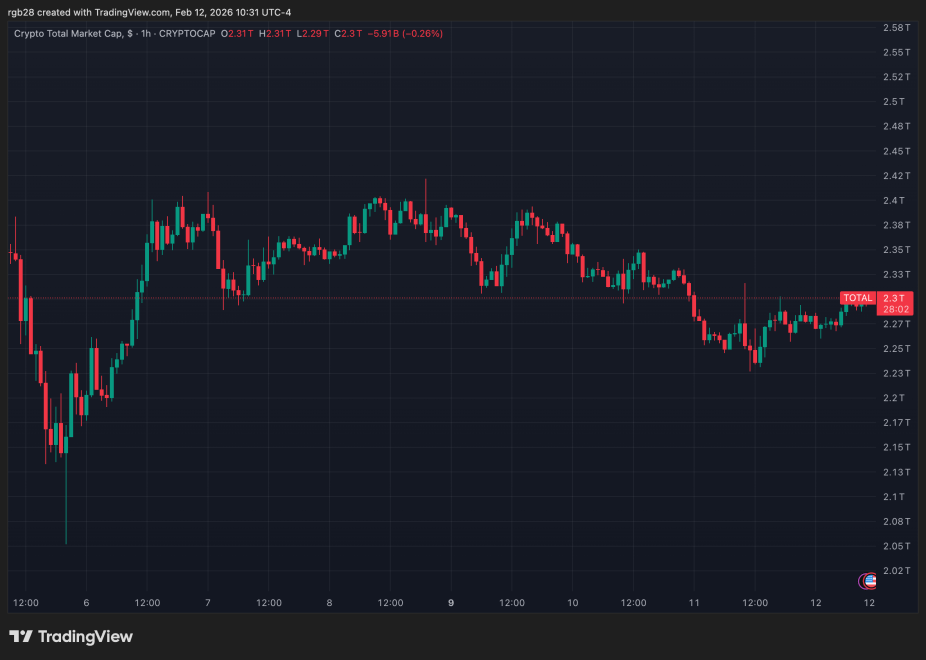
The total crypto market capitalization is at $2.3 trillion in the one-week chart. Source: TOTAL on TradingView


Pertanyaan Terkait

QWhat is the main request made by the American Bankers Association (ABA) to the Office of the Comptroller of the Currency (OCC)?

AThe ABA requested the OCC to pause the review of national bank charter applications for crypto firms until regulatory uncertainty is cleared and Congress finishes establishing the rules.

QWhich crypto companies received conditional bank charters from the OCC in December, as mentioned in the article?

AThe OCC approved conditional bank charters for Ripple, Circle, BitGo, Paxos, and Fidelity in December.

QWhat specific recommendation did the ABA make regarding the naming of new charter applicants?

AThe ABA recommended that the OCC prohibit any charter applicant limited to fiduciary activities or trust company operations from including the word 'bank' in its name to avoid misrepresentation.

QWhy did US banking groups oppose granting crypto and fintech companies direct access to the Federal Reserve's payment systems?

ABanking groups argued that the Fed should block access until newly licensed stablecoin issuers prove they can operate safely, expressing concerns about crypto's less robust regulatory status.

QWhat was the concern raised by US Senator Elizabeth Warren regarding World Liberty Financial's charter application?

ASenator Warren asked the OCC to pause its review of the application until President Donald Trump divests from the crypto company, arguing it could create a government ethics problem.

Bacaan Terkait

Bank Italia Tidak Melihat Keunggulan Sistemik Stablecoin dalam Transfer

Studi Bank Italia menunjukkan bahwa stablecoin tidak memberikan keunggulan sistemik yang berkelanjutan dalam hal biaya dan kecepatan transfer uang. Semua keuntungan hilang akibat biaya untuk deposit dan penarikan ke/dari fiat serta proses dalam infrastruktur pembayaran lokal. Peneliti membandingkan transfer 200 USDC di 10 koridor bilateral antara Italia dengan Brasil, Argentina, Jepang, UEA, dan Afrika Selatan. Metriknya adalah biaya total dan waktu penyelesaian dibandingkan layanan uang standar. Biaya akhir transfer stablecoin bervariasi dari 0,3% hingga hampir 9%, tergantung arahnya. Di koridor dengan sistem pembayaran instan, penyelesaian membutuhkan waktu kurang dari 20 menit. Sementara di daerah tanpa infrastruktur tersebut, proses memakan waktu satu hingga dua hari kerja. Biaya dan penundaan utama dikaitkan dengan pertukaran dan konversi mata uang, serta kualitas infrastruktur lokal. Komisi blockchain bukan faktor utama. Rata-rata biaya transfer uang global adalah 6,65%. Di sebagian besar koridor yang diteliti, stablecoin lebih murah dari level ini, namun dibandingkan dengan Wise, stablecoin hanya lebih unggul di tiga dari tujuh rute yang sebanding. Penulis berpendapat efeknya akan lebih terasa jika stablecoin bisa dibelanjakan langsung untuk barang/jasa tanpa konversi ke mata uang lokal. Mereka juga mencatat bahwa rezim regulasi yang melarang tidak menghilangkan permintaan akan "koin stabil", dan aturan yang terlalu ketat justru mempersulit penggunaan oleh klien ritel.

cryptonews.ru1j yang lalu

Bank Italia Tidak Melihat Keunggulan Sistemik Stablecoin dalam Transfer

cryptonews.ru1j yang lalu

Boom Bitcoin Memanas: Pernyataan Baru Saylor Picu Spekulasi Pembelian

Ketua Eksekutif MicroStrategy Inc., Michael Saylor, kembali memicu spekulasi pembelian Bitcoin baru perusahaan setelah memposting pesan "Bitcoin Drive engaged" pada 2 Agustus. Postingan hari Minggu ini disertai dengan pelacak pembelian biasa MicroStrategy, yang sejalan dengan praktik Saylor memberi sinyal perubahan treasury sebelum laporan mingguan. Laporan Saylor menunjukkan bahwa cadangan Bitcoin MicroStrategy adalah 843.775 BTC dengan nilai pasar sekitar $53,25 miliar. Dua penjualan Bitcoin baru-baru ini, total 3.588 BTC, telah mengurangi cadangan dari 847.363 BTC. Penjualan ini, menurut pengajuan SEC, ditujukan untuk mendanai pembayaran saham preferen dan menambah cadangan dolar AS. Perusahaan juga dilaporkan tidak melakukan pembelian Bitcoin dalam minggu yang berakhir 26 Juli, sambil meningkatkan cadangan dolar AS menjadi sekitar $3,75 miliar. Ekspektasi untuk pengumuman treasury pada hari Senin diperkuat oleh pola sebelumnya, di mana sinyal serupa pada hari Minggu mendahului pengungkapan cadangan uang yang lebih besar pada 27 Juli. Pembaruan data hari Senin ini akan menunjukkan apakah MicroStrategy kembali ke akumulasi Bitcoin, karena perusahaan menyeimbangkan cadangan Bitcoinnya yang besar dengan kewajiban tunai yang meningkat dan manajemen modal yang aktif. Risiko keuangan tetap tinggi setelah MicroStrategy melaporkan kerugian operasional $8,33 miliar untuk kuartal II 2026, termasuk kerugian belum terealisasi $8,32 miliar pada aset digitalnya.

cryptonews.ru1j yang lalu

Boom Bitcoin Memanas: Pernyataan Baru Saylor Picu Spekulasi Pembelian

cryptonews.ru1j yang lalu

Saham Perusahaan yang Bergerak di Bidang Kecerdasan Buatan Diperdagangkan Seperti 'Meme Coin', Sementara Bitcoin Hampir Tak Berubah Harganya — Tinjauan Mingguan

Tinjauan minggu ini menyoroti dominasi berita pasar saham tradisional dan makroekonomi atas berita kripto. Peringatan keamanan mendesak dikeluarkan untuk pengguna Coldcard terkait potensi kompromi kunci pribadi. Sementara itu, Bitcoin relatif stabil di sekitar $64.000, perhatian pasar justru terfokus pada volatilitas ekstrem di saham AI dan pasar Asia, terutama Korea Selatan yang mengalami penurunan signifikan. Likuidasi besar oleh dana "Situational Awareness" diduga berkontribusi pada penurunan ini. Di sektor kripto, tren bearish berlanjut dengan beberapa perusahaan seperti BitMart dan Storj Labs mengumumkan penutupan atau kebangkrutan. Perusahaan yang masih beroperasi, seperti Coinbase, mengalami tekanan dengan penurunan harga saham dan gelombang PHK di industri. Di sisi lain, MicroStrategy terus menambah cadangan kasnya dan membeli kembali sahamnya. Ekosistem DeFi menghadapi tantangan potensial dari kesuksesan proyek seperti Trade.xyz dan Pump.fun, yang dapat memutuskan untuk beroperasi secara mandiri. Isu perdagangan orang dalam juga mencuat di platform Hyperliquid. Sementara itu, token AI seperti Bittensor (TAO) menarik perhatian investor venture capital, meski disertai peringatan agar investor retail berhati-hati. Artikel ditutup dengan penekanan kembali pada pentingnya kewaspadaan keamanan, khususnya dalam penyimpanan aset kripto secara mandiri, di tengah potensi meningkatnya kerentanan perangkat keras dompet digital.

cryptonews.ru2j yang lalu

Saham Perusahaan yang Bergerak di Bidang Kecerdasan Buatan Diperdagangkan Seperti 'Meme Coin', Sementara Bitcoin Hampir Tak Berubah Harganya — Tinjauan Mingguan

cryptonews.ru2j yang lalu

Trading

Spot
活动图片




