The US Dollar Challenges Japan's Intervention Threshold: Will the Carry Trade Collapse Again?

marsbitDipublikasikan tanggal 2026-06-23Terakhir diperbarui pada 2026-06-23

Abstrak

The U.S. dollar remains strong, with the Dollar Index holding above 101 as Federal Reserve policy expectations turn more hawkish. The 2-year Treasury yield is near highs from early 2025, boosting the dollar's appeal against currencies like the euro and pound. The USD/JPY pair is approaching a critical level near 161.96, which would mark the yen's weakest point since December 1986. This pressure stems from the widening interest rate differential between the U.S. and Japan. Japanese authorities have issued verbal warnings about potential intervention to support the yen, but uncertainty remains over if and when action will be taken. Oil prices rebounded after a recent drop, introducing renewed inflation concerns. While not the main driver, higher oil prices could further fuel expectations that the Fed will maintain a restrictive policy. Market focus centers on three key issues: whether the Fed will follow through on rate hike expectations, the possibility of Japanese FX intervention, and the trajectory of oil prices. The resolution of these factors will determine whether the current strong dollar trend persists or gives way to increased volatility.

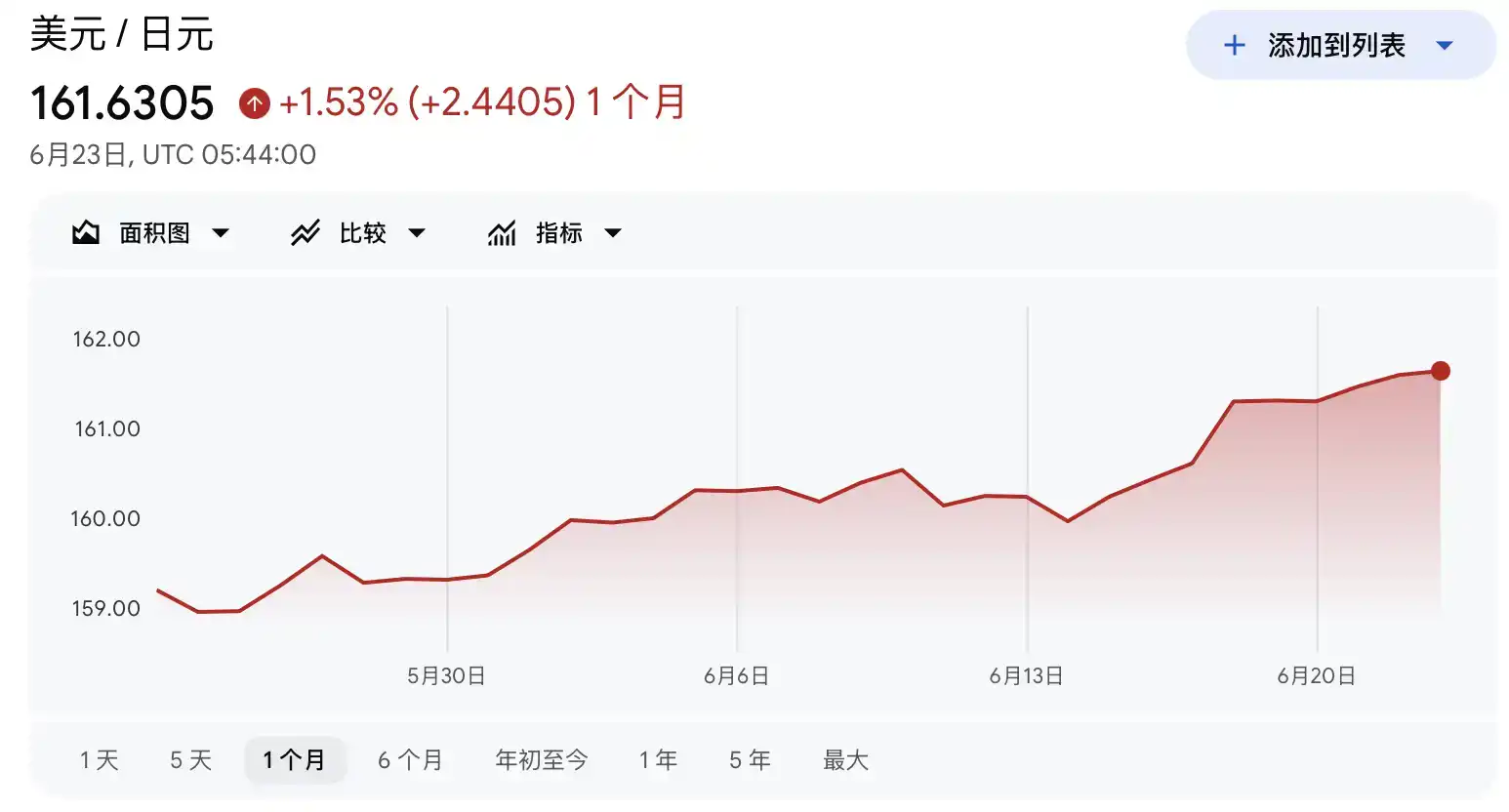
During the session on June 23rd, the US Dollar Index remained above 101, with USD/JPY approaching a key level near 161.96. This level is under scrutiny because a break above it would send the yen into its weakest territory since December 1986. The main theme in the forex market is tightening: Fed policy expectations have turned hawkish again, short-term US Treasury yields are elevated, and the yen's weakness is pushing the question of potential Japanese intervention to the forefront for traders. For investors, this isn't just about a stronger dollar; it's about global funding costs, carry trades, and pressure on Asian currencies.
Fed Expectations Turn Hawkish, Dollar Holds Above 101

As of the June 23rd session, the US Dollar Index was around 101.01, not far from the week's high of 101.13. The DXY, which measures the dollar against a basket of major currencies, regained strength, with the most direct driver being a shift in Federal Reserve policy expectations.

According to Reuters, the Fed held the federal funds rate steady at 3.50% to 3.75% on June 17th, but the latest dot plot showed that nine officials project a rate hike before the end of 2026. The statement also removed wording hinting at a rate cut this year. This change made it harder for markets to continue trading on easing expectations, and futures markets have significantly increased bets on the possibility of a hike within the year or before September.

Short-term US Treasury yields provided concurrent support. The 2-year yield hovered between 4.22% and 4.23% during the session, near its highest level since February 2025. For forex markets, rising short-end yields increase the appeal of dollar-denominated assets, especially when the policy outlooks of other major economies like Japan and Europe remain relatively dovish.

OCBC FX strategist Sim Moh Siong believes that rising yields and more hawkish Fed expectations are jointly supporting the dollar. If the dollar index further breaks above its 14-month high of 101.97, the dollar could gain fresh upward momentum. This level makes the area above 101 not just a simple integer threshold but a technical zone for short-term funds to observe whether the dollar can continue strengthening.

Other major currencies are also under pressure. During the session, the euro was around 1.1423, sterling around 1.3246, and the Australian and New Zealand dollars around 0.6991 and 0.5704, respectively. Remarks from ECB President Lagarde downplaying secondary inflation concerns and political changes in the UK affecting sterling did not alter the day's main theme. The market focused more on whether US rate expectations would continue to rise.

Yen Approaches 161.96, Japan's Verbal Warnings Intensify

The yen is one of the most sensitive assets in this round of dollar strength. As of the June 23rd session, USD/JPY was around 161.59, having touched 161.93 intraday, just a step away from the 161.96 level. According to The Japan Times and Reuters, a break above approximately 161.95 to 161.96 would mean the yen falls to its lowest level since December 1986.

The core reason for the yen's sustained pressure remains the US-Japan interest rate differential. Renewed bets on US rate hikes, coupled with the relatively slow pace of policy normalization by the Bank of Japan, have widened the yield advantage for investors holding dollar assets, increasing selling pressure on the yen. A weak yen benefits Japanese exporters' profit conversion but also raises import costs, particularly for energy and food, putting pressure on household purchasing power and inflation expectations.

Therefore, the stance of Japan's Ministry of Finance has become a market focus. Japanese Finance Minister Katayama Satoki recently issued verbal warnings about yen volatility, stating that Japan is prepared to act if necessary. This has led traders to speculate that Japanese authorities might intervene in the currency market by buying yen and selling dollars as it nears historic lows.

However, intervention remains at the expectation stage and is not a confirmed policy action. Historical experience shows that Japanese FX intervention can typically create sharp volatility in the short term, forcing short-covering. If the US-Japan yield gap continues to widen, a single intervention is unlikely to fundamentally change the USD/JPY trend. Japanese authorities are more likely to alter the pace of appreciation rather than completely reverse the trend.

This makes the area near 161.96 a dual threshold. On one side, yield differentials and dollar strength continue to push USD/JPY higher; on the other, the closer it gets to the nearly 40-year low, the higher the policy intervention risk. For short-term traders, this level is not only a technical point but also a policy risk point.

Oil Price Rebound Brings Inflation Concerns Back into Trading

Beyond forex, oil prices also re-entered the market spotlight during the same trading session. According to Reuters, oil prices fell about 4% on June 22nd on news of progress in US-Iran talks and related reports about the opening of the Strait of Hormuz passage. The subsequent rebound in oil prices shows the market is still waiting for clearer geopolitical and supply signals.

The Strait of Hormuz is one of the world's most crucial oil transport chokepoints, with about one-fifth of seaborne oil passing through it. Once expectations for resumed passage strengthen, oil supply risks decrease, typically pressuring prices. However, as long as progress in talks, shipping security, and actual supply restoration are not fully confirmed, oil prices are prone to fluctuate between news headlines.

The reason oil prices affect dollar trading is that they re-enter inflation expectations and central bank policy assessments. If the oil price rebound persists, markets will find it harder to believe inflationary pressures have subsided, and the Fed's rationale for maintaining higher rates or even hiking would strengthen. If oil prices decline again, some inflation concerns might ease.

Currently, oil prices are more of a supplementary clue alongside the dollar and US Treasury yields rather than the main theme in the forex market that day. However, in an environment where Fed expectations have already turned hawkish, any sustained energy price rebound could amplify market sensitivity to inflation.

The Strong Dollar Trade Still Hinges on Three Unresolved Questions

The market's most immediate question is whether the Fed will actually hike rates within the year or before September. Futures market bets have clearly heated up, but this is not a Fed commitment and ultimately depends on upcoming inflation, employment, and growth data. If data continues to support a hawkish stance, the dollar may find further support. If inflation falls or employment weakens, rate hike bets could cool rapidly.

The second question lies with Japan. The closer USD/JPY gets to 161.96, the stronger intervention expectations become. However, whether Japanese authorities will act, the scale of any action, and whether the US will cooperate all remain uncertain. What the market truly worries about is not the verbal warnings themselves but the potential for instant volatility that intervention could bring.

The third question comes from oil prices. There is still distance between expectations regarding US-Iran talks, the Strait of Hormuz passage opening, and actual supply restoration. If oil prices continue to rebound, they will rekindle inflation concerns, in turn supporting US Treasury yields and the dollar.

For now, this market move is still primarily driven by US rate expectations. Whether the dollar index can break above 101.97, whether USD/JPY will surpass 161.96, and whether Japanese authorities will move from verbal warnings to concrete action will determine whether the forex market continues with a strong dollar or enters a period of more intense two-way volatility.


Pertanyaan Terkait

QWhy is the 161.96 level particularly significant for USD/JPY?

AThe 161.96 level is significant because if USD/JPY breaks above it, the yen would enter its weakest trading range since December 1986. This makes it a key technical level and a potential trigger for intervention by Japanese authorities.

QWhat are the main drivers behind the recent strengthening of the US dollar?

AThe main drivers are a shift towards more hawkish Federal Reserve policy expectations, with market pricing indicating increased chances of a rate hike later in the year, and high short-term US Treasury yields (like the 2-year), which enhance the appeal of dollar-denominated assets.

QWhat is the market's primary concern regarding a potential Japanese intervention in the FX market?

AThe primary concern is not the intervention itself, but the sharp and volatile price swings it could cause in the short term, forcing traders to quickly adjust their positions. The market doubts a single intervention could sustainably reverse the USD/JPY trend if the US-Japan interest rate differential continues to widen.

QHow does the oil price factor into the current market dynamics for the dollar?

AOil price rebounds can reintroduce inflation concerns into the market. In an environment where the Fed has already turned more hawkish, rising oil prices could amplify these concerns, potentially providing further support for the case for higher US interest rates and, by extension, the US dollar.

QWhat three unresolved questions are currently key for the strong dollar trade according to the article?

A1. Whether the Federal Reserve will actually hike rates later this year. 2. Whether and how Japanese authorities will intervene as USD/JPY approaches key historical levels. 3. The direction of oil prices, as sustained increases could reinforce inflation fears and support the dollar.

Bacaan Terkait

Kirim Pesan Bisa Transfer Koin? Telegram Akan 'Suntik' Dompet Kripto untuk 1 Miliar Pengguna Musim Panas Ini

Pendiri Telegram, Pavel Durov, mengumumkan bahwa musim panas ini dompet kripto non-penampung (non-custodial) asli, "Gram wallet", akan dibangun ke dalam semua aplikasi Telegram. Langkah ini menargetkan lebih dari 1 miliar pengguna bulanan, menawarkan transfer aset kripto instan dan tanpa biaya. Dompet baru ini berbeda dari bot @wallet pihak ketiga yang sudah ada, karena dikembangkan langsung oleh Telegram dan pengguna mengontrol kunci pribadi mereka sendiri. Pengumuman tersebut mendorong harga GRAM (sebelumnya Toncoin) naik sekitar 8%. Namun, harga saat ini masih jauh dari titik tertinggi sebelumnya. Keputusan Durov ini adalah bagian dari roadmap "Make TON Great Again" (MTONGA), menandai kembalinya Telegram ke proyek blockchain TON setelah sebelumnya berkonflik dengan SEC pada 2018-2020. Langkah Telegram terjadi di tengah persaingan ketat fitur pembayaran di aplikasi super. X Money pimpinan Elon Musk fokus pada rute fiat yang sesuai regulasi, sementara Meta mengeksplorasi pembayaran stablecoin. Telegram memilih jalur asli kripto dengan dompet non-penampung, memanfaatkan basis pengguna besar dan kedekatan alami dengan komunitas kripto. Namun, janji "tanpa biaya" dan detail teknis lainnya, seperti dukungan aset selain GRAM serta strategi edukasi pengguna baru, masih belum diungkap. Jadwal peluncuran yang tepat juga hanya disebut "musim panas ini".

marsbit36m yang lalu

Kirim Pesan Bisa Transfer Koin? Telegram Akan 'Suntik' Dompet Kripto untuk 1 Miliar Pengguna Musim Panas Ini

marsbit36m yang lalu

7 Bulan Setelah Runtuhnya Huiwang, Lanskap Platform Jaminan Asia Tenggara Menghadapi Reshuffle Besar

Setelah platform garansi terkenal Asia Tenggara, "Huiwang Pay", runtuh pada Desember tahun lalu, pasar menyaksikan perubahan besar dan kemunculan platform-platform baru yang mengisi kekosongan. Platform-platform seperti XinBi, JinBei/JinBo, DaLi/TianCheng, Fulilai, dan LingHang kini beroperasi di wilayah gelap, terutama melayani industri abu-abu dan ilegal. Data dari Bitrace menunjukkan bahwa pendapatan platform XinBi telah melebihi 1,6 miliar USDT. Sementara itu, platform LingHang secara terbuka menyediakan layanan garansi untuk transaksi yang terkait dengan perdagangan manusia. JinBei, yang terkait erat dengan bisnis kasino, telah berganti nama menjadi JinBo. DaLi mewarisi banyak bisnis dari platform "Tudou" yang sebelumnya terkait dengan Huiwang. Adapun Fulilai terkait dengan kelompok kriminal keluarga Liu di Myanmar Utara. Meskipun platform-platform ini sering dijuluki "Alipay Asia Tenggara", fungsi sebenarnya jauh dari itu. Seperti yang ditunjukkan dalam laporan Elliptic, pasar garansi Huiwang telah menangani lebih dari 310 miliar dolar AS, menjadikannya pasar ilegal online terbesar yang pernah ada, yang terutama melayani pencucian uang, penipuan, perjudian, dan perdagangan manusia. Kebangkitan platform-platform baru ini mencerminkan ekosistem keuangan bawah tanah yang terus beradaptasi dan berkembang di Asia Tenggara, menunggu tindakan penegakan hukum lebih lanjut.

Odaily星球日报48m yang lalu

7 Bulan Setelah Runtuhnya Huiwang, Lanskap Platform Jaminan Asia Tenggara Menghadapi Reshuffle Besar

Odaily星球日报48m yang lalu

Cahaya Tak Semenarik Dulu: Apa yang Sedang Dialami oleh VC Kripto?

Krisis Dana Ventura Kripto Khusus: Pergeseran Menuju Infrastruktur dan Masa Depan yang Terpolarisasi Dana ventura khusus kripto, seperti Paradigm yang baru saja mengalihkan fokus ke AI dan robotika, sedang menghadapi tantangan eksistensial. Artikel ini membahas apakah dana semacam ini sedang menuju kepunahan, dengan menarik paralel dari siklus hidup dana khusus sebelumnya di sektor energi bersih dan SPAC. Inti masalahnya adalah runtuhnya *information advantage* (keunggulan informasi) yang dulunya dimiliki dana khusus. Saat teknologi kripto matang dan diadopsi raksasa tradisional seperti Stripe dan BlackRock, pengetahuan mendalam tentang MEV atau ekonomi validator tidak lagi menjadi penghalang masuk. Dana generalis besar (seperti a16z, Sequoia) kini dapat menilai proyek kripto dengan logika yang sama seperti fintech biasa. Industri ventura mengalami polarisasi "barbell": di satu ujung, platform besar multifokus; di ujung lain, dana kecil niche yang bisa bertahan dengan satu "home run". Dana khusus kripto ukuran menengah terjepit di "zona kematian", karena ukurannya terlalu besar untuk bergantung pada investasi seed kecil, namun terlalu kecil untuk bersaing di putaran growth. Ini memaksa banyak dana, seperti Framework Ventures, untuk melebarkan mandat investasi. Bahkan dana yang tetap berlabel "kripto" seperti Dragonfly dan a16z kini mendefinisikan ulang fokus mereka terutama pada infrastruktur keuangan berbasis blockchain (stablecoin, pasar prediksi), yang juga diminati dana generalis. Perubahan ini didorong oleh tekanan dari Limited Partner (LP) yang haus akan hasil di tengah kinerja buruk portofolio kripto mereka, dan teralihkan oleh daya tarik AI yang menyedot 70% modal ventura. Implikasi bagi startup kripto adalah tantangan baru: bersaing dengan proyek AI untuk mendapatkan perhatian di dana generalis, dan kehilangan sponsor jangka panjang untuk riset infrastruktur dasar yang kurang komersial (seperti yang pernah didanai Paradigm). Kesimpulannya, "dana ventura kripto" sebagai kategori mandiri mungkin akan usang, mirip dengan "dana internet". Kripto berevolusi menjadi infrastruktur dasar. Masa depan akan mengikuti pola barbell: dana besar multifokus mendanai pertumbuhan, sementara dana kecil khusus akan muncul untuk niche eksperimental baru (seperti tokenisasi). Dana ukuran menengah yang hanya fokus pada kripto akan menghadapi kesulitan bertahan.

Foresight News1j yang lalu

Cahaya Tak Semenarik Dulu: Apa yang Sedang Dialami oleh VC Kripto?

Foresight News1j yang lalu

Ketika Konsensus Semakin Cepat, Apa yang Ditaruhkan oleh Investor Muda?

Dengan kemajuan teknologi yang semakin cepat, terutama di bidang AI, robotika, dirgantara, dan komputasi kuantum, para investor muda berhadapan dengan perubahan logika investasi. Mereka tidak lagi cukup mengandalkan model keuangan dan pengalaman industri lama, tetapi juga harus memahami bahasa teknologi, menerima rute yang belum konvergen, dan membuat keputusan sebelum konsensus terbentuk. WAIC merilis daftar "Alpha Youth Investment Leaders," yang mencerminkan beberapa tren utama dalam investasi teknologi saat ini. Tren pertama adalah pergeseran AI dari layar ke dunia fisik. Perhatian kini beralih ke perangkat ujung, robot, mobil, sistem industri, dan infrastruktur luar angkasa. Meskipun robot humanoid dan kecerdasan emboddied menarik perhatian, fokus utama adalah kemampuan pengiriman dan ROI yang nyata, bukan hanya demonstrasi yang mengesankan. Kecerdasan ujung menjadi kunci, dengan perangkat keras AI yang membangun hubungan data dan layanan berkelanjutan dengan pengguna. Tren kedua adalah beralihnya fokus kompetisi dari model dasar ke "roda terbang cerdas." Manfaat model besar belum sepenuhnya terealisasi dalam merekonstruksi produktivitas. Nilai jangka panjang terletak pada perusahaan yang dapat mengintegrasikan kemampuan model ke dalam alur kerja nyata, membentuk siklus tertutup data, pelatihan, dan umpan balik pengguna yang saling memperkuat (roda terbang cerdas). Ini menciptakan nilai yang bertahan melampaui sekadar pembaruan model. Tren ketiga adalah munculnya teknologi dasar baru untuk mengatasi hambatan data. Ketika data manusia yang berkualitas tinggi menjadi langka, pembelajaran penguatan, permainan mandiri, dan model dasar ilmiah menjadi arah yang diperhatikan. Model-model ini bertujuan untuk membangun kemampuan yang lebih mendasar dan universal dalam bidang seperti ilmu kehidupan dan material, menggunakan data dan umpan balik eksperimen khusus untuk mendorong pertumbuhan kemampuan AI selanjutnya. Tren keempat adalah perlunya modal yang sabar untuk teknologi keras. Di bidang seperti dirgantara komersial, komputasi kuantum, dan energi canggih, siklus validasi lebih panjang dan penuh ketidakpastian teknis. Investasi di bidang ini memerlukan pemahaman awal tentang kemampuan teknik dan ketahanan tim, dengan harapan pengembalian dalam skala waktu yang lebih panjang, sambil mendorong perkembangan industri dan akumulasi kemampuan dasar. Peran investor muda adalah memahami teknologi lebih awal, masuk lebih dalam ke industri, dan membuat pilihan jangka panjang di tengah ketidakpastian.

marsbit1j yang lalu

Ketika Konsensus Semakin Cepat, Apa yang Ditaruhkan oleh Investor Muda?

marsbit1j yang lalu

Trading

Spot
活动图片




