The Scythe of Bitcoin's Leading Figure: A Record of a Nasdaq Robbery

marsbitDipublikasikan tanggal 2026-02-18Terakhir diperbarui pada 2026-02-18

Abstrak

This investigation details a sophisticated financial scheme orchestrated by David Bailey, CEO of Nakamoto Holdings ($NAKA). Through a reverse merger with a shell company, NAKA's stock skyrocketed from $2 to over $30, luring retail investors while early PIPE investors entered at just $1.12 per share. The stock then collapsed by 99% to $0.29. Amid the crash, Bailey engaged in desperate debt refinancing, accruing massive losses. He then used the crippled public company to acquire his own private firms, BTC Inc and UTXO Management, at a fixed share price of $1.12—nearly four times the market rate. This acquisition, approved by shareholders during the stock's peak without their full understanding, resulted in massive dilution for existing investors. The entire operation, while technically compliant, transferred wealth from retail investors to insiders. Bailey, who compared himself to historical financial dynasties, ultimately used the wreckage of the public company to enrich himself and his private empire, showcasing a brutal intersection of influencer culture and public markets.

Editor's Note: This article provides an in-depth analysis of the astonishing capital operations behind David Bailey and the Nakamoto Holdings ($NAKA) he controls. From the frenzied surge during the backdoor listing to the 99% crash after retail investors entered the market, and then using the devastated listed company to acquire his private assets at a high premium, it is a meticulously designed wealth transfer leveraging information asymmetry and regulatory loopholes.

This is a brutal investigation into greed, compliance games, and influencer capitalism. It serves as a warning that when belief is packaged as a financial product, and when the slogan of decentralization meets centralized greed, retail investors are often the last exit liquidity. Understanding this story might give you more clarity and less blind following the next time a big name promotes an investment.

Below is the full content:

This morning, David Bailey used a listed company whose market value has evaporated by 99% to acquire two private companies he founded at a premium four times the current stock price—all without requiring a shareholder vote.

What's most shocking? This asset transfer drama was locked in long before retail investors bought their first share.

To understand how this was done, we must start from the beginning.

In May 2025, a zombie company named KindlyMD announced a merger with Nakamoto Holdings, a Bitcoin reserve tool founded by David Bailey.

The stock price soared from $2 to over $30 within days, attracting a flood of retail investors. Bitcoin influencers celebrated, and Bailey even compared himself to the Morgans, the Medicis, and the Rothschilds.
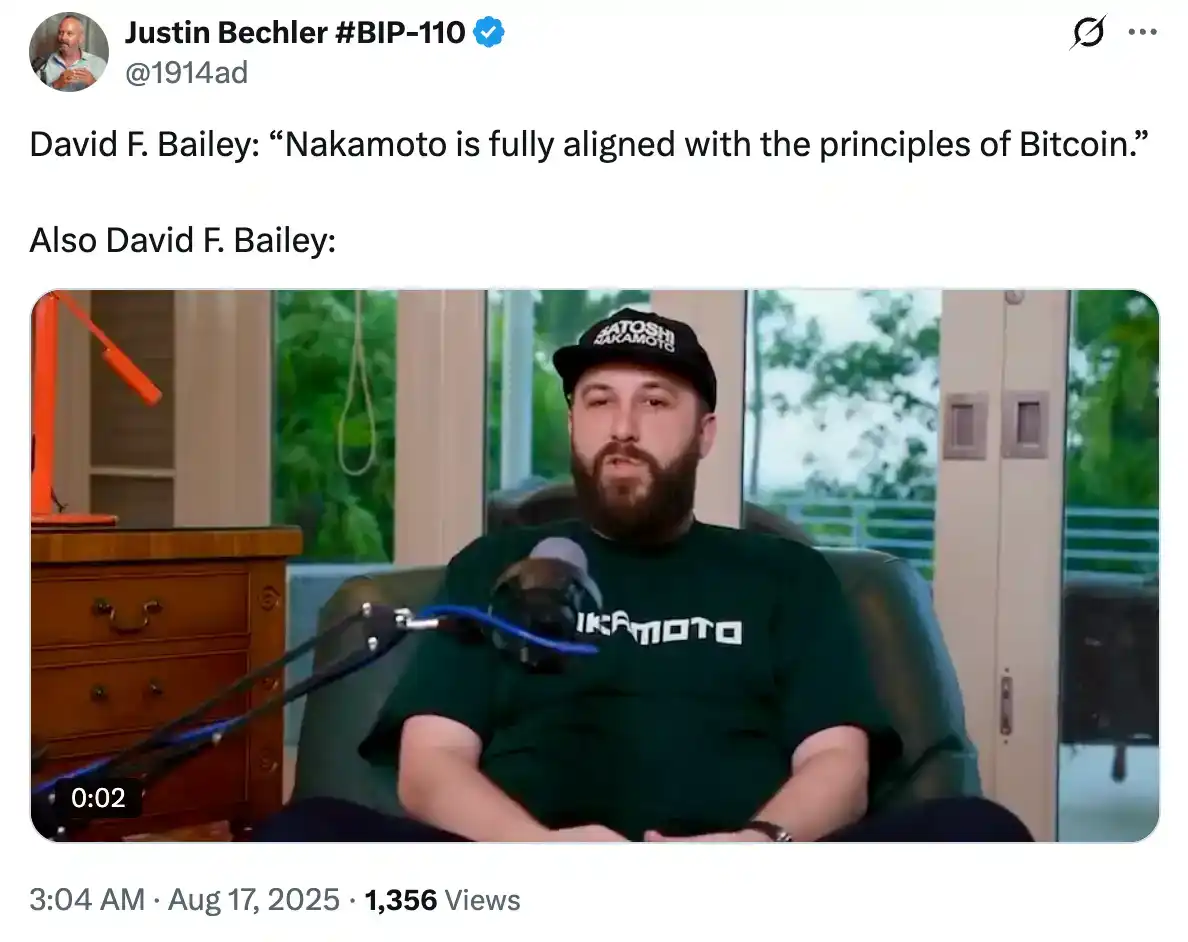
Nine months later, the stock price fell to 29 cents, and Bailey just used this stock to buy his own companies.

The Pump

The mechanism was quite ingeniously designed.

KindlyMD was originally an unnoticed micro-cap stock on Nasdaq. Nakamoto Holdings went public through a reverse merger, backed by $510 million in PIPE (Private Investment in Public Equity) financing and $200 million in convertible bonds.

On paper, it seemed like the birth of a Bitcoin reserve giant, with a new generation of Bitcoin influencers rushing to tell you why to buy $NAKA (of course, the reason was to own more Bitcoin).

Within days, NAKA's price-to-NAV ratio reached an astonishing 23x, meaning speculators paid $23 for every $1 of Bitcoin held by the company.

Michael Saylor's MicroStrategy never reached such a premium. The difference is that MicroStrategy has years of operational history, a software business generating actual revenue, and a CEO who didn't manipulate the transaction structure to enrich himself on the backend.

Insiders knew secrets that retail investors didn't. The PIPE investors—including the notorious BIP-110 opponents Udi Wertheimer, Jameson Lopp, and Adam Back—got in at $1.12 per share. Retail investors bought at $28, $30, $31, and even higher.

This information asymmetry was built into the structure from day one.

In June, Bailey completed another $51.5 million PIPE financing at $5.00 per share. Although the second batch of investors got in at a much lower cost than retail, it was still far above the $1.12 floor price, and they were ultimately harvested too.

Bailey celebrated the financing, saying it took less than 72 hours and investor demand was extremely strong.

Let's take a closer look at this strategy.

The Dump

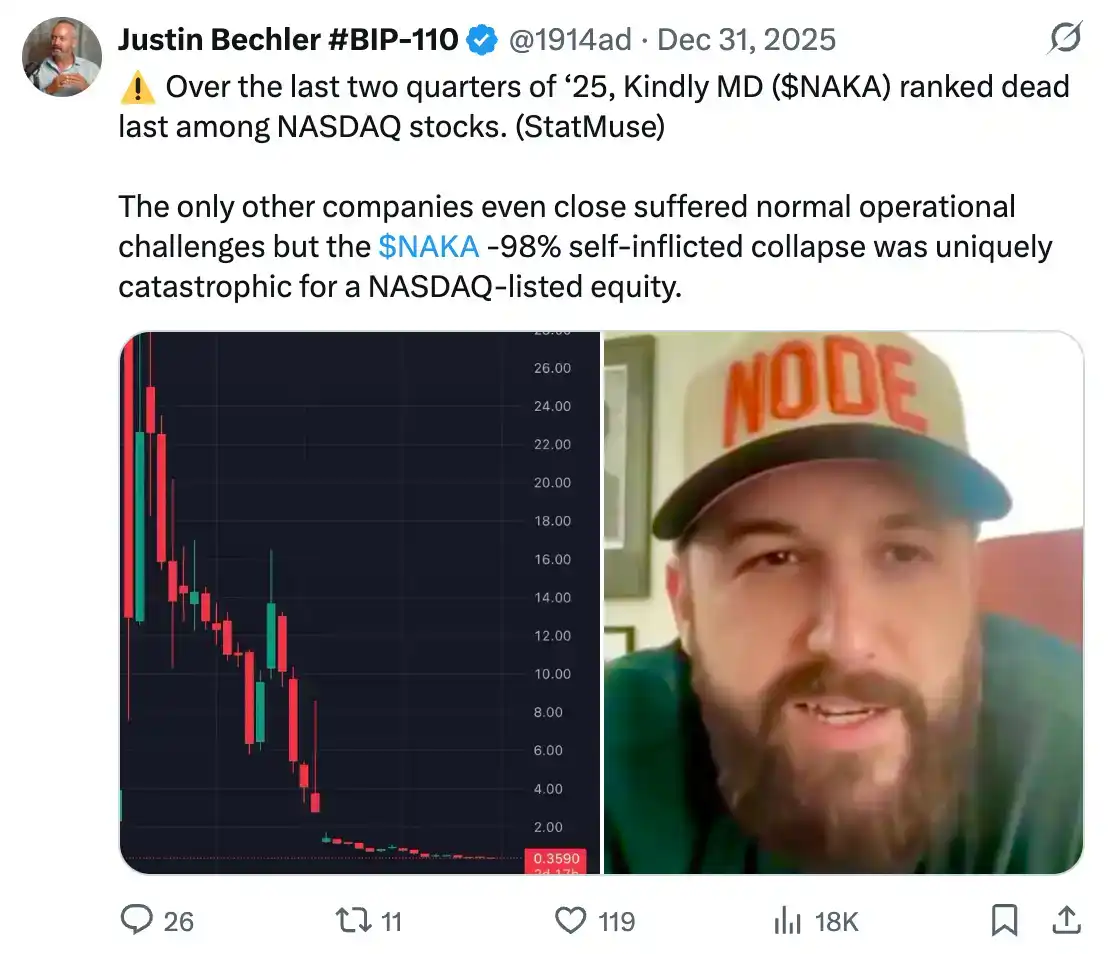
By September, NAKA had plummeted by 96%.

The early PIPE investors who obtained shares at $1.12 could finally cash out after the merger was completed in August, and they did so.

Bailey's response was quite bizarre for a public company CEO; he told shareholders who were just there for a quick trade to leave.

So they left.

The stock price continued to fall. Below $1. Below 50 cents. Below 30 cents. A company holding about 5,765 Bitcoins (worth over $500 million) now had a market cap of less than $300 million.

The market valued Nakamoto even lower than the Bitcoin on its balance sheet, which says a lot about how investors view the management team and corporate structure wrapped around these Bitcoins.
Debt Spiral

As the stock price crashed, Bailey changed lenders frequently, like a gambler borrowing money on the casino floor.

The initial capital structure included $200 million in convertible bonds from Yorkville Advisors, with a conversion price of $2.80. As NAKA's stock price fell below this level, the convertible bonds became debt that could devour equity. So, on October 3, Nakamoto took out a $203 million term loan from Two Prime Lending to redeem Yorkville's notes and interest.

Four days later, on October 7, they borrowed $206 million in USDT from Antalpha at 7% interest to repay Two Prime. Antalpha's loan had a term of only 30 days (with an option to extend for another 30 days). They replaced the term loan with a 30-day bridge loan within a week.

The plan was to convert this bridge loan into a $250 million 5-year secured convertible bond from Antalpha. Use the new convertible to repay the bridge loan, the bridge loan to repay the term loan, and the term loan to repay the old convertible.

But that $250 million convertible never materialized on Antalpha's terms.

On December 16, Nakamoto borrowed $210 million in USDT from Kraken at 8% interest, over-collateralized by 150% with Bitcoin from its treasury.
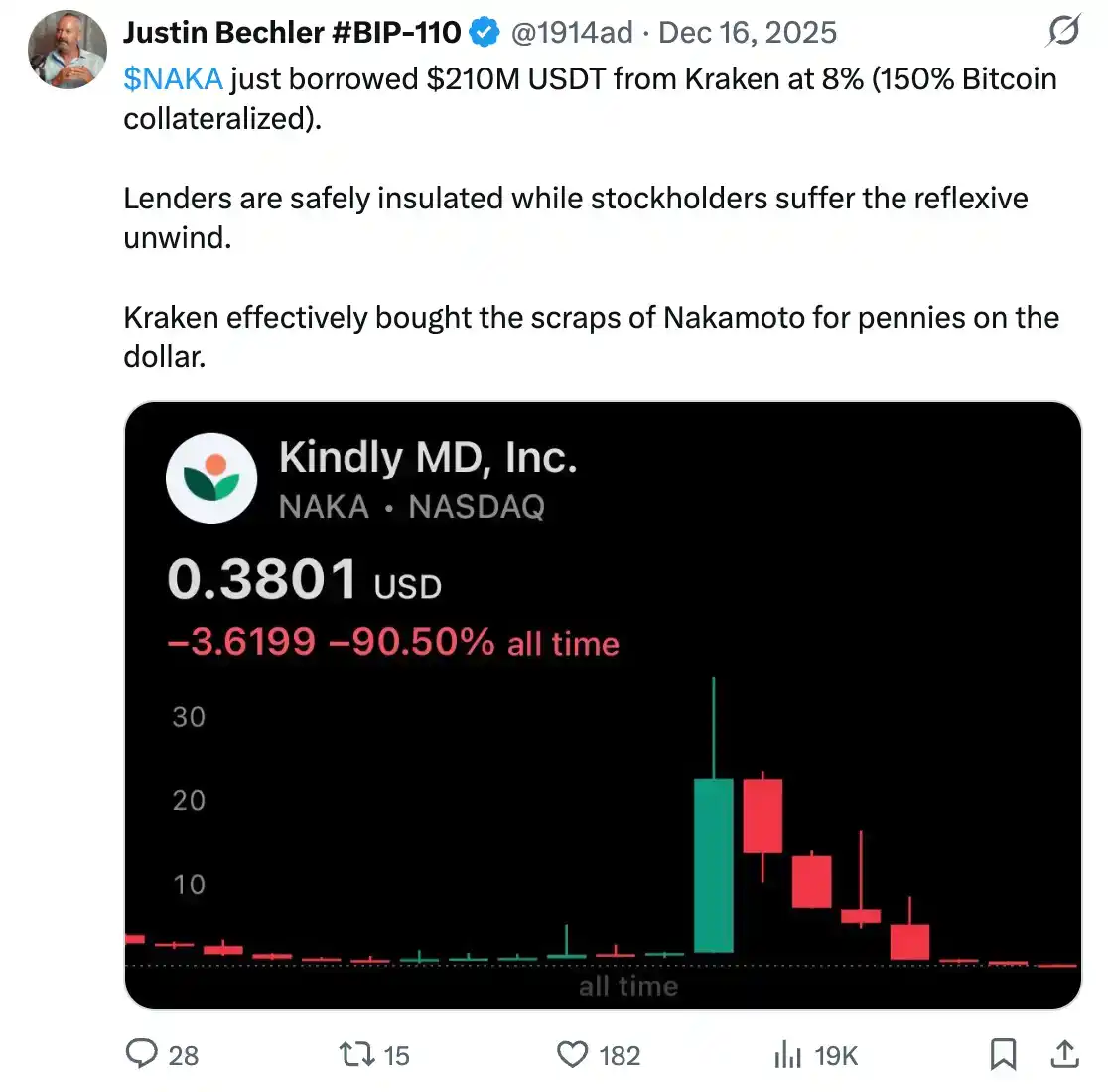
Do the math: The lender has $315 million worth of Bitcoin as collateral for a $210 million loan. If NAKA's stock goes to zero, Kraken takes the collateral. If Bitcoin drops 33%, Kraken remains unscathed. At every stage of this drama, the lenders were tightly protected, while common shareholders bore the full brunt of the reflexive crash.

Each new loan tightened the noose.

Countdown

On December 10, Nasdaq notified Nakamoto that it faced delisting risk because its stock price had been below $1 for 30 consecutive business days. The company must regain compliance by June 8, 2026, meaning the closing price must be above $1 for 10 consecutive trading days.

The current stock price is 29 cents.
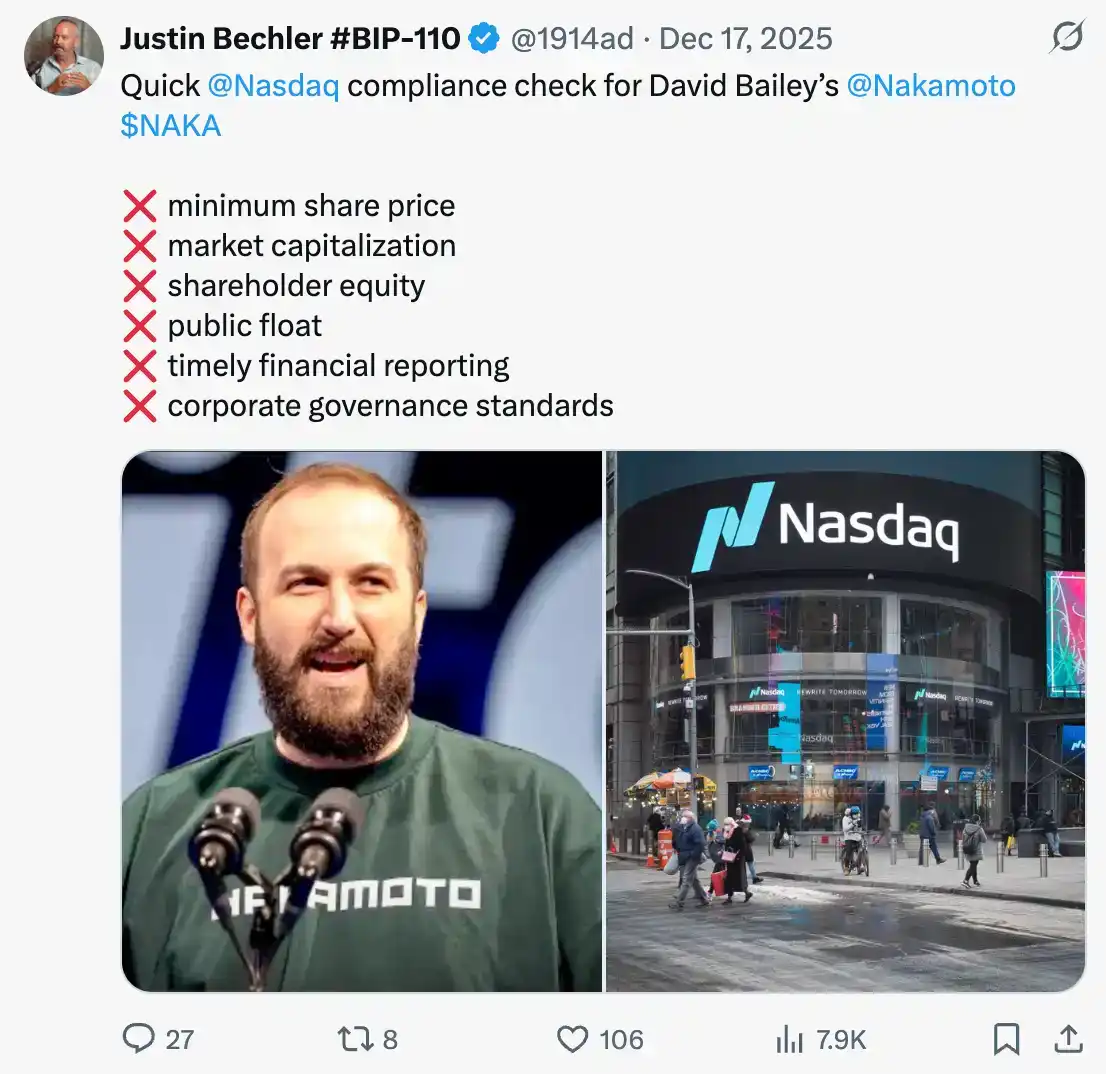
If delisted, Nakamoto would be unable to conduct ATM (at-the-Market) offerings, issue convertible bonds, or use stock as acquisition currency. Everything Bailey assembled in this shell relies on a Nasdaq listing that currently cannot be maintained.

Accounting Disaster

In November, Nakamoto filed a Form 12b-25 with the SEC, admitting it could not submit its quarterly financial report on time due to accounting complexities from the merger. Preliminary data revealed the truth:

The Nakamoto acquisition resulted in a $59.75 million loss (payment price higher than net asset value)

$22.07 million unrealized loss on digital assets

$1.41 million realized loss from selling Bitcoin

$14.45 million loss on debt extinguishment from refinancing rotations

A quarterly loss of approximately $97 million, partially offset by a $21.8 million accounting gain from contingent liabilities. This company, which was supposed to be the perfect Bitcoin reserve tool, couldn't even submit its books on time.

The Heist

This brings us back to this morning.

Nakamoto announced signing a definitive merger agreement to acquire BTC Inc and UTXO Management. BTC Inc owns Bitcoin Magazine and operates the Bitcoin Conference. UTXO manages a Bitcoin-focused hedge fund.

Bailey is the Chairman and CEO of the buyer, Nakamoto.

He is also the founder of the sellers, BTC Inc and UTXO.

He is the buyer, the seller, and the CEO approving the terms.

But weeks before the acquisition, he quietly handed the CEO title to Brandon Greene, creating a paper-thin separation between himself and the entities he was about to buy with shareholder equity.

This morning's deal was entirely financed with Nakamoto stock, priced at $1.12 per share based on a call option embedded in the original marketing services agreement. And $NAKA is still struggling to climb back to $0.29.

Bailey's companies received a stock valuation nearly four times the current market price. Security holders of BTC Inc and UTXO will receive 363.6 million shares, valuing the deal at $107.3 million at market prices.

But these shares were issued at $1.12, meaning the deal was structured when NAKA's stock was flying high, and the terms were never adjusted when the stock crashed.

Forget the fictional pricing on the contract. What really matters is that 363.6 million new shares just entered the float. Regardless of whether the documents say $1.12 or $0.29, existing shareholders were diluted by this quantity. The $1.12 label is a courtesy to the seller, but the dilution is real.

No additional shareholder approval was needed because the call option was already embedded in the original merger documents, and shareholders voted to approve them when NAKA's stock was still at $20, $30.

The retail investors who approved these terms had no idea they were authorizing the future acquisition of Bailey's private business at a locked-in high premium while their own shares were turning to dust.

Architecture of Self-Dealing

Stepping back, the entire architecture is breathtakingly elegant.
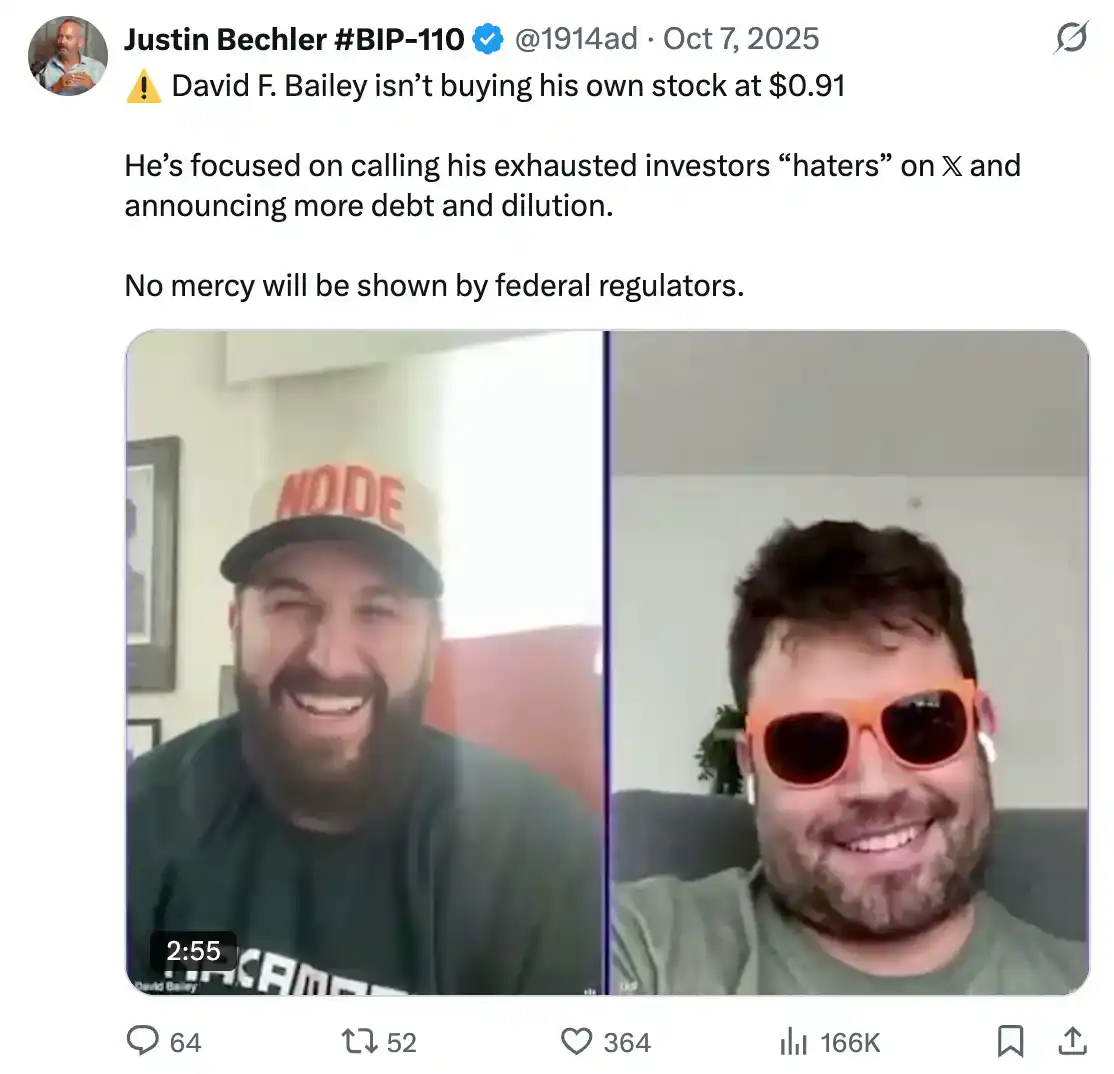
Bailey created Nakamoto Holdings. Merged it into a public shell company via KindlyMD, raising $710 million in the process. Driven by retail enthusiasm, the stock was pumped to 23x NAV. PIPE investors got in at $1.12, while the public paid 20 to 30 times that. The stock then crashed 99%.

During this time, the company changed lenders three times in a week, trying to manage $200 million in debt that was structured to convert to equity when the stock price was much higher.

Now, with the shattered stock price below 30 cents, Bailey is using this hollowed-out tool to swallow his private empire at terms agreed upon when the stock was a hundred times higher. The initial KindlyMD merger was the Trojan horse, and the acquisition of BTC Inc was the real payload.

Bailey told us from the start. In the initial press release, he said Nakamoto would acquire BTC Inc, subject to audit and call option exercise. The MSA was publicly filed, and the option terms were disclosed. Everything was legally compliant and fully transparent—just like all complex financial engineering, the truth was buried in piles of documents no one would read.

The person who operates Bitcoin Magazine, organizes the world's largest Bitcoin conference, and positions himself as a leader of the Bitcoin movement, built a public company, destroyed 99% of shareholder value, and is now using it to acquire his own businesses at a premium.

He once compared himself to the Medicis. At least the Medicis created value for Florence before taking their cut.

Nakamoto is the freak show that happens when influencer culture meets the public stock market.

Exit Liquidity

David Bailey raised $710 million from over 200 investors across six continents. He promised them a future like the Morgans, Medicis, and Rothschilds, a financial dynasty built on Bitcoin. He told them Nakamoto would bring Bitcoin to the center of global capital markets. He said their names would echo through history.

But he delivered a 99% loss.

He priced the PIPE at $1.12 while retail bought at $28. He embedded call options to acquire his own companies into the filings without shareholders understanding what they were authorizing. He rotated three lenders in a week to prevent $200 million in debt from crushing equity, accumulating $14 million in debt extinguishment losses along the way. He sold Bitcoin at a loss from the treasury that was supposed to only accumulate, not sell. He couldn't even submit quarterly financial reports on time. And when the stock price finally fell to 29 cents...

When the rubble was cleared and the retail investors who trusted him were wiped out, he exercised that call option, using the wreckage of their investment to buy his private empire at four times the market price.

Bailey holds 11 million shares at a cost of $1.12. Adam Back holds nearly 9 million shares. Balaji, Lopp, Yusko, Salinas, Jihan Wu—they all got in at a price that teachers, truck drivers, or first-time investors could never access. These are the people who shape the Bitcoin narrative. They run conferences, publish magazines, manage funds, post tweets. They are the supply chain of belief, turning skeptics into believers and believers into bag holders.

Now, Bailey owns Bitcoin Magazine, the Bitcoin Conference, and a hedge fund, all packed into a public company with a market cap only a fraction of its Bitcoin holdings, all acquired with stock priced four times the market value, all approved before a single cent from retail entered.

And he's not done.

Nakamoto has already filed with the SEC for a $5 billion ATM (At-the-Market) stock offering. Bailey now controls the media division, the conference division, the hedge fund, and a shelf registration that allows him to keep issuing stock collateralized by the Bitcoin treasury until the last bit of value is squeezed out.

When exactly did the Bitcoin community hand the keys to conference promoters and influencer capitalists? And why is anyone surprised when they drive away with the car?


Pertanyaan Terkait

QWhat was the key mechanism David Bailey used to acquire his private companies at a premium using the struggling Nakamoto Holdings stock?

AHe utilized a call option embedded in the original marketing services agreement, which was approved by shareholders when the stock price was high, allowing the acquisition at $1.12 per share despite the market price collapsing to $0.29.

QHow did the PIPE investors benefit from the retail investors in the Nakamoto Holdings deal?

APIPE investors, including prominent Bitcoin figures, acquired shares at $1.12, while retail investors bought in at prices 20 to 30 times higher, around $28 to $31, creating a massive information asymmetry from the start.

QWhat was the consequences of Nakamoto's stock price falling below $1 for an extended period?

AThe company received a delisting notice from Nasdaq, threatening its ability to conduct ATM offerings, issue convertible notes, or use its stock as acquisition currency, which was crucial for Bailey's plans.

QWhat financial maneuvers did Nakamoto employ to manage its $200 million debt as the stock price collapsed?

AThe company rapidly cycled through lenders, first replacing a convertible note with a term loan, then a 30-day bridge loan, and finally a loan from Kraken secured by 150% over-collateralization of its Bitcoin treasury, accruing significant losses in the process.

QHow did David Bailey structure the acquisition to avoid additional shareholder approval for buying his own companies?

AThe call option for the acquisition was pre-approved by shareholders in the initial merger documents when the stock was highly valued, so no further vote was required when the deal was executed after the price crash.

Bacaan Terkait

Menurunkan Ekspektasi untuk Bull Market Bitcoin Berikutnya

Artikel ini membahas penurunan ekspektasi penulis terhadap potensi kenaikan harga Bitcoin (BTC) pada siklus bull market berikutnya. Penulis, Alex Xu, yang sebelumnya memegang BTC sebagai aset terbesarnya, telah mengurangi porsi BTC dari full menjadi sekitar 30% pada kisaran harga $100.000-$120.000, dan kembali mengurangi di level $78.000-$79.000. Alasan utama penurunan ekspektasi ini adalah: 1. **Energi Penggerak yang Melemah:** Narasi adopsi BTC yang mendorong kenaikan signifikan di siklus sebelumnya (dari aset niche hingga institusi besar via ETF) sulit terulang. Langkah berikutnya, seperti masuknya BTC ke dalam cadangan bank sentral negara maju, dianggap sangat sulit tercapai dalam 2-3 tahun ke depan. 2. **Biaya Peluang Pribadi:** Penulis menemukan peluang investasi yang lebih menarik di perusahaan-perusahaan lain. 3. **Dampak Resesi Industri Kripto:** Menyusutnya industri kripto secara keseluruhan (banyak model bisnis seperti SocialFi dan GameFi terbukti gagal) dapat memperlambat pertumbuhan basis pemegang BTC. 4. **Biaya Pendanaan Pembeli Utama:** Perusahaan pembeli BTC terbesar, Stratis, menghadapi kenaikan biaya pendanaan yang memberatkan, yang dapat mengurangi kecepatan pembeliannya dan memberi tekanan jual. 5. **Pesaing Baru untuk "Emas Digital":** Hadirnya "tokenized gold" (emas yang ditokenisasi) menawarkan keunggulan yang mirip dengan BTC (seperti dapat dibagi dan dipindahkan) sehingga menjadi pesaing serius. 6. **Masalah Anggaran Keamanan:** Imbalan miner yang terus berkurang pasca halving menimbulkan kekhawatiran tentang keamanan jaringan, sementara upaya mencari sumber fee baru seperti ordinals dan L2 dinilai gagal. Penulis menyatakan tetap memegang BTC sebagai aset besar dan terbuka untuk membeli kembali jika alasannya tidak lagi relevan atau muncul faktor positif baru, meski siap menerima jika harganya sudah terlalu tinggi untuk dibeli kembali.

marsbit04/27 02:47

Menurunkan Ekspektasi untuk Bull Market Bitcoin Berikutnya

marsbit04/27 02:47

Trading

Spot
Futures

Artikel Populer

Apa Itu BITCOIN

Memahami HarryPotterObamaSonic10Inu (ERC-20) dan Posisinya dalam Ruang Crypto Dalam beberapa tahun terakhir, pasar cryptocurrency telah menyaksikan peningkatan popularitas koin meme, menarik minat tidak hanya dari para pedagang, tetapi juga mereka yang mencari keterlibatan komunitas dan nilai hiburan. Di antara token unik ini adalah HarryPotterObamaSonic10Inu (ERC-20), sebuah proyek menarik yang memadukan referensi budaya ke dalam dunia cryptocurrency. Artikel ini membahas aspek-aspek kunci dari HarryPotterObamaSonic10Inu, menjelajahi mekanismenya, etos yang digerakkan oleh komunitas, dan keterlibatannya dengan lanskap crypto yang lebih luas. Apa itu HarryPotterObamaSonic10Inu (ERC-20)? Seperti namanya, HarryPotterObamaSonic10Inu adalah koin meme yang dibangun di atas blockchain Ethereum, diklasifikasikan di bawah standar ERC-20. Berbeda dengan cryptocurrency tradisional yang mungkin menekankan utilitas praktis atau potensi investasi, token ini berkembang berdasarkan nilai hiburan dan kekuatan komunitasnya. Proyek ini bertujuan untuk menciptakan lingkungan di mana pengguna yang terlibat dapat berkumpul, berbagi ide, dan berpartisipasi dalam aktivitas yang terinspirasi oleh berbagai fenomena budaya. Salah satu fitur mencolok dari HarryPotterObamaSonic10Inu adalah nol pajak pada transaksi. Elemen menarik ini bertujuan untuk mendorong perdagangan dan keterlibatan komunitas, tanpa biaya tambahan yang dapat menghalangi pedagang berskala kecil. Total pasokan koin ditetapkan pada satu miliar token, sebuah angka yang menandakan niatnya untuk menjaga sirkulasi yang substansial di dalam komunitas. Pencipta HarryPotterObamaSonic10Inu (ERC-20) Asal usul HarryPotterObamaSonic10Inu agak diselimuti misteri; rincian tentang penciptanya tetap tidak diketahui. Pengembangan token ini tidak memiliki tim yang teridentifikasi atau cetak biru yang jelas, yang bukan hal yang aneh dalam sektor koin meme. Sebaliknya, proyek ini muncul secara organik, dengan kemajuannya sangat bergantung pada antusiasme dan partisipasi komunitasnya. Investor HarryPotterObamaSonic10Inu (ERC-20) Terkait investasi eksternal dan dukungan, HarryPotterObamaSonic10Inu juga tetap ambigu. Token ini tidak mencantumkan yayasan investasi atau dukungan organisasi yang signifikan. Sebaliknya, denyut nadi proyek ini adalah komunitas akar rumputnya, yang menginformasikan pertumbuhannya dan keberlanjutan melalui aksi kolektif dan keterlibatan di ruang crypto. Bagaimana HarryPotterObamaSonic10Inu (ERC-20) Bekerja? Sebagai koin meme, HarryPotterObamaSonic10Inu beroperasi terutama di luar kerangka tradisional yang sering mengatur nilai aset. Ada beberapa aspek khas yang mendefinisikan cara kerja proyek ini: Transaksi Tanpa Pajak: Dengan tidak ada biaya pajak pada transaksi, pengguna dapat membeli dan menjual token tanpa khawatir akan biaya tersembunyi. Keterlibatan Komunitas: Proyek ini berkembang melalui interaksi komunitas, memanfaatkan platform media sosial untuk menciptakan buzz dan memfasilitasi keterlibatan. Diskusi, berbagi konten, dan keterlibatan adalah elemen penting yang membantu memperluas jangkauannya dan membangun loyalitas di antara para pendukung. Tidak Ada Utilitas Praktis: Perlu dicatat bahwa HarryPotterObamaSonic10Inu tidak menawarkan utilitas konkret dalam ekosistem finansial. Sebaliknya, ia diklasifikasikan sebagai token yang terutama untuk hiburan dan aktivitas komunitas. Referensi Budaya: Token ini dengan cerdik menggabungkan elemen dari budaya populer untuk menarik minat, terhubung dengan penggemar meme dan pengikut crypto. HarryPotterObamaSonic10Inu menunjukkan bagaimana koin meme beroperasi berbeda dari proyek cryptocurrency yang lebih tradisional, memasuki pasar sebagai konstruksi sosial yang inovatif daripada aset utilitarian. Garis Waktu HarryPotterObamaSonic10Inu (ERC-20) Sejarah HarryPotterObamaSonic10Inu ditandai oleh beberapa tonggak yang patut dicatat: Penciptaan: Token ini muncul dari meme viral, menangkap imajinasi banyak penggemar crypto. Tanggal penciptaan spesifik tidak tersedia, menekankan kebangkitannya yang organik. Pendaftaran di Bursa: HarryPotterObamaSonic10Inu telah muncul di berbagai bursa, memungkinkan akses dan perdagangan yang lebih mudah oleh komunitas. Inisiatif Keterlibatan Komunitas: Kegiatan yang sedang berlangsung bertujuan untuk meningkatkan interaksi komunitas, termasuk kontes, kampanye media sosial, dan generasi konten dari penggemar dan pendukung. Rencana Ekspansi Masa Depan: Peta jalan proyek ini mencakup peluncuran koleksi NFT, merchandise, dan situs eCommerce yang terkait dengan tema budayanya, lebih lanjut melibatkan komunitas dan berusaha menambahkan lebih banyak dimensi ke ekosistemnya. Poin Kunci Tentang HarryPotterObamaSonic10Inu (ERC-20) Sifat yang Diggerakkan oleh Komunitas: Proyek ini memprioritaskan masukan dan kreativitas kolektif, memastikan bahwa keterlibatan pengguna berada di garis depan pengembangannya. Klasifikasi Koin Meme: Ini mewakili puncak cryptocurrency berbasis hiburan, terpisah dari kendaraan investasi tradisional. Tidak Ada Afiliasi Langsung dengan Bitcoin: Meskipun ada kesamaan dalam nama ticker, HarryPotterObamaSonic10Inu berbeda dan tidak memiliki hubungan dengan Bitcoin atau cryptocurrency lain yang mapan. Fokus pada Kolaborasi: HarryPotterObamaSonic10Inu dirancang untuk menciptakan ruang untuk kolaborasi dan berbagi cerita di antara para pemegangnya, memberikan saluran untuk kreativitas dan ikatan komunitas. Prospek Masa Depan: Ambisi untuk berkembang melampaui premis awalnya ke dalam NFT dan merchandise menggambarkan jalur bagi proyek ini untuk berpotensi memasuki lebih banyak saluran arus utama dalam budaya digital. Seiring dengan terus meningkatnya daya tarik koin meme di komunitas cryptocurrency, HarryPotterObamaSonic10Inu (ERC-20) menonjol karena keterikatan budayanya dan pendekatan yang berorientasi pada komunitas. Meskipun mungkin tidak sesuai dengan pola tipikal token berbasis utilitas, esensinya terletak pada kegembiraan dan persahabatan yang ditegakkan di antara para pendukungnya, menyoroti sifat cryptocurrency yang terus berkembang dalam era digital yang semakin meningkat. Saat proyek ini terus berkembang, akan penting untuk mengamati bagaimana dinamika komunitas mempengaruhi trajektori dalam lanskap teknologi blockchain yang selalu berubah.

1.5k Total TayanganDipublikasikan pada 2024.04.01Diperbarui pada 2024.12.03

Apa Itu BITCOIN

Cara Membeli BTC

Selamat datang di HTX.com! Kami telah membuat pembelian Bitcoin (BTC) menjadi mudah dan nyaman. Ikuti panduan langkah demi langkah kami untuk memulai perjalanan kripto Anda.Langkah 1: Buat Akun HTX AndaGunakan alamat email atau nomor ponsel Anda untuk mendaftar akun gratis di HTX. Rasakan perjalanan pendaftaran yang mudah dan buka semua fitur.Dapatkan Akun SayaLangkah 2: Buka Beli Kripto, lalu Pilih Metode Pembayaran AndaKartu Kredit/Debit: Gunakan Visa atau Mastercard Anda untuk membeli Bitcoin (BTC) secara instan.Saldo: Gunakan dana dari saldo akun HTX Anda untuk melakukan trading dengan lancar.Pihak Ketiga: Kami telah menambahkan metode pembayaran populer seperti Google Pay dan Apple Pay untuk meningkatkan kenyamanan.P2P: Lakukan trading langsung dengan pengguna lain di HTX.Over-the-Counter (OTC): Kami menawarkan layanan yang dibuat khusus dan kurs yang kompetitif bagi para trader.Langkah 3: Simpan Bitcoin (BTC) AndaSetelah melakukan pembelian, simpan Bitcoin (BTC) di akun HTX Anda. Selain itu, Anda dapat mengirimkannya ke tempat lain melalui transfer blockchain atau menggunakannya untuk memperdagangkan mata uang kripto lainnya.Langkah 4: Lakukan trading Bitcoin (BTC)Lakukan trading Bitcoin (BTC) dengan mudah di pasar spot HTX. Cukup akses akun Anda, pilih pasangan perdagangan, jalankan trading, lalu pantau secara real-time. Kami menawarkan pengalaman yang ramah pengguna baik untuk pemula maupun trader berpengalaman.

9.9k Total TayanganDipublikasikan pada 2024.12.12Diperbarui pada 2025.03.21

Cara Membeli BTC

Apa Itu $BITCOIN

EMAS DIGITAL ($BITCOIN): Analisis Komprehensif Pengenalan EMAS DIGITAL ($BITCOIN) EMAS DIGITAL ($BITCOIN) adalah proyek berbasis blockchain yang beroperasi di jaringan Solana, yang bertujuan untuk menggabungkan karakteristik logam mulia tradisional dengan inovasi teknologi terdesentralisasi. Meskipun berbagi nama dengan Bitcoin, yang sering disebut sebagai “emas digital” karena persepsinya sebagai penyimpan nilai, EMAS DIGITAL adalah token terpisah yang dirancang untuk menciptakan ekosistem unik dalam lanskap Web3. Tujuannya adalah untuk memposisikan diri sebagai aset digital alternatif yang layak, meskipun rincian mengenai aplikasi dan fungsionalitasnya masih dalam pengembangan. Apa itu EMAS DIGITAL ($BITCOIN)? EMAS DIGITAL ($BITCOIN) adalah token cryptocurrency yang dirancang secara eksplisit untuk digunakan di blockchain Solana. Berbeda dengan Bitcoin, yang menyediakan peran penyimpanan nilai yang diakui secara luas, token ini tampaknya lebih fokus pada aplikasi dan karakteristik yang lebih luas. Aspek-aspek penting meliputi: Infrastruktur Blockchain: Token ini dibangun di atas blockchain Solana, yang dikenal karena kemampuannya menangani transaksi berkecepatan tinggi dan biaya rendah. Dinamika Pasokan: EMAS DIGITAL memiliki pasokan maksimum yang dibatasi pada 100 kuadriliun token (100P $BITCOIN), meskipun rincian mengenai pasokan yang beredar saat ini belum diungkapkan. Utilitas: Meskipun fungsionalitas yang tepat tidak dijelaskan secara eksplisit, ada indikasi bahwa token ini dapat digunakan untuk berbagai aplikasi, yang mungkin melibatkan aplikasi terdesentralisasi (dApps) atau strategi tokenisasi aset. Siapa Pencipta EMAS DIGITAL ($BITCOIN)? Saat ini, identitas pencipta dan tim pengembang di balik EMAS DIGITAL ($BITCOIN) tetap tidak diketahui. Situasi ini umum terjadi di antara banyak proyek inovatif dalam ruang blockchain, terutama yang sejalan dengan keuangan terdesentralisasi dan fenomena koin meme. Meskipun anonimitas semacam ini dapat mendorong budaya yang dipimpin komunitas, hal ini juga meningkatkan kekhawatiran tentang tata kelola dan akuntabilitas. Siapa Investor EMAS DIGITAL ($BITCOIN)? Informasi yang tersedia menunjukkan bahwa EMAS DIGITAL ($BITCOIN) tidak memiliki pendukung institusional yang dikenal atau investasi modal ventura yang menonjol. Proyek ini tampaknya beroperasi dengan model peer-to-peer yang berfokus pada dukungan dan adopsi komunitas daripada jalur pendanaan tradisional. Aktivitas dan likuiditasnya terutama terletak di bursa terdesentralisasi (DEX), seperti PumpSwap, daripada platform perdagangan terpusat yang mapan, lebih menyoroti pendekatan akar rumputnya. Bagaimana EMAS DIGITAL ($BITCOIN) Bekerja Mekanisme operasional EMAS DIGITAL ($BITCOIN) dapat dijelaskan berdasarkan desain blockchain dan atribut jaringannya: Mekanisme Konsensus: Dengan memanfaatkan bukti sejarah (PoH) unik dari Solana yang dipadukan dengan model bukti kepemilikan (PoS), proyek ini memastikan validasi transaksi yang efisien yang berkontribusi pada kinerja tinggi jaringan. Tokenomik: Meskipun mekanisme deflasi tertentu belum dijelaskan secara mendetail, pasokan token maksimum yang besar menunjukkan bahwa ini mungkin ditujukan untuk mikrotransaksi atau kasus penggunaan niche yang masih perlu didefinisikan. Interoperabilitas: Ada potensi untuk integrasi dengan ekosistem lebih luas Solana, termasuk berbagai platform keuangan terdesentralisasi (DeFi). Namun, rincian mengenai integrasi spesifik tetap tidak ditentukan. Garis Waktu Peristiwa Kunci Berikut adalah garis waktu yang menyoroti tonggak penting terkait EMAS DIGITAL ($BITCOIN): 2023: Penempatan awal token terjadi di blockchain Solana, ditandai dengan alamat kontraknya. 2024: EMAS DIGITAL mendapatkan visibilitas saat tersedia untuk diperdagangkan di bursa terdesentralisasi seperti PumpSwap, memungkinkan pengguna untuk memperdagangkannya melawan SOL. 2025: Proyek ini menyaksikan aktivitas perdagangan sporadis dan potensi minat dalam keterlibatan yang dipimpin komunitas, meskipun belum ada kemitraan atau kemajuan teknis yang signifikan yang didokumentasikan hingga saat ini. Analisis Kritis Kekuatan Skalabilitas: Infrastruktur Solana yang mendasari mendukung volume transaksi yang tinggi, yang dapat meningkatkan utilitas $BITCOIN dalam berbagai skenario transaksi. Aksesibilitas: Potensi harga perdagangan yang rendah per token dapat menarik investor ritel, memfasilitasi partisipasi yang lebih luas karena peluang kepemilikan fraksional. Risiko Kurangnya Transparansi: Ketidakhadiran pendukung, pengembang, atau proses audit yang dikenal publik dapat menimbulkan skeptisisme mengenai keberlanjutan dan keandalan proyek. Volatilitas Pasar: Aktivitas perdagangan sangat bergantung pada perilaku spekulatif, yang dapat mengakibatkan volatilitas harga yang signifikan dan ketidakpastian bagi investor. Kesimpulan EMAS DIGITAL ($BITCOIN) muncul sebagai proyek yang menarik namun ambigu dalam ekosistem Solana yang berkembang pesat. Meskipun berusaha memanfaatkan narasi “emas digital”, perbedaannya dari peran Bitcoin yang sudah mapan sebagai penyimpan nilai menyoroti perlunya diferensiasi yang lebih jelas mengenai utilitas dan struktur tata kelolanya. Penerimaan dan adopsi di masa depan kemungkinan akan bergantung pada penanganan ketidakjelasan saat ini dan mendefinisikan strategi operasional dan ekonominya dengan lebih eksplisit. Catatan: Laporan ini mencakup informasi yang disintesis yang tersedia hingga Oktober 2023, dan perkembangan mungkin telah terjadi di luar periode penelitian.

93 Total TayanganDipublikasikan pada 2025.05.13Diperbarui pada 2025.05.13

Apa Itu $BITCOIN

Diskusi

Selamat datang di Komunitas HTX. Di sini, Anda bisa terus mendapatkan informasi terbaru tentang perkembangan platform terkini dan mendapatkan akses ke wawasan pasar profesional. Pendapat pengguna mengenai harga BTC (BTC) disajikan di bawah ini.

活动图片













