The End of the 'Talk-to-Earn' Era? X Delivers Heavy Blow, Bans InfoFi, Cutting Off Funding for a Batch of Projects

比推Dipublikasikan tanggal 2026-01-16Terakhir diperbarui pada 2026-01-16

Abstrak

On January 15, X (formerly Twitter) revoked API access for InfoFi applications, effectively ending the "post-to-earn" model. The platform cited concerns over AI-generated spam and low-quality replies as the reason for the policy change, prioritizing user experience over the significant revenue these apps generated. Major InfoFi platforms like Kaito and Cookie DAO are now pivoting to alternative models, such as content marketing tools and market intelligence services. The move triggered sharp declines in related token values and NFT floor prices, with some teams accused of insider trading prior to the announcement. The crackdown is seen as a necessary step to combat spam and improve content quality on the platform, though it also reflects broader challenges in the crypto content ecosystem.

Author: Nancy, PANews

Original Title: 'Talk-to-Earn' Players' 'World Collapses'! Twitter Bans InfoFi, Ecosystem Projects Forced to Adapt Drastically


On the night of January 15th, the crypto Twitter circle (CT) was suddenly hit by a silent 'earthquake'.

With X (formerly Twitter) issuing an announcement cutting off API access for InfoFi applications, the 'post-to-earn' mechanism was brought to a halt. Project teams are choosing to pivot, while 'talk-to-earn' players exclaim that 'the sky has fallen'.

Revoking API Access, Rejecting Millions in 'Toll Fees'

The InfoFi sector changed overnight.

X's Product Lead and Solana Ecosystem Advisor, Nikita Bier, officially announced last night that the platform is revising its developer API policy and will no longer allow applications that reward users for posting, directly naming InfoFi.

Nikita stated bluntly that such incentive mechanisms are the root cause of the platform being flooded with a large amount of AI-generated spam and low-quality replies. Currently, X has revoked the API access permissions for these applications. Once the bots realize they are no longer being paid, the user experience should begin to improve soon.

For developers whose accounts were terminated, Nikita also 'thoughtfully' suggested that teams could help them transition their business to Meta's Threads and the decentralized social media platform Bluesky, a comment full of sarcasm.

More importantly, X resolutely chose to forgo this revenue, even though high-frequency API-calling applications like InfoFi contributed significant 'toll fees'. "InfoFi applications were already paying us millions of dollars for enterprise API access. We don't want that money," Nikita said. This statement also indicates that user experience is X's current strategic priority, especially since these earnings are insignificant compared to X's overall annual revenue.

This officially宣告 (declares) the end of the InfoFi model寄生 (parasitizing) the X ecosystem. The simple and brutal 'talk-to-earn' era is gone for good.

In fact, this is not the first time Nikita has 'declared war' on low-quality content.

Not long ago, he criticized crypto tweets for heading towards suicidal demise. Nikita posted at the time that since last October, a notion has been spreading within CT that users need to reply hundreds of times a day to achieve account growth. However, each post consumes part of the day's influence. Since the average user only browses 20 to 30 posts per day, the platform cannot show all posts from one user to all their followers. Therefore, crypto Twitter users end up wasting all their influence on hundreds of 'gm' replies. When they post substantive content like project announcements, very few people see it. The decline of crypto tweets stems from their own behavior, not algorithm issues.
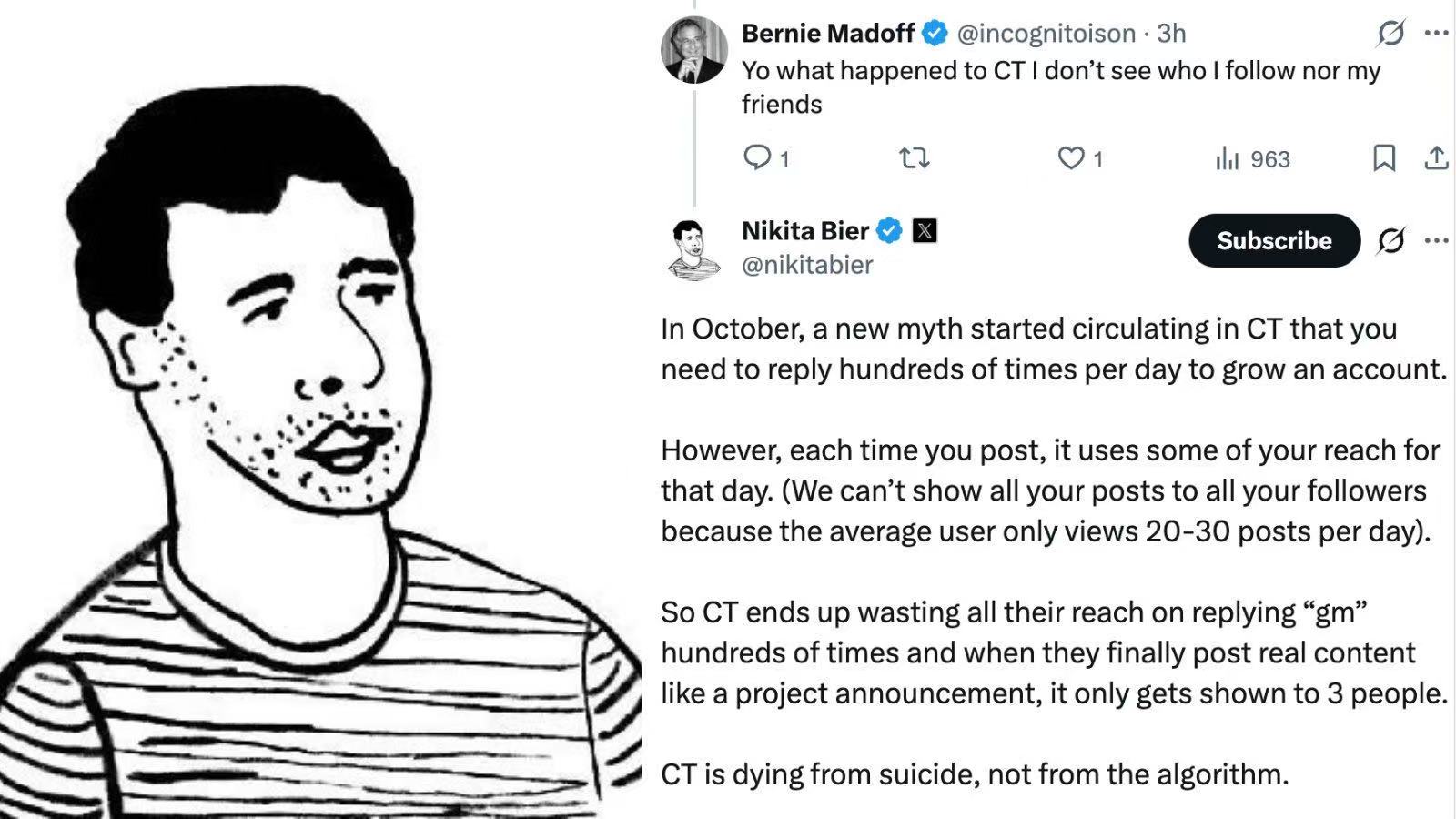
This post sparked strong dissatisfaction within the crypto community at the time, even leading to a large-scale 'GM' counter-attack, which eventually resulted in the tweet being deleted. But in hindsight, X's determination to clean up low-quality content had already been foreshadowed.

Ecosystem Projects Make Drastic Survival Moves, Teams Accused of Dumping Tokens Early

As X tightens its API policy, the InfoFi narrative is facing a cold spell.

CoinGecko data shows that in the past 24 hours, the market capitalization of the InfoFi sector fell to $350 million, with many tokens experiencing double-digit declines. Even the floor price of Yapybaras NFT from Kaito couldn't escape, plummeting.

Faced with a survival test, multiple InfoFi applications have announced pivots.

Yu Hu, founder of the representative project Kaito, stated that the company will gradually terminate Yaps and the incentivized leaderboard system, instead launching a new Kaito Studio. This decision stems from the platform's issues with low-quality content and spam, as well as a shift in the crypto industry from a high-frequency global distribution model towards more precise marketing. After discussions with the X platform, both parties reached a consensus: a completely permissionless distribution system is no longer viable and does not meet the needs of high-quality brands, serious content creators, or the X platform itself. Over the past few months, the platform has been developing Kaito Studio. This product will adopt a layered traditional marketing model, connecting brands with high-quality creators through top-tier analytical tools, covering multiple platforms like X, YouTube, TikTok, and expanding beyond cryptocurrency into areas like finance and AI.

Meanwhile, Cookie DAO, after consulting with the X team, decided to immediately shut down the Snaps platform and all creator activities. Cookie DAO stated it will wait for confirmation and guidance from the X platform to determine if creator activities similar to Snaps can operate in any form in the future. Simultaneously, the platform is communicating directly with all project teams running Snaps activities. Some situations are more complex, involving pre-paid activity fees and promised rewards. While full solutions are not yet available, they will adhere to principles of fairness and communicate directly with each project. The platform has taken snapshot archives of all active activities and will provide updates to creators as soon as possible. Other products under Cookie are unaffected. Additionally, over the past six months, the platform has been continuously developing Cookie Pro, a crypto real-time market intelligence tool, planned for launch in the first quarter.

Judging from the project teams' statements, this policy adjustment is not a sudden black swan event; the teams were already aware of the changing winds and had布局 (laid out plans for) a pivot in advance. This has also sparked market controversy, with the community质疑 (questioning) whether projects knew about the negative news in advance and dumped their tokens.
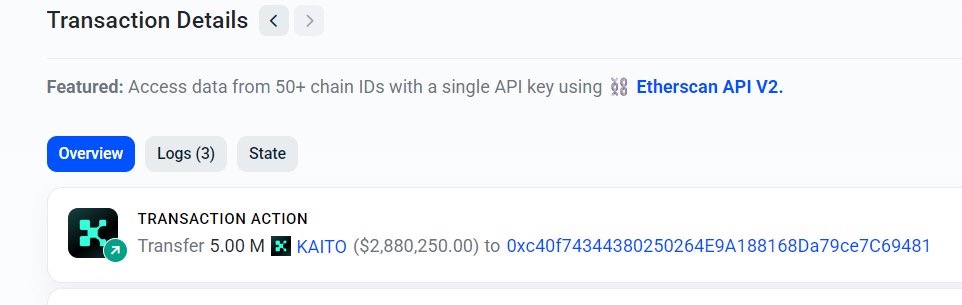
Taking Kaito as an example, its multi-signature contract address distributed and transferred a cumulative 24 million KAITO (approx. $13.31 million) to 5 addresses two weeks ago. Among them, according to monitoring by crypto KOL "vasucrypto", the 0x049A address associated with the Kaito team transferred 5 million KAITO to Binance 7 days ago, possibly for sale. More intriguingly, crypto KOL "加密无畏" (Crypto Fearless) added that Kaito's staking unlocks also peaked in the past few days. 1.1 million KAITO tokens are also scheduled to unlock tomorrow (January 17th), with the unstaking period being 7 days.

Farewell to the 'Talk-to-Earn' Era, Long-Overdue Content Justice

X's brutal industry purge is not just an adjustment of platform rules but also a reshaping of the crypto content ecosystem.

For X, which highly relies on advertising revenue and subscription services, facing external pressures like slowing user growth, inefficient traffic monetization, and the strong rise of competitors, this adjustment is an inevitable choice for survival. In fact, over the past few months, X has already begun making sweeping reforms in content and traffic distribution, including adjusting algorithm weights and increasing revenue for high-quality creators. Ultimately, X's true target is not solely the InfoFi model, but the low-quality content that severely dilutes the platform's value and drives away real users.

For the crypto Twitter circle, this is also a long-overdue form of content justice. Although the original intention of the InfoFi model was to encourage creators to produce high-quality content through token incentives, and it did shine briefly, this mechanism was also hijacked by 'airdrop farming' behavior, where a large number of profit-seekers疯狂制造 (frantically produced) low-quality and repetitive spam information. This false流量繁荣 (traffic prosperity) not only made content dull but also caused truly deep and valuable content to be drowned out by noise, accelerating the loss of real users.

This 'ban' is undoubtedly a 'noise filter' for CT users who are tired of spam; their timelines can finally catch a breath.

However, the decline in CT's热度 (heat) is not entirely attributable to InfoFi; it is also closely related to the overall downturn cycle of the crypto industry. Even the viewership of crypto content on YouTube has fallen to its lowest level since January 2021.

Regardless, the end of this InfoFi model is a necessary path to improving the readability of crypto content and returning to the essence of content. For InfoFi projects, now that the shortcut of寄生 (parasitizing) Web2 giant traffic has been cut off, how to establish a SocialFi mechanism based on the flow of real value is a难题 (challenge) that urgently needs answering.


Twitter:https://twitter.com/BitpushNewsCN

Bitpush TG Discussion Group:https://t.me/BitPushCommunity

Bitpush TG Subscription: https://t.me/bitpush

Original Link:https://www.bitpush.news/articles/7603422

Pertanyaan Terkait

QWhat major change did X (formerly Twitter) announce regarding InfoFi applications on January 15th?

AX revoked API access for InfoFi applications, effectively ending the 'post-to-earn' model that rewarded users for posting.

QAccording to X's product lead Nikita Bier, why was the API access for InfoFi apps terminated?

ABecause these incentive mechanisms were identified as the main cause of a large amount of AI-generated spam and low-quality replies on the platform, which degraded user experience.

QHow did the InfoFi ecosystem react to X's policy change, as mentioned in the article?

AProjects like Kaito and Cookie DAO announced they were pivoting or shutting down their incentivized platforms, with Kaito developing a new marketing tool and Cookie DAO focusing on a market intelligence product.

QWhat controversy emerged concerning the Kaito team's actions prior to the official announcement?

AThe community questioned if the team had prior knowledge of the policy change, as a team-associated address transferred a large amount of KAITO tokens to Binance potentially for selling, and a significant token unlock was scheduled around the same time.

QWhat does the article suggest is the broader implication of X's crackdown on InfoFi for the crypto content ecosystem?

AIt is seen as a necessary step to filter out low-quality content and spam, a 'long-overdue content justice' that could improve readability and push the ecosystem to focus on genuine value and content quality rather than artificial engagement for rewards.

Bacaan Terkait

Migrasi Dana DeFi 30 Miliar Dolar: LayerZero Terjatuh, Chainlink Untung Besar

Penulis: Nancy, PANews Insiden peretasan Kelp DAO, salah satu insiden keamanan DeFi terbesar pada tahun 2026 hingga saat ini, memicu perpindahan likuiditas besar-besaran senilai lebih dari $30 miliar dalam satu minggu dari LayerZero ke Chainlink CCIP. Banyak protokol DeFi, termasuk Kelp DAO sendiri, bermigrasi karena kekhawatiran keamanan. LayerZero mengalami krisis kepercayaan setelah insiden tersebut. Diskusi komunitas mengungkapkan kekhawatiran tentang risiko keamanan dalam konfigurasi defaultnya dan aktivitas yang tidak biasa dari alamat multisignature-nya. Menanggapi kritik, CEO LayerZero Bryan Pellegrino mengakui beberapa masalah dan menyarankan proyek untuk beralih dari konfigurasi default. LayerZero kemudian secara resmi meminta maaf, mengakui kelemahan manajemen risiko, dan mengumumkan serangkaian peningkatan keamanan seperti menghentikan konfigurasi node tunggal dan bermigrasi ke multisignature yang lebih ketat. Sementara itu, Chainlink muncul sebagai penerima manfaat utama. Selain mendapatkan migrasi protokol DeFi, Chainlink juga terus mendapatkan adopsi dari lembaga keuangan tradisional seperti DTCC dan SIX Group. Data on-chain menunjukkan peningkatan aktivitas yang signifikan pada jaringan Chainlink, termasuk peningkatan jumlah alamat aktif dan akumulasi token LINK oleh alamat besar (whale). Insiden ini menyoroti betapa kritisnya keamanan infrastruktur lintas rantai (cross-chain) dalam industri DeFi, di mana krisis kepercayaan dapat dengan cepat mengalihkan likuiditas dan pengaruh pasar.

marsbit35m yang lalu

Migrasi Dana DeFi 30 Miliar Dolar: LayerZero Terjatuh, Chainlink Untung Besar

marsbit35m yang lalu

Dari Gas Limit hingga "Keyed Nonces", Bagaimana Memahami Tahap Berikutnya dalam Skalabilitas Ethereum?

Secara objektif, pengalaman langsung pengguna Ethereum seringkali berasal dari operasi on-chain, seperti penurunan biaya Gas dan peningkatan interoperabilitas. Skalabilitas Ethereum baru berarti jika diterjemahkan menjadi biaya lebih rendah, operasi lebih lancar, dan pengalaman dompet lebih aman. Dinamika baru, termasuk **Gas Limit menuju 2 miliar** dalam upgrade Glamsterdam dan **Keyed Nonces (EIP-8250)**, menunjukkan upaya memindahkan kompleksitas dari pengguna/DApp ke lapisan protokol. Peningkatan **Gas Limit** dari 60 juta ke 200 juta (dengan konsensus arahan pasca-Glamsterdam) bukan hanya memperbesar blok, tetapi bagian dari pendekatan holistik dengan ePBS, Block-Level Access Lists (BAL), dan EIP-8037 untuk menjaga desentralisasi dan keamanan node. **Keyed Nonces** mengubah model antrian transaksi. Alih-alih satu nonce linier per akun, mekanisme (nonce_key, nonce_seq) memungkinkan beberapa domain nonce independen. Ini seperti memiliki jalur terpisah untuk transfer biasa, transaksi privasi, otorisasi sesi, atau eksekusi batch, mengurangi tabrakan dan pemblokiran. Vitalik Buterin melihatnya sebagai langkah pertama menuju strategi skalabilitas status yang lebih luas. Bagi pengguna biasa, upgrade protokol ini akan diterjemahkan ke dalam **pengalaman dompet yang lebih baik**. Kompleksitas seperti pemahaman nonce, konflik transaksi, dan otorisasi multi-langkah dapat dikurangi. Tujuannya adalah antarmuka yang lebih intuitif, aman, dan lancar untuk interaksi on-chain yang semakin beragam. Secara keseluruhan, fokus Ethereum berkembang dari sekadar "transaksi lebih murah" (melalui L2) menuju "pengalaman on-chain yang terpadu", dengan peningkatan kapasitas L1, model akun yang lebih fleksibel, dan interoperabilitas yang lebih baik — di mana dompet berperan krusial sebagai penerjemah kemampuan teknis ini bagi pengguna.

marsbit58m yang lalu

Dari Gas Limit hingga "Keyed Nonces", Bagaimana Memahami Tahap Berikutnya dalam Skalabilitas Ethereum?

marsbit58m yang lalu

Setelah Meninggalkan OpenAI, Berapa Kali Lipat Nilai Kekayaan Mereka Meningkat?

Judul: Setelah Meninggalkan OpenAI, Berapa Kali Lipat Nilai Mereka Meningkat? Artikel ini membahas bagaimana para mantan karyawan OpenAI menjadi sangat berharga dengan mendirikan perusahaan atau berinvestasi di bidang AI. Nilai gabungan mereka diperkirakan mendekati $10 triliun. Contohnya termasuk Dario Amodei (Anthropic, valuasi potensial $9 triliun), Ilya Sutskever (SSI, valuasi $320 miliar), Aravind Srinivas (Perplexity, valuasi $212 miliar), dan Mira Murati (Thinking Machines Lab, valuasi $120 miliar). Sorotan utama adalah Leopold Aschenbrenner, yang dipecat pada usia 23 tahun. Ia menulis laporan "Situational Awareness" dan berhasil meningkatkan aset dana lindung nilai dari $225 juta menjadi $5,5 miliar dengan berinvestasi di perusahaan nuklir Vistra dan bahan bakar Bloom Energy, berdasarkan pengetahuan internalnya tentang kebutuhan energi AI. Selain pendiri, ada juga yang beralih ke investasi. Misalnya, dana Zero Shot senilai $100 juta yang didirikan oleh mantan karyawan OpenAI seperti Evan Morikawa. Mereka berfokus pada investasi tahap awal, dengan keunggulan utama mereka adalah mengetahui area mana yang harus dihindari berdasarkan wawasan internal, seperti alat "pemrograman atmosfer" atau perusahaan robotika yang mengandalkan data video manusia. Artikel ini juga menyoroti jaringan investasi malaikat di antara alumni, seperti Sam Altman yang dengan cepat mendukung mantan karyawan yang memulai bisnis. Jaringan ini didorong oleh keyakinan bersama pada masa depan AGI (Kecerdasan Buatan Umum), berbeda dengan "PayPal Mafia" yang didasarkan pada pengalaman bersama. Kesimpulannya, alumni OpenAI menggunakan "kesadaran situasional" unik mereka — pemahaman mendalam tentang lanskap AI — untuk membuat keputusan strategis, baik dengan membangun perusahaan baru atau berinvestasi. Pergeseran mereka dari pembangun menjadi investor menunjukkan keyakinan yang kuat pada peluang yang telah mereka identifikasi.

marsbit1j yang lalu

Setelah Meninggalkan OpenAI, Berapa Kali Lipat Nilai Kekayaan Mereka Meningkat?

marsbit1j yang lalu

Trading

Spot
Futures

Artikel Populer

Cara Membeli ERA

Selamat datang di HTX.com! Kami telah membuat pembelian Caldera (ERA) menjadi mudah dan nyaman. Ikuti panduan langkah demi langkah kami untuk memulai perjalanan kripto Anda.Langkah 1: Buat Akun HTX AndaGunakan alamat email atau nomor ponsel Anda untuk mendaftar akun gratis di HTX. Rasakan perjalanan pendaftaran yang mudah dan buka semua fitur.Dapatkan Akun SayaLangkah 2: Buka Beli Kripto, lalu Pilih Metode Pembayaran AndaKartu Kredit/Debit: Gunakan Visa atau Mastercard Anda untuk membeli Caldera (ERA) secara instan.Saldo: Gunakan dana dari saldo akun HTX Anda untuk melakukan trading dengan lancar.Pihak Ketiga: Kami telah menambahkan metode pembayaran populer seperti Google Pay dan Apple Pay untuk meningkatkan kenyamanan.P2P: Lakukan trading langsung dengan pengguna lain di HTX.Over-the-Counter (OTC): Kami menawarkan layanan yang dibuat khusus dan kurs yang kompetitif bagi para trader.Langkah 3: Simpan Caldera (ERA) AndaSetelah melakukan pembelian, simpan Caldera (ERA) di akun HTX Anda. Selain itu, Anda dapat mengirimkannya ke tempat lain melalui transfer blockchain atau menggunakannya untuk memperdagangkan mata uang kripto lainnya.Langkah 4: Lakukan trading Caldera (ERA)Lakukan trading Caldera (ERA) dengan mudah di pasar spot HTX. Cukup akses akun Anda, pilih pasangan perdagangan, jalankan trading, lalu pantau secara real-time. Kami menawarkan pengalaman yang ramah pengguna baik untuk pemula maupun trader berpengalaman.

659 Total TayanganDipublikasikan pada 2025.07.17Diperbarui pada 2025.07.17

Cara Membeli ERA

Diskusi

Selamat datang di Komunitas HTX. Di sini, Anda bisa terus mendapatkan informasi terbaru tentang perkembangan platform terkini dan mendapatkan akses ke wawasan pasar profesional. Pendapat pengguna mengenai harga ERA (ERA) disajikan di bawah ini.

活动图片