Strategy Watch #4

insights.glassnodeDipublikasikan tanggal 2026-05-22Terakhir diperbarui pada 2026-05-22

Abstrak

Strategy Watch #4 provides a monthly institutional analysis of digital asset fund performance and allocation trends. The report covers six sections. Key findings for April show mixed capital flows: Bitcoin outflows eased significantly, nearing neutral, while stablecoin inflows surged to multi-month highs, indicating a defensive rotation into dollar instruments. Ethereum remained in persistent net outflow. ETF and DAT flows were positive for Bitcoin, while Ethereum flows staged a notable late-month reversal from deep outflows to meaningful inflows. However, DeFi TVL on Ethereum reversed its March stabilization, with accelerated outflows suggesting sustained allocator caution toward on-chain yield strategies. CME basis yields for both BTC and ETH deteriorated sharply, turning deeply negative as futures moved into backwardation, removing carry opportunities. Across strategies, all sub-strategies posted gains for the month, a rare alignment. Despite a more constructive market backdrop, manager cash levels climbed to multi-year highs, indicating selective and cautious positioning. The report also includes a DeFi/Yield strategy deep dive, on-chain vault performance analysis, and updates on institutional allocations, including rising pension fund activity.

The full report is freely available in PDF format.

Download PDF version

Welcome to Strategy Watch #4

Strategy Watch was built to address a clear demand for high-signal, impartial analysis of fund-level performance and allocation trends in digital assets.

Our objective is straightforward — to make Strategy Watch a must-read monthly publication for the digital asset investment community.

This publication is strengthened by direct input from market participants. Funds and allocators that contribute data and insights help shape a more complete and valuable view of the landscape. If you have insights, data, or allocation updates worth sharing, we welcome your contribution.

Present your latest initiatives and updates to a curated audience of institutional allocators.

Share updates ↗

Inside the Latest Strategy Watch

The report is structured across six core sections, each focused on a distinct dimension of institutional activity in digital assets:

01 Institutional Flow Monitor | Defensive positioning persisted through April as BTC and ETH outflows eased further, stablecoin demand accelerated, and ETF inflows remained constructive.

02 Fund and SMA Performance | Every sub-strategy posted gains for the month, a level of cross-strategy alignment not seen in recent memory. Is this a rebound or repositioning?

03 Strategy Deep Dive: DeFi/Yield | Hear a CIO's perspective on where edge comes from as lending spreads compress and smart contract risk evolves

04 On-chain Vault Performance | Are ETH curators underperforming ETH staking yield?

05 Manager Monitor | Find out how more than 400+ managers are positioning for Q2, with cash levels climbing to multi-year highs despite a more constructive market backdrop.

06 Allocation Updates | Pension allocations rise alongside strategic acquisitions and new launches across yield, trading, and digital asset strategies.

in partnership with

The Premier Digital Assets Allocator Platform. Learn more


Institutional Flow Monitor

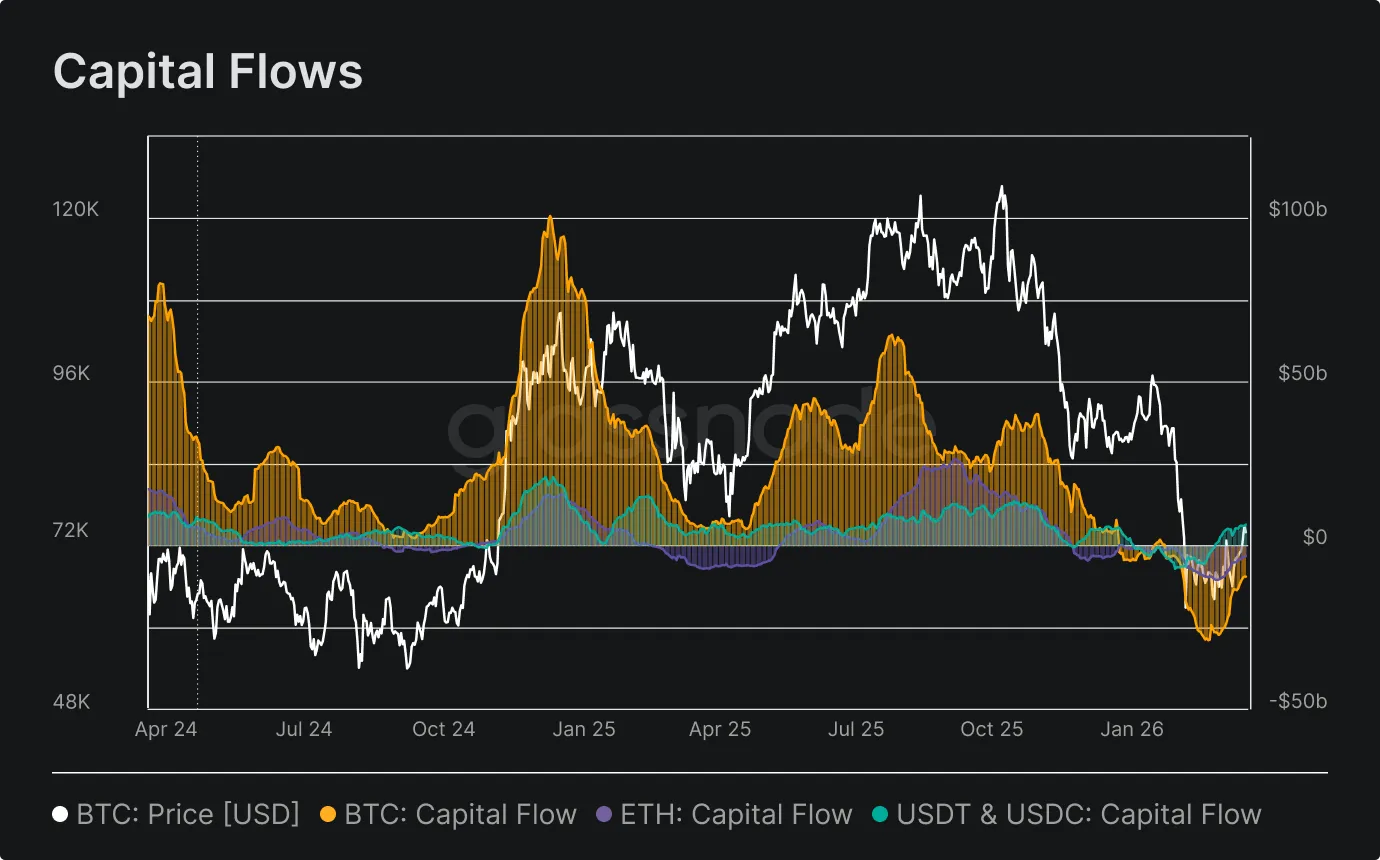
  • BTC capital flows nearly recovered to neutral through April while stablecoin inflows surged to multi-month highs, though ETH remained persistently in net outflow.

Bitcoin capital flows recovered materially through April, improving from -$6.9B at month-open to nearly neutral at -$0.7B by month-end, continuing the gradual deceleration of outflows observed in March. Stablecoins showed the strongest directional move, with inflows accelerating from +$1.8B in early April to +$5.4B by month-end, suggesting a meaningful rotation of capital into dollar-denominated on-chain instruments. Ethereum stood apart from both trends, remaining in persistent net outflow throughout the month and closing at -$1.6B, broadly unchanged from its March reading. The divergence between a stabilizing BTC, surging stablecoin demand, and a lagging ETH points to a selective rather than broad-based recovery in capital allocation.
ETF & DAT Net Flows

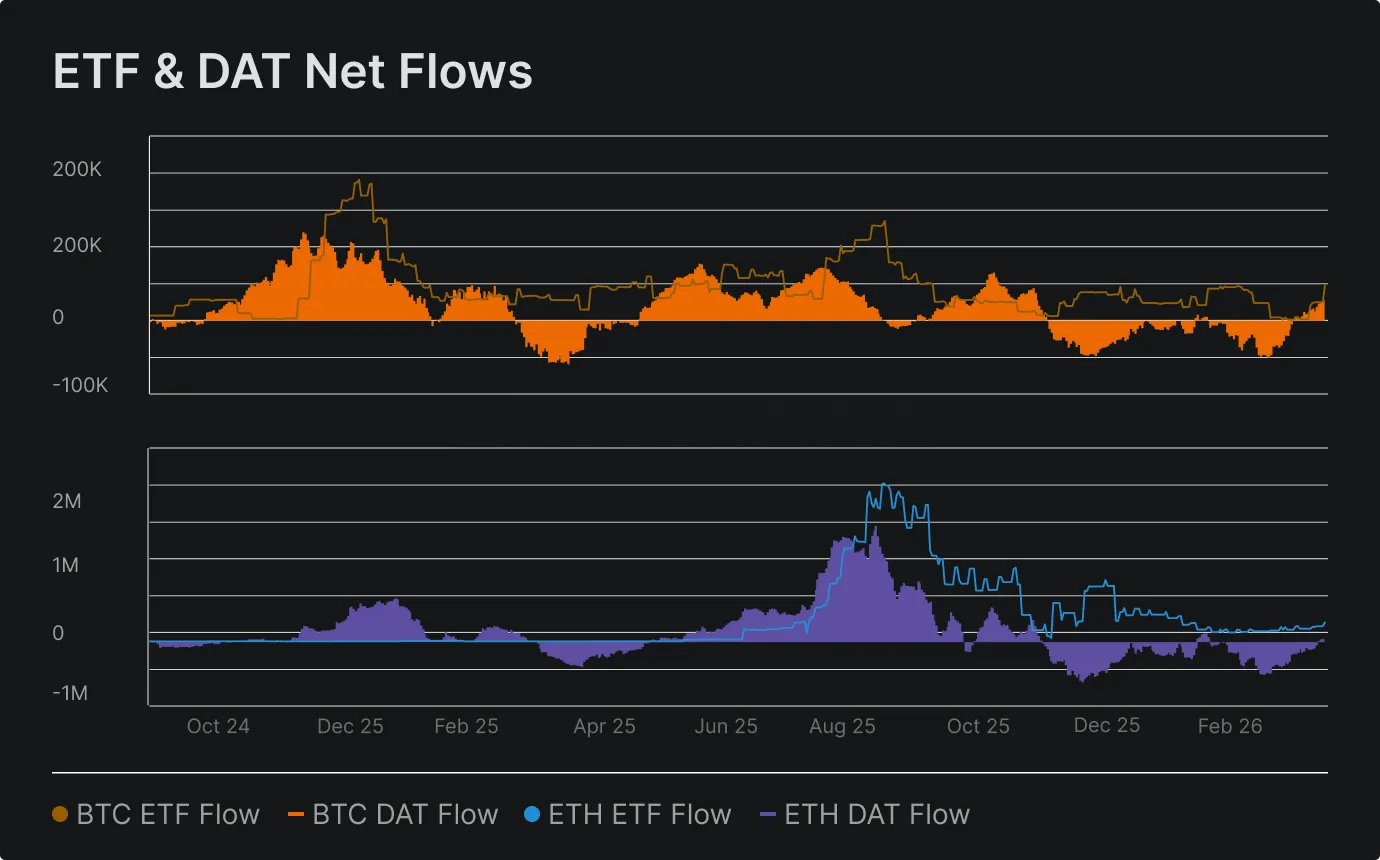
  • BTC ETF and DAT flows held positive through April while ETH staged a notable turnaround, flipping from deep outflow in early April to meaningful inflows by month-end.

Bitcoin ETF flows maintained positive territory throughout April, recovering from a mid-month dip to close at +26.3k BTC, while DAT flows strengthened progressively to +58.8k BTC by month-end. The more significant shift came from Ethereum, where ETF flows opened the month at -135k ETH before turning positive around April 18 and closing at +140.6k ETH. ETH DAT flows remained constructive throughout, finishing at +408.6k ETH. While BTC institutional demand showed consistency, the ETH turnaround is the more notable development, though it remains early and the magnitude of the late-month recovery warrants monitoring before drawing conclusions about a durable change in positioning.
DeFi TVL & Stablecoin Cap

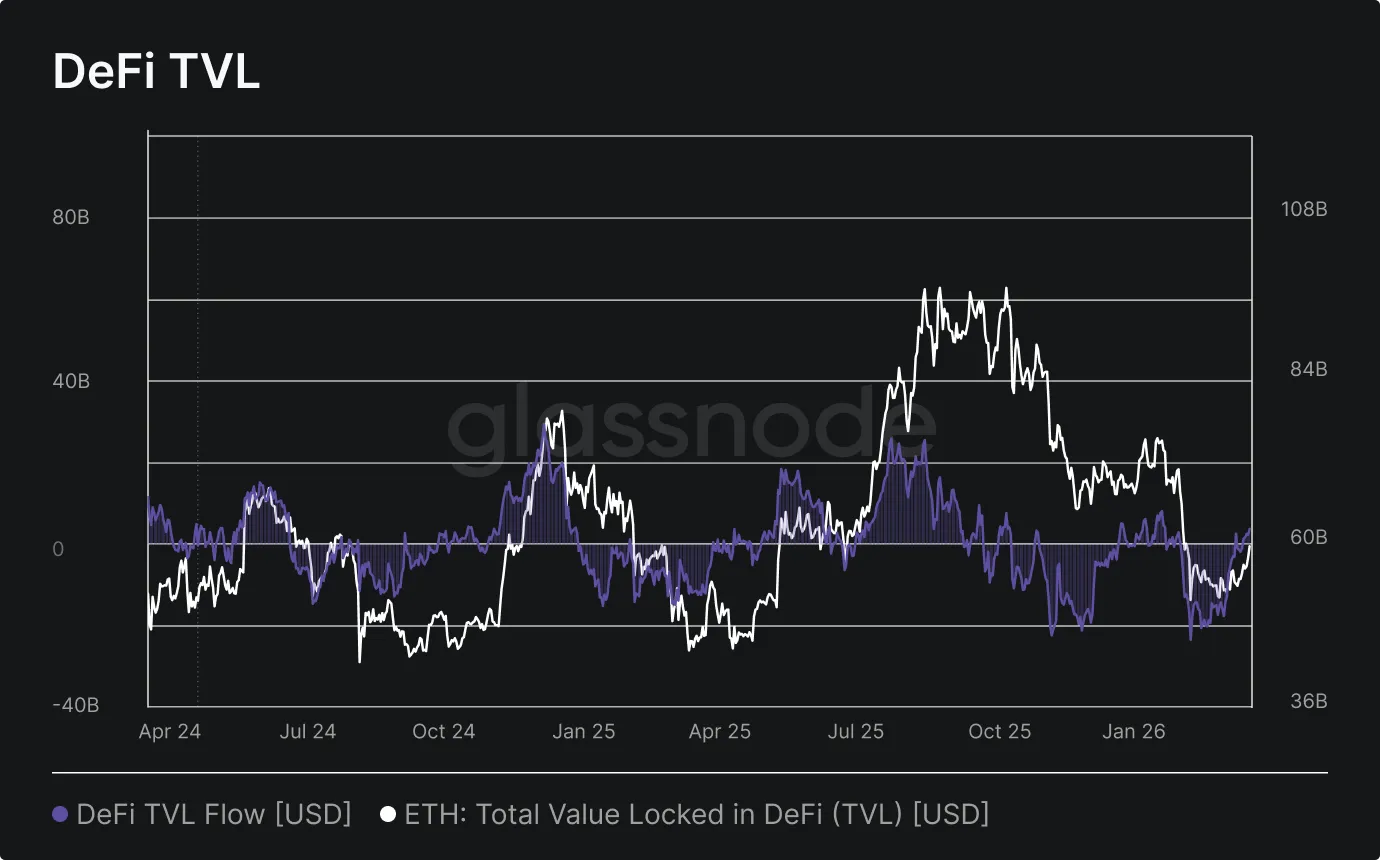
  • DeFi TVL flows on Ethereum reversed sharply in April, erasing the March stabilization as outflows accelerated to multi-month highs in the final week.

After nearly reaching neutral at month-end March, Ethereum DeFi TVL flows deteriorated steadily through April. The first half of the month was relatively contained, with flows oscillating near neutral before turning more negative around mid-month. The picture changed materially in the final ten days, with outflows accelerating to a peak of -$11.3B around April 25 before partially recovering to -$7.6B at month-end. Total ETH locked in DeFi fell from ~$54B at month-open to ~$44.9B by close. The reversal of March's stabilization trend suggests the earlier recovery was fragile, and the renewed pace of withdrawal points to sustained allocator caution toward on-chain yield strategies heading into May.
CME Basis Yield

  • CME basis yield deteriorated sharply through April for both BTC and ETH, with carry returns turning deeply negative by month-end as futures markets shifted into persistent backwardation.

After closing March at -$3.9M and +$0.9M respectively, BTC and ETH CME basis yields both briefly recovered in early-to-mid April, with BTC reaching +$3.3M and ETH +$1.7M around April 9-12. The recovery proved short-lived. Both assets deteriorated sharply through the second half of the month, with BTC closing April at -$21.2M and ETH at -$6.0M. The depth and pace of this reversal suggests futures markets moved into meaningful backwardation, removing the economic basis for cash-and-carry strategies entirely. For institutions running market-neutral books, the carry environment in April offered no compensation, reinforcing the broader picture of reduced leverage deployment and subdued institutional risk appetite.


Disclaimer: This report does not provide any investment advice. All data is provided for information and educational purposes only. No investment decision shall be based on the information provided here and you are solely responsible for your own investment decisions.
Exchange balances presented are derived from Glassnode’s comprehensive database of address labels, which are amassed through both officially published exchange information and proprietary clustering algorithms. While we strive to ensure the utmost accuracy in representing exchange balances, it is important to note that these figures might not always encapsulate the entirety of an exchange’s reserves, particularly when exchanges refrain from disclosing their official addresses. We urge users to exercise caution and discretion when utilizing these metrics. Glassnode shall not be held responsible for any discrepancies or potential inaccuracies. Please read our Transparency Notice when using exchange data.

Pertanyaan Terkait

QWhat is the primary objective of the Strategy Watch publication?

AThe primary objective of Strategy Watch is to become a must-read monthly publication for the digital asset investment community by providing high-signal, impartial analysis of fund-level performance and allocation trends in digital assets.

QAccording to the Institutional Flow Monitor, what was the trend for Bitcoin (BTC) and stablecoin capital flows in April?

AIn April, Bitcoin (BTC) capital flows nearly recovered to neutral, showing a significant improvement from a -$6.9B net outflow at the beginning of the month to nearly -$0.7B by month-end. In contrast, stablecoin inflows surged to multi-month highs, accelerating from +$1.8B to +$5.4B by month-end.

QHow did Ethereum (ETH) ETF flows change during the month of April?

AEthereum (ETH) ETF flows staged a notable turnaround in April. They opened the month at a deep outflow of -135k ETH, then turned positive around April 18th, and closed the month at a meaningful inflow of +140.6k ETH.

QWhat happened to DeFi TVL (Total Value Locked) on Ethereum in April?

ADeFi TVL flows on Ethereum reversed sharply in April. After nearly stabilizing in March, outflows accelerated, reaching a peak of -$11.3B around April 25th and closing the month at -$7.6B. Total ETH locked in DeFi fell from approximately $54B to $44.9B.

QWhat was the trend for CME basis yield for both BTC and ETH through April?

ACME basis yield for both BTC and ETH deteriorated sharply through April. After briefly recovering in early-to-mid April, both turned deeply negative by month-end, with BTC closing at -$21.2M and ETH at -$6.0M, indicating futures markets moved into persistent backwardation.

Bacaan Terkait

Mengapa Zhipu AI Bisa Meroket Hampir 30% dalam Satu Hari?

Hari ini, saham "Glodon" (02513.HK), yang dijuluki "saham model besar global pertama", melonjak hampir 30%. Pemicu utamanya adalah peluncuran API "GLM-5.1-highspeed" yang menawarkan kecepatan generasi hingga 400 token per detik, mencatat rekor baru untuk API model besar. Kecepatan ini sangat penting karena pergeseran paradigma dari AI chatbot ke era Agen (Agent), di mana tugas kompleks memerlukan puluhan hingga ratusan panggilan model. Setiap penghematan latensi akan terakumulasi dan secara signifikan memengaruhi efisiensi keseluruhan. Pencapaian 400 token/detik ini kira-kira 3-5 kali lebih cepat dari rata-rata industri (OpenAI GPT-4o: 100-150, Claude Sonnet: 80-120) dan dicapai tanpa mengorbankan kemampuan model inti. Lonjakan performa ini didukung oleh tiga inovasi teknis: 1. **TileRT**: Mesin inferensi yang mengkompilasi seluruh model menjadi pipeline kontinu, menghilangkan overhead start/stop antar operator dan menerapkan "Warp Specialization" untuk paralelisasi optimal dalam GPU. 2. **Strategi Paralel Heterogen untuk MLA (Multi-head Latent Attention)**: Mengatasi tantangan komputasi sparse dalam mekanisme perhatian MLA dengan menugaskan GPU berbeda untuk tugas "pengindeksan" dan "komputasi padat", meminimalkan sinkronisasi. 3. **Arsitektur Jaringan ZCube**: Mengganti topologi jaringan standar ROFT (Fat-Tree) dengan desain datar tanpa lapisan Spine. Desain ini menciptakan "jalur tunggal optimal" antara GPU mana pun, secara fundamental menghilangkan kemacetan jaringan. Hasilnya, pada perangkat keras yang sama, ZCube meningkatkan throughput cluster sebesar 15% (setara dengan peningkatan kapasitas gratis), mengurangi latensi ekor sebesar 40,6% (meningkatkan stabilitas), dan memotong biaya perangkat jaringan hingga sepertiga. Secara jangka panjang, inovasi perangkat lunak ini berpotensi mengikis dominasi NVIDIA di ekosistem jaringan (seperti InfiniBand) dan membuka jalan bagi integrasi yang lebih mudah dengan chip AI domestik seperti Huawei Ascend.

marsbit1j yang lalu

Mengapa Zhipu AI Bisa Meroket Hampir 30% dalam Satu Hari?

marsbit1j yang lalu

Era Powell Berakhir: Warsh Meneruskan Jabatan di The Fed, Apa Artinya Bagi Keuangan Global dan Pasar Kripto?

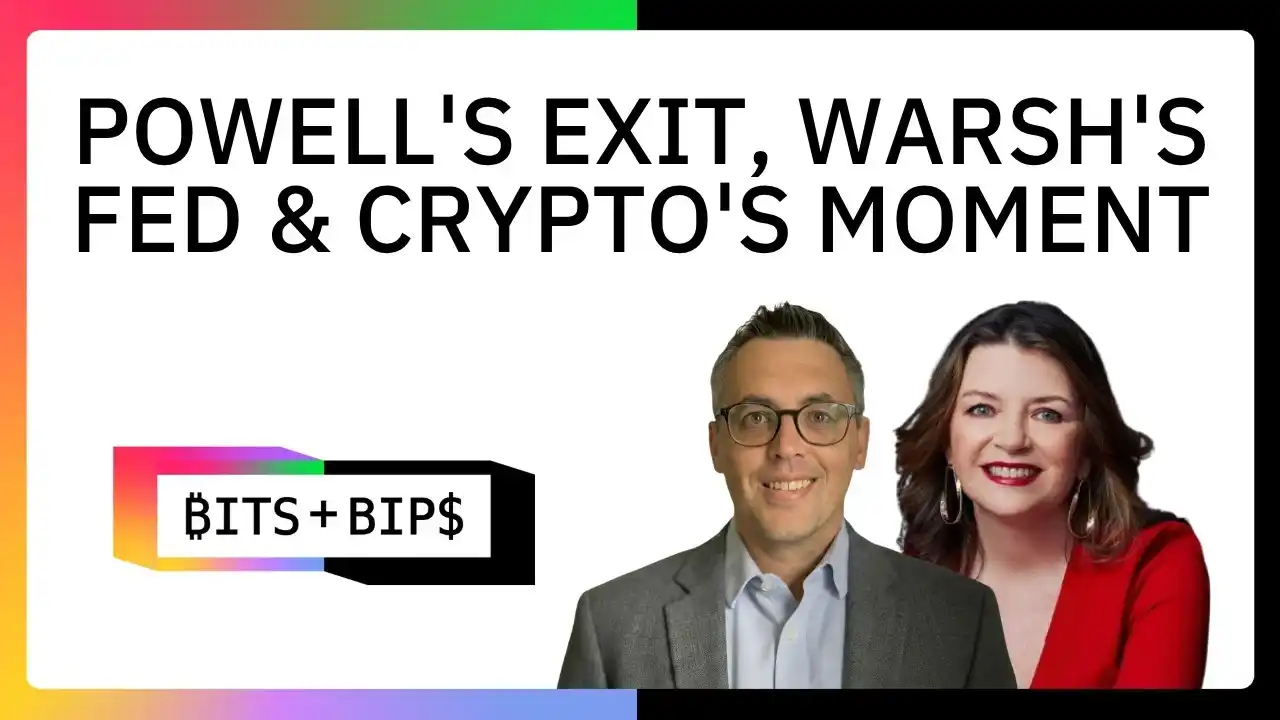
Era Powell berakhir, digantikan oleh Kevin Warsh sebagai Ketua Federal Reserve AS. Podcast ini membahas implikasi pergantian kepemimpinan ini terhadap pasar keuangan global dan aset kripto. Analis Noelle Acheson menyoroti beberapa poin kunci: **Kondisi Makro & Pasar:** - Terjadi divergensi besar antara pasar saham (didorong euforia AI) dan pasar obligasi (yang mencerminkan kekhawatiran inflasi dan pengetatan global). - Inflasi inti AS tetap tinggi (2.6%-3%) dan tidak turun dengan cepat, didorong oleh tren deglobalisasi, tarif, dan krisis geopolitik. - "Bliss Trade" menggantikan "Taco Trade", yaitu ekspektasi struktural bahwa pemerintah akan selalu menyelamatkan ekonomi/pasar dalam krisis, menciptakan risiko moral dan mendorong apetite risiko. **Masa Jabatan Powell:** - Diakui mempertahankan independensi Fed, namun juga dikritik sebagai dalang di balik 'debanking' perusahaan kripto dan salah menilai inflasi sebagai 'sementara'. **Prospek di Bawah Warsh:** - Warsh ingin Fed fokus pada kebijakan moneter dan mengurangi intervensi fiskal, serta mungkin mengurangi panduan ke depan (forward guidance). - Namun, pasar obligasi akan menjadi penentu utama, membatasi ruang geraknya. Kemungkinan besar suku bunga akan bertahan tinggi (*higher for longer*), tanpa pemotongan atau kenaikan signifikan dalam waktu dekat. **Dampak pada Aset Kripto:** - Bitcoin telah menjadi aset makro, berfungsi sebagai lindung nilai terhadap depresiasi mata uang akibat stimulus. - Namun, status ini juga membuat Bitcoin sekadar satu dari banyak pilihan aset makro. Investor yang mencari volatilitas tinggi kini beralih ke tema lain seperti AI. - RUU Clarity Act, jika disahkan, akan lebih menguntungkan Ethereum daripada Bitcoin (yang sudah memiliki kejelasan regulatif), dan dapat mendorong eksperimen tokenisasi. **Perhatian & Peringatan:** - Inflasi tetap menjadi indikator kritis yang harus dipantau. - Kesenjangan yang melebar antara indeks S&P 500 berbasis kapitalisasi pasar dan berbasis bobot sama menjadi sinyal peringatan, mengingatkan pada gelembung dot-com tahun 1999.

marsbit1j yang lalu

Era Powell Berakhir: Warsh Meneruskan Jabatan di The Fed, Apa Artinya Bagi Keuangan Global dan Pasar Kripto?

marsbit1j yang lalu

Meninggalkan “Perjudian Abu-abu”!Polymarket Berlari ke Jalur Kepatuhan, Bagaimana Mempengaruhi Seluruh Industri Kripto?

Polymarket, platform pasar prediksi crypto terdesentralisasi, telah menyelesaikan perjalanan transformatif dari zona abu-abu ke jalur kepatuhan. Didirikan pada 2020 oleh Shayne Coplan, platform ini dengan cepat populer, terutama selama Pemilu AS 2024, dengan volume perdagangan melonjak dan akurasi prediksi yang mengungguli jajak pendapat tradisional. Namun, keberhasilannya diwarnai tantangan regulasi. Pada 2022, CFTC menjatuhkan denda $1,4 juta kepada Polymarket dan mengusirnya dari pasar AS karena menawarkan kontrak derivatif tanpa izin. Puncaknya, pada November 2024, penyelidikan oleh FBI dan CFTC diluncurkan terkait dugaan pelanggaran perjanjian sebelumnya. Perubahan politik membuka jalan bagi resolusi. Pada 2025, Polymarket mengakuisisi bursa berlisensi CFTC, QCX, senilai $112 juta, sekaligus mendapatkan status kepatuhan dan izin untuk beroperasi kembali di AS. Pergeseran sikap regulator, termasuk penarikan proposal larangan kontrak terkait pemilu oleh CFTC pada 2026, semakin memudahkan integrasi industri. Kisah Polymarket mencerminkan pola yang lebih luas dalam inovasi crypto: nilai nyata pada akhirnya akan dicari untuk dimasukkan ke dalam kerangka regulasi. Langkahnya, baik melalui perolehan lisensi (seperti Polymarket) atau aplikasi langsung (seperti Kalshi), menunjukkan berbagai jalur menuju kepatuhan. Investasi $2 miliar dari ICE (induk perusahaan NYSE) menandakan pengakuan institusional atas potensi data pasar prediksi. Transformasi Polymarket dari "permainan crypto" menjadi infrastruktur finansial yang diatur menandai babak baru untuk industri pasar prediksi dan inovasi crypto pada umumnya.

marsbit1j yang lalu

Meninggalkan “Perjudian Abu-abu”!Polymarket Berlari ke Jalur Kepatuhan, Bagaimana Mempengaruhi Seluruh Industri Kripto?

marsbit1j yang lalu

Trading

Spot
Futures

Artikel Populer

Cara Membeli 4

Selamat datang di HTX.com! Kami telah membuat pembelian 4 (4) menjadi mudah dan nyaman. Ikuti panduan langkah demi langkah kami untuk memulai perjalanan kripto Anda.Langkah 1: Buat Akun HTX AndaGunakan alamat email atau nomor ponsel Anda untuk mendaftar akun gratis di HTX. Rasakan perjalanan pendaftaran yang mudah dan buka semua fitur.Dapatkan Akun SayaLangkah 2: Buka Beli Kripto, lalu Pilih Metode Pembayaran AndaKartu Kredit/Debit: Gunakan Visa atau Mastercard Anda untuk membeli 4 (4) secara instan.Saldo: Gunakan dana dari saldo akun HTX Anda untuk melakukan trading dengan lancar.Pihak Ketiga: Kami telah menambahkan metode pembayaran populer seperti Google Pay dan Apple Pay untuk meningkatkan kenyamanan.P2P: Lakukan trading langsung dengan pengguna lain di HTX.Over-the-Counter (OTC): Kami menawarkan layanan yang dibuat khusus dan kurs yang kompetitif bagi para trader.Langkah 3: Simpan 4 (4) AndaSetelah melakukan pembelian, simpan 4 (4) di akun HTX Anda. Selain itu, Anda dapat mengirimkannya ke tempat lain melalui transfer blockchain atau menggunakannya untuk memperdagangkan mata uang kripto lainnya.Langkah 4: Lakukan trading 4 (4)Lakukan trading 4 (4) dengan mudah di pasar spot HTX. Cukup akses akun Anda, pilih pasangan perdagangan, jalankan trading, lalu pantau secara real-time. Kami menawarkan pengalaman yang ramah pengguna baik untuk pemula maupun trader berpengalaman.

734 Total TayanganDipublikasikan pada 2025.10.20Diperbarui pada 2025.10.20

Cara Membeli 4

Diskusi

Selamat datang di Komunitas HTX. Di sini, Anda bisa terus mendapatkan informasi terbaru tentang perkembangan platform terkini dan mendapatkan akses ke wawasan pasar profesional. Pendapat pengguna mengenai harga 4 (4) disajikan di bawah ini.

活动图片