"Poor Man's Gold" Is No Longer Cheap!

marsbitDipublikasikan tanggal 2026-01-23Terakhir diperbarui pada 2026-01-23

Abstrak

"Silver, once known as 'poor man's gold,' is undergoing a fundamental revaluation as it shifts from a financial derivative of gold to a critical industrial material facing a structural supply deficit. The market is no longer treating silver as just a cheaper alternative to gold. Since 2021, the global silver market has experienced a sustained physical deficit, not from financial cycles, but from booming industrial demand. Key drivers include the photovoltaic (PV) sector, where silver is essential and difficult to substitute, with demand reaching 198 million ounces in 2024. Electric vehicles and AI infrastructure further contribute to this inelastic, high-reliability demand. Crucially, supply cannot keep pace. Over 70% of silver production is a by-product of mining for base metals like copper, zinc, and lead, meaning its output is unresponsive to silver price signals. Mine production grew less than 1% in 2024. With visible inventories covering only 1-1.5 months of consumption—below the 3-month safety threshold—the market is moving from cyclical shortage to structural tightness. Silver has shed its identity as gold's shadow and is now a strategically consumed industrial commodity, making its historic undervaluation a thing of the past."

Author: Yan Wai Zhi Yi, Wall Street Insights

In the past, silver was called "poor man's gold" not because it was truly cheap, but because the market never took its scarcity seriously.

Ample supply, adjustable inventories, and dispersed uses—for a long time, the market firmly believed that no matter how demand fluctuated, silver could always be quickly replenished. Because of this, it could be repeatedly traded as a shadow of gold but was almost never seriously allocated.

But this premise has been shattered by reality.

Since 2021, the global silver market has experienced a physical supply-demand deficit for several consecutive years. Unlike the short-term tightness amplified by previous financial cycles, this deficit stems directly from the industrial side: demand for silver in key sectors such as photovoltaics, electrification, and high-end electronics is expanding rapidly and simultaneously, while supply can hardly keep pace.

More critically, silver's supply system is highly unresponsive to price signals.

Over 70% of global silver production comes as a by-product of other metals, with production rhythms determined by the investment cycles of copper, lead, and zinc, not by the price of silver itself. This means that even if prices rise, supply cannot quickly increase; when buffer inventories are continuously depleted, the market faces not temporary fluctuations but sustained constraints.

It is at this moment that silver truly begins to break free from the "poor man's gold" narrative. It is no longer just a cheap alternative when gold rises but is becoming a material that is continuously consumed by key industries and is difficult to replace.
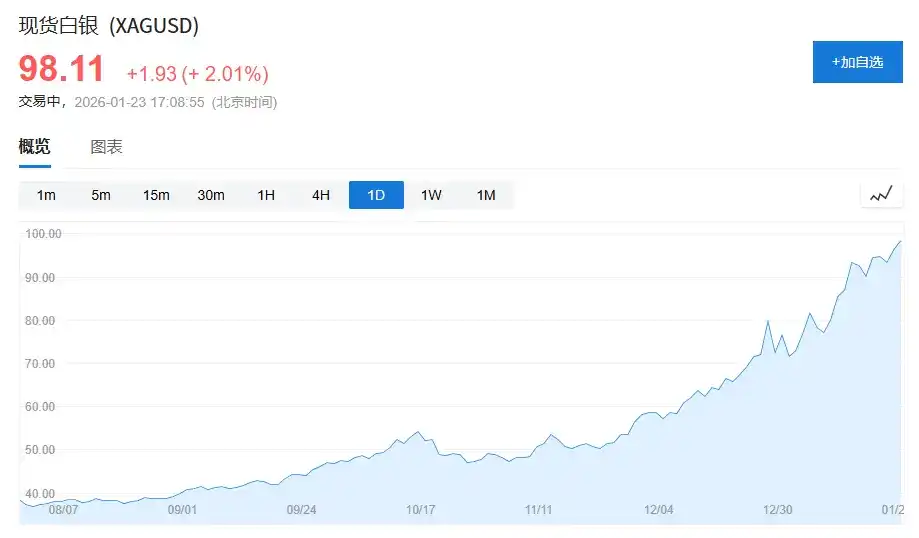
(Silver prices approach $100 per ounce. In mid-October last year, silver was only $50/ounce, nearly doubling in 3 months.)

1. Silver's "Identity Dilemma": Stuck Between Gold and Industrial Metals

To understand why silver has long been undervalued, one must first understand its "identity dilemma."

In the modern commodity system, assets can be broadly divided into two categories:

One is credit-based assets, typically represented by gold. Gold's value anchor does not come from industrial use but from the credit system and reserve demand. Even in the weakest years of demand, global central banks' net gold purchases still account for 15%–25% of total demand, providing a stable foundation for its price.

The other is growth assets, such as copper, crude oil, and iron ore. These metals have almost no financial attributes; their prices are mainly driven by economic cycles, infrastructure, and manufacturing investment.

Silver, however, is stuck between these two.

According to the "World Silver Survey 2025," global silver demand in 2024 was 1.164 billion ounces (approx. 36,200 tons), of which:

Industrial demand was 681 million ounces, accounting for about 58%;

Jewelry and silverware demand was 263 million ounces, accounting for about 23%;

Investment demand (bars, coins, ETFs) was about 191 million ounces, accounting for about 16%.

The problem is that these three types of demand have completely different behavioral patterns:

Industrial demand relies on the industry cycle, jewelry demand is highly price-sensitive, and investment demand is highly susceptible to macro sentiment.

This structural split has long left silver without a stable, single, dominant pricing anchor.

The result is reflected in the price: silver has long been forced to price itself relative to gold.

A clear indicator is the gold-silver ratio. Over the past half-century, the historical average of this ratio has been roughly 55–60; but between 2018–2020, it once exceeded 90, and at the peak of the pandemic shock, it even approached 120.

Even against the backdrop of silver's industrial demand hitting a record high in 2024, the gold-silver ratio has long remained in the 80–90 range, significantly higher than the long-term average.

This is not because silver is "useless," but because the market is still pricing silver using gold's financial logic.

2. Silver's Repositioning: From "Dispersed Use" to "Locked In by Industry"

The real change did not start in the financial markets but occurred quietly on the industrial side.

To summarize the current change in one sentence: Silver is shifting from an industrial metal with dispersed uses to a functional material locked in by key industries.

1. Photovoltaics: Silver Becomes "Indispensable" for the First Time

Photovoltaics are the most critical factor in the change of silver's demand structure.

In 2015, global new PV installations were about 50GW; by 2024, this number exceeded 400GW, an increase of over 8 times in less than a decade.

The industry is indeed continuously "de-silvering." Silver usage per watt has dropped from about 0.3 grams in the early days to around 0.1 grams with current mainstream technology.

But the expansion speed of installation scale is far faster than the decline in unit usage.

According to the "World Silver Survey 2025," the actual demand for silver from the PV industry in 2024 reached 198 million ounces, an increase of over 160% compared to 2019, accounting for about 17% of global silver demand.

More critically, silver's position in photovoltaics is not "easily replaceable." In terms of key indicators such as conductive efficiency, long-term stability, and reliability, silver remains the optimal choice overall. Technological progress changes the method of use, not the status.

This gives silver, for the first time, a source of demand that is large-scale, fast-growing, and price-inelastic.

2. Electric Vehicles and AI Infrastructure: Usage Not Exaggerated, but Extremely Difficult to Substitute

If photovoltaics bring certainty in demand scale, then electric vehicles and digital infrastructure bring a change in the nature of demand.

A traditional internal combustion engine vehicle uses about 15–20 grams of silver on average; a new energy vehicle typically uses 30–40 grams.

Against the backdrop of limited overall growth in global auto sales, the penetration rate of new energy vehicles has risen from less than 3% in 2019 to nearly 20% in 2024, structurally increasing silver demand.

Meanwhile, the demand for silver from data centers, AI servers, and high-end electronic devices is reflected more in its irreplaceability than in absolute volume.

In 2024, silver demand from electrical and electronic related fields reached 461 million ounces, setting new historical records for many consecutive years.

These application scenarios are relatively price-insensitive but are extremely sensitive to supply stability.
3. The Reality on the Supply Side: Silver Is Not a Metal That "Can Increase Production Just Because Prices Rise"

In stark contrast to the certainty on the demand side is the rigidity on the supply side.

In 2024, global silver mine production was approximately 820 million ounces, with a year-on-year growth rate of less than 1%.

More importantly, over 70% of global silver production comes as a by-product, mainly依附于 (attached to) lead, zinc, copper, and gold mines. This structure has hardly changed substantially over the past two decades.

Primary silver mine production is only about 228 million ounces, accounting for less than 30%, and is still in a long-term downward trend.

This means that silver production is not determined by the silver price but is主导 (led) by the investment cycles of base metals.

4. From Cyclical Shortage to Structural Tightness

Looking back at history, silver has experienced bull markets before, but past rallies were mostly derivatives of financial cycles.

The difference is that since 2021, the silver market has experienced a physical supply-demand deficit for several consecutive years.

According to the "World Silver Survey 2025," the average annual physical deficit in the global silver market from 2021–2024 was about 150–200 million ounces, with a cumulative deficit接近 (approaching) 800 million ounces.

And silver's visible inventories themselves are not ample. Current global流通 (circulating) inventories can only cover about 1–1.5 months of consumption, significantly below the 3-month safety line typically considered for commodities.

Once a large amount of silver enters PV modules, electrical equipment, and infrastructure, it is difficult to return to the流通市场 (circulating market).

5. Silver Is No Longer Just Gold's Shadow

Silver has not suddenly become scarce; it is just the first time it simultaneously satisfies three conditions:

Demand scale is real and sustained

Key uses are difficult to替代 (substitute)

Supply growth is highly constrained

In the past, these three points never appeared simultaneously.

While the market still understands silver as "poor man's gold," the industrial chain has already begun to re-examine it by the standards of a key functional material.

Silver may still be volatile, but it is certain that it is no longer just gold's shadow.

And this is the most important, yet most easily underestimated, underlying change in this round of market activity.


Pertanyaan Terkait

QWhy has silver historically been called 'poor man's gold' and what has changed recently?

ASilver was called 'poor man's gold' because it was seen as a cheaper, more accessible alternative to gold, and the market never took its scarcity seriously, assuming supply could always meet demand. This has changed because the market is now experiencing a sustained physical deficit driven by industrial demand from sectors like photovoltaics, electrification, and high-end electronics, while supply remains constrained and unable to keep pace.

QWhat is the main reason silver supply cannot quickly respond to price increases?

AOver 70% of global silver production comes as a by-product of mining other metals like copper, lead, and zinc. This means silver output is determined by the investment cycles of these base metals, not by the price of silver itself, making supply highly inelastic to silver price signals.

QWhich industry is the most significant driver of the new structural growth in silver demand, and why is it so important?

AThe photovoltaic (solar) industry is the most significant driver. It is important because, despite efforts to reduce silver use per watt (de-silverization), the massive expansion in global solar installations (from ~50GW in 2015 to over 400GW in 2024) has caused demand to surge. Silver's role is also crucial as it remains the optimal material for conductivity and reliability in solar cells, making it difficult to replace.

QHow does the 'identity dilemma' of silver affect its pricing in the commodity market?

ASilver's 'identity dilemma' refers to its split between being a credit asset (like gold, with financial and store-of-value properties) and a growth asset (like copper, driven by industrial cycles). This split means it lacks a single, stable pricing anchor. Consequently, its price has historically been heavily influenced by and correlated with gold (as seen in the gold-silver ratio), rather than being driven solely by its own industrial fundamentals.

QWhat evidence suggests the current silver market deficit is structural rather than just a cyclical shortage?

AThe evidence includes: 1) The deficit has been persistent, lasting for multiple consecutive years (2021-2024) with an average annual shortfall of 150-200 million ounces. 2) The deficit is driven by fundamental, long-term industrial demand growth (e.g., photovoltaics, EVs) rather than short-term financial speculation. 3) Supply is structurally rigid and cannot be quickly increased due to its by-product nature. 4) Once used in industrial applications like solar panels, silver is effectively 'consumed' and removed from the market, reducing available above-ground stocks.

Bacaan Terkait

Dialog dengan Ray Dalio: Saat Ini Berada dalam Gelembung AI, 1% Portofolio Investasi Adalah Bitcoin

Sumber: The Diary Of A CEO Ray Dalio, pendiri Bridgewater Associates yang meramalkan krisis keuangan 2008, memperingatkan bahwa ledakan AI saat ini menunjukkan tanda-tanda klasik gelembung ekonomi yang dapat pecah dan memicu resesi. Dalam wawancara podcast, dia menjelaskan dinamika "siklus besar" yang didorong oleh ketimpangan kekayaan, defisit pemerintah, dan perubahan geopolitik. Dalio mengidentifikasi pola di mana antusiasme berlebihan terhadap teknologi revolusioner baru, seperti AI, menyebabkan harga aset melambung dan pinjaman berlebihan. Ketika kondisi berubah (seperti kenaikan suku bunga atau kebutuhan tunai), gelembung ini dapat pecah, menyebabkan penurunan harga aset, kerugian luas, dan kontraksi ekonomi. Untuk melindungi kekayaan di masa ketidakpastian, Dalio sangat menekankan pentingnya **diversifikasi portofolio**—termasuk saham, obligasi, emas, dan real estat—daripada mengandalkan uang tunai saja. Dia mengungkapkan bahwa sekitar **1% portofolionya adalah Bitcoin**, yang diakuinya sebagai aset keras, tetapi dia lebih menyukai **emas fisik** karena sejarahnya sebagai penyimpan nilai dan aset bebas liabilitas. Mengenai dampak AI, Dalio percaya bahwa teknologi ini akan menggantikan tidak hanya tenaga fisik tetapi juga kemampuan kognitif manusia, berpotensi memperlebar kesenjangan antara pemilik modal dan pekerja. Masa depan akan menguntungkan mereka yang dapat memadukan kecerdasan manusia (seperti emosi dan intuisi) dengan kemitraan AI. Secara geopolitik, Dalio menggambarkan dunia yang memasuki fase "penurunan" dalam tatanan global, dengan Amerika Serikat menghadapi tantangan internal dan eksternal, termasuk konflik seperti di Iran yang mengungkap kelemahannya. Dia memprediksi dunia mungkin menjadi lebih terregionalisasi di masa depan. Secara keseluruhan, kunci untuk navigasi melalui periode kompleks ini adalah pemahaman akan pola sejarah, adaptasi, dan diversifikasi yang cermat.

marsbit2j yang lalu

Dialog dengan Ray Dalio: Saat Ini Berada dalam Gelembung AI, 1% Portofolio Investasi Adalah Bitcoin

marsbit2j yang lalu

Rekor! Beli Bersih Asing 7,2 Triliun Won dalam Sehari, Wall Street: Tekanan Likuiditas di Pasar Saham Korea Telah Mereda

**Ringkasan: Rekor Pembelian Asing dan Peningkatan Likuiditas di Pasar Saham Korea** Aliran modal asing menunjukkan perubahan signifikan di pasar saham Korea (KOSPI). Pada 31 Juli, investor asing melakukan pembelian bersih rekor sebesar 7,2 triliun Won Korea dalam sehari, menandai pembalikan dari tren penjualan bersih besar-besaran dalam beberapa bulan terakhir. Secara bulanan, penjualan bersih asing menyusut drastis menjadi 9,8 triliun Won di Juli, turun dari 48,4 triliun dan 44,5 triliun Won pada Juni dan Mei. Tekanan penjualan dari lembaga domestik juga mereda. Dana pensiun dan reksa dana domestik justru menjadi pembeli bersih 1,0 triliun Won di Juli, setelah dua bulan sebelumnya menjadi penjual bersih. Faktor pendukung lainnya adalah peraturan baru dari Komisi Jasa Keuangan (FSC) yang memberlakukan syarat lebih ketat bagi investor ritel untuk masuk ke ETF leverage saham tunggal, yang langsung mengurangi volume perdagangan instrumen tersebut hingga sekitar 50%. Kebijakan ini diperkirakan dapat menekan volatilitas pasar. Citigroup mempertahankan target indeks KOSPI di level 10.000 poin, menyoroti memudarnya angin penentu likuiditas. Analis mereka menilai faktor fundamental seperti industri chip memori yang solid, valuasi historis yang rendah, fundamental ekonomi Korea yang kuat, dan dukungan kebijakan berpotensi menjadi pendorong bagi pasar.

marsbit2j yang lalu

Rekor! Beli Bersih Asing 7,2 Triliun Won dalam Sehari, Wall Street: Tekanan Likuiditas di Pasar Saham Korea Telah Mereda

marsbit2j yang lalu

Pembaruan! AI Generasi Berikut OpenAI Pecahkan 10 Masalah Kelas Medali Fields

**OpenAI Model Astra Pecahkan 10 Masalah Matematika Kelas Fields Medal!** OpenAI mengumumkan terobosan besar dari model internal terbarunya, Astra. Model ini dilaporkan telah membuat kemajuan signifikan dalam **10 masalah matematika yang belum terpecahkan**, dengan biaya komputasi hanya sekitar **$2000**. Hasilnya dipublikasikan dalam makalah setebal 249 halaman. Beberapa pencapaian utama meliputi: 1. **Menyelesaikan masalah "non-sofic group"** yang diajukan Mikhail Gromov tahun 1999, dengan membangun contoh kelompok yang tak hingga dan finitely presented yang bukan sofic. Ini dianggap sebagai kemajuan bersejarah. 2. **Memecahkan batas lama dalam masalah pengepakan bola berdimensi tinggi** (sphere packing), meningkatkan batas yang telah bertahan sejak 1978 untuk dimensi tak hingga. 3. **Menyangkal dugaan "Connes Rigidity"** dengan membangun keluarga tak terhitung dari kelompok berbeda yang menghasilkan aljabar von Neumann yang sama persis. Semua bukti telah diverifikasi menggunakan asisten pembuktian formal Lean 4, memastikan ketepatannya. Para ahli matematika menyebut temuan ini sebagai **momen bersejarah**, setara dengan prestasi penghargaan Fields Medal, dan menandai kemampuan AI untuk melakukan penalaran matematika mendalam di berbagai bidang. OpenAI juga membagikan proses penalaran model, menunjukkan langkah maju yang besar menuju AGI (Artificial General Intelligence).

marsbit4j yang lalu

Pembaruan! AI Generasi Berikut OpenAI Pecahkan 10 Masalah Kelas Medali Fields

marsbit4j yang lalu

Bagaimana Membuat Diri Sendiri Tak Tergantikan oleh Kecerdasan Buatan

**Ringkasan: Bagaimana Membuat Diri Anda Tak Tergantikan oleh AI** Artikel ini membahas ancaman nyata dalam era AI: bukan kehilangan pekerjaan, tetapi "perbudakan gaji"—ketergantungan pada sistem dan orang lain untuk bertahan hidup. Solusinya adalah menjadi "individu super" yang "tak bisa dipekerjakan" dengan membangun bisnis atau karya sendiri. Kunci untuk bertahan dan berkembang di masa depan bukan sekadar keterampilan teknis, tetapi menguasai lima elemen yang sulit digantikan AI: 1. **Otonomi (Agency):** Kemampuan bertindak tanpa menunggu perintah. 2. **Rasa (Taste):** Pengalaman untuk mengetahui apa yang bernilai untuk ditawarkan. 3. **Kemampuan Persuasi (Persuasion):** Keterampilan menarik perhatian dan pengakuan. 4. **Ketekunan (Persistence):** Memahami bahwa kegagalan adalah bagian dari proses. 5. **Iterasi (Iteration):** Kemampuan memperbaiki kesalahan berdasarkan umpan balik. Lima elemen ini dapat dikembangkan dengan **membuat konten** (media). Dibandingkan pemrograman (code), konten lebih unggul karena nilainya subjektif, membutuhkan penilaian manusia, dan merupakan alat distribusi yang ampuh untuk membangun koneksi dan otoritas. Untuk memulai transformasi: 1. **Ubah lingkungan** Anda secara drastis untuk memicu perubahan identitas. 2. **Gali "bahan mentah"** Anda: Identifikasi pengetahuan mendalam, masalah yang pernah Anda selesaikan, dan minat unik masa kecil Anda. 3. **Temukan "poros pemikiran balik"**: Tentukan pendapat kontra-intuitif atau keyakinan Anda yang bertentangan dengan arus utama dalam bidang Anda. 4. **Luncurkan ide pertama** Anda besok. Gabungkan jawaban dari langkah 2 dan 3, lalu publikasikan. Umpan balik nyata dari dunia adalah guru terbaik. Intinya, bangunlah *karier seumur hidup* yang autentik berdasarkan pengalaman dan sudut pandang unik Anda. Dengan memanfaatkan AI sebagai alat dan fokus pada pengembangan diri yang tak tergantikan, Anda dapat mengambil kendali atas hidup dan masa depan Anda.

marsbit4j yang lalu

Bagaimana Membuat Diri Sendiri Tak Tergantikan oleh Kecerdasan Buatan

marsbit4j yang lalu

Kunci Bitcoin Disimpan Offline Berkat Lemparan Dadu, Tetapi Tidak Semua Orang Akan Melakukannya

Berdasarkan insiden kerentanan generator angka acak pada perangkat hardware wallet Coldcard, artikel ini membahas metode pembuatan kunci Bitcoin menggunakan dadu untuk menghasilkan entropi mandiri. Claude Shannon mengukur ketidakpastian dengan konsep entropi, di mana satu lemparan dadu enam sisi setara dengan sekitar 2,585 bit. Praktik melempar dadu 50 hingga 99 kali dapat menghasilkan frasa pemulihan 12 kata yang aman (128 bit entropi), melampaui ketergantungan pada generator perangkat. Namun, insiden Coldcard mengungkap bahwa meskipun seed utama dibuat dari dadu aman, fungsi lain seperti dompet kertas, kunci kloning, dan password masih berpotensi menggunakan generator cacat. Peneliti keamanan Kevin Loaec menekankan bahwa perlindungan hanya berlaku untuk seed utama, bukan keseluruhan sistem. Proses manual ini membutuhkan ketelitian tinggi, rentan kesalahan, dan tidak praktis bagi kebanyakan pengguna baru. Oleh karena itu, meski kuat secara matematis, metode ini lebih cocok untuk pengguna berpengalaman. Artikel menyarankan pemilik Coldcard untuk memperbarui firmware, memeriksa fungsi yang pernah digunakan, dan mempertimbangkan skema multisignature dengan perangkat dari produsen berbeda untuk mitigasi risiko. Tujuan jangka panjang adalah perangkat yang dapat menghasilkan keacakan kuat secara mandiri, tanpa memerlukan prosedur rumit dari pengguna.

cryptonews.ru8j yang lalu

Kunci Bitcoin Disimpan Offline Berkat Lemparan Dadu, Tetapi Tidak Semua Orang Akan Melakukannya

cryptonews.ru8j yang lalu

Trading

Spot
活动图片




