For Web3, This Time Cai Wensheng Is Determined to Get His Hands Dirty

marsbitDipublikasikan tanggal 2026-03-16Terakhir diperbarui pada 2026-03-16

Abstrak

Cai Wenshou, a prominent Chinese internet entrepreneur and investor, is making a significant push into the Web3 space with a hands-on approach, moving beyond his previous role as a financial backer. Despite early successes in domains and internet companies like Meitu, his advocacy for Meitu's $100 million cryptocurrency investment in 2021 led to substantial paper losses and public criticism, eventually resulting in his departure as chairman. After stepping down, he reduced his stake in Meitu and invested personal funds into Web3 initiatives. He purchased a 25-story commercial building in Hong Kong, renamed it "CAI Tower" (representing Crypto and AI), offering free rent to Web3 and AI startups in exchange for first investment rights. He also acquired two Hong Kong-listed companies, rebranding them as CAI Holdings and LONG Investment Group, to build a Web3 and AI asset management platform. Additionally, he integrated a licensed virtual asset exchange, EXIO, into his ecosystem, creating a full-cycle support system from incubation to trading. Cai believes in the long-term potential of Web3, comparing its growth trajectory to AI's gradual rise. He remains optimistic about Bitcoin's future, predicting it could reach $1.1 million. Unlike some early crypto figures who have exited the industry, Cai is deepening his involvement, aiming to foster tangible projects and ecosystems. His commitment reflects a broader need for established leaders to drive real-world adoption and achieve a ...

Author:Zhou, ChainCatcher

If there are still any investors in the current crypto industry worth looking forward to, Cai Wensheng should be one of them.

Starting from the early domain name business, to the successive successes of 58.com, Storm Player, and Meitu, then to strongly advocating for Meitu to hoard cryptocurrencies, facing billions in floating losses and being criticized for speculative trading, stepping down as chairman, cashing out to buy buildings, and betting on Hong Kong Web3.

He is a person who has been repeatedly misunderstood by the times, yet repeatedly validated by the times.

Only this time, he decided to "get his hands dirty."

Last Time, Didn't Get a Good Result

2021 年, Cai Wensheng strongly advocated for Meitu to buy Bitcoin and Ethereum, with a total investment of about $100 million.

When buying, Cai Wensheng once said in his WeChat Moments: "Someone has to be the first to eat the crab. This should be the first Hong Kong-listed company to purchase BTC digital currency, and also the world's first listed company to use ETH Ethereum as a monetary value reserve."

However, as a Hong Kong-listed company, any major asset allocation by Meitu needed to be approved by the board of directors. Although he held over 25% of the shares at the time and, as chairman, could push for the purchase, he could not prevent the sale.

2022 年, the crypto market plummeted, and Meitu's paper losses exceeded 280 million RMB, with accusations of "speculative crypto trading" flooding in. The stock price of Meitu in Hong Kong also hit a historic low.
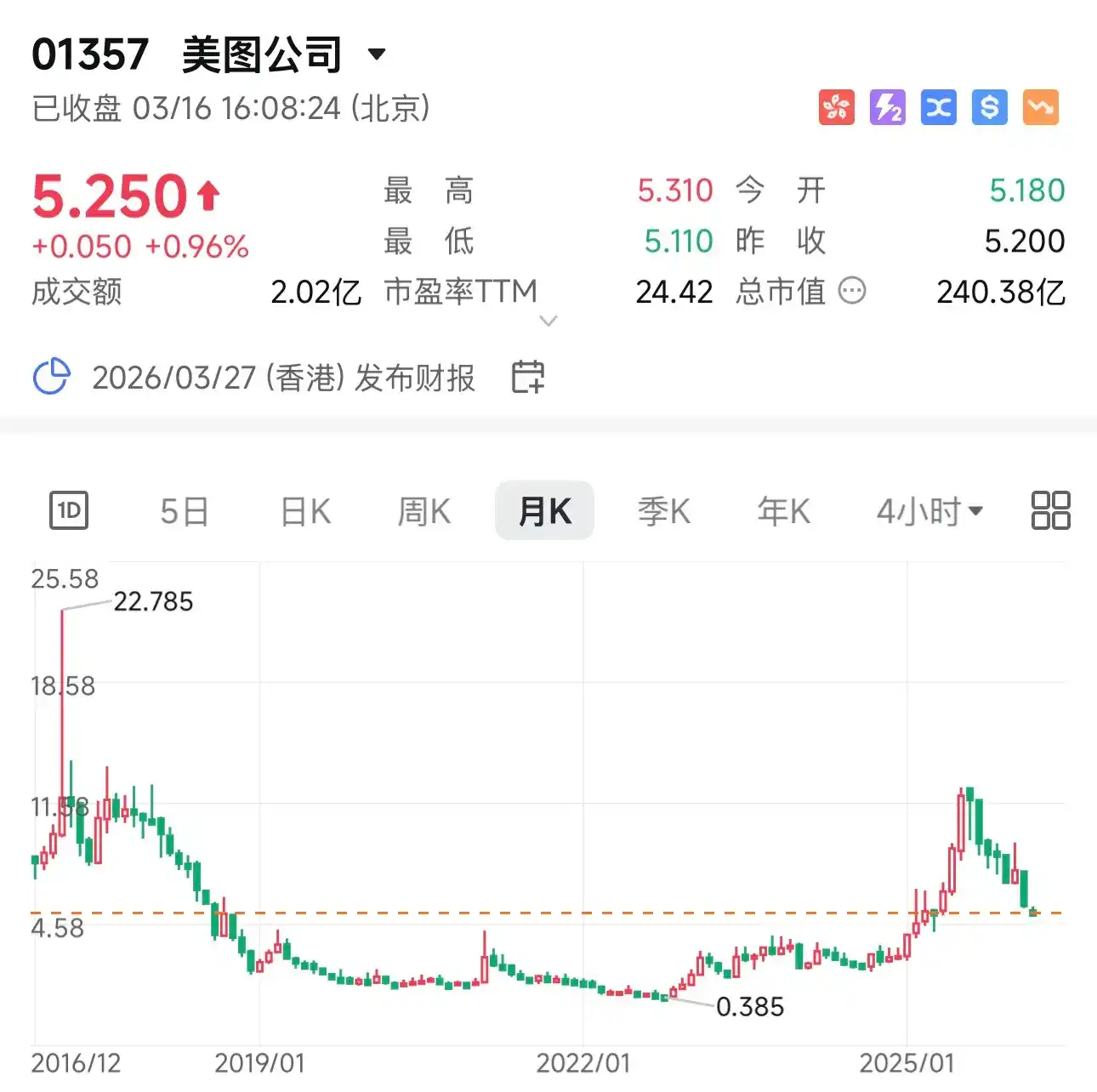

Publicly listed companies sometimes have less tolerance for floating losses than individual investors—stock price pressure, shareholder doubts, media siege—these were external pressures that anyone at the time could not withstand.

2023 年, he stepped down as chairman amid skepticism, and Wu Xinhong returned to take charge, immediately beginning to "tear off the Cai Wensheng label," with the strategic focus fully shifting to AI.

The ending of the story is quite ironic. Meitu issued an announcement in early December 2024, stating that as of that date, it had sold all its cryptocurrency, with a total cash consideration of approximately $180 million, realizing a gain of about $79.63 million, equivalent to approximately RMB 571 million.

If they had held on back then, Meitu would have been one of the first batch of DAT companies in Hong Kong.

The trend was validated, but it was no longer related to him.

Getting Involved, Getting Hands Dirty

From domain names, mobile internet, to Web3, people in each era said he was gambling.

He once said in an interview that what Web3 entrepreneurs do is often not understood, especially by traditional investors.

At the same time, he expressed firm belief in the explosion of Web3, though the timing is hard to predict, just like AI went through many years of dormancy before迎来 the ChatGPT explosion.

According to RootData显示, Cai Wensheng's Longling Capital早年 invested in the crypto exchange OKX (formerly OKCoin). In 2018, he revealed publicly that he had invested in over 10 blockchain projects, including Theta, Ontology, Zipper, etc.

<极好的, I will continue the translation from where it left off, ensuring all HTML tags are preserved and the structure is maintained.

img style="max-width:100%;overflow:hidden;" src="https://d1x7dwosqaosdj.cloudfront.net/images/2026-03/ba38047c3f24461f9b57e864d3fc5780.jpg" alt="">


This time, he simply increased his bet.

After stepping down, Cai Wensheng chose to reduce his stake in Meitu, with his shareholding比例 dropping from a peak of about 25% to less than 10%.

650 million Hong Kong dollars to buy a 25-story commercial building in Tin Hau, Hong Kong, renamed CAI Building. He specifically stated: "CAI is the abbreviation of Crypto and AI, not my surname."

It is reported that CAI Building does not charge rent, only asks for the优先 investment right in the first round of financing, no discount, no controlling stake. He publicly stated that the goal is to incubate 5 unicorns within three years.

Last November, Cai Wensheng said at Hong Kong Fintechweek that buying this building was to "set an example." Now this building is fully occupied by AI and Web3 companies.

Capital operations also followed. He successively acquired two Hong Kong-listed companies—China New Economy Investment and China Financial Leasing, renamed them CAI Holdings and LONG Investment Group respectively,打造 a Web3+AI asset management platform.

In early 2026, CAI Holdings又 acquired the equity of two early-stage projects, Forestheaven and EXIO, by issuing new shares. The seller was precisely Longling Capital, wholly owned by Cai Wensheng.

Among them, EXIO is a licensed virtual asset trading platform in Hong Kong, holding SFC Type 1 and Type 7 licenses. It is the first compliant exchange in Hong Kong with a securities background. Longling Capital was one of its early investors.

Incorporating this piece into CAI Holdings means his ecosystem extends from incubation to circulation—projects cultivated in the CAI Building can be directly listed for compliant trading on a licensed exchange.

Crypto OGs Need a Decent Victory

Among the crypto OGs we know, Cai Wensheng is not the one who has benefited the most.

The fates of early crypto OGs vary.

Some achieved financial freedom and completely faded out—Babbitt founder Chang Jia was once the most powerful spokesperson for long-termism in the crypto industry. Since 2023, he has turned to AI entrepreneurship.

Multicoin Capital co-founder Kyle Samani became famous for early bets on Solana. When leaving the圈, he publicly stated that "cryptocurrency is not as interesting as many people think."

Some stay in the圈, but their focus has shifted—Shenyu was a representative figure in the mining圈 early on. Now, content about AI tools占了大半 on his social accounts.

And those who, like Cai Wensheng, choose to stay include Xiao Feng and Feng Bo, etc.

Xiao Feng turned from traditional finance, leading HashKey on an institutionalized compliance path, operating with licenses, and connecting with traditional capital; Feng Bo布局 in a professional crypto VC manner, closer to the standard institutional investor approach.

They are同样 optimistic about this industry, but their paths are截然不同.

Cai Wensheng chose a "dirtier" path: not taking the institutional route, not making pure financial bets, personally putting down roots in Hong Kong, getting involved hands-on.

At the 2023 Hong Kong Web3 Carnival, Cai Wensheng said: "People who have worked from Web1 to Web3, this seems like a compliment, but it actually means that we have not been successful from Web1 to Web3, we have always been on the road. But many people from Web1 to Web3 are no longer here, but we are still here,说明 we are veterans. Old soldiers never die, they just fade away."

In early 2026, he predicted that Bitcoin would rise to $1.1 million, which means the total market capitalization of Bitcoin would be about $21 trillion. Previously, he publicly stated that he held about 10,000 Bitcoins. There is no news yet showing that he has exited.

Of course, the controversy has not disappeared. Continuously endorsing during a bear market, whether it is坚守 against the market or having to tell stories after being trapped, is still difficult for outsiders to distinguish.

But the ammunition from cashing out, the buildings bought, the companies acquired—these are all actions with real money.

This industry has experienced too many indecent endings. Project方 running away, whales dumping and fleeing, OGs quietly leaving the scene. What remains in the public eye are often only those news about changes in whale addresses.

This industry does not lack people who喊单, it lacks people who truly stay and get their hands dirty.

A bull market unlocking cannot solve the industry's root problems. In the end, it still relies on projects that truly succeed and ecosystems that truly land to win a decent victory for crypto OGs.


Pertanyaan Terkait

QWhat was the outcome of Cai Wensheng's push for Meitu to invest in Bitcoin and Ethereum in 2021?

AMeitu invested approximately $100 million in Bitcoin and Ethereum in 2021, but faced a paper loss of over 280 million RMB in 2022 due to the crypto market crash. Cai Wensheng stepped down as chairman amid criticism, and Meitu later sold all its cryptocurrency holdings in 2024 for about $180 million, realizing a profit of approximately $79.63 million.

QWhat does 'CAI' stand for in the name of the building Cai Wensheng purchased in Hong Kong?

ACAI stands for 'Crypto and AI', not Cai Wensheng's surname. The building, named CAI Mansion, is intended to incubate AI and Web3 startups.

QHow is Cai Wensheng currently involved in the Web3 and crypto industry after leaving Meitu?

ACai Wensheng is deeply involved by purchasing a 25-story commercial building in Hong Kong (CAI Mansion) to incubate Web3 and AI startups, acquiring and renaming two Hong Kong-listed companies to create Web3+AI asset management platforms, and integrating a licensed virtual asset trading platform (EXIO) into his ecosystem.

QWhat is Cai Wensheng's prediction for the future price of Bitcoin?

ACai Wensheng predicted that Bitcoin would rise to $1.1 million, which would imply a total market capitalization of approximately $21 trillion.

QWhich early blockchain projects did Cai Wensheng's Longling Capital invest in?

ALongling Capital invested in early blockchain projects including Theta, Ontology, Zipper, and the crypto exchange OKX (formerly OKCoin).

Bacaan Terkait

OpenAI Tidak Lagi Mengandalkan Model Termahal untuk Menghasilkan Uang

OpenAI tidak lagi mengandalkan model termahal untuk menghasilkan uang. Pada 30 Juli, perusahaan mengumumkan penyesuaian harga, menurunkan harga model GPT-5.6 Luna sebesar 80% dan Terra sebesar 20%. Yang lebih penting dari angka penurunan harga adalah pesan intinya: untuk banyak tugas, model terkuat (seperti Sol) tidak selalu diperlukan. OpenAI secara eksplisit merekomendasikan strategi di mana model mahal (Sol) menangani perencanaan dan analisis kompleks, sementara model yang lebih terjangkau (Luna) mengeksekusi tugas, menulis kode, dan menjalankan pengujian. Pergeseran ini mencerminkan perubahan industri AI dari hanya mengejar kecerdasan tertinggi menuju optimisasi biaya dan efisiensi untuk penggunaan skala besar. Anthropic juga mengikuti pola serupa dengan meluncurkan Claude Opus 5 dengan harga setengah dari model andalannya, Fable 5. Kedua raksasa Silicon Valley ini menunjukkan bahwa model flagship kini berfungsi lebih untuk nilai merek dan pembuktian teknologi, sementara model "kendaraan massal" yang lebih murah (seperti Luna, Terra, Opus) yang akan mendorong adopsi komersial luas dan menghasilkan pendapatan utama. OpenAI mengungkapkan bahwa penurunan biaya ini sebagian didorong oleh model AI (Sol) yang mengoptimalkan kode produksi dan alur kerjanya sendiri, menciptakan siklus peningkatan efisiensi yang dapat mempercepat penurunan biaya di masa depan. Intinya, kompetisi AI bergeser dari "siapa yang paling pintar" menjadi "mana yang paling bernilai". Perusahaan tidak lagi membeli satu model tunggal, tetapi merancang sistem dengan beberapa model yang cocok untuk tugas yang berbeda—mirip dengan arsitektur komputasi awan. Tujuan akhir OpenAI adalah membangun ekosistem yang mengunci alur kerja pengembang melalui volume panggilan API yang sangat besar dan biaya yang sangat rendah, sehingga menciptakan daya tarik yang kuat. Ketika AI menjadi murah dan tersebar luas seperti listrik, tertanam dalam setiap proses tanpa diperdebatkan, era sesungguhnya baru dimulai.

marsbit1j yang lalu

OpenAI Tidak Lagi Mengandalkan Model Termahal untuk Menghasilkan Uang

marsbit1j yang lalu

Gaji Puluhan Miliar untuk Rebut Tukang Listrik, Meta Buru-buru Buka Sekolah Kejuruan Sendiri

Perlombaan AI kini menghadapi hambatan baru: **kelangkaan tenaga ahli teknik**, terutama tukang listrik. Proyek data center raksasa seperti "Stargate" OpenAI membutuhkan ratusan pekerja konstruksi yang bekerja hingga 7 hari seminggu. Menurut prediksi, AS membutuhkan **130.000 tukang listrik tambahan** hingga 2030, namun puluhan ribu lowongan per tahun tetap tak terisi. Gaji yang ditawarkan sangat tinggi, mencapai **$240.000-$280.000 per tahun** untuk tukang listrik andal. Namun, kelambatan proyek karena kekurangan tenaga kerja bisa menyebabkan kerugian **$14,2 juta per bulan**. Presiden Microsoft menyebut kelangkaan tukang listrik sebagai **hambatan utama** ekspansi data center. Kompleksitas data center AI sangat tinggi karena kebutuhan daya besar (setara puluhan ribu rumah), sistem distribusi listrik rumit, dan tantangan pendinginan yang membutuhkan ahli pipa dan HVAC. Akibatnya, perusahaan seperti Meta dan Alphabet berinvestasi besar dalam pelatihan. Meta mengalokasikan **$115 juta** untuk mendirikan sekolah pelatihan konstruksi, menawarkan program gratis dengan tunjangan hidup. Upaya ini menarik minat generasi Z, dengan lonjakan pendaftaran sekolah kejuruan. Namun, tantangan berlanjut: konsumsi listrik data center AI melonjak **84,2% per tahun**, mendorong harga listrik naik. Selain itu, pekerjaan konstruksi bersifat proyek - setelah data center selesai, ribuan pekerja terlatih harus mencari pekerjaan baru, berpotensi membanjiri sektor lain dan menekan upah. Masa depan pasar tenaga kerja teknik pasca-boom AI masih belum pasti.

marsbit1j yang lalu

Gaji Puluhan Miliar untuk Rebut Tukang Listrik, Meta Buru-buru Buka Sekolah Kejuruan Sendiri

marsbit1j yang lalu

The Fed Harus Naikkan Suku Bunga di September? Bagaimana Tekanannya pada Crypto dan Saham AS?

Pasar telah meningkatkan perkiraan suku bunga Federal Reserve (The Fed) pada September menjadi lebih dari 73%, meningkat pesat dari kurang dari 53% sepekan sebelumnya. Lonjakan ini dipicu oleh perbedaan suara dalam rapat The Fed Juli (9-3) dan kekhawatiran inflasi akibat kenaikan harga minyak, yang didorong oleh ketegangan geopolitik di dekat Selat Hormuz. Kunci penentu berikutnya adalah data CPI bulan Juli pada 12 Agustus. Jika inflasi menunjukkan kenaikan berlanjut, probabilitas kenaikan suku bunga September akan semakin kuat. Untuk aset kripto seperti Bitcoin, ekspektasi kenaikan suku bunga biasanya menekan harga karena meningkatkan biaya peluang memegang aset tidak menghasilkan dan menarik aliran modal ke aset yang lebih aman. Namun, dampaknya mungkin terbatas jika pasar memandang kenaikan ini sebagai akhir dari siklus pengetatan. Saham AS terkait kripto (seperti Coinbase, MicroStrategy) cenderung bereaksi lebih volatil. Kenaikan suku bunga meningkatkan tingkat diskonto dalam valuasi, memberi tekanan lebih besar pada saham pertumbuhan dan teknologi. Hal ini bertepatan dengan musim laporan keuangan dimana investor kini lebih kritis, menilai apakah pengeluaran modal besar-besaran untuk AI dapat benar-benar menghasilkan pendapatan dan arus kas. Perusahaan dengan cerita pertumbuhan lemah dan arus kas negatif mungkin menghadapi volatilitas lebih tinggi jika The Fed benar-benar menaikkan suku bunga.

marsbit1j yang lalu

The Fed Harus Naikkan Suku Bunga di September? Bagaimana Tekanannya pada Crypto dan Saham AS?

marsbit1j yang lalu

Trading

Spot
活动图片




