CoinW Research Institute
Abstract
This article takes the escalation of the US-Iran conflict as a starting point to analyze how a geopolitical event is rapidly transformed into a global risk variable in the contemporary financial system. Since the event occurred over the weekend when traditional financial markets were closed, on-chain markets were still operating. Crypto assets and on-chain commodity contracts experienced sharp fluctuations first, completing the initial expression of risk; prediction markets directly probabilized war and political changes, achieving real-time pricing of the event path. After traditional markets opened on Monday, energy, the US dollar, US bonds, and risk assets completed systemic confirmation, with risk premiums transmitted layer by layer along the macro chain. The article points out that in the 24/7 operating environment of digital markets, risk is no longer priced only at the opening bell. Geopolitics is being financialized in real time; markets are not just passively reacting to events but are participating in the pricing of risk itself during the development of events.
1. Conflict Escalation: How a Geopolitical Event Becomes a Global Risk Variable
Recently, tensions between the US and Iran escalated sharply. Multiple media reports indicated that Iran's Supreme Leader Ayatollah Ali Khamenei was killed in an airstrike, leading to a rapid deterioration of the regional situation. Military actions and strong statements combined quickly turned the situation from a regional friction point into a global focus.
Subsequently, the Islamic Revolutionary Guard Corps of Iran announced restrictions on ship passage through the Strait of Hormuz. As one of the world's most important energy transport channels, this key hub, which long carries about one-fifth of global crude oil and liquefied natural gas shipments, faced severe restrictions, with several shipping companies suspending passage or choosing detours.
The impact of the conflict is no longer limited to the military level. The Middle East is the core region for global energy supply, and disturbances in the Strait of Hormuz directly push up energy risk premiums, which are quickly transmitted to global markets through oil prices, inflation expectations, and capital flows.
Thus, this conflict has become a systemic global risk variable. It affects not only the regional security landscape but also the energy supply-demand balance, the US dollar liquidity environment, and the valuation system of risk assets.
When war escalates into a systemic risk, where is the risk traded first? In a structure where traditional markets operate on a time-bound basis while on-chain markets operate 24/7, the timing sequence of price discovery is changing.
2. Weekend Time Frame: On-Chain Markets Complete the First Round of Price Discovery
Notably, this conflict occurred over the weekend. When the news broke, most global traditional financial markets were closed: spot gold paused quotes, crude oil futures halted trading, and stock markets were closed. Risk had emerged, but the traditional system could not price it immediately. However, on-chain markets were still operating, and risk sentiment shifted to a still-open pricing venue.
Crypto Assets Lead with Sharp Fluctuations
After the conflict news emerged, Bitcoin's price briefly approached $63,000 before rebounding to around $66,000, completing significant volatility in a short time. This volatility was not simply safe-haven buying or panic selling but a concentrated gamble on risk expectations in the absence of traditional anchors like gold and crude oil. When other assets were untradeable, the crypto market became an outlet for risk expression.
On-Chain Commodity Contracts: Risk Premiums Form Instantly
Over the weekend, multiple media reports indicated that on the Hyperliquid platform, perpetual contracts linked to crude oil, gold, and silver showed significant increases: crude oil perpetual contracts rose about 5% to approximately $70.6/barrel; gold perpetual contracts rose about 1.3% to around $5,323/ounce; silver perpetual contracts rose about 2% to about $94.9/ounce. Trading volumes also expanded. The 24-hour trading volume for silver contracts exceeded $227 million, and gold contracts reached about $173 million, showing real capital participation. These were prices truly formed in the 24/7 on-chain market, reflecting the immediate judgment of market participants on supply risks and geopolitical premiums during the closure of traditional markets.
Monday Opening: Traditional Markets "Catch Up"
When traditional markets reopened, prices quickly adjusted in the direction of the weekend on-chain movements. International oil prices opened higher on Monday, with Brent crude rising to $82.37/barrel at one point and WTI crude jumping above $75; spot gold broke through $5,300/ounce; major global stock index futures generally weakened, with risk assets under pressure. The price sequence was clear: risk emerged over the weekend; on-chain markets fluctuated first; traditional markets completed larger-scale confirmation and diffusion on Monday.
During the time window when traditional markets were closed, on-chain markets assumed the function of the first wave of risk expression. This structural time difference is changing the pricing rhythm of global risk events.
3. Prediction Markets: War Is Probabilized in Real Time for the First Time
Polymarket: Explosive Pricing of Conflict Nodes
During this event, the trading volume of contracts related to the conflict escalation on the on-chain prediction platform Polymarket significantly expanded.
The series of contracts on "Will the US or Israel strike Iran by a certain date?" accumulated a trading volume of over $500 million, with the trading volume on the day of the airstrike alone reaching about $90 million, making it one of the largest geopolitical markets in the platform's history.
After the confirmation of the leader's death, contracts related to "Will Khamenei lose his position as Supreme Leader of Iran by March 31?" were quickly settled, with a trading volume of about $57 million. The implied probability of long-term political direction contracts like "Will the Iranian regime collapse by June 30?" once rose to nearly 50%, indicating that the market had begun pricing deeper institutional risks. These data show that betting was not scattered behavior but formed concentrated and high-intensity capital participation.
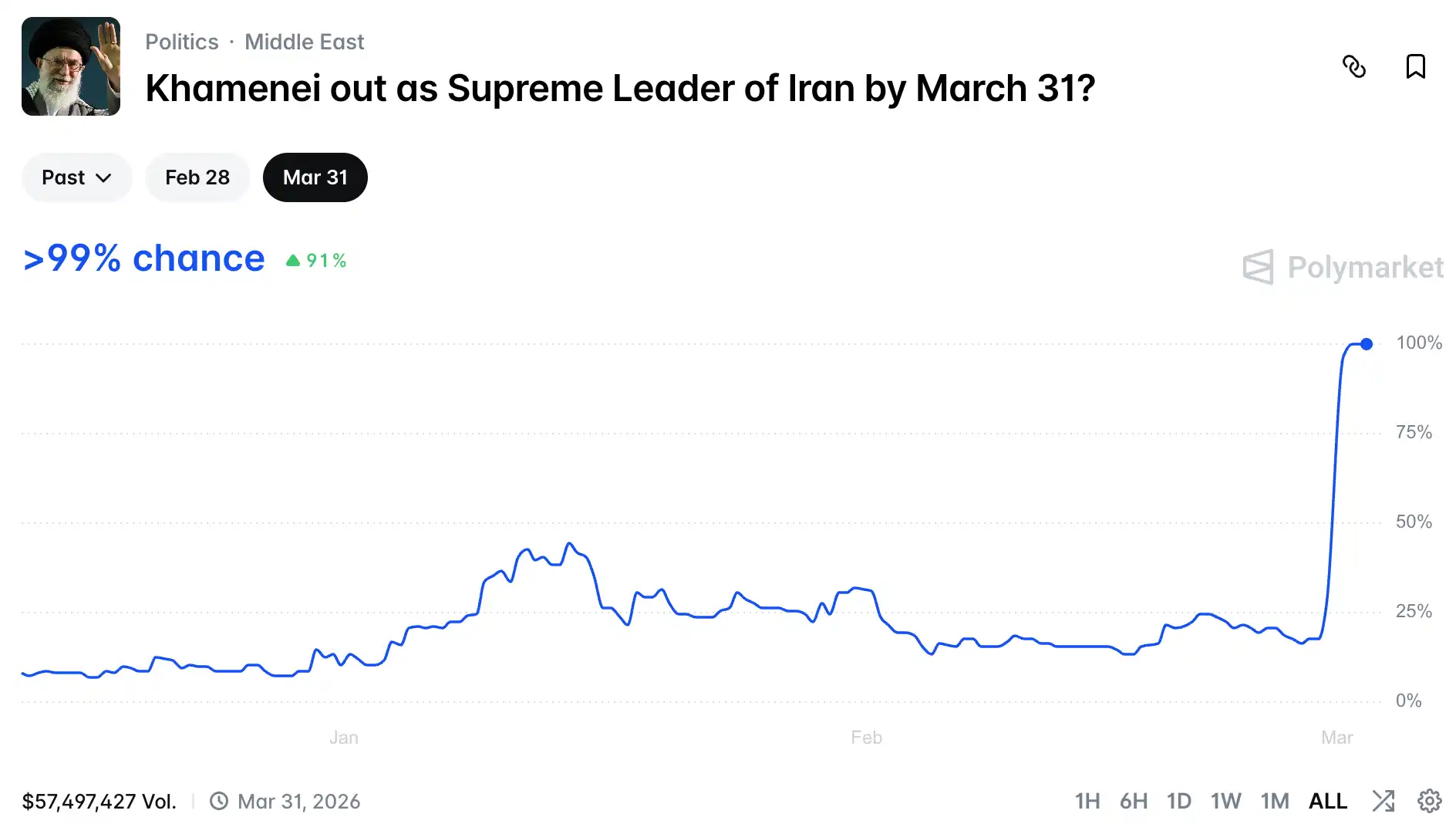
Source: https://polymarket.com/event/khamenei-out-as-supreme-leader-of-iran-by-march-31
Opinion: Multi-Dimensional Pricing of Conflict Paths and Institutional Risks
On Opinion, contracts related to the US-Iran conflict also showed high activity. One type of market precisely defines military triggers. For example, "Will the US strike Iran by a certain date?" specifies that it is only judged as Yes if the US military actually hits Iranian territory or official embassies with drones, missiles, or airstrikes; intercepted weapons or other forms of military action are not counted. The trading volume of this contract has exceeded $12.6 million, showing the market's high attention to specific military trigger conditions.
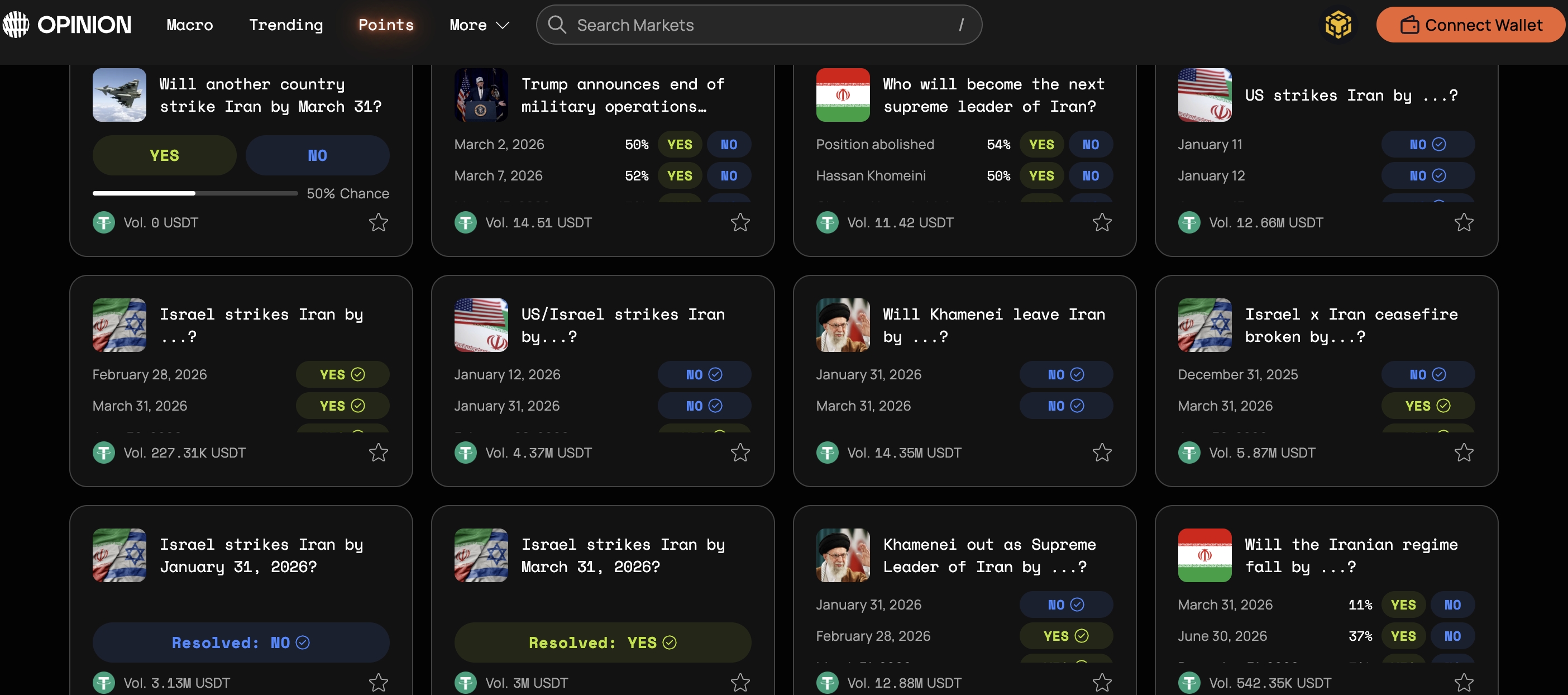
Source:https://app.opinion.trade/search?q=Iran
Another type of market turns to institutional layer risks. "Khamenei out as Supreme Leader of Iran by ...?" prices whether Iran's Supreme Leader Ali Khamenei loses power within a specific time window. The rules include resignation, detention, loss of position, or inability to perform duties as judgment standards and use credible media consensus as the settlement basis, with a trading volume of about $12.9 million. Additionally, markets like "Will the Iranian regime collapse by XX date?" and "Will the ceasefire between Israel and Iran be broken by XX date?" probabilistically express regime stability and ceasefire sustainability, respectively.
Although the number of related contracts and overall trading scale are still lower than Polymarket, Opinion presents a clearer risk stratification structure: military actions, ceasefire status, leader retention, and regime direction are decomposed into multiple independent variables for parallel pricing. Thus, war is no longer just a single-point question of "whether it happens" but a risk path that can be segmented, quantified, and continuously corrected. Prediction markets here serve as real-time measurement tools for sovereign risk and institutional stability.
Probability Curve as a "Risk Thermometer"
Unlike crude oil or gold, prediction markets do not indirectly express risk through assets but directly probabilistically price "whether an event will happen." When the probability of conflict escalation rises, odds jump; when the situation eases, the probability falls. The odds curve itself becomes an immediate scale of risk sentiment. Some analysis pointed out that a few hours before the airstrike news spread widely, a small number of new wallets concentrated on buying related contracts and profited after the event was confirmed. This phenomenon sparked discussions on whether information entered the market early, making the time sensitivity of prediction markets particularly prominent.
Traditional markets typically reflect outcomes through rising oil prices or falling stock markets; prediction markets directly trade "whether it escalates" and "whether it spreads." The former prices the impact, the latter prices the path. When traditional markets are not yet open, risk is already quantified and bet on on-chain.
4. Traditional Asset Opening Confirmation: How Are Risk Premiums Transmitted?
When on-chain markets fluctuate first, true cross-asset linkage occurs after traditional markets reopen.
Energy: The First Stop for Risk Premiums
Energy remains the first stop for risk premiums. The Strait of Hormuz carries about 20% of global crude oil shipments. As long as the market worries that supply may be hindered, oil prices will提前计入 risk premiums. Conflict escalation pushes oil prices up, thereby boosting inflation expectations and affecting interest rate policies and corporate cost structures.
US Dollar and US Bonds: Tug-of-War Between Safety and Inflation
When uncertainty rises, funds usually flow to the most liquid assets, so the US dollar and US bonds benefit short-term. The dollar strengthens, and US bond yields fall temporarily, reflecting increased safe-haven demand. But if the conflict continues and pushes up inflation expectations, US bond yields may face a tug-of-war between safe-haven buying and inflationary pressure.
Positioning of Risk Assets and Bitcoin
Gold serves the traditional safe-haven function, crude oil embodies risk premiums, and US bonds provide a liquidity safety net. Bitcoin's performance is closer to a high-elasticity risk asset. In the initial stage of the conflict, it did not rise unilaterally but fluctuated sharply, showing its high sensitivity to liquidity and risk appetite. Therefore, in the initial stage of extreme uncertainty, Bitcoin behaves more like a high-beta risk asset than a pure safe-haven tool.
Overall, on-chain markets express risk first, prediction markets probabilize risk, and traditional assets complete systemic confirmation after opening. Risk premiums are transmitted layer by layer along energy, interest rates, and asset valuations, eventually forming a联动 reaction in global markets.
5. Structural Changes: Is the Risk Pricing Mechanism Migrating?
The significance of this event may lie not only in the conflict itself but in how risk was priced.
Geopolitics Is Being Financialized in Real Time
In the past, geopolitics remained more at the news and diplomatic levels; now, it is being financialized in real time. Whether war escalates, whether sanctions are implemented, and how election results evolve can all be bet on, hedged, and probabilized in the market. Risk is no longer only interpreted after the fact but is traded during its occurrence.
On-Chain Markets Become 24/7 Risk Buffers
On-chain markets are beginning to assume a new function. Traditional markets have weekend closures and holiday breaks. When major events happen during this gap, prices cannot reflect sentiment immediately. But on-chain markets operate 24/7, becoming buffers for the first wave of sentiment release. Prices and probabilities fluctuate there first, and then traditional markets reopen for larger-scale confirmation and diffusion.
Price Discovery Rights Are Marginally Migrating
This time structure difference is bringing a deeper change: the marginal migration of price discovery rights. If on-chain contracts fluctuate first, if the odds curve of prediction markets jumps before oil prices and stock indices, will institutional investors start monitoring these data? Will macro models incorporate on-chain fluctuations as reference variables? Will media and traders regard prediction market probabilities as early warning signals for risk?
These questions are not yet settled, but the direction is clear. The "first expression" of risk is shifting from the opening bell of traditional exchanges to digital markets that operate 24/7. When war can be traded in real time, markets are no longer just passively responding to the outcomes of events but are participating in the pricing process of risk itself.







