Crypto Stablecoin Liquidity Shifts As Bear Market Deepens – What The Data Reveal

bitcoinistDipublikasikan tanggal 2026-02-18Terakhir diperbarui pada 2026-02-18

Abstrak

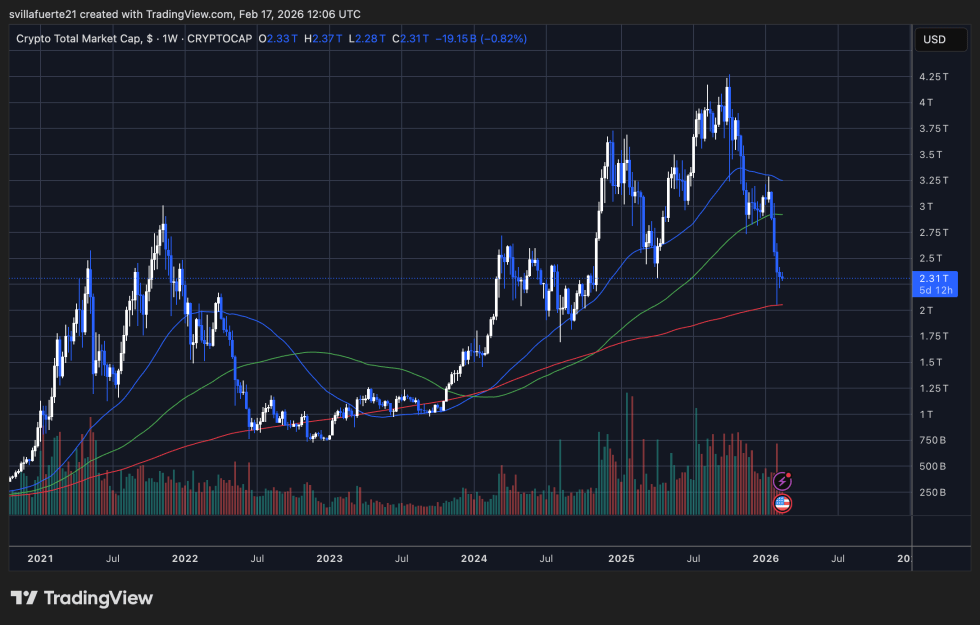
The crypto market faces intense selling pressure as Bitcoin and Ethereum struggle to reclaim key levels, with on-chain data revealing significant shifts in stablecoin liquidity. Stablecoin reserves grew by $11.4 billion in the 30 days before November 5, 2025, but fell $8.4 billion by December 23 as bearish conditions intensified. Outflows have recently slowed to about $2 billion, suggesting potential stabilization, though recovery remains uncertain. Binance dominates stablecoin liquidity, holding $47.5 billion in USDT and USDC—a 31% annual increase—accounting for 65% of all exchange reserves. USDT represents $42.3 billion of Binance’s holdings, while USDC reserves remain flat at $5.2 billion. Other exchanges like OKX ($9.5 billion) and Coinbase ($5.9 billion) lag significantly. The total crypto market cap has retraced from late-2025 peaks near $4 trillion, testing support around $2.3 trillion. Trend indicators show a shift from expansion to consolidation, with subdued buying pressure and elevated selling volume indicating ongoing distribution. The broader uptrend depends on holding long-term support, with a breakdown risking a deeper correction.

Trusted Editorial content, reviewed by leading industry experts and seasoned editors. Ad Disclosure

The crypto market continues to face intense selling pressure as both Bitcoin and Ethereum struggle to reclaim key psychological levels. Repeated rejection near resistance zones has reinforced cautious sentiment across the sector, with investors increasingly defensive after months of declining liquidity and volatile price action. While corrective phases are typical following strong bull market advances, the persistence of downside pressure suggests a more prolonged adjustment period may be unfolding.

On-chain data provides additional context for this shift in market dynamics. According to recent analysis, stablecoin reserve growth peaked shortly before the late-2025 price decline. In the 30 days leading up to November 5, reserves expanded by approximately $11.4 billion, reflecting strong liquidity availability and risk appetite at the time. However, this trend reversed quickly as market conditions deteriorated, with reserves falling roughly $8.4 billion by December 23 as the bear phase began to take shape.

More recently, the pace of outflows has moderated, with reserves declining by about $2 billion over the past month. This slowdown may indicate stabilization in liquidity conditions, though it does not yet confirm a sustained recovery. For now, the market remains sensitive to macro conditions, capital flows, and investor confidence.
Stablecoin Liquidity Concentration Highlights Binance’s Dominant Market Role

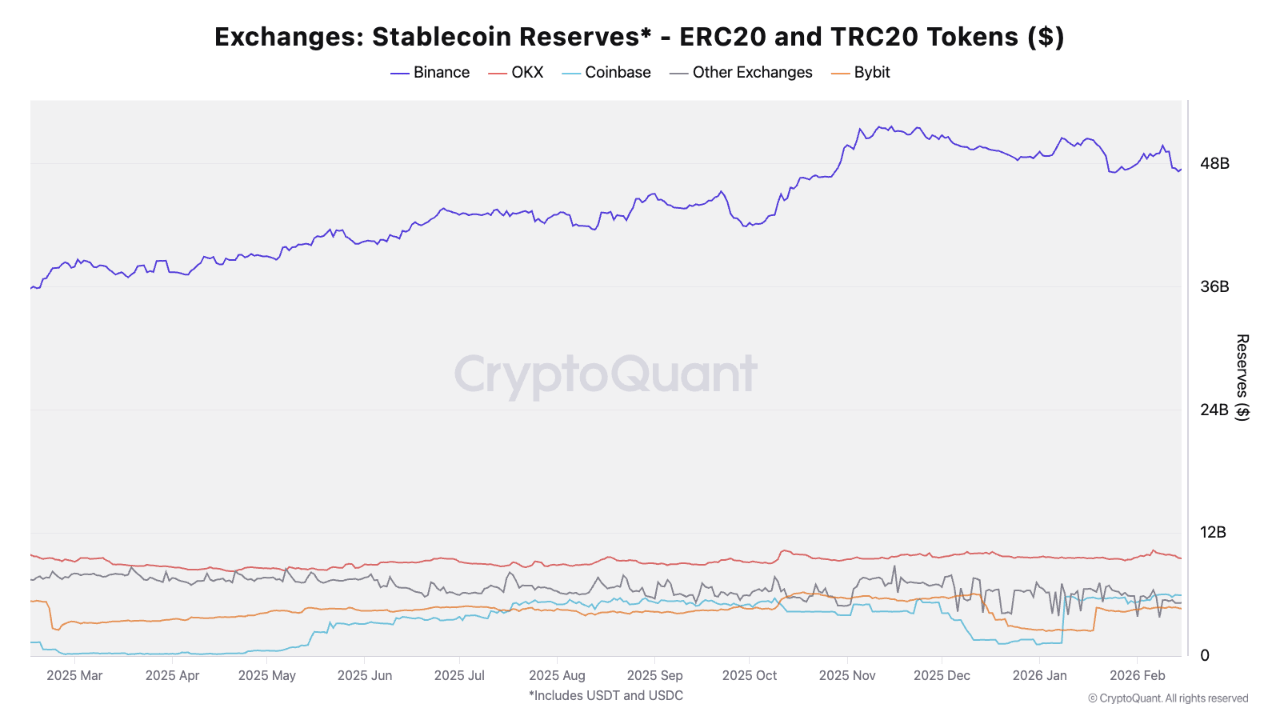
The data further shows that stablecoin liquidity remains heavily concentrated on Binance, reinforcing its role as the primary hub for crypto market liquidity. Current figures indicate the exchange holds roughly $47.5 billion in combined USDT and USDC reserves, marking a 31% year-over-year increase from about $35.9 billion. This concentration is significant, as Binance alone accounts for approximately 65% of all USDT and USDC held across centralized exchanges, highlighting its dominant position in facilitating trading flows and liquidity provisioning.
Crypto Exchanges Stablecoin Reserves | Source: CryptoQuant

Other major exchanges lag considerably behind in stablecoin reserves. OKX holds around $9.5 billion, representing roughly a 13% share, while Coinbase maintains approximately $5.9 billion, or about 8%. Bybit follows with close to $4 billion, equivalent to roughly 6% of exchange stablecoin liquidity. These balances are distributed mainly across Ethereum and TRON networks, which continue to serve as the primary infrastructure layers for stablecoin settlement.

Within Binance itself, liquidity remains overwhelmingly USDT-driven. About $42.3 billion of its reserves are held in USDT, reflecting a 36% year-over-year increase from approximately $31 billion. In contrast, USDC reserves stand near $5.2 billion and have remained broadly flat over the same period, suggesting stable but limited growth compared with USDT dominance.

Editorial Process for bitcoinist is centered on delivering thoroughly researched, accurate, and unbiased content. We uphold strict sourcing standards, and each page undergoes diligent review by our team of top technology experts and seasoned editors. This process ensures the integrity, relevance, and value of our content for our readers.

Sebastian Villafuerte

Follow

Sebastian's journey into the world of crypto began four years ago, driven by a fascination with the potential of blockchain technology to revolutionize financial systems. His initial exploration focused on understanding the intricacies of various crypto projects, particularly those focused on building innovative financial solutions. Through countless hours of research and learning, Sebastian developed a deep understanding of the underlying technologies, market dynamics, and potential applications of cryptocurrencies. As his knowledge grew, Sebastian felt compelled to share his insights with others. He began actively contributing to online discussions on platforms like X and LinkedIn, focusing on fintech and crypto-related content. His goal was to expose valuable trends and insights to a wider audience, fostering a deeper understanding of the rapidly evolving crypto landscape. Sebastian's contributions quickly gained recognition, and he became a trusted voice in the online crypto community. To further enhance his expertise, Sebastian pursued a UC Berkeley Fintech: Frameworks, Applications, and Strategies certification. This rigorous program equipped him with valuable skills and knowledge regarding Financial Technology, bridging the gap between traditional finance (TradFi) and decentralized finance (DeFi). The certification deepened his understanding of the broader financial landscape and its intersection with blockchain technology. Sebastian's passion for finance and writing is evident in his work. He enjoys delving into financial research, analyzing market trends, and exploring the latest developments in the crypto space. In his spare time, Sebastian can often be found immersed in charts, studying 10-K forms, or engaging in thought-provoking discussions about the future of finance. Sebastian's journey as a crypto analyst and investor has been marked by a relentless pursuit of knowledge and a dedication to sharing his insights. His ability to navigate the complex world of crypto, combined with his passion for financial research and communication, makes him a valuable asset to the industry. As the crypto landscape continues to evolve, Sebastian remains at the forefront, providing valuable insights and contributing to the growth of this revolutionary technology.

Full Profile

Related Posts

CFTC Chair Says Crypto Market Structure Bill Nears Final Approval

Why Kraken Is Backing Wyoming ‘Trump Accounts’, A Crypto Policy Gamble?

Polygon supera a Ethereum en tarifas diarias: la señal definitiva del auge de las L2

Zashi Becomes Zodl: Zcash Wallet Rebrands Following Internal Split

Kraken Backs Trump Accounts, Points To Shared Crypto Vision

Crypto And The 2026 Elections: By The Numbers And What Lies Ahead

Pertanyaan Terkait

QWhat does the data reveal about the shift in stablecoin reserves leading up to and during the crypto bear market?

AThe data shows that stablecoin reserve growth peaked shortly before the late-2025 price decline, expanding by approximately $11.4 billion in the 30 days leading up to November 5. However, this trend reversed as the bear market took hold, with reserves falling roughly $8.4 billion by December 23. More recently, the pace of outflows has moderated, declining by about $2 billion over the past month, which may indicate a stabilization in liquidity conditions.

QWhich exchange holds the dominant share of stablecoin liquidity, and what are the specific figures?

ABinance holds the dominant share of stablecoin liquidity, with approximately $47.5 billion in combined USDT and USDC reserves. This represents a 31% year-over-year increase and accounts for roughly 65% of all USDT and USDC held across centralized exchanges.

QHow does the distribution of stablecoin reserves on Binance compare between USDT and USDC?

AOn Binance, liquidity is overwhelmingly dominated by USDT. About $42.3 billion of its reserves are held in USDT, reflecting a 36% year-over-year increase. In contrast, USDC reserves stand near $5.2 billion and have remained broadly flat over the same period.

QWhat is the current state of the total crypto market capitalization and its key support level?

AThe total crypto market capitalization has retraced significantly from its late-2025 peak near $4 trillion and has recently stabilized around the $2.3 trillion level. This area is functioning as an interim key support zone, though price action remains fragile with reduced upside momentum.

QWhat do the volume dynamics during the market decline indicate about investor behavior?

AThe volume dynamics indicate that elevated selling volume accompanied the most recent decline, which suggests active distribution by sellers rather than a passive price drift. However, the subsequent moderation in volume hints that panic selling may be easing, even though conviction buying has not yet returned decisively.

Bacaan Terkait

Hardman Exclusive | Perusahaan Kecerdasan Berbadan Laut 'Shihang Intelligent' Raih Pendanaan Rekor 10 Miliar, Zhu Xiaohu dan Temasek Berinvestasi

Penulis: Qiu Xiaofen Editor: Yuan Silai Perusahaan kecerdasan berwujud laut "Shihang Intelligent" telah menyelesaikan pendanaan Seri A senilai lebih dari 10 miliar yuan, menjadi putaran pendanaan tunggal terbesar di bidang robot laut global. Pendanaan ini dipimpin oleh dana industri dari perusahaan chip "Moore Thread" dan "Kunlunxin," termasuk Shanghe Momentum Fund, Vertex Growth (platform investasi negara Singapura), dan perusahaan publik Dayang Motor. Selain itu, Jinshajiang Venture Capital juga melakukan investasi tambahan, yang merupakan investasi kelima dari pendirinya Zhu Xiaohu. Pemegang saham lama seperti Vertex China, Huaying Capital, dan Changshi Capital juga ikut serta dalam putaran ini. Didirikan oleh CEO Chen Xiaobo (alumni Universitas Teknik Harbin kelahiran 1989), perusahaan telah lama fokus pada pengembangan robot bawah laut. Pada usia 28, Chen memenangkan Penghargaan Kemajuan Sains dan Teknologi Pertahanan Nasional, menjadikannya penerima termuda, dan memimpin pengembangan robot pembersih bawah laut komersial pertama di Tiongkok. Dana ini akan digunakan untuk pengembangan teknologi inti, ekspansi pasar global, dan pembangunan ekosistem rantai pasokan, guna mempercepat penerapan robot laut dalam skenario bawah laut yang kompleks. Laut dianggap sebagai salah satu lingkungan tersulit untuk aplikasi robotika, karena harus menghadapi tantangan seperti pencahayaan rendah, kekeruhan tinggi, arus laut kompleks, komunikasi terbatas, tekanan tinggi, dan korosi. "Shihang Intelligent" mengembangkan teknologi inti mencakup enam sistem utama: tenaga penggerak, kontrol, sensor, navigasi, penyegelan, dan penyebaran. Robot mereka mampu beroperasi hingga kedalaman 10.000 meter dengan kebebasan penuh, melakukan gerakan kompleks seperti maju, mundur, bergerak menyamping, dan berguling, serta mendukung navigasi otonom dan operasi multi-robot. Hingga saat ini, robot mereka telah diterapkan dalam pembersihan kapal, keamanan bawah laut, energi angin lepas pantai, peternakan laut, dan inspeksi dasar laut. Pada paruh pertama 2026, perusahaan telah menerima pesanan senilai lebih dari 10 miliar yuan. Pada April, perusahaan meluncurkan model besar kecerdasan berwujud laut "Cangqiong CEORION." Model ini mengintegrasikan persepsi lingkungan, pemahaman tugas, dan generasi tindakan dalam satu arsitektur ujung-ke-ujung, dilatih dengan data operasi nyata dan simulasi. "Cangqiong CEORION" dapat menangani 12 jenis skenario operasi bawah laut, termasuk inspeksi, deteksi, pembersihan, penangkapan, pemotongan, pengelasan, eksplorasi, pencarian, dan penyelamatan. Dalam pengujian simulasi, tingkat keberhasilan tugas mencapai lebih dari 90%, dengan kemampuan adaptasi tanpa contoh sebelumnya melebihi 70%. Model ini juga mengurangi tingkat kecelakaan tabrakan hingga 80% melalui modul penalaran fisik terintegrasi. Pada paruh pertama tahun ini, "Shihang Intelligent" terpilih sebagai mitra inti dalam Program Inspeksi dan Pembersihan Lambung Kapal Bawah Laut Nasional oleh Otoritas Maritim dan Pelabuhan Singapura. Perusahaan berencana untuk terus berinvestasi dalam teknologi inti robot laut, model kecerdasan berwujud laut, dan skenario aplikasi global, mendorong penerapan robot laut dalam operasi bawah laut bernilai tinggi, berisiko tinggi, dan tantangan tinggi.

marsbit49m yang lalu

Hardman Exclusive | Perusahaan Kecerdasan Berbadan Laut 'Shihang Intelligent' Raih Pendanaan Rekor 10 Miliar, Zhu Xiaohu dan Temasek Berinvestasi

marsbit49m yang lalu

Tiga Bulan 35 Miliar, Investor Berebut OpenAI Dunia Fisik

Momen akrab itu terulang kembali. Dalam tiga bulan, Jijia Shijie (极佳视界) telah merampungkan tiga putaran pendanaan, mengumpulkan total 35 miliar RMB. Para investor, mulai dari dana 'tim nasional', modal industri, hingga lembaga keuangan ternama, berbaris mendukung. Didirikan oleh Dr. Huang Guan, seorang doktor lulusan Tsinghua berusia 90-an dengan pengalaman di bidang AI fisik, visi Jijia Shijie adalah mencapai AGI Fisik (Kecerdasan Umum Buatan di Dunia Fisik). Mereka mengatasi tantangan utama seperti fragmentasi data dan keterbatasan model bahasa dengan membangun sistem "Piramida Ganda" yang terdiri dari algoritma dan data. Inti teknologinya adalah sistem model "Generasi Dunia-Tindakan". Model tindakan (seperti GigaBrain-0 dan GigaWorld-Policy) mengubah pemahaman dunia menjadi strategi aksi untuk robot, meraih peringkat tertinggi dalam berbagai benchmark global. Model generasi dunia (seperti GigaWorld-1 dan DriveDreamer) memahami dan mensimulasikan dunia fisik, menyediakan data dan dasar simulasi. Keduanya saling melengkapi untuk mendorong AGI Fisik menuju "momen GPT-3"-nya. Jijia Shijie tidak hanya berfokus pada riset. Mereka mengejar realisasi nilai industri melalui dua jalur: masuk ke rumah (sektor C) dan pabrik (sektor B). Untuk sektor C, mereka meluncurkan merek "ShiGuang SeeLight" dan robot humanoid serbaguna "S1", yang telah mendapatkan pesanan nyata dan akan mulai dioperasikan secara komersial. Di sektor B, mereka bekerja sama dengan perusahaan industri seperti FAW Mold dan Longsheng Technology untuk menyebarkan ribuan robot serbaguna dalam skenario manufaktur, menandai dimulainya produksi massal. Model dunia mengemudi DriveDreamer mereka juga telah digunakan oleh lebih dari 30 perusahaan otomotif dan otonom terkemuka. Dengan pendekatan "penggerak ganda" ini, Jijia Shijie bertujuan untuk mengumpulkan data dunia nyata yang berharga dan arus kas, yang selanjutnya akan memberi makan sistem piramida data mereka, menciptakan siklus pertumbuhan yang berkelanjutan. Mereka membayangkan masa depan di mana AGI Fisik, dengan kemampuannya untuk memahami dan bertindak dalam dunia nyata, tidak hanya meningkatkan efisiensi informasi tetapi juga secara mendalam membentuk kembali produksi dan gaya hidup, akhirnya melayani setiap rumah tangga.

marsbit1j yang lalu

Tiga Bulan 35 Miliar, Investor Berebut OpenAI Dunia Fisik

marsbit1j yang lalu

Apa Hubungannya Huang Zheng, Pendiri Pinduoduo, dengan Blockchain?

Menurut artikel ini, pendiri Pinduoduo, Huang Zheng, memandang bisnis inti platformnya sebagai "asuransi terbalik" yang berhubungan dengan ketidakpastian. Argumen utamanya adalah bahwa dalam kapitalisme tradisional, orang kaya mengumpulkan kekayaan dengan menanggung ketidakpastian (seperti risiko finansial) yang tak tertanggungkan bagi orang biasa, yang kemudian membayar premi (seperti melalui tabungan rendah bunga atau membeli produk mahal demi kepastian) untuk mengalihkan risiko tersebut. Uang mengalir dari bawah ke atas. Pinduoduo berusaha "membalikkan" aliran ini. Melalui fitur seperti "pembelian kelompok" dan penawaran waktu terbatas, platform ini mengumpulkan banyak niat pembelian yang tersebar menjadi permintaan agregat yang pasti dan besar dalam waktu singkat. Kepastian permintaan massal ini memungkinkan pabrik mengurangi risiko kelebihan produksi dan menurunkan harga, sehingga mengembalikan sebagian nilai (dalam bentuk diskon) ke konsumen. Namun, tantangan utama adalah janji atau niat beli individu tidak berharga karena mudah dibatalkan tanpa konsekuensi. Di sinilah kaitannya dengan blockchain muncul. Huang Zheng bertanya-tanya apakah teknologi blockchain, dengan kontrak pintar dan sifat terdesentralisasi, bisa menjadi solusi untuk membuat komitmen individu menjadi terikat, dapat dipercaya, dan dapat diberi harga. Kontrak pintar dapat mengunci janji beli dengan jaminan keuangan, sehingga pembatalan akan dikenakan penalti. Ini mengubah "keinginan membeli" menjadi janji yang dapat ditegakkan, memberikan kepastian yang dapat dipercaya pabrik tanpa perantara. Artikel tersebut juga menarik paralel dengan Bitcoin, menyebutkan dua jalan menciptakan kepastian: 1) **Jalan Pinduoduo**: mengumpulkan keinginan tersebar menjadi skala besar untuk menghilangkan ketidakpastian. 2) **Jalan Bitcoin**: mengunci aturan dalam kode yang tidak dapat diubah (seperti pasokan tetap), menggantikan kepercayaan pada manusia dengan kepercayaan pada aturan algoritmik. Kedua pendekatan memiliki trade-off: yang pertama membatasi kebebasan individu untuk koordinasi massa, yang kedua mengorbankan fleksibilitas aturan untuk kepastian absolut.

链捕手2j yang lalu

Apa Hubungannya Huang Zheng, Pendiri Pinduoduo, dengan Blockchain?

链捕手2j yang lalu

Trading

Spot
Futures
活动图片