Coinbase Q1 Earnings Report: Nearly $4 Billion Loss, Trading Volume Halved. Can AI + RWA Turn Things Around?

链捕手Dipublikasikan tanggal 2026-05-08Terakhir diperbarui pada 2026-05-08

Abstrak

Coinbase's Q1 2026 earnings report revealed a net loss of $394 million, largely driven by $482 million in unrealized losses on its crypto asset holdings. Total revenue fell 31% year-over-year to $1.41 billion. Transaction revenue declined 40% to $756 million, reflecting a market-wide slump in crypto trading volumes. Consumer trading was particularly weak, down 48%, though Coinbase's global spot market share rose to a record 8.6%. Key bright spots included institutional trading revenue, which grew 37%, and a surge in derivatives activity following the Deribit acquisition. Subscription and services revenue of $584 million was more resilient, with stablecoin revenue up 11% to $305 million. Adjusted EBITDA remained positive at $303 million. Ahead of earnings, Coinbase announced a 14% workforce reduction (~700 employees) to accelerate its transition to an "AI-native" organizational model. Strategically, the company is pursuing its "Everything Exchange" vision, expanding into derivatives and predictive markets. Its partnership with Circle on USDC remains a core revenue moat, with over 25% of the stablecoin's $80 billion supply held on its platform. The company is actively engaged in shaping stablecoin legislation like the CLARITY Act. Despite significant losses and cyclical pressures, Coinbase is positioning itself as a broader on-chain financial infrastructure provider.

On May 7th, after the US stock market closed, Coinbase released its first-quarter financial report for 2026. The data showed the company's total revenue was $1.41 billion, a year-on-year decrease of 31%.

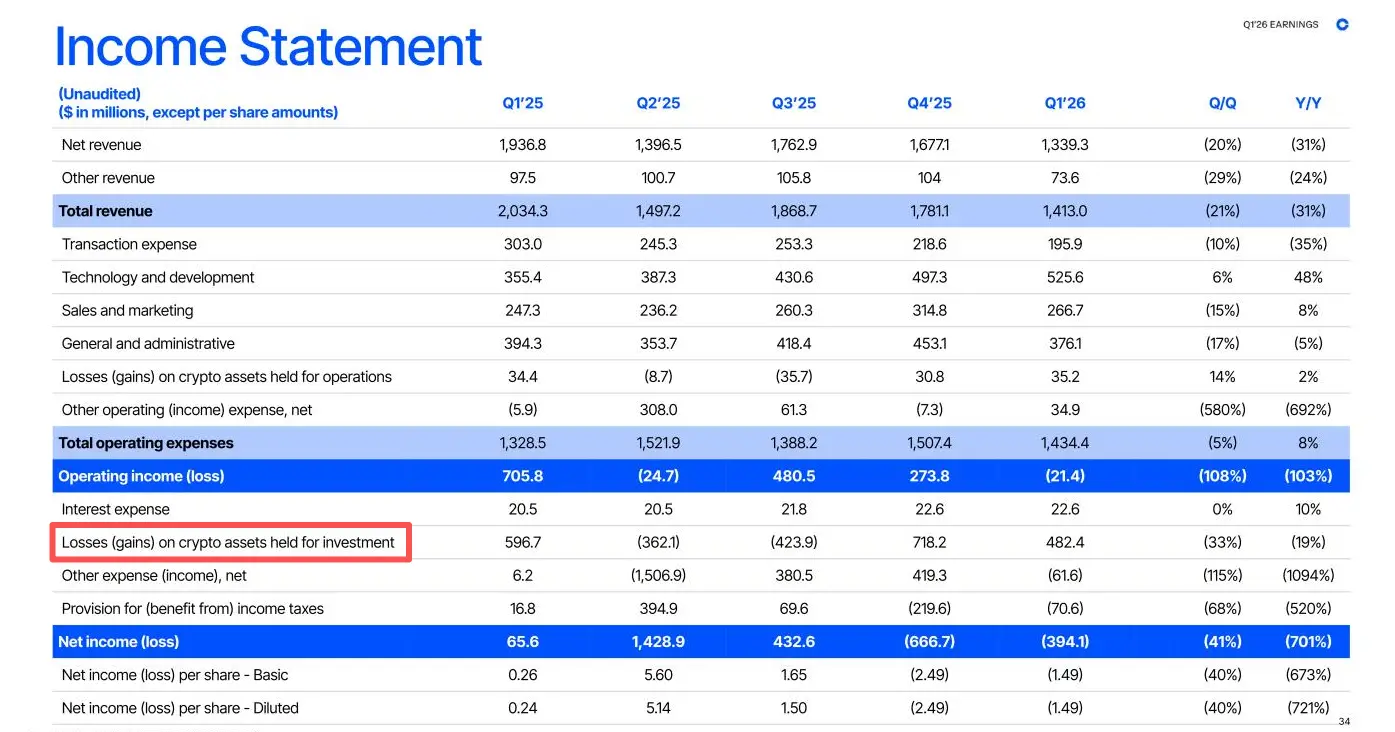
Dragged down by unrealized losses on held crypto assets, the company recorded a net loss of $394 million, with a loss per share of $1.47. In contrast, the company achieved a net profit of $66 million in the same period last year.

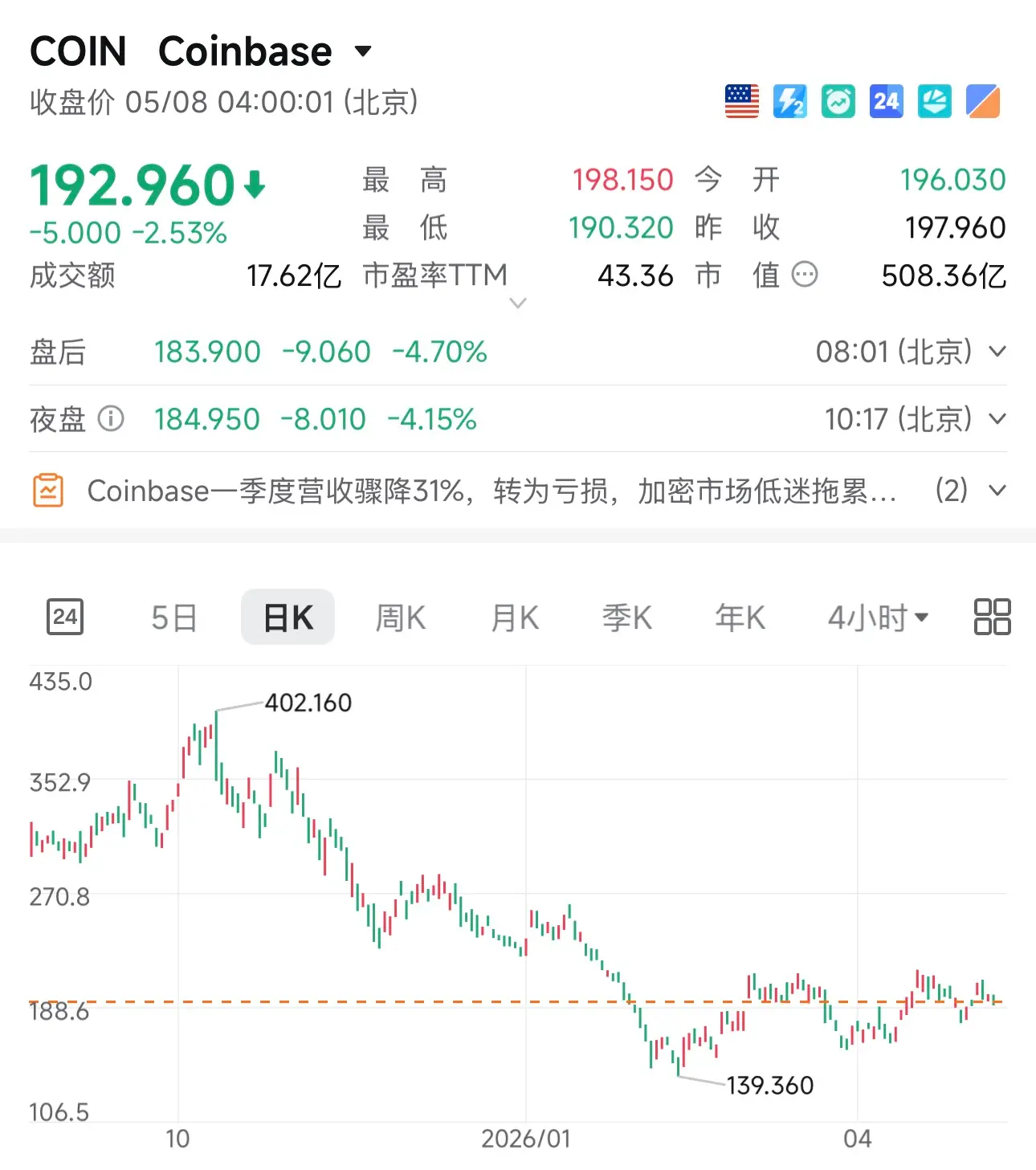
Following the earnings release, Coinbase's stock price fell approximately 4.7% in after-hours trading. The cumulative decline for the year-to-date has now exceeded 15%.
Transaction Revenue Down 40%, Institutional and Stablecoin Business as Bright Spots

Most of Coinbase's loss this quarter came from paper losses.

Behind the net loss of $394 million is an unrealized loss of $482 million from the company's investment crypto assets. This loss is accounted for with market price fluctuations and does not represent an actual cash outflow.

Excluding this portion, the company's adjusted net loss was only $45.6 million, and adjusted EBITDA remained positive at $303 million, with an operating loss of approximately $21.4 million.
The crypto market was generally weak in Q1. The price of Bitcoin fell from over $97,000 in early January to around $63,000 in early February, hovering below $70,000 by the end of the period. Market sentiment shifted rapidly, and retail trading activity contracted significantly. According to CoinGlass data, global crypto spot trading volume in Q1 was approximately $1.94 trillion, down about 44% year-on-year.

As a result, the company's total transaction revenue declined 40% to $756 million, with consumer transaction revenue at $567 million, a 48% year-on-year drop. Despite the halving of trading volume, Coinbase's global crypto spot market share rose to a record high of 8.6%, ranking fourth among global spot exchanges.

The institutional side, however, showed a completely different trend. The company's institutional transaction revenue reached $136 million, a 37% year-on-year increase. More notably, the derivatives business stood out, with derivatives trading volume growing 169% year-on-year, benefiting from the consolidation of Deribit acquired in August 2025. The collateral pledged by derivatives clients also surged from $27.4 million at the end of last year to $333 million at the end of this quarter, an increase of more than 10 times.

In terms of subscription and services revenue, the company recorded $584 million for the quarter, a 14% year-on-year decline, a significantly smaller drop than the transaction business. This segment's share of total net revenue increased to 44%. Notably, stablecoin revenue was $305 million, up 11% year-on-year, one of the few bright spots this quarter. Total assets on the platform stood at $294.4 billion at the end of the quarter.

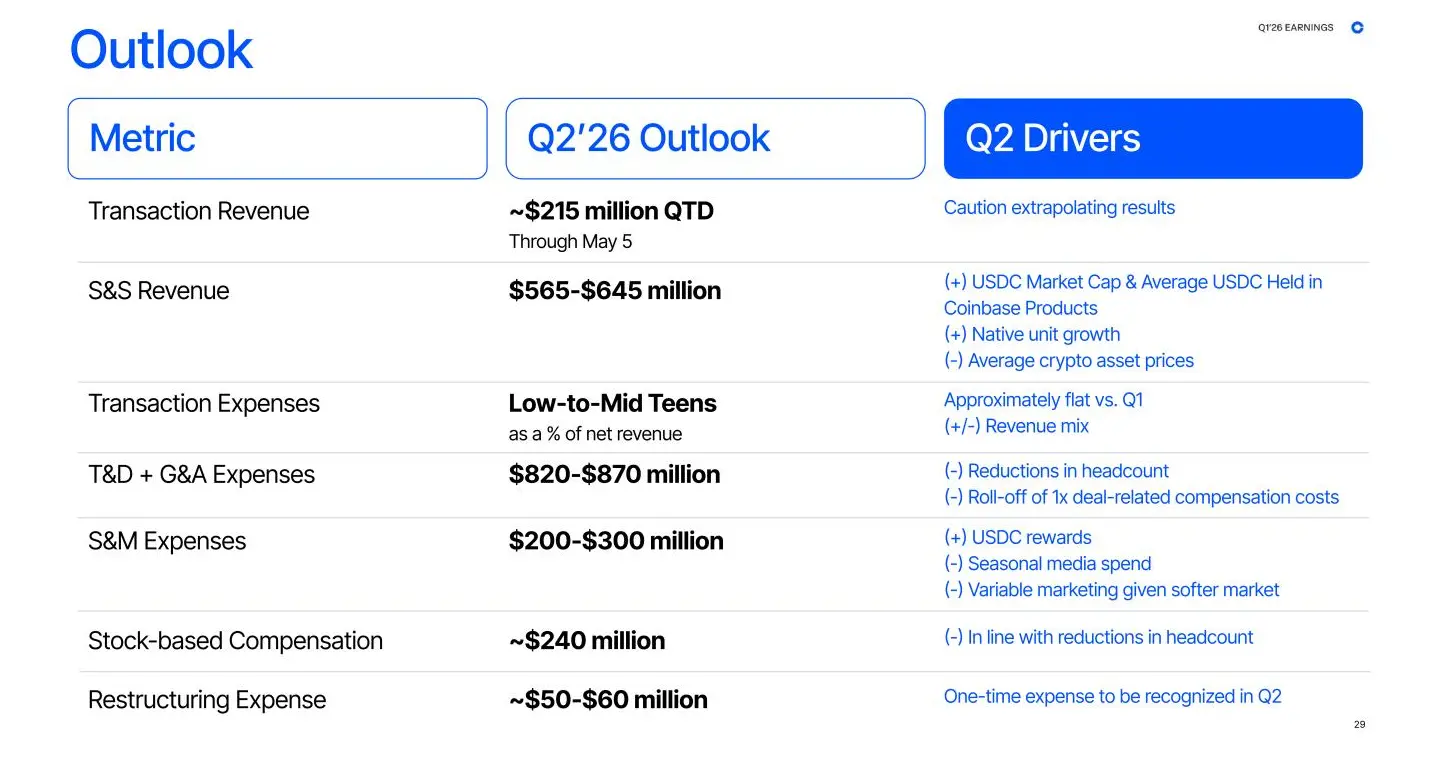
For Q2, management's outlook is generally cautious. The company disclosed that transaction revenue through May 5th was approximately $215 million, but management emphasized that current market volatility is high and this figure does not represent the trend for the entire quarter. The guidance range for subscription and services revenue is $565 million to $645 million, with the midpoint slightly above Q1's $584 million, indicating management's continued confidence in this revenue line. Restructuring expenses related to the recent layoffs, amounting to $50 to $60 million, will be recognized in Q2. Cost pressure is expected to ease significantly thereafter.
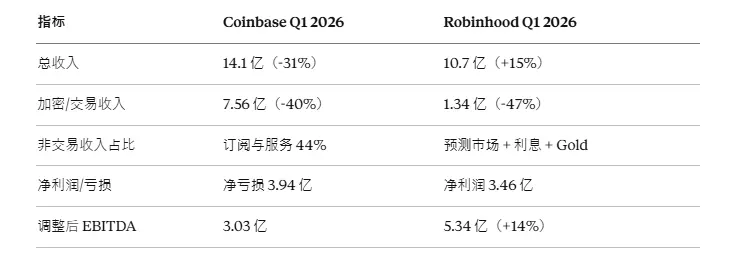
It is worth noting that Robinhood's Q1 earnings report presented a different picture. Its total revenue increased 15% year-on-year to $1.07 billion, with a net profit of $346 million and adjusted EBITDA reaching $534 million.

Examining the structure, the quality of this growth warrants scrutiny. Crypto-related revenue also declined 47% to $134 million. The company mainly filled the gap with three business segments: revenue from prediction market contracts skyrocketed 320%, becoming the largest incremental source; net interest income grew 24% to $359 million; and Gold subscription service revenue grew 32% to $50 million.

Additionally, Robinhood secured the role of sole initial trustee for the Trump account, investing approximately $100 million in related setup costs.

This quarter, Robinhood sustained growth through the policy tailwinds of prediction markets and the Trump account, while Coinbase bet on a longer-term transformation under the pressure of halved trading volumes.
Defensive Moves: Laying Off 700 Employees, What Is the Company Restructuring?

On May 5th, just two days before the earnings release, Coinbase announced cutting approximately 700 jobs, representing about 14% of its global workforce.

CEO Brian Armstrong stated that this restructuring aims to bring the company back to startup speed and accelerate the transition to an AI-native organization. The goal is to refactor Coinbase into an organization with intelligence at its core, augmented by humans at the edges.

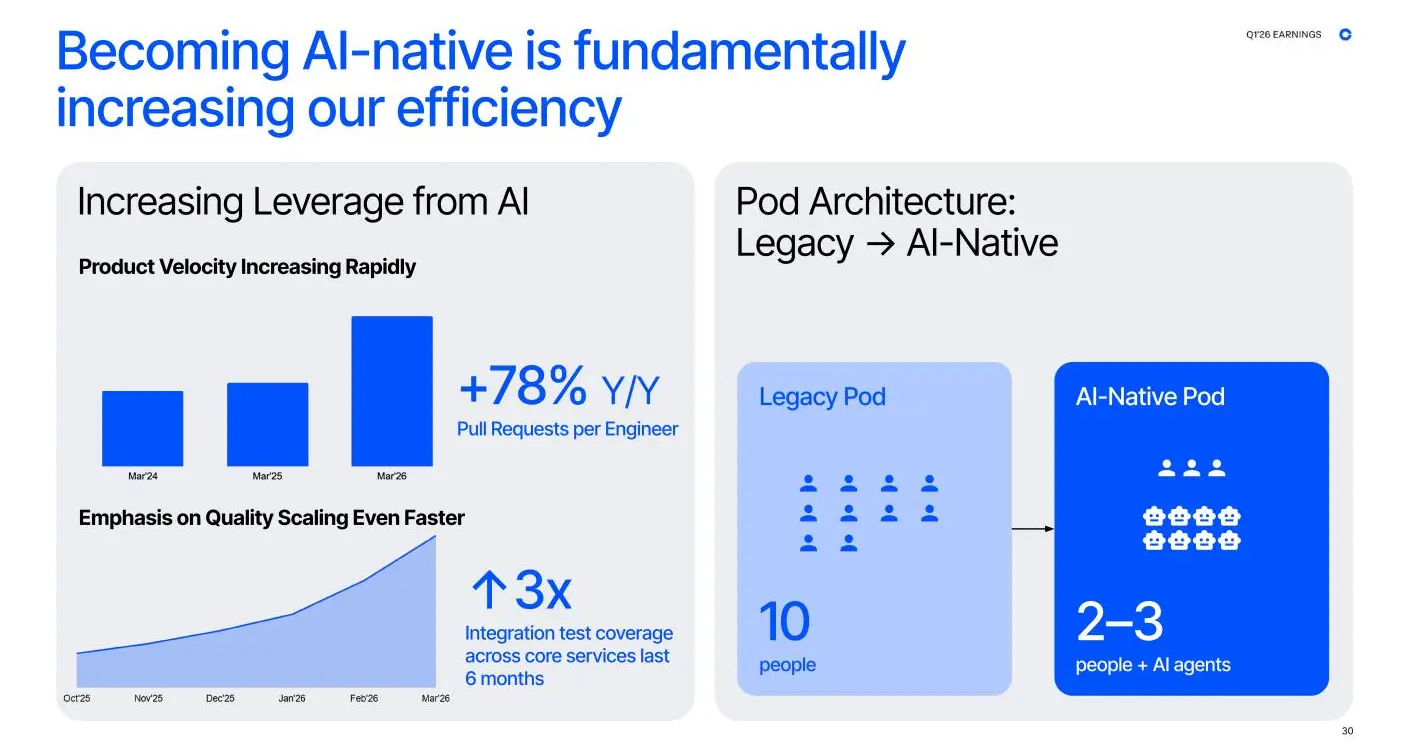
Coinbase defines this approach as "AI-native"—not just introducing AI tools into the existing organization, but redesigning the company's operational model from the ground up. Company data shows a 78% year-on-year increase in engineer pull requests per capita. Team structures have been reorganized from traditional 10-person pods to AI-Native pods consisting of 2-3 people plus AI agents. Core service integration test coverage tripled within six months.
However, the financial implications need to be carefully considered. Omar, a partner at crypto venture capital firm Dragonfly, estimates that this layoff could save the company approximately $225 million in annual salary costs. But the full-year 2026 expense guidance indicates that, excluding the impact of increased USDC rewards, expenses will be roughly flat year-on-year. In other words, a significant portion of the cost savings from layoffs is offset by investments in user incentive programs.

It is also worth noting that over the past year or so, OpenAI has poached at least six senior marketing executives from Coinbase, including former CMO Kate Rouch, Sarah Russell, and others. Sarah Wolf, head of marketing for the Base chain, moved to Anthropic. Coinbase officially characterized these departures as normal personnel movement, but it is noteworthy that while the company is using AI to restructure its organization and reduce headcount, it is also supplying AI companies with marketing talent who best understand branding and growth.

When asked about potential future layoffs, CFO Alesia Haas stated, "We can't predict the future, but as a public company, we will always do what is best for the company."

Offensive Moves: Building On-Chain Financial Infrastructure

The "Everything Exchange" Blueprint

At the end of last year, Armstrong proposed the strategic goal of an "Everything Exchange"—transforming Coinbase from a primarily spot crypto platform into a comprehensive multi-asset platform encompassing derivatives, commodities, futures, and prediction market contracts, allowing users to avoid switching between different platforms.

Q1 data shows strong growth in derivatives, prediction markets, and decentralized exchanges. On the Base chain, stablecoin transactions initiated by AI agents already account for 90% of total chain transaction volume. Derivatives trading volume reached a record high, with contract business exceeding spot trading for the first time.

With initial results showing, the company has continued to double down recently, including: investing in Centrifuge to secure the tokenization infrastructure for RWA; taking a stake in Kemet to integrate institutional derivatives channels; launching the stablecoin credit fund CUSHY; obtaining the OCC national trust charter to clear the compliance hurdle for institutional custody; and partnering with AWS to integrate wallet infrastructure and the x402 protocol into Amazon Bedrock's AgentCore payment system, enabling AI agents to autonomously complete micropayments using USDC.

The Stablecoin Moat

Beyond expanding trading categories, the stablecoin business constitutes a deeper revenue moat for Coinbase.

According to Coinbase's revenue-sharing agreement with Circle, 100% of the earnings generated by USDC held on the Coinbase platform go to Coinbase, while off-platform USDC earnings are split approximately 50/50 between the two parties.

USDC's market capitalization has now reached a record high of approximately $80 billion, with over 25% held on the Coinbase platform. The balance on the platform has grown nearly 10-fold compared to three years ago. As USDC adoption continues to expand, Coinbase's share of the pie grows proportionally.

However, this revenue stream is not without risks. This quarter, the average interest rate declined by 67 basis points, negatively impacting stablecoin revenue by approximately $57.5 million. Changes in the interest rate environment may weaken the resilience of this revenue line.

CFO Alesia Haas emphasized during the earnings call, "Our USDC contract automatically renews every three years, and it renews in perpetuity. This contract cannot be terminated." CLO Paul Grewal added immediately, "We expect to continue our partnership with Circle on the same terms going forward."

These statements were clearly addressing market concerns about stablecoin regulation legislation. Regarding the CLARITY Act, Coinbase has engaged in a prolonged game of chess:

  • In January, it withdrew support due to unfavorable earnings provisions, causing the Senate to delay the vote;
  • In March, it rejected a new draft again, causing Circle's stock price to plummet 20% in a single day;
  • In early May, a compromise text emerged, prohibiting "pay for hold" but retaining space for rewards tied to real activities. Armstrong replied "Mark it up" on X, and Grewal also publicly expressed being "very confident" about the bill passing this summer.

The true value of this game is that Coinbase is not just complying with rules but participating in shaping them. The legal teams, compliance processes, and regulatory communication capabilities required to repackage yield products constitute a resource barrier that smaller exchanges cannot replicate in the short term.

In other words, once the CLARITY Act is enacted, the advantages of leading platforms will be solidified by legislation. Regulatory clarity is beneficial for the entire industry, but the deepest beneficiaries will always be the few capable of sitting at the negotiation table.

However, it is noteworthy that after the bill passes, there will be a 12-month rule-making phase, and the final boundaries are yet to be defined, leaving uncertainties.

Conclusion

With trading volume halved and a net loss of $394 million, Coinbase's earnings report once again reminds the market that the company remains strongly tied to the crypto cycle. There is no shortage of skeptical voices questioning whether the AI narrative represents a genuine transformation or merely a wrapper for declining business performance.

Brian Armstrong has repeatedly emphasized, "All finance will eventually move on-chain." As crypto increasingly resembles traditional finance, Coinbase is also striving to make itself look more like a mature financial infrastructure company. This might be the answer it is offering in the current cycle.

Kripto yang Sedang Tren

Pertanyaan Terkait

QWhat were the key factors contributing to Coinbase's Q1 2026 net loss of $394 million?

ACoinbase's Q1 2026 net loss of $394 million was primarily driven by $482 million in unrealized losses on its investment portfolio of crypto assets due to market price declines. Excluding this mark-to-market impact, the adjusted net loss was $45.6 million.

QHow did Coinbase's consumer and institutional trading revenues perform in Q1 2026, and what is the 'Everything Exchange' strategy?

AIn Q1 2026, Coinbase's consumer transaction revenue fell 48% to $567 million, while institutional transaction revenue grew 37% to $136 million. The 'Everything Exchange' strategy aims to transform Coinbase from a primarily spot crypto platform into a multi-asset platform covering derivatives, commodities, futures, and prediction markets, creating a one-stop financial platform.

QWhat cost-saving measure did Coinbase announce alongside its earnings, and what is its broader organizational transformation goal?

ACoinbase announced a layoff of approximately 700 employees, about 14% of its workforce, aimed at saving an estimated $225 million in annual compensation costs. The broader goal is to accelerate its transformation into an 'AI-native' organization, fundamentally redesigning operations around AI agents to increase speed and efficiency.

QWhy is USDC stablecoin revenue significant for Coinbase, and what are the associated risks?

AUSDC revenue is a significant and growing income stream for Coinbase, reaching $305 million in Q1 (up 11% YoY). Its importance stems from a revenue-sharing agreement with Circle. However, this revenue faces risks from potential regulatory changes like the CLARITY Act, which could restrict yield products, and from sensitivity to interest rate fluctuations, which negatively impacted Q1 revenue by approximately $57.5 million.

QHow does Coinbase's Q1 2026 performance and outlook compare to its competitor Robinhood's?

ACoinbase's Q1 performance was challenged, with total revenue down 31% and a net loss, largely due to crypto market weakness. In contrast, Robinhood reported 15% revenue growth and a net profit of $346 million. However, Robinhood's crypto revenue also fell 47%; its growth was fueled by other segments like prediction markets and net interest income, while Coinbase is investing heavily in long-term infrastructure and diversification.

Bacaan Terkait

Setelah Tiga Kuartal Berturut-Turut Turun, Bisakah Pasar Kripto Menyambut Jendela Stabilitas di Kuartal Ketiga?

Pasar kripto mengalami kuartal terburuk sejak 2022, dengan kapitalisasi pasar turun 12.6% menjadi $2.1 triliun, didorong oleh keluarnya modal dan penurunan volume perdagangan. Bitcoin dan Ethereum masing-masing jatuh 14.2% dan 25.4% di kuartal kedua. Aliran keluar bersih dari ETF Bitcoin AS mencapai $4.67 miliar, menandakan tekanan jual yang berkelanjutan. Faktor utama meliputi terputusnya hubungan dengan saham AS, kebijakan moneter Federal Reserve yang ketat, dan pelepasan aset oleh perusahaan seperti Strategy. Proses legislasi UU CLARITY yang akan memberikan kejelasan regulasi terhambat, meningkatkan premi risiko di sektor ini. Namun, ada tanda-tanda potensi stabilisasi. Aliran keluar ETF yang besar secara historis sering terjadi di akhir fase penurunan, dan para pemegang Bitcoin jangka panjang mulai menambah kepemilikan lagi. Sementara sebagian besar sektor menyusut, pasar prediksi dan aset koleksi yang ditokenisasi mencatat pertumbuhan signifikan. Pandangan untuk kuartal ketiga sangat bergantung pada pertemuan Fed akhir Juli. Sinyal kebijakan yang lunak dapat mendukung pemulihan Bitcoin, sementara sikap yang hawkish dapat memicu konsolidasi lebih lanjut. Meskipun tantangan regulasi tetap ada, indikator teknis seperti harga Bitcoin yang mendekati rata-rata bergerak 200-mingguannya menunjukkan dasar jangka panjang belum rusak. Logika pasar telah bergeser dari mengandalkan narasi ke faktor fundamental seperti kebijakan dan ekspektasi suku bunga.

marsbit16j yang lalu

Setelah Tiga Kuartal Berturut-Turut Turun, Bisakah Pasar Kripto Menyambut Jendela Stabilitas di Kuartal Ketiga?

marsbit16j yang lalu

The SpaceX Trade, Terbuka: SPCXON Mulai Diperdagangkan di WEEX

SpaceX meluncurkan IPO terbesar dalam sejarah pada Juni 2026, namun akses bagi banyak pedagang terhambat oleh batasan regional dan prosedur broker. WEEX kini menghadirkan SPCXON/USDT di pasar spotnya, sebuah instrumen tokenisasi yang memungkinkan paparan terhadap pergerakan harga SpaceX melalui akun kripto yang diselesaikan dengan USDT, tanpa memerlukan broker AS atau pembiayaan bank. SPCXON adalah produk tokenisasi yang mencerminkan ekonomi kepemilikan SpaceX bagi pedagang yang memenuhi syarat di luar AS, dengan dividen diinvestasikan kembali. Aset ini diperdagangkan di WEEX sebagai pasangan spot dengan USDT, tersedia selama jam pasar, memberikan akses mudah bagi trader kripto. Kasus investasi untuk SpaceX didasarkan pada pertumbuhan pendapatan Starlink dan pencapaian Starship, meskipun valuasinya yang tinggi (sekitar 90-110 kali pendapatan) telah memperhitungkan eksekusi sempurna selama bertahun-tahun. Faktor seperti jumlah saham publik yang terbatas dan masa buka kunci (unlock) insider pertama menjadi pertimbangan penting. Penting untuk diingat bahwa SPCXON memberikan paparan, bukan kepemilikan langsung atas saham atau hak suara. Harganya dapat diperdagangkan pada premium atau diskon terhadap nilai aset bersih. WEEX menawarkan akses ke berbagai aset TradFi yang ditokenisasi seperti ini dalam satu akun terpadu, bersama dengan pasar futures dan kampanye perdagangan dengan pool hadiah.

TheNewsCrypto16j yang lalu

The SpaceX Trade, Terbuka: SPCXON Mulai Diperdagangkan di WEEX

TheNewsCrypto16j yang lalu

Momen Perdagangan BIT: BTC Masih Tertekan oleh EMA 200 Mingguan, Setelah Ditolak Mungkin Kembali Turun, Saham Penyimpanan dan Semikonduktor yang Melonjak Malam Kemudian Mulai Anjlok di Pasar Malam

**PASAR KRIPTO & SAHAM: BTC Hadapi Resistensi, Saham Semikonduktor Turun di Perdagangan Malam** Pasar kripto melanjutkan pemulihan, dengan harga Bitcoin bertahan di sekitar $66,000 setelah rebound lebih dari 15% dari titik terendah Juli. Namun, BTC menghadapi **tembok resistensi kuat di dekat $68,000**, yang bertepatan dengan biaya rata-rata investor selama lima bulan terakhir dan titik gagalnya rebound pertengahan Juni. Secara teknis, perhatian tertuju pada **200 EMA mingguan (~$68,328) sebagai level kunci**. Jika BTC ditolak di level ini, potensi penurunan menuju support $63,000 terbuka. Analis menyoroti volume rendah dan penurunan open interest futures di CME, menandakan rebound ini lebih dipicu likuiditas rendah musim panas daripada awal bull run penuh. Di pasar saham AS, **indeks futures utama turang** setelah sesi kemarin yang kuat. Sektor semikonduktor dan penyimpanan (storage), yang melonjak pada hari Selasa (contoh: Micron +12%), **mengalami koreksi di perdagangan malam (night trading)**. ETF semikonduktor turun 2,22% dan saham Micron turun 2,29%. Meski begitu, ada sorotan positif seperti **Super Micro Computer (SMCI)** yang naik lebih dari 15% setelah melaporkan pandangan pendapatan yang kuat dan pesanan baru yang sangat besar, mengonfirmasi permintaan server AI tetap solid. Kekhawatiran makro muncul dari **kenaikan harga minyak mentah (di atas $91)** akibat ketegangan geopolitik dan **lonjakan imbal hasil (yield) obligasi pemerintah AS**, dengan imbal hasil 10-tahun mencapai sekitar 4,64%. Faktor-faktor ini dapat menambah tekanan inflasi dan membatasi ruang gerak pasar saham. Saham terkait kripto seperti Coinbase dan Robinhood naik kuat didorong oleh perkembangan regulasi yang lebih jelas di AS. Di Asia, **Korea Selatan** dan **Jepang** menunjukkan kinerja beragam. Indeks KOSPI Korea naik didukung pemulihan saham semikonduktor, sementara pasar Jepang melemah dengan **Yen terus melemah ke level terendah sejak 1986**, meningkatkan kekhawatiran akan intervensi bank sentral. **Yang Perlu Diperhatikan Selanjutnya:** * **22 Juli:** Acara AI AMD, rilis laporan keuangan dari Google (Alphabet), Tesla, IBM. * **23 Juli:** Keputusan suku bunga Bank Sentral Eropa (ECB), data klaim pengangguran AS, laporan keuangan Intel. * Perkembangan lebih lanjut dari **harga minyak, imbal hasil obligasi, dan dinamika Yen Jepang** akan menjadi penentu sentimen pasar risiko secara keseluruhan.

marsbit16j yang lalu

Momen Perdagangan BIT: BTC Masih Tertekan oleh EMA 200 Mingguan, Setelah Ditolak Mungkin Kembali Turun, Saham Penyimpanan dan Semikonduktor yang Melonjak Malam Kemudian Mulai Anjlok di Pasar Malam

marsbit16j yang lalu

Mantan Ketua CFTC dan Presiden Circle, Tarbert: Satu Pihak Menasihati Anda untuk Berpikir Jangka Panjang, di Sisi Lain Menguangkan $30 Juta Sendiri

Penulis: Zen, PANews Heath Tarbert, mantan Ketua CFTC dan Presiden Circle, baru-baru ini menyerukan kepada investor untuk mengadopsi pandangan jangka panjang terhadap saham Circle, meskipun harganya telah turun 70% dari puncaknya. Namun, ia sendiri secara konsisten menjual saham CRCL sejak perusahaan go public, menguangkan sekitar $30 juta tanpa pernah membeli saham tambahan di pasar terbuka. Tarbert, yang bergabung dengan Circle pada Juli 2023 dan menjadi Presiden pada awal 2025, dikenal sebagai pendukung kuat narasi "jangka panjang" perusahaan. Namun, sehari sebelum IPO Circle, ia menetapkan rencana perdagangan 10b5-1 untuk menjual hingga 353.290 saham dalam setahun. Dalam 13 bulan setelah IPO, ia menjual lebih dari 360.000 saham, termasuk penjualan tunggal senilai $11,5 juta pada Maret 2026. Ia bahkan menetapkan rencana 10b5-1 kedua untuk menjual hingga 160.000 saham lagi pada akhir tahun 2026. Langkah Tarbert ini menuai kecaman karena dianggap tidak konsisten dengan pesan "jangka panjang" yang ia sampaikan kepada publik. Perjalanan kariernya sering dikaitkan dengan "revolving door" antara regulator dan dunia keuangan. Setelah mengundurkan diri sebagai Ketua CFTC pada Maret 2021, ia bergabung dengan Citadel Securities hanya 27 hari kemudian sebagai Kepala Penasihat Hukum, tepat saat perusahaan itu menghadapi pengawasan ketat terkait peristiwa GameStop. Di Citadel, ia juga mendukung undang-undang yang memperluas wewenang CFTC atas pasar crypto, sementara Citadel diketahui berencana berekspansi ke aset kripto. Tarbert kemudian pindah ke Circle pada 2023, membantu perusahaan mengatasi tantangan regulasi dan akhirnya go public melalui IPO langsung. Meskipun sangat berharga bagi perusahaan, tindakannya menjual saham dalam jumlah besar sambil mendorong investor untuk bertahan menimbulkan pertanyaan tentang komitmennya yang sebenarnya terhadap masa depan jangka panjang Circle.

marsbit17j yang lalu

Mantan Ketua CFTC dan Presiden Circle, Tarbert: Satu Pihak Menasihati Anda untuk Berpikir Jangka Panjang, di Sisi Lain Menguangkan $30 Juta Sendiri

marsbit17j yang lalu

Gate Research Institute: Produk Keuangan Kripto Menggulirkan Gelombang "Wall Street-ization", Kompetisi atau Integrasi?

**Ringkasan: Gelombang "Wall Street-ization" Produk Keuangan Kripto: Kompetisi atau Integrasi?** Artikel ini membahas fenomena konvergensi antara keuangan tradisional (TradFi) dan keuangan kripto (Crypto). Meskipun Bitcoin awalnya dirancang sebagai sistem peer-to-peer yang terdesentralisasi dan bebas dari perantara seperti bank, pasar kripto kini semakin diintegrasikan ke dalam infrastruktur keuangan tradisional. **Tren "Wall Street-ization":** Dimulai dengan disetujuinya ETF spot Bitcoin pada 2024, aset kripto kini dikemas menjadi produk seperti ETF (oleh BlackRock, Fidelity, dll.), futures, dan sekuritisasi aset riil (RWA) seperti obligasi pemerintah yang ditokenisasi. Ini memberikan akses yang mudah dan teregulasi bagi investor institusional, tetapi juga berarti kekuasaan atas penerbitan, penentuan harga, kustodian, dan distribusi aset kripto semakin bergeser ke lembaga keuangan besar. **Dua Jalur Konvergensi (1+1>2):** Artikel ini menyoroti dua arah integrasi: 1. **Dari CEX ke TradFi:** Dilambangkan oleh **Gate.io**, yang berkembang dari bursa kripto menjadi platform multi-aset. Gate kini menawarkan perdagangan saham nyata (AS, Hong Kong, Korea) menggunakan USDT, menyediakan akses tanpa batas waktu ke pasar tradisional. 2. **Dari TradFi ke Crypto:** Dilambangkan oleh **Robinhood**, platform broker tradisional yang memperluas layanannya ke aset kripto (termasuk melalui akuisisi Bitstamp) dan mengembangkan produk seperti token saham di blockchain. **Tujuan Bersama: Akun Keuangan "Super" Terpadu:** Kedua jalur ini bertujuan menciptakan **akun keuangan generasi berikutnya yang terpadu**. Pengguna di masa depan mungkin dapat memperdagangkan Bitcoin, saham Apple, ETF, emas, dan obligasi pemerintah yang ditokenisasi dalam satu antarmuka yang sama, menggunakan stablecoin sebagai lapisan dana. **RWA dan Obligasi Pemerintah di On-Chain sebagai Lapisan Tengah:** Tokenisasi aset dunia nyata, terutama obligasi pemerintah AS, menyediakan aset berpenghasilan rendah risiko di ekosistem on-chain. Pasar ini tumbuh pesat (naik 40% pada paruh pertama 2026) meskipun pasar kripto turun, menunjukkan permintaan nyata. **Kesimpulan:** "Wall Street-ization" bukanlah pengambilalihan sepihak, melainkan **transformasi timbal balik**. TradFi dan Crypto saling melengkapi: Crypto mendapatkan akses ke likuiditas, kepatuhan, dan jaringan distribusi yang luas, sementara TradFi mengadopsi efisiensi, kecepatan, dan pasar 24/7 dari Crypto. Hasil akhirnya adalah pembentukan **pasar modal terpadu yang lebih efisien dan global**, di mana batas antara aset tradisional dan kripto semakin kabur.

marsbit17j yang lalu

Gate Research Institute: Produk Keuangan Kripto Menggulirkan Gelombang "Wall Street-ization", Kompetisi atau Integrasi?

marsbit17j yang lalu

Trading

Spot

Artikel Populer

Cara Membeli 4

Selamat datang di HTX.com! Kami telah membuat pembelian 4 (4) menjadi mudah dan nyaman. Ikuti panduan langkah demi langkah kami untuk memulai perjalanan kripto Anda.Langkah 1: Buat Akun HTX AndaGunakan alamat email atau nomor ponsel Anda untuk mendaftar akun gratis di HTX. Rasakan perjalanan pendaftaran yang mudah dan buka semua fitur.Dapatkan Akun SayaLangkah 2: Buka Beli Kripto, lalu Pilih Metode Pembayaran AndaKartu Kredit/Debit: Gunakan Visa atau Mastercard Anda untuk membeli 4 (4) secara instan.Saldo: Gunakan dana dari saldo akun HTX Anda untuk melakukan trading dengan lancar.Pihak Ketiga: Kami telah menambahkan metode pembayaran populer seperti Google Pay dan Apple Pay untuk meningkatkan kenyamanan.P2P: Lakukan trading langsung dengan pengguna lain di HTX.Over-the-Counter (OTC): Kami menawarkan layanan yang dibuat khusus dan kurs yang kompetitif bagi para trader.Langkah 3: Simpan 4 (4) AndaSetelah melakukan pembelian, simpan 4 (4) di akun HTX Anda. Selain itu, Anda dapat mengirimkannya ke tempat lain melalui transfer blockchain atau menggunakannya untuk memperdagangkan mata uang kripto lainnya.Langkah 4: Lakukan trading 4 (4)Lakukan trading 4 (4) dengan mudah di pasar spot HTX. Cukup akses akun Anda, pilih pasangan perdagangan, jalankan trading, lalu pantau secara real-time. Kami menawarkan pengalaman yang ramah pengguna baik untuk pemula maupun trader berpengalaman.

794 Total TayanganDipublikasikan pada 2025.10.20Diperbarui pada 2026.06.02

Cara Membeli 4

Diskusi

Selamat datang di Komunitas HTX. Di sini, Anda bisa terus mendapatkan informasi terbaru tentang perkembangan platform terkini dan mendapatkan akses ke wawasan pasar profesional. Pendapat pengguna mengenai harga 4 (4) disajikan di bawah ini.

活动图片