Behind the 25% Surge: The On-Chain Life-and-Death Game of Hyperliquid

比推Dipublikasikan tanggal 2026-03-09Terakhir diperbarui pada 2026-03-09

Abstrak

A dramatic 25% surge in WTI crude oil prices, reaching $119.5 per barrel, has triggered a high-stakes on-chain showdown on the Hyperliquid derivatives exchange. The price spike was driven by a geopolitical crisis: the seven-day blockade of the Strait of Hormuz, a critical chokepoint for 20% of global oil supply. This event led to massive liquidations for several prominent traders who had heavily shorted oil. Key figures include trader CBB, who faced a $3.8 million unrealized loss on a $13.78 million short position, and the account "2 frères 2 fauves," the platform's largest oil short with a $3.4 million loss. Both faced liquidation at $120.76. Another whale, 0x8Af7, was fully liquidated, losing $1.55 million, only to immediately reopen a new $6.48 million short position. In contrast, Sky (formerly MakerDAO) co-founder Rune Christensen profited significantly, gaining over $1.36 million from a $7.82 million long position opened around $93. He employed a sophisticated macro-hedging strategy, simultaneously shorting ETH and equity indices to bet on war-driven oil premiums and risk-off sentiment. The event highlights the emergence and risks of on-chain commodity trading. Platforms like Hyperliquid offer democratized access to leveraged oil futures without traditional brokers or safeguards. However, the automated, unforgiving liquidation mechanisms provide no protection against black swan events like a geopolitical crisis, demonstrating that while the tools are new, the lessons ...

Written by: angelilu, Foresight News

Original title: Crude Oil Surges 25%, Hyperliquid Stages On-Chain Life-and-Death Game


"Friends shorting crude oil are completely fired up."

When on-chain analyst Ai Yi sent this tweet on the morning of March 9, WTI crude oil touched $108 per barrel. The account at the top of Hyperliquid's holdings leaderboard was facing a floating loss approaching $3.4 million, with the liquidation price set at $120.76.

As of publication, the WTI crude oil contract price reached an intraday high of $119.5 and is currently reported at $114.5, accumulating a gain of over 25% since last Friday's closing price.
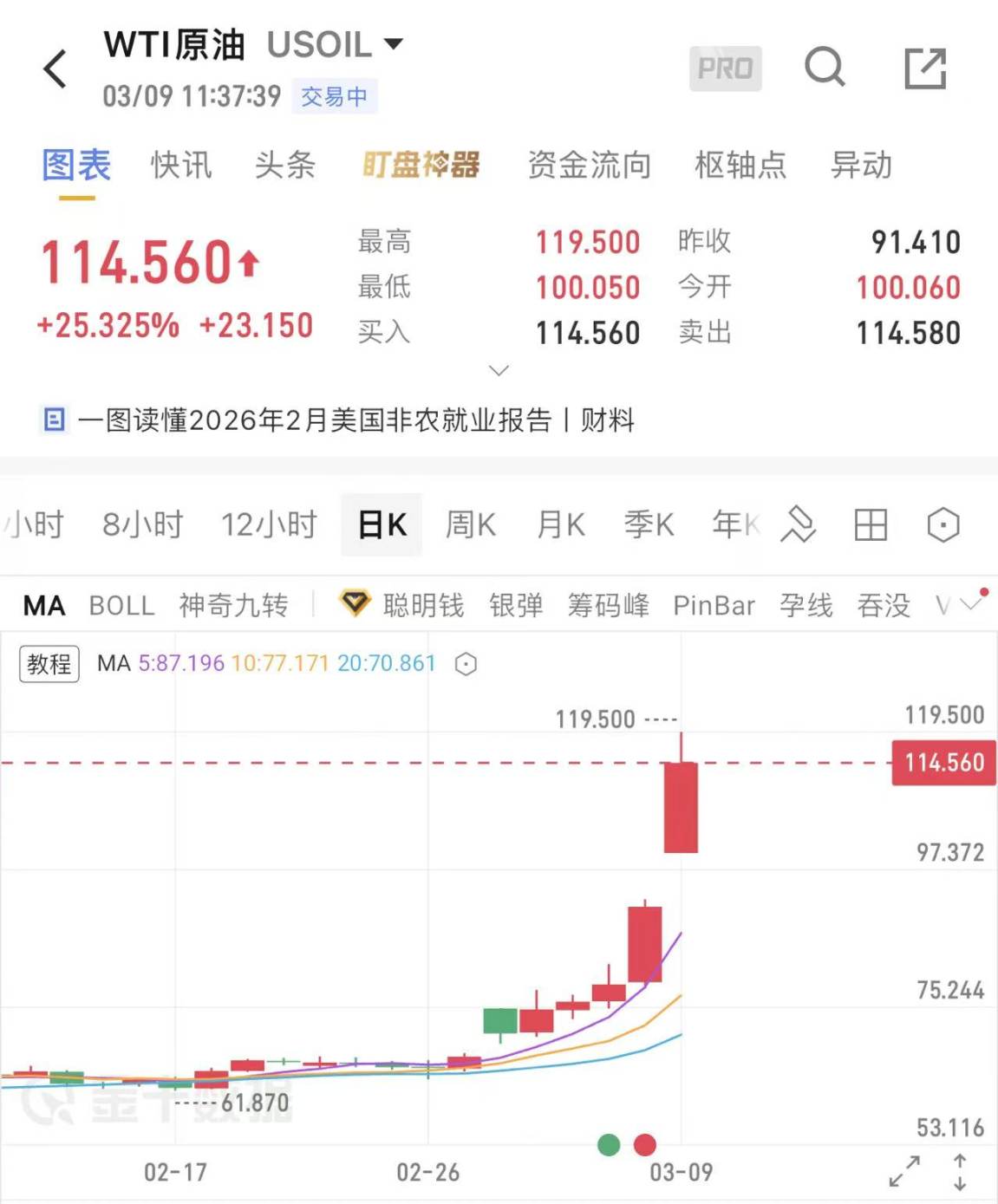
Due to a Strait, Crude Oil Surges Over 40% in a Week

The story begins with Iran's Strait of Hormuz.

By March 9, the Strait of Hormuz had been almost completely blocked for seven consecutive days. The shutdown of this choke point, which carries about 20% of the world's oil supply, triggered a market quake. By March 9, the WTI crude oil price had surged dramatically within just a week, setting a rare volatility record in recent years, accumulating a gain of over 40% compared to pre-conflict levels.

The shockwaves spread rapidly. The Nikkei index fell 5.4% in a single day, its largest drop since the tariff turmoil; South Korea's KOSPI plummeted 7%; Germany's DAX fell over 3%. Bitcoin was not spared either, falling below $66,000, with the crypto market seeing $120 million in liquidations within an hour. The Crypto Fear & Greed Index dropped to 12, entering the "extreme fear" zone.

But on Hyperliquid, another war was raging.

Three Stories of Shorting Crude Oil

In the on-chain circle, CBB (@Cbb0fe) is not an unfamiliar face. A few months ago, he publicly formed a team specifically to "hunt" another whale, @qwatio. This time, he himself became the prey.

https://x.com/lookonchain/status/2030817006107369727

According to Lookonchain monitoring, CBB shorted 127,175 xyz:CL (WTI crude oil mapping contracts) at an average price of $78.37, with a notional value of approximately $13.78 million. As oil prices soared, his floating loss reached $3.81 million, with the liquidation price hanging at $120.76.

Only a few tenths of a dollar away from that number. But no one knows when the situation in Iran will cool down.

Another account, "2 frères 2 fauves," is in equally dangerous territory. He entered a short position at $78.36, currently holding 12,717 CL with a notional value of approximately $13.37 million, ranking first in CL contract holdings on Hyperliquid. His floating loss is $3.4 million, with the same liquidation price of $120.76.

More dramatic is the experience of whale 0x8Af7. He shorted 72,179 CL (approx. $7.8 million). As oil prices rose, his short position was entirely force-liquidated, resulting in a loss exceeding $1.55 million.

Yet, just hours after the liquidation, he immediately reopened a position—60,166 new short contracts, with a notional value of $6.48 million.

Was it a misjudgment or inherent gambling tendencies? Perhaps both. But this choice itself speaks to a certain ethos of on-chain high-leverage trading: liquidation is not the end, just the conclusion of the previous round.

There Are Also Winners, The Other Side of a Sky Co-Founder

On the same Hyperliquid, during the same period, Sky (formerly MakerDAO) co-founder Rune Christensen was laughing on the other side, watching the storm.

On-chain analyst EmberCN disclosed that RuneKek (Rune's on-chain account) went long on approximately $7.82 million worth of crude oil contracts, with an entry cost around $93. As of today, with oil prices touching $109, his floating profit has exceeded $1.36 million.

More noteworthy is his portfolio strategy: while going long on crude oil, he also shorted some ETH and XYZ100 (US stock index mapping contracts). This makes his strategy more like a hedge against geopolitical conflict—crude oil benefits from war premiums, while stocks and cryptocurrencies suffer from risk-off sentiment. By positioning on both sides, he hedges out the risk of a one-way bet.

Rune Christensen, a DeFi protocol founder, used on-chain perpetual contracts to build a macro hedging portfolio. This fact itself is more noteworthy than how much money he made.

On-Chain Commodities: New Tools, Old Lessons

This round of oil行情 pushed a previously inconspicuous topic to the forefront: on-chain commodity trading.

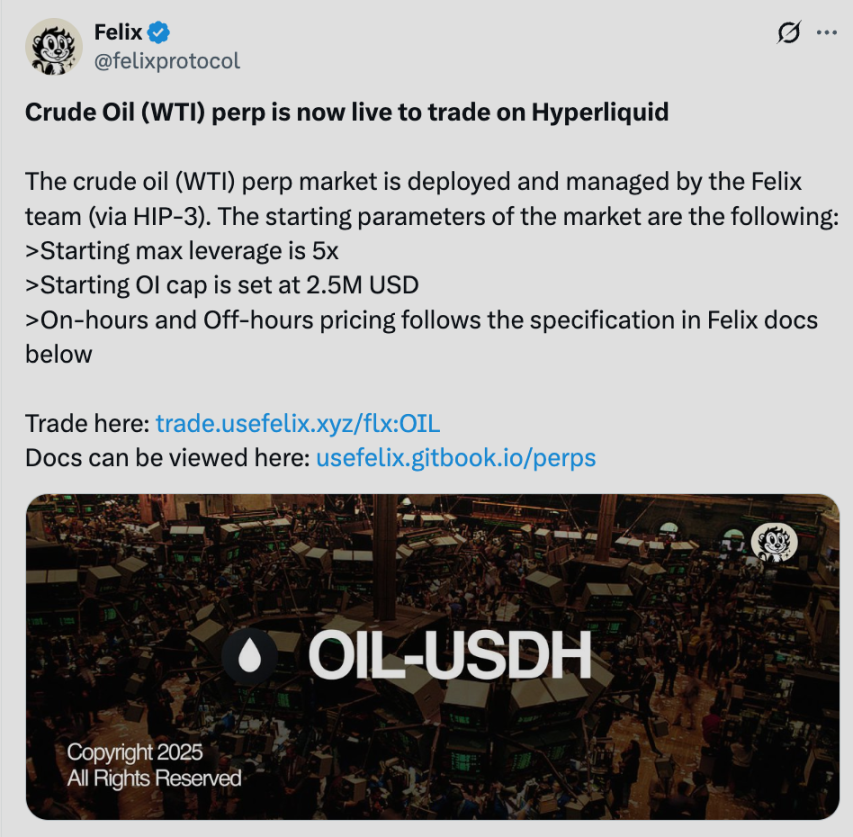
The crude oil on Hyperliquid was launched by the Felix protocol (HIP-3 market deployer on Hyperliquid) on January 9, 2026, about two months ago. The initial parameters were a maximum of 5x leverage and an open interest cap of $2.5 million, representing an early small-scale launch. Trading volume only truly exploded after Iran blocked the strait.
Platforms like Phantom have also陆续 launched perpetual contracts for traditional commodities like crude oil and gold. Theoretically, anyone with a wallet can trade crude oil futures like they trade Bitcoin, without opening a traditional futures account or needing a broker.
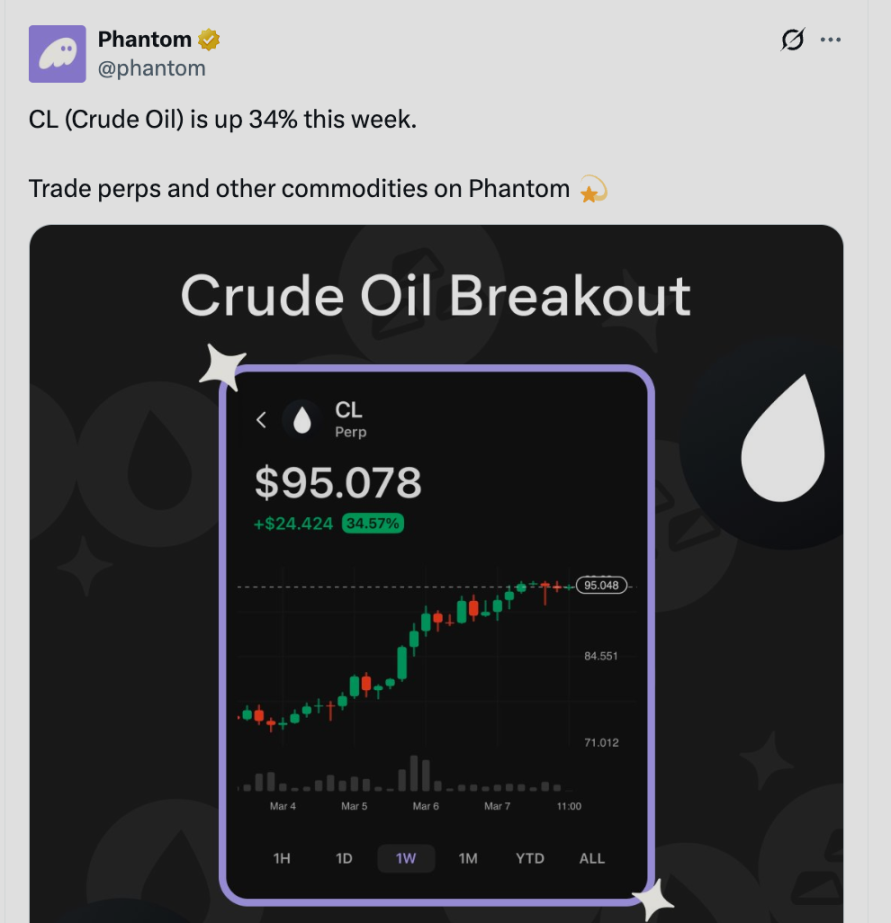
This is genuine financial democratization. But the other side of the coin is equally real.

Traditional commodity futures markets have strict margin systems, circuit breakers, position limits, and are backed by risk control teams from brokers constantly monitoring the screens. The rules of on-chain perpetual contracts are much simpler: if the position value falls to the liquidation line, the system automatically force-closes it. There are no phone call reminders, no manual intervention.

The liquidation prices for CBB, "2 frères 2 fauves," and others are all set near $120.76—this number isn't random; it's the "safety margin" they calculated when initially building their positions. In normal oil price fluctuations, having over fifty dollars of room from the entry price of $78 seemed quite ample.

But what they didn't anticipate was that a geopolitical crisis could push oil prices up 50% within 72 hours.

This isn't a strategy error; it's a black swan arrival. The problem is, on-chain, there is no mechanism to let you catch your breath when the black swan lands.

When DeFi Meets Hormuz

The connection between the crypto market and traditional geopolitics is happening faster than anyone anticipated.

Hyperliquid users now need to watch the latest developments in Iran's Strait of Hormuz; while DeFi OGs are using on-chain derivatives to hedge war risks.

As the variety of on-chain commodities and on-chain US stock mapping contracts continues to expand, on-chain players will only be increasingly exposed to macro risks. In the traditional financial world, this is called "global macro strategy," requiring professional teams and robust risk control systems. On-chain, it's called "one person's position."



Original link:https://www.bitpush.news/articles/7617972

Pertanyaan Terkait

QWhat event caused the price of WTI crude oil to surge by over 25% in a week on Hyperliquid?

AThe blockade of the Strait of Hormuz by Iran, a critical chokepoint for approximately 20% of global oil supply, for seven consecutive days caused the price surge.

QWhich prominent Hyperliquid user faced a significant unrealized loss of over $3.8 million on their short oil position?

AThe user CBB (@Cbb0fe) faced an unrealized loss of over $3.8 million on a short position of 127,175 xyz:CL contracts, with a liquidation price at $120.76.

QHow did Rune Christensen, a co-founder of Sky (formerly MakerDAO), profit from the oil price movement on Hyperliquid?

ARune Christensen profited by taking a long position on oil contracts worth approximately $7.82 million at a cost of around $93. As the price rose to $109, he realized an unrealized profit of over $1.36 million.

QWhat is a key difference between trading traditional commodity futures and their on-chain perpetual contract equivalents, as highlighted in the article?

AA key difference is that traditional markets have strict margin requirements, circuit breakers, position limits, and broker risk teams monitoring positions, while on-chain perpetual contracts have simpler rules with automatic liquidation at the margin call price without human intervention or warnings.

QWhat new type of trading strategy did Rune Christensen employ on Hyperliquid during the geopolitical crisis?

ARune Christensen employed a macro hedging strategy by simultaneously longing oil contracts and shorting both ETH and the XYZ100 (a US stock index mapping contract), betting that oil would benefit from war premiums while stocks and crypto would suffer from risk-off sentiment.

Bacaan Terkait

Dua Struktur Hidup Market Maker dan Arbitrageur

Dalam perdagangan mikro-frekuensi tinggi, dua kelompok utama bertahan lama: pembuat pasar yang bergantung pada spread dengan mengajukan penawaran satu sisi dan sering menggunakan order "maker", serta arbitrase lintas bursa yang mengejar selisih harga dan suku bunga pendanaan, biasanya sebagai "taker". Artikel ini membahas karakteristik eksposur risiko kedua pendekatan tersebut. Eksposur risiko muncul karena pertukaran antara kendali waktu dan harga. Pembuat pasar, sebagai pembuat order, mendapatkan hak menetapkan harga tetapi menyerahkan kendali atas waktu eksekusi kepada "taker". Risiko utama bagi pembuat pasar adalah "risiko persediaan" dan penetapan harga yang adil, sementara arbitrase lintas bursa menghadapi eksposur akibat asimetri aturan, latensi pencocokan, dan fragmentasi di berbagai bursa. Fragmentasi untuk pembuat pasar berasal dari sifat pasif dan tidak kontinu dari pencocokan order book, sering kali terpencar secara acak dalam sumbu waktu. Di sisi lain, fragmentasi arbitrase lintas bursa bersifat eksternal dan aktif, disebabkan oleh perbedaan aturan seperti ukuran lot minimum yang bervariasi antar bursa. Dalam hal karakteristik eksposur, pembuat pasar menghadapi situasi di mana persediaan dapat menguntungkan dalam kondisi pasar yang rata atau dapat merugikan selama tren satu arah yang kuat. Arbitrase lintas bursa lebih terpapar pada risiko teknis seperti likuidasi otomatis (ADL) bursa, penyimpangan oracle, manipulasi pendanaan, dan kerusakan korelasi aset. Hubungan antara eksposur risiko dan keuntungan juga berbeda. Pembuat pasar mengejar probabilitas kemenangan tinggi, perputaran cepat, dan keuntungan per transaksi rendah, dengan eksposur persediaan yang berkontribusi pada keuntungan selama dalam batas kendali. Arbitrase lintas bursa mengejar selisih harga yang pasti dan pendanaan struktural, di mana eksposur risiko cenderung menjadi pengurangan keuntungan, dan mereka mentoleransi fragmentasi untuk menghindari biaya slipage yang lebih tinggi. Pada akhirnya, kedua pendekatan berevolusi menuju sistem hibrida yang menggabungkan elemen "maker" dan "taker" berdasarkan pertimbangan biaya, latensi, dan kondisi pasar. Pembuat pasar menjual waktu dan mengekspos persediaan kepada pasar, sementara arbitrase menjual ruang (modal) dan menenggelamkan modal ke dalam pasar. Keduanya menggunakan berbagai bentuk eksposur risiko untuk memperoleh kepastian yang kecil namun krusial di pasar.

链捕手3j yang lalu

Dua Struktur Hidup Market Maker dan Arbitrageur

链捕手3j yang lalu

Mendadak: Reorganisasi Besar-besaran di OpenAI, Presiden Brockman Mengambil Alih Kekuasaan

**OpenAI Lakukan Reorganisasi Besar-besaran, Presiden Brockman Ambil Alih Kendali Produk** OpenAI mengumumkan reorganisasi besar dan penggabungan tiga produk intinya—ChatGPT, Codex, dan API—menjadi satu organisasi produk terpadu. Presiden sekaligus salah satu pendiri, Greg Brockman, mengambil alih kendali penuh atas strategi produk. Nick Turley, sosok kunci di balik pertumbuhan ChatGPT, dialihkan untuk menangani produk *enterprise*. Ashley Alexander, mantan wakil presiden Instagram, menggantikannya memimpin produk konsumen. Sementara itu, Thibault Sottiaux, yang sebelumnya memimpin Codex, kini mengepalai tim produk dan platform gabungan yang baru. Restrukturisasi ini bertujuan untuk fokus pada "Agentic Future" (Era Agen Cerdas). Langkah ini juga merupakan persiapan untuk meluncurkan "Super App", sebuah aplikasi desktop yang menggabungkan ChatGPT, kemampuan pemrograman Codex, dan *browser* Atlas yang akan datang untuk menjalankan tugas digital secara otonom. Langkah reorganisasi terjadi di tengah tekanan kompetisi yang ketat. Saingan utama, Anthropic, dikabarkan telah mengamankan pendanaan dengan valuasi mencapai $900 miliar, melampaui valuasi OpenAI. Selain itu, Google diperkirakan akan meluncurkan produk AI baru pada konferensi Google I/O minggu depan. Restrukturisasi ini juga dilihat sebagai respons terhadap sejumlah kepergian eksekutif kunci dan ketidakpastian cuti sakit CEO AGI Deployment, Fidji Simo. Dengan IPO yang dikabarkan akan berlangsung tahun ini, OpenAI berupaya menampilkan cerita yang lebih terfokus dan kuat kepada calon investor pasar modal.

marsbit3j yang lalu

Mendadak: Reorganisasi Besar-besaran di OpenAI, Presiden Brockman Mengambil Alih Kekuasaan

marsbit3j yang lalu

Siapa yang Akan Mendefinisikan Aturan di Era AI? Anthropic Membahas Lanskap AI AS-China pada 2028

Anthropic, perusahaan AI AS, menerbitkan analisis tentang persaingan AI AS-China menuju 2028. Mereka mengidentifikasi empat bidang persaingan: kemampuan model, adopsi domestik, distribusi global, dan ketahanan. Saat ini, AS dan sekutunya memimpin dalam daya komputasi (komputasi), elemen kunci untuk pengembangan AI mutakhir, berkat inovasi perusahaan dan kebijakan kontrol ekspor. Namun, lab AI China tetap kompetitif dengan memanfaatkan celah kontrol ekspor untuk mengakses chip canggih dan melakukan "serangan distilasi" untuk meniru kemampuan model AS. Anthropic menguraikan dua skenario untuk 2028: 1. **Kepemimpinan AS yang Meluas:** Jika AS menutup celah akses komputasi dan distilasi, serta mempercepat adopsi AI, keunggulan model AS dapat mencapai 12-24 bulan. Ini akan mengamankan pengaruh AS dalam tata kelola AI global. 2. **Persaingan Ketat (Neck-and-neck):** Jika China terus mengakses chip dan kemampuan model AS, mereka dapat mengejar ketertinggalan. Model China yang "cukup baik dan murah" serta infrastruktur global (seperti Huawei) dapat meningkatkan adopsi worldwide, menggeser keseimbangan kekuatan. Kesimpulannya, Anthropic mendorong pembuat kebijakan AS untuk mengamankan keunggulan dengan: memperketat kontrol ekspor dan penegakan hukum terhadap chip, membatasi serangan distilasi, dan mendorong ekspor teknologi AI yang tepercaya ke pasar global. Tindakan saat ini akan menentukan siapa yang membentuk masa depan AI pada 2028.

marsbit5j yang lalu

Siapa yang Akan Mendefinisikan Aturan di Era AI? Anthropic Membahas Lanskap AI AS-China pada 2028

marsbit5j yang lalu

Trading

Spot
Futures
活动图片



