AI2 Releases Fully Open-Source Web Agent MolmoWeb: Controlling Web Pages Using Only "Vision"

marsbitDipublikasikan tanggal 2026-03-26Terakhir diperbarui pada 2026-03-26

Abstrak

AI2 has released MolmoWeb, a groundbreaking, fully open-source web agent that operates solely by analyzing screenshots, marking a significant leap in vision-driven web navigation. Unlike traditional agents that rely on DOM, MolmoWeb captures and interprets visual data to make decisions—such as clicking, scrolling, or typing—making its process transparent and robust. Despite its compact size (4B and 8B parameters), MolmoWeb performs impressively: it scores 78.2% on the WebVoyager benchmark, nearing OpenAI’s proprietary o3 model (79.3%), and achieves up to 94.7% success with multiple attempts. It even surpasses Anthropic’s Claude3.7 in UI element localization. AI2 also released MolmoWebMix, a massive open dataset with 36K human-browsing tasks, over 2.2M screenshot-QA pairs, and GPT-4o-verified synthetic data. The model and data are fully available on Hugging Face and GitHub under Apache 2.0, promoting transparency and collaboration in AI development. Challenges remain in complex instructions, logins, and legal compliance.

The Allen Institute for Artificial Intelligence (AI2) recently released the groundbreaking fully open-source web agent MolmoWeb . Unlike traditional agents that rely on a webpage's underlying code (DOM), MolmoWeb makes decisions solely by reading screenshots, marking a significant leap forward in "vision-driven" web navigation technology.

Core Technology: "Seeing" Web Pages Like a Human

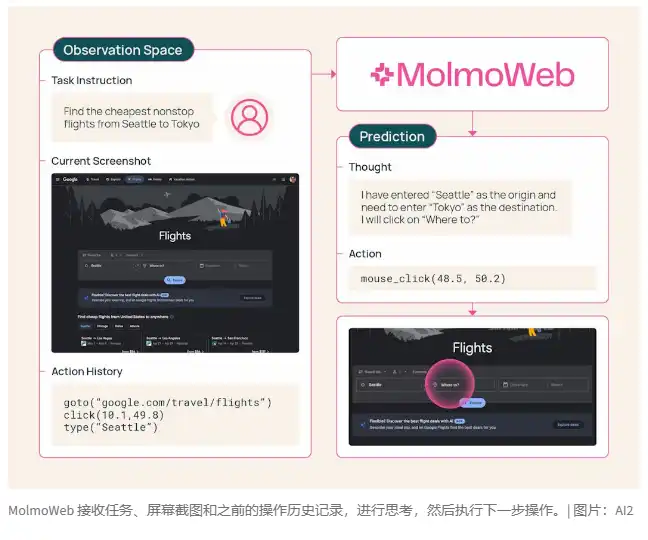
MolmoWeb's operating logic is very intuitive: it captures a screenshot of the current browser window, decides the next action (such as clicking, scrolling, or paging) through visual analysis, then executes it and repeats. This "what you see is what you get" model makes it more robust than traditional agents because the visual layout of a webpage is generally more stable than its underlying code, and its decision-making process is completely transparent and explainable to human users.
Performance Leap: Small Model Outperforms Giants

Despite having parameter sizes of only 4B and 8B, MolmoWeb demonstrates a "small but mighty" performance:

  • Topping the Charts: In the WebVoyager test, the 8B version scored an impressive 78.2%, not only ranking among the top open-source models but also approaching the performance of OpenAI's proprietary model o3 (79.3%).

  • Huge Potential: Research found that by running tasks multiple times and selecting the optimal result, its success rate could further jump to 94.7%.

  • Precise Localization: In UI element localization benchmark tests, it even surpassed Anthropic's Claude3.7.

Data Support: The Largest Open Dataset to Date

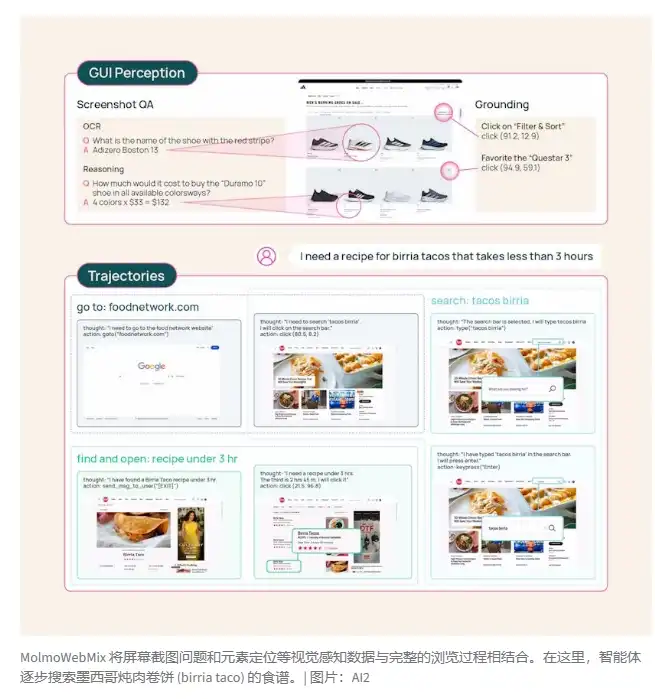
AI2 has not only open-sourced the model weights but also contributed a massive dataset named MolmoWebMix. This dataset contains:

  • 36,000 real browsing tasks completed by human volunteers.

  • Over 2.2 million screenshot-question-answer pairs.

  • Automated synthetic data verified by GPT-4o. Experiments show that synthetic data is even better than human trajectories at guiding the agent to find the "optimal path".
Open-Source Spirit and Future Challenges

Currently, MolmoWeb is fully available under the Apache 2.0 license on Hugging Face and GitHub. Although it still faces challenges in handling complex instructions, login authentication, and legal compliance (such as terms of service), AI2 firmly believes that only through complete transparency and community collaboration can we truly counter the data monopoly of large tech companies.


Pertanyaan Terkait

QWhat is the name of the fully open-source web agent released by the Allen Institute for AI (AI2) that navigates using only screenshots?

AThe web agent is called MolmoWeb.

QHow does MolmoWeb's approach to web navigation differ from traditional web agents?

AUnlike traditional agents that rely on a webpage's underlying code (DOM), MolmoWeb makes decisions by reading and analyzing screenshots, making it a 'vision-driven' technology.

QWhat was the performance score of the 8B parameter version of MolmoWeb on the WebVoyager test, and how does it compare to OpenAI's model?

AThe 8B version scored 78.2% on the WebVoyager test, which is very close to the performance of OpenAI's proprietary model o3, which scored 79.3%.

QWhat is the name of the large, open dataset released alongside MolmoWeb, and what does it contain?

AThe dataset is called MolmoWebMix. It contains 36,000 real browsing tasks completed by human volunteers, over 2.2 million screenshot-QA pairs, and automated synthetic data verified by GPT-4o.

QOn which platforms has MolmoWeb been made available, and under what license?

AMolmoWeb has been fully released on Hugging Face and GitHub under the Apache 2.0 license.

Bacaan Terkait

Fujian Jinjiang, Sebuah Unicorn Super Penyimpanan yang Tumbuh dalam Diam

Perusahaan memori super unicorn Fujian Jinhua secara diam-diam bersembunyi di Jinjiang, Fujian, yang terkenal dengan sepatu olahraganya. Dulu, Jinhua adalah salah satu dari tiga basis chip memori domestik bersama Yangtze Memory dan ChangXin Memory Technologies (CXMT), bahkan pernah menjadi yang paling menjanjikan. Namun, Jinhua menghadapi rintangan besar. Pada 2018, ia dimasukkan dalam daftar entitas oleh Departemen Perdagangan AS dan menghadapi tuduhan pidana, yang menghentikan produksinya selama hampir lima tahun. Baru pada Februari 2024, pengadilan federal AS membebaskannya dari semua tuduhan. Jinhua didirikan pada 2016 dengan misi nasional untuk mematahkan monopoli Samsung, SK Hynix, dan Micron di pasar DRAM. Perusahaan ini bekerja sama dengan United Microelectronics Corporation (UMC) dari Taiwan. Chen Zhengkun, mantan eksekutif Micron, memimpin proyek ini sebagai CEO, didorong oleh mimpi mengembangkan teknologi DRAM secara mandiri. Meskipun pembangunan pabrik berjalan cepat, Micron menuduh UMC dan Jinhua mencuri rahasia dagangnya, memicu sengketa hukum panjang. Setelah dimasukkan dalam daftar entitas, Jinhua harus membangun kembali lini produksinya hampir dari nol dengan mengurangi ketergantungan pada teknologi AS, dipimpin oleh Chen yang dijuluki "penyihir hasil". Saat ini, Jinhua fokus pada pasar DRAM ceruk (niche) untuk perangkat seperti TV pintar dan router. Kapasitas produksinya mencapai sekitar 40.000 wafer 12 inci per bulan, dengan target 60.000 wafer pada 2026. Perusahaan memiliki lebih dari 1.000 paten. Meski bebas secara hukum, Jinhua masih berada dalam daftar entitas AS. Dukungan kuat dari pemerintah kota Jinjiang dan provinsi Fujian sangat penting bagi kelangsungan hidup Jinhua selama masa sulit. Kota yang secara tradisional mengandalkan tekstil dan makanan ini sekarang berinvestasi besar dalam industri sirkuit terpadu, dengan Jinhua sebagai pionir. Industri IC Jinjiang diperkirakan akan mencapai nilai output lebih dari 14 miliar yuan pada 2025. Dalam siklus super memori yang didorong oleh AI, meskipun skala Jinhua masih kecil dibandingkan raksasa global, kebangkitannya dari keterpurukan melambangkan ketahanan dan tekad dalam mengembangkan industri memori China.

marsbit1j yang lalu

Fujian Jinjiang, Sebuah Unicorn Super Penyimpanan yang Tumbuh dalam Diam

marsbit1j yang lalu

Trading

Spot
活动图片




