2-Year Return of 225x? Uncovering Mysterious Researcher Serenity's AI 'Choke Point' Investment Strategy

链捕手Dipublikasikan tanggal 2026-05-27Terakhir diperbarui pada 2026-05-27

Abstrak

"2 Years, 225x Returns? Decoding Serenity's AI 'Chokepoint' Investment Strategy" This article profiles Serenity (formerly AleaBito on Reddit's WallStreetBets), a pseudonymous researcher known for exceptional returns by applying a "Chokepoint Theory" to AI investments. His methodology involves a bottom-up, reverse-engineering approach of the AI hardware supply chain. He identifies critical, irreplaceable physical bottlenecks (chokepoints) that could cripple entire AI systems if disrupted, bypassing Wall Street's top-down focus on major tech firms. Key examples include pinpointing essential suppliers in the emerging Silicon Photonics and Co-Packaged Optics (CPO) sector—components vital for next-generation AI data center interconnects—such as niche companies providing external laser sources, molecular beam epitaxy equipment, or ultra-pure raw materials. Similarly, he highlights geopolitical "chokepoints" in the humanoid robotics supply chain, where key hardware components and rare earth elements are concentrated in Asia. Serenity validates his investment theses through rigorous adversarial AI debates before publication. He leverages institutional blind spots, directing a sophisticated network of retail followers toward undervalued, under-covered micro-cap stocks across global exchanges, driving significant price movements in names like Sivers ($SIVE), Soitec, and Raspberry Pi ($RPI). While presenting a powerful framework for finding critical system dependencies, the strategy...

Author:BruceBlue , FormerBing Ventures GP

How did the mysterious researcher Serenity achieve over 225 times the return in 2 years?

Using the Checkpoint Theory to identify the irreplaceable physical switches in the AI era.

Employing a bottom-up supply chain reverse engineering mindset to pinpoint the choke points.

Before making any investment hypothesis, engage in fierce debates with various AI models to uncover potential flaws and limitations, comparable to a top-tier investment committee.
Foreword

Over the past few months, if you've been following the secondary market for AI infrastructure, it has been hard to miss a name: Serenity @aleabitoreddit
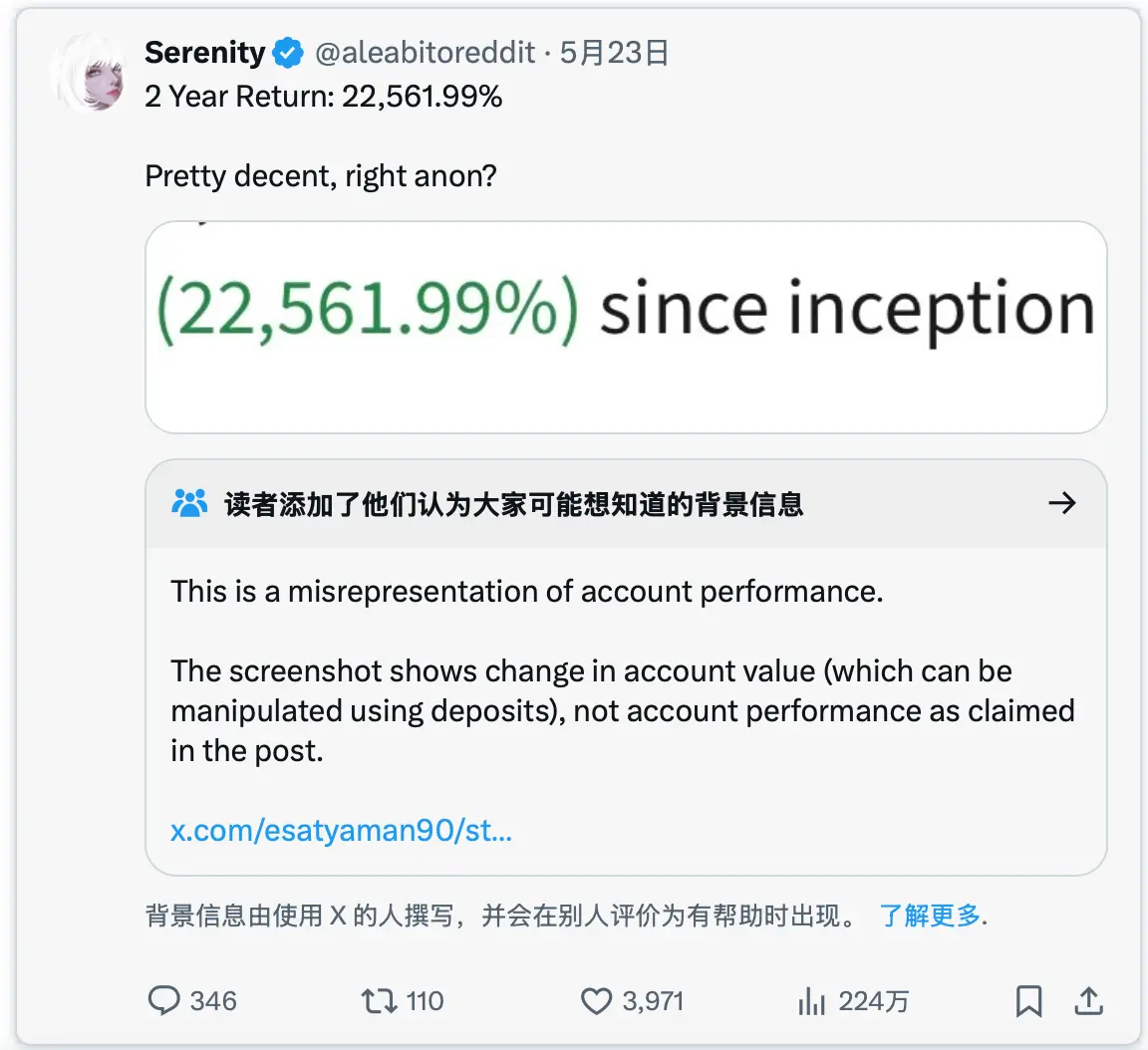
Aformer trader permanently banned by Reddit's WallStreetBets (WSB), he switched platforms, adopted an anime female avatar, and amassed over 300,000 followers in less than a year. One of his tweets can cause a FTSE 250 constituent stock to surge nearly 90% in two days, his research is cited by Bloomberg and Reuters, and some hedge funds engage in his copytrade.

The market marvels at his reported 22,561.99% return over the past two years, or questions his unverifiable background: "former AI research scientist," "Nature paper author," "RISC-V Foundation member," even claiming to have declined an offer to lead Nvidia's AI team around 2018 when its stock price was about $6.
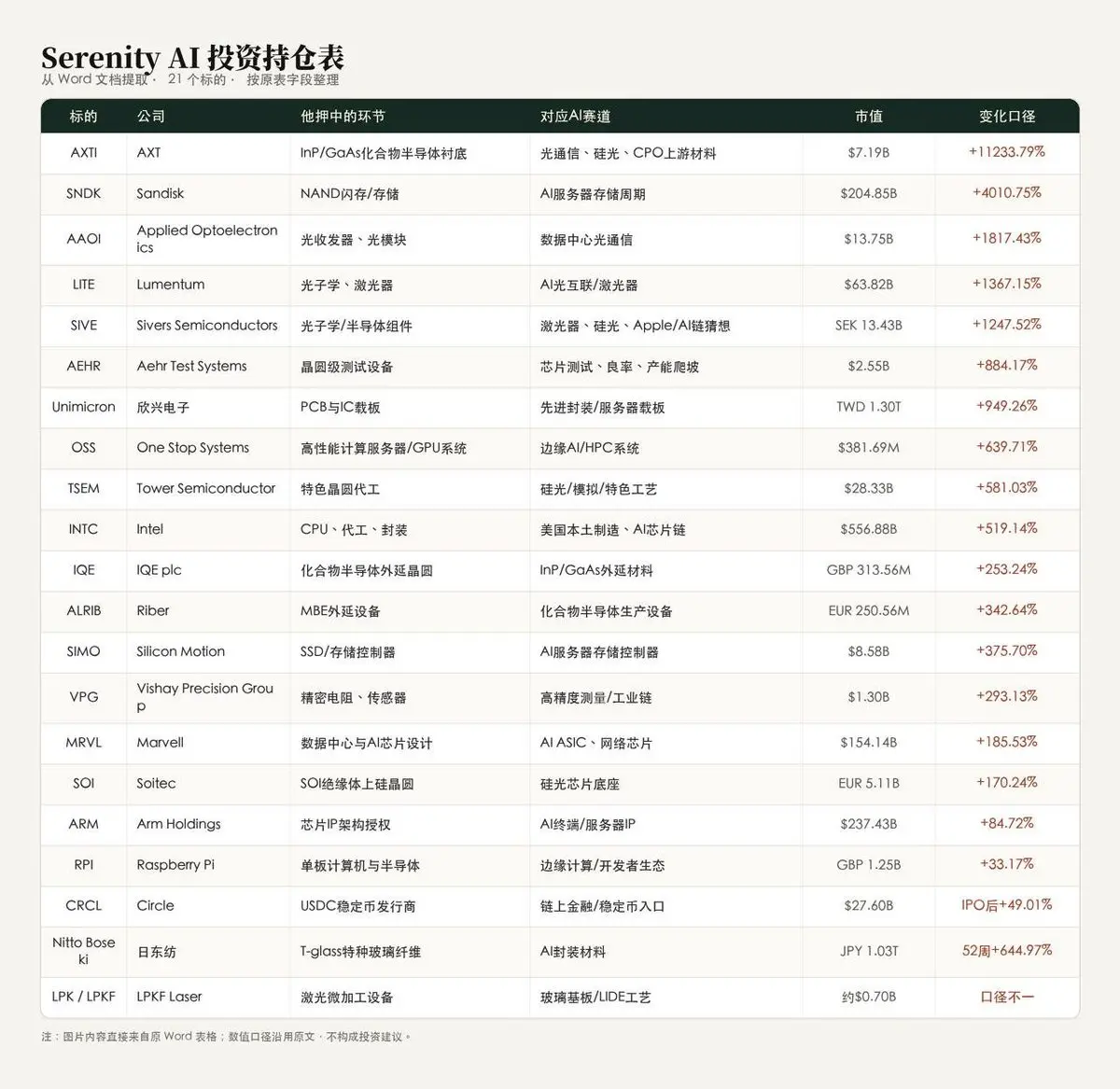
Serenity's AI Portfolio

But what truly matters isn't those dazzling numbers, nor whether he actually published in Nature.

What truly matters is this: He provides a paradigm for reverse engineering the AI era and executes violent arbitrage on information asymmetry within Wall Street's institutional blind spots.

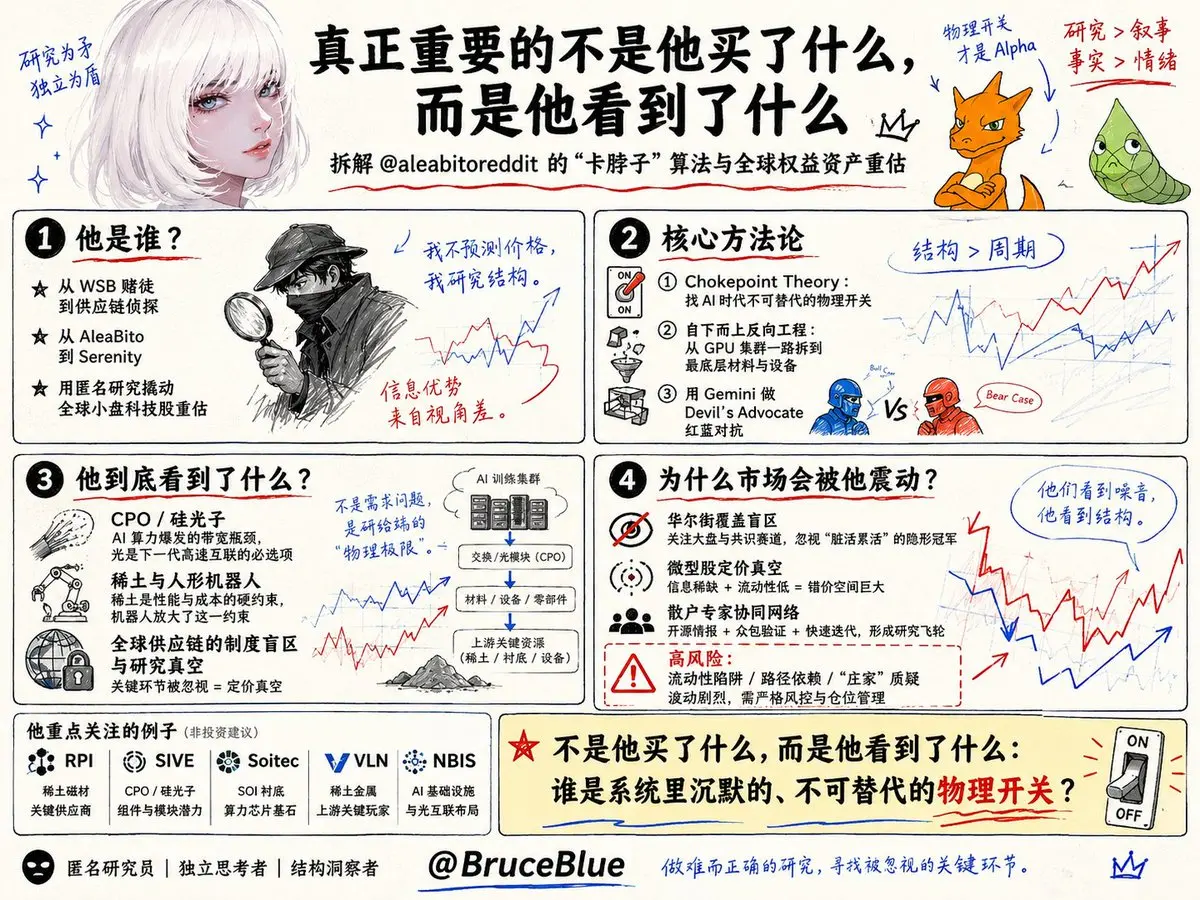
The core of this paradigm is what he calls Chokepoint Theory (Supply Chain Bottleneck Theory).

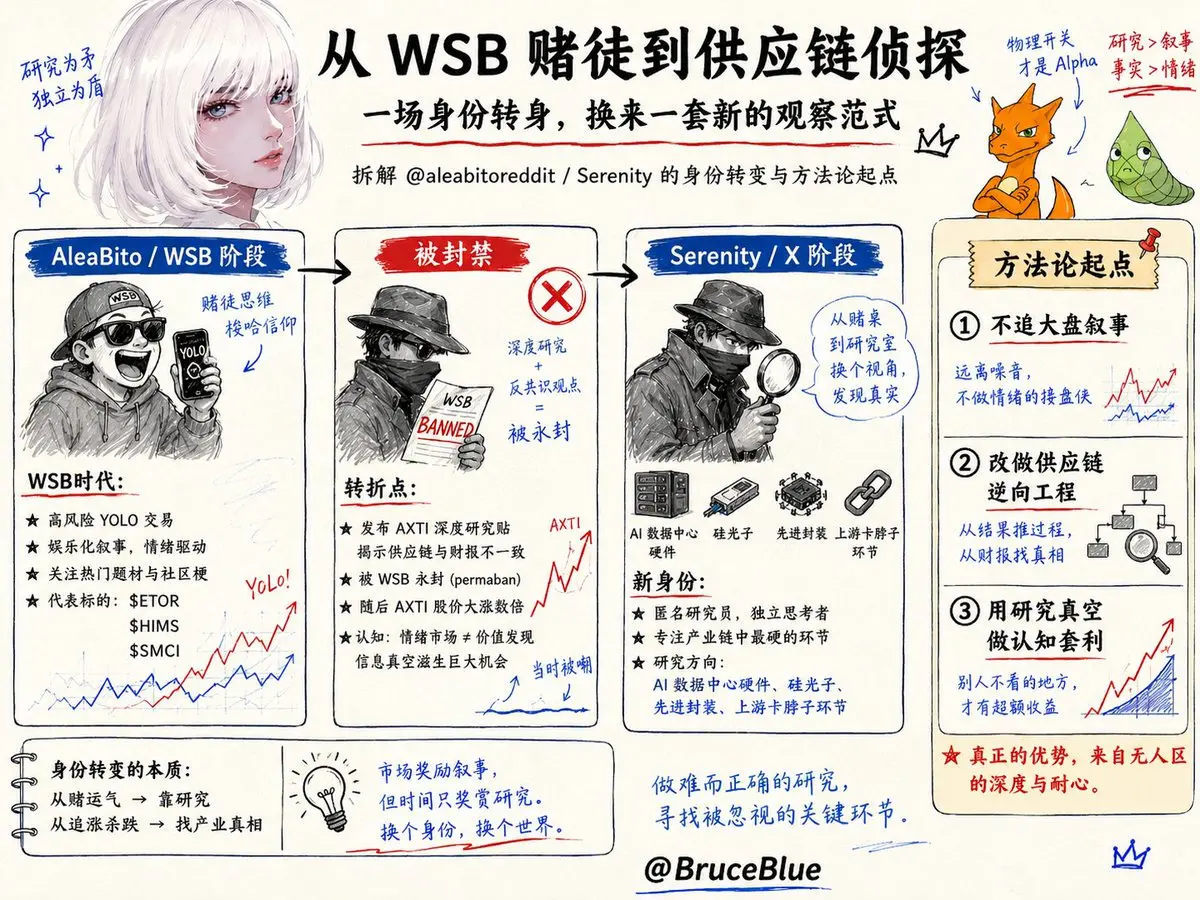
From WSB Gambler to Supply Chain Detective: An Identity Transformation

First, some background. His story began in early 2022 on the famous retail trader subreddit r/wallstreetbets (WSB).

The account then was named AleaBito, bearing the distinct colors of a WSB retail trader, keen on high-leverage, high-risk, and highly entertaining options and IPO plays. He once made a $175,000 single-sided options "YOLO" trade during the eToro ($ETOR) IPO based on the mock logic that its technical chart resembled "Bluefin Tuna Toro." In trading Hims & Hers Health $HIMS, he allocated a $100,000 position based on the "Gym Bro Formation." He also accurately predicted Super Micro Computer $SMCI would break $120 when its stock was near lows, based on developments in liquid cooling technology.

┌────────────────────────────────────────────────────────────────────────┐

│ @aleabitoreddit / Serenity's Evolution Path

├────────────────────────────────────────────────────────────────────────┤

│ Reddit Stage (Pre-2022) : AleaBito

│ Style: Hardcore financial analysis combined with highly entertaining "WSB retail" narrative, preference for high-risk "YOLO"

│ Feats:$ETOR (Tuna Toro), $HIMS (Gym Bro), $SMCI (Low-point prediction of $120 breakout)

│ X Platform Stage (2022-Present) : Serenity

│ Style: Focus on AI data center hardware, silicon photonics, advanced packaging; "bottom-up" supply chain reverse engineering

│ Feats:$RPI, $SIVE, Soitec, $VLN, $NBIS

└────────────────────────────────────────────────────────────────────────┘

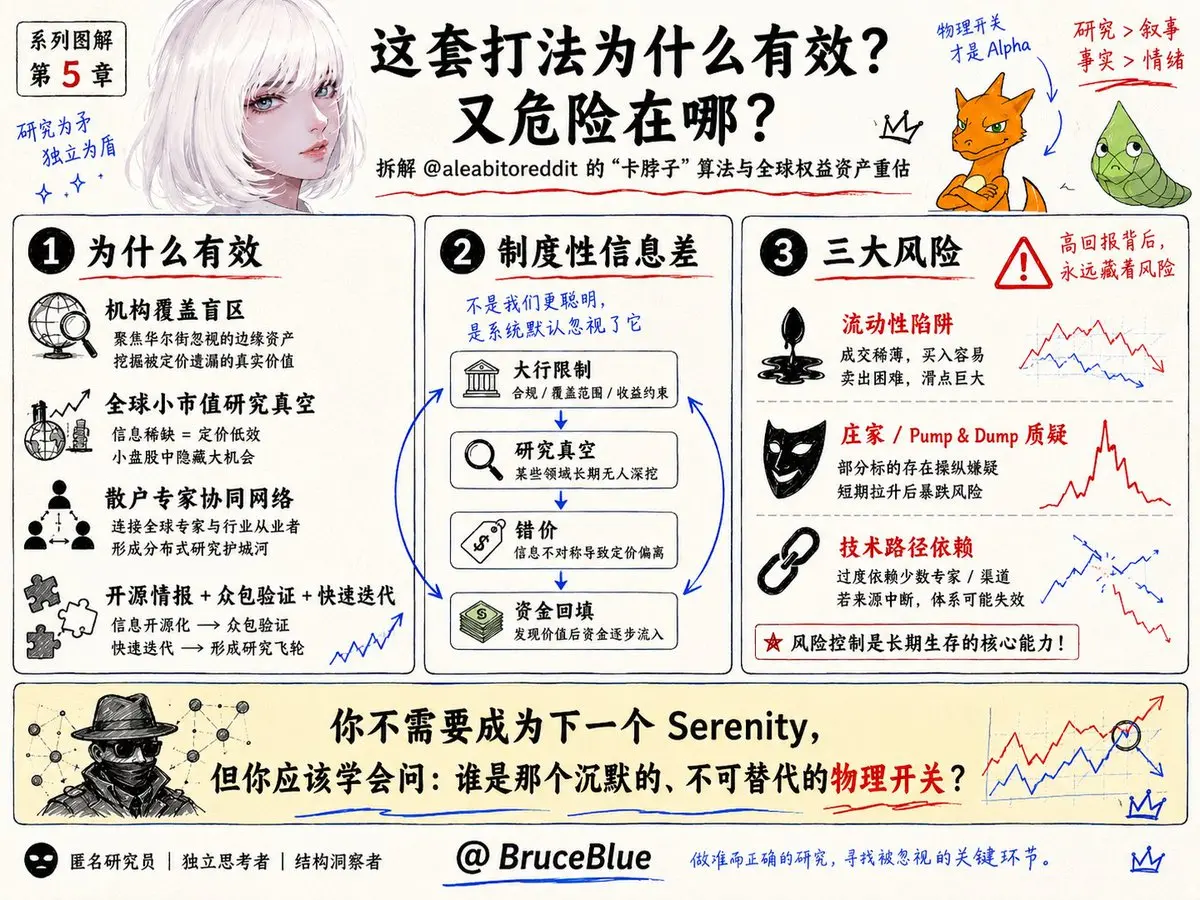
The turning point occurred in early 2022. He posted a deep fundamental research report on AXT, Inc. $AXTI, a compound semiconductor substrate manufacturer, on WSB. At the time, $AXTI had a market cap of just $200 million, with a stock price around $12. The report's professional nature clashed with the forum's speculative atmosphere, leading moderators to permanently ban the account on grounds of "deliberate influence" and "pump-and-dump."

Subsequently, $AXTI soared to $70 driven by surging demand for compound semiconductors and optoelectronic substrates, resulting in over 1000% paper gains, becoming the researcher's "defining battle." This ban directly prompted the migration to X, and after renaming to "Serenity," the investment focus was completely locked onto "choke point" segments of semiconductor core hardware and the precision supply chain.
Core Framework: Finding the "Strait of Hormuz" of the AI Era

The vast majority of Wall Street sell-side institutions look at AI from a top-down perspective. They stare at Nvidia, Microsoft, Google, calculating guidance for trillion-dollar Capex, engaging in fierce mathematical modeling games around next quarter's revenue.

Serenity's perspective is bottom-up. He employs a supply chain reverse engineering model.

Using Nvidia's H100, B200, and other GPU supercomputing clusters as the physical origin, he deconstructs layer by layer downwards until uncovering ultra-micro components or raw materials at the physical level that are irreplaceable and monopolized by one or a very few companies. These extremely niche segments operate silently outside the spotlight of trillion-dollar market caps. Yet, if a supply disruption occurs, the entire downstream AI industry cluster faces physical paralysis.

He calls these nodes "Choke Points," likening them to the Strait of Hormuz controlling global oil passageways, or the indispensable yet unnoticed shiso leaf in high-end Ginza kaiseki cuisine.

  • Integration of Physical and Geographic Coordinate Maps

Serenity constructs a precise global semiconductor choke point physical and geopolitical map. This map spans US, Taiwanese, European, and Japanese stocks, integrating the geographic coordinates of production facilities, technical patent barriers, geopolitical risks, and national export control policies for each niche giant in the supply chain. When new geopolitical conflicts, export bans, or earnings reports emerge, he can quickly locate specific physical nodes on the supply chain map and execute high-conviction directional bets using his concentrated stock positions.

  • Adversarial AI Argumentation Testing

Before formally publishing any investment hypothesis, Serenity has a unique "red team/blue team" argumentation process. He inputs research drafts into different large language models, commanding the AI to play the role of an extremely demanding "Devil's Advocate," specifically picking out flaws, technical physical limitations, alternative threats, and potential valuation biases in his investment logic. Only after passing multiple rounds of technical and logical interrogation by AI does he publicly release the report.

The Physical Barriers of Silicon Photonics and Co-Packaged Optics (CPO)

Within Serenity's supply chain map, the physical evolution of data center AI computing power infrastructure is his core investment theme.
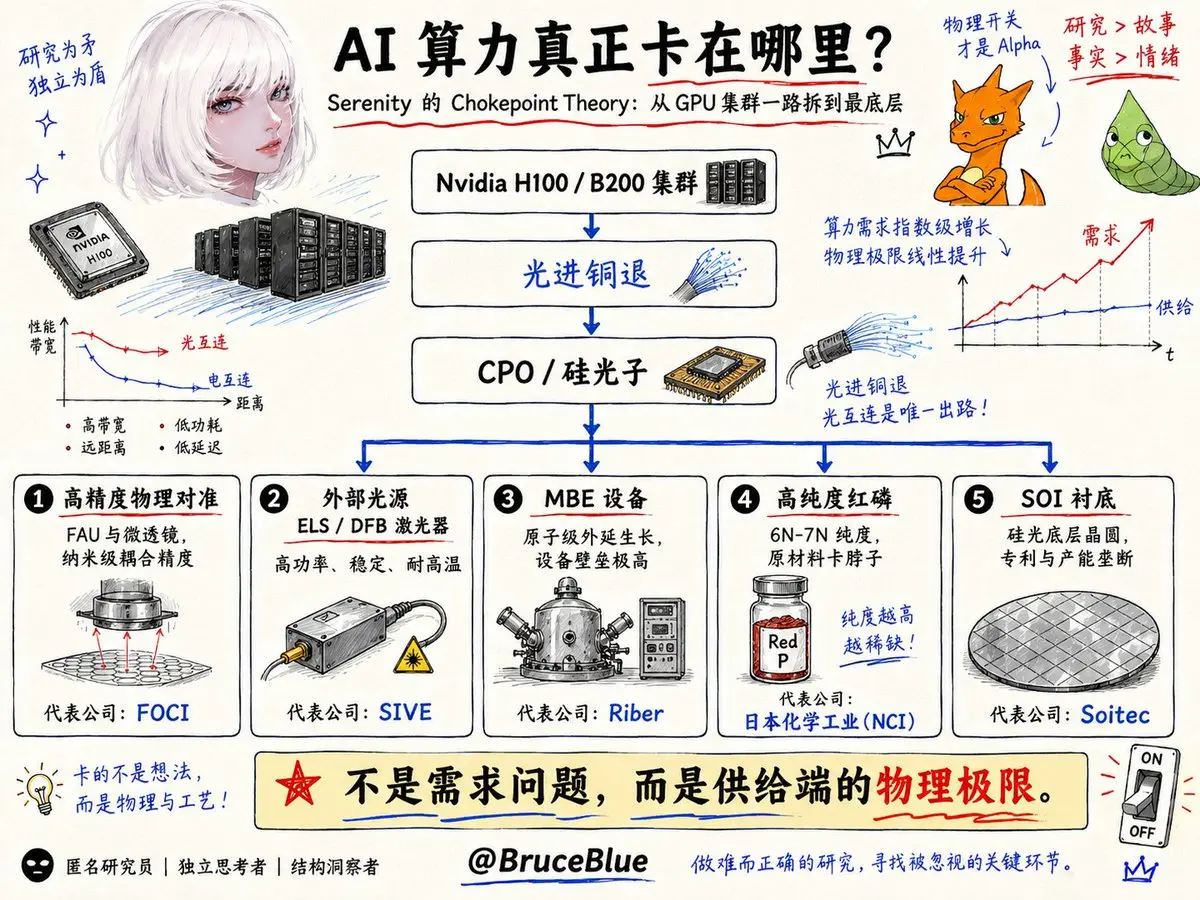
As large language model parameters grow exponentially, the interconnection of ten-thousand, hundred-thousand, or even million-card GPU clusters becomes the physical bottleneck for computing power scaling. At extremely high data throughput rates, traditional copper interconnects face insurmountable physical limits: high-frequency electrical signals in copper suffer from high attenuation, uncontrollable electromagnetic interference, and high power consumption and heat dissipation burdens.

To break this "copper wall," the process of converting electrical signals to optical signals for high-bandwidth, low-latency transmission—"optics in, copper out"—has become an inevitable path in AI infrastructure construction. The forefront of this physical layer revolution is the "Co-Packaged Optics" (CPO) architecture led by giants like TSMC and Nvidia.

The core idea of CPO is integrating the electro-optical conversion chip directly with the core computing chip on the same multi-chip packaging substrate, shortening the electrical signal transmission distance within the package to the millimeter level. Serenity focuses on five major "choke point" technical and physical barriers in this revolutionary architecture:

Serenity's CPO (Co-Packaged Optics) Reverse Engineering Diagram:

Nvidia H100/B200 Clusters (10k-card interconnection demand)

Optics in, Copper out (Breaking copper cable physical limits: attenuation, power, heat)

┌────────────────────────────────────────────────────────────────────────┐

│ Five Physical Barriers of Silicon Photonics & CPO (Choke Points)

│ 1. High-precision Physical Alignment: Fiber Array Unit (FAU) & Micro-lenses

│ → $FOCI (Browave, Taiwan): Indispensable physical choke point status

│ 2. External Light Source (ELS) & High-Power Continuous Wave (CW) DFB Laser

│ → $SIVE (Sivers, Sweden): Extremely scarce physical asset for 1.6T LRO/CPO

│ 3. Molecular Beam Epitaxy (MBE) Equipment Barrier

│ → $ALRIB (Riber, France): Global monopolist, "choking the capacity neck" of epitaxy vendors

│ 4. High-Purity Red Phosphorus Raw Material (Purity 6N-7N, i.e., 99.9999%+)

│ → NCI (Nippon Chemical Industrial, Japan): Monopolized by very few specialty chemical giants

│ 5. Underlying Wafer: Silicon-on-Insulator (SOI) Substrate Material

│ → Soitec (France): Smart-Cut patent, absolute global technology and capacity monopolist

└────────────────────────────────────────────────────────────────────────┘

  • High-precision Physical Alignment Barrier

Since the optical waveguide dimensions inside silicon photonic chips are typically sub-micron, this requires nano-level physical alignment between the external fiber and the waveguide. Any tiny misalignment leads to severe "optical coupling loss." Serenity was the first in the English-speaking world to systematically anchor Browave (FOCI, 3363.TW), a stock highly focused on by Taiwanese retail investors, to the evolution of global CPO technology.

  • External Light Source (ELS) and High-Power Continuous Wave DFB Laser Barrier

Silicon, as an indirect bandgap semiconductor, cannot achieve efficient light emission under electrical injection. CPO architecture must rely on independent external light sources to provide high-power continuous wave laser. This laser must maintain single longitudinal mode operation in the high-temperature, high-pressure data center environment, with extremely high process requirements. Sweden-listed Sivers Semiconductors $SIVE, due to possessing relevant technology, becomes an extremely scarce physical asset in the CPO external light source supply chain.

  • Molecular Beam Epitaxy (MBE) Equipment Barrier

In the growth of epitaxial wafers for high-power lasers and other compound semiconductors, the core physical process is Molecular Beam Epitaxy (MBE), which allows for atomic-level precision growth of ultra-thin crystalline films. Serenity pinpointed the absolute monopolist of global MBE equipment: French listed company Riber $ALRIB.

  • High-Purity Red Phosphorus Raw Material Barrier

Compound semiconductor (e.g., indium phosphide substrate) manufacturing requires extremely stringent raw material purity. Serenity's reverse engineering leads to the most fundamental chemical element: high-purity red phosphorus (purity 99.9999%+). Capacity is almost entirely monopolized by a very few Japanese giants like Nippon Chemical Industrial Co., Ltd. (NCI). If supply is disrupted, downstream production halts entirely.

  • Silicon-on-Insulator (SOI) Substrate Material Barrier

Silicon photonic chips require SOI wafers as the underlying substrate. French company Soitec, with its exclusively invented Smart-Cut technology, holds absolute global technology and capacity monopoly in the silicon photonics SOI wafer market; even a giant like Japan's Shin-Etsu Chemical must pay it patent licensing fees.

The Geopolitical Game of "Physical Switches" in Humanoid Robots and Rare Earth Resources

In 2026, Serenity further horizontally expanded his "choke point" map to the geopolitical game involving humanoid robots and rare earth elements.

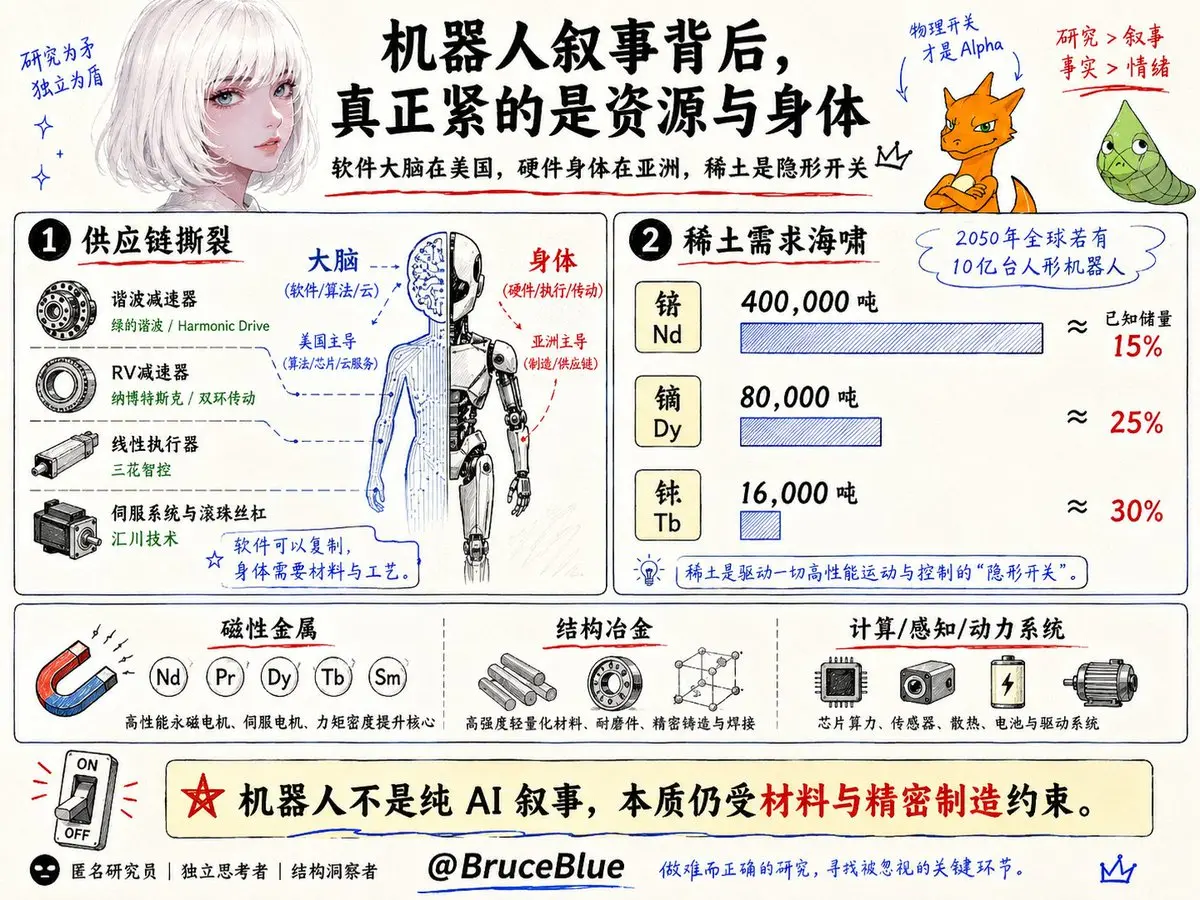
  • Supply Chain Tearing Between Software "Brain" and Hardware "Body"

Most market discussions about Tesla Optimus focus on AI algorithms and large models, overlooking a fatal physical reality: the US is losing the hardware and material manufacturing race for humanoid robots.

The humanoid robot's "brain" remains in the US, but the "body" components responsible for movement (joints, actuators, reducers, etc.) are almost entirely in the hands of Asian manufacturers:

  • Harmonic Reducers: Leader Harmonious Drive Systems (China), Harmonic Drive (Japan)

  • RV Reducers: Nabtesco (Japan), Sihuan Transmission (China)

  • Linear Actuators: Sanhua Intelligent Controls (China)

  • Servo Systems & Ball Screws: Inovance Technology (China)

To reduce costs, US robotics companies have already signed long-term contracts with these Chinese and Japanese component giants. This high dependence means that hardware supply chains face physical shutdown if geopolitical friction occurs.

  • Rare Earth "Demand Tsunami" and the Morgan Stanley Model

Serenity cites Morgan Stanley's demand forecasting model for quantitative extrapolation: if global humanoid robot stock reaches 1 billion units by 2050, its consumption of core rare earth resources will cause a catastrophic "demand tsunami":

  • Neodymium (Nd): Cumulative consumption ~400,000 tons (15% of global known reserves)

  • Dysprosium (Dy): Cumulative consumption ~80,000 tons (25% of global known reserves)

  • Terbium (Tb): Cumulative consumption ~16,000 tons (30% of global known reserves)

These are physical necessities for maintaining permanent magnet motor demagnetization resistance at high temperatures. Serenity emphasizes that if Western capital wants to ensure supply chain security, it must direct tens of billions in heavy capital towards rebuilding a local rare earth refining ecosystem.

Based on this, he lists three physical sectors that must be closely monitored:

  • Magnetic Metals: Light rare earths (Nd, Pr), heavy rare earths (Dy, Tb), specialty magnets (Sm, Co).

  • Structural Metallurgy: Precision gear materials (Ti, V, Mo), high-strength steel additives (Nb, Cr, Ni, Mn), wear-resistant elements (Ce, La).

  • Computing, Perception & Power Systems: Advanced semiconductors (Ga, Ge), batteries & wiring (each unit consumes 2kg Li, 3kg graphite, 6.5kg Cu).
Core Case Studies and Empirical Performance Evaluation

Through keen capture of technical barriers and commercialization inflection points, Serenity has successfully unearthed and led the value revaluation of multiple classic small-to-mid cap technology stocks across different global capital markets.
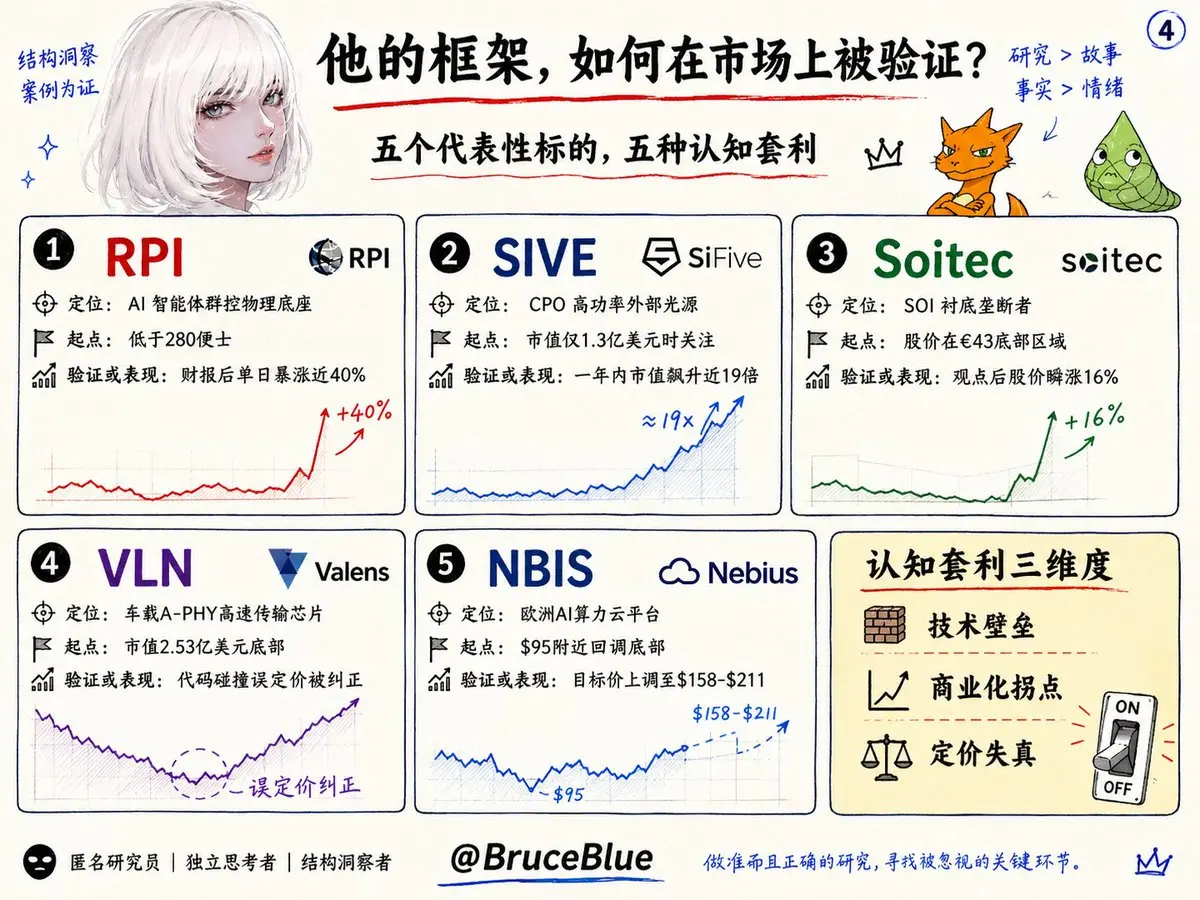
┌────────────────────────────────────────────────────────────────────────┐

│ Serenity Core Investment Picks & Empirical Performance Validation

├────────────────────────────────────────────────────────────────────────┤

│ $RPI (Raspberry Pi) | LSE UK

│ Positioning: Physical base for AI agent swarm control

│ Starting Point: Price below 280 pence (IPO price)

│ Validation: March 2026 annual report disclosed strong profit growth, chip unit sales up 47%, confirming its role as AI base logic

│ Performance: Single-day surge of nearly 40% on earnings, rebounded over 60% from lows

│ $SIVE (Sivers) | Stockholm Sweden

│ Positioning: Core supplier of high-power external light source DFB lasers for silicon photonics CPO

│ Starting Point: Market cap only $130 million when recommended

│ Validation: Secured strategic cooperation with Jabil, received $6.6M support from US CHIPS Act

│ Performance: Market cap soared nearly 19x within a year after recommendation (now over $2.3B)

│ Soitec | Euronext Paris France

│ Positioning: Global patent and capacity absolute monopolist for key silicon photonics SOI substrate material

│ Starting Point: Stock price in bottom area around €43

│ Validation: Listed as a Class 1 exclusive material standard by TSMC and Nvidia

│ Performance: European market stock price instantly surged 16% the day his view was published

│ $VLN (Valens) | NYSE USA

│ Positioning: Automotive A-PHY high-speed transmission chips

│ Starting Point: Market cap $253 million bottom (recommended with $93.5M net cash, zero debt, ~60-62% gross margin guidance)

│ Validation: Pointed out mispricing due to code collision error in scanners

│ Performance: Guided market's mine-sweeping revaluation of this asset by pointing out the "code collision" bug

│ $NBIS (Nebius Group) | NASDAQ USA

│ Positioning: Europe's largest AI GPU/Rubin computing cluster cloud service provider

│ Starting Point: Pullback bottom area around $95

│ Validation: Holding $3.7B net cash (end-2025), backlog of unexecuted contracts nearing $50B

│ Performance: Back on high-growth trajectory, analyst target price raised to $158-$211

└────────────────────────────────────────────────────────────────────────┘

Deep Analysis: Three Dimensions of Cognitive Arbitrage

  • Raspberry Pi$RPI : Relative Value Game Model

When the market viewed Raspberry Pi as a declining educational component maker, Serenity captured a dramatic shift in the AI developer ecosystem: numerous startups rushed to buy Raspberry Pis as physically isolated bases for deploying "AI agent swarm control systems." If buying Apple Mac Minis, such hoarding would be negligible in Apple's $3.7 trillion market cap; but for Raspberry Pi with a market cap of just £500 million, this is a transformative boost.

  • Valens Semiconductor$VLN : Information Arbitrage on Quantitative Code Collision

$VLN had $93.5 million net cash on the books, zero debt, ~60-62% gross margin guidance, secured Mercedes front-end design wins, yet its market cap was only $253 million. Serenity discovered a physical bug: mainstream global quantitative stock screeners had a "ticker code collision error," confusing data for $VLN with energy stock $VLO on the Toronto Exchange, causing key metrics to be severely distorted. He precisely listed the deviations, guiding funds to a "mine-sweeping" revaluation.

  • Nebius Group$NBIS : Deep Bottom Capture Amid Mechanical Panic

As a leading European AI-dedicated cloud service provider, $NBIS saw its stock price plummet to $95 due to mechanical hedging pressure from early-stage complex convertible bond share conversions. Serenity pointed out this was "mechanical panic from non-fundamental factors." At $95, the market gave this company, with 2026 revenue guidance of $30-34 billion (nearly 6x growth) and holding billions in net cash, an utterly absurd discount.

Retail Capital Synergy and Potential Structural Risks

  • Expert Retailer Synergy Network

In Serenity's framework, retail traders are no longer mere "dumb money" providing liquidity or blindly following trends but are reshaped into an "Expert Retailer Synergy Network." Traditional WSB relies on short-term options gamma squeezes or emotional memes to drive surges. In contrast, Serenity's completely free, technically high-threshold hardcore analysis subjects followers to a deep "intellectual filtration."

This highly specialized capital synergy enables them to rapidly form combined force in multiple extremely illiquid, remote micro-cap markets that Wall Street banks cannot cover, completing pricing dominance over core assets.

  • Institutional Blind Spots and Information Arbitrage

Analysts at large institutions are constrained by internal compliance, minimum market cap thresholds (e.g., not covering below $1B), and regional specialization (US equity analysts don't write on Sweden or Taiwan). This creates huge research vacuums in the global supply chain. As a completely anonymous independent researcher, Serenity ignores market cap and geographic barriers, directly guiding global long capital to violently refill these vacuums.

  • Structural Risks and Potential Game Dilemmas

However, blindly following this strategy comes with unavoidable fatal risks:

  • Liquidity Traps and Stampede Risk: Micro-cap stocks have extremely low daily trading volume. They surge instantly when the retail synergy rushes in; once technology implementation falls short of expectations, the extremely narrow exit channel leads to severe stampedes.

  • Polarized Public Opinion and "Market Manipulator" Allegations: Veteran shorts sharply criticize it as essentially a "pump and dump with high-IQ academic packaging." Its game characteristics of using massive public voice to attract retail to lift the price keep it long exposed to the shadow of compliance allegations.

  • "Fatal Minefield" of Physical Technology Single-Path Dependency: All of Serenity's core positions are built on the assumptions that "CPO is the only physical evolution path" and "humanoid robots will see a billion-unit explosion." This is a high-stakes gamble. If Nvidia finds CPO has insurmountable engineering dead ends and shifts to advanced thin-film copper cables, or if the West fails to rebuild rare earth separation chains, his entire supply chain empire built on silicon photonics, SOI, MBE equipment, and heavy rare earths could be physically dismantled in an instant.

Conclusion: Using Geek Depth to Beat Financial Breadth

Following Serenity isn't about getting a get-rich-quick stock ticker, but about acquiring an analytical framework that breaks consensus.

In this era of information overload, the most common mistake retail investors make is trying to compete with institutions on the speed of information acquisition or trading macro data that's already fully priced. Serenity demonstrates another possibility: using reverse engineering to deconstruct systems, using AI as a "Devil's Advocate" to challenge one's own logic, to find the truly controlling, silent gears of system operation.

You don't need to be the next Serenity. You don't need to buy any stock he buys.

But you should learn to ask a question like he does:

In this system, who is the silent, irreplaceable physical switch?

If you can answer that question, you already have one more perspective than 99% of market participants. The rest is just waiting for the market to catch up to your cognition.

Disclaimer:

This article does not constitute any investment advice.

All background information about Serenity himself is self-reported and unverified by third parties.

His past performance is not indicative of future results.

Conduct independent research before making any investment decisions.

NFA. DYOR.

Pertanyaan Terkait

QWhat is the core investment framework that researcher Serenity uses to identify opportunities in the AI era, as described in the article?

ASerenity's core framework is the 'Chokepoint Theory' or '供应链瓶颈理论' (Supply Chain Bottleneck Theory). It involves a bottom-up, supply chain reverse engineering approach to identify critical, non-replaceable physical components or raw materials (the 'choke points') that are monopolized by a few companies. If these points are disrupted, the entire downstream AI industry cluster faces physical paralysis.

QAccording to the article, what is a unique step in Serenity's research process before publishing an investment thesis?

ABefore publishing any investment hypothesis, Serenity subjects his research drafts to a unique 'red-blue team' adversarial AI argumentation test. He inputs the drafts into different large language models, commanding the AI to act as a highly critical 'Devil's Advocate' to identify logical flaws, technical physical limitations, threats from alternative solutions, and potential valuation biases. He only publishes the report after it withstands multiple rounds of this AI-driven technical and logical cross-examination.

QWhat are the five major physical barriers (or 'choke points') identified in the Silicon Photonics and Co-Packaged Optics (CPO) supply chain?

AThe five major physical barriers in the Silicon Photonics and CPO supply chain are: 1. High-precision physical alignment (e.g., Fiber Array Units, micro-lenses, represented by FOCI), 2. External Light Source (ELS) and high-power Continuous Wave DFB lasers (represented by Sivers Semiconductors, $SIVE), 3. Molecular Beam Epitaxy (MBE) equipment barrier (represented by Riber, $ALRIB), 4. High-purity red phosphorus raw material (99.9999%+ purity, monopolized by Japanese chemical giants like NCI), and 5. Underlying Silicon-On-Insulator (SOI) wafer substrate material (dominated by Soitec with its Smart-Cut patent).

QWhat key risk does the article highlight regarding the humanoid robot supply chain for the United States?

AThe article highlights that the United States is at risk of losing the hardware and materials manufacturing race for humanoid robots. While the AI 'brain' (software and algorithms) remains in the US, critical 'body' components like joints, actuators, and reducers are almost entirely controlled by Asian manufacturers (e.g., Harmonic Drive in Japan,绿的谐波 in China, Nabtesco in Japan). This creates a dangerous dependency, meaning any geopolitical friction could lead to a physical shutdown of the hardware supply chain for US robot companies.

QWhat are some of the structural risks associated with following Serenity's investment strategy, as mentioned in the conclusion?

AKey structural risks include: 1. Liquidity traps and stampede risk in micro-cap stocks with low daily trading volumes, 2. Intense polarization of public opinion and accusations of being a sophisticated 'pump and dump' scheme, 3. Fatal reliance on a single physical technology path. If the foundational assumptions fail (e.g., if CPO faces insurmountable engineering hurdles or if the predicted mass adoption of humanoid robots doesn't materialize), the entire investment thesis built on related supply chains (silicon photonics, SOI, MBE, rare earths) could collapse physically and financially.

Bacaan Terkait

Pesta Triliunan Penjual Memori, Laba Pembeli Memori Tergilas

**Ringkasan: Pesta Triliunan Penjual Memori, Laba Pembeli Terpangkas** Pada 26 Mei, dua peristiwa kontras terjadi: laba bersih disesuaikan Xiaomi anjlok 43,1%, sementara saham Micron melonjak 19% dan valuasinya menembus US$1 triliun. Micron mendapat revaluasi besar dari analis seperti UBS dan JP Morgan, yang berargumen bahwa perjanjian jangka panjang (LTA) dengan raksasa cloud untuk suplai chip AI (seperti HBM dan DDR5) dapat menghilangkan siklus volatilitas industri memori. Mereka memperkirakan valuasi bergeser dari saham siklus menjadi seperti utilitas. Namun, peningkatan tajam harga memori ini menyakiti pembeli seperti Xiaomi. Biaya memori untuk satu ponsel naik sekitar 1.500 yuan, memaksa Xiaomi mengurangi model entry-level. Pasar memori kini terpecah: lapisan AI (HBM, server) sangat ketat dengan kontrak jangka panjang; lapisan ponsel/ponsel pintar menghadapi kenaikan harga paksa karena kapasitas dialihkan ke AI; sementara lapisan ritel PC (DDR5, SSD) justru turun karena penjualan persediaan. Meski narasi "siklus super" kuat, artikel mempertanyakan ketahanan LTA jika permintaan AI melambat. Ekspansi kapasitas besar-besaran oleh Micron dan lainnya berisiko menciptakan kelebihan suplai di masa depan. Keuntungan Micron saat ini didorong terutama oleh kenaikan harga, bukan volume, menjadikannya rentan jika siklus berbalik. Artikel mengingatkan bahwa menggunakan laba puncak siklus untuk valuasi bisa menjadi jebakan klasik.

marsbit7m yang lalu

Pesta Triliunan Penjual Memori, Laba Pembeli Memori Tergilas

marsbit7m yang lalu

Para Dewa Saham Generasi Ini yang Berkecimpung di Pasar AS Sudah Tidak Lagi Melihat Laporan Keuangan

Para dewa saham baru di AS tahun 2026 tidak lagi melihat laporan keuangan. Mereka fokus pada "penargetan rantai pasokan" dan saham mikrokapitalisasi yang diabaikan oleh analis Wall Street. Figur seperti Leopold Aschenbrenner, yang mengubah $200 juta menjadi $14 miliar, dan Serenity dari forum Reddit WallStreetBets (WSB), menjadi simbol tren ini. Serenity, misalnya, berhasil memprediksi kenaikan saham AXTI dari $15 menjadi mendekati $150 dengan menganalisis posisi monopoli perusahaannya di bahan substrat fosfor indium untuk industri AI. Budaya ini berkembang dari WSB ke platform seperti X (Twitter) dan Substack. Akun-akun seperti KawzInvests, PhotonCap, dan u/imacompnerd (yang sukses dengan saham DOCN DigitalOcean) mewakili generasi baru investor. Mereka tidak menganalisis laporan keuangan klasik, tetapi mendalami siklus sertifikasi pelanggan, detail rute teknologi, dan titik kritis dalam rantai pasokan industri yang sedang berkembang pesat, terutama AI. Mereka mencari perusahaan kecil yang kurang diliput, namun memegang peran kunci di hulu industri besar. Saham mikrokap ini menarik bagi trader retail karena likuiditasnya yang rendah membuat sulit bagi lembaga keuangan besar untuk masuk, menciptakan peluang "alfa". Namun, pendekatan ini juga mirip dengan ekonomi perhatian (attention economy), di mana narasi kuat dapat mendorong harga sebelum fundamental terbukti, dan berisiko mengalami kerumunan saat keluar. Intinya, tren ini mencerminkan pergeseran dari investasi nilai ala Buffett menuju analisis tematik dan industri yang mendalam, didorong oleh komunitas online dan disiplin baru dalam menemukan aset yang kurang diperhatikan di tengah demam AI.

marsbit10m yang lalu

Para Dewa Saham Generasi Ini yang Berkecimpung di Pasar AS Sudah Tidak Lagi Melihat Laporan Keuangan

marsbit10m yang lalu

Pesta Triliunan Penjual Memori, Laba Pembeli Memori Terpotong Separuh

**Ringkasan: Pesta Triliunan Penjual Memori, Laba Pembeli Memori Anjlok** Pada 26 Mei, dua peristiwa kontras terjadi. Xiaomi merilis laporan keuangan Q1 2026 dengan laba turun drastis. Presidennya, Lu Weibing, menyalahkan kenaikan harga memori hampir 4x yang menambah biaya sekitar 1500 RMB per ponsel. Di sisi lain, Micron Technology melonjak 19%, valuasinya tembus $1 triliun, didorong laporan analis bullish dari berbagai bank seperti UBS dan Citi. Narasi utama di balik kenaikan Micron adalah **AI** dan munculnya **Perjanjian Jangka Panjang (LTA)**. Vendor cloud besar seperti Microsoft dan Google dikabarkan menandatangani kontrak 3-5 tahun untuk mengunci pasokan HBM dan DDR5, lengkap dengan uang muka. Ini diklaim dapat mengurangi siklus boom-and-bust tradisional industri memori, dan mengubah valuasi perusahaan dari saham siklus menjadi mirip utilitas infrastruktur. Namun, pasar memori saat ini sangat terfragmentasi: 1. **Memori AI (HBM, DDR5 server)**: Kelangkaan ekstrem, harga meroket, LTA berlaku. 2. **Memori ponsel**: Juga naik tajam, memeras margin produsen seperti Xiaomi yang terpaksa menyerap biaya. 3. **Memori PC ritel**: Justru mengalami koreksi harga karena penjualan inventaris. Kesenjangan ini mencerminkan prioritas produsen memori: mengalihkan kapasitas ke segmen AI yang lebih menguntungkan. Pertumbuhan pendapatan Micron saat ini lebih didorong kenaikan harga (ASP) daripada volume penjualan. Pertanyaan kritis: **Apakah LTA benar-benar dapat menghilangkan siklus?** Optimisme bergantung pada permintaan AI yang terus meledak. Jika pertumbuhan belanja modal AI melambat, dan kapasitas baru dari ekspansi agresif Micron & pesaing mulai beroperasi, keseimbangan pasokan-permintaan bisa berbalik dengan cepat. Sejarah pasar komoditas menunjukkan kontrak jangka panjang paling rentan justru saat paling dibutuhkan. Saat seluruh Wall Street berseru "kali ini berbeda," ada baiknya mengingat pelajaran dari gelembung masa lalu, seperti Cisco di era dot-com. Pesta mungkin masih berlanjut, tetapi kewaspadaan tetap diperlukan.

链捕手16m yang lalu

Pesta Triliunan Penjual Memori, Laba Pembeli Memori Terpotong Separuh

链捕手16m yang lalu

Pembodohan GPT-5.5 Terbongkar, Dokumen Resmi OpenAI Akui

**Intisari: GPT-5.5 Ketahuan 'Bodoh Tiba-tiba', Dokumen OpenAI Akui Penggantian Model Diam-diam** Pengguna melaporkan ChatGPT dengan mode "GPT-5.5 Extended Thinking" tiba-tiba menjadi lebih lamban dan kurang akurat setelah digunakan beberapa jam, meski label model di antarmuka tetap sama. Kecurigaan bahwa model yang lebih canggih diam-diam diganti dengan versi yang lebih sederhana (seperti 'mini') dikonfirmasi oleh dokumen bantuan resmi OpenAI. Dokumen tersebut menyatakan bahwa untuk pengguna ChatGPT Plus, setelah 160 permintaan dalam 3 jam, sistem akan *secara diam-diam* beralih ke model mini hingga kuota reset. Tidak ada pemberitahuan atau perubahan label. Pengguna Pro juga melaporkan mode 'Heavy Thinking' mereka mengalami degradasi atau pembatasan kapasitas saat beban server tinggi, juga tanpa peringatan. Bukti lain muncul dari pengujian pengembang: ketika ditanya tanggal cutoff data pelatihan, model yang seharusnya GPT-5.5 Thinking menjawab dengan tanggal yang cocok untuk versi Instant, mengindikasikan pergantian. Insiden serupa dengan trace command juga pernah terjadi pada GPT-5.3 Codex awal tahun ini, di mana model yang diminta tidak sesuai dengan yang dilayani. Keluhan tentang penurunan kualitas (atau "lobotomisasi") telah menyertai setiap rilis besar OpenAI sejak GPT-5. Meski status laporan sering ditandai "terselesaikan", keluhan baru terus bermunculan. Analis menduga praktik ini didorong oleh tekanan biaya komputasi. Ironisnya, sementara pengguna GPT-5.5 berjuang dengan pengalaman yang tidak konsisten, GPT-5.6 sudah terlihat dalam log internal dan diprediksi rilis pada Juni.

marsbit1j yang lalu

Pembodohan GPT-5.5 Terbongkar, Dokumen Resmi OpenAI Akui

marsbit1j yang lalu

Perusahaan DAT yang Dimasukkan ke Indeks Russell, Tidak Bisa Menyelamatkan Ethereum

Penulis: Eric, Foresight News FTSE Russell telah merilis daftar awal untuk Indeks Russell 3000 2026, mencakup beberapa saham terkait kripto seperti CoreWeave (CRWV), Iren Limited (IREN), Galaxy Digital Holdings (GLXY), serta perusahaan DAT (Digital Asset Treasury) Ethereum BitMine (BMNR), Sharplink (SBET), dan perusahaan DAT SOL Forward Industries (FWDI). Jika tidak ada perubahan hingga 29 Juni, dana pasif miliaran dolar yang melacak indeks Russell akan mengalokasikan aset ke saham-saham ini, terlepas dari sikap pribadi manajer investasi terhadap kripto. Ini berita baik bagi investor saham kripto, tetapi belum tentu untuk aset kripto itu sendiri. Penambahan ke indeks Russell biasanya mendorong kenaikan harga saham jangka pendek karena pembelian wajib oleh dana pasif. Bagi perusahaan DAT, kenaikan harga saham dapat memudahkan penerbitan saham baru untuk membeli lebih banyak aset kripto. Namun, aliran dana ini mungkin tidak langsung mendukung harga ETH. David Hoffman, pendiri Bankless, baru-baru ini menjual seluruh kepemilikannya di ETH, bukan karena pesimis terhadap jaringan Ethereum, tetapi karena mempertanyakan narasi "ETH sebagai mata uang". Ia berpendapat bahwa Ethereum adalah infrastruktur publik yang memberikan ruang blokir aman dengan biaya rendah, sehingga kesuksesan jaringan tidak sepenuhnya tercermin pada harga ETH. Nilai banyak ditangkap oleh lapisan aplikasi dan L2, sementara ETH hanya mendapat porsi kecil. Meski BitMine telah membeli 3,6–3,7 juta ETH dalam 9 bulan terakhir, harga ETH turun hampir 60% dari rekor tertingginya. Integrasi keuangan tradisional dan aset digital melalui indeks Russell adalah tonggak penting, tetapi bagi DAT, masuknya dana tidak serta-merta menguntungkan aset kripto dasar. Narasi nilai token perlu diperbarui di luar logika pendapatan jaringan dan buyback.

marsbit1j yang lalu

Perusahaan DAT yang Dimasukkan ke Indeks Russell, Tidak Bisa Menyelamatkan Ethereum

marsbit1j yang lalu

Trading

Spot
Futures

Artikel Populer

Apa Itu $S$

Memahami SPERO: Tinjauan Komprehensif Pengenalan SPERO Seiring dengan perkembangan lanskap inovasi, munculnya teknologi web3 dan proyek cryptocurrency memainkan peran penting dalam membentuk masa depan digital. Salah satu proyek yang telah menarik perhatian di bidang dinamis ini adalah SPERO, yang dilambangkan sebagai SPERO,$$s$. Artikel ini bertujuan untuk mengumpulkan dan menyajikan informasi terperinci tentang SPERO, untuk membantu para penggemar dan investor memahami dasar-dasar, tujuan, dan inovasi dalam domain web3 dan crypto. Apa itu SPERO,$$s$? SPERO,$$s$ adalah proyek unik dalam ruang crypto yang berusaha memanfaatkan prinsip desentralisasi dan teknologi blockchain untuk menciptakan ekosistem yang mendorong keterlibatan, utilitas, dan inklusi finansial. Proyek ini dirancang untuk memfasilitasi interaksi peer-to-peer dengan cara baru, memberikan pengguna solusi dan layanan keuangan yang inovatif. Pada intinya, SPERO,$$s$ bertujuan untuk memberdayakan individu dengan menyediakan alat dan platform yang meningkatkan pengalaman pengguna dalam ruang cryptocurrency. Ini termasuk memungkinkan metode transaksi yang lebih fleksibel, mendorong inisiatif yang dipimpin komunitas, dan menciptakan jalur untuk peluang finansial melalui aplikasi terdesentralisasi (dApps). Visi mendasar dari SPERO,$$s$ berputar di sekitar inklusivitas, bertujuan untuk menjembatani kesenjangan dalam keuangan tradisional sambil memanfaatkan manfaat teknologi blockchain. Siapa Pencipta SPERO,$$s$? Identitas pencipta SPERO,$$s$ tetap agak samar, karena ada sumber daya publik yang terbatas yang memberikan informasi latar belakang terperinci tentang pendiriannya. Kurangnya transparansi ini dapat berasal dari komitmen proyek terhadap desentralisasi—sebuah etos yang banyak proyek web3 bagi, memprioritaskan kontribusi kolektif di atas pengakuan individu. Dengan memusatkan diskusi di sekitar komunitas dan tujuan kolektifnya, SPERO,$$s$ mewujudkan esensi pemberdayaan tanpa menonjolkan individu tertentu. Dengan demikian, memahami etos dan misi SPERO tetap lebih penting daripada mengidentifikasi pencipta tunggal. Siapa Investor SPERO,$$s$? SPERO,$$s$ didukung oleh beragam investor mulai dari modal ventura hingga investor malaikat yang berdedikasi untuk mendorong inovasi di sektor crypto. Fokus investor ini umumnya sejalan dengan misi SPERO—memprioritaskan proyek yang menjanjikan kemajuan teknologi sosial, inklusivitas finansial, dan tata kelola terdesentralisasi. Fondasi investor ini biasanya tertarik pada proyek yang tidak hanya menawarkan produk inovatif tetapi juga memberikan kontribusi positif kepada komunitas blockchain dan ekosistemnya. Dukungan dari investor ini memperkuat SPERO,$$s$ sebagai pesaing yang patut diperhitungkan di domain proyek crypto yang berkembang pesat. Bagaimana SPERO,$$s$ Bekerja? SPERO,$$s$ menerapkan kerangka kerja multi-faceted yang membedakannya dari proyek cryptocurrency konvensional. Berikut adalah beberapa fitur kunci yang menekankan keunikan dan inovasinya: Tata Kelola Terdesentralisasi: SPERO,$$s$ mengintegrasikan model tata kelola terdesentralisasi, memberdayakan pengguna untuk berpartisipasi aktif dalam proses pengambilan keputusan mengenai masa depan proyek. Pendekatan ini mendorong rasa kepemilikan dan akuntabilitas di antara anggota komunitas. Utilitas Token: SPERO,$$s$ memanfaatkan token cryptocurrency-nya sendiri, yang dirancang untuk melayani berbagai fungsi dalam ekosistem. Token ini memungkinkan transaksi, hadiah, dan fasilitasi layanan yang ditawarkan di platform, meningkatkan keterlibatan dan utilitas secara keseluruhan. Arsitektur Berlapis: Arsitektur teknis SPERO,$$s$ mendukung modularitas dan skalabilitas, memungkinkan integrasi fitur dan aplikasi tambahan secara mulus seiring dengan perkembangan proyek. Kemampuan beradaptasi ini sangat penting untuk mempertahankan relevansi di lanskap crypto yang selalu berubah. Keterlibatan Komunitas: Proyek ini menekankan inisiatif yang dipimpin komunitas, menggunakan mekanisme yang memberikan insentif untuk kolaborasi dan umpan balik. Dengan memelihara komunitas yang kuat, SPERO,$$s$ dapat lebih baik memenuhi kebutuhan pengguna dan beradaptasi dengan tren pasar. Fokus pada Inklusi: Dengan menawarkan biaya transaksi yang rendah dan antarmuka yang ramah pengguna, SPERO,$$s$ bertujuan untuk menarik basis pengguna yang beragam, termasuk individu yang mungkin sebelumnya tidak terlibat dalam ruang crypto. Komitmen ini terhadap inklusi sejalan dengan misi utamanya untuk memberdayakan melalui aksesibilitas. Garis Waktu SPERO,$$s$ Memahami sejarah proyek memberikan wawasan penting tentang trajektori dan tonggak perkembangannya. Berikut adalah garis waktu yang disarankan yang memetakan peristiwa signifikan dalam evolusi SPERO,$$s$: Fase Konseptualisasi dan Ideasi: Ide awal yang membentuk dasar SPERO,$$s$ dikembangkan, sangat selaras dengan prinsip desentralisasi dan fokus komunitas dalam industri blockchain. Peluncuran Whitepaper Proyek: Setelah fase konseptual, whitepaper komprehensif yang merinci visi, tujuan, dan infrastruktur teknologi SPERO,$$s$ dirilis untuk menarik minat dan umpan balik komunitas. Pembangunan Komunitas dan Keterlibatan Awal: Upaya jangkauan aktif dilakukan untuk membangun komunitas pengguna awal dan investor potensial, memfasilitasi diskusi seputar tujuan proyek dan mendapatkan dukungan. Acara Generasi Token: SPERO,$$s$ melakukan acara generasi token (TGE) untuk mendistribusikan token asli kepada pendukung awal dan membangun likuiditas awal dalam ekosistem. Peluncuran dApp Awal: Aplikasi terdesentralisasi (dApp) pertama yang terkait dengan SPERO,$$s$ diluncurkan, memungkinkan pengguna untuk terlibat dengan fungsionalitas inti platform. Pengembangan Berkelanjutan dan Kemitraan: Pembaruan dan peningkatan berkelanjutan terhadap penawaran proyek, termasuk kemitraan strategis dengan pemain lain di ruang blockchain, telah membentuk SPERO,$$s$ menjadi pemain yang kompetitif dan berkembang di pasar crypto. Kesimpulan SPERO,$$s$ berdiri sebagai bukti potensi web3 dan cryptocurrency untuk merevolusi sistem keuangan dan memberdayakan individu. Dengan komitmen terhadap tata kelola terdesentralisasi, keterlibatan komunitas, dan fungsionalitas yang dirancang secara inovatif, ia membuka jalan menuju lanskap keuangan yang lebih inklusif. Seperti halnya investasi di ruang crypto yang berkembang pesat, calon investor dan pengguna dianjurkan untuk melakukan riset secara menyeluruh dan terlibat dengan perkembangan yang sedang berlangsung dalam SPERO,$$s$. Proyek ini menunjukkan semangat inovatif industri crypto, mengundang eksplorasi lebih lanjut ke dalam berbagai kemungkinan yang ada. Meskipun perjalanan SPERO,$$s$ masih berlangsung, prinsip-prinsip dasarnya mungkin benar-benar mempengaruhi masa depan cara kita berinteraksi dengan teknologi, keuangan, dan satu sama lain dalam ekosistem digital yang saling terhubung.

75 Total TayanganDipublikasikan pada 2024.12.17Diperbarui pada 2024.12.17

Apa Itu $S$

Apa Itu AGENT S

Agent S: Masa Depan Interaksi Otonom di Web3 Pendahuluan Dalam lanskap Web3 dan cryptocurrency yang terus berkembang, inovasi secara konstan mendefinisikan ulang cara individu berinteraksi dengan platform digital. Salah satu proyek perintis, Agent S, menjanjikan untuk merevolusi interaksi manusia-komputer melalui kerangka agen terbuka. Dengan membuka jalan untuk interaksi otonom, Agent S bertujuan untuk menyederhanakan tugas-tugas kompleks, menawarkan aplikasi transformasional dalam kecerdasan buatan (AI). Eksplorasi mendetail ini akan menyelami seluk-beluk proyek, fitur uniknya, dan implikasinya untuk domain cryptocurrency. Apa itu Agent S? Agent S berdiri sebagai kerangka agen terbuka yang inovatif, dirancang khusus untuk mengatasi tiga tantangan mendasar dalam otomatisasi tugas komputer: Memperoleh Pengetahuan Spesifik Domain: Kerangka ini secara cerdas belajar dari berbagai sumber pengetahuan eksternal dan pengalaman internal. Pendekatan ganda ini memberdayakannya untuk membangun repositori pengetahuan spesifik domain yang kaya, meningkatkan kinerjanya dalam pelaksanaan tugas. Perencanaan Selama Rentang Tugas yang Panjang: Agent S menggunakan perencanaan hierarkis yang ditingkatkan pengalaman, pendekatan strategis yang memfasilitasi pemecahan dan pelaksanaan tugas-tugas rumit dengan efisien. Fitur ini secara signifikan meningkatkan kemampuannya untuk mengelola beberapa subtugas dengan efisien dan efektif. Menangani Antarmuka Dinamis dan Tidak Seragam: Proyek ini memperkenalkan Antarmuka Agen-Komputer (ACI), solusi inovatif yang meningkatkan interaksi antara agen dan pengguna. Dengan memanfaatkan Model Bahasa Besar Multimodal (MLLM), Agent S dapat menavigasi dan memanipulasi berbagai antarmuka pengguna grafis dengan mulus. Melalui fitur-fitur perintis ini, Agent S menyediakan kerangka kerja yang kuat yang mengatasi kompleksitas yang terlibat dalam mengotomatisasi interaksi manusia dengan mesin, membuka jalan untuk berbagai aplikasi dalam AI dan seterusnya. Siapa Pencipta Agent S? Meskipun konsep Agent S secara fundamental inovatif, informasi spesifik tentang penciptanya tetap samar. Pencipta saat ini tidak diketahui, yang menyoroti baik tahap awal proyek atau pilihan strategis untuk menjaga anggota pendiri tetap tersembunyi. Terlepas dari anonimitas, fokus tetap pada kemampuan dan potensi kerangka kerja. Siapa Investor Agent S? Karena Agent S relatif baru dalam ekosistem kriptografi, informasi terperinci mengenai investor dan pendukung keuangannya tidak secara eksplisit didokumentasikan. Kurangnya wawasan yang tersedia untuk umum mengenai fondasi investasi atau organisasi yang mendukung proyek ini menimbulkan pertanyaan tentang struktur pendanaannya dan peta jalan pengembangannya. Memahami dukungan sangat penting untuk mengukur keberlanjutan proyek dan potensi dampak pasar. Bagaimana Cara Kerja Agent S? Di inti Agent S terletak teknologi mutakhir yang memungkinkannya berfungsi secara efektif dalam berbagai pengaturan. Model operasionalnya dibangun di sekitar beberapa fitur kunci: Interaksi Komputer yang Mirip Manusia: Kerangka ini menawarkan perencanaan AI yang canggih, berusaha untuk membuat interaksi dengan komputer lebih intuitif. Dengan meniru perilaku manusia dalam pelaksanaan tugas, ia menjanjikan untuk meningkatkan pengalaman pengguna. Memori Naratif: Digunakan untuk memanfaatkan pengalaman tingkat tinggi, Agent S memanfaatkan memori naratif untuk melacak sejarah tugas, sehingga meningkatkan proses pengambilan keputusannya. Memori Episodik: Fitur ini memberikan panduan langkah demi langkah kepada pengguna, memungkinkan kerangka untuk menawarkan dukungan kontekstual saat tugas berlangsung. Dukungan untuk OpenACI: Dengan kemampuan untuk berjalan secara lokal, Agent S memungkinkan pengguna untuk mempertahankan kontrol atas interaksi dan alur kerja mereka, sejalan dengan etos terdesentralisasi Web3. Integrasi Mudah dengan API Eksternal: Versatilitas dan kompatibilitasnya dengan berbagai platform AI memastikan bahwa Agent S dapat dengan mulus masuk ke dalam ekosistem teknologi yang ada, menjadikannya pilihan menarik bagi pengembang dan organisasi. Fungsionalitas ini secara kolektif berkontribusi pada posisi unik Agent S dalam ruang kripto, saat ia mengotomatisasi tugas-tugas kompleks yang melibatkan banyak langkah dengan intervensi manusia yang minimal. Seiring proyek ini berkembang, aplikasi potensialnya di Web3 dapat mendefinisikan ulang bagaimana interaksi digital berlangsung. Garis Waktu Agent S Pengembangan dan tonggak Agent S dapat dirangkum dalam garis waktu yang menyoroti peristiwa pentingnya: 27 September 2024: Konsep Agent S diluncurkan dalam sebuah makalah penelitian komprehensif berjudul “Sebuah Kerangka Agen Terbuka yang Menggunakan Komputer Seperti Manusia,” yang menunjukkan dasar untuk proyek ini. 10 Oktober 2024: Makalah penelitian tersebut dipublikasikan secara terbuka di arXiv, menawarkan eksplorasi mendalam tentang kerangka kerja dan evaluasi kinerjanya berdasarkan tolok ukur OSWorld. 12 Oktober 2024: Sebuah presentasi video dirilis, memberikan wawasan visual tentang kemampuan dan fitur Agent S, lebih lanjut melibatkan pengguna dan investor potensial. Tanda-tanda dalam garis waktu ini tidak hanya menggambarkan kemajuan Agent S tetapi juga menunjukkan komitmennya terhadap transparansi dan keterlibatan komunitas. Poin Kunci Tentang Agent S Seiring kerangka Agent S terus berkembang, beberapa atribut kunci menonjol, menekankan sifat inovatif dan potensinya: Kerangka Inovatif: Dirancang untuk memberikan penggunaan komputer yang intuitif seperti interaksi manusia, Agent S membawa pendekatan baru untuk otomatisasi tugas. Interaksi Otonom: Kemampuan untuk berinteraksi secara otonom dengan komputer melalui GUI menandakan lompatan menuju solusi komputasi yang lebih cerdas dan efisien. Otomatisasi Tugas Kompleks: Dengan metodologinya yang kuat, ia dapat mengotomatisasi tugas-tugas kompleks yang melibatkan banyak langkah, membuat proses lebih cepat dan kurang rentan terhadap kesalahan. Perbaikan Berkelanjutan: Mekanisme pembelajaran memungkinkan Agent S untuk belajar dari pengalaman masa lalu, terus meningkatkan kinerja dan efektivitasnya. Versatilitas: Adaptabilitasnya di berbagai lingkungan operasi seperti OSWorld dan WindowsAgentArena memastikan bahwa ia dapat melayani berbagai aplikasi. Saat Agent S memposisikan dirinya di lanskap Web3 dan kripto, potensinya untuk meningkatkan kemampuan interaksi dan mengotomatisasi proses menandakan kemajuan signifikan dalam teknologi AI. Melalui kerangka inovatifnya, Agent S mencerminkan masa depan interaksi digital, menjanjikan pengalaman yang lebih mulus dan efisien bagi pengguna di berbagai industri. Kesimpulan Agent S mewakili lompatan berani ke depan dalam pernikahan AI dan Web3, dengan kapasitas untuk mendefinisikan ulang cara kita berinteraksi dengan teknologi. Meskipun masih dalam tahap awal, kemungkinan aplikasinya sangat luas dan menarik. Melalui kerangka komprehensifnya yang mengatasi tantangan kritis, Agent S bertujuan untuk membawa interaksi otonom ke garis depan pengalaman digital. Saat kita melangkah lebih dalam ke dalam ranah cryptocurrency dan desentralisasi, proyek-proyek seperti Agent S pasti akan memainkan peran penting dalam membentuk masa depan teknologi dan kolaborasi manusia-komputer.

900 Total TayanganDipublikasikan pada 2025.01.14Diperbarui pada 2025.01.14

Apa Itu AGENT S

Cara Membeli S

Selamat datang di HTX.com! Kami telah membuat pembelian Sonic (S) menjadi mudah dan nyaman. Ikuti panduan langkah demi langkah kami untuk memulai perjalanan kripto Anda.Langkah 1: Buat Akun HTX AndaGunakan alamat email atau nomor ponsel Anda untuk mendaftar akun gratis di HTX. Rasakan perjalanan pendaftaran yang mudah dan buka semua fitur.Dapatkan Akun SayaLangkah 2: Buka Beli Kripto, lalu Pilih Metode Pembayaran AndaKartu Kredit/Debit: Gunakan Visa atau Mastercard Anda untuk membeli Sonic (S) secara instan.Saldo: Gunakan dana dari saldo akun HTX Anda untuk melakukan trading dengan lancar.Pihak Ketiga: Kami telah menambahkan metode pembayaran populer seperti Google Pay dan Apple Pay untuk meningkatkan kenyamanan.P2P: Lakukan trading langsung dengan pengguna lain di HTX.Over-the-Counter (OTC): Kami menawarkan layanan yang dibuat khusus dan kurs yang kompetitif bagi para trader.Langkah 3: Simpan Sonic (S) AndaSetelah melakukan pembelian, simpan Sonic (S) di akun HTX Anda. Selain itu, Anda dapat mengirimkannya ke tempat lain melalui transfer blockchain atau menggunakannya untuk memperdagangkan mata uang kripto lainnya.Langkah 4: Lakukan trading Sonic (S)Lakukan trading Sonic (S) dengan mudah di pasar spot HTX. Cukup akses akun Anda, pilih pasangan perdagangan, jalankan trading, lalu pantau secara real-time. Kami menawarkan pengalaman yang ramah pengguna baik untuk pemula maupun trader berpengalaman.

1.3k Total TayanganDipublikasikan pada 2025.01.15Diperbarui pada 2025.03.21

Cara Membeli S

Diskusi

Selamat datang di Komunitas HTX. Di sini, Anda bisa terus mendapatkan informasi terbaru tentang perkembangan platform terkini dan mendapatkan akses ke wawasan pasar profesional. Pendapat pengguna mengenai harga S (S) disajikan di bawah ini.

活动图片