Glassnode: Uncertainty Amongst Whales and Old Hands

GlassnodeDipublikasikan tanggal 2022-11-22Terakhir diperbarui pada 2022-11-22

Abstrak

In the wake of the FTX fallout, we explore the developing trends in on-chain data, which suggest that the confidence and financial position of Whales and Bitcoin old hands has been shaken by the event.

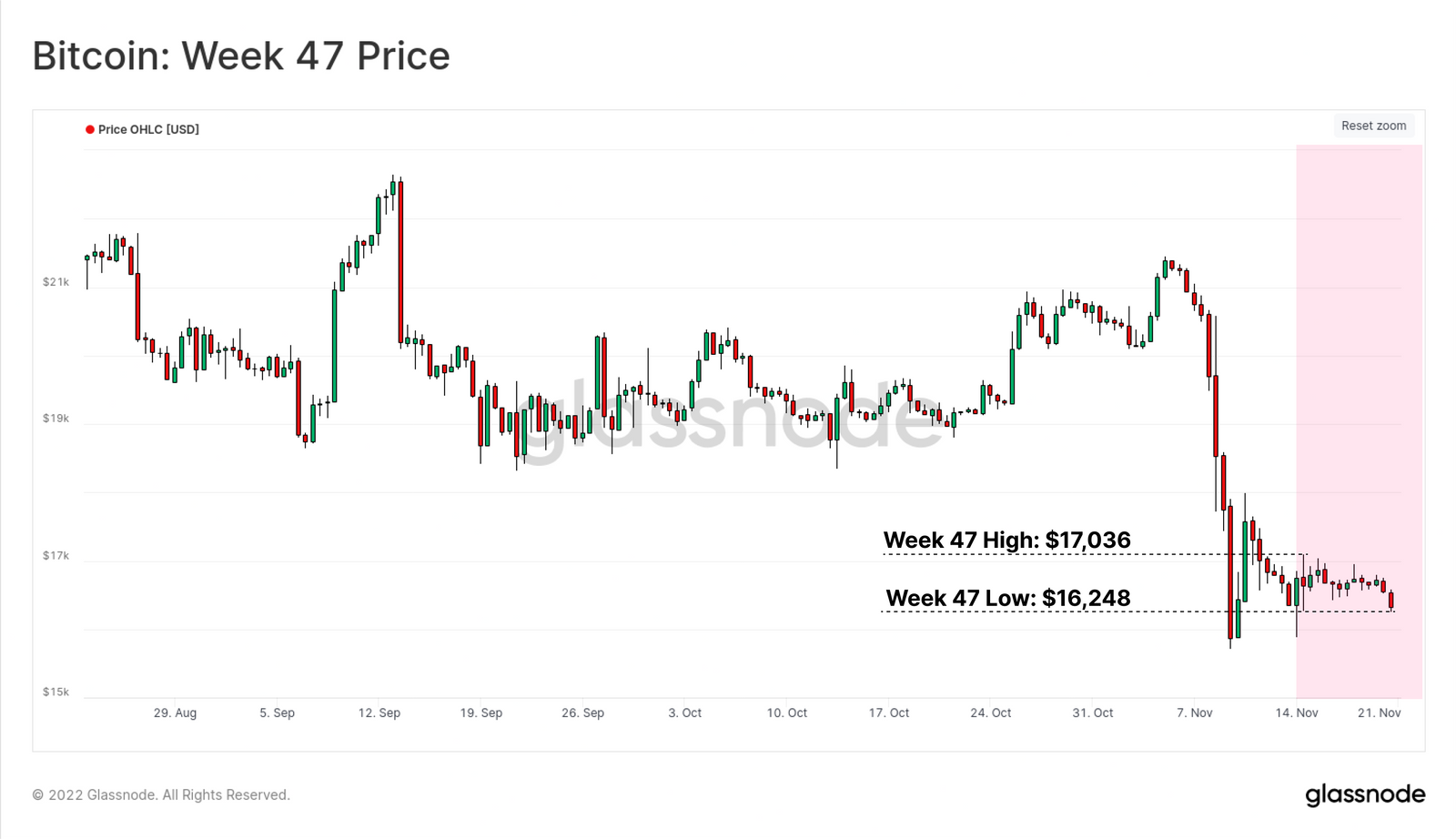
As the dust settles following the FTX fallout, and with a few more weeks of data available, we are able to assess whether recent market weakness has shaken the confidence of Bitcoin holders. The market continues to consolidate this week, however did trade down from the early-week high of $17,036, to close at $16,248, one of the lowest closing prices of the cycle.

In this edition we will zoom into three specific topics, with the goal of assessing how much of a hit Bitcoin investor conviction has taken in the wake of the FTX collapse:

Exchange outflows, which have continue to break historical records.

Whales who are more than likely underwater on their position in aggregate.

Long-term holders, whom are currently spending coins at a historically significant rate.
⚡Cyber Week Deal: 40% Off Advanced Plans⚡

Starting today, you can take advantage of our first-ever end of year sale! Save 40% on a monthly or yearly Glassnode Advanced plan and access data and insights that are helping thousands of crypto traders and investors around the world.

Translations

This Week On-chain is now being translated into Spanish, Italian, Chinese, Japanese, Turkish, French, Portuguese, Farsi, Polish, Arabic, Russian, Vietnamese and Greek.

The Week Onchain Dashboard

The Week Onchain Newsletter has a live dashboard with all featured charts available here. This dashboard and all covered metrics are explored further in our Video Report, which is released on Tuesdays each week. Visit and subscribe to our Youtube Channel, and visit our Video Portal for more video content and metric tutorials.

Coins Flood Out of Exchanges

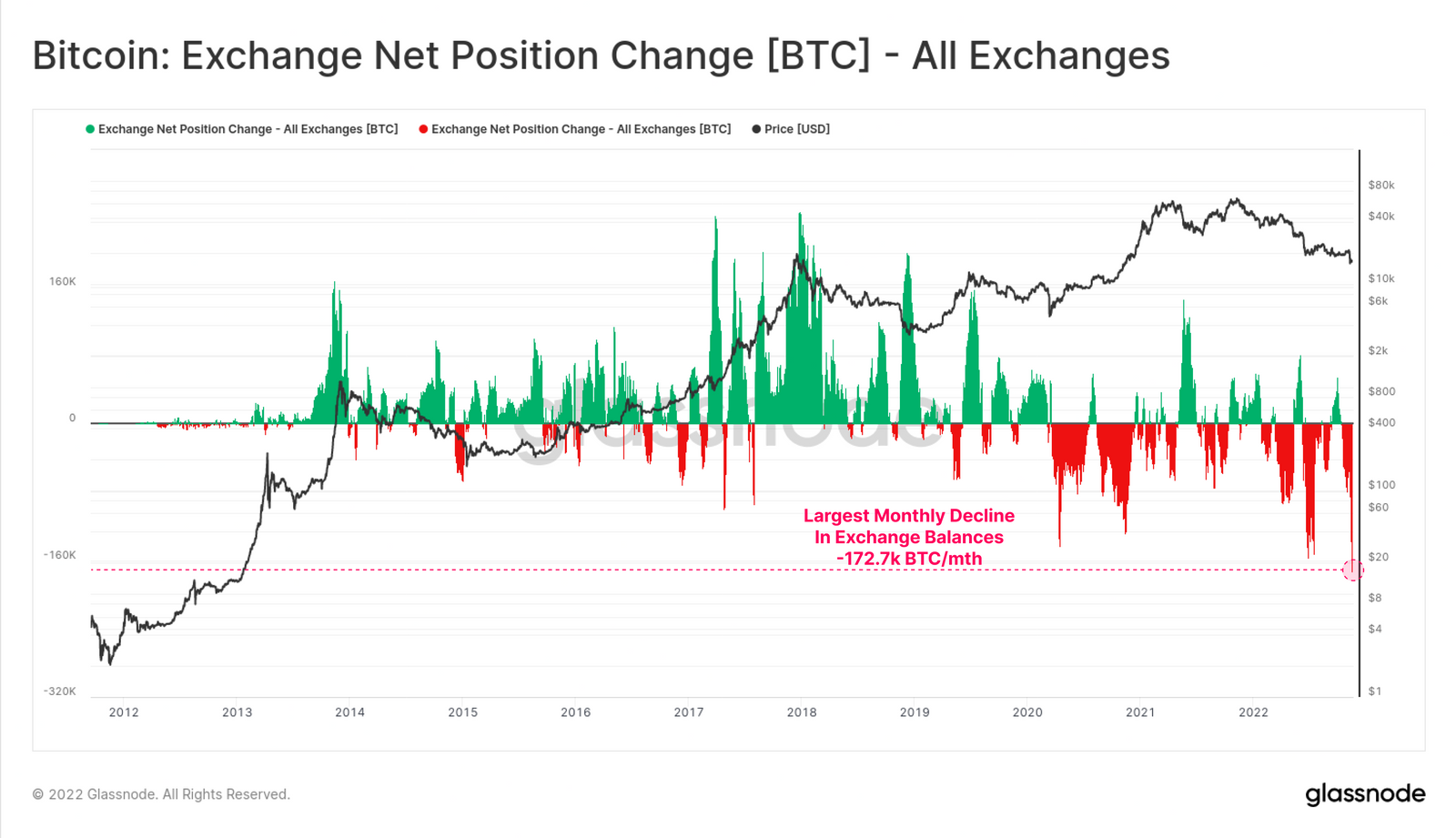
As we covered in last weeks edition, outflows from exchanges and into investor wallets of almost all sizes have been historical in scale, as BTC holders seek safety in self-custody. As a result, the 30-day net position change of all exchange balances has reached a new all-time-high for outflows this week.

BTC is currently flowing out of exchanges at a rate of -172.7k BTC per month, eclipsing the previous peak set following the June 2022 sell-off.
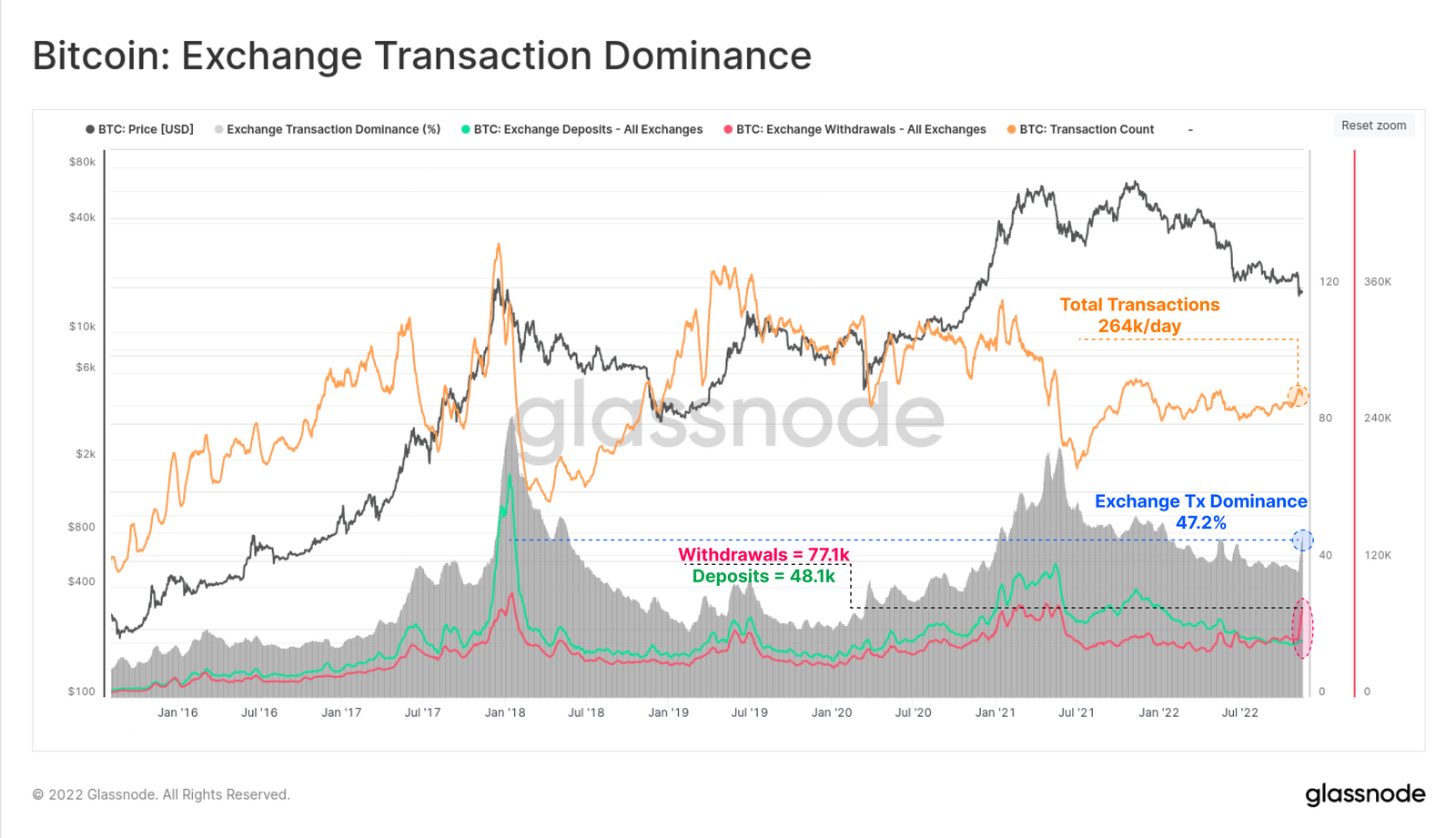
Total confirmed transactions have also seen an uptick over the last two weeks, reaching a multi-month high of 246k confirmed transactions per day. Out of this total, around 29.2% were related exchange withdrawal transfers (77.1k withdrawals), and 18.2% were exchange deposits transfers (48.1k deposits).

This burst of exchange related activity pushes the dominance of exchange deposit or withdrawal transactions to 47.4% of the toal, the highest level year-to-date. Historically, higher exchange dominance can be associated with bull markets (sustained trends), and high volatility sell-off events (short-term spikes).
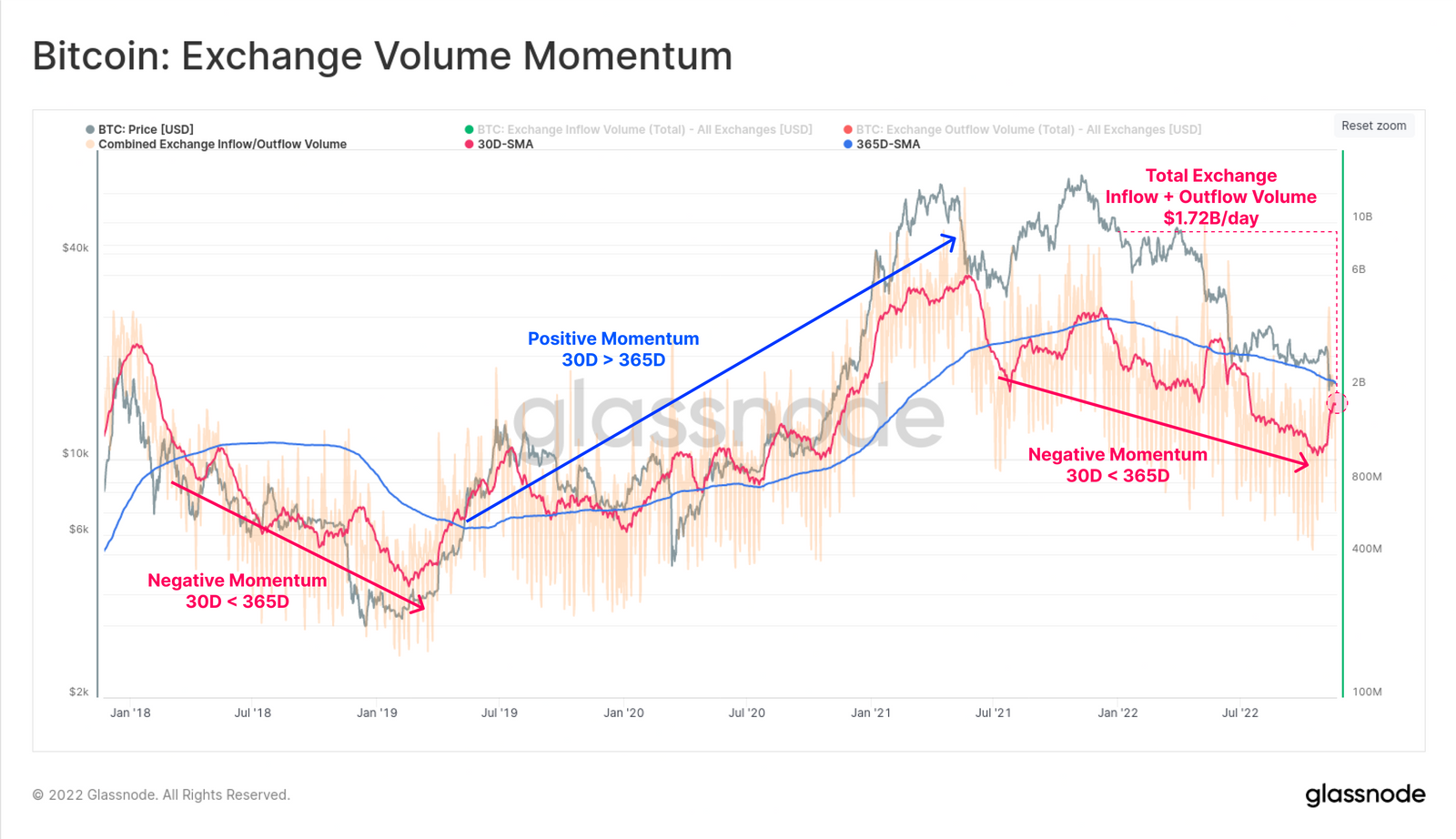
On a 30-day moving average basis, the combined USD denominated inflow and outflow volumes across all exchanges spiked higher, reaching $1.72B/day this week. The chart below presents this monthly average 🔴 relative to the yearly average 🔵 as a gauge for overall momentum of the Bitcoin economy.

Historically, periods where the monthly average of exchange volumes exceeds the yearly has signalled positive market momentum, as more coin volume changes hands. In the current market, the combined exchange inflow and outflow volume would have to reach and sustain levels above $2.15B to signify positive momentum on this front.
Whales Underwater

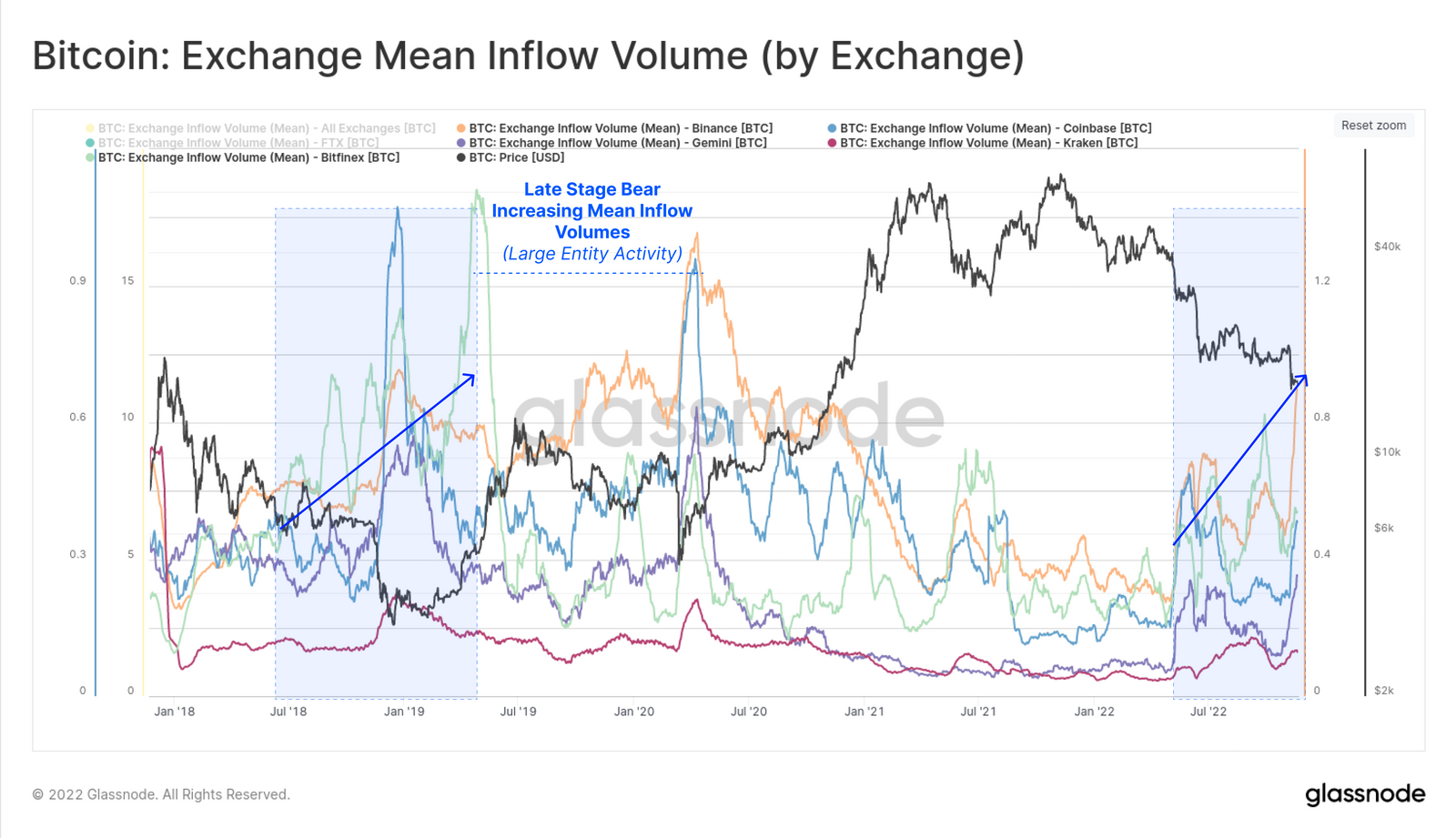
A trend which can be observed during the later stages of the 2018-19 bear market is an aggregate increase in the Mean Inflow Volume to exchanges. In other words, the average deposit size across all major exchanges increases in USD terms as the market formed a cycle bottom. This is present across all major exchanges including Binance, Bitfinex, Coinbase, Gemini, and Kraken.

A similar trend has been in effect since late May following the collapse of the LUNA-UST project. This indicates that in general, there has been a net increase in larger size deposits over the last 6-months. This indicates that entities such as whales, institutions, and trading firms have had a larger dominance across exchange deposits.
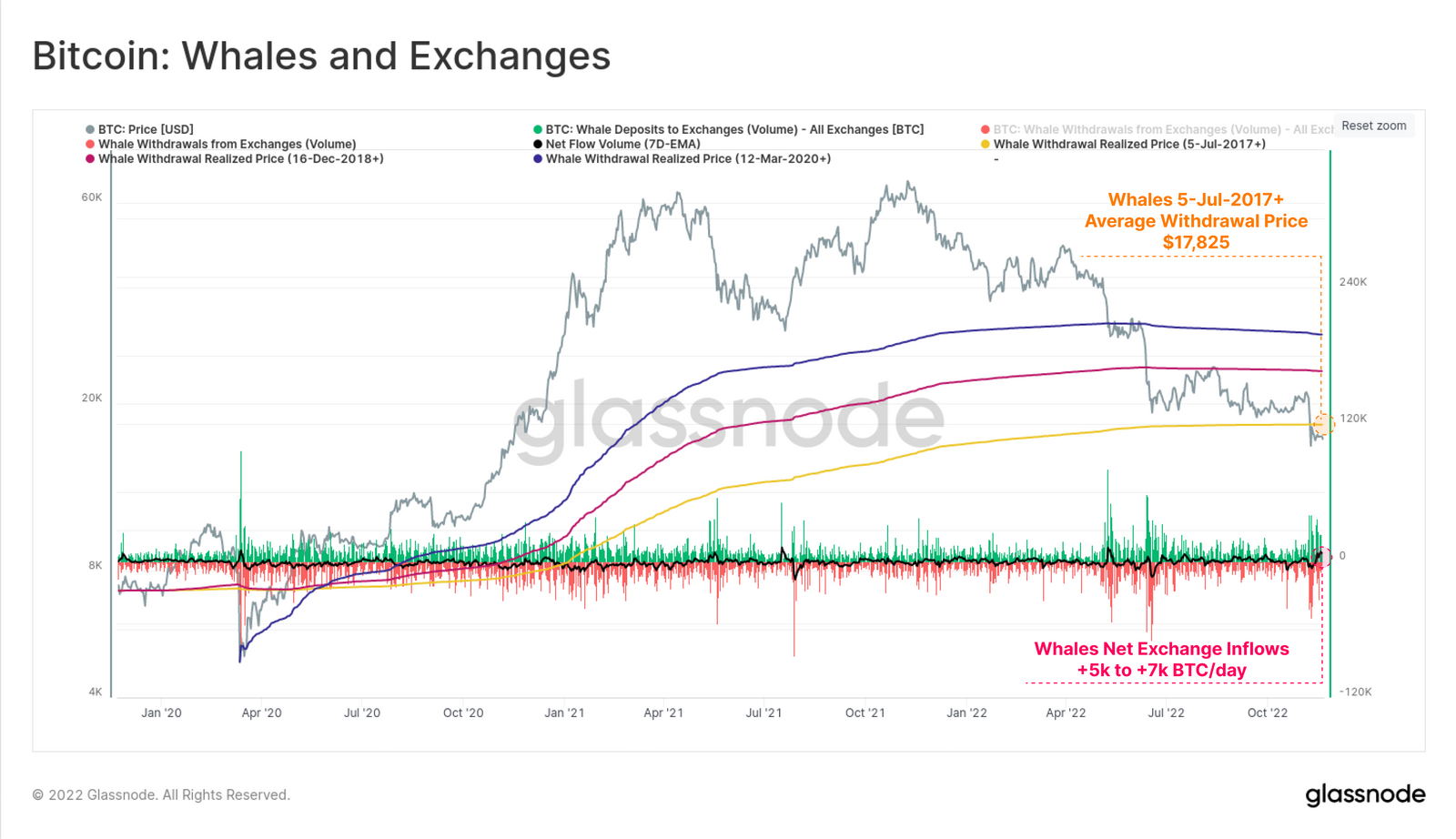
A driving factor of this may be the financial position of Whales (entities > 1k BTC). The yellow trace below shows the average withdrawal price of the Whale cohort since 5-Jul-2017 (launch of Binance), which is trading at $17,825.

With spot prices currently at $16.2k, this is the the first time since March 2020 that this Whale cohort has been at an unrealized loss. In response, Whales have actually been depositing coins to exchanges, with an excess of between 5k and 7k BTC per day in net inflows over the past week.
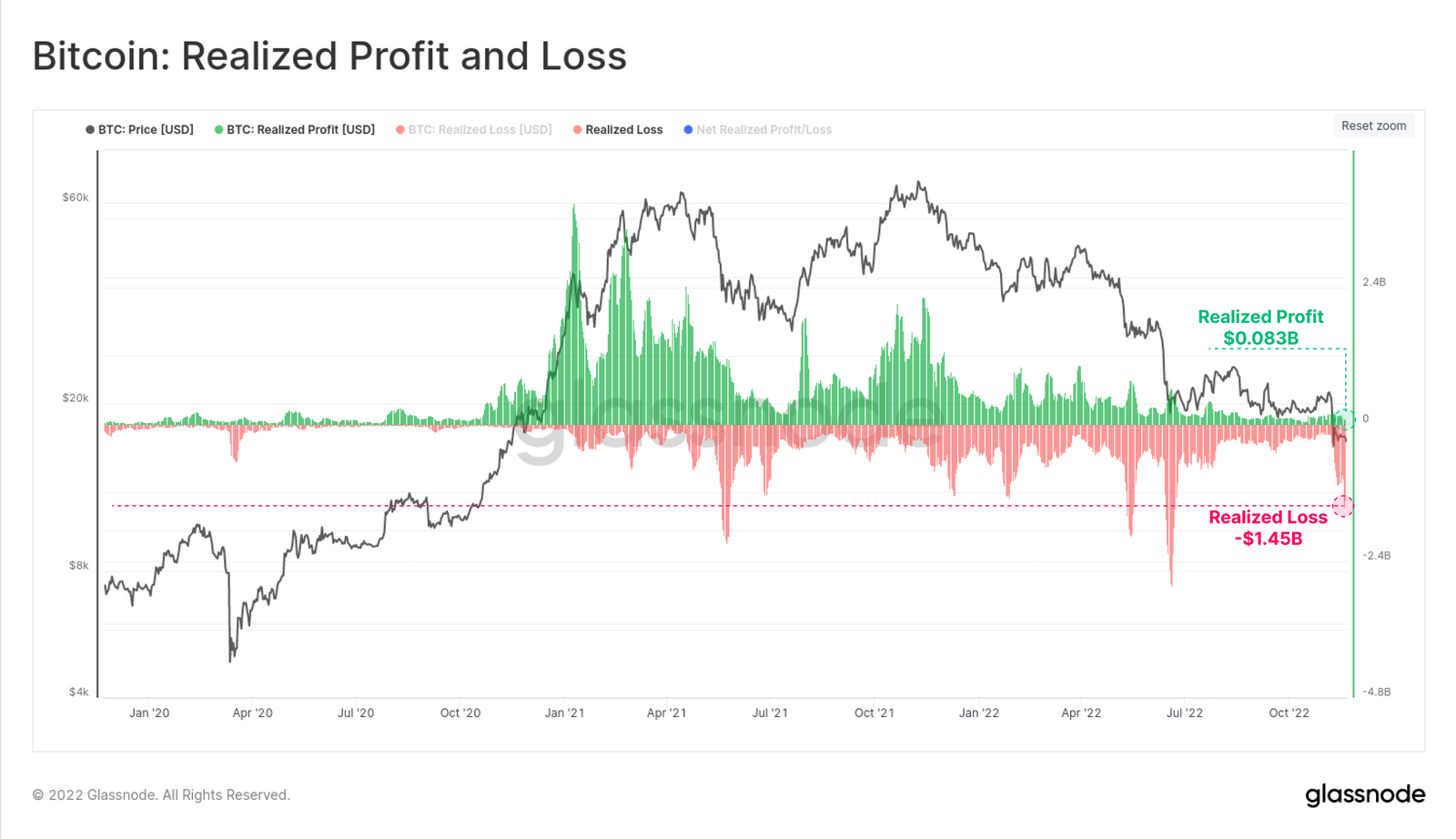
This magnitude of financial pain is being expressed across the wider market, with one of the largest spikes in Realized Loss in the 2020-22 cycle. A peak daily value of -$1.45B in realized loss was locked in this week, ranking as the fourth largest in history.

A comparably small $83M in realized profits occurred, suggesting that the vast majority of spent volume at present is sourced from investors from the current cycle, and very little coin volume from previous cycles are on the move.
Old Hands Awaken

A pattern of interest we highlighted in our last edition was the uptick in spending by Bitcoin longer-term holders. During bear markets, significant and sustained upticks in old coin spending is often a signal of reduced conviction, fear, and capitulation amongst this more experienced cohort.

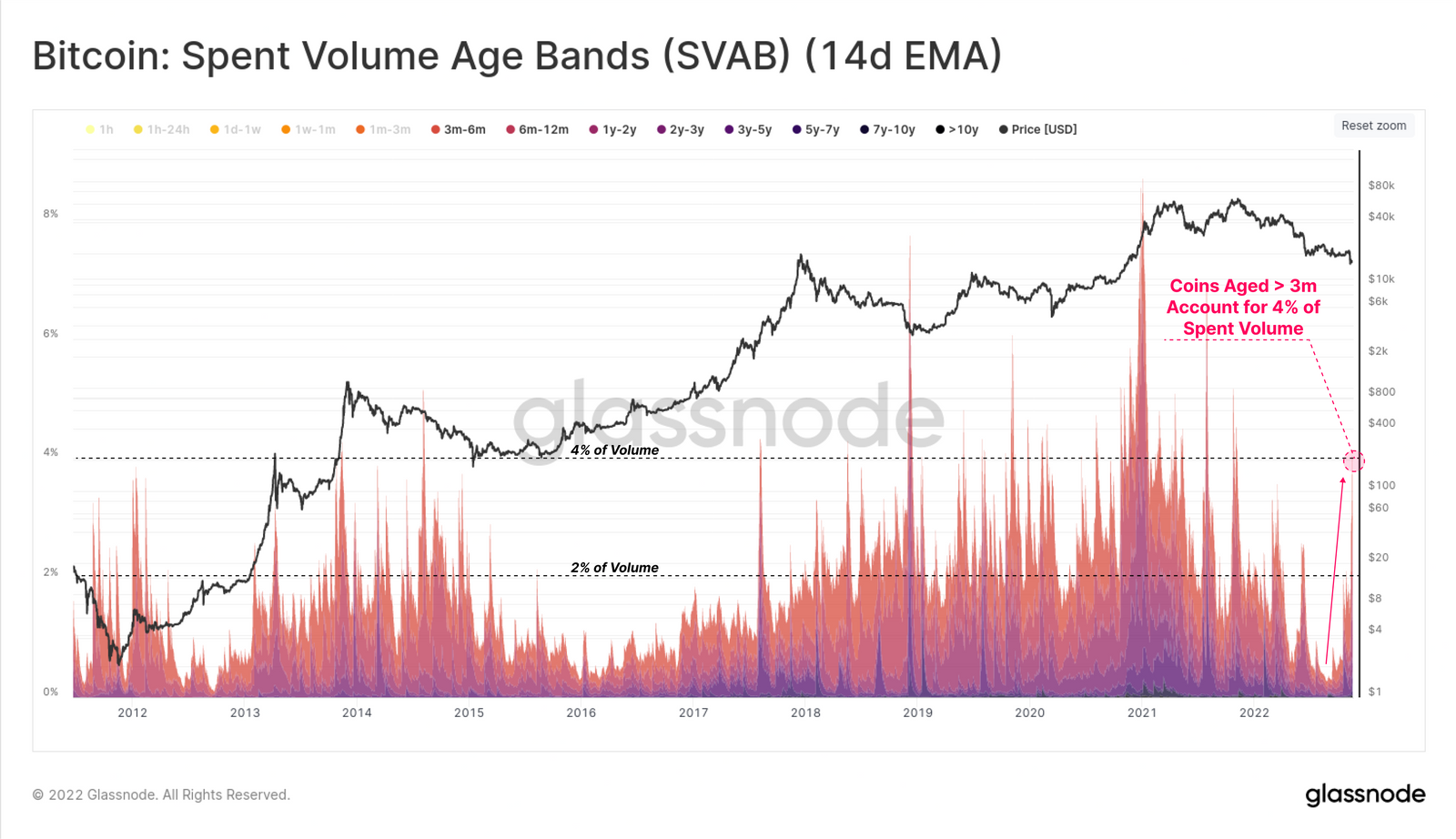
The Spent Volume Age Bands (SVAB) metric shows that just over 4% of all spent volume was sourced from coins older than 3-months this week, which is the highest level in 2022. This relative magnitude is coincident with some of the largest in history, often seen during capitulation events and wide scale panic events.
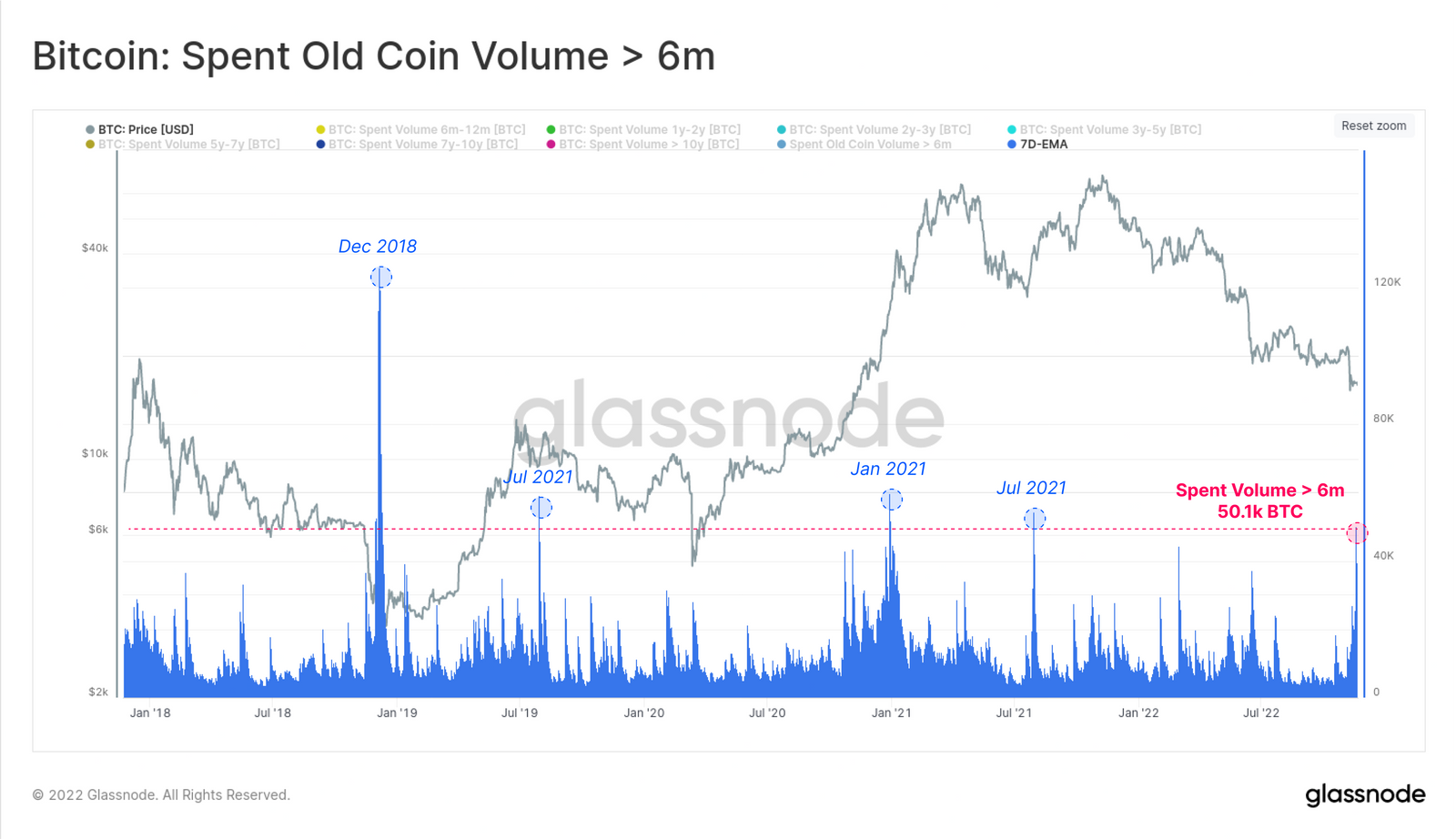
The spent BTC volume older than 6-months has hit also the fifth highest value over the last five years. Over 130.6k BTC aged 6-months or more were spent on 17-Nov alone, with the 7-day average now at 50.1k BTC per day.

This suggests that there is significant uncertainty, which is prompting the changing of hands, and or shuffling of coins by longer-term investors.
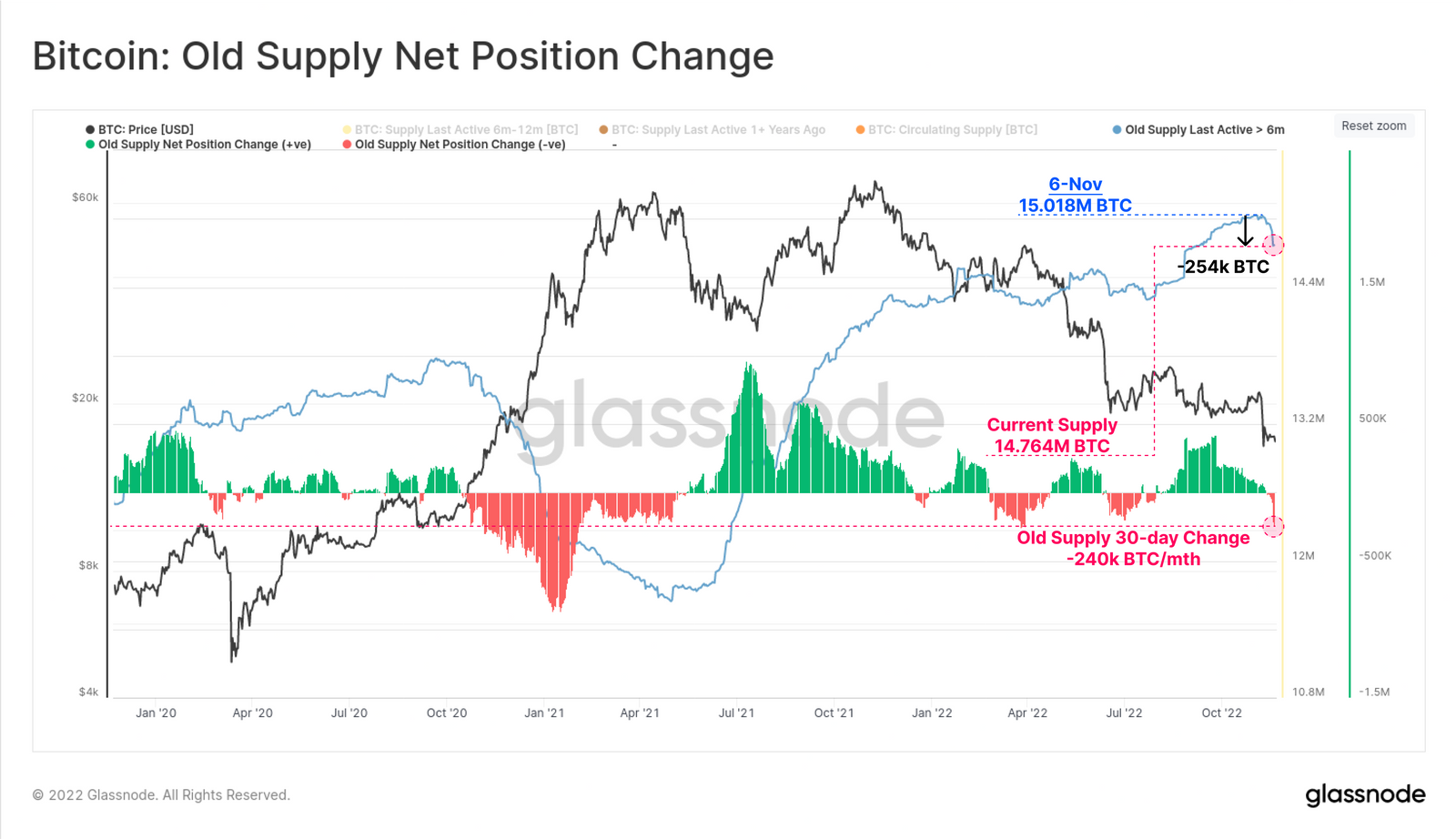
In the time since FTX collapsed, a total of 254k BTC older than 6-months have been spent, equivalent to around 1.3% of the circulating supply. On a 30-day change basis, this is the steepest decline in older coin supply since the Jan 2021 bull run, where long-term investors were taking profits in the bull market.
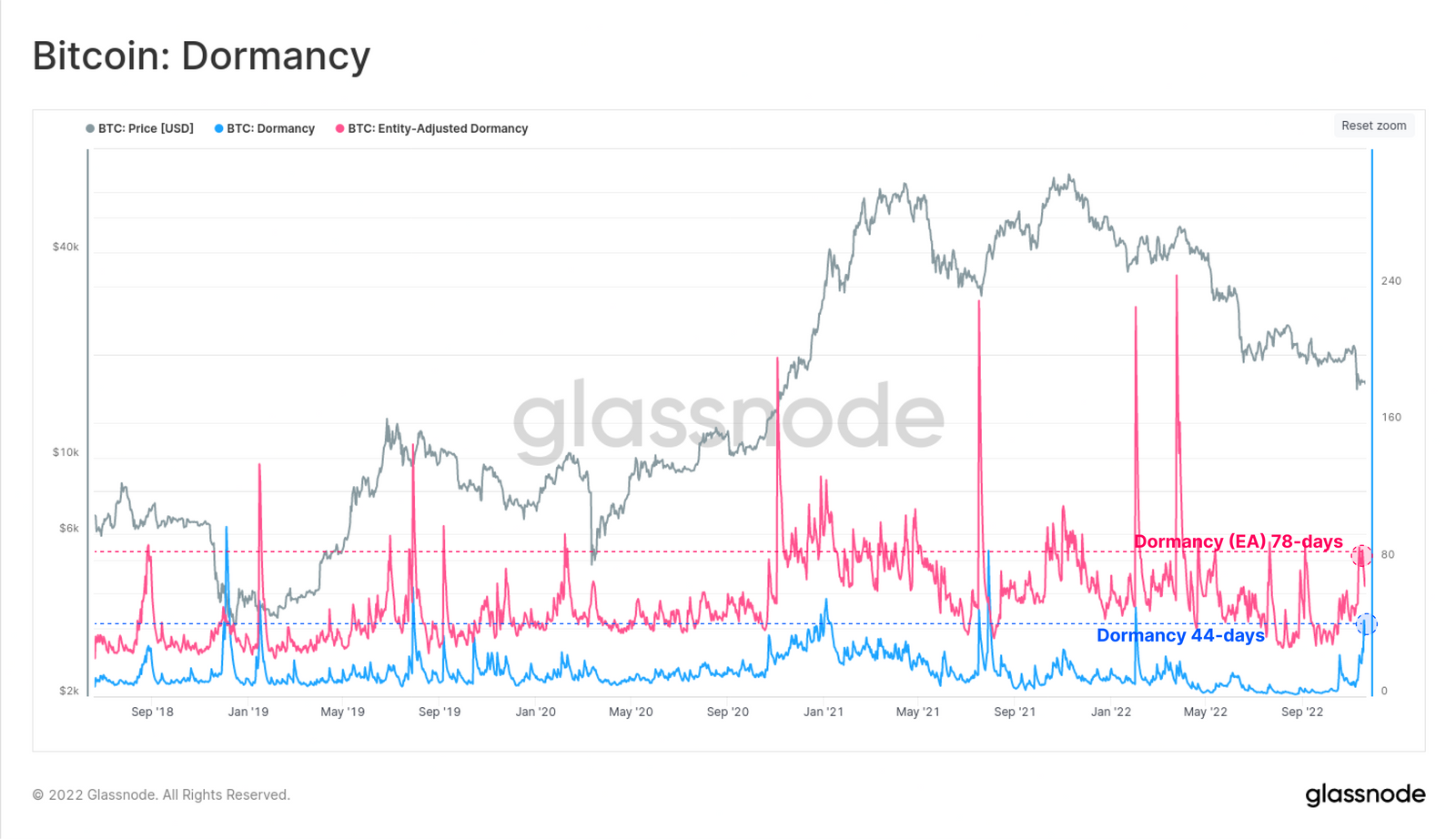
The average age per spent coin can be measured via the Dormancy metric, which has also seen a significant uptick over recent weeks. Two traces are show below, for different variants of Dormancy:

🔵 Dormancy: which has rallied to 44-days, and presents the average age per spent coin across the whole market.

🔴 Entity-Adjusted Dormancy: has similarly rallied, hitting 78-days. This variant reflects filtered data that removes self-spends and internal wallet reshuffling.

When both metrics experience a similar spike higher, it provides confidence that a meaningful portion of the spending taking place is related to coins changing hands, and less so to internal wallet shuffling. Thus it appears that even Bitcoin long-term holders have been spooked by recent events, and a sub-set of them are spending coins and divesting in response.
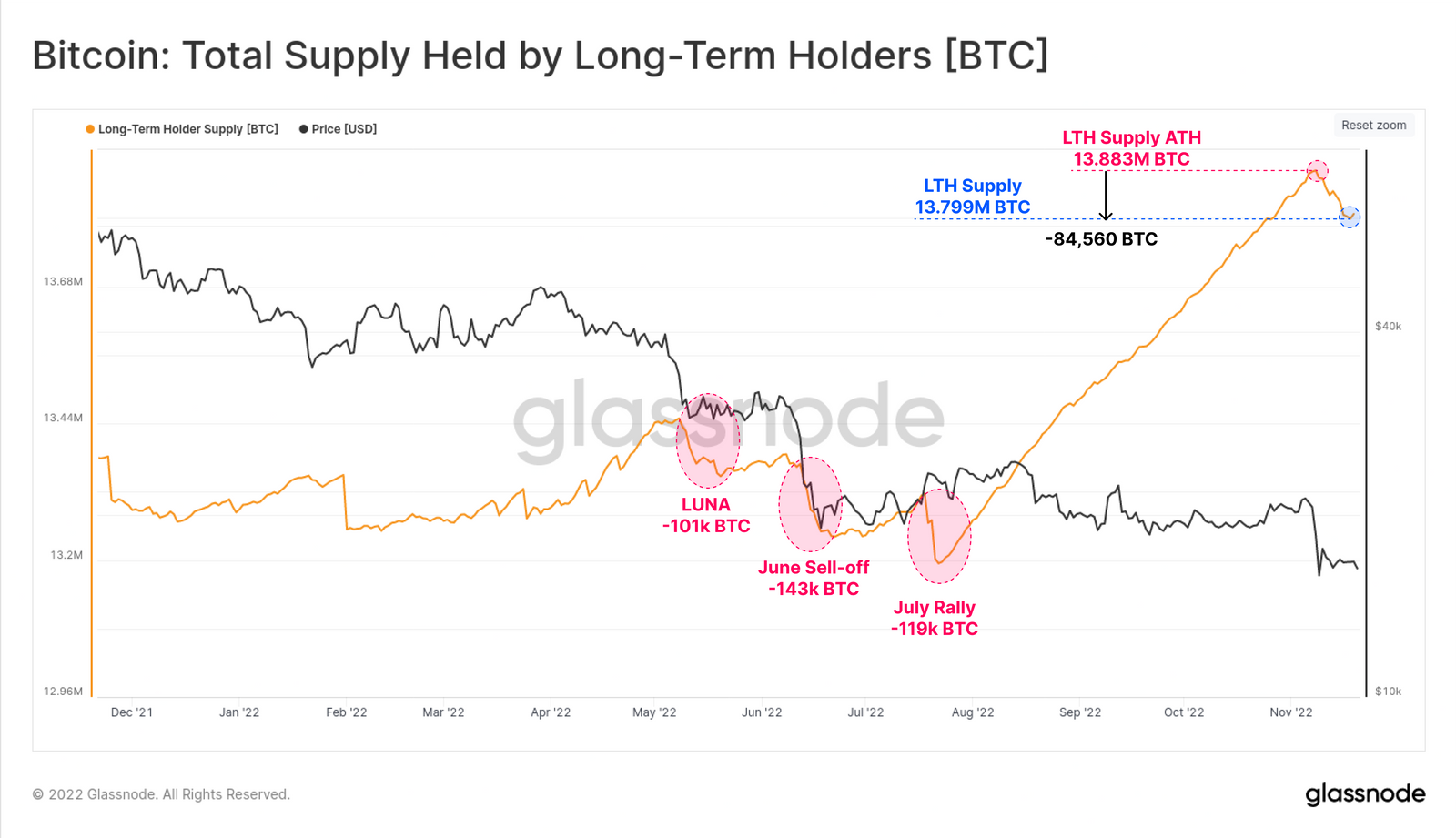
Finally, we will inspect the behavior of Long-Term Holders, which accounts for the entities that are statistically the least likely to spend in the face of volatility. Their supply has declined by 84,560 BTC post-FTX, which remains one of the most significant declines in the last year. As shown in the chart below, LTH supply declines have exceeded 100k BTC in three back-to-back months through May, June and July this year. This makes the current decline notable, but not the largest, although it is still underway.
Summary and Conclusions

Across many metrics that describe the behavior of Bitcoin longer-term investors, several are signalling that a non-trivial volume of spending, and divestment is underway. As noted last week, a slow-down and retrace of these metrics would signify this may be a short-term event, however with each passing day that these trends persist, it becomes increasingly plausible that a wider scale reduction in confidence is in play.

The Whale cohort are in a mode of net distribution at present, sending between 5k and 7k in excess BTC into exchanges. Meanwhile, the flight of coins off exchanges by almost all cohorts is at an all-time high. The whirlwind impact of the FTX collapse continues to play out, and it remains to be seen just how extensive the shake-up to investor confidence has been.


Bacaan Terkait

Paruh Kedua Kebijakan Kripto AS: UU CLARITY Perjuangkan 60 Suara, Komite "Satu Orang" CFTC Jadi Variabel Terbesar

Penulis: Cleve Mesidor, Direktur Eksekutif National Blockchain Foundation di Washington DC Industri kripto di AS tengah menantikan momen pentingnya dengan kemajuan RUU CLARITY di Senat, yang membutuhkan 60 suara untuk disahkan. Untuk mencapainya, Partai Republik mungkin perlu berkompromi dengan Gedung Putih dan menarik beberapa senator yang masih ragu-ragu. Waktu yang tersisa sangat terbatas, hanya sekitar 40 hari kerja legislatif. Selain prospek RUU CLARITY, beberapa proposal perpajakan kripto yang dipisahkan dari RUU PARITY baru berpeluang disahkan tahun ini dengan menumpang pada undang-undang yang lebih besar. Undang-Undang Kepastian Regulasi Blockchain juga berusaha memasukkan perlindungan bagi pengembang ke dalam hukum. Situasi di Commodity Futures Trading Commission (CFTC) memprihatinkan karena kekurangan empat komisioner, menambah ketidakpastian. Perdebatan mengenai yurisdiksi atas pasar prediksi—apakah jatuh ke negara bagian, CFTC, Securities and Exchange Commission (SEC), atau Mahkamah Agung—juga masih berlangsung. Industri akan kehilangan dua pendukung kunci: Komisioner SEC Hester M. Peirce dan Senator Cynthia Lummis, yang keduanya memainkan peran sentral dalam kebijakan kripto. Para ahli berpendapat: - **Sara K. Weed**: Peluang RUU CLARITY lolos tahun ini kecil karena kendala waktu dan pemilu, sehingga SEC dan CFTC harus lebih aktif memberikan kepastian. - **Sulolit 'Raj' Mukherjee**: Reformasi pajak kripto yang berarti kemungkinan akan disahkan dengan menempel pada paket undang-undang yang lebih besar, bukan sebagai RUU mandiri. - **Rashan Colbert**: CFTC sedang berupaya membangun kerangka regulasi yang lebih kokoh untuk pasar prediksi yang tengah berkembang, meski perdebatan klasifikasinya sebagai infrastruktur keuangan atau perjudian masih berlanjut. Babak kedua pertarungan kebijakan kripto telah dimulai. Meski waktu sempit, peluang masih ada, tetapi diperlukan komunikasi dan dorongan pragmatis lintas partai untuk mencapai hasil substansial pada 2026.

marsbit15m yang lalu

Paruh Kedua Kebijakan Kripto AS: UU CLARITY Perjuangkan 60 Suara, Komite "Satu Orang" CFTC Jadi Variabel Terbesar

marsbit15m yang lalu

Artikel Baru Dan Koe: Melarikan Diri dari Nasib Pekerja Kantoran, Bagaimana Bertahan di Tengah Gelombang Penggantian AI?

**Rangkuman Artikel: Lolos dari Nasib Karyawan dan Bertahan di Era Penggantian AI** Banyak yang khawatir pekerjaan mereka akan sepenuhnya digantikan oleh AI, tetapi ancaman sebenarnya bukanlah teknologi, melainkan ketergantungan pada orang lain untuk masa depan dan kesejahteraan kita. Artikel ini membahas cara keluar dari "perbudakan gaji" (hidup hanya untuk bekerja pada hal yang tidak bermakna) dan menemukan cara kerja yang lebih bermakna. Kunci untuk bertahan dan berkembang di era AI adalah **memulai usaha sendiri**. Untuk melakukan ini, Anda perlu menguasai lima elemen inti kesuksesan: 1. **Agen (Agency):** Kemampuan untuk bertindak tanpa menunggu perintah. 2. **Selera (Taste):** Intuisi untuk membedakan yang baik dan bernilai. 3. **Persuasif:** Kemampuan meyakinkan orang lain. 4. **Ketekunan (Persistence):** Memahami bahwa kegagalan adalah bagian dari proses. 5. **Iterasi (Iteration):** Kemampuan untuk terus memperbaiki berdasarkan umpan balik. Lima elemen ini mengerucut pada dua keterampilan utama: **memecahkan masalah dan akumulasi pengalaman** untuk mengetahui apa yang harus dilakukan. **Langkah praktis untuk memulai:** 1. **Ubah Lingkungan Anda:** Untuk mengubah identitas dan kebiasaan, ubah total lingkungan dan rangsangan di sekitar Anda—mulai dari konten yang dikonsumsi hingga rutinitas harian. 2. **Pilih Media Konten sebagai Wahana Utama:** Dibandingkan coding, keterampilan membuat konten (tulisan, video, podcast) lebih berharga karena nilainya subjektif dan membutuhkan selera yang tidak bisa sepenuhnya digantikan AI. Ini adalah "jagoan" masa depan. 3. **Temukan "Panggilan Hidup" Anda, Bukan Hanya Membangun Merek Pribadi:** Jawab pertanyaan-pertanyaan mendalam untuk menggali bahan baku unik Anda: * Topik apa yang paling Anda kuasai atau ingin pelajari tanpa dibayar? * Masalah apa yang mudah Anda selesaikan tetapi orang lain kesulitan? * Pendapat "anti-konsensus" apa yang Anda pegang teguh di bidang Anda? 4. **Langkah Aksi: Terbitkan Gagasan Pertama Anda.** Gabungkan jawaban dari pencarian panggilan hidup Anda menjadi satu potong konten dan PUBLIKASIKAN. Umpan balik nyata dari dunia adalah guru terbaik untuk belajar, beriterasi, dan mengembangkan keterampilan persuasif serta selera Anda. Mulailah dengan meluangkan 15 menit untuk menjawab pertanyaan-pertanyaan inti dan mempublikasikan satu ide. Proses inilah yang akan membebaskan Anda dari ketergantungan finansial pada orang lain.

marsbit46m yang lalu

Artikel Baru Dan Koe: Melarikan Diri dari Nasib Pekerja Kantoran, Bagaimana Bertahan di Tengah Gelombang Penggantian AI?

marsbit46m yang lalu

Interpretasi Riset: Morgan Stanley Memperjelas SanDisk (SNDK), Kebenaran Kekuatan Penetapan Harga di Pusat Data Cloud dan Dividen Inferensi AI

**Ringkasan Laporan: Morgan Stanley Menganalisis SNDK, Kekuatan Penetapan Harga di Pusat Data Awan & Realitas Manfaat AI Inference** Morgan Stanley (MS) pada 22 Juni meningkatkan target harga SNDK dari $1100 menjadi $1750, dengan rating "Overweight". Alasan utamanya: permintaan untuk **AI inference** mengubah aturan pasar NAND. Pelanggan pusat data awan (cloud) yang membayar premium untuk penyimpanan **KV Cache** dan konteks AI menjadi kurang sensitif terhadap harga, memberikan SNDK **kekuatan penetapan harga**. SNDK mengunci profitabilitas masa depan melalui **NBM (New Business Model)**, kontrak jangka panjang (3-5 tahun) yang telah mencakup lebih dari sepertiga volume bit FY27. Kontrak ini memiliki harga tetap atau struktur floor/ceiling, dan bahkan pada harga terendah (floor) dapat mempertahankan margin kotor sekitar **80%**. MS memproyeksikan margin kotor SNDK akan melonjak dari 30.3% (FY25) menjadi 86.7% (FY27e). Dengan pasokan NAND yang diperkirakan tetap ketat hingga setidaknya pertengahan 2027, SNDK berfokus pada pertumbuhan melalui peningkatan kepadatan (density), bukan ekspansi kapasitas besar-besaran. Pertumbuhan pendapatan yang diproyeksikan (6.6x dari FY25 ke FY27) berasal dari segmen cloud ber-margin tinggi. **Katalis:** Adopsi eSSD di pusat data yang melampaui ekspektasi, pertumbuhan AI di edge, dan teknologi baru seperti HBM. **Risiko:** Pertumbuhan industri melambat, kompetisi meningkat (termasuk dari produsen China seperti YMTC), dan kehilangan pangsa pasar di segmen pusat data. Logika utama MS: **1)** Perubahan struktural permintaan AI inference, **2)** Perlindungan margin oleh kontrak NBM, dan **3)** Pasokan NAND yang ketat. Target harga $1750 didasarkan pada 28x PER FY27e.

marsbit1j yang lalu

Interpretasi Riset: Morgan Stanley Memperjelas SanDisk (SNDK), Kebenaran Kekuatan Penetapan Harga di Pusat Data Cloud dan Dividen Inferensi AI

marsbit1j yang lalu

850 Juta USDT Lari dalam Semalam, Masih Aman Menyimpan Stablecoin di Vault Berpenghasilan Tinggi?

**Ringkasan:** Artikel ini membahas kekacauan likuiditas yang dialami Altura, sebuah platform stablecoin berimbal hasil (yield), setelah laporan bahwa perusahaan audit pihak ketiga Accountable menghentikan kerja sama dengan platform serupa MainStreet. Meskipun Altura menegaskan tidak memiliki keterkaitan aset dengan MainStreet, keputusan audit tersebut memicu kehilangan kepercayaan pasar yang luas terhadap produk sejenis, menyebabkan penarikan massal (bank run) lebih dari 8,5 juta USDT dari Altura dalam 24 jam. Insiden ini menyoroti risiko operasional utama produk stablecoin berimbal hasil: ketidaksesuaian antara janji likuiditas instan bagi pengguna dan siklus penyelesaian (settlement cycles) dari aset dasar seperti pinjaman privat dan investasi aset dunia nyata (RWA). Ketakutan pengguna bahwa mereka mungkin tidak dapat menarik dana mereka dengan cepat memicu gelombang penebusan yang mempercepat diri sendiri, memaksa Altura untuk memulai penutupan vault secara tertib. Pelajaran pentingnya adalah bahwa dalam ekosistem DeFi, kepercayaan pasar adalah faktor penting. Transparansi melalui audit dan bukti cadangan (proof-of-reserves) dirancang untuk membangun kepercayaan, tetapi berita negatif tentangnya dapat menyebar lebih cepat daripada klarifikasi platform, menyebabkan kepanikan bahkan tanpa kerugian aset yang mendasarinya. Tantangan ke depan bagi Altura dan industri adalah memastikan proses likuidasi yang tertib dan mengelola ekspektasi pengguna tentang waktu penebusan.

Foresight News1j yang lalu

850 Juta USDT Lari dalam Semalam, Masih Aman Menyimpan Stablecoin di Vault Berpenghasilan Tinggi?

Foresight News1j yang lalu

Lompatan Kinerja Tiga Kali Lipat! NEAR Mencapai Batas Fisik 200ms untuk Pembuatan Blok Berkat SPICE

NEAR, melalui tim inti Near One, mengumumkan rencana implementasi SPICE (Pemisahan Konsensus dan Eksekusi), sebuah peningkatan arsitektur utama untuk protokolnya. Saat ini, NEAR menghasilkan blok setiap 600 milidetik. Dengan SPICE, kecepatan ini akan meningkat tiga kali lipat menjadi 200 milidetik — batas teoritis fisik untuk produksi blok — dengan finalitas transaksi menjadi 0,4 detik. Inti dari SPICE adalah memisahkan proses konsensus (penyusunan dan kesepakatan urutan transaksi) dari eksekusi (perhitungan status dan penerapan transaksi). Pemisahan ini memungkinkan lapisan konsensus berjalan pada kecepatan penuh tanpa menunggu eksekusi selesai. Peningkatan ini membawa tiga manfaat utama: kecepatan blok lebih tinggi, latensi transaksi lebih rendah, dan dukungan untuk transaksi kompleks dengan siklus eksekusi lebih panjang. Ini akan sangat meningkatkan pengalaman pengguna untuk aplikasi seperti near.com dan NEAR Intents, serta memenuhi kebutuhan kecepatan tinggi untuk ekonomi agen AI. SPICE juga merupakan langkah penting menuju Nightshade 3.0. Arsitekturnya memungkinkan eksekusi atomik lintas-shard di masa depan, menyederhanakan pengembangan kontrak pintar yang kompleks dengan menghindari logika asinkron yang rumit. Selain itu, kombinasi blok yang lebih singkat dan kontrak pintar tersharding akan meningkatkan keamanan jaringan dan efisiensi sumber daya. Peningkatan SPICE sedang dalam pengembangan intensif oleh Near One dan dijadwalkan untuk diluncurkan dalam beberapa bulan ke depan.

Foresight News2j yang lalu

Lompatan Kinerja Tiga Kali Lipat! NEAR Mencapai Batas Fisik 200ms untuk Pembuatan Blok Berkat SPICE

Foresight News2j yang lalu

Trading

Spot
Futures
活动图片