Will zkEVM be the Savior of Ethereum?

Huobi ResearchDipublikasikan tanggal 2022-02-18Terakhir diperbarui pada 2022-02-18

Abstrak

This article compares the features of two mainstream Rollup solutions and points out that zkRollup has better performance but poor compatibility, thus limiting its application scope. zkRollup needs to include zkEVM's to be able to run all kinds of general-purpose smart contracts in order to address the above shortcomings. The main points of zkEVM and the characteristics of two different technical routes are then described, and the mainstream projects of zkEVM are introduced. Finally, it is envisioned that ZKEVM will act as a savior for Ethereum in the near future to help expand the capacity of Ethereum, and has the possibility to play a role on other public chains in the longer term.

No doubt that Ethereum has become the superstar public chain that runs thousands of smart contracts on it. However, the traffic is so busy that “traffic jams” could often been spotted, even a “highway” like Ethereum must confront a long queue of transactions to be packed and sent, even though the toll (gas fee) could be enormous. The network congestion was not beyond expectation. An earlier incidence dating back to 2018 , a game named Crypto Kitten, had the privilege to bring about the weakness of Ethereum in handling mass transactions, let alone the number of users and Dapps have soared to several times of those in 2018. Ethereum has bear the burden of being the avant-garde, dragging it slower and slower as time goes by ; an update to alleviate the congestion cannot wait. not dropped significantly; when denominated in US dollars, the handling fee has risen to a certain extent due to the increase in the price of ETH.

What if there is a Layer 2 solution that could offer fast and secure transaction with low gas fee, highly compatible with vast majority of smart contracts and Dapps yet private enough without the controversial week-long waiting time, would you make it in your wish list? In fact, this nearly perfect Layer 2 solution could probably be live in the market in the near future.

What could Layer 2 and Rollup Do?

The most well-known ETH 2.0 is like a massive renovation of “the highway”; the process will eventually be slow since the renovation is naturally difficult to implement and benefits of various parties are involved. If it were to exempt a direct renovation on “the highway” by implementing ETH 2.0, a Layer 2 solution is more or less an indirect solution that it creates overpasses above “the highway” in order to achieve scaling. The mainstream Layer 2 scaling technique is Rollup: it handles more transactions without taking up space by compiling data. In other words, larger data packs could commute like a bus on " the highway" instead of cars with limited capacity, thus more passengers, data, in this case, could be transported.

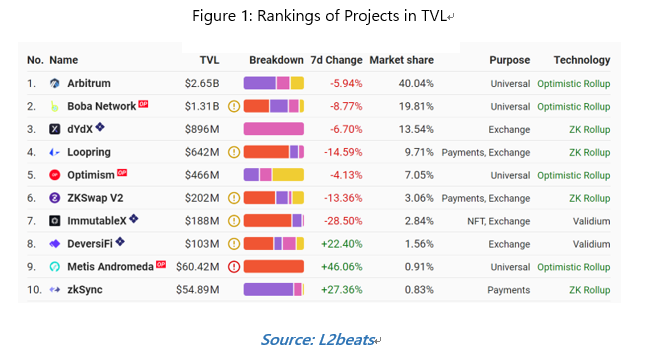
Rollup could be classified by whether it interacts with proofs submitted to Layer 1. There are 2 Rollup technical tracks. One is the Interactive Rollup. For short, we identify one-round interaction and multi-round interaction as Optimistic Rollup (OP Rollup), Arbitrum, Boba Network and Optimism are some outstanding projects in this category: the number of projects in the ecosystem and TVL skyrocket in this year, and the TVL of this three projects occupied almost 70% of the whole Layer 2 market. The other is Non-interactive, also know as ZK Rollup; exemplary projects in this track are dYdX, Loopring and zkSync. They have a comparatively smaller market share.
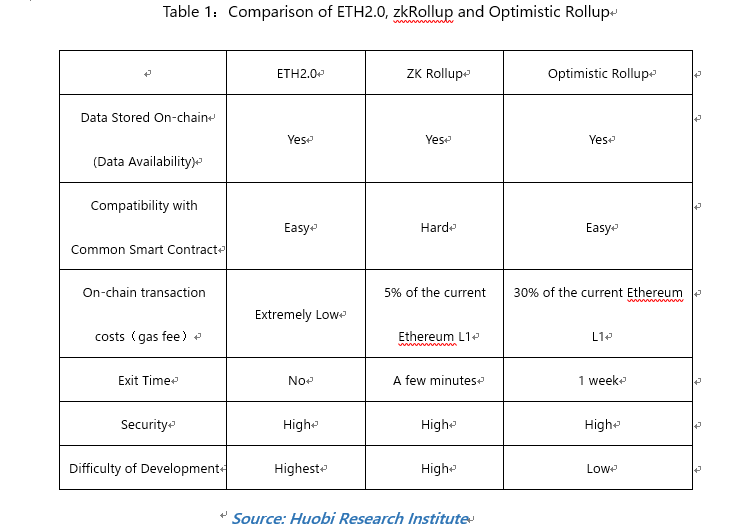
If Optimistic Rollup were the innocent and romantic Juliet girl, longing for a love fairy tale with Romeo in a perfect world, ZK Rollup would be more like a considerate office lady, tact and neat. For immature ideas from an innocent girl would consume a large amount of time to be proven, and the result would not be necessarily right. Just as how it performs in Optimistic Rollup: the fraud proof could still be flawed even after a week-long verification period. However, the neat office lady, ZK Rollup, prefers a much faster and result-driven “state proof”. As the nature of verification differs, ZK Rollup outperforms OP Rollup with better performance, lower transaction fee and unconstrained exit time.

Defects of ZK Rollup

Compatibility is the main defect of ZK Rollup compared to OP Rollup. As illustrated in the below, ZK Rollup is only compatible with payment and transaction types of applications, while OP Rollup supports a variety more, lacking appropriate development of ZK Rollup, which leads to the mere 3.6% market share of Layer 2 in the whole Ethereum in terms of TVL.
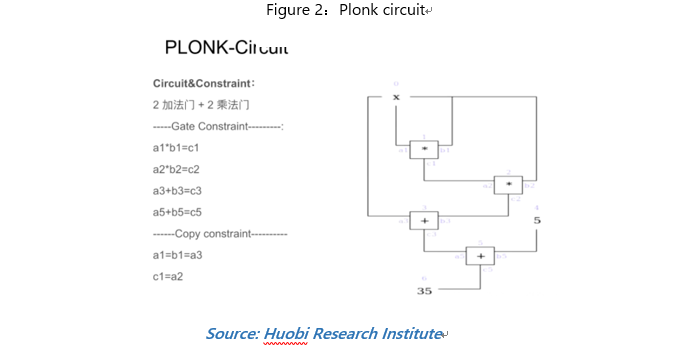
ZK Rollup submits Zero Knowledge Proof to Ethereum mainnet as an effective proof; the inherent complexity of generating Zero Knowledge Proof triggers low compatibility with most applications. In the intricate process, logic of codes must be first converted to a mathematical circuit, not only including basic calculations such as plus or minus, and also accompanied with convoluted logic such as “and”, “or”, “Not”, Hash, bit operation,and other operations on smart contracts. Moreover, this diagram could only support plus and multiplication calculations, and Ethereum opcode is not Zero Knowledge Proof friendly as it was not designed to do so. Furthermore, the most frequently deployed Hashing method, such as AEW-128 or SHA-256, consist of enormous bit operations(“and” and “or” commands); it would be extremely complicated and substantial when converted to gate constraints in the cir.

We need ZK EVM

The current ZK Rollup has constructed a parallel path above the Ethereum boulevard. However, it is more like a bike trail that could only carries out simple transactions, whereas loaded trucks like smart contracts are too heavy to pass. In this case, should ZK Rollup conquer a larger market share by running smart contracts and produce proofs on Layer 2 in order that verification on mainnet could pass faster, a special virtual machine, ZK EVM, must be in place.

There are two key requirements under this circumstance. First, ZK EVM could be compatible with current EVM that codes on Layer 1 could be executed immediately on Layer 2. Second, ZK EVM must be capable of producing proofs for various operations while consuming less computation and storage resources.

Luckily, thanks to the vast development of Zero Knowledge Proof, a new algorism, “Plonk Zero Knowledge Proof”, has come to earth that accelerates the landing of ZK EVM. “Plonk Zero Knowledge Proof” does not produce the proof by calculating the whole circuit from head to toe; instead, it only verifies constraints in the circuit. That is to say, two points make a line, and to draw a line only need two points. Just as shown in the following chart, as long as the gate constraint and the copy constraint are verified, the whole circuit could be verified. In addition, the new algorism sets a trust mark to the whole unit instead of partially trusted, the verification process thus speeds up.
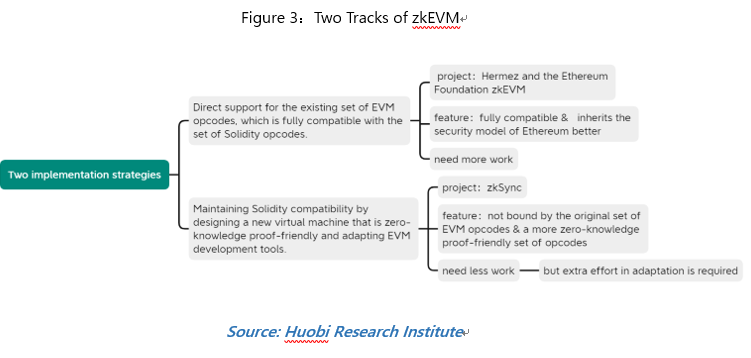
Tech Tracks of zEVM

There are two mainstream tech tracks:First, EVM friendly projects which embed Zero Knowledge Proof in current EVM. It aims to provide further support to native EVM opcode that codes are still executed in EVM and completely compatible with solidity commands. Applied ZKP and Hermez draw the most attention in this track.

Second, Zero Knowledge Proof friendly projects that build EVM with the foundation on Zero Knowledge Proof friendly opcode. This track focuses on the redesign of virtual machine that codes executed here could generate Zero Knowledge Proof much easier. That is to say, the original Zero Knowledge Proof unfriendly codes would be modified, adapting EVM developer tools in order to maintain compatibility with solidity.
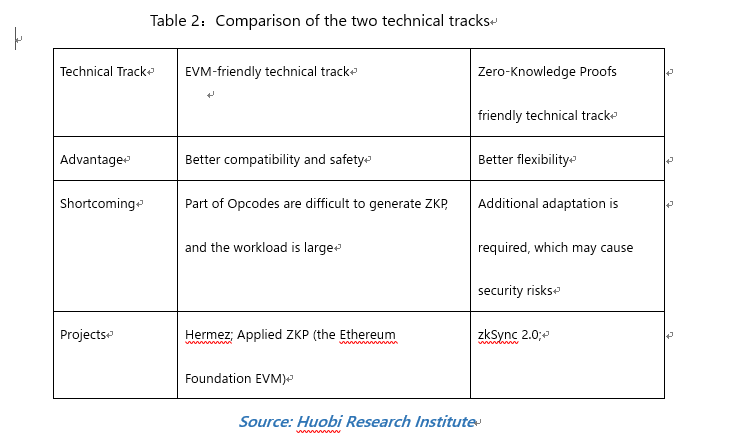
The appealing point of EVM friendly track is compatibility. It is completely compatible with current ecosystem and developer tools, well inherited the credited security model from Ethereum. From the overview of Ethereum ecosystem, this kind of update would be so gradual that current projects could be transferred smoothly before anyone could notice once succeeded. However, as mentioned above, Zero Knowledge Proof will also be generated for those commands deviating from the generation of proofs, which may consume enormous resource along the way. Ethereum. From the overview of Ethereum ecosystem, this kind of update would be so gradual that current projects could be transferred smoothly before anyone could notice once succeeded. However, as mentioned above, Zero Knowledge Proof will also be generated for those commands deviating from the generation of proofs, which may consume enormous resource along the way.

Zero Knowledge Proof friendly track wins over in terms of flexibility. It does not strictly generate proofs for every single command, and code to a set of commands that is more Zero Knowledge Proof friendly instead. Throughout the transformation of codes, Zero Knowledge Proofs are generated while the functions of smart contract are sustained. As a result, it could potentially prevail that avant-garde projects are more likely to be attracted to participate by the tempting benefits of considerately smaller workload and less difficulties to be encountered. However, extra workload may be conducted to transform EVM codes to intermediary codes, especially in the case of replacing the most frequently deployed Keccak Hash functions with other functions. It remains mysterious that if the process of this transformation could be flawless that comes with extra security and compatibility problems.

Table 2:Advantages, shortcoming and outstanding projects of the two zkEVM technology tracks
Typical projects

zkSync 2.0

ZkSync 2.0 is a representative project in the second track mentioned above. Which is Zero Knowledge Proof friendly. The updated version of zkSync 1.0, zkSync 2.0, would be a much better solution that is EVM compatible. Matter Lab explored various technical implementation plans, including TinyRam, Optimized Special Ops, Recursive TinyRam is a simple and traditional random browser for R1SC circuit (a commonly used circuit in Zero Knowledge Proof). It processes logic from smart contract and generate circuit for common opcodes. However, the consumption could be tremendous: The amount of gates in TinyRam could be thousand times more than that in normal fixed circuit. In other words, in a normal fixed circuit, an “add” calculation could be done via merely one gate, whereas 1000 gates must be involved in TinyRam; the more gates, the higher the gas fee. Even though TinyRam is somewhat inefficient, it has minor influence on the whole consumption structure because a rather small percentage is reserved in dealing with logic. This is a tradeoff between efficiency and compatibility, which the latter weighs more for ZKEVM.

Except, there are some longer commands in EVM, such as CALL, DATACOPY, EXP, CREATE, and so on. These commands are naturally unfriendly to circuit proof. For these special commands, zkEVM of zkSync inserted Optimized Special Ops accordingly in order to facilitate the expression of these longer commands in EVM via specially designed codes as intermediary.

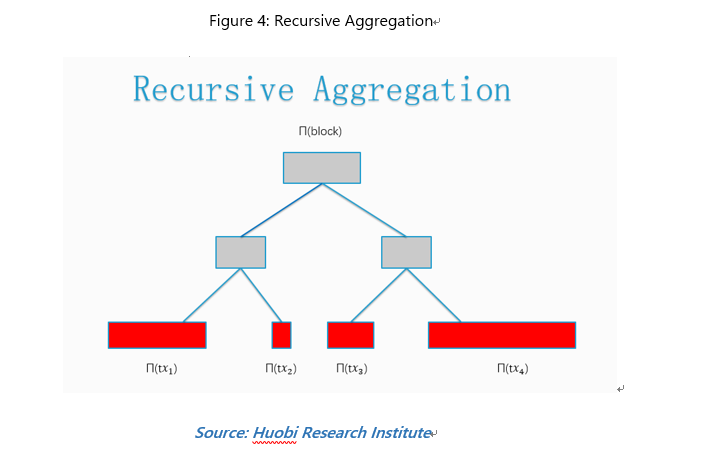
To enhance verification efficiency, EVM added Recursive Aggregation. Through Recursive Aggregation, those proofs, which originally must undergo the verification process separately, only need to be transformed a binary tree as root proof and verified; it is sufficient enough to verify that all proofs from leaf nodes are correct. Thus, verification efficiency is elevated.
As mentioned above, Zero Knowledge Proof friendly tech track employs the method of recreating a set of opcode to support Zero Knowledge Proof, which is much less impracticable that ZkSync 2.0 might be the first mature product in the market. Matter Labs has already launched closed beta for zkSync 2.0 that runs Uniswap V2; a trial experience to the Testnet is recommended if more relevant information is desired. The team has not announced the official schedule for the mainnet launch; it is likely that more tests must be conducted in order to confirm the security settings for this typical zkEVM.

Hermez

Hermez devoted to obtain full compatibility to Dapps of Ethereum by exploiting nativeommand set of EVM. It enables an optimized implementation from existing tools and ecosystem on Ethereum with higher security.

However, some native EVM commands are reluctant to Zero Knowledge Proof. The team alter the tough codes to some intermediary codes, micro opcode, to express the same logic that could be accepted. This kind of intermediary codes are customized and optimized; Zero Knowledge Proof is more likely to be generated in this case. Therefore, a balance is more likely to be achieved between maximizing Zero Knowledge Proof generation and optimizing compatibility of EVM, in the middle between the two tracks.

As native opcode of EVM requires executing environment, intermediary opcode is subject to a typical environment-uVM. UVM is composed by ROM and Main SM, and Main SM consists of various SM that could handle multiple functions.

Let’s dive into how Hermez produces proofs according to the program logic. A program has to be executed step by step no matter how complicated the logic is. For instance, extracting a number, completing a calculation, responding to a condition, jumping to another string, etc, the program reiterates various execution of commands until an ending condition is encountered. Although the trace, which represents the pathway of execution and number of executions, could be random, the result would be still within a certain scope of possible outcomes. That is to say, even though the program could not determine the specific route to go through, it would proceed on one of the Hermez stores these certain intermediary opcode in ROM, and configures responding codes according to different storage locations and commands characteristics, namely rom(x). During the process of program execution, a real opcode would be generated according to each operation, namely instTrace(x). Plookup algorism could be utilized in the process of verifying instTrace(x) is a subset of rom(x).
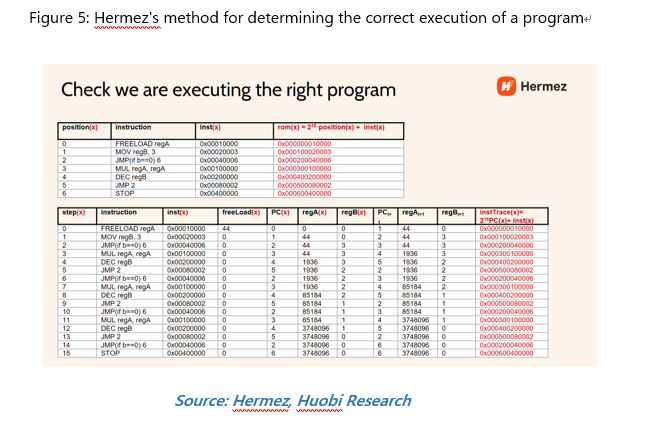
One could not identify a song if he or she could not hear the melody that belongs to the typical song. The same thing applies when identifying a program: A program is determined to be falsely executed if codes being executed are not genetically part of the program.

An assumption was made earlier by someone anonymous: It would be irrational to consider a program is correctly executed if it follows certain paths but in misplaced order. From my perspective, it is controversial to conclude the status of program execution merely by how it is executed. ZkEVM need, and only need to verify the exact codes of smart contract to be executed on Layer 2. Other possible glitch or the order of codes execution should not be part of zkEVM verification; developers who write and deploy the smart contract should be concerned.

In terms of proving the consistency of storage, Hermez utilize the prove of correlation for key-values. Compared to Applied ZKP, Hermez introduced Hash and Merkle Tree; a considerable amount of hash computations exist. However, the consumption for generating Zero Knowledge Proof by Hashing could be enormous, Hermez has not declared any official treatments in this case. From my own perspective, and consistent with the logic mentioned earlier this article, as long as the fixed logic is executed and verified, the degree of completion is entirely beyond concern.

The next proofs from SM could be integrated as a whole to be sent and verified by the verifiers.

Last but not least, Hermez employs a large amount of polynomial promises: the proof being generated is zk-STARK instead of zk-SNARK. Zk-STARK constitute a large proportion of storage, deviating from the principle that Rollup is born to minimize the amount of data submitted to Layer 1. As a result, Hermez proposed that a proof could be synthesized for a typical proof: A STARK proof could be generated first, PLONK or Groth 16 coule then come to play the role in synthesizing a shorter proof. It is commensurate with two separated compilation that directly reduce the consumption of the verifier and save unnecessary occupation of Layer 1 storage, achieving the function of scaling.

Hermez team prepares to launch Testnet in Q4 2021, and Mainnet in Q2 2022. Stay

AppliedZKP

Except zkSync 2.0 and Hermez, the construction of the “overpass” cannot be whole without AppliedZKP. An interesting topic is first spotted on AppliedZKP: Bus Mapping.

The inherent logic of Bus Mapping is to deal with storage and computation independently. When corresponding data is correctly read by a group of codes, executed in a preset order and intervened the account status, it would be considered as an effective execution. They categorized proof to “Status Proof” and “EVM Proof”. “Status Proof” is the final outcome that operations of status/storage/stacks are correctly executed, while EVM confirms the correct codes are executed within certain time range. With these two proofs in appearance, Ethereum Mainnet would be capable of authenticating whether programs are being executed on Layer 2.

To be more specific, “Status Proof” must match the status of operations related to storage completed in the EVM. An EVM storage is composed by 3 parts: Storage, Memory and Stack. “Status Proof” has to provide proof to each part respectively. Bus Mapping plays a role as a gateway transporting data between computation module and storage module. “Status Proof” would be the one to communicate with the computation module that data transported in Bus Mapping is consistent with that in the storage module.
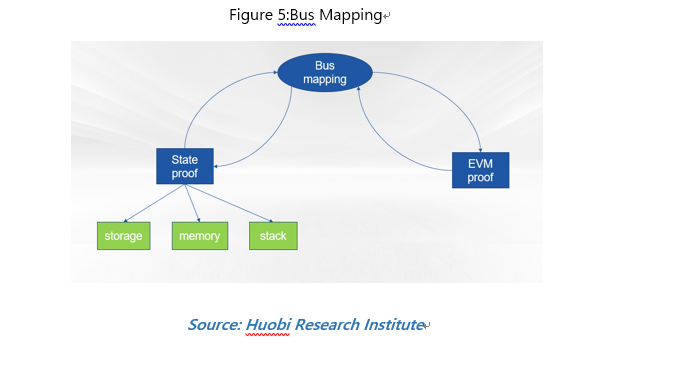
The reflection of Bus Mapping includes two operations according to status. One is to read the old status, the other is to rewrite a new status. Storage status (applicable for Storage, Memory and Stack) is organized by sorts of key-values , a confirmation of receiving the correct data is equal to a confirmation that data transported by Bus Mapping match the data in storage status. Furthermore, plookup algorism would be employed to verify that the keys and values transported by Bus Mapping are inside the source being read; keys and values match each other. Thus, plookup finishes the verification process, in other words, academically, a relationship of subset between two data sets is confirmed.

Plookup first transforms the proof of bit operation to the verification that if input and output match the default setting in the lookup table, and then to the summary of whether the group of vectors is inclusive of another. By doing so, the number of Gate Constraints could be reduced, therefore efficiency levels up.

Proof of EVM need to confirm every single operation in the program, including calculation (plus, minus, multiplication and division), logic operation (“and” , “or” and “not”), program redirect (call), etc.. Each step requires to undergo an entire process of realizing opcode, defining constraints and EVM execution result, confirming elements of execution step in order to complete the EVM circuit.

Summary and Expectations

For Ethereum, the well-known “highway”, ZK Rollup has increased total transaction volume over 500 times, boosting TPS to 2000, which is on the par with current VISA payment system. After vast development of ZKEVM, ZK Rollup would be capable of handling more cases and providing comprehensive support for various applications, thus stands out to be a pioneer in the Rollup market.

Pressure of traffic on Ethereum could be enormously alleviated thanks to faster transportation of data. On one hand, in this case, Ethereum stands a better chance in the fierce competition of newly emerged public chains, such as Solana, Avalanche, Fantom, etc.. As a result, these public chains lost comparative advantage in terms of performance so that they have to differentiate from each other and employ more innovative strategies in order to attract users and grow their ecosystem. On the other hand, more newly launched projects could deploy on Ethereum with a lower cost and still benefit from the mature and powerful Ethereum ecosystem. In all, ZKEVM is the key. We believe that the development of technology would eventually make everything mentioned above true. Perhaps, the discussion of ZKEVM should not be in the scale of “whether ZKEVM would come” any more, but “when ZKEVM would come” instead.

Besides, ZKEVM is not the finish line of Rollup. The future of Rollup could way beyond our imagination rather than a temporary transition. According to Vitalik, for Ethereum, Rollups are more than likely to be the sole scalable solution without trust in the short run, or even long term. The volume of Rollup could be optimized by the reduction of gas fee for the calldata part in the block, cutting more than 5 times cost down, which is less than 1% of that in Layer 1; when Sharding is successful, scalability of Rollup could be amplified exponentially that further curtails the transaction fee to negligibly low.

Rollup could prevail among all public chains other than Ethereum. A newly developed district would be sparsely populated because very few could perceive and embrace the advanced philosophy of design; traffic jam might not be an issue at this time. So are the public chains. However, traffic would be eventually accumulated to a certain level that may cause traffic jam, an “overpass” is necessary sooner or later to sooth the situation. Rollup remains indispensable considering possible consequences that may appear in the future, and ZKEVM would play a vital role in the challenges yet to come.

Bacaan Terkait

Berhenti Fokus pada GPU, Intel Lemparkan Gerakan Besar, Bisakah Mengakhiri Monopoli Komputasi NVIDIA?

Dalam dua tahun terakhir, GPU telah menjadi pusat perangkat keras AI, mendorong dominasi Nvidia. Namun, di COMPUTEX 2026, Intel menyajikan perspektif berbeda: **era AI selanjutnya tidak boleh hanya berfokus pada GPU**. Kuncinya adalah **Agentic AI (agen cerdas)**. Agen cerdas mengubah paradigma komputasi dari sistem tanya-jawab menjadi entitas yang aktif "berpikir, merencanakan, bertindak, dan merefleksikan" dalam alur kerja nyata. Pergeseran ini akan **membentuk ulang alokasi komputasi di pusat data**. Untuk beban kerja pelatihan model, rasio CPU:GPU bisa mencapai 1:8, tetapi untuk inferensi agen cerdas yang membutuhkan pengaturan tugas, pemanggilan alat, dan koordinasi sistem, rasio tersebut bergerak menuju 1:1 atau bahkan membutuhkan kepadatan CPU lebih tinggi. Intel meluncurkan **prosesor Xeon 6+** berbasis proses 18A, dengan hingga 288 core efisiensi dan 576MB cache L3, dirancang untuk beban kerja cloud-native, Agentic AI, dan jaringan yang padat. Solusi rak yang ditawarkan menawarkan efisiensi energi lebih tinggi. Lebih lanjut, Intel memperkenalkan **arsitektur inferensi terpisah (fully decoupled inference)** bekerja sama dengan mitra seperti SambaNova. Skema ini membagi tugas inferensi agen cerdas di antara CPU Xeon 6 (untuk pengaturan), SambaNova SN40 RDU (dekode), dan GPU NVIDIA Blackwell (prefill), sehingga setiap tahap berjalan pada perangkat keras paling optimal. Di sisi *edge*, **prosesor Core Ultra Gen 3** menjadi inti AI lokal, memungkinkan alokasi beban kerja dinamis antara perangkat dan cloud untuk mengurangi biaya, latensi, dan meningkatkan privasi. Intel juga memperluasnya ke *gaming handheld* dan komputasi tepi. Strategi Intel melampaui prosesor umum. Perusahaan menekankan **chip khusus/custom** melalui kolaborasi dengan pelanggan seperti Google (untuk IPU) dan Ericsson, menawarkan solusi yang disesuaikan untuk kinerja dan efisiensi maksimal. Intel bertujuan untuk menjadi **"ada di mana-mana"** dengan memenuhi beragam kebutuhan di seluruh rantai AI – dari pengaturan agen di pusat data, inferensi terpisah, AI lokal di PC, hingga chip khusus untuk berbagai industri. Tantangan tetap ada dari dominasi Nvidia dan persaingan AMD, tetapi Intel melihat peluang dalam **periode redistribusi infrastruktur AI** di mana efisiensi sistem secara keseluruhan, bukan hanya kinerja puncak chip tunggal, menjadi kunci.

marsbit1j yang lalu

Berhenti Fokus pada GPU, Intel Lemparkan Gerakan Besar, Bisakah Mengakhiri Monopoli Komputasi NVIDIA?

marsbit1j yang lalu

Jembatan Cross-Chain Berubah Aktif, LI.FI Gunakan Arsitektur Intensi untuk Menjadi Pusat Likuiditas Institusi TradFi

**LI.FI Beradaptasi: Dari Jembatan Lintas Rantai ke Pusat Likuiditas untuk Institusi TradFi dengan Arsitektur Intents** Saat aset TradFi seperti pembayaran stablecoin dan RWA mulai berintegrasi dengan ekosistem on-chain, LI.FI, sebuah protokol jembatan lintas rantai, tidak tinggal diam. Menghadapi penurunan volume transaksi di sektor jembatan dan likuiditas pasar yang menyusut, LI.FI secara aktif mencari peran baru. Memanfaatkan pendanaan segar, LI.FI memperluas layanannya. Mereka meluncurkan **LI.FI Intents**, sebuah arsitektur eksekusi berbasis *intent* yang menargetkan perusahaan fintech, *neo-bank*, dompet digital, dan institusi keuangan terdaftar. Produk ini bertujuan menjadi lapisan eksekusi dasar untuk pembayaran stablecoin, RWA, dan likuiditas on-chain yang sesuai regulasi. LI.FI Intents menawarkan: * **Kemudahan Penggunaan:** Mengotomatiskan proses kompleks seperti manajemen gas dan langkah-langkah teknis blockchain, memungkinkan pertukaran stablecoin lintas rantai yang presisi. * **Kepatuhan (Kunci Utama):** Jaringannya terdiri dari entitas terverifikasi. Institusi dapat menyetujui pesanan secara individual dan memilih sistem pemrosesan yang tepercaya. Semua dompet yang berinteraksi diperiksa sesuai daftar OFAC AS. * **Cakupan Ekosistem Luas:** Mendukung jaringan utama seperti EVM, Solana, dan Tron. Intinya, LI.FI beralih dari sekadar "protokol transmisi likuiditas" menjadi penyedia layanan otomatis tingkat perusahaan. Dengan LI.FI Intents, pengguna institusional hanya perlu menetapkan tujuan akhir (*intent*), sementara sistem yang efisien dan sesuai regulasi akan menangani seluruh proses eksekusinya.

Odaily星球日报1j yang lalu

Jembatan Cross-Chain Berubah Aktif, LI.FI Gunakan Arsitektur Intensi untuk Menjadi Pusat Likuiditas Institusi TradFi

Odaily星球日报1j yang lalu

"Xiaomei" dan Yuanbao Saling Terhubung, Ini Sinyal Uji Coba untuk Smart Agent WeChat?

**Ringkasan:** Artikel ini membahas kemitraan antara asisten AI Meituan, "Xiaomei," dan asisten AI Tencent, "Yuanbao." Kolaborasi ini, yang memungkinkan pengguna Yuanbao mengakses layanan hidup lokal Meituan, dilihat sebagai strategi saling menguntungkan: Meituan mendapatkan akses ke pintu masuk AI baru, sedangkan Yuanbao memperkaya kemampuan layanannya. Kerja sama ini juga dianggap sebagai "tes tekanan" untuk persiapan peluncuran "WeChat Agent" Tencent, asisten AI terintegrasi di WeChat yang dapat menjalankan jutaan mini-program. Keberhasilan kemitraan Meituan-Yuanbao dapat menentukan kesediaan platform besar lain untuk bergabung dengan ekosistem WeChat Agent. Artikel ini menyoroti tantangan yang dihadapi Meituan dari AI asisten seperti Doubao (ByteDance) dan Qianwen (Alibaba), yang mengintegrasikan layanan mereka sendiri dan berpotensi melewati "parit pertahanan" Meituan. Sementara itu, Yuanbao, meskipun terintegrasi dengan ekosistem Tencent, tertinggal dalam hal pengguna aktif dan kurangnya ekosistem layanan komersial mandiri, sehingga kemitraan dengan Meituan menjadi penting. Tantangan utama kolaborasi ini meliputi: batasan pengalaman pengguna karena arsitektur "Agent to Agent" yang terpisah, pembagian keuntungan, dan kelancaran pengalaman pengguna di antara dua platform yang berbeda. Namun, jika berhasil, ini dapat membuka jalan bagi model kolaborasi serupa di ekosistem WeChat Agent di masa depan.

marsbit2j yang lalu

"Xiaomei" dan Yuanbao Saling Terhubung, Ini Sinyal Uji Coba untuk Smart Agent WeChat?

marsbit2j yang lalu

Trading

Spot
Futures

Artikel Populer

Apa Itu ETH 2.0

ETH 2.0: Era Baru untuk Ethereum Pendahuluan ETH 2.0, yang dikenal luas sebagai Ethereum 2.0, menandai peningkatan monumental pada blockchain Ethereum. Transisi ini bukan sekadar tampilan baru; tujuannya adalah untuk secara fundamental meningkatkan skalabilitas, keamanan, dan keberlanjutan jaringan. Dengan peralihan dari mekanisme konsensus Proof of Work (PoW) yang mengkonsumsi energi tinggi ke Proof of Stake (PoS) yang lebih efisien, ETH 2.0 menjanjikan pendekatan transformasional terhadap ekosistem blockchain. Apa itu ETH 2.0? ETH 2.0 adalah kumpulan pembaruan yang berbeda dan saling terhubung yang fokus pada pengoptimalan kemampuan dan kinerja Ethereum. Perombakan ini dirancang untuk mengatasi tantangan kritis yang dihadapi mekanisme Ethereum yang ada, khususnya terkait dengan kecepatan transaksi dan kemacetan jaringan. Tujuan ETH 2.0 Tujuan utama dari ETH 2.0 berputar di sekitar perbaikan tiga aspek inti: Skalabilitas: Bertujuan untuk secara signifikan meningkatkan jumlah transaksi yang dapat ditangani jaringan per detik, ETH 2.0 berusaha untuk melampaui batasan saat ini yang kira-kira 15 transaksi per detik, berpotensi mencapai ribuan. Keamanan: Langkah-langkah keamanan yang diperkuat merupakan bagian integral dari ETH 2.0, terutama melalui peningkatan ketahanan terhadap serangan siber dan pelestarian etos terdesentralisasi Ethereum. Keberlanjutan: Mekanisme PoS yang baru dirancang tidak hanya untuk meningkatkan efisiensi tetapi juga untuk secara drastis mengurangi konsumsi energi, menyelaraskan kerangka operasional Ethereum dengan pertimbangan lingkungan. Siapa Pencipta ETH 2.0? Penciptaan ETH 2.0 dapat diperkirakan dari Ethereum Foundation. Organisasi nirlaba ini, yang memainkan peran penting dalam mendukung pengembangan Ethereum, dipimpin oleh co-founder terkenal Vitalik Buterin. Visi beliau untuk Ethereum yang lebih skalabel dan berkelanjutan telah menjadi kekuatan pendorong di balik peningkatan ini, melibatkan kontribusi dari komunitas pengembang dan penggemar di seluruh dunia yang berdedikasi untuk meningkatkan protokol. Siapa Investor ETH 2.0? Sementara rincian seputar investor untuk ETH 2.0 belum dipublikasikan, Ethereum Foundation dikenal menerima dukungan dari berbagai organisasi dan individu di ruang blockchain dan teknologi. Mitra-mitra ini mencakup perusahaan modal ventura, perusahaan teknologi, dan organisasi filantropi yang memiliki minat bersama untuk mendukung pengembangan teknologi terdesentralisasi dan infrastruktur blockchain. Bagaimana ETH 2.0 Bekerja? ETH 2.0 dikenal karena memperkenalkan serangkaian fitur kunci yang membedakannya dari pendahulunya. Proof of Stake (PoS) Peralihan ke mekanisme konsensus PoS adalah salah satu perubahan utama dari ETH 2.0. Berbeda dengan PoW, yang bergantung pada penambangan yang mengkonsumsi energi untuk verifikasi transaksi, PoS memungkinkan pengguna untuk memvalidasi transaksi dan membuat blok baru sesuai dengan jumlah ETH yang mereka pertaruhkan dalam jaringan. Ini menghasilkan efisiensi energi yang lebih baik, mengurangi konsumsi hingga sekitar 99,95%, menjadikan Ethereum 2.0 sebagai alternatif yang jauh lebih ramah lingkungan. Shard Chains Shard chains adalah inovasi kritis lainnya dari ETH 2.0. Rantai yang lebih kecil ini beroperasi secara paralel dengan rantai utama Ethereum, memungkinkan beberapa transaksi untuk diproses secara bersamaan. Pendekatan ini meningkatkan kapasitas keseluruhan jaringan, mengatasi kekhawatiran skalabilitas yang telah mengganggu Ethereum. Beacon Chain Di inti ETH 2.0 adalah Beacon Chain, yang mengoordinasikan jaringan dan mengelola protokol PoS. Ini berfungsi sebagai semacam organisasi: ia mengawasi para validator, memastikan bahwa shard tetap terhubung ke jaringan, dan memantau kesehatan keseluruhan ekosistem blockchain. Jadwal ETH 2.0 Perjalanan ETH 2.0 telah ditandai oleh beberapa tonggak kunci yang menggambarkan evolusi peningkatan signifikan ini: Desember 2020: Peluncuran Beacon Chain menandai pengenalan PoS, mempersiapkan jalan untuk migrasi ke ETH 2.0. September 2022: Penyelesaian dari “The Merge” merupakan momen penting di mana jaringan Ethereum berhasil beralih dari kerangka PoW ke PoS, menyambut era baru untuk Ethereum. 2023: Peluncuran yang diharapkan dari shard chains bertujuan untuk lebih meningkatkan skalabilitas jaringan Ethereum, mengukuhkan ETH 2.0 sebagai platform yang kuat untuk aplikasi dan layanan terdesentralisasi. Fitur Kunci dan Manfaat Skalabilitas yang Ditingkatkan Salah satu keuntungan paling signifikan dari ETH 2.0 adalah skalabilitasnya yang ditingkatkan. Kombinasi PoS dan shard chains memungkinkan jaringan untuk memperluas kapasitasnya, memungkinkan untuk menampung volume transaksi yang jauh lebih besar dibandingkan dengan sistem lama. Efisiensi Energi Implementasi PoS merupakan langkah besar menuju efisiensi energi dalam teknologi blockchain. Dengan secara drastis mengurangi konsumsi energi, ETH 2.0 tidak hanya mengurangi biaya operasional tetapi juga lebih selaras dengan tujuan keberlanjutan global. Keamanan yang Ditingkatkan Mekanisme yang diperbarui ETH 2.0 berkontribusi pada peningkatan keamanan di seluruh jaringan. Penerapan PoS, bersamaan dengan langkah pengendalian inovatif yang ditetapkan melalui shard chains dan Beacon Chain, memastikan tingkat perlindungan yang lebih tinggi terhadap potensi ancaman. Biaya yang Lebih Rendah bagi Pengguna Seiring dengan perbaikan skalabilitas, efek pada biaya transaksi juga akan terlihat. Peningkatan kapasitas dan pengurangan kemacetan diharapkan dapat diterjemahkan menjadi biaya yang lebih rendah bagi pengguna, membuat Ethereum lebih mudah diakses untuk transaksi sehari-hari. Kesimpulan ETH 2.0 menandai evolusi signifikan dalam ekosistem blockchain Ethereum. Saat ini menangani isu-isu penting seperti skalabilitas, konsumsi energi, efisiensi transaksi, dan keamanan secara keseluruhan, pentingnya peningkatan ini tidak dapat diabaikan. Peralihan ke Proof of Stake, pengkenalan shard chains, dan kerja dasar dari Beacon Chain menunjukkan masa depan di mana Ethereum dapat memenuhi permintaan yang meningkat dari pasar terdesentralisasi. Dalam industri yang didorong oleh inovasi dan kemajuan, ETH 2.0 berdiri sebagai bukti kemampuan teknologi blockchain dalam membuka jalan menuju ekonomi digital yang lebih berkelanjutan dan efisien.

235 Total TayanganDipublikasikan pada 2024.04.04Diperbarui pada 2024.12.03

Apa Itu ETH 2.0

Apa Itu ETH 3.0

ETH3.0 dan $eth 3.0: Sebuah Pemeriksaan Mendalam tentang Masa Depan Ethereum Pendahuluan Dalam lanskap cryptocurrency dan teknologi blockchain yang berkembang pesat, ETH3.0, yang sering disingkat sebagai $eth 3.0, telah muncul sebagai topik yang menarik perhatian dan spekulasi. Istilah ini mencakup dua konsep utama yang perlu dijelaskan: Ethereum 3.0: Ini mewakili upgrade potensial di masa depan yang bertujuan untuk meningkatkan kemampuan blockchain Ethereum yang ada, khususnya fokus pada peningkatan skalabilitas dan kinerja. ETH3.0 Meme Token: Proyek cryptocurrency yang berbeda ini berusaha memanfaatkan blockchain Ethereum untuk menciptakan ekosistem yang berfokus pada meme, mempromosikan keterlibatan dalam komunitas cryptocurrency. Memahami aspek-aspek ini dari ETH3.0 sangat penting tidak hanya untuk para penggemar crypto tetapi juga bagi mereka yang mengamati tren teknologi yang lebih luas di ruang digital. Apa itu ETH3.0? Ethereum 3.0 Ethereum 3.0 dianggap sebagai upgrade yang diusulkan untuk jaringan Ethereum yang sudah ada, yang telah menjadi tulang punggung banyak aplikasi terdesentralisasi (dApps) dan kontrak pintar sejak berdirinya. Peningkatan yang dibayangkan terutama berkonsentrasi pada skalabilitas—mengintegrasikan teknologi canggih seperti sharding dan zero-knowledge proofs (zk-proofs). Inovasi teknologi ini bertujuan untuk memfasilitasi jumlah transaksi per detik (TPS) yang belum pernah terjadi sebelumnya, yang berpotensi mencapai jutaan, sehingga mengatasi salah satu batasan paling signifikan yang dihadapi oleh teknologi blockchain saat ini. Peningkatan ini tidak hanya bersifat teknis tetapi juga strategis; ini bertujuan untuk mempersiapkan jaringan Ethereum untuk adopsi dan utilitas yang luas dalam masa depan yang ditandai dengan meningkatnya permintaan akan solusi terdesentralisasi. ETH3.0 Meme Token Berbeda dengan Ethereum 3.0, ETH3.0 Meme Token menjelajahi domain yang lebih ringan dan lebih bermain dengan menggabungkan budaya meme internet dengan dinamika cryptocurrency. Proyek ini memungkinkan pengguna untuk membeli, menjual, dan memperdagangkan meme di blockchain Ethereum, menyediakan platform yang mendorong keterlibatan komunitas melalui kreativitas dan minat bersama. ETH3.0 Meme Token bertujuan untuk menunjukkan bagaimana teknologi blockchain dapat berinteraksi dengan budaya digital, menciptakan kasus penggunaan yang menghibur dan finansial yang layak. Siapa Pencipta ETH3.0? Ethereum 3.0 Inisiatif menuju Ethereum 3.0 sebagian besar didorong oleh konsorsium pengembang dan peneliti dalam komunitas Ethereum, yang mencakup Justin Drake. Dikenal karena pandangannya dan kontribusinya terhadap evolusi Ethereum, Drake telah menjadi tokoh terkemuka dalam diskusi tentang transisi Ethereum ke lapisan konsensus baru, yang disebut sebagai “Beam Chain.” Pendekatan kolaboratif dalam pengembangan ini menunjukkan bahwa Ethereum 3.0 bukanlah produk dari satu pencipta tetapi merupakan manifestasi dari kecerdasan kolektif yang terfokus pada kemajuan teknologi blockchain. ETH3.0 Meme Token Detail mengenai pencipta ETH3.0 Meme Token saat ini tidak dapat dilacak. Sifat token meme sering kali mengarah pada struktur yang lebih terdesentralisasi dan didorong oleh komunitas, yang dapat menjelaskan kurangnya atribusi spesifik. Ini sejalan dengan ethos komunitas crypto yang lebih luas, di mana inovasi sering kali muncul dari upaya kolaboratif daripada individu. Siapa Investor ETH3.0? Ethereum 3.0 Dukungan untuk Ethereum 3.0 sebagian besar berasal dari Yayasan Ethereum bersama dengan komunitas pengembang dan investor yang antusias. Asosiasi dasar ini memberikan derajat legitimasi yang signifikan dan meningkatkan prospek implementasi yang sukses karena memanfaatkan kepercayaan dan kredibilitas yang dibangun selama bertahun-tahun operasi jaringan. Dalam iklim cryptocurrency yang berubah cepat, dukungan komunitas memainkan peran penting dalam mendorong pengembangan dan adopsi, memposisikan Ethereum 3.0 sebagai pesaing serius untuk kemajuan blockchain di masa depan. ETH3.0 Meme Token Sementara sumber yang tersedia saat ini tidak memberikan informasi eksplisit mengenai dasar investasi atau organisasi yang mendukung ETH3.0 Meme Token, ini mencerminkan model pendanaan tipikal untuk token meme, yang sering kali bergantung pada dukungan akar rumput dan keterlibatan komunitas. Investor dalam proyek semacam itu biasanya terdiri dari individu yang termotivasi oleh potensi inovasi yang didorong oleh komunitas dan semangat kerjasama yang terdapat dalam komunitas crypto. Bagaimana ETH3.0 Bekerja? Ethereum 3.0 Fitur pembeda dari Ethereum 3.0 terletak pada implementasi yang diusulkan dari sharding dan teknologi zk-proof. Sharding adalah metode untuk membagi blockchain menjadi bagian-bagian yang lebih kecil dan dapat dikelola atau “shards,” yang dapat memproses transaksi secara bersamaan daripada secara berurutan. Desentralisasi pemrosesan ini membantu mencegah kemacetan dan memastikan jaringan tetap responsif bahkan di bawah beban berat. Teknologi zero-knowledge proof (zk-proof) memberikan lapisan kecanggihan lain dengan memungkinkan validasi transaksi tanpa mengungkapkan data mendasar yang terlibat. Aspek ini tidak hanya meningkatkan privasi tetapi juga meningkatkan efisiensi keseluruhan jaringan. Ada juga pembicaraan tentang memasukkan Ethereum Virtual Machine zero-knowledge (zkEVM) dalam upgrade ini, yang lebih memperkuat kemampuan dan utilitas jaringan. ETH3.0 Meme Token ETH3.0 Meme Token membedakan dirinya dengan memanfaatkan popularitas budaya meme. Ini mendirikan pasar bagi pengguna untuk terlibat dalam perdagangan meme, tidak hanya untuk hiburan tetapi juga untuk potensi keuntungan ekonomi. Dengan mengintegrasikan fitur seperti staking, penyediaan likuiditas, dan mekanisme tata kelola, proyek ini menciptakan lingkungan yang mendorong interaksi dan partisipasi komunitas. Dengan menawarkan perpaduan unik antara hiburan dan kesempatan ekonomi, ETH3.0 Meme Token bertujuan untuk menarik audiens yang beragam, mulai dari penggemar crypto hingga penggemar meme kasual. Garis Waktu ETH3.0 Ethereum 3.0 11 November 2024: Justin Drake memberi sinyal tentang upgrade ETH 3.0 yang akan datang, yang berpusat pada peningkatan skalabilitas. Pengumuman ini menandai awal diskusi formal mengenai arsitektur masa depan Ethereum. 12 November 2024: Proposal yang diantisipasi untuk Ethereum 3.0 diharapkan akan diungkapkan di Devcon di Bangkok, menetapkan panggung untuk umpan balik komunitas yang lebih luas dan langkah-langkah selanjutnya dalam pengembangan. ETH3.0 Meme Token 21 Maret 2024: ETH3.0 Meme Token resmi terdaftar di CoinMarketCap, menandai langkahnya ke domain crypto publik dan meningkatkan visibilitas bagi ekosistem yang berbasis meme. Poin Kunci Sebagai kesimpulan, Ethereum 3.0 mewakili evolusi signifikan dalam jaringan Ethereum, yang fokus pada mengatasi batasan terkait skalabilitas dan kinerja melalui teknologi canggih. Upgrade yang diusulkan mencerminkan pendekatan proaktif terhadap permintaan dan kegunaan di masa depan. Di sisi lain, ETH3.0 Meme Token mencerminkan esensi budaya yang dipimpin komunitas di ruang cryptocurrency, memanfaatkan budaya meme untuk menciptakan platform yang menarik yang mendorong kreativitas dan partisipasi pengguna. Memahami tujuan dan fungsi berbeda dari ETH3.0 dan $eth 3.0 sangat penting bagi siapa saja yang tertarik dengan perkembangan yang sedang berlangsung dalam ruang crypto. Dengan kedua inisiatif yang membuka jalan yang unik, mereka secara kolektif menggarisbawahi sifat dinamis dan multi-faceted dari inovasi blockchain.

209 Total TayanganDipublikasikan pada 2024.04.04Diperbarui pada 2024.12.03

Apa Itu ETH 3.0

Cara Membeli ETH

Selamat datang di HTX.com! Kami telah membuat pembelian Ethereum (ETH) menjadi mudah dan nyaman. Ikuti panduan langkah demi langkah kami untuk memulai perjalanan kripto Anda.Langkah 1: Buat Akun HTX AndaGunakan alamat email atau nomor ponsel Anda untuk mendaftar akun gratis di HTX. Rasakan perjalanan pendaftaran yang mudah dan buka semua fitur.Dapatkan Akun SayaLangkah 2: Buka Beli Kripto, lalu Pilih Metode Pembayaran AndaKartu Kredit/Debit: Gunakan Visa atau Mastercard Anda untuk membeli Ethereum (ETH) secara instan.Saldo: Gunakan dana dari saldo akun HTX Anda untuk melakukan trading dengan lancar.Pihak Ketiga: Kami telah menambahkan metode pembayaran populer seperti Google Pay dan Apple Pay untuk meningkatkan kenyamanan.P2P: Lakukan trading langsung dengan pengguna lain di HTX.Over-the-Counter (OTC): Kami menawarkan layanan yang dibuat khusus dan kurs yang kompetitif bagi para trader.Langkah 3: Simpan Ethereum (ETH) AndaSetelah melakukan pembelian, simpan Ethereum (ETH) di akun HTX Anda. Selain itu, Anda dapat mengirimkannya ke tempat lain melalui transfer blockchain atau menggunakannya untuk memperdagangkan mata uang kripto lainnya.Langkah 4: Lakukan trading Ethereum (ETH)Lakukan trading Ethereum (ETH) dengan mudah di pasar spot HTX. Cukup akses akun Anda, pilih pasangan perdagangan, jalankan trading, lalu pantau secara real-time. Kami menawarkan pengalaman yang ramah pengguna baik untuk pemula maupun trader berpengalaman.

5.5k Total TayanganDipublikasikan pada 2024.12.10Diperbarui pada 2026.06.02

Cara Membeli ETH

Diskusi

Selamat datang di Komunitas HTX. Di sini, Anda bisa terus mendapatkan informasi terbaru tentang perkembangan platform terkini dan mendapatkan akses ke wawasan pasar profesional. Pendapat pengguna mengenai harga ETH (ETH) disajikan di bawah ini.

活动图片