Editor's Note: Stablecoins, on-chain payments, and AI are simultaneously transforming the financial system. On one hand, fund flows have become faster and more transparent; on the other, the combination of public ledgers, address labeling, and AI analysis tools makes account balances, transaction counterparts, and business relationships easier to track continuously.
Against this backdrop, Grayscale Research brings Zcash back into investors' view. The focus is not on "whether privacy coins are experiencing a new round of hype," but on a more fundamental question: as the traceability of digital finance continues to increase, will privacy remain a niche demand, or will it re-emerge as a core attribute of money?
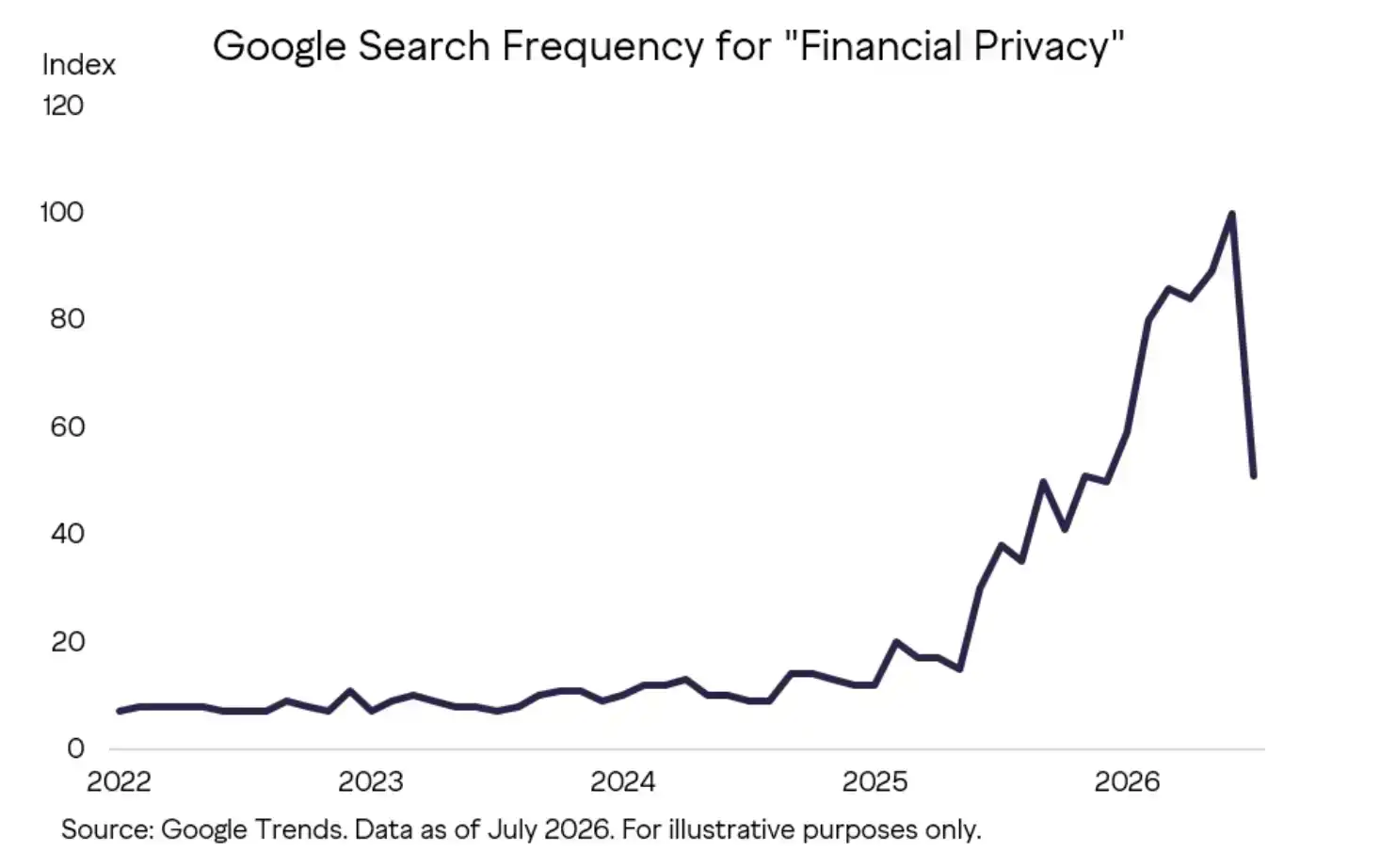
Grayscale believes that the development of stablecoins, public blockchains, and AI analysis tools is pushing financial privacy back into public discourse.
Grayscale researcher Michael Zhao argues in the report that AI may drive financial privacy into its third wave of attention cycles, following bank digitization and internet popularization. Zcash has been operational for nearly a decade, with recent improvements in shielded transactions, wallets, and mining infrastructure, yet its market share remains low. If the market begins to reprice privacy, ZEC could undergo a valuation reassessment.
This remains an investment thesis with a clear stance. Whether AI will significantly increase demand for privacy-focused currencies, whether shielding functionality can translate into sustained usage, and whether trading platforms and regulators are willing to support such assets have yet to be validated. Zcash's opportunity and risk precisely stem from this significant gap.
The following is the translated original text:
Financial privacy is not an add-on feature of money; it is part of what makes money usable.
Cash inherently possesses this attribute: transactions are not, by default, publicly disclosed. In the banking system, individual accounts and fund transfers are also typically not directly accessible to the public, and law enforcement generally requires legal procedures to obtain such information.
Technological progress constantly shifts this balance. In the 1970s, the digitization of financial records and the implementation of the U.S. Bank Secrecy Act sparked a new round of discussion about financial privacy; after the popularization of the internet and online banking, the risks of data breaches and network surveillance pushed encryption, two-factor authentication, and other security tools into the mainstream.
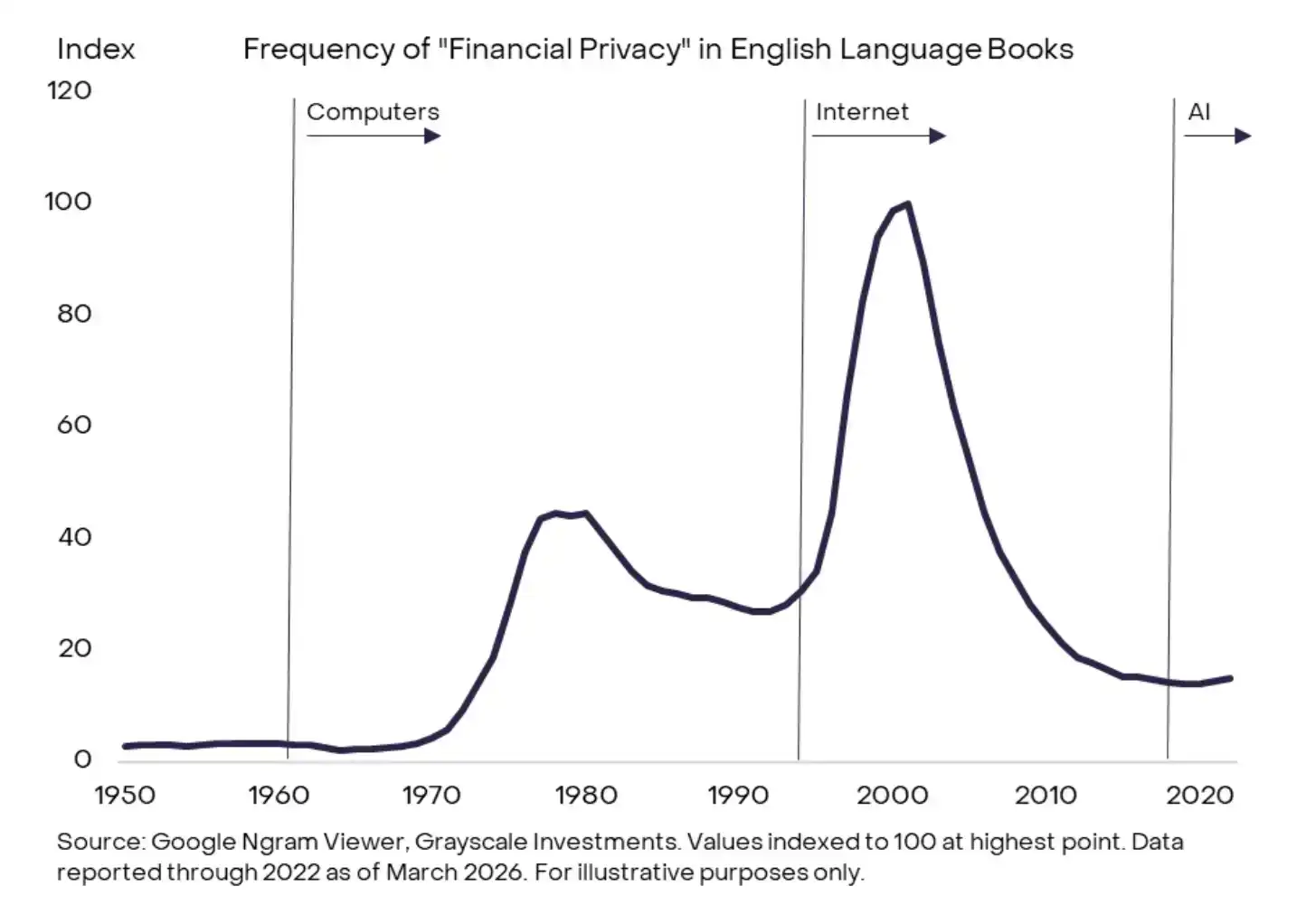
From the digitization of bank records and internet finance to AI analysis, technological advancement continuously alters the balance between privacy and traceability while improving financial efficiency.
Grayscale believes that the development of stablecoins, blockchain applications, and AI may trigger a third wave of financial privacy discussions. Especially on public blockchains, AI can combine addresses, exchange records, wallet behaviors, and counterparty information to continuously identify chain users who were originally only "pseudonymous."
Under this assessment, Zcash's value does not solely come from a cryptographic feature, but from its potential to become "private digital cash" outside of public ledgers.
Bitcoin Solved Digital Scarcity, But Not Transaction Privacy
Bitcoin established verifiable digital scarcity through public ledgers, but this transparency also limits its use in certain payment scenarios.
Balances, transaction counterparts, and historical records on public blockchains can be preserved long-term. Even if users employ addresses that don't directly display names, exchange accounts, transfer recipients, wallet operation habits, and on-chain analysis tools can gradually link them to real-world identities.
This affects not only individual users. Businesses typically don't want suppliers, salary payments, fund allocations, and customer relationships to be monitored in real-time by competitors; institutions may also be unwilling to publicize wallet structures and trading strategies. Therefore, financial privacy is not synonymous with complete anonymity; more often, it is the confidentiality required for normal business activities.
Zcash shares a similar monetary structure with Bitcoin: a total supply cap of 21 million coins, using a proof-of-work mechanism, with peer-to-peer value transfer as its primary purpose. The most important distinction is that Zcash allows users to choose whether to disclose transaction information.
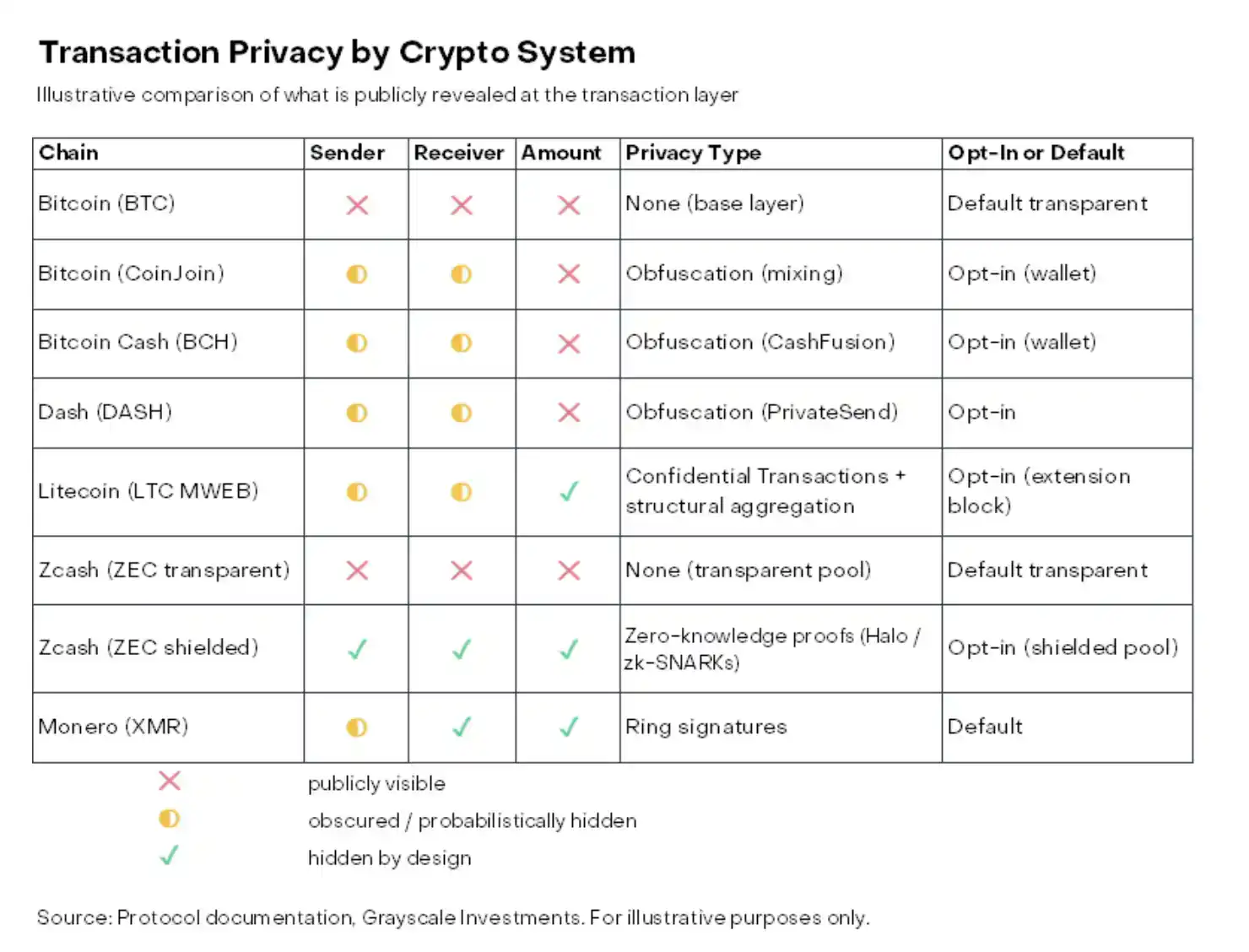
CoinJoin and other coin mixing mechanisms primarily increase transaction tracing difficulty, Monero hides key transaction information by default, while Zcash allows users to choose between transparent or shielded transactions.
Zcash supports two types of transactions:
1. Transparent Transactions: Sender, receiver, and amount are public, resembling Bitcoin's transaction model.
2. Shielded Transactions: The network can confirm the transaction's validity without disclosing the sender, receiver, or amount.
Its underlying tool is zero-knowledge proofs, meaning users can prove a transaction complies with rules without revealing the original information used for verification. The network can confirm the payer is authorized to use the funds, the amounts balance before and after the transaction, and that no new coins were created out of thin air, all without seeing the specific transaction details.
Zcash also supports selective disclosure via viewing keys. Users can open parts of their shielded transaction history to audit institutions, counterparties, or other designated third parties. Therefore, Zcash's design is not to make transactions permanently unviewable, but to transfer the right to disclose information from the public ledger back to the user.
The Technology Has Operated for a Decade; the Real Bottleneck Remains Usability
Zcash launched in 2016 and was one of the earliest projects to attempt to use zero-knowledge proofs directly in a base-layer digital currency. However, its early challenge was not whether private transactions were possible, but the high cost of using them.
Initial shielded transactions required long proof-generation times and significant memory, making smooth experiences difficult for ordinary wallets and mobile devices. Subsequent rounds of upgrades primarily focused on lowering these usage barriers:
The 2018 Sapling upgrade significantly reduced the time and memory required for shielded transactions.
The 2022 NU5 upgrade introduced the Orchard shielding protocol and Halo 2, eliminating the need for trusted setups for new shielding pools.
Unified addresses improved the interaction experience between transparent and shielded addresses.
The Zodl wallet began supporting cross-asset swaps, cross-asset receipts, and cold storage for shielded balances, attempting to allow users to maintain privacy throughout the entire transaction flow.
Mining infrastructure is also expanding. Foundry announced in March 2026 the launch of a US Zcash mining pool targeting institutions and publicly listed mining companies, providing more standardized operational and compliance support for the network.
Grayscale believes these changes may signal that Zcash is entering a new development phase. However, wallet functionality and pool expansion only indicate improved infrastructure, not direct proof of large-scale growth in end-user demand.
What's more critical next is "whether privacy can scale." Tachyon aims to reduce the computational and synchronization costs of shielded transactions; Crosslink focuses on improving transaction finality and network reliability; if shielded asset proposals are advanced again, Zcash's privacy features could extend from native ZEC to other assets.
Most of these projects still involve complex technical development and network coordination, with their timelines and actual effects not yet fully determined.
90% Shielded Transactions: Enough to Prove Real Demand?
Grayscale's core evidence comes from on-chain usage.
According to the report's methodology, as of July 20, 2026, shielded transactions accounted for approximately 90% of Zcash transaction count; the shielded pool held about 4.2 million ZEC, equivalent to roughly 25% of the circulating supply at that time.
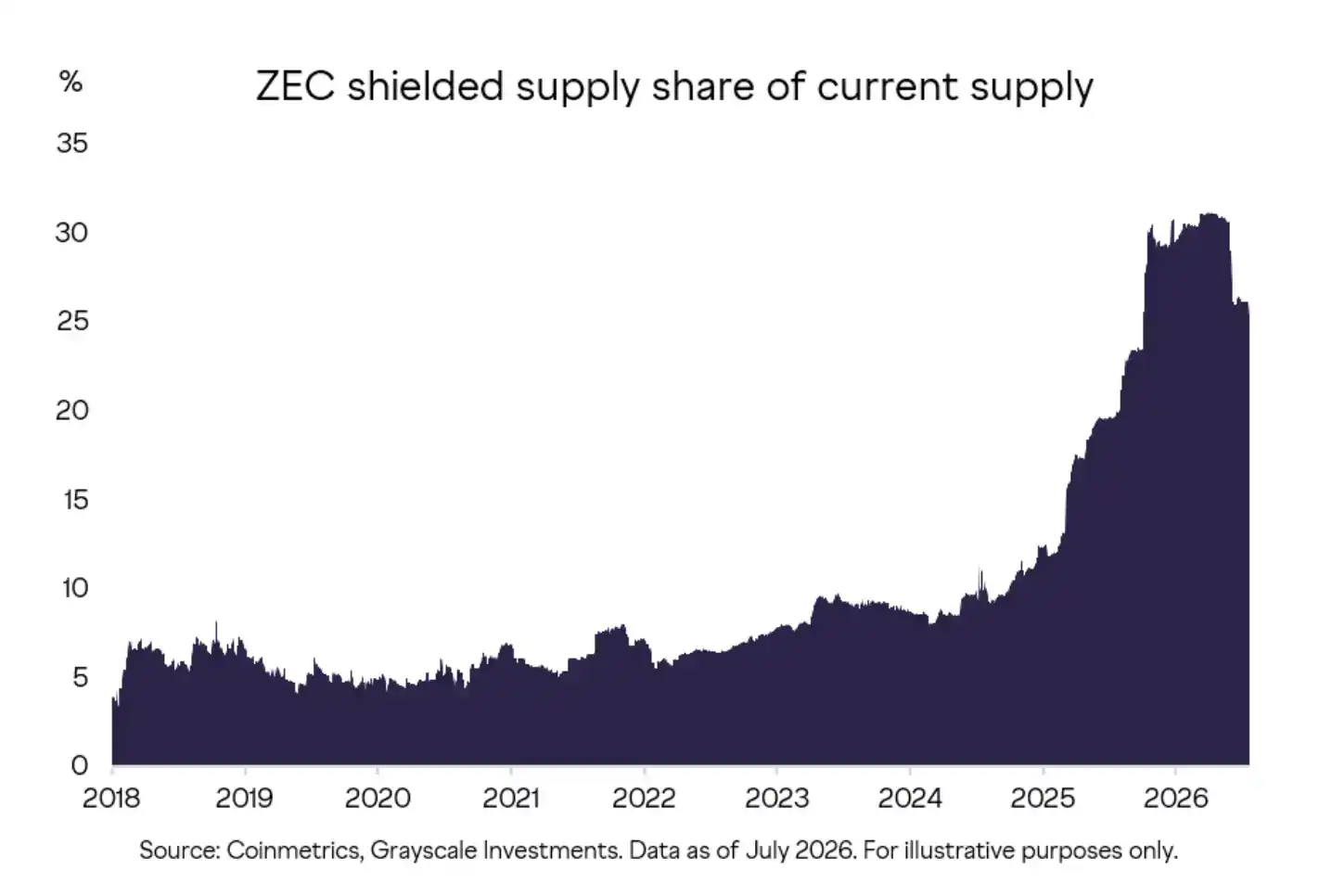
As of the statistical point used in the Grayscale report, approximately 4.2 million ZEC were in the shielded pool, representing about 25% of the circulating supply.
This indicates the shielding feature is not just a product narrative but has formed observable on-chain behavior. However, this data requires careful interpretation: different analytics platforms may have varying classification methods for "shielded transactions," statistical dates, and whether they consolidate multiple shielding pools, potentially leading to different percentages externally. An increase in shielded transaction count also does not equate to synchronous growth in user numbers, payment volume, or economic activity.
What Grayscale is truly betting on is not that Zcash has already achieved mass adoption, but that the market may change its valuation of privacy in the future. As of the July 2026 data used in the report, the total market cap of the "Digital Currency" crypto sector as defined by Grayscale was approximately $1.4 trillion, with Bitcoin comprising about 90%, and ZEC's market cap around $8 billion, accounting for about 0.6% of this sector.
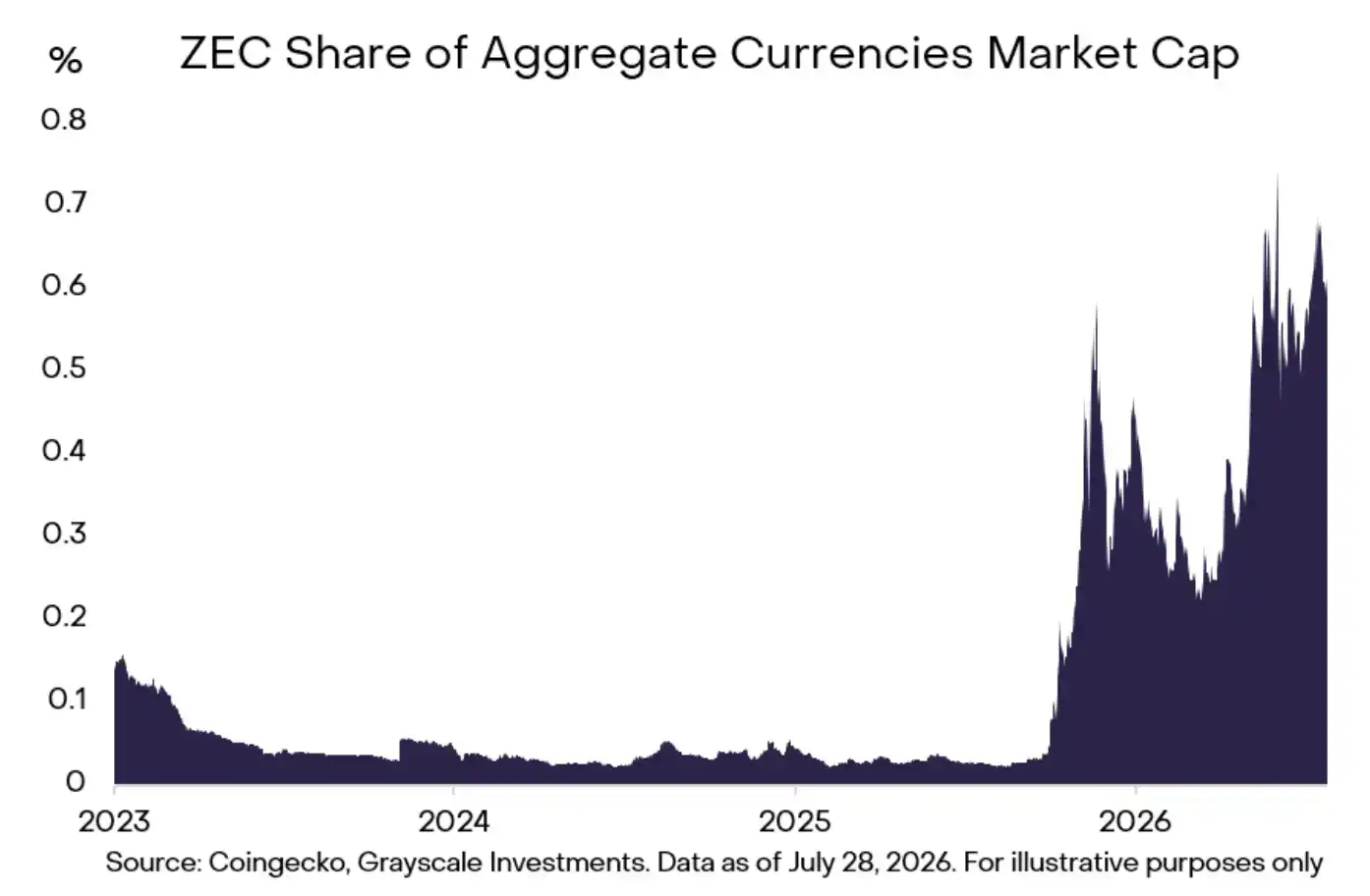
According to Grayscale's methodology, ZEC's market cap accounts for about 0.6% of the Digital Currency sector; "rising to 5% corresponds to ~9x valuation" is merely a market share scenario analysis, not a price target.
The report constructs a scenario analysis based on this: if ZEC could capture a 5% market share of this sector in the future, corresponding to a market cap of about $70 billion, that would be approximately 8.75x its market cap at the time, rounded to about 9x.
This is not a price target, nor does it represent Grayscale's prediction that ZEC will necessarily rise 9x. It is merely a sensitivity analysis based on market share changes, and it incorporates simplified assumptions such as the Digital Currency sector's total market cap remaining unchanged, and ZEC's supply and competitive landscape not undergoing major shifts.
More accurately, Grayscale believes the current valuation reflects the expectation that "privacy will remain a marginal market feature." If investors are willing in the future to view privacy as a foundational attribute of digital currency, ZEC's low market share may offer valuation elasticity.
Rising Privacy Demand Doesn't Guarantee Zcash Will Benefit
This investment thesis first faces regulatory and distribution risks.
Zcash's viewing keys can help users disclose transaction records to specific entities, providing some tools for compliance audits. However, information is still selectively released by the user, not equivalent to the default traceability of public blockchains. Simultaneously, the Financial Action Task Force (FATF) continuously requires Virtual Asset Service Providers to implement Customer Due Diligence, record-keeping, Suspicious Transaction Reporting, and the "Travel Rule."
Therefore, selective disclosure can reduce some compliance friction but cannot guarantee that exchanges, custodians, and regulatory bodies are willing to support shielded transactions. The stronger the privacy protection, the more likely ZEC may face restrictions in listing, custody, wallet integration, and fiat on/off-ramps.
The second risk comes from protocol security.
In 2026, developers discovered a soundness vulnerability in the original Orchard circuit, theoretically usable to create undetectable counterfeit ZEC. NU6.2 fixed the relevant circuit. The subsequently launched Ironwood new shielding pool further restricts funds from entering the old Orchard pool and restores the ability to verify the integrity of the shielded supply through a fund migration mechanism.
It is crucial to emphasize this was a theoretical vulnerability, not an actual discovery of ZEC counterfeiting. Ironwood improves the future security structure, but the old shielding pool and its fund migration remain a legacy risk requiring ongoing observation.
Quantum computing is a longer-term concern. The mechanisms introduced by Ironwood help preserve a recovery path for future quantum-resistant migration, but the official technical proposal clearly states this change itself does not give Zcash full quantum resistance.
Finally, there is execution risk. Zcash's investment thesis still relies on simultaneous improvements in wallet experience, protocol scaling, and ecosystem distribution. Any delay in an upgrade, coordination failure, or lack of user adoption could weaken the "privacy at scale" narrative.
The Next Step is to See if Privacy Becomes a Demand, Not Just a Topic
The bullish thesis for Zcash does not require it to replace Bitcoin. Grayscale is betting on another possibility: as on-chain fund flows become increasingly transparent and AI analysis capabilities continue to strengthen, the market may begin to pay a premium for "verifiable but not public" digital currency.
To validate this assessment, the next indicators to watch are not whether the ZEC price continues to rise, but several more specific metrics: whether shielded pool funds and real users continue to increase, whether wallets can lower the usability barrier for complete private transaction flows, whether upgrades like Tachyon proceed as planned, and whether exchanges and custodians expand rather than restrict support.
If privacy usage grows but liquidity and compliance channels continue to deteriorate, Zcash may still struggle to form a larger market. Conversely, if usage, infrastructure, and market access improve simultaneously, ZEC could transition from an "established privacy coin" to a tool for pricing digital financial privacy demand.
Zcash's current valuation gap essentially corresponds not to a confirmed growth story, but to an option that has yet to be fully validated: In the AI era, what is financial privacy really worth?