A Critical Moment for Capital? The AI Narrative Shifts from Technology to Financing, Giants' Cash Flow Dries Up, Debt Markets Sound Alarm

marsbitDipublikasikan tanggal 2026-08-17Terakhir diperbarui pada 2026-08-17

Abstrak

The narrative of AI investment is shifting from a technology story to a capital expenditure story, and now to a financing story. This marks a "critical moment for capital," as noted by Bridgewater's Greg Jensen. Morgan Stanley forecasts that the total cost of AI infrastructure through 2028 will reach $3.2 trillion, with approximately $1.75 trillion expected to be raised from credit markets. However, free cash flow projections for major hyperscale cloud providers are declining sharply, with Oracle's 2027 forecast nearing -$40 billion. The bond market is already pricing in the rising risks. Apollo data shows AI-related bonds constitute 40% of long-duration supply. Credit spreads for hyperscalers have widened significantly this year—around 25 basis points for high-quality names—while the overall investment-grade market remained flat. Oracle's credit default swaps (CDS) have surged dramatically, indicating particular market concern. Renowned bond investor Jeff Gundlach sharply criticized financing plans using AI assets like GPUs as collateral, comparing them to "issuing 30-year ABS backed by bananas" due to the assets' rapid obsolescence. Although current balance sheets for hyperscalers appear strong, the future funding gap is widening. Morgan Stanley has nearly doubled its 2027 cloud capital expenditure growth forecast to 29%, amplifying the financing challenge. Purchasing commitments have exploded to $982 billion, with significant capital expenditures now existing off-balance...

The narrative around AI investment is shifting. It began as a technology story, evolved into a capital expenditure story, and is now becoming a financing story.

Recently, Bridgewater's Greg Jensen summarized the current situation in one sentence: "We are entering a critical moment for capital."

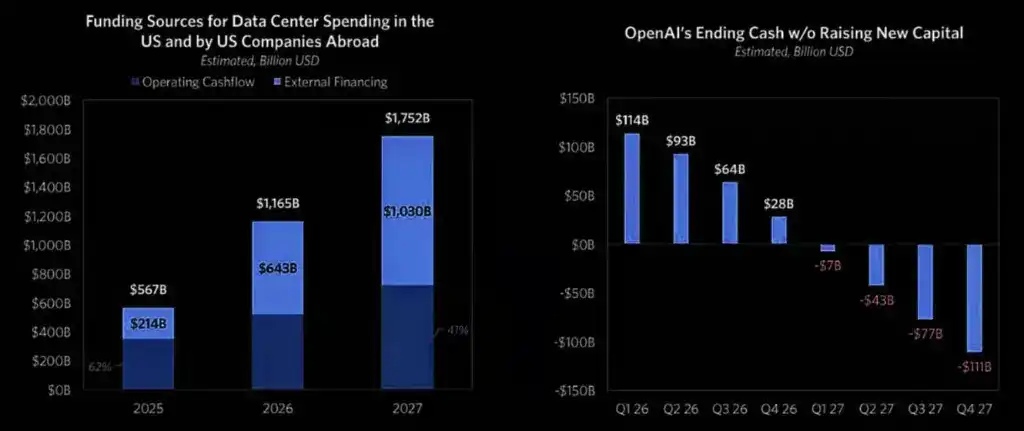
Morgan Stanley predicts that total spending on AI infrastructure construction will reach $3.2 trillion by 2028, with approximately $1.75 trillion needing to be raised through the credit markets. Funding sources have expanded from traditional investment-grade bonds to leveraged loans, private credit, and securitized products. Money is available, but it won't be cheap.

The bond market has already started to react. Apollo data shows that AI-related bond issuance now accounts for 40% of long-duration supply. Credit spreads for hyperscale cloud providers (Hyperscalers) have widened significantly this year, while the overall investment-grade market has remained virtually unchanged.

The "new bond king" Gundlach was even more direct, stating that issuing long-term bonds backed by GPUs is akin to "making a 30-year ABS out of bananas."
Cash Flow is Moving in the Wrong Direction

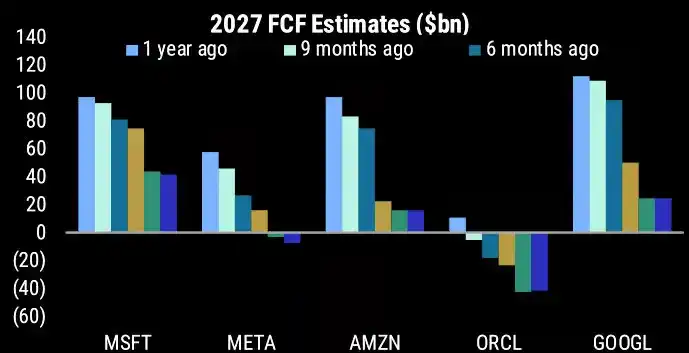
Capital expenditure forecasts are repeatedly revised upwards, while free cash flow forecasts continue to slide.

Morgan Stanley has significantly lowered its free cash flow forecasts for major hyperscale cloud providers for 2027. Oracle's situation is the most prominent, with its 2027 free cash flow forecast now approaching -$40 billion.
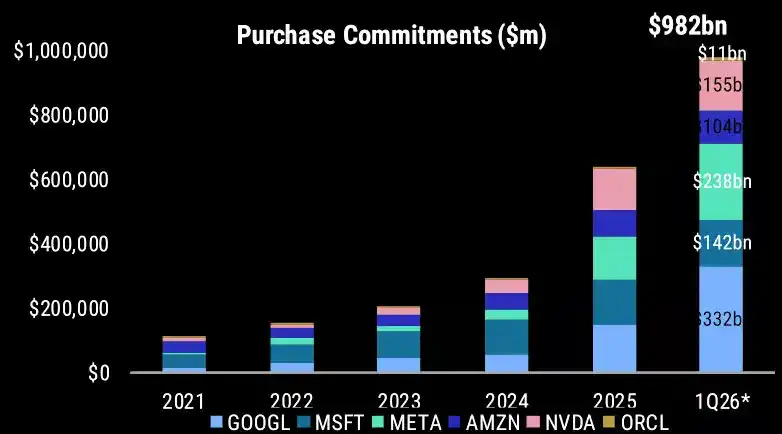
The scale of spending commitments is equally staggering. Purchase commitments from hyperscalers have exploded to $982 billion. Morgan Stanley points out that a significant portion of the real capital expenditure now exists off-balance-sheet. This means that looking only at the balance sheet severely underestimates the actual funding pressure.
Credit Markets Have Begun Pricing Risk

Investors are demanding higher compensation for risk.

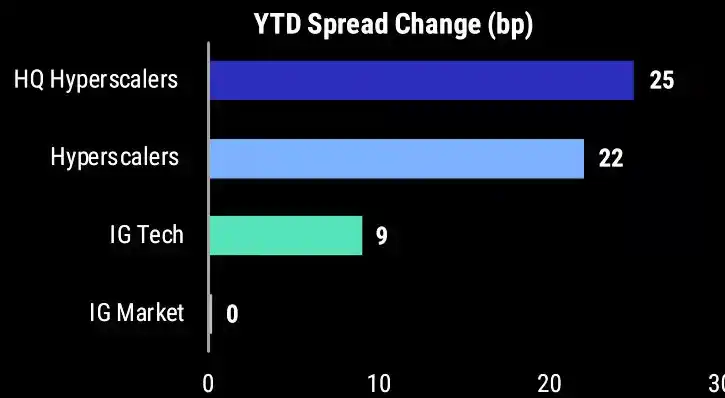
Morgan Stanley data shows that credit spreads for hyperscale cloud providers have "widened significantly this year, far exceeding the overall investment-grade market"—spreads for high-quality hyperscalers (HQ Hyperscalers) widened by about 25 basis points, regular hyperscalers widened by about 22 basis points, while the overall investment-grade market spread changed by 0.
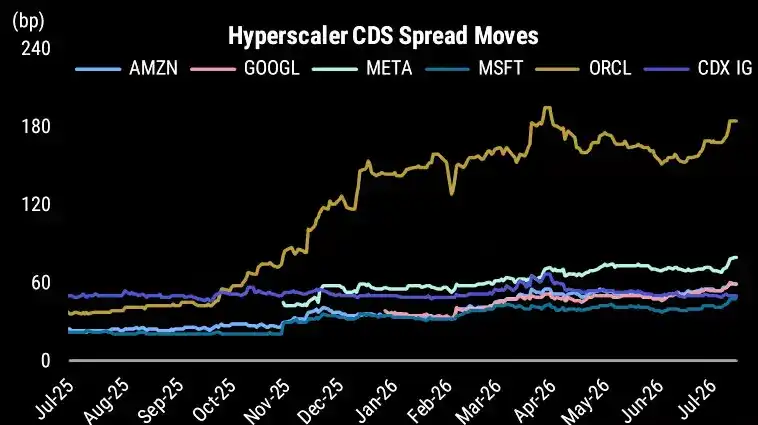
Oracle is the most watched case among them. While other hyperscalers' credit default swaps (CDS) generally trade in the 30 to 80 basis points range, Oracle's CDS surged from around 40 basis points in mid-2025 to a peak near 190 basis points in April 2026, and currently hovers around 180 basis points. Meta's CDS has risen more modestly to about 75 basis points. The credit market has clearly singled out the company it is most concerned about.
Balance Sheets are Strong, But the Problem Lies Ahead

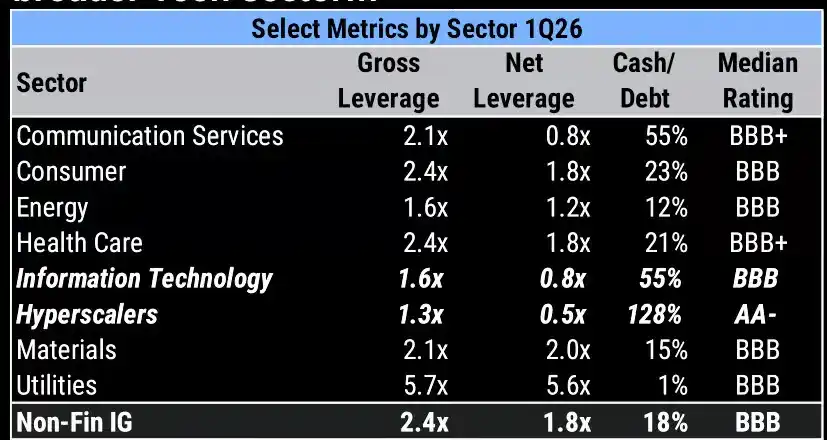
Morgan Stanley's Q1 2026 data shows that hyperscalers' total leverage ratio is only 1.3x, net leverage is 0.5x, the cash-to-debt ratio is as high as 128%, and the median credit rating is AA-. In contrast, the overall non-financial investment-grade universe has a total leverage ratio of 2.4x and a rating of BBB.

But the problem lies ahead. Morgan Stanley has sharply raised its forecast for cloud computing capital expenditure growth in 2027 from 14% to 29%, while hyperscalers are "reaffirming confidence in investment returns." As spending forecasts double, the financing gap widens accordingly.
"New Bond King" Gundlach: Using GPUs as Collateral is Like Using Bananas for ABS

Regarding financing schemes emerging in the market that use AI assets as collateral, renowned bond market investor Jeff Gundlach offered sharp criticism.

He warned about a planned $50 billion fund consortium, stating the plan is "likely not to stand the test of time." He asked on social media: "Using assets with unknown life spans as collateral for long-term debt? Why not do a 30-year ABS trade backed by bananas in a warehouse?" He added, these are "brand new engineered bananas with unknown life spans."

Gundlach's analogy gets to the core issue: GPUs depreciate extremely quickly, with technology refresh cycles far shorter than the tenure of the debt. When using such assets as collateral for long-term financing, the actual value of the collateral is highly uncertain.


Kripto yang Sedang Tren

Pertanyaan Terkait

QWhat is the main shift in the narrative of AI investment according to the article?

AThe narrative is shifting from being a technology story to a capital expenditure story, and is now becoming a financing story.

QWhat is the significant warning that Jeff Gundlach gives about using AI assets as collateral?

AJeff Gundlach warns that using assets like GPUs as collateral for long-term debt is akin to using bananas for a 30-year ABS, highlighting the risk due to their fast depreciation and short technological lifecycle compared to the debt tenure.

QWhat do the widening credit spreads for Hyperscalers indicate, according to the article?

AThe widening credit spreads for Hyperscalers indicate that investors are demanding higher risk compensation, signaling growing market concern about their future financial health amidst heavy AI infrastructure spending.

QWhich company's financial situation is highlighted as particularly concerning in the credit markets?

AOracle's financial situation is highlighted as particularly concerning. Its Credit Default Swap (CDS) spreads surged dramatically to around 190 basis points, far exceeding those of other Hyperscalers, and its 2027 free cash flow forecast is deep in negative territory.

QAccording to Morgan Stanley, what is the estimated total spending on AI infrastructure by 2028 and the financing need?

AMorgan Stanley predicts total AI infrastructure spending will reach $3.2 trillion by 2028, with approximately $1.75 trillion of that needing to be raised through credit markets.

Bacaan Terkait

Efek Repo Obligasi AS Hanya Bertahan 24 Jam? Bessent: Kami Punya Banyak Alat, Kita Lihat Saja

Menteri Keuangan AS, Steven Mnuchin, melepaskan serangkaian sinyal kebijakan pada 20 Agustus. Meskipun Departemen Keuangan AS baru saja mengumumkan peningkatan dua kali lipat dalam operasi pembelian kembali (repo) obligasi jangka panjang untuk mendukung likuiditas pasar, dampak positif terhadap imbal hasil obligasi hanya bertahan kurang dari 24 jam. Mnuchin menanggapi bahwa fluktuasi dalam 24 jam hanyalah "kebisingan" dan menegaskan bahwa Departemen Keuangan memiliki "kotak alat yang besar" serta belum menggunakan semua alat intervensinya. Dia menyatakan operasi repo tunggal dapat melebihi $4 miliar dan bahwa imbal hasil obligasi saat ini tidak mencerminkan fundamental ekonomi AS, dengan likuiditas obligasi 30 tahun sangat rendah. Mnuchin juga mengungkapkan bahwa pemerintah Trump akan segera mengumumkan rencana konsolidasi fiskal baru pada akhir pekan atau awal minggu depan, yang dipimpinnya bersama Direktur OMB. Rencana ini bertujuan untuk mengatasi biaya pinjaman tinggi jangka panjang. Pada isu Iran, Mnuchin mengumumkan akan mengadakan konferensi pers pada 24 Agustus untuk merinci rencana aksi AS. Dia menegaskan pemerintah AS akan meningkatkan tekanan ekonomi terhadap Iran, menyebutnya sebagai "isolasi ekonomi terkoordinasi terbesar dalam sejarah," dan berpendapat tekanan ekonomi maksimum dapat mengurangi kemungkinan konflik militer besar-besaran. Selain itu, Mnuchin kembali menegaskan kebijakan dolar AS yang kuat, menyatakan dolar telah kembali ke level dua bulan lalu. Dia menyatakan tidak memahami kenaikan harga minyak pada hari Kamis tetapi meyakini tindakan AS yang akan datang akan mendorong penurunan harga minyak lebih cepat. Mnuchin juga berkomentar tentang dampak investasi AI, mencatat bahwa ekspektasi pengembalian tinggi dari AI membuat penerbitan obligasi korporasi hampir tidak sensitif terhadap imbal hasil, dan investasi ini pada akhirnya diharapkan mendorong pertumbuhan produktivitas.

marsbit31m yang lalu

Efek Repo Obligasi AS Hanya Bertahan 24 Jam? Bessent: Kami Punya Banyak Alat, Kita Lihat Saja

marsbit31m yang lalu

Trading

Spot

Artikel Populer

Cara Membeli FLOW

Selamat datang di HTX.com! Kami telah membuat pembelian Flow (FLOW) menjadi mudah dan nyaman. Ikuti panduan langkah demi langkah kami untuk memulai perjalanan kripto Anda.Langkah 1: Buat Akun HTX AndaGunakan alamat email atau nomor ponsel Anda untuk mendaftar akun gratis di HTX. Rasakan perjalanan pendaftaran yang mudah dan buka semua fitur.Dapatkan Akun SayaLangkah 2: Buka Beli Kripto, lalu Pilih Metode Pembayaran AndaKartu Kredit/Debit: Gunakan Visa atau Mastercard Anda untuk membeli Flow (FLOW) secara instan.Saldo: Gunakan dana dari saldo akun HTX Anda untuk melakukan trading dengan lancar.Pihak Ketiga: Kami telah menambahkan metode pembayaran populer seperti Google Pay dan Apple Pay untuk meningkatkan kenyamanan.P2P: Lakukan trading langsung dengan pengguna lain di HTX.Over-the-Counter (OTC): Kami menawarkan layanan yang dibuat khusus dan kurs yang kompetitif bagi para trader.Langkah 3: Simpan Flow (FLOW) AndaSetelah melakukan pembelian, simpan Flow (FLOW) di akun HTX Anda. Selain itu, Anda dapat mengirimkannya ke tempat lain melalui transfer blockchain atau menggunakannya untuk memperdagangkan mata uang kripto lainnya.Langkah 4: Lakukan trading Flow (FLOW)Lakukan trading Flow (FLOW) dengan mudah di pasar spot HTX. Cukup akses akun Anda, pilih pasangan perdagangan, jalankan trading, lalu pantau secara real-time. Kami menawarkan pengalaman yang ramah pengguna baik untuk pemula maupun trader berpengalaman.

488 Total TayanganDipublikasikan pada 2024.12.10Diperbarui pada 2026.06.02

Cara Membeli FLOW

Diskusi

Selamat datang di Komunitas HTX. Di sini, Anda bisa terus mendapatkan informasi terbaru tentang perkembangan platform terkini dan mendapatkan akses ke wawasan pasar profesional. Pendapat pengguna mengenai harga FLOW (FLOW) disajikan di bawah ini.

活动图片