Qualcomm: AI Hype Subsides, When Will Smartphones Emerge from the Gloom?

marsbitDipublikasikan tanggal 2026-08-03Terakhir diperbarui pada 2026-08-03

Abstrak

Qualcomm reported its Q3 FY2026 results (ending June 2026), with revenue of $9.95B, down 4% YoY but above expectations. Gross margin declined to 53.1%, pressured by rising costs across manufacturing and memory. Key business segments showed mixed performance: Handset revenue fell 19.6% YoY to $5.09B, dragged by an 11% decline in non-Apple Android shipments and weaker high-end mix. Conversely, Automotive revenue surged 61% to $1.59B, and IoT grew 9% to $1.83B. Core operating profit dropped 41% YoY due to margin compression and higher expenses. Management's Q4 FY2026 guidance projects revenue of $9.7B-$10.5B, in line with consensus, but Non-GAAP EPS guidance of $2.05-$2.25 fell short of expectations. Amidst persistent weakness in its core handset market, Qualcomm is pursuing growth in AI, focusing on Edge AI (smartphones, PCs, automotive) and Data Center AI. Its data center strategy includes four pillars: AI accelerators (e.g., AI200), commercial CPUs (Dragonfly C1000), custom silicon, and connectivity solutions. While these initiatives initially boosted its stock, concerns over AI capital expenditure sustainability have since erased those gains. The company targets $5B in data center revenue for FY2027 and $15B for FY2029. The report concludes that with the traditional handset business still under pressure, the data center opportunity is currently viewed as a longer-term option, and a more conservative valuation based on core operations may be warranted until AI contributio...

Qualcomm (QCOM.O) released its fiscal year 2026 third-quarter earnings report (ending June 2026) after the U.S. market closed on the morning of July 30, 2026, Beijing time. Key points are as follows:

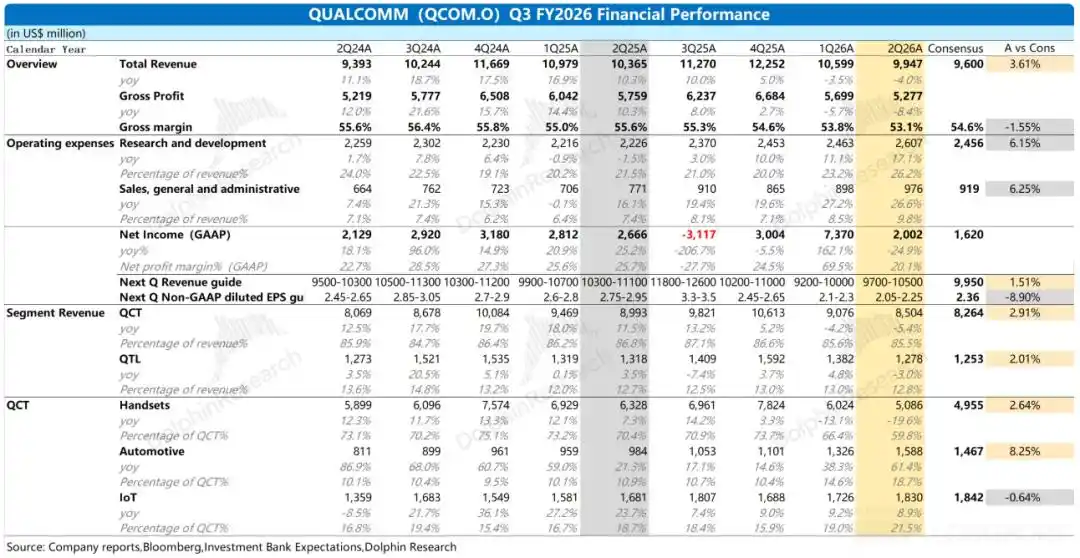
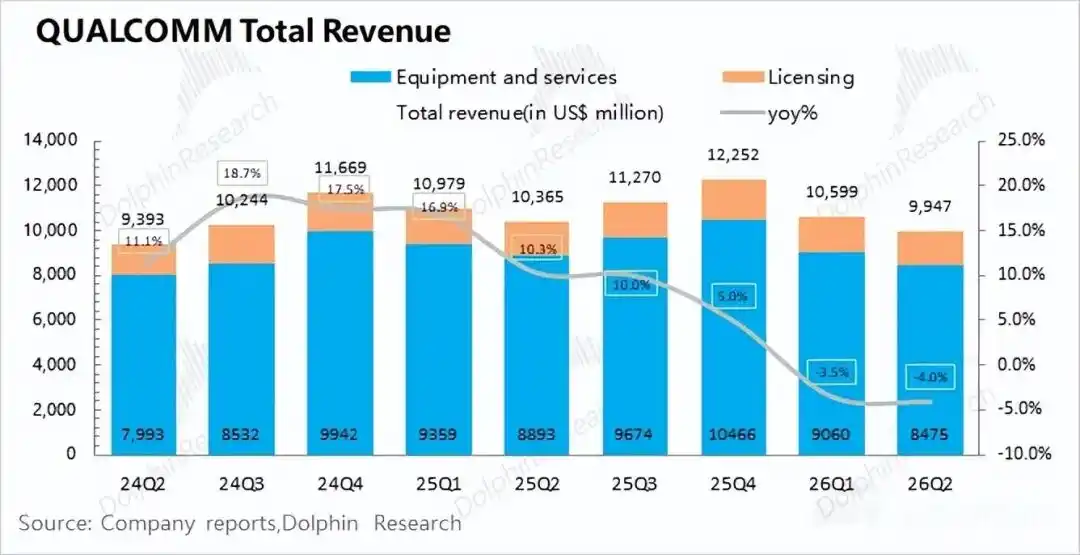
1. Core Data: Qualcomm's revenue for this quarter was $9.95 billion, down 4% year-over-year, better than market expectations ($9.6 billion). Despite significant growth in the automotive business, revenue was still dragged down by the decline in the handset business.

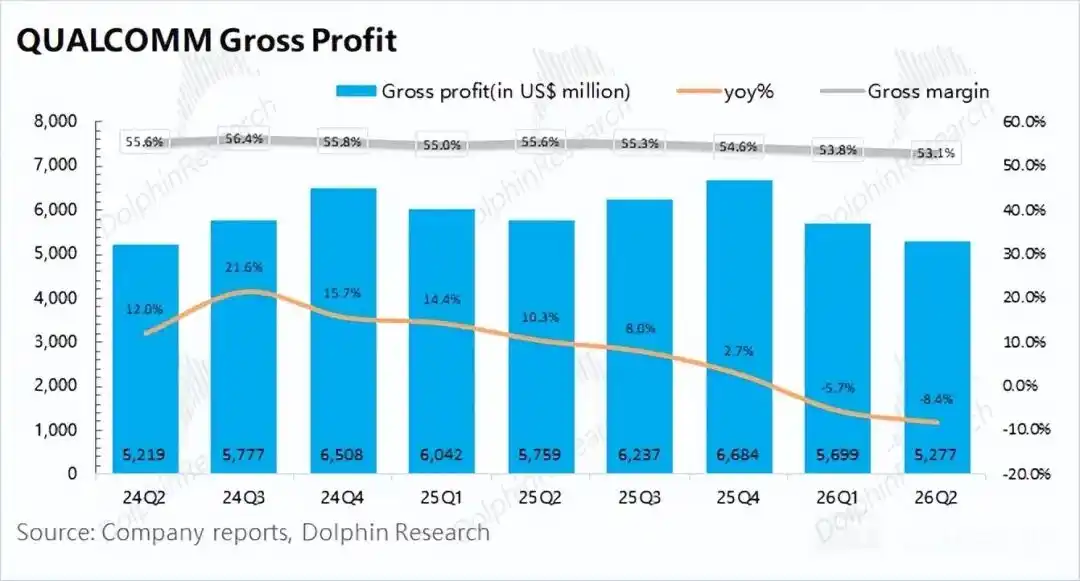
The company's gross margin for this quarter was 53.1%, down 2.5 percentage points year-over-year, below market expectations (54.6%). Increases in costs across wafer fabrication, packaging, testing, advanced packaging, memory, and other materials put significant pressure on the company's gross margin.

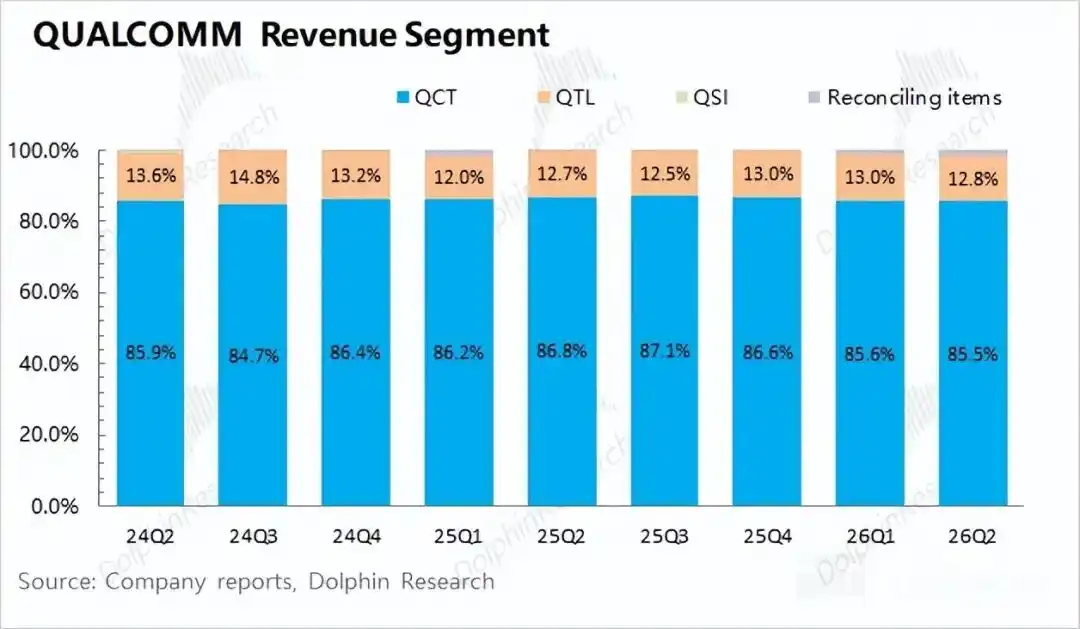
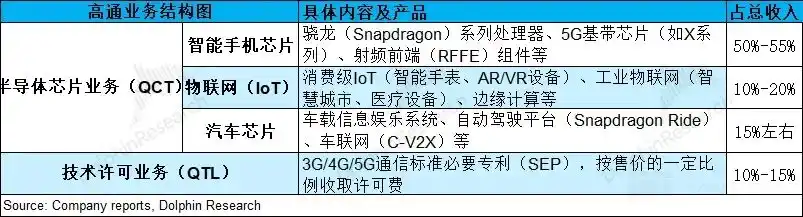
2. Business Segment Details: $Qualcomm's (QCOM.US) business is primarily divided into the Semiconductor Chip business (QCT) and the Technology Licensing business (QTL), with the Semiconductor Chip business being the largest revenue source, accounting for over 80%.

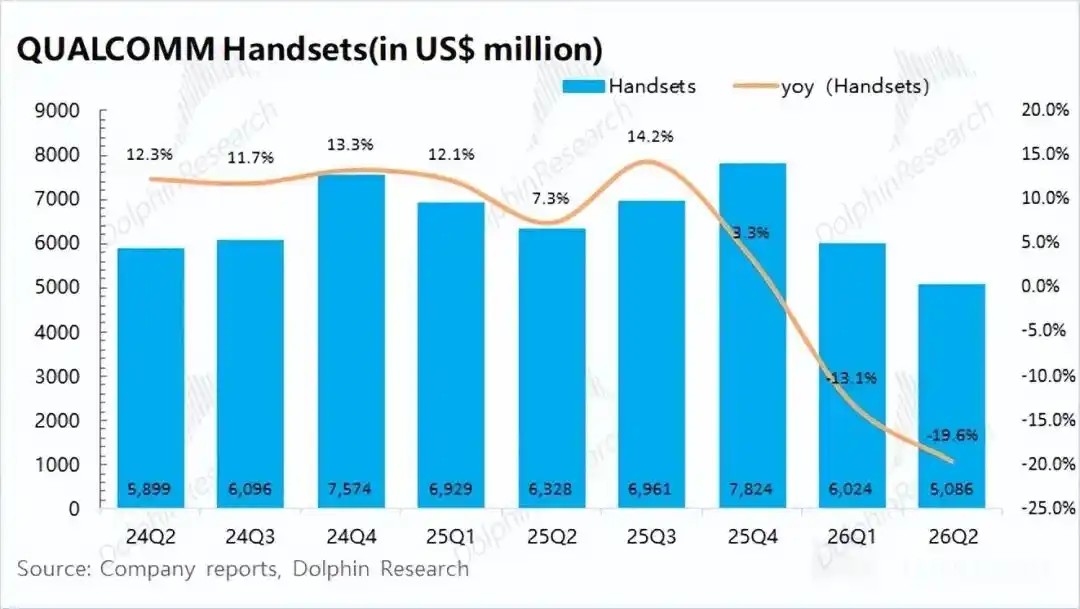
Within the Semiconductor Chip business: 1. Handset business this quarter was $5.09 billion, down 19.6% year-over-year. The decline in the company's handset business was mainly influenced by two factors: Firstly, industry-wide factors, as handset shipments (excluding Apple) fell 11% this quarter; secondly, a weakening internal mix towards premium models, with handset manufacturers tending to use previous-generation platforms to reduce costs.

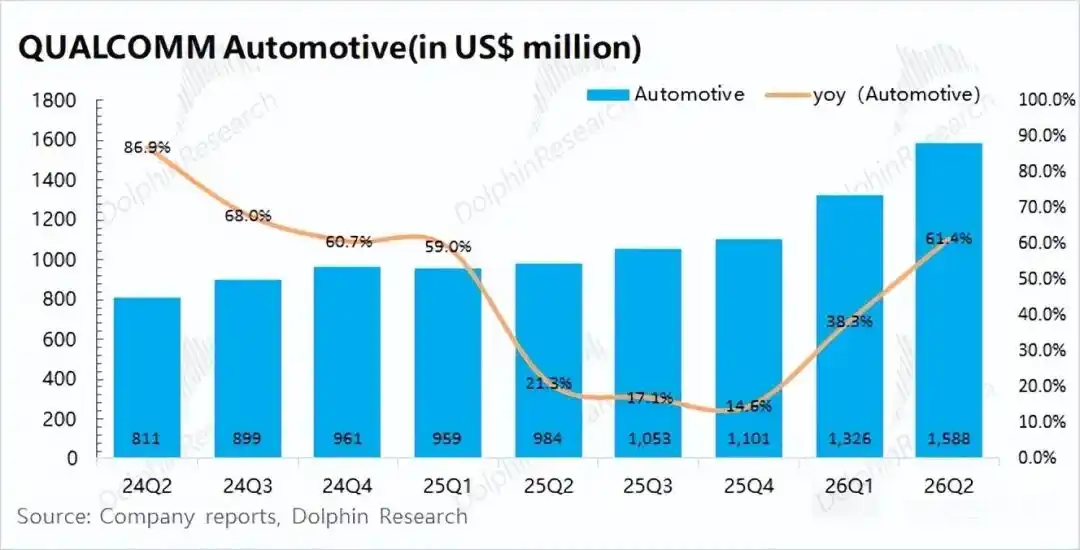
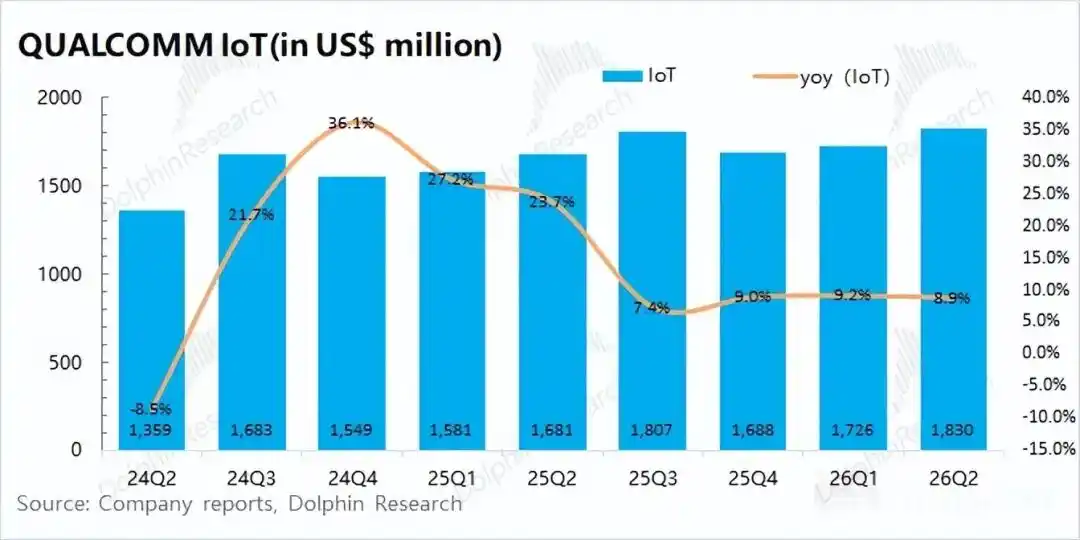
2. Automotive business this quarter was $1.59 billion, up 61% year-over-year, driven by shipments of the fourth-generation Snapdragon Digital Chassis. The company's fifth-generation Snapdragon Digital Chassis will ramp up production in September, with significantly higher value per vehicle. 3. IoT business this quarter was $1.83 billion, up 9% year-over-year, with growth driven by consumer and industrial product demand.

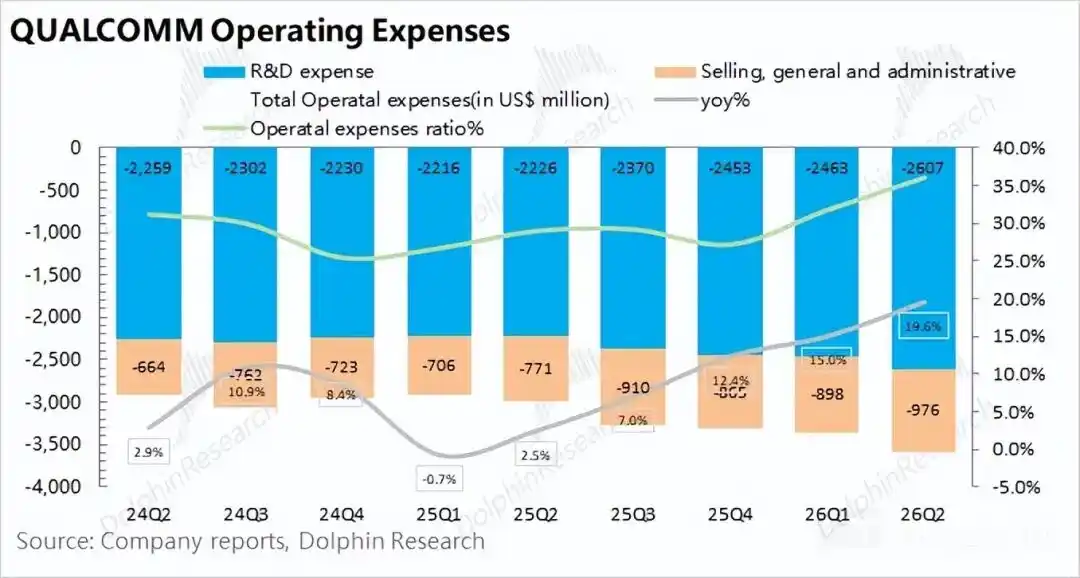
3. Operating Expenses: The company's core operating expenses increased to approximately $3.6 billion, with R&D expenses rising to $2.6 billion this quarter and SG&A expenses amounting to $980 million for the quarter.

The company reported net income of $2.0 billion for the quarter, following the release of a valuation allowance for deferred tax assets (approximately $5.7 billion) in the previous quarter. From an operational perspective, core operating profit for the quarter was $1.63 billion, down 41% year-over-year, primarily due to lower gross margin and increased expenses.

4. Next Quarter Guidance: Qualcomm expects fiscal Q4 2026 revenue of $9.7-$10.5 billion, in line with market expectations ($9.95 billion).; The company expects Non-GAAP EPS for the next quarter to be $2.05-$2.25, below market expectations ($2.36).
Dolphin Research's Overall View: Memory Weighs on Handsets, Data Center "Promises" Await Fulfillment

Qualcomm's earnings report this time remains tepid. While revenue met market expectations, it continues to show a declining trend. Gross margin continues to fall, primarily due to factors like memory price increases and weak demand, leading to higher costs.

Looking at the guidance for the next quarter, the company expects revenue of $9.7-$10.5 billion, showing no clear signs of recovery; while Non-GAAP EPS is expected to be $2.05-$2.25, below market expectations ($2.36). Demand in end markets like handsets remains weak, and factors like memory price increases will continue to pressure the company's costs.
While its traditional core business is sluggish, the company is actively seeking breakthroughs in the data center domain. It plans to focus on four areas: custom chips, commercial CPUs, AI accelerators, and connectivity products. This initially pushed the company's stock price above $250. As market concerns grew about the sustainability of AI Capex, the stock price fell back below $160, essentially erasing the gains brought by data center prospects.

Beyond this earnings report, the market is focusing on the following aspects of Qualcomm:

1) Traditional Domains: The Core Business, Bearing the Pressure of Memory

The handset business is Qualcomm's largest segment, accounting for over half of its business. Its weak performance amidst the overall sluggish handset market puts significant pressure on the company's results. Global handset shipments this quarter remained at 290 million units, down 6% year-over-year.

The handset market mainly consists of Apple and Android. Looking in detail, Apple's handset shipments grew nearly 20% year-over-year this quarter. Shipments for the rest of the Android camp fell approximately 11% year-over-year, directly impacting Qualcomm's handset business performance this quarter.
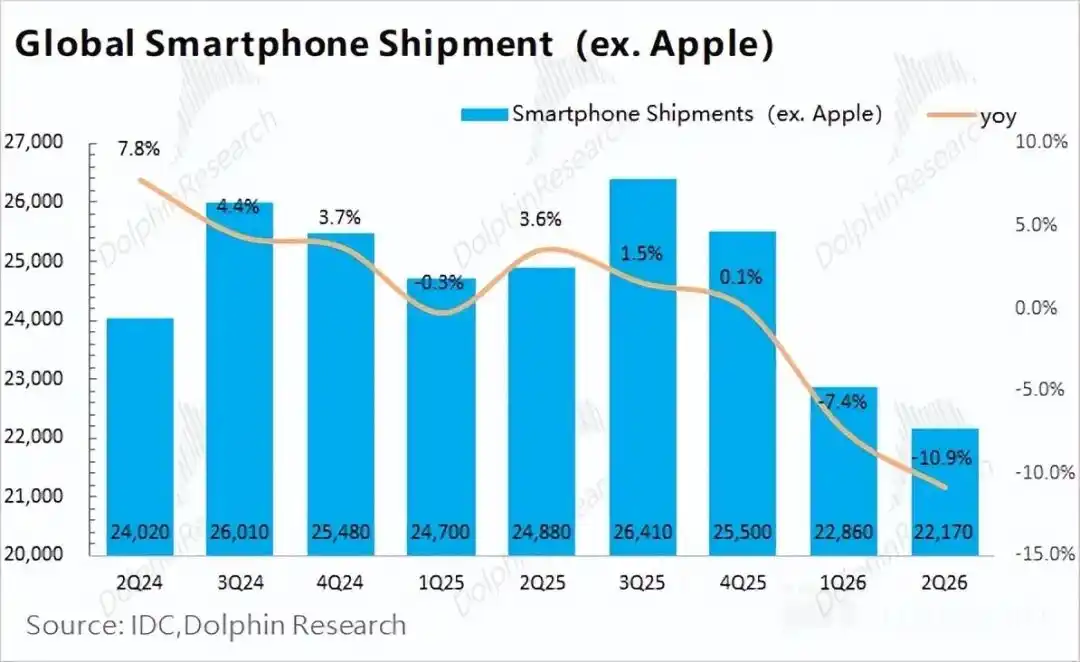
The company expects next quarter's handset business to be around $5.2 billion, down about 25% year-over-year, with Android sequential growth partially offset by declining Apple product revenue (seasonal uptick in the second half, the traditional peak season).

The recent pace of memory price increases has started to slow. As seen in OPPO and VIVO rejecting price hikes from memory suppliers, the "skyrocketing memory" has caused market discontent. If the memory cycle turns downward subsequently, pressure on the company's traditional core business may ease.

2) AI Domain: On-Device AI and Data Center, Potential Growth Markets

While traditional markets are weak, the company is also actively laying out in the AI field, hoping for new breakthroughs.

a) On-Device AI: The company views on-device AI as a core part of its Physical AI strategy, covering all end devices like smartphones, PCs, cars, XR, robots, and industrial IoT, areas where the company already has a presence.

The two main areas: 1. The potential replacement cycle driven by AI Phones, as AI Agents become the "new interface" for smartphones; 2. In the AI PC domain, the company has launched the Snapdragon C platform (for Windows laptops), with core advantages in: Oryon CPU, low-power AI inference, heterogeneous computing (CPU+GPU+NPU collaboration, supporting on-device AI Agent operation).

b) AI Data Center: Qualcomm ultimately couldn't resist entering the main AI arena, which is also the company's most notable strategic plan in the AI field.

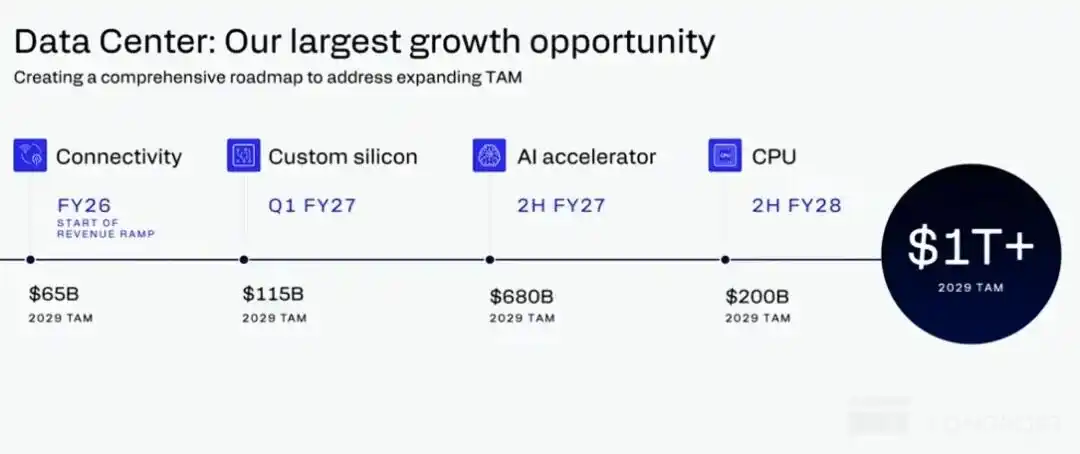
At its investor day on June 24, 2026, Qualcomm disclosed that its AI data center strategy will cover four product lines:

1. AI Accelerators (HBC): Microsoft confirmed a multi-generation partnership.

Qualcomm's core differentiated technology, using LPDDR5X (vs. HBM) to enable Processing Near Memory, optimized for memory-capacity-intensive AI inference workloads.

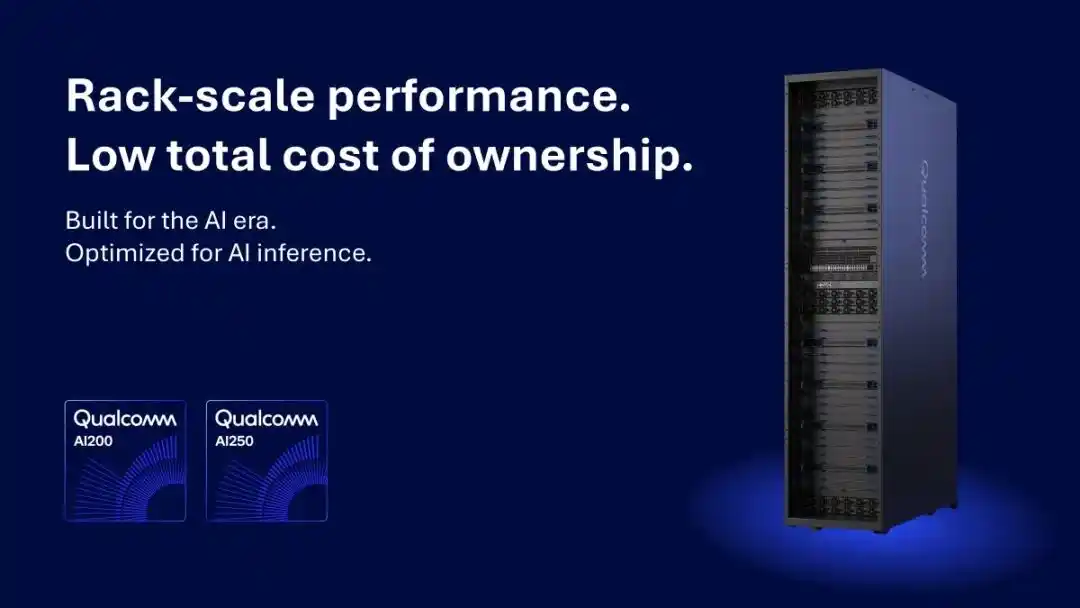
AI200 is currently ramping production; the next-gen AI250 is expected to sample in 2027. Subsequent AI300 will be based on UALink and ESUN for Scale-up network interconnection, with effective bandwidth 54 times that of AI200.
2. Commercial CPU (Dragonfly C1000): Meta confirmed a multi-generation partnership.

This is primarily based on Qualcomm's Oryon CPU architecture from smartphones and PCs, extended to the data center. Positioned as an "Agentic CPU," specifically for CPU-intensive workloads like agent orchestration, multi-step reasoning, and tool invocation.

3. Custom Silicon Business: Confirmed 2 hyperscale customers (each contributing $1 billion+ in FY2027)

This is based on capabilities acquired from Alphawave Semi (SerDes, Die-to-Die, PCIe/CXL, HBM PHY) and Ventana (Veyron V2 RISC-V CPU), primarily providing custom AI chip (XPU) design services to hyperscale customers.

4. Connectivity Business: Secured first hyperscale customer.

Based on Alphawave IP, offering products like 800G/1.6T optical modules, AOCs, AECs. The company currently has 800G LR2 modules, 800G optical modules/AOCs/AECs in production; 1.6T optical modules/AOCs/AECs expected in 2026-2027.
Previously, driven by AI hype, the company's move into the AI data center field once pushed its stock price above $250. Now, with concerns over AI Capex, the stock has fallen back to around $160, erasing the growth expectations from data centers.

Although the company estimates the AI data center business market opportunity at $1 trillion, its data center business currently doesn't contribute significant revenue. Looking back at the traditional business, with weak end markets like handsets, the company's current P/E multiple is actually relatively high.

As for the data center business, while management has set a $15 billion revenue target for FY2029, the focus should currently be on nearer-term performance. Based on the company's FY2027 data center revenue target of $5 billion, this could contribute about $1.2 billion in operating profit (referencing the company's OPM).

In the current fragile market environment, it's more prudent to look for Qualcomm's relatively safe bottom range. From a traditional business perspective, a further decline in the stock price is safer. Of course, this essentially treats the data center business as "an option."

If the company's FY2027 targets are met, they will inject valuation expectations for the data center segment.

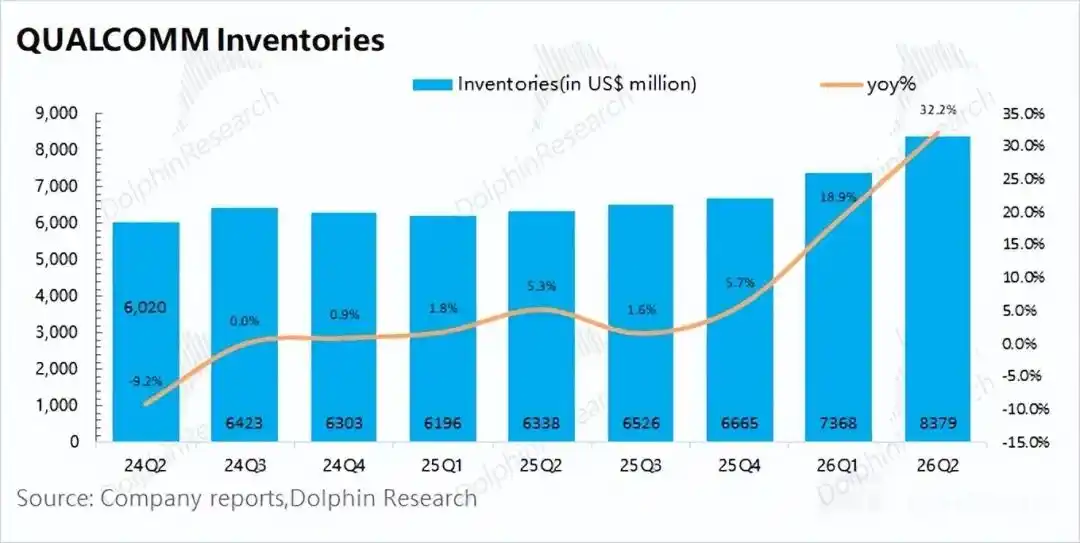
Below are relevant charts from Dolphin Research regarding this Qualcomm earnings report:
This article is from the WeChat public account "Dolphin Investment Research" (ID: haituntouyan), author: Dolphin Research


Kripto yang Sedang Tren

Pertanyaan Terkait

QAccording to the article, what were the key financial highlights of Qualcomm's Q3 2026 earnings report?

AIn its Q3 2026 earnings report, Qualcomm's revenue was $9.95 billion, a 4% year-over-year (YoY) decline but surpassing market expectations of $9.6 billion. The company's gross margin was 53.1%, a decrease of 2.5 percentage points YoY, which fell below market expectations of 54.6%. Net profit reached $2 billion.

QWhat were the main factors causing the decline in Qualcomm's mobile phone business revenue in Q3 2026?

AThe decline in Qualcomm's mobile phone business revenue, which fell 19.6% YoY to $5.09 billion, was primarily attributed to two factors: first, a broader industry downturn where smartphone shipments (excluding Apple) declined by 11% in the quarter; second, a weakening structure within the high-end smartphone market, where manufacturers tended to use previous-generation platforms to reduce costs.

QWhat are the four key product lines in Qualcomm's AI data center strategy as mentioned in the article?

AQualcomm's AI data center strategy comprises four key product lines: 1) AI Accelerators (HBC), with Microsoft as a confirmed multi-generation partner; 2) Commercial CPUs (Dragonfly C1000), with Meta as a confirmed multi-generation partner; 3) Custom Silicon, with two confirmed hyperscale customers expected to contribute over $1 billion each in fiscal year 2027; and 4) Connectivity Business, which has secured its first hyperscale customer.

QWhat is the outlook for Qualcomm's mobile phone business in the next quarter (Q4 2026) according to the article?

AFor the next quarter (Q4 2026), Qualcomm expects its mobile phone business revenue to be approximately $5.2 billion, representing a year-over-year decline of around 25%. The article notes that this forecast includes some seasonal recovery in Android phone shipments, which is partly offset by a decline in revenue from Apple's products.

QHow does the article characterize the market's current view of Qualcomm's AI data center business, and what is the company's related financial target?

AThe article characterizes the market's current view of Qualcomm's AI data center business as cautious, describing it as a "piece of 'optionality'" given its lack of significant current revenue contribution. Amid concerns about AI capital expenditure sustainability, the stock price surge driven by this business has largely been erased. However, the article mentions that management has set a target of $15 billion in revenue from the data center business by fiscal year 2029, with a nearer-term goal of $5 billion for fiscal year 2027.

Bacaan Terkait

OpenAI Tidak Lagi Mengandalkan Model Termahal untuk Menghasilkan Uang

OpenAI tidak lagi mengandalkan model termahal untuk menghasilkan uang. Pada 30 Juli, perusahaan mengumumkan penyesuaian harga, menurunkan harga model GPT-5.6 Luna sebesar 80% dan Terra sebesar 20%. Yang lebih penting dari angka penurunan harga adalah pesan intinya: untuk banyak tugas, model terkuat (seperti Sol) tidak selalu diperlukan. OpenAI secara eksplisit merekomendasikan strategi di mana model mahal (Sol) menangani perencanaan dan analisis kompleks, sementara model yang lebih terjangkau (Luna) mengeksekusi tugas, menulis kode, dan menjalankan pengujian. Pergeseran ini mencerminkan perubahan industri AI dari hanya mengejar kecerdasan tertinggi menuju optimisasi biaya dan efisiensi untuk penggunaan skala besar. Anthropic juga mengikuti pola serupa dengan meluncurkan Claude Opus 5 dengan harga setengah dari model andalannya, Fable 5. Kedua raksasa Silicon Valley ini menunjukkan bahwa model flagship kini berfungsi lebih untuk nilai merek dan pembuktian teknologi, sementara model "kendaraan massal" yang lebih murah (seperti Luna, Terra, Opus) yang akan mendorong adopsi komersial luas dan menghasilkan pendapatan utama. OpenAI mengungkapkan bahwa penurunan biaya ini sebagian didorong oleh model AI (Sol) yang mengoptimalkan kode produksi dan alur kerjanya sendiri, menciptakan siklus peningkatan efisiensi yang dapat mempercepat penurunan biaya di masa depan. Intinya, kompetisi AI bergeser dari "siapa yang paling pintar" menjadi "mana yang paling bernilai". Perusahaan tidak lagi membeli satu model tunggal, tetapi merancang sistem dengan beberapa model yang cocok untuk tugas yang berbeda—mirip dengan arsitektur komputasi awan. Tujuan akhir OpenAI adalah membangun ekosistem yang mengunci alur kerja pengembang melalui volume panggilan API yang sangat besar dan biaya yang sangat rendah, sehingga menciptakan daya tarik yang kuat. Ketika AI menjadi murah dan tersebar luas seperti listrik, tertanam dalam setiap proses tanpa diperdebatkan, era sesungguhnya baru dimulai.

marsbit1j yang lalu

OpenAI Tidak Lagi Mengandalkan Model Termahal untuk Menghasilkan Uang

marsbit1j yang lalu

Gaji Puluhan Miliar untuk Rebut Tukang Listrik, Meta Buru-buru Buka Sekolah Kejuruan Sendiri

Perlombaan AI kini menghadapi hambatan baru: **kelangkaan tenaga ahli teknik**, terutama tukang listrik. Proyek data center raksasa seperti "Stargate" OpenAI membutuhkan ratusan pekerja konstruksi yang bekerja hingga 7 hari seminggu. Menurut prediksi, AS membutuhkan **130.000 tukang listrik tambahan** hingga 2030, namun puluhan ribu lowongan per tahun tetap tak terisi. Gaji yang ditawarkan sangat tinggi, mencapai **$240.000-$280.000 per tahun** untuk tukang listrik andal. Namun, kelambatan proyek karena kekurangan tenaga kerja bisa menyebabkan kerugian **$14,2 juta per bulan**. Presiden Microsoft menyebut kelangkaan tukang listrik sebagai **hambatan utama** ekspansi data center. Kompleksitas data center AI sangat tinggi karena kebutuhan daya besar (setara puluhan ribu rumah), sistem distribusi listrik rumit, dan tantangan pendinginan yang membutuhkan ahli pipa dan HVAC. Akibatnya, perusahaan seperti Meta dan Alphabet berinvestasi besar dalam pelatihan. Meta mengalokasikan **$115 juta** untuk mendirikan sekolah pelatihan konstruksi, menawarkan program gratis dengan tunjangan hidup. Upaya ini menarik minat generasi Z, dengan lonjakan pendaftaran sekolah kejuruan. Namun, tantangan berlanjut: konsumsi listrik data center AI melonjak **84,2% per tahun**, mendorong harga listrik naik. Selain itu, pekerjaan konstruksi bersifat proyek - setelah data center selesai, ribuan pekerja terlatih harus mencari pekerjaan baru, berpotensi membanjiri sektor lain dan menekan upah. Masa depan pasar tenaga kerja teknik pasca-boom AI masih belum pasti.

marsbit1j yang lalu

Gaji Puluhan Miliar untuk Rebut Tukang Listrik, Meta Buru-buru Buka Sekolah Kejuruan Sendiri

marsbit1j yang lalu

The Fed Harus Naikkan Suku Bunga di September? Bagaimana Tekanannya pada Crypto dan Saham AS?

Pasar telah meningkatkan perkiraan suku bunga Federal Reserve (The Fed) pada September menjadi lebih dari 73%, meningkat pesat dari kurang dari 53% sepekan sebelumnya. Lonjakan ini dipicu oleh perbedaan suara dalam rapat The Fed Juli (9-3) dan kekhawatiran inflasi akibat kenaikan harga minyak, yang didorong oleh ketegangan geopolitik di dekat Selat Hormuz. Kunci penentu berikutnya adalah data CPI bulan Juli pada 12 Agustus. Jika inflasi menunjukkan kenaikan berlanjut, probabilitas kenaikan suku bunga September akan semakin kuat. Untuk aset kripto seperti Bitcoin, ekspektasi kenaikan suku bunga biasanya menekan harga karena meningkatkan biaya peluang memegang aset tidak menghasilkan dan menarik aliran modal ke aset yang lebih aman. Namun, dampaknya mungkin terbatas jika pasar memandang kenaikan ini sebagai akhir dari siklus pengetatan. Saham AS terkait kripto (seperti Coinbase, MicroStrategy) cenderung bereaksi lebih volatil. Kenaikan suku bunga meningkatkan tingkat diskonto dalam valuasi, memberi tekanan lebih besar pada saham pertumbuhan dan teknologi. Hal ini bertepatan dengan musim laporan keuangan dimana investor kini lebih kritis, menilai apakah pengeluaran modal besar-besaran untuk AI dapat benar-benar menghasilkan pendapatan dan arus kas. Perusahaan dengan cerita pertumbuhan lemah dan arus kas negatif mungkin menghadapi volatilitas lebih tinggi jika The Fed benar-benar menaikkan suku bunga.

marsbit1j yang lalu

The Fed Harus Naikkan Suku Bunga di September? Bagaimana Tekanannya pada Crypto dan Saham AS?

marsbit1j yang lalu

Trading

Spot

Artikel Populer

Cara Membeli HYPE

Selamat datang di HTX.com! Kami telah membuat pembelian Hyperliquid (HYPE) menjadi mudah dan nyaman. Ikuti panduan langkah demi langkah kami untuk memulai perjalanan kripto Anda.Langkah 1: Buat Akun HTX AndaGunakan alamat email atau nomor ponsel Anda untuk mendaftar akun gratis di HTX. Rasakan perjalanan pendaftaran yang mudah dan buka semua fitur.Dapatkan Akun SayaLangkah 2: Buka Beli Kripto, lalu Pilih Metode Pembayaran AndaKartu Kredit/Debit: Gunakan Visa atau Mastercard Anda untuk membeli Hyperliquid (HYPE) secara instan.Saldo: Gunakan dana dari saldo akun HTX Anda untuk melakukan trading dengan lancar.Pihak Ketiga: Kami telah menambahkan metode pembayaran populer seperti Google Pay dan Apple Pay untuk meningkatkan kenyamanan.P2P: Lakukan trading langsung dengan pengguna lain di HTX.Over-the-Counter (OTC): Kami menawarkan layanan yang dibuat khusus dan kurs yang kompetitif bagi para trader.Langkah 3: Simpan Hyperliquid (HYPE) AndaSetelah melakukan pembelian, simpan Hyperliquid (HYPE) di akun HTX Anda. Selain itu, Anda dapat mengirimkannya ke tempat lain melalui transfer blockchain atau menggunakannya untuk memperdagangkan mata uang kripto lainnya.Langkah 4: Lakukan trading Hyperliquid (HYPE)Lakukan trading Hyperliquid (HYPE) dengan mudah di pasar spot HTX. Cukup akses akun Anda, pilih pasangan perdagangan, jalankan trading, lalu pantau secara real-time. Kami menawarkan pengalaman yang ramah pengguna baik untuk pemula maupun trader berpengalaman.

473 Total TayanganDipublikasikan pada 2024.12.11Diperbarui pada 2026.06.02

Cara Membeli HYPE

Diskusi

Selamat datang di Komunitas HTX. Di sini, Anda bisa terus mendapatkan informasi terbaru tentang perkembangan platform terkini dan mendapatkan akses ke wawasan pasar profesional. Pendapat pengguna mengenai harga HYPE (HYPE) disajikan di bawah ini.

活动图片